
Fast shooting firearms have played a major role in modern military and defense technology. Designed to deliver extremely high rates of fire, these weapons are built for situations where overwhelming firepower matters. From rotary cannons mounted on aircraft to compact submachine guns used in close‑quarters combat, fast shooting guns demonstrate how engineering can dramatically increase firing speed while maintaining reliability. Many of these weapons became famous not only for their speed but also for their influence on battlefield tactics.
This guide explores 20 types of fast shooting guns known for their impressive firing rates and historical importance. Some are experimental designs capable of extraordinary theoretical firepower, while others are widely used military weapons that have proven themselves in real-world combat. The goal of this article is simple: provide clear, educational explanations of each firearm, focusing on how it works, why it fires so quickly, and where it fits within the broader evolution of automatic weapons.
20 Types of Fast Shooting Guns
1. Metal Storm
Metal Storm is often described as one of the most radical firearm concepts ever created, and its extremely high firing rate places it firmly among the fastest shooting weapons ever developed. Unlike traditional guns that rely on mechanical actions such as bolts, chambers, or feed systems, the Metal Storm system uses a completely different idea known as electronically ignited stacked projectiles. In this design, multiple bullets are stacked inside a barrel, each separated by a propellant charge. When triggered electronically, the charges fire sequentially at incredibly high speeds, allowing the system to discharge multiple rounds almost instantly.
This unusual mechanism removes many of the moving parts that normally limit firing speed in conventional weapons. Because there is no mechanical cycling required between shots, the firing rate can theoretically reach extraordinary levels. Some experimental demonstrations suggested that the Metal Storm system could reach firing rates far beyond traditional machine guns, sometimes reaching hundreds of thousands or even millions of rounds per minute in short bursts under laboratory conditions. These figures are theoretical and depend heavily on the configuration of the weapon, but they demonstrate the remarkable potential of the design.
Another interesting feature of Metal Storm is its flexibility. The system can be configured in different ways, from handheld launchers to large defensive platforms. Engineers experimented with applications such as automated perimeter defense systems, naval weapon platforms, and grenade launchers. Because the projectiles are stacked directly inside the barrel, reloading works differently compared with conventional firearms. Instead of feeding individual cartridges through a magazine or belt, the barrel itself is loaded with pre‑stacked ammunition modules.
Although Metal Storm generated considerable interest in military research circles, it never became widely adopted. One reason is that the system introduces logistical and operational challenges, including complicated ammunition loading procedures and the difficulty of sustaining continuous fire once the stacked projectiles are expended. Nevertheless, the technology remains an important milestone in the development of high‑rate‑of‑fire weapons. It demonstrates how innovative engineering can dramatically change the way firearms operate, pushing the boundaries of what is possible in rapid‑fire weapon systems.
2. M134 Minigun
The M134 Minigun is one of the most recognizable rapid‑fire weapons in the world, widely known for its distinctive multi‑barrel rotary design and extremely high firing rate. Developed during the Cold War era, the weapon uses a Gatling‑style mechanism in which multiple barrels rotate around a central axis while firing. This rotating system allows the weapon to achieve very high rates of fire while preventing overheating, since each barrel fires only a portion of the total rounds.
The Minigun is typically chambered in 7.62×51mm NATO ammunition and can fire thousands of rounds per minute. Depending on the configuration, the firing rate usually ranges between 2,000 and 6,000 rounds per minute. Such firepower allows the weapon to deliver overwhelming suppressive fire in combat situations. Because of this capability, the M134 is most often mounted on helicopters, armored vehicles, naval craft, and other military platforms rather than being used as a handheld weapon.
One reason the Minigun can sustain such a high rate of fire is its electrically powered rotation system. Instead of relying on gas pressure or recoil to cycle the action, the barrels are rotated by an external electric motor. This approach allows the weapon to maintain consistent firing speed and reduces the mechanical stress placed on individual components. It also means that the weapon can be precisely controlled in terms of firing rate, which can be adjusted depending on operational needs.
Over time, the M134 Minigun became iconic in both military history and popular culture. It has been used extensively by armed forces around the world, particularly in helicopter gunship roles where its high rate of fire can suppress enemy forces or provide close air support. Despite its age, the Minigun remains relevant because its core design continues to deliver unmatched rapid‑fire capability in many combat scenarios.
3. M61 Vulcan
The M61 Vulcan is another rotary cannon that represents the pinnacle of rapid‑fire aircraft weapon systems. Designed primarily for fighter jets, this 20mm cannon uses a six‑barrel Gatling configuration similar in principle to the Minigun but scaled up significantly in size and power. The weapon is capable of delivering a tremendous volume of fire in a very short period of time, making it highly effective for air‑to‑air combat and strafing ground targets.
Unlike smaller automatic weapons, the M61 Vulcan fires large 20mm projectiles that carry significant destructive power. Even though each round is larger and heavier than standard rifle ammunition, the rotary barrel system still allows the cannon to achieve extremely high firing rates. Depending on the variant, the Vulcan typically fires around 6,000 rounds per minute, though aircraft often carry limited ammunition to balance weight and performance considerations.
The Vulcan cannon became a standard armament for many Western fighter aircraft, including famous models like the F‑15, F‑16, and F/A‑18. Its ability to unleash a dense stream of projectiles makes it extremely effective during short dogfight engagements, where pilots may only have a brief moment to hit a fast‑moving target. The weapon’s reliability and high rate of fire helped restore confidence in aircraft cannons during an era when missiles were initially expected to replace guns entirely.
Beyond fighter jets, the M61 Vulcan has also been adapted for other roles. Some naval defense systems and ground‑based air defense platforms use versions of the cannon to intercept incoming threats such as missiles or aircraft. This adaptability demonstrates how a well‑engineered rapid‑fire weapon can remain relevant for decades. The Vulcan continues to serve as one of the most powerful examples of fast shooting gun technology in modern military service.
4. GAU‑8 Avenger
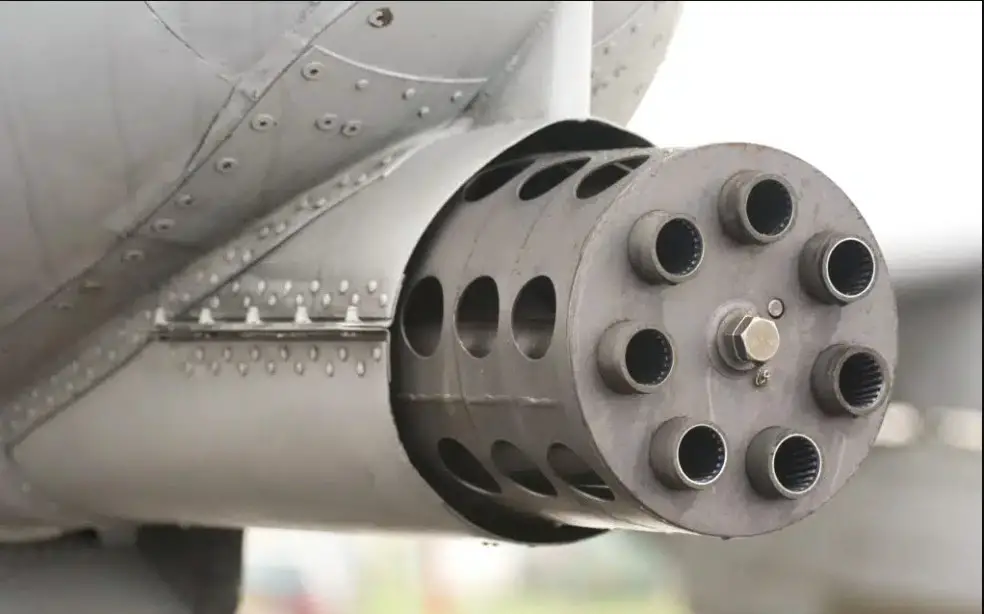
The GAU‑8 Avenger is one of the most powerful rapid‑fire cannons ever mounted on an aircraft. Designed specifically for the A‑10 Thunderbolt II attack aircraft, the weapon was built to destroy heavily armored ground targets such as tanks and armored vehicles. Unlike many other aircraft cannons that prioritize air‑to‑air combat, the Avenger focuses on delivering devastating firepower against ground forces.
This massive rotary cannon uses a seven‑barrel Gatling design and fires 30mm armor‑piercing rounds. Even though the ammunition is extremely large compared with rifle cartridges, the weapon can still achieve an impressive firing rate of around 3,900 rounds per minute. Each projectile carries enough energy to penetrate armored vehicles, which makes the Avenger one of the most feared close‑air‑support weapons in modern warfare.
One of the most remarkable aspects of the GAU‑8 Avenger is that the A‑10 aircraft was essentially designed around the weapon itself. The cannon is mounted directly along the aircraft’s centerline to manage recoil forces and maintain stability during firing. When the gun fires, the sound it produces has become legendary among military aviation enthusiasts, often described as a distinctive roaring burst that signals overwhelming firepower.
Despite its enormous size and power, the Avenger remains remarkably reliable and accurate. Its combination of rapid fire and heavy ammunition allows the A‑10 to engage multiple targets quickly during close support missions. The weapon’s effectiveness has ensured its continued service for decades, proving that rapid‑fire cannons can remain crucial tools in modern combat operations.
5. GShG‑7.62 Machine Gun
The GShG‑7.62 machine gun is a Soviet‑designed rotary weapon that demonstrates how rapid‑fire technology can be adapted for lighter ammunition. Developed by the famous Gryazev‑Shipunov design bureau, this weapon was intended primarily for helicopter armament. It fires the standard 7.62×54mmR cartridge, which is widely used in Russian military rifles and machine guns.
Unlike many traditional machine guns that rely on a single barrel, the GShG‑7.62 uses a four‑barrel rotary configuration. This design allows the weapon to reach extremely high firing rates, often exceeding 6,000 rounds per minute. The multi‑barrel system distributes heat and mechanical stress, enabling the weapon to maintain sustained rapid fire during combat operations.
Helicopters benefit greatly from weapons like the GShG‑7.62 because rapid bursts of suppressive fire can quickly overwhelm enemy positions. In airborne combat environments, where engagements can develop quickly and unpredictably, the ability to deliver thousands of rounds in a short time provides a significant tactical advantage. The weapon is typically mounted in helicopter gun pods or turret systems where it can be aimed and fired by onboard crew members.
Although less famous internationally than some Western rotary guns, the GShG‑7.62 represents an important development in Soviet rapid‑fire weapon engineering. Its design combines high speed, relatively compact size, and powerful ammunition, making it a versatile system for aerial combat roles. Today, it remains an example of how engineers can adapt the rotary gun concept to different calibers and operational requirements.
6. YakB‑12.7 Machine Gun
The YakB‑12.7 machine gun is a Soviet rotary heavy machine gun designed specifically for helicopter armament, and it stands among the most impressive examples of fast shooting guns developed during the Cold War. Chambered in the powerful 12.7×108mm cartridge, this weapon was built to deliver devastating suppressive fire from airborne platforms. Its primary deployment platform was the Mil Mi‑24 attack helicopter, one of the most iconic gunships ever produced. Unlike conventional single‑barrel heavy machine guns, the YakB‑12.7 uses a four‑barrel rotary system similar in concept to the Gatling gun. This design dramatically increases the firing rate while also distributing heat across multiple barrels, allowing the weapon to sustain rapid bursts without overheating as quickly as traditional machine guns.
One of the defining characteristics of the YakB‑12.7 is its extremely high firing rate, which can reach approximately 4,000 to 5,000 rounds per minute. For a weapon firing such large ammunition, this level of speed is remarkable. The weapon is typically mounted in a turret beneath the nose of the Mi‑24 helicopter, where it can be controlled by the gunner to engage ground targets. This configuration allows the aircraft to provide close air support, suppress enemy positions, and defend itself against lightly armored vehicles or infantry units equipped with anti‑aircraft weapons.
The design philosophy behind the YakB‑12.7 focused on maximizing firepower in a compact and efficient package suitable for helicopter operations. Rotary guns generally rely on external power sources to rotate their barrels, and the YakB‑12.7 follows this principle. This external drive ensures consistent firing speed and reduces the likelihood of mechanical malfunctions during rapid bursts. Additionally, the multi‑barrel arrangement allows each barrel to cool between shots, increasing reliability during sustained engagements.
Although it is not as widely recognized as Western rotary guns like the Minigun, the YakB‑12.7 remains a fascinating example of Soviet engineering aimed at achieving high firing rates with heavy ammunition. Its integration into helicopter gunship tactics demonstrated how rapid‑fire weapons could dominate battlefield engagements from the air, delivering overwhelming firepower in seconds. Even today, the YakB‑12.7 is often cited when discussing the evolution of helicopter armament and the role of high‑speed machine guns in modern combat aviation.
7. Gryazev‑Shipunov GSh‑6‑23
The Gryazev‑Shipunov GSh‑6‑23 is a formidable six‑barrel rotary cannon developed in the Soviet Union, designed primarily for use on fighter aircraft and interceptor platforms. As part of the famous Gryazev‑Shipunov family of aircraft weapons, this cannon represents a major step forward in high‑speed automatic weapon engineering. The GSh‑6‑23 fires 23mm ammunition, which is significantly larger and more powerful than standard machine gun rounds. Despite the large caliber, the weapon achieves an extremely high firing rate that rivals many smaller automatic weapons.
One of the most remarkable features of the GSh‑6‑23 is its firing speed. Depending on the configuration, the cannon can reach rates of up to 9,000 rounds per minute. This incredible rate of fire allows fighter aircraft to release a dense cloud of projectiles within a fraction of a second. In air‑to‑air combat, where engagement windows are extremely short, such rapid fire dramatically increases the probability of hitting a fast‑moving target. Even a brief trigger pull can send dozens of powerful projectiles toward an enemy aircraft.
The GSh‑6‑23 uses a gas‑operated rotating barrel system rather than the electric motor systems seen in many Western Gatling guns. This design allows the weapon to remain relatively lightweight while still achieving extraordinary firing speed. The rotating barrel assembly distributes heat effectively and reduces mechanical wear, ensuring the cannon can withstand the intense stress of high‑speed firing bursts.
This cannon has been installed on several Soviet and Russian aircraft, including the MiG‑31 interceptor and certain variants of the Su‑24 strike aircraft. In these roles, it provides powerful close‑range firepower capable of damaging aircraft, destroying lightly armored ground targets, or intercepting incoming threats. The GSh‑6‑23 remains one of the fastest firing aircraft cannons ever developed, illustrating how rotary weapon technology can scale up to larger calibers while maintaining extraordinary performance.
8. MG42 Machine Gun
The MG42 machine gun is widely regarded as one of the most influential automatic weapons ever created, and its extremely high firing rate earned it a legendary reputation during World War II. Developed by Germany as a replacement for the earlier MG34, the MG42 was designed with simplicity, reliability, and rapid production in mind. One of its most distinctive characteristics is its astonishing rate of fire, which typically ranges between 1,200 and 1,500 rounds per minute. For a single‑barrel machine gun, this speed was remarkable and gave the weapon a unique battlefield presence.
The MG42 operates using a recoil‑operated roller‑locked mechanism that cycles extremely quickly. When fired, the weapon produces a distinctive ripping sound that soldiers famously described as resembling the tearing of fabric. This sound became one of the most recognizable auditory signatures of World War II combat. The high firing rate allowed the MG42 to deliver intense suppressive fire, forcing enemy troops to remain under cover and limiting their ability to maneuver effectively.
Another advantage of the MG42 was its barrel‑change system. Because rapid firing generates enormous heat, machine guns must periodically replace their barrels to prevent overheating. The MG42 was designed with a quick‑change barrel mechanism that allowed trained crews to swap barrels within seconds. This feature ensured that the weapon could maintain continuous fire during extended engagements.
Even decades after its introduction, the MG42’s influence remains evident in modern machine gun design. Its concepts inspired numerous postwar weapons, including the MG3 and several NATO machine guns. The MG42 demonstrated that extremely high firing rates could be achieved with a relatively simple mechanical system, and its legacy continues to shape the development of fast shooting guns today.
9. MG3 Machine Gun
The MG3 machine gun represents the modern continuation of the famous MG42 design, adapted to meet the needs of post‑World War II military forces. Developed in Germany during the 1950s, the MG3 retained the core operating principles of its predecessor while being updated to fire the widely used 7.62×51mm NATO cartridge. By maintaining the high‑speed roller‑locked mechanism of the MG42, the MG3 preserved the rapid firing characteristics that made the original weapon so effective.
One of the defining features of the MG3 is its high firing rate, which typically ranges from 1,000 to 1,300 rounds per minute depending on the bolt configuration used. This rate of fire allows the weapon to provide extremely dense suppressive fire during combat operations. Infantry units often rely on machine guns like the MG3 to dominate key areas of the battlefield, preventing enemy movement and protecting advancing troops.
Despite being based on an older design, the MG3 remains widely used by numerous military forces around the world. Its reliability, firepower, and proven performance have ensured its continued relevance for decades. The weapon can be deployed in several configurations, including bipod‑mounted for infantry use or tripod‑mounted for sustained defensive fire. It can also be installed on vehicles and armored platforms where its high rate of fire is especially valuable.
The MG3 illustrates how effective weapon designs can endure for generations. By refining and modernizing the original MG42 concept, engineers created a machine gun capable of delivering exceptional performance even in modern combat environments. Its high rate of fire and dependable operation keep it firmly among the most respected fast shooting guns still in service today.
10. MK‑15 Phalanx CIWS
The MK‑15 Phalanx Close‑In Weapon System, commonly known as CIWS, is one of the most advanced rapid‑fire defensive weapon systems ever deployed on naval vessels. Unlike traditional machine guns or cannons operated directly by soldiers, the Phalanx system functions as an automated defense platform designed to intercept incoming threats such as anti‑ship missiles, aircraft, and drones. At the heart of the system is a six‑barrel rotary cannon based on the same principles as the M61 Vulcan aircraft cannon.
The Phalanx CIWS fires 20mm rounds at an extremely high rate of approximately 4,500 rounds per minute. This rapid stream of projectiles creates a dense wall of fire designed to destroy or disable incoming threats before they reach the ship. Because modern anti‑ship missiles travel at extremely high speeds, naval vessels require defensive systems that can react almost instantly. The Phalanx system addresses this challenge by combining radar detection, computer tracking, and automatic firing capabilities into a single integrated unit.
One of the most impressive aspects of the Phalanx system is its automation. The weapon can detect an incoming threat using radar, track its trajectory, calculate the optimal firing solution, and engage the target automatically within seconds. This rapid response is critical because the window for intercepting a missile may be extremely short. The high firing rate ensures that enough projectiles are launched to increase the likelihood of destroying the threat before it reaches the ship.
Since its introduction, the MK‑15 Phalanx CIWS has become a standard defensive system on many naval vessels around the world. Its reliability and effectiveness have made it a cornerstone of modern naval defense strategies. By combining advanced sensors with one of the fastest shooting cannons ever developed, the Phalanx demonstrates how rapid‑fire weapon technology continues to evolve in response to new battlefield challenges.
11. GAU‑19/A Gatling Gun
The GAU‑19/A Gatling Gun is a modern rotary machine gun developed in the United States to provide extremely high rates of fire with powerful heavy‑machine‑gun ammunition. Chambered in the formidable .50 BMG (12.7×99mm) cartridge, the GAU‑19/A was designed primarily for use on helicopters, naval vessels, and ground vehicles where sustained, rapid fire can provide overwhelming suppressive power. Unlike traditional single‑barrel heavy machine guns such as the M2 Browning, this weapon uses a three‑barrel rotary system driven by an external electric motor. This configuration allows the barrels to rotate continuously while firing, dramatically increasing the rate of fire and reducing the risk of overheating.
One of the most impressive aspects of the GAU‑19/A is its firing speed. Depending on the specific configuration and operational settings, the weapon can achieve a rate of approximately 1,000 to 2,000 rounds per minute. For a firearm chambered in such a large caliber, this level of speed is remarkable. The combination of heavy ammunition and rapid fire allows the GAU‑19/A to deliver tremendous kinetic energy against targets. This capability makes it highly effective against lightly armored vehicles, defensive positions, and fast‑moving threats such as small boats.
Because of its size and power requirements, the GAU‑19/A is typically mounted on stabilized weapon platforms rather than carried by individual soldiers. Helicopters often use this gun to provide close air support or suppress enemy forces during transport missions. Naval vessels may also employ the weapon for defensive operations against small, fast attack craft. In these roles, the rapid firing capability allows operators to saturate a target area with heavy rounds in seconds, creating a powerful deterrent against hostile forces.
The GAU‑19/A represents an important step in the evolution of rotary machine guns. By combining the Gatling‑style rotating barrel concept with heavy machine gun ammunition, engineers created a weapon capable of delivering extraordinary firepower in a relatively compact system. As one of the most powerful fast shooting guns used by modern military forces, the GAU‑19/A demonstrates how advanced engineering can push the limits of both speed and destructive capability in automatic weapon design.
12. M197 Gatling Gun
The M197 Gatling Gun is a lightweight rotary cannon designed for use on military helicopters and light aircraft. Developed in the United States, the weapon was created as a more compact version of the well‑known M61 Vulcan cannon. While the Vulcan features six barrels, the M197 uses a three‑barrel configuration, making it significantly lighter and easier to integrate into smaller aircraft platforms. Despite its reduced size, the M197 still delivers an impressive rate of fire and powerful 20mm ammunition.
This cannon typically fires at a rate of approximately 750 to 1,500 rounds per minute, depending on the configuration. Although this rate is lower than some larger rotary cannons, it remains extremely effective for airborne operations. The weapon is widely used on aircraft such as the AH‑1 Cobra attack helicopter, where it provides rapid‑fire support against ground targets. The combination of high explosive 20mm rounds and rapid firing speed allows the M197 to neutralize enemy vehicles, fortifications, and troop concentrations quickly.
Like other rotary cannons, the M197 relies on an externally powered drive system to rotate its barrels and feed ammunition into the firing chamber. This design ensures smooth operation even during sustained bursts of fire. The rotating barrels distribute heat evenly, reducing the risk of overheating and improving overall reliability during combat situations. The weapon’s compact design also allows aircraft to carry sufficient ammunition while maintaining balance and maneuverability.
The M197 demonstrates how rotary gun technology can be adapted to meet the needs of modern aviation platforms. By balancing firepower, weight, and reliability, engineers produced a weapon that remains highly effective decades after its introduction. In the context of fast shooting guns, the M197 stands out as an example of how high firing rates can be achieved without sacrificing mobility or operational flexibility.
13. XM214 Microgun
The XM214 Microgun is one of the most unusual and intriguing rapid‑fire weapons ever developed. Essentially a scaled‑down version of the famous Minigun, the Microgun was designed to fire the smaller 5.56×45mm NATO cartridge while still maintaining the multi‑barrel rotary firing system. The goal of the project was to create a compact weapon capable of delivering extremely high volumes of fire while using lightweight ammunition commonly employed by infantry rifles.
What makes the XM214 Microgun remarkable is its extraordinary firing rate. The weapon is capable of firing approximately 10,000 rounds per minute under ideal conditions, making it one of the fastest shooting guns ever designed for small‑caliber ammunition. This incredible speed allows the Microgun to release a massive number of rounds in a very short time, producing an intense barrage of firepower. However, such extreme firing rates also create significant logistical challenges, including rapid ammunition consumption and the need for large power sources to operate the rotary mechanism.
The Microgun uses an electrically powered motor to rotate its barrels and feed ammunition through the weapon. As the barrels spin, each chamber cycles through the processes of loading, firing, and ejecting spent cartridges. This continuous rotation enables the weapon to sustain extremely rapid firing speeds while maintaining mechanical stability. The rotating barrel system also helps distribute heat, reducing the risk of overheating during short bursts.
Although the XM214 Microgun was never widely adopted for regular military service, it remains a fascinating example of experimental firearm engineering. The weapon demonstrates how rotary gun technology can be scaled down to smaller calibers while achieving unprecedented rates of fire. As a result, the Microgun continues to capture the attention of firearm enthusiasts and historians interested in the extremes of automatic weapon performance.
14. PPSh‑41 Submachine Gun
The PPSh‑41 submachine gun is one of the most iconic firearms of World War II and is well known for its high rate of fire and rugged reliability. Designed in the Soviet Union by Georgy Shpagin, the weapon was developed as a simple and inexpensive automatic firearm that could be produced in large quantities during wartime. Chambered for the 7.62×25mm Tokarev cartridge, the PPSh‑41 quickly became a favorite among Soviet infantry due to its impressive firepower and ease of use.
One of the defining characteristics of the PPSh‑41 is its extremely high firing rate for a submachine gun, typically around 900 to 1,000 rounds per minute. This rapid firing speed allowed soldiers to unleash a powerful stream of bullets during close‑quarters combat. Combined with its large drum magazine, which could hold up to 71 rounds, the weapon could deliver sustained bursts of automatic fire that were highly effective in urban battles and trench warfare.
The design of the PPSh‑41 emphasized simplicity and durability. Many of its components were stamped from sheet metal rather than machined from solid steel, allowing factories to produce the weapon quickly and efficiently. Despite its relatively simple construction, the firearm proved extremely reliable even in harsh environments such as freezing winter conditions or muddy battlefields.
The PPSh‑41 played a major role in many of the Eastern Front battles of World War II, including the famous Battle of Stalingrad. Its rapid firing capability and large ammunition capacity gave Soviet soldiers a significant advantage in close‑range engagements. Even decades later, the weapon remains a symbol of wartime industrial ingenuity and is frequently cited as one of the most recognizable fast shooting guns in military history.
15. Uzi Submachine Gun
The Uzi submachine gun is one of the most recognizable automatic firearms ever created, known worldwide for its compact design and reliable performance. Developed in Israel during the late 1940s by engineer Uziel Gal, the weapon was designed to provide soldiers and security forces with a lightweight firearm capable of delivering rapid automatic fire in close‑quarters environments. Over time, the Uzi became widely adopted by military units, police forces, and special operations teams across the globe.
A key feature of the Uzi is its relatively high rate of fire, typically around 600 rounds per minute. While this rate is lower than some other submachine guns, it provides a balanced combination of speed and controllability. This allows operators to fire short bursts accurately without losing control of the weapon due to excessive recoil. The moderate firing rate also helps conserve ammunition during prolonged engagements.
One of the most innovative aspects of the Uzi’s design is its telescoping bolt system. In this configuration, the bolt wraps partially around the rear portion of the barrel when the weapon cycles. This clever arrangement shortens the overall length of the firearm while maintaining a full‑length barrel for improved accuracy and ballistic performance. As a result, the Uzi remains compact and easy to maneuver in tight spaces such as vehicles or buildings.
Over the decades, several variations of the Uzi have been developed, including the Mini Uzi and Micro Uzi, both of which feature higher firing rates and even more compact dimensions. Despite the introduction of many newer firearms, the Uzi continues to be admired for its simplicity, durability, and effectiveness. In discussions about fast shooting guns, it stands as a classic example of a well‑balanced submachine gun that combines reliability with rapid automatic fire.
16. MAC‑10 Submachine Gun
The MAC‑10 submachine gun, officially known as the Military Armament Corporation Model 10, is a compact automatic firearm recognized for its extremely high rate of fire and simple mechanical design. Developed in the United States during the 1960s, the weapon was designed to provide close‑quarters firepower in a lightweight and portable platform. The MAC‑10 is typically chambered in .45 ACP or 9×19mm Parabellum, and its compact frame made it particularly attractive for military personnel, special operations units, and security teams who needed a firearm that could be deployed quickly in confined spaces.
One of the defining characteristics of the MAC‑10 is its remarkably fast firing speed. Depending on the caliber and specific variant, the weapon can reach a firing rate of roughly 1,000 to 1,200 rounds per minute. This rapid cycle allows the firearm to release a burst of ammunition in an extremely short period of time, which is why it is often classified among the notable fast shooting guns used during the late twentieth century. The high rate of fire was intended to maximize the chances of hitting a target during close‑range engagements where reaction time is critical.
The mechanical design of the MAC‑10 is relatively straightforward, using a simple blowback operating system. This simplicity allowed the firearm to be manufactured efficiently and maintained easily in field conditions. However, the extremely fast rate of fire can make the weapon challenging to control during sustained automatic bursts. For that reason, operators often rely on short bursts of fire rather than continuous firing to maintain accuracy and conserve ammunition.
Despite its compact size and somewhat controversial reputation in popular culture, the MAC‑10 remains an interesting example of how firearm designers experimented with lightweight automatic weapons capable of extremely rapid firing. Within discussions of types of fast shooting guns, the MAC‑10 represents a balance between portability, mechanical simplicity, and sheer firing speed. Even decades after its introduction, the weapon continues to be studied as part of the broader evolution of automatic submachine gun design.
17. Heckler & Koch MP7
The Heckler & Koch MP7 is a modern personal defense weapon developed in Germany during the late 1990s. Designed to provide compact automatic firepower with improved armor‑penetration capability, the MP7 represents an evolution beyond traditional submachine guns. Instead of firing standard pistol cartridges, the weapon uses the specialized 4.6×30mm round, a lightweight high‑velocity cartridge designed to penetrate modern body armor while maintaining manageable recoil.
One of the reasons the MP7 is often included among fast shooting guns is its relatively high firing rate, typically around 950 rounds per minute. This rapid firing speed allows the weapon to deliver controlled bursts of fire that can quickly engage targets at close to medium distances. Despite its compact dimensions, the MP7 offers impressive accuracy thanks to its ergonomic layout, integrated folding grip, and adjustable stock, all of which contribute to stable shooting during automatic fire.
Another important feature of the MP7 is its modern modular design. The weapon includes integrated accessory rails that allow operators to attach optics, lights, and other tactical equipment. This flexibility makes the firearm highly adaptable to different operational environments, from urban counter‑terrorism operations to vehicle crew defense roles. The combination of rapid firing capability and lightweight ammunition also allows operators to carry more rounds without significantly increasing their equipment load.
The MP7 has been adopted by numerous military and law‑enforcement agencies around the world. Its compact size and high rate of fire make it particularly useful for special units that require a weapon capable of delivering rapid bursts of fire while remaining easy to maneuver in confined spaces. As a modern example of fast shooting guns, the MP7 demonstrates how contemporary firearm engineering blends compactness, high firing speed, and advanced ammunition technology into a single platform.
18. FN P90
The FN P90 is a unique and highly recognizable firearm developed by the Belgian manufacturer FN Herstal. Introduced in the early 1990s, the weapon was designed as a personal defense weapon for military personnel who require a compact firearm with significant firepower. The P90 fires the specialized 5.7×28mm cartridge, a lightweight high‑velocity round developed to offer improved penetration against body armor while maintaining low recoil and manageable automatic fire.
In terms of firing speed, the FN P90 typically operates at around 900 rounds per minute. This rate of fire places it firmly among notable fast shooting guns used in modern military and law enforcement environments. The weapon’s relatively high firing rate allows operators to deliver rapid bursts of fire, which is particularly useful in close‑quarters situations where quick engagement is necessary. At the same time, the manageable recoil of the 5.7mm cartridge helps maintain control during automatic firing.
One of the most distinctive aspects of the P90 is its innovative magazine design. The weapon uses a horizontal top‑mounted magazine that holds up to 50 rounds. This configuration keeps the firearm compact while providing a large ammunition capacity, reducing the need for frequent reloading. The bullpup layout also allows the weapon to maintain a longer barrel length while keeping the overall size short, improving ballistic performance without sacrificing maneuverability.
Over time, the FN P90 has gained a reputation for reliability, compactness, and futuristic design. It has been used by numerous military units, special forces teams, and security agencies worldwide. In discussions of types of fast shooting guns, the P90 stands out not only for its firing rate but also for its innovative engineering solutions that combine high capacity, lightweight ammunition, and rapid automatic fire in a remarkably compact firearm platform.
19. AN‑94 Abakan Rifle
The AN‑94 Abakan rifle is a unique Russian assault rifle developed during the late stages of the Cold War as part of a program to improve infantry weapon accuracy and effectiveness. Designed by engineer Gennadiy Nikonov, the rifle introduced an innovative operating mechanism that allowed it to fire a two‑round burst at an extremely high speed before the shooter experiences significant recoil. This system was intended to increase the likelihood of hitting a target by placing two rounds very close together on impact.
The most remarkable feature of the AN‑94 is its hyper‑burst firing mode, which fires the first two rounds at a rate of approximately 1,800 rounds per minute. After the initial burst, the weapon transitions to a more conventional firing rate of around 600 rounds per minute. This unusual firing sequence makes the AN‑94 one of the most technically interesting fast shooting guns ever developed. The extremely rapid two‑round burst allows both bullets to leave the barrel before recoil significantly affects the weapon’s aim.
The rifle achieves this performance through a complex pulley‑based operating system that separates the firing cycle from the movement of the shooter’s hands. While the mechanism is highly innovative, it also introduces greater mechanical complexity compared to traditional assault rifles. As a result, the weapon is more difficult to manufacture and maintain than simpler designs such as the AK‑series rifles.
Although the AN‑94 was officially adopted by the Russian military in limited numbers, its complexity prevented widespread deployment. Nevertheless, it remains a fascinating example of engineering creativity within the world of automatic firearms. Among types of fast shooting guns, the AN‑94 stands out because its speed is concentrated in an extremely rapid burst rather than continuous automatic fire, demonstrating a different approach to improving combat effectiveness through innovative firing mechanics.
20. FAMAS F1 Rifle
The FAMAS F1 rifle is a distinctive French assault rifle developed during the 1970s and used by the French military for several decades. Known for its futuristic appearance and bullpup configuration, the FAMAS places the magazine and action behind the trigger, allowing the rifle to maintain a full‑length barrel while keeping the overall weapon compact. This layout improves maneuverability without sacrificing ballistic performance, making the rifle suitable for both open terrain and urban combat environments.
The FAMAS F1 operates at a firing rate of approximately 900 to 1,100 rounds per minute, depending on the specific configuration. This relatively high rate of fire places the rifle among notable fast shooting guns within the category of military assault rifles. The rapid firing speed allows soldiers to deliver quick bursts of fire during engagements while maintaining effective suppression of enemy positions.
A notable feature of the FAMAS is its lever‑delayed blowback operating system, which differs from the gas‑operated mechanisms commonly used in many other assault rifles. This design contributes to the rifle’s distinctive firing characteristics and helps maintain consistent operation across various environmental conditions. The weapon also includes a built‑in bipod and integrated carrying handle, features that enhance stability and convenience during field operations.
For many years, the FAMAS served as the standard service rifle of the French armed forces and became closely associated with French military identity. Its combination of compact design, rapid firing capability, and distinctive engineering has made it a well‑known firearm among military historians and enthusiasts. In discussions about types of fast shooting guns, the FAMAS F1 remains an important example of how innovative design can combine high firing speed with compact military rifle architecture.
Conclusion
Fast firing firearms represent one of the most fascinating areas of modern and historical weapon engineering. When examining the many types of fast shooting guns, it becomes clear that designers across different countries and time periods have consistently searched for ways to increase firepower while maintaining reliability and control. From compact submachine guns to heavy rotary cannons, each weapon in this guide demonstrates a different approach to achieving extremely rapid firing speeds. Some designs rely on advanced mechanical systems, while others achieve high rates of fire through lightweight ammunition, multiple rotating barrels, or innovative recoil management systems.
Many of the fast shooting guns discussed in this article were created for specific tactical purposes. Rotary weapons such as the M134 Minigun or the M61 Vulcan were developed primarily for aircraft and vehicle platforms where large ammunition supplies and mechanical power sources allow them to operate efficiently. Meanwhile, infantry weapons such as the FN P90, Heckler & Koch MP7, and MAC‑10 provide soldiers with compact firearms capable of delivering rapid bursts of fire during close‑range engagements. Even historical designs like the MG42 or PPSh‑41 played an important role in shaping modern concepts of automatic firepower, influencing the development of later military weapons.
Another important observation is how firearm designers balance rate of fire with practicality. While extremely high firing speeds may appear impressive on paper, real‑world military applications often require a balance between controllability, accuracy, ammunition consumption, and mechanical durability. As a result, many modern weapons are engineered to deliver controlled bursts rather than continuous streams of fire. This design philosophy ensures that soldiers can maintain accuracy and conserve ammunition while still benefiting from the advantages of rapid automatic fire.
Overall, exploring these 20 types of fast shooting guns highlights the diversity and ingenuity found in firearm development. Each weapon represents a combination of engineering innovation, tactical requirements, and historical context. Whether designed for aircraft defense systems, armored vehicles, or individual soldiers, fast shooting firearms continue to demonstrate how technology evolves to meet the demands of modern combat environments. For readers interested in military equipment and weapon engineering, these guns offer a compelling look into the ongoing evolution of high‑speed automatic firepower.
Frequently Asked Questions About Fast Shooting Guns
1. What are fast shooting guns?
Fast shooting guns are firearms designed to fire rounds at a very high rate per minute. These weapons typically include machine guns, submachine guns, and certain advanced rifles capable of rapid automatic or burst fire.
2. What determines the firing speed of a gun?
The firing speed of a gun is determined by its internal operating mechanism, ammunition type, barrel design, and whether the weapon uses semi‑automatic, burst, or fully automatic firing modes.
3. What is the rate of fire?
The rate of fire refers to the number of rounds a firearm can discharge in one minute, usually measured in rounds per minute (RPM).
4. Which gun has the fastest rate of fire?
Some experimental systems like the Metal Storm concept reached theoretical firing speeds of up to one million rounds per minute, although most practical military weapons operate at much lower rates.
5. Are fast shooting guns always automatic?
Most fast shooting guns are automatic or capable of burst firing, but some semi‑automatic firearms can also be fired quickly depending on the shooter’s skill.
6. Why do military forces use fast shooting guns?
Military forces use these weapons to provide suppressive fire, defend vehicles or aircraft, and quickly engage multiple targets during combat situations.
7. What is suppressive fire?
Suppressive fire is a tactic where a high volume of bullets is fired toward enemy positions to limit their movement and reduce their ability to return fire.
8. What is the difference between a machine gun and a submachine gun?
A machine gun usually fires rifle‑caliber ammunition and is designed for sustained fire, while a submachine gun fires pistol cartridges and is typically smaller and lighter.
9. Do fast shooting guns overheat easily?
Yes, firearms that fire rapidly generate significant heat, which is why many machine guns feature heavy barrels, cooling systems, or barrel replacement designs.
10. What is a rotary cannon?
A rotary cannon is a weapon with multiple rotating barrels that allows extremely high firing speeds while distributing heat across several barrels.
11. What is a Gatling gun system?
A Gatling system uses several rotating barrels powered by an external motor, allowing continuous high‑speed firing with improved reliability.
12. Are fast shooting guns accurate?
They can be accurate when fired in short bursts, but continuous automatic fire may reduce precision due to recoil and barrel movement.
13. What is burst fire mode?
Burst fire mode allows a weapon to automatically fire a fixed number of rounds, often two or three, with a single trigger pull.
14. What is the purpose of burst fire?
Burst fire improves hit probability while conserving ammunition and maintaining better control compared to full automatic fire.
15. What is the difference between cyclic rate and practical rate of fire?
Cyclic rate refers to the maximum mechanical speed of a gun, while practical rate of fire accounts for reloading, cooling, and aiming.
16. Do aircraft use fast shooting guns?
Yes, many aircraft weapons systems such as rotary cannons rely on extremely high firing speeds for air‑to‑air and air‑to‑ground combat.
17. Why do aircraft weapons need high firing speeds?
Aircraft move quickly, so a high rate of fire increases the chances of hitting a fast‑moving target during a brief engagement window.
18. Are fast shooting guns used by infantry?
Yes, infantry units often use light machine guns or submachine guns capable of delivering rapid bursts of fire.
19. What is a personal defense weapon?
A personal defense weapon is a compact automatic firearm designed for soldiers who require more firepower than a pistol but less bulk than a rifle.
20. What role do machine guns play in squads?
Machine guns provide sustained suppressive fire, allowing other soldiers to maneuver safely on the battlefield.
21. What makes the MG42 famous?
The MG42 gained a reputation during World War II for its extremely high rate of fire and distinctive sound.
22. How does ammunition affect firing speed?
Ammunition size, weight, and pressure can influence how quickly a weapon cycles and how controllable it remains.
23. Why are some fast guns mounted on vehicles?
Vehicle mounting helps support the weapon’s weight, ammunition supply, and recoil management.
24. What is a light machine gun?
A light machine gun is a portable automatic firearm designed to be operated by a single soldier while providing sustained fire.
25. What is recoil in firearms?
Recoil is the backward force generated when a gun fires a round, caused by the expansion of gases pushing the bullet forward.
26. Why do high‑speed guns produce strong recoil?
Rapid firing generates repeated recoil impulses, which can make automatic weapons harder to control.
27. What materials are used in fast shooting guns?
Modern firearms often use steel alloys, aluminum components, and advanced polymers to balance durability and weight.
28. Are fast shooting guns reliable?
Reliability depends on design quality, maintenance, and environmental conditions.
29. How are machine guns cooled?
Cooling methods include heavy barrels, air cooling, water cooling, or quick‑change barrel systems.
30. What is a quick‑change barrel?
A quick‑change barrel system allows operators to replace a hot barrel with a cool one during sustained firing.
31. What is a bullpup firearm?
A bullpup design places the magazine and firing mechanism behind the trigger to reduce overall weapon length.
32. Are bullpup rifles capable of fast firing?
Yes, many bullpup rifles have automatic or burst modes similar to traditional assault rifles.
33. What is a rotary machine gun?
A rotary machine gun uses multiple rotating barrels to achieve extremely high firing speeds.
34. Why do militaries still use older machine guns?
Many older designs remain reliable, effective, and easier to maintain in various conditions.
35. What is the difference between a rifle and a machine gun?
A rifle is typically a standard infantry weapon, while a machine gun is designed for sustained automatic fire.
36. Can fast shooting guns be used for defense systems?
Yes, naval and air defense systems often use rapid‑fire guns to intercept missiles or aircraft.
37. Why do some guns have multiple barrels?
Multiple barrels distribute heat and allow higher firing speeds without damaging the weapon.
38. How does barrel length affect firing performance?
Longer barrels often improve bullet velocity and accuracy.
39. Are fast shooting guns heavy?
Some are heavy due to cooling systems and ammunition belts, while others are designed to be lightweight for portability.
40. What is belt‑fed ammunition?
Belt‑fed systems feed cartridges through a linked belt, allowing continuous firing without frequent magazine changes.
41. Do submachine guns fire faster than rifles?
Many submachine guns have higher firing rates because of their lighter ammunition and compact design.
42. What is a cyclic mechanism?
The cyclic mechanism is the internal system that chambers, fires, and ejects rounds during automatic firing.
43. Are fast shooting guns difficult to control?
They can be challenging to control during full automatic fire, which is why trained operators often fire in bursts.
44. What role does engineering play in firearm speed?
Engineering determines how efficiently a firearm cycles, cools, and maintains reliability during rapid fire.
45. Why is ammunition capacity important?
High‑capacity magazines or belts allow weapons to sustain rapid fire without frequent reloading.
46. Do modern armies rely heavily on machine guns?
Yes, machine guns remain a critical component of infantry tactics and support roles.
47. What is the purpose of a suppressor on fast shooting guns?
Suppressors reduce noise and muzzle flash, though they do not significantly reduce firing speed.
48. Are fast shooting guns used by law enforcement?
Some specialized units may use compact automatic weapons for tactical operations.
49. What is the advantage of rapid automatic fire?
Rapid fire increases the volume of bullets delivered in a short time, improving suppression and engagement capability.
50. Why are fast shooting guns studied by enthusiasts?
They represent major advancements in mechanical engineering, military history, and firearm design.
51. Will future firearms become faster?
Future weapon systems may incorporate new technologies, but practical considerations such as control, accuracy, and ammunition supply will continue to influence design.
Read more: 30 Types of Gun Shooting Sports Explained: Complete Guide for Beginners & Enthusiasts