
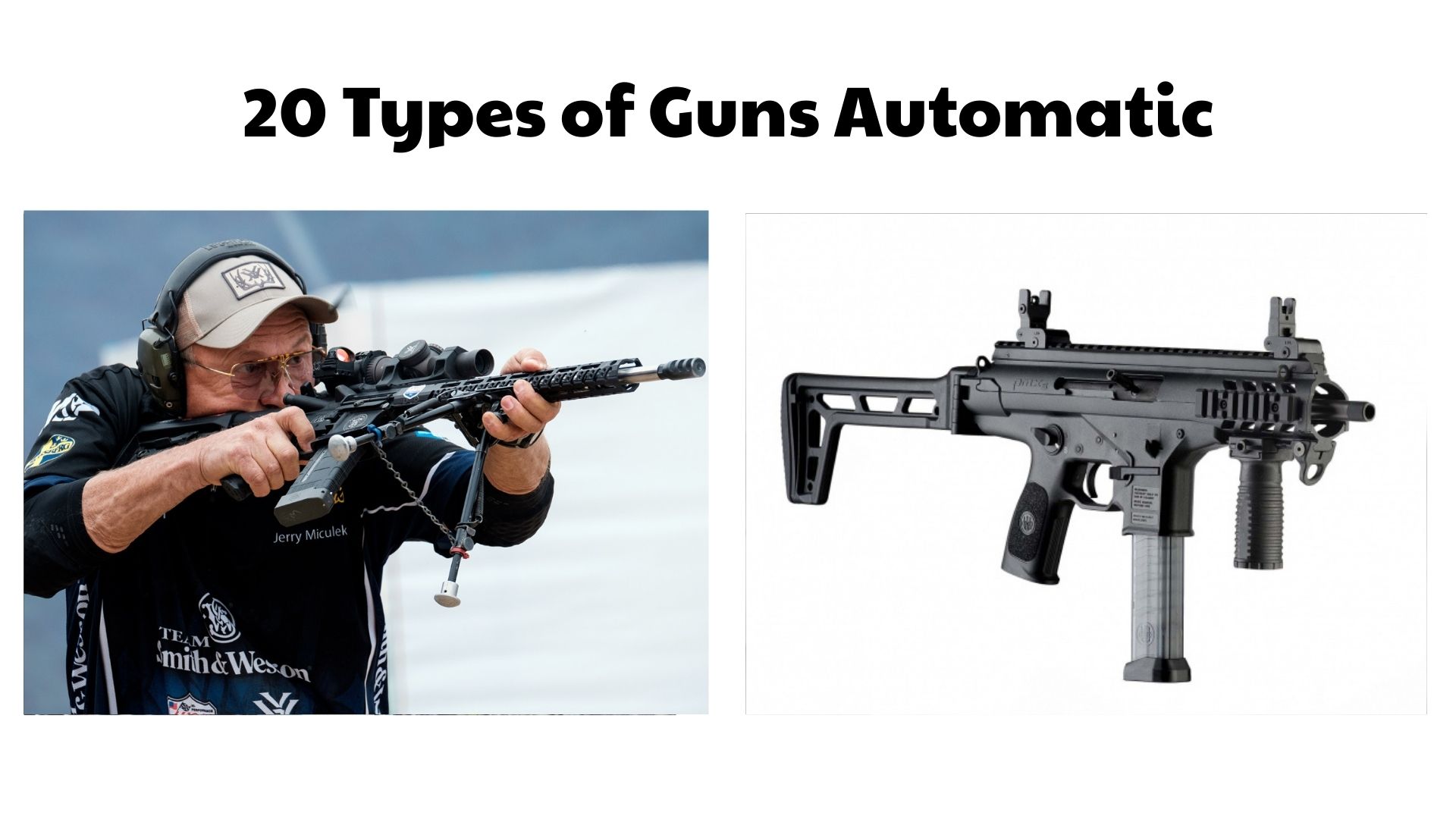
Automatic firearms have played a significant role in modern military history and weapon engineering. These weapons are designed to continue firing rounds as long as the trigger remains pressed and ammunition is available, making them fundamentally different from semi‑automatic firearms that require a trigger pull for every shot. Because of their ability to deliver sustained firepower, automatic weapons have been used for battlefield suppression, defensive operations, and specialized tactical roles across the world.
In this guide, we will explore 20 types of guns automatic that have influenced military design and firearm development over the past century. Each example highlights different engineering philosophies, battlefield roles, and historical contexts. Some are famous for their reliability and simplicity, while others stand out because of their high rate of fire or unique design approach. This overview focuses on clarity and practical understanding rather than heavy technical detail, helping readers understand why these guns automatic remain important in military discussions and firearm history.
20 Types of Guns Automatic
1. M60 Machine Gun
The M60 machine gun is one of the most recognizable automatic firearms developed for modern military service. Introduced in the late 1950s, the weapon was designed to provide American infantry units with a reliable general‑purpose machine gun capable of delivering sustained automatic fire in various combat conditions. Its development came from the need to replace several earlier systems with a single, versatile platform that could function in multiple roles on the battlefield. As a result, the M60 quickly became a standard component of infantry squads, vehicle mounts, and defensive positions. Even decades after its introduction, the weapon remains widely recognized and continues to appear in military training materials, historical accounts, and discussions about the evolution of guns automatic.
One of the defining characteristics of the M60 is its belt‑fed ammunition system, which allows the gunner to fire long bursts without needing to reload frequently. This capability made the weapon particularly valuable during extended engagements where sustained suppressive fire was necessary to control enemy movement or support advancing troops. The design also features a quick‑change barrel system, which helps manage heat buildup during prolonged firing sessions. Automatic weapons generate tremendous heat because of the rapid cycling of rounds, and the ability to replace the barrel quickly ensures that the weapon can continue operating safely during intense combat situations. This practical feature is one of the reasons the M60 became an enduring example when discussing types of guns automatic used in military operations.
Another reason the M60 gained such a strong reputation is its adaptability. The weapon can be mounted on tripods for defensive positions, attached to vehicles for mobile fire support, or carried by infantry soldiers as a squad automatic weapon. Each configuration allows the gun to serve a different tactical purpose. When mounted on a tripod, the M60 provides accurate sustained fire over longer distances, while a mobile configuration allows soldiers to reposition quickly and maintain battlefield flexibility. These design choices illustrate how guns automatic often serve as the backbone of infantry firepower, offering a balance between mobility and continuous firing capability.
Historically, the M60 saw extensive use during the Vietnam War, where its high rate of fire and relatively manageable weight made it a preferred support weapon for many units. Soldiers relied on the weapon to suppress enemy positions, protect patrol movements, and defend temporary bases in difficult terrain. Over time, newer machine guns replaced the M60 in many official roles, but its influence on later automatic firearm designs remains clear. Today, the M60 is still studied as a classic example of how types of guns automatic evolved to meet the practical needs of modern infantry forces while balancing durability, reliability, and firepower.
2. M240 Machine Gun
The M240 machine gun represents a later generation of automatic weapon design and is widely considered one of the most reliable general‑purpose machine guns currently in service. Developed from the Belgian FN MAG platform, the M240 was adopted by the United States military to provide a durable and consistent automatic firearm capable of operating under demanding battlefield conditions. Over time, it replaced several older systems and became a central component of infantry and vehicle‑mounted weapon configurations. Because of its robust construction and dependable operation, the M240 is frequently cited in discussions about modern types of guns automatic used by professional military forces.
A key feature of the M240 is its belt‑fed ammunition system combined with a gas‑operated firing mechanism. This configuration allows the weapon to cycle rounds smoothly while maintaining a steady firing rhythm, even during extended engagements. Reliability is critical for guns automatic because these weapons are often used in situations where continuous fire is needed to protect friendly units or suppress opposing forces. The M240’s internal engineering emphasizes durability, ensuring that the firearm continues operating even in dusty, muddy, or otherwise challenging environments. These design priorities highlight the practical considerations that guide the development of many automatic weapons.
Another advantage of the M240 platform is its flexibility across multiple battlefield roles. Variants of the weapon exist for infantry use, helicopter mounting, armored vehicles, and defensive emplacements. Each version maintains the same core firing mechanism while adapting external features such as barrels, mounting systems, and carrying handles to suit different tactical environments. This versatility reflects a broader principle in firearm engineering: the most successful guns automatic are those that can be adapted to many operational scenarios without sacrificing reliability or performance.
The M240’s reputation for accuracy and stability also contributes to its widespread adoption. While machine guns are typically associated with suppressive fire rather than pinpoint accuracy, the M240’s design allows trained operators to maintain controlled bursts and consistent shot placement over considerable distances. This balance between sustained firepower and manageable recoil is a defining trait of effective automatic weapons. As a result, the M240 continues to serve as an important reference point when discussing modern types of guns automatic and the engineering improvements that distinguish contemporary machine guns from earlier generations.
3. Browning M2 Heavy Machine Gun
The Browning M2 heavy machine gun is one of the longest‑serving automatic firearms ever developed, with a history that stretches back to the early twentieth century. Designed by American firearms engineer John Moses Browning, the weapon was originally created to provide powerful automatic fire capable of engaging vehicles, aircraft, and fortified positions. Over the decades, the M2 has become an iconic symbol of military firepower and remains in active service in many armed forces around the world. Its longevity demonstrates how well‑designed guns automatic can remain relevant for generations when they combine durability, reliability, and raw performance.
Unlike many lighter automatic weapons used by infantry, the M2 is classified as a heavy machine gun because it fires the powerful .50 caliber cartridge. This ammunition provides significantly greater range and impact compared to standard rifle rounds, allowing the weapon to engage targets at distances far beyond those typical of smaller automatic firearms. Because of its size and power, the M2 is usually mounted on vehicles, aircraft, naval vessels, or fixed defensive positions rather than carried directly by individual soldiers. This role highlights an important distinction among types of guns automatic: some are designed for portability, while others prioritize maximum firepower and long‑range effectiveness.
The operating mechanism of the M2 relies on a recoil‑operated system that cycles each round automatically as long as the trigger remains engaged. This system has proven remarkably reliable over decades of military service. Engineers and soldiers alike have praised the weapon for its ability to function in harsh environmental conditions, including extreme heat, dust, and cold weather. Such reliability is essential for heavy automatic weapons, which are often used in defensive positions where consistent firepower is critical to maintaining control of strategic areas.
Beyond its technical characteristics, the Browning M2 also represents a milestone in the evolution of automatic weapon design. The firearm has served in numerous conflicts and has been mounted on everything from tanks to naval patrol boats. Its continued presence in modern military inventories shows that effective engineering can outlast many technological trends. When discussing types of guns automatic and their historical significance, the M2 stands as one of the clearest examples of a weapon whose design has endured for nearly a century while still fulfilling its intended role on the battlefield.
4. MG42 Machine Gun
The MG42 machine gun is widely recognized as one of the most influential automatic firearms ever produced. Developed in Germany during the Second World War, the weapon quickly gained a reputation for its extremely high rate of fire and efficient manufacturing design. Engineers created the MG42 to replace earlier machine guns that were expensive and time‑consuming to produce. By using stamped metal components and simplified construction techniques, the designers made it possible to manufacture large numbers of weapons while maintaining strong battlefield performance. Because of these innovations, the MG42 remains a landmark example in the history of guns automatic.
One of the defining features of the MG42 is its exceptionally rapid firing rate, which produces a distinctive sound often described in historical accounts as similar to fabric tearing. This high rate of fire allows the weapon to deliver intense suppressive bursts capable of controlling large areas of the battlefield. Automatic weapons with such firing speeds can create a psychological effect as well as a tactical advantage, discouraging opposing forces from advancing or exposing themselves to return fire. For this reason, the MG42 became one of the most feared machine guns of its era and influenced many later automatic firearm designs.
Another notable aspect of the MG42 is its quick‑change barrel system. Because the weapon fires at such a high rate, barrels can heat rapidly during continuous operation. The quick‑change feature allows operators to replace a hot barrel with a cooler spare in a matter of seconds, ensuring that the weapon can continue firing safely without damaging internal components. This design principle has since become standard for many modern guns automatic, demonstrating the lasting impact of the MG42’s engineering solutions.
Although the original MG42 was designed for wartime use, its legacy continues through modern derivatives that retain many of the same mechanical concepts. These later versions refine the original design while adapting it to contemporary military requirements. As a result, the MG42 remains an important reference point in discussions about types of guns automatic and the technological developments that shaped modern machine gun engineering.
5. MG34 Machine Gun
The MG34 machine gun represents one of the earliest successful attempts to create a true general‑purpose automatic firearm. Developed in Germany during the 1930s, the weapon was designed to perform multiple battlefield roles using a single adaptable platform. Prior to the MG34, many armies relied on separate machine guns for different tasks such as infantry support, vehicle mounting, or defensive positions. The MG34 changed this approach by combining versatility with high performance, making it one of the first weapons to fully embody the concept of a general‑purpose machine gun. Because of this innovation, the MG34 occupies an important place in the historical development of types of guns automatic.
A key advantage of the MG34 was its modular design. The weapon could be mounted on bipods for mobile infantry support, attached to tripods for sustained defensive fire, or installed in vehicles and aircraft. This adaptability allowed military units to standardize their equipment while still maintaining flexibility in combat situations. Engineers also equipped the MG34 with a belt‑fed ammunition system, enabling it to fire extended bursts without frequent reloading. Such sustained firing capability is a defining feature of guns automatic and a major factor in their value as support weapons.
Despite its impressive capabilities, the MG34 was relatively complex to manufacture because it required precise machining of many components. While this precision contributed to the weapon’s accuracy and reliability, it also increased production time and cost. These manufacturing challenges eventually led to the development of the MG42, which used simpler construction methods. Even so, the MG34 remained an effective automatic firearm and served extensively during its period of use.
Today, the MG34 is remembered not only for its performance but also for the design philosophy it introduced. By demonstrating that a single machine gun could fulfill multiple tactical roles, the weapon helped shape the direction of future automatic firearm development. Modern general‑purpose machine guns continue to follow the same principles of versatility, reliability, and sustained firepower. For this reason, the MG34 remains a significant example when exploring the broader category of guns automatic and understanding how early innovations continue to influence contemporary weapon systems.
6. FN Minimi Machine Gun
The FN Minimi machine gun is widely recognized as one of the most influential light automatic weapons developed in the late twentieth century. Designed by the Belgian firearms manufacturer FN Herstal, the Minimi was created to provide infantry units with a lightweight yet highly effective automatic firearm capable of delivering sustained suppressive fire. Its name, which stands for “Mini Mitrailleuse,” reflects the design goal of producing a compact machine gun that could still perform the essential battlefield roles traditionally handled by larger systems. Over time, the FN Minimi became a cornerstone of modern infantry firepower and an important example when discussing modern types of guns automatic used around the world.
One of the key strengths of the FN Minimi lies in its flexible ammunition system. The weapon can operate using disintegrating belt‑fed ammunition, which allows for continuous firing during extended engagements, but it can also accept standard rifle magazines in certain configurations. This dual‑feed capability gives soldiers valuable flexibility in the field, especially during situations where belt ammunition may be limited or when quick reloads are necessary. Like many successful guns automatic, the Minimi balances sustained firepower with manageable weight, allowing a single soldier to carry and operate the weapon without excessive strain during long patrols or combat operations.
The Minimi also incorporates a gas‑operated firing mechanism that cycles rounds efficiently while maintaining reliability in harsh environments. Dust, mud, and extreme temperatures can challenge many firearms, but the Minimi was engineered with battlefield durability in mind. Its robust internal components and relatively simple maintenance procedures allow operators to keep the weapon functioning even under demanding conditions. This reliability is one of the reasons the Minimi has been adopted by numerous military forces across different continents, making it one of the most widely distributed automatic machine guns in modern history.
Another important aspect of the FN Minimi is its role within the infantry squad. In most tactical formations, the weapon serves as a primary source of suppressive fire, helping control enemy movement while other soldiers maneuver into advantageous positions. The gunner and assistant gunner typically operate together, carrying additional ammunition and spare barrels to support sustained firing when needed. This teamwork reflects the broader tactical philosophy behind many guns automatic: they are not only weapons but also critical tools for shaping battlefield dynamics. Through its balance of portability, reliability, and sustained fire capability, the FN Minimi remains a defining example of modern automatic firearm design.
7. M249 Squad Automatic Weapon
The M249 Squad Automatic Weapon, often referred to simply as the M249 SAW, is closely related to the FN Minimi and serves as its American military variant. Introduced to provide infantry squads with a dependable light machine gun, the M249 quickly became a key component of modern battlefield tactics. Its primary function is to deliver continuous automatic fire that suppresses enemy positions and allows friendly forces to maneuver safely. Because of this role, the M249 is frequently highlighted in discussions about types of guns automatic designed specifically for infantry squad support.
One of the defining characteristics of the M249 is its ability to provide a high volume of fire while remaining relatively portable compared to heavier machine guns. Soldiers can carry the weapon with a bipod for mobile operations, allowing them to deploy quickly in changing combat situations. The belt‑fed ammunition system enables extended firing sequences, which is crucial when maintaining pressure on opposing forces during engagements. At the same time, the M249 is designed with a quick‑change barrel system that allows operators to replace overheated barrels during prolonged firing, ensuring safe operation and sustained battlefield performance.
Another reason the M249 has remained widely used is its compatibility with standard infantry equipment. The weapon fires the same ammunition used by many service rifles, which simplifies logistics and ammunition supply during operations. This compatibility allows units to share resources when necessary, improving overall efficiency during extended missions. Guns automatic like the M249 demonstrate how modern military design often focuses not only on raw firepower but also on practical considerations such as supply chains, maintenance procedures, and training requirements.
Over the years, the M249 has been deployed in numerous military operations and training environments, where it has earned a reputation for reliability and versatility. Its ability to deliver sustained suppressive fire while remaining mobile makes it a valuable tool for infantry squads operating in diverse terrain. While newer systems continue to emerge, the M249 remains an important reference point for understanding the evolution of automatic squad weapons and the broader category of guns automatic used by modern armed forces.
8. PKM Machine Gun
The PKM machine gun is one of the most widely recognized general‑purpose automatic weapons originating from Eastern European firearm design. Developed in the Soviet Union and introduced during the 1960s, the PKM was engineered to replace earlier machine gun models with a lighter and more efficient system. Its design emphasizes simplicity, durability, and ease of maintenance, qualities that have helped the weapon remain in active service for decades. Because of its widespread use and reputation for reliability, the PKM is often included in discussions about classic types of guns automatic used across many military forces worldwide.
A major advantage of the PKM lies in its relatively lightweight construction compared to other machine guns of similar power. This reduced weight allows infantry soldiers to carry the weapon more easily during long movements while still maintaining the ability to deliver sustained automatic fire. The belt‑fed ammunition system enables extended bursts, making the PKM effective for suppressive roles and defensive positions. Like many guns automatic designed for military use, the PKM also incorporates a quick‑change barrel mechanism that helps manage heat buildup during prolonged firing sessions.
Another notable feature of the PKM is its rugged operating system. The weapon uses a gas‑operated mechanism derived from earlier Soviet firearm designs, which prioritizes reliability under harsh conditions. Military forces operating in extreme climates, including deserts, forests, and mountainous terrain, have relied on the PKM because it continues functioning even when exposed to dust, dirt, or limited maintenance. This reputation for durability has contributed significantly to the weapon’s global adoption.
Beyond its technical features, the PKM also represents a design philosophy focused on practicality and mass production. Its straightforward engineering allows it to be manufactured and maintained without overly complex equipment. This simplicity ensures that soldiers can keep the weapon operational even in remote environments where advanced maintenance facilities may not be available. As a result, the PKM stands as a prominent example of how guns automatic can combine reliability, firepower, and efficient design to meet the needs of modern military forces.
9. RPK Light Machine Gun
The RPK light machine gun is another important example of an automatic firearm designed to provide sustained firepower at the squad level. Developed in the Soviet Union as an extension of the AK‑series rifle platform, the RPK was created to offer greater firing capacity and improved stability compared to standard infantry rifles. By adapting the familiar AK operating system into a heavier support weapon, designers produced a firearm that maintained reliability while giving infantry units an effective automatic weapon for suppressive fire. Because of its origins and practical design, the RPK is frequently mentioned among notable types of guns automatic developed during the Cold War era.
One of the defining characteristics of the RPK is its extended barrel and reinforced receiver, which help the weapon handle the heat and stress generated by automatic fire. These structural improvements allow the firearm to maintain accuracy and durability during sustained firing sessions. The RPK also features a bipod that provides additional stability when the gunner fires from a prone or supported position. This setup helps control recoil and maintain consistent shot placement, which is essential for automatic weapons intended to support infantry movements on the battlefield.
Unlike many machine guns that rely exclusively on belt‑fed ammunition, the RPK typically uses high‑capacity magazines or drum magazines derived from the AK rifle platform. This design choice simplifies ammunition management and allows soldiers to share magazines with standard rifles if necessary. Such compatibility demonstrates how some guns automatic prioritize logistical efficiency as well as firepower, ensuring that infantry units can operate effectively even when supply conditions become challenging.
The RPK’s reliability and straightforward design have contributed to its widespread use across numerous countries and military organizations. Soldiers appreciate the weapon’s familiarity, as it retains many operational similarities with the widely known AK rifle family. This shared design language reduces training requirements and simplifies maintenance procedures. As a result, the RPK remains an important example of how automatic firearms can evolve from existing platforms while expanding their role within infantry squads.
10. RPD Machine Gun
The RPD machine gun represents an earlier generation of Soviet automatic weapon design and played a significant role in the development of later light machine guns. Introduced in the mid‑twentieth century, the RPD was designed to provide infantry units with a portable yet powerful automatic firearm capable of delivering sustained suppressive fire. At a time when many armies were transitioning from heavier machine guns to lighter squad‑level support weapons, the RPD helped demonstrate how compact guns automatic could still offer substantial battlefield effectiveness.
One of the distinguishing features of the RPD is its belt‑fed ammunition system housed within a drum‑style container attached beneath the weapon. This configuration allows the gunner to carry a relatively large supply of ammunition while maintaining mobility during combat operations. Belt‑fed systems are particularly valuable for automatic firearms because they enable longer firing sequences without frequent reloads. For infantry units operating in dynamic environments, this sustained firing capability can provide a crucial advantage when suppressing enemy positions or defending key terrain.
The RPD uses a gas‑operated mechanism that cycles rounds reliably even under demanding conditions. Designers focused on simplicity and durability, ensuring that soldiers could maintain the weapon with minimal tools and training. This practical engineering approach reflects the broader philosophy behind many types of guns automatic developed during the mid‑twentieth century: reliability and ease of use were often prioritized over complex mechanical features.
Although the RPD was eventually replaced in many military forces by newer designs such as the RPK, it remains an important historical example of early light machine gun development. The weapon demonstrated how automatic firearms could be adapted for squad‑level support while still maintaining portability and sustained fire capability. Today, the RPD continues to be studied by firearm historians and military analysts as a key step in the evolution of modern guns automatic and the engineering principles that shape contemporary machine gun design.
11. Bren Light Machine Gun
The Bren Light Machine Gun stands as one of the most respected automatic firearms of the twentieth century and remains a prominent example when discussing classic types of guns automatic used by infantry forces. Developed from the Czech ZB vz.26 design and later refined for British military service, the Bren machine gun earned a reputation for reliability, accuracy, and adaptability in a wide range of battlefield conditions. Its name, “Bren,” actually reflects its origins, combining the names of the cities Brno in the former Czechoslovakia and Enfield in the United Kingdom, where the design was refined and produced. This heritage demonstrates how international collaboration often plays a role in the development of effective military technology.
One of the most recognizable features of the Bren Light Machine Gun is its top‑mounted curved magazine. While many automatic weapons rely on belt‑fed ammunition systems, the Bren’s magazine design provided a practical balance between portability and sustained fire capability. The elevated magazine allowed gravity to assist the feeding process, improving reliability during prolonged firing sequences. Combined with a gas‑operated mechanism and a relatively stable bipod firing position, the Bren offered infantry units a dependable automatic weapon capable of delivering accurate bursts of suppressive fire.
Another factor that contributed to the Bren’s success was its exceptional build quality. The weapon was carefully manufactured and engineered with precision components, which helped maintain smooth operation even in challenging environments such as dusty deserts or muddy battlefields. Soldiers often praised the Bren for its accuracy compared to many other guns automatic of its era, making it useful not only for suppressive fire but also for controlled engagements at moderate distances. This balance between automatic firepower and accuracy made the Bren an effective support weapon within infantry squads.
Beyond its technical characteristics, the Bren Light Machine Gun also holds an important place in military history. It was widely used throughout major conflicts of the twentieth century and remained in service with various forces long after its initial introduction. Its reliability, manageable recoil, and relatively straightforward maintenance procedures helped establish it as a trusted weapon among soldiers. Even today, the Bren is frequently referenced in historical studies and firearms discussions as a classic example of how early guns automatic evolved into the more advanced light machine guns used by modern military forces.
12. Lewis Machine Gun
The Lewis Machine Gun represents one of the earliest successful attempts to create a portable automatic weapon capable of supporting infantry operations. Developed in the early twentieth century by American designer Isaac Newton Lewis, the weapon quickly gained attention for its innovative engineering and distinctive appearance. The Lewis machine gun became widely used by multiple military forces, particularly during the early years of mechanized warfare, and it continues to be recognized as an important milestone in the development of types of guns automatic designed for battlefield mobility.
One of the most distinctive aspects of the Lewis machine gun is its large pan‑style drum magazine mounted above the receiver. This unique feeding system allowed the weapon to carry a significant number of rounds while maintaining a relatively balanced structure. The top‑mounted magazine also helped ensure consistent feeding during rapid firing sequences. Combined with the weapon’s gas‑operated mechanism, this design enabled soldiers to maintain continuous automatic fire for extended periods, which was essential for suppressing enemy positions during early twentieth‑century combat scenarios.
Another notable feature of the Lewis machine gun is its distinctive barrel cooling system. The weapon incorporates a shroud surrounding the barrel, designed to draw air through the system during firing and help dissipate heat. At a time when overheating posed significant challenges for automatic firearms, this cooling system represented an innovative solution that improved the weapon’s sustained firing capability. Guns automatic developed during this period often experimented with various cooling methods, and the Lewis machine gun stands as a notable example of these early engineering efforts.
The Lewis machine gun also gained popularity due to its versatility. It was used not only by infantry units but also in early aircraft and vehicle mounts, demonstrating how adaptable automatic weapons could be across different combat roles. Over time, the weapon influenced later machine gun designs by demonstrating the importance of portability, sustained fire capability, and mechanical reliability. While modern automatic firearms have evolved significantly, the Lewis machine gun remains a fascinating historical example of how early engineers approached the challenges of creating effective guns automatic for military use.
13. Chauchat Machine Rifle
The Chauchat Machine Rifle occupies a unique place in the history of automatic firearms and is often discussed as one of the earliest attempts to produce a lightweight automatic weapon for infantry units. Developed in France during the early twentieth century, the Chauchat was designed to provide soldiers with mobile automatic fire support during rapidly evolving battlefield conditions. Although the weapon faced several mechanical challenges, it nonetheless played a significant role in the broader evolution of types of guns automatic designed for infantry mobility and squad‑level support.
One of the defining characteristics of the Chauchat was its curved magazine system and relatively lightweight construction compared to heavier machine guns of the time. Designers attempted to create a weapon that a single soldier could carry and operate while advancing across difficult terrain. This concept represented an important shift in military thinking, emphasizing mobility and squad‑level firepower rather than relying solely on heavy machine guns positioned in static defensive locations. The Chauchat therefore contributed to the broader development of portable guns automatic intended to accompany infantry units directly into combat.
The weapon operated using a long‑recoil mechanism, which differed from many later gas‑operated machine gun designs. While innovative, this system sometimes introduced reliability issues, particularly when the weapon was exposed to mud or debris. However, it is important to view the Chauchat within its historical context. At the time of its introduction, engineers were still exploring effective ways to create lightweight automatic firearms, and the Chauchat represented an ambitious attempt to address this challenge.
Despite its limitations, the Chauchat Machine Rifle influenced future firearm development by demonstrating the potential advantages of portable automatic weapons. The concept of equipping infantry squads with lightweight automatic firepower eventually led to the creation of more refined designs such as modern light machine guns and squad automatic weapons. As a result, the Chauchat remains an important historical reference point when studying the early evolution of guns automatic and the engineering experiments that shaped modern infantry support weapons.
14. Johnson M1941 Light Machine Gun
The Johnson M1941 Light Machine Gun is a distinctive automatic firearm developed in the United States during the early years of the Second World War. Designed by Melvin Johnson, this weapon represented an alternative approach to light machine gun development at a time when military engineers were exploring different solutions for portable automatic firepower. Although it was produced in relatively limited numbers compared to some other machine guns of the era, the Johnson M1941 remains an interesting example of experimental engineering within the broader category of types of guns automatic.
One of the most notable aspects of the Johnson M1941 Light Machine Gun is its rotating bolt system and short recoil operation, which differed from many contemporary machine guns that relied on gas‑operated mechanisms. This design allowed the weapon to cycle smoothly while maintaining controlled automatic fire. The firearm also used a side‑mounted drum magazine that could be loaded with individual rounds or pre‑loaded clips, offering flexibility in ammunition management during combat situations. Such design choices reflected ongoing experimentation with different feeding systems and operating mechanisms in the development of guns automatic.
Another advantage of the Johnson M1941 was its relatively lightweight structure compared to many other machine guns of the same period. This allowed soldiers to transport and deploy the weapon more easily across various battlefield environments. The firearm was also designed with a quick‑detachable barrel, which simplified maintenance and allowed operators to address overheating during sustained firing. These features demonstrated an understanding of the practical challenges faced by soldiers using automatic weapons in real combat conditions.
Although the Johnson M1941 was eventually overshadowed by other machine gun designs that achieved wider adoption, it remains an important example of innovative firearm engineering. The weapon illustrates how designers experimented with different mechanical systems while searching for the ideal balance between reliability, portability, and sustained firepower. For historians and firearm enthusiasts alike, the Johnson M1941 Light Machine Gun provides valuable insight into the evolving technology behind modern guns automatic.
15. HK21 Machine Gun
The HK21 Machine Gun represents a modern approach to automatic firearm design and reflects the engineering philosophy of the German manufacturer Heckler & Koch. Introduced during the latter half of the twentieth century, the HK21 was developed as a versatile general‑purpose machine gun capable of delivering reliable automatic fire in a variety of combat scenarios. Drawing inspiration from the roller‑delayed blowback system used in several Heckler & Koch rifle platforms, the HK21 offers a distinctive mechanical approach compared to many traditional gas‑operated guns automatic.
One of the defining features of the HK21 is its modular design. The weapon was engineered to be adaptable, allowing operators to configure it for different roles depending on mission requirements. It can be mounted on bipods for mobile infantry support or installed on tripods and vehicle mounts for more sustained defensive fire positions. This versatility highlights the broader trend in modern firearm development toward multi‑role weapons that can adapt to changing battlefield conditions while maintaining consistent performance.
Another strength of the HK21 is its belt‑fed ammunition system, which enables extended firing sequences during combat operations. Belt‑fed mechanisms are particularly valuable for automatic weapons because they allow the gunner to maintain continuous suppressive fire without frequent interruptions for reloading. Combined with the weapon’s stable firing platform and well‑balanced design, the HK21 provides a steady stream of automatic fire capable of supporting infantry movements or defending key positions.
Beyond its technical features, the HK21 also reflects the precision manufacturing standards associated with modern European firearm engineering. Components are carefully machined and assembled to ensure consistent performance and durability under demanding conditions. As a result, the HK21 has been adopted by various military and security organizations around the world. Its combination of modular adaptability, reliable operation, and sustained fire capability ensures that it remains a notable example within the broader family of guns automatic used in contemporary military environments.
16. IMI Negev Machine Gun
The IMI Negev Machine Gun is a modern light machine gun developed by Israel Military Industries, now known as Israel Weapon Industries. Designed to provide infantry units with a reliable and versatile automatic support weapon, the Negev has become a respected example among contemporary types of guns automatic used in modern military operations. Introduced during the late twentieth century, the firearm was engineered with the goal of combining portability, durability, and sustained fire capability into a single platform suitable for a wide variety of battlefield environments.
One of the defining characteristics of the IMI Negev Machine Gun is its belt‑fed ammunition system, which allows soldiers to maintain continuous automatic fire during combat situations. Sustained suppressive fire is an essential element of infantry tactics, as it helps limit enemy movement and creates opportunities for friendly forces to reposition or advance. Like many guns automatic designed for squad support roles, the Negev was developed with an emphasis on delivering consistent firepower while remaining manageable enough for a single operator to carry and deploy effectively.
Another strength of the Negev is its adaptability. The weapon includes adjustable gas settings that allow operators to regulate the firing cycle depending on environmental conditions or operational needs. This feature helps maintain reliable functioning even when the weapon is exposed to dust, sand, or other harsh elements often encountered in real‑world military deployments. Such adaptability reflects the broader philosophy behind many modern automatic firearms, where reliability across varied environments is considered just as important as raw firepower.
The IMI Negev Machine Gun also incorporates ergonomic improvements that enhance usability for soldiers in the field. Its design allows for stable firing from a bipod, while optional mounting systems enable use on tripods or vehicles for more sustained defensive operations. These flexible configurations demonstrate how contemporary guns automatic are built to fulfill multiple roles within infantry units. Through its combination of durability, sustained fire capability, and adaptable design, the Negev continues to represent a modern approach to automatic weapon engineering.
17. Steyr AUG HBAR Light Machine Gun
The Steyr AUG HBAR Light Machine Gun is a specialized automatic firearm derived from the well‑known Steyr AUG rifle platform. Developed in Austria, the AUG family of weapons is widely recognized for its distinctive bullpup configuration, where the action and magazine are positioned behind the trigger. The HBAR variant, which stands for “Heavy Barrel Automatic Rifle,” was designed to provide greater sustained fire capability compared to standard rifle versions. Because of its unique configuration and modular structure, the AUG HBAR is often included in discussions about innovative types of guns automatic developed during the late twentieth century.
One of the most notable features of the Steyr AUG HBAR is its heavier barrel, which allows the weapon to withstand the increased heat generated during automatic firing sequences. Sustained firing can quickly raise barrel temperatures, potentially affecting performance or accuracy, so the reinforced barrel design helps ensure stable operation. Additionally, the weapon typically includes a bipod that improves stability when firing from a prone or supported position, allowing the gunner to maintain consistent shot placement during extended bursts.
The AUG HBAR retains the bullpup layout of the original rifle platform, which offers several practical advantages. By placing the action behind the trigger, designers were able to maintain a relatively compact overall length while still incorporating a full‑length barrel. This compact structure improves maneuverability, especially in confined environments or during mobile operations. Many guns automatic prioritize portability and flexibility, and the AUG HBAR demonstrates how creative engineering solutions can address these design goals.
Another important aspect of the AUG HBAR Light Machine Gun is its modularity. The weapon was designed as part of a broader family of firearms that share interchangeable components and similar operating systems. This approach simplifies training and maintenance for military personnel while allowing units to adapt their equipment for different tactical roles. As a result, the Steyr AUG HBAR stands as an interesting example of how modern guns automatic can evolve from versatile rifle platforms while still providing effective squad‑level automatic fire support.
18. ZB vz.26 Light Machine Gun
The ZB vz.26 Light Machine Gun is a historically significant automatic firearm developed in Czechoslovakia during the interwar period. Produced by the Zbrojovka Brno factory, the weapon quickly gained international recognition due to its reliability, accuracy, and efficient design. Many historians consider the ZB vz.26 one of the most influential early light machine guns, and its engineering concepts helped inspire later designs used by various military forces around the world. Because of its impact on firearm development, the ZB vz.26 is frequently mentioned when discussing early types of guns automatic intended for infantry squad support.
One of the most recognizable features of the ZB vz.26 is its top‑mounted box magazine, which feeds ammunition downward into the weapon’s action. This arrangement improves reliability because gravity assists the feeding process, reducing the likelihood of mechanical interruptions during firing. Combined with a gas‑operated operating system, the design allows the weapon to cycle rounds smoothly even during extended firing sequences. These characteristics made the ZB vz.26 a dependable automatic weapon capable of supporting infantry operations in diverse battlefield environments.
The weapon also incorporates a quick‑change barrel system, which was a valuable feature for machine guns expected to deliver sustained fire. During prolonged firing, barrels can become extremely hot, potentially affecting performance or safety. The ability to replace the barrel quickly allows soldiers to maintain continuous operation without long interruptions. Many later guns automatic adopted similar systems, highlighting the ZB vz.26’s influence on future machine gun engineering.
Beyond its mechanical design, the ZB vz.26 achieved widespread international use and became the basis for several derivative firearms produced in other countries. Its reputation for durability and simplicity helped establish it as one of the most respected light machine guns of its time. Even decades after its introduction, the ZB vz.26 remains an important reference point for historians studying the evolution of automatic firearms and the engineering principles that shaped modern guns automatic.
19. Villar Perosa Automatic Weapon
The Villar Perosa Automatic Weapon represents one of the earliest attempts to develop a compact automatic firearm capable of delivering rapid bursts of fire. Originating in Italy during the early twentieth century, the Villar Perosa was initially designed for aircraft use but later adapted for ground operations. Its unusual design features two separate barrels and firing mechanisms mounted side by side, creating a dual‑barrel automatic system that could produce extremely high rates of fire. Because of this unconventional structure, the Villar Perosa occupies a unique position in the historical development of types of guns automatic.
Unlike most later machine guns that rely on belt‑fed ammunition systems, the Villar Perosa used detachable magazines inserted into each of its two firing assemblies. This configuration allowed the weapon to fire rapidly from both barrels in alternating sequences. Although the concept was innovative, it also presented challenges in terms of ammunition capacity and sustained operation. Nevertheless, the design demonstrated early experimentation with achieving high rates of automatic fire in a relatively compact platform.
As warfare evolved and infantry tactics changed, engineers began to refine the concept of portable automatic weapons. While the Villar Perosa itself was eventually replaced by more practical designs, it contributed valuable insights into the mechanics of rapid‑fire firearms. Its dual‑barrel system highlighted both the possibilities and limitations of early automatic weapon experimentation, influencing later developments in submachine guns and light machine guns.
Today, the Villar Perosa is primarily remembered as a historical curiosity and an important step in the technological progression of automatic firearms. It reflects a period of rapid innovation when designers were exploring various approaches to delivering continuous firepower on the battlefield. Even though modern guns automatic have evolved far beyond this early concept, the Villar Perosa remains a fascinating example of how experimentation and engineering creativity shaped the early history of automatic weapon design.
20. UKM‑2000 Machine Gun
The UKM‑2000 Machine Gun represents a modern evolution of the classic Soviet‑designed PK series of machine guns. Developed in Poland, the weapon was designed to modernize existing machine gun systems while maintaining the reliability and simplicity that made earlier models successful. By adapting the design to meet contemporary military standards, engineers created a versatile automatic firearm capable of supporting infantry operations across a variety of environments. As such, the UKM‑2000 is often included among modern types of guns automatic used by armed forces seeking dependable general‑purpose machine guns.
One of the key improvements introduced with the UKM‑2000 is its compatibility with NATO‑standard ammunition. This modification allows the weapon to integrate more easily into modern military logistics systems used by allied forces. Standardization of ammunition simplifies supply chains and ensures that soldiers operating in multinational environments can share resources effectively. Many modern guns automatic are designed with this type of compatibility in mind, reflecting the importance of interoperability in contemporary military operations.
The UKM‑2000 retains the belt‑fed ammunition system typical of general‑purpose machine guns, enabling extended firing sequences during combat engagements. Combined with a durable gas‑operated mechanism, the weapon is capable of delivering consistent automatic fire while maintaining reliability under demanding conditions. Its design also includes a bipod for mobile operations and compatibility with tripods for more stable firing positions, allowing it to serve multiple tactical roles within infantry units.
In addition to its mechanical reliability, the UKM‑2000 incorporates several ergonomic improvements that enhance usability for modern soldiers. Updated materials, improved grips, and refined mounting systems make the weapon easier to handle and maintain during long missions. These upgrades demonstrate how contemporary firearm engineering continues to refine established machine gun platforms rather than replacing them entirely. As a result, the UKM‑2000 stands as a modern example of how guns automatic can evolve through incremental improvements while preserving the dependable performance that soldiers rely on in demanding operational environments.
Conclusion
Automatic firearms have played a significant role in the evolution of modern military equipment, and understanding the different types of guns automatic provides valuable insight into how battlefield technology has developed over time. From early experimental designs to advanced modern machine guns, these weapons were created with the same core goal: delivering sustained firepower that supports infantry operations and enhances tactical effectiveness. Each firearm discussed in this guide reflects a specific moment in engineering history, demonstrating how designers approached challenges such as reliability, portability, ammunition capacity, and heat management during extended firing sequences.
Some of the guns automatic highlighted in this article represent groundbreaking innovations that influenced future weapon designs. Early systems such as the Lewis Machine Gun and the Chauchat Machine Rifle show how engineers experimented with different operating mechanisms while searching for practical solutions for mobile automatic fire. Later designs like the FN Minimi, IMI Negev, and HK21 illustrate how automatic weapon technology continued to evolve with improved materials, refined operating systems, and modular configurations that support a wide range of tactical roles. These advancements demonstrate how firearm engineering adapts continuously to the changing needs of modern military forces.
Another key takeaway from examining these types of guns automatic is the diversity of design approaches used across different eras and countries. Some weapons emphasize lightweight portability for squad‑level operations, while others prioritize sustained firepower through belt‑fed systems and heavier support platforms. Even historical designs such as the Villar Perosa or the ZB vz.26 provide valuable lessons that influenced later developments in machine gun technology. By studying these firearms collectively, it becomes easier to appreciate how decades of experimentation and innovation gradually shaped the automatic weapons used by modern armed forces.
Ultimately, the world of guns automatic represents a fascinating combination of engineering, history, and tactical evolution. Whether examining classic light machine guns or modern general‑purpose machine guns, each design reflects a balance between mechanical complexity and battlefield practicality. For enthusiasts, historians, and readers interested in military technology, exploring these 20 types of guns automatic offers a deeper understanding of how automatic firearms have developed and why they continue to play an essential role in modern military equipment.
FAQ’s
1. What are automatic guns?
Automatic guns are firearms designed to continuously fire bullets as long as the trigger is pressed and ammunition is available. Unlike semi-automatic firearms, which fire one round per trigger pull, automatic guns provide rapid, sustained fire, making them suitable for military and tactical applications.
2. How do automatic guns work?
Automatic guns typically operate using gas, recoil, or blowback mechanisms. These systems cycle the firing, ejecting, and reloading process automatically, enabling continuous firing without manually operating the weapon after each shot.
3. What is the difference between automatic and semi-automatic guns?
Semi-automatic guns fire one round per trigger pull, while automatic guns continue firing as long as the trigger is held down. Automatic guns are generally used for military or professional purposes due to their sustained fire capability.
4. Are automatic guns legal for civilians?
In most countries, fully automatic firearms are heavily regulated or banned for civilian ownership. Exceptions exist in certain jurisdictions, often requiring special permits, registration, and compliance with strict legal requirements.
5. What are the main types of automatic guns?
Automatic guns include submachine guns, assault rifles, light machine guns, general-purpose machine guns, and heavy machine guns. Each type serves specific tactical roles based on range, rate of fire, and portability.
6. What is a light machine gun?
A light machine gun (LMG) is an automatic firearm designed to provide sustained firepower while remaining portable enough for infantry use. Examples include the FN Minimi and the RPK.
7. What is a general-purpose machine gun?
General-purpose machine guns (GPMG) are versatile automatic firearms that can serve in both portable infantry roles and mounted positions. They often have higher caliber rounds and longer barrels to support sustained fire.
8. What is a submachine gun?
Submachine guns are compact automatic weapons that fire pistol-caliber ammunition. They are often used in close-quarters combat due to their small size, low recoil, and rapid rate of fire. Examples include the HK MP5 and the Colt 9mm SMG.
9. What is an assault rifle?
An assault rifle is a selective-fire firearm capable of both semi-automatic and automatic firing modes. It uses intermediate cartridges, balancing range and recoil. Examples include the HK416 and the Steyr AUG HBAR.
10. Why are automatic guns important in the military?
Automatic guns provide suppressive fire, allow squads to control enemy movements, and increase the volume of fire during engagements. They are essential for both offensive and defensive operations in modern combat scenarios.
11. How are automatic guns maintained?
Maintenance involves regular cleaning of the barrel, bolt, and chamber, lubrication of moving parts, and inspection for wear or damage. Proper maintenance ensures reliability and longevity of the firearm in demanding conditions.
12. Can automatic guns overheat?
Yes, sustained firing can cause barrels to overheat. Many automatic guns, such as the FN Minimi and the M249 SAW, include quick-change barrels or cooling systems to manage heat during prolonged use.
13. What is belt-fed ammunition?
Belt-fed ammunition is a system where cartridges are linked together in a belt, allowing automatic guns to fire continuously without frequent reloading. This is common in machine guns like the PKM and the UKM-2000.
14. What is magazine-fed automatic fire?
Magazine-fed automatic guns use detachable magazines to store and feed ammunition. While they offer less sustained fire than belt-fed systems, they provide mobility and quicker reloads, as seen in the RPK or M249 SAW.
15. How do soldiers carry automatic guns?
Automatic guns can be carried with slings, backpacks, or specialized mounts. Light machine guns are designed to be portable for infantry, while heavier GPMGs may require bipods or tripods for firing stability.
16. What is a bipod in automatic firearms?
A bipod is a two-legged support attached to the firearm to stabilize it during firing. It is commonly used with light and general-purpose machine guns to reduce recoil and improve accuracy.
17. Can automatic guns be mounted on vehicles?
Yes, many automatic guns like the HK21, UKM-2000, and PKM can be mounted on vehicles, helicopters, or tripods to provide sustained firepower and cover large areas in tactical operations.
18. What are the advantages of automatic guns?
Automatic guns offer rapid fire, sustained suppressive capability, and flexibility in combat situations. They allow small units to exert significant firepower without relying solely on larger artillery or support weapons.
19. What are the disadvantages of automatic guns?
Automatic guns can be heavy, require more ammunition, and may overheat during prolonged firing. They also demand greater training to handle recoil and maintain accuracy during bursts.
20. What are some famous types of guns automatic?
Notable examples include the FN Minimi, M249 SAW, PKM, RPK, HK21, Steyr AUG HBAR, M2 Browning, and the Lewis machine gun. Each of these firearms has been widely used by military forces worldwide.
21. What is a quick-change barrel system?
A quick-change barrel system allows operators to replace the barrel rapidly during sustained fire to prevent overheating. This system is common in modern LMGs like the FN Minimi and the M249 SAW.
22. How do automatic guns affect infantry tactics?
Automatic guns allow infantry squads to suppress enemy positions, cover movements, and provide continuous fire in both defensive and offensive operations, shaping the flow of combat effectively.
23. Are automatic guns suitable for civilians?
In most countries, civilian ownership of fully automatic guns is prohibited or heavily restricted. Legal semi-automatic variants are available in some jurisdictions but may have limited magazine capacities.
24. What calibers are used in automatic guns?
Automatic guns come in various calibers, ranging from pistol calibers in SMGs (9mm) to intermediate cartridges in assault rifles (5.56mm, 7.62mm) and larger calibers for machine guns (7.62mm, .50 BMG).
25. What is the difference between light and heavy machine guns?
Light machine guns are designed for mobility and can be operated by a single soldier, while heavy machine guns have larger calibers, more sustained firepower, and often require crew operation or mounting systems.
26. What role does the gas-operated mechanism play?
The gas-operated mechanism uses propellant gases from fired cartridges to cycle the weapon automatically. This allows continuous firing without manual operation, a core feature of guns automatic.
27. What are squad automatic weapons?
Squad automatic weapons (SAWs) are light machine guns assigned to infantry squads to provide suppressive fire. Examples include the M249 SAW and the RPK.
28. How is recoil managed in automatic guns?
Recoil is managed through design features such as heavier barrels, bipods, muzzle brakes, or gas-regulated operating systems, which help maintain control during rapid automatic fire.
29. Can automatic guns be used in urban combat?
Yes, submachine guns and light automatic rifles are often used in urban combat for close-quarters engagements due to their mobility, controllable recoil, and rapid firing capability.
30. How do automatic guns compare to sniper rifles?
Automatic guns focus on volume of fire and suppressive capability, while sniper rifles prioritize long-range precision and accuracy. Each serves different tactical purposes in military operations.
31. What is a selective-fire gun?
A selective-fire gun allows the operator to switch between semi-automatic, burst, or fully automatic firing modes, offering flexibility for various combat scenarios. Many modern assault rifles fall into this category.
32. What maintenance challenges do automatic guns face?
Automatic guns can accumulate fouling and debris, experience wear on moving parts, and require careful lubrication. Regular inspections and barrel maintenance are crucial to ensure reliable operation.
33. What is the typical range of automatic guns?
Ranges vary by type and caliber. Light machine guns may be effective up to 600 meters, general-purpose machine guns can reach 1,000 meters or more, and submachine guns are usually limited to 100–200 meters.
34. Can automatic guns use optics?
Yes, modern automatic guns often include rails or mounting systems for scopes, red dot sights, and other optics to improve accuracy and target acquisition.
35. Are automatic guns heavier than rifles?
Generally, automatic guns are heavier than standard rifles due to reinforced barrels, cooling systems, and bipods required for sustained fire, though designs like the FN Minimi prioritize portability.
36. What is burst fire mode?
Burst fire mode allows a firearm to fire a predetermined number of rounds (usually 2–3) per trigger pull. This helps conserve ammunition while maintaining some of the suppressive capabilities of automatic fire.
37. How does barrel length affect automatic guns?
Longer barrels improve accuracy and bullet velocity but increase weight and reduce mobility. Shorter barrels enhance portability but may sacrifice effective range.
38. Why are automatic guns used in vehicles?
Mounting automatic guns on vehicles provides increased firepower, protection for the crew, and the ability to engage multiple targets rapidly in both offensive and defensive operations.
39. What is the importance of ammunition type?
The caliber and type of ammunition determine the effective range, stopping power, and rate of fire. Military automatic guns are typically chambered in standardized calibers for interoperability and logistics.
40. How do automatic guns affect soldier training?
Soldiers must learn recoil management, burst control, maintenance, and safe handling of automatic firearms. Proper training ensures effective use in combat and reduces the risk of weapon malfunctions or accidents.
41. What is a roller-delayed blowback system?
This mechanism, used in firearms like the HK21, delays the opening of the bolt using rollers, ensuring safe and reliable automatic firing while reducing recoil.
42. How does environmental condition affect automatic guns?
Dust, sand, mud, and extreme temperatures can affect reliability. Modern designs include dust covers, gas adjustments, and durable materials to maintain performance in harsh conditions.
43. What is the role of a gunner and assistant gunner?
In squad operations, the gunner operates the automatic weapon, while the assistant carries extra ammunition, helps change barrels, and ensures continuous fire support.
44. Can automatic guns be suppressed?
Yes, suppressors can be added to certain automatic guns to reduce noise and muzzle flash. However, they may affect cycling reliability and are more common on lighter caliber weapons.
45. What is the difference between light and medium machine guns?
Light machine guns are portable for infantry use and typically chamber intermediate rounds, while medium machine guns fire larger calibers with extended range and are often mounted on tripods or vehicles.
46. How has automatic gun technology evolved?
Automatic guns have evolved from early recoil-operated designs like the Villar Perosa to modern gas-operated, modular firearms with adjustable rates of fire, improved ergonomics, and enhanced durability.
47. What are common examples of modern automatic guns?
Examples include the FN Minimi, M249 SAW, HK21, PKM, Steyr AUG HBAR, M2 Browning, and IMI Negev, each serving distinct roles in contemporary military forces.
48. What are dual-feed automatic guns?
Dual-feed guns can operate with either magazine or belt-fed ammunition. This feature provides flexibility in combat situations, allowing soldiers to adapt based on available resources.
49. How important is weight distribution in automatic guns?
Proper weight distribution reduces fatigue, improves control, and allows accurate bursts. Features like bullpup designs and balanced receivers enhance maneuverability during extended operations.
50. Why are automatic guns preferred in suppressive fire roles?
Automatic guns provide continuous fire that limits enemy movement, protects friendly forces, and allows infantry to maneuver strategically, making them crucial in tactical operations.
51. How does a quick-change barrel improve safety?
Quick-change barrels prevent overheating by allowing soldiers to replace hot barrels during sustained fire, reducing the risk of barrel warping or catastrophic failure.
52. Are automatic guns more expensive than rifles?
Generally, yes. Automatic guns are more complex, require more durable materials, and include features like quick-change barrels and bipods, which increase production costs compared to standard rifles.
Read more: 30 Types of Guns for Beginners: A Complete Guide to Beginner-Friendly Firearms