
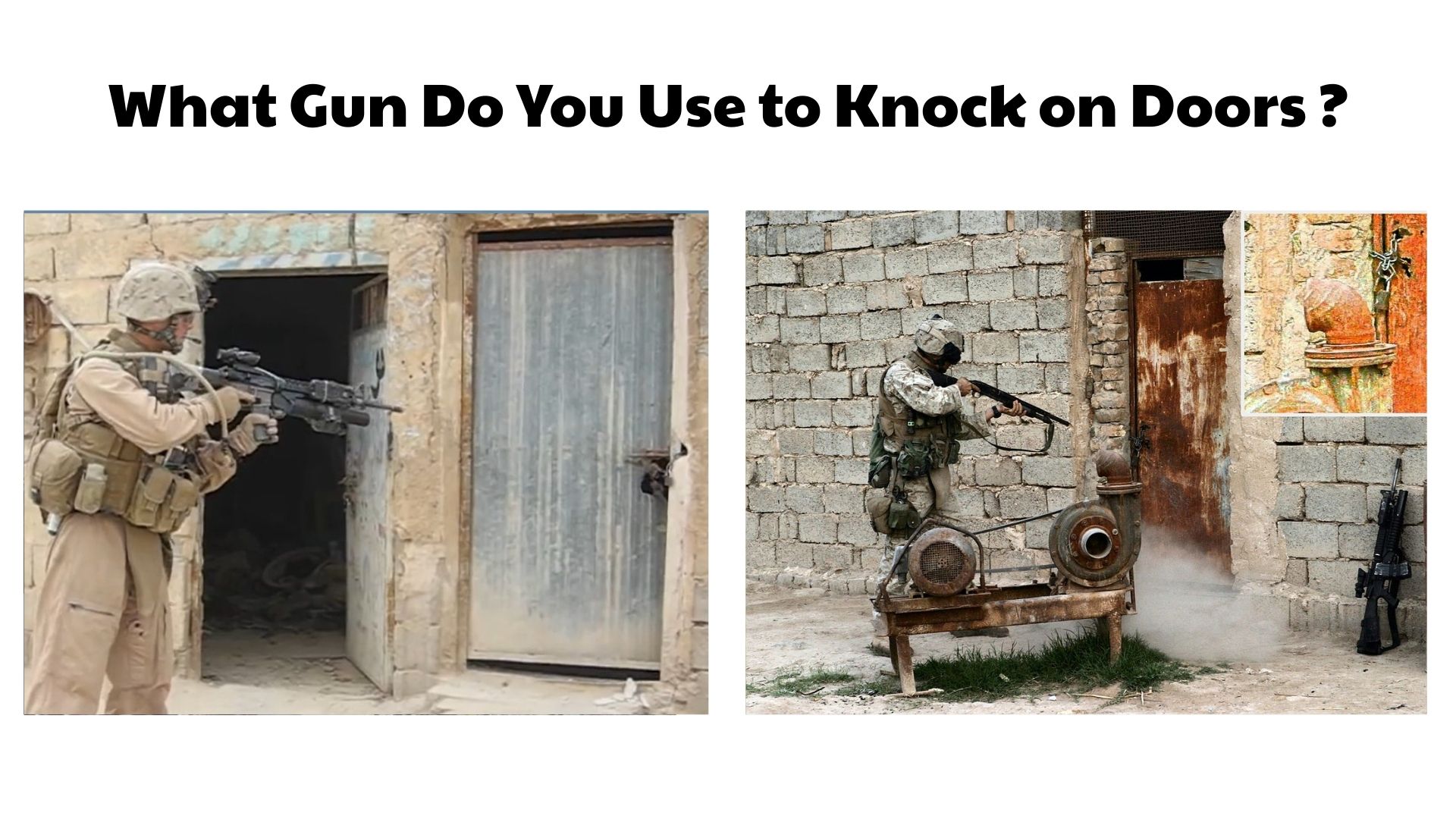
In military and tactical operations, the phrase “knock on doors” often refers to forced entry techniques used by specialized units such as SWAT teams or military breaching teams. Instead of literally knocking, these teams use specialized tools and equipment to open locked or barricaded doors quickly and safely. Among the most widely used tools is the breaching shotgun, a firearm designed specifically for destroying door locks, hinges, and other entry points. Understanding what gun do you use to knock on doors helps explain how modern tactical teams perform controlled entries while minimizing risk to personnel and bystanders.
Most door‑breaching firearms are based on 12‑gauge shotguns that fire specialized breaching rounds. These rounds are designed to disintegrate after striking a lock or hinge, reducing the chance of dangerous ricochets. The goal is not to fire through the door itself but to disable the mechanical components that keep the door closed. Once the locking mechanism fails, the entry team can open the door quickly and move inside. Because speed and reliability are critical in these situations, breaching shotguns are usually compact, durable, and extremely simple to operate.
In this guide, we explore several well‑known breaching firearms that are often discussed when people ask what gun do you use to knock on doors. Each of these shotguns is known for its reliability, compact design, and ability to deliver the precise force required for tactical door entry. While their appearance may vary, they all serve the same purpose: helping trained professionals gain rapid access during controlled operations.
What Gun Do You Use to Knock on Doors ?

1. Remington 870 Tactical Door Breacher Shotgun
The Remington 870 Tactical Door Breacher is one of the most recognizable firearms used in tactical breaching operations, and it frequently appears in discussions about what gun do you use to knock on doors. Built on the legendary Remington 870 pump‑action platform, this shotgun has been trusted for decades by military units, law enforcement agencies, and security professionals. Its reputation for reliability is one of the primary reasons it remains a popular choice for breaching tasks. The design is simple, robust, and capable of functioning under harsh conditions, which is essential for situations where equipment failure is not an option.
The breaching version of the Remington 870 typically includes a shortened barrel and a specialized breaching muzzle device. This muzzle attachment features a toothed or ported design that allows the shotgun to be pressed firmly against the door without causing dangerous pressure buildup in the barrel. When breaching rounds are fired into the lock or hinge, the muzzle device helps control the direction of debris while maintaining a stable firing position. This design ensures that the operator can deliver controlled shots precisely where they are needed to disable the locking mechanism quickly.
Another reason the Remington 870 remains a preferred breaching tool is its pump‑action system. Pump shotguns are known for their mechanical simplicity, which allows them to function reliably with a wide variety of ammunition types, including specialized breaching rounds. Unlike some semi‑automatic shotguns that may require specific loads to cycle properly, the manual action of the 870 ensures consistent performance even in demanding conditions. This reliability is particularly valuable during tactical operations where time is critical and equipment must work flawlessly.
The compact size of the tactical breacher configuration also makes it easy to maneuver in tight environments such as hallways or stairwells. Entry teams often operate in confined spaces, and a shorter shotgun reduces the risk of the weapon catching on obstacles while moving through doorways. Combined with its rugged construction and proven design, the Remington 870 Tactical Door Breacher continues to serve as one of the most dependable answers to the question of what gun do you use to knock on doors.
2. Benelli M4 Entry Breaching Shotgun
The Benelli M4 Entry Breaching Shotgun represents a more modern approach to tactical breaching firearms. Unlike traditional pump‑action shotguns, the M4 uses a semi‑automatic operating system known as the Auto‑Regulating Gas‑Operated (ARGO) system. This mechanism automatically adjusts to different ammunition pressures, allowing the shotgun to cycle reliably with a wide range of loads. Because of this advanced design, the Benelli M4 is often considered one of the most sophisticated shotguns used in tactical environments.
In breaching applications, the Benelli M4 is typically configured with a shortened barrel and a dedicated breaching muzzle device. This setup allows operators to place the muzzle directly against the door’s locking hardware before firing a breaching round. The round is designed to destroy the lock or hinge while minimizing the risk of fragments traveling beyond the immediate impact area. Once the hardware is disabled, the door can be pushed open quickly so the entry team can proceed with their mission.
One advantage of the Benelli M4 is its ability to deliver rapid follow‑up shots if necessary. Because the shotgun operates semi‑automatically, the shooter does not need to manually cycle the action after each shot. While breaching usually requires only one or two well‑placed rounds, the ability to fire quickly can be helpful if additional hardware needs to be disabled. This feature provides a slight speed advantage during certain types of entry operations.
Durability is another major strength of the M4 platform. The shotgun was originally developed to meet demanding military standards, which means it is capable of withstanding heavy use, harsh weather conditions, and repeated recoil from powerful loads. These characteristics make it a dependable tool for tactical teams that require equipment capable of performing consistently in unpredictable environments. For these reasons, the Benelli M4 Entry Breaching Shotgun is often included when discussing what gun do you use to knock on doors.
3. Mossberg 590A1 Tactical Breach Shotgun
The Mossberg 590A1 Tactical Breach Shotgun is another highly respected platform used for forced entry operations. Known for its rugged construction and military‑grade durability, the 590A1 has earned a strong reputation among tactical professionals. It features a heavy‑walled barrel, reinforced internal components, and a design intended to withstand extensive use under demanding conditions. These qualities make it a reliable tool when discussing what gun do you use to knock on doors in professional entry operations.
Like many breaching shotguns, the Mossberg 590A1 is typically equipped with a short barrel and a specialized breaching muzzle device. This attachment allows the shotgun to be pressed firmly against a door’s lock or hinge before firing a breaching round. The purpose of the round is to destroy the mechanical components that keep the door closed rather than penetrate the door itself. By targeting these specific points, breaching teams can open doors quickly while maintaining control over debris and impact energy.
One of the advantages of the Mossberg platform is its intuitive control layout. The safety and action release are positioned in locations that allow quick operation even while wearing gloves or tactical gear. In fast‑paced situations where every second counts, simple and accessible controls can make a noticeable difference. The pump‑action system also ensures reliable cycling regardless of the ammunition type being used.
The 590A1’s reputation for durability extends to its internal components as well. The shotgun was designed to meet strict military testing standards, including resistance to heavy recoil and rough handling. Because breaching operations can place significant stress on equipment, this level of robustness is an important feature. As a result, the Mossberg 590A1 Tactical Breach Shotgun remains a common example when explaining what gun do you use to knock on doors in tactical scenarios.
4. Knight’s Armament Masterkey Under‑Barrel Breaching Shotgun
The Knight’s Armament Masterkey is a unique breaching system that differs from traditional standalone shotguns. Instead of being carried separately, the Masterkey is designed to attach beneath a rifle as an under‑barrel breaching shotgun. This configuration allows operators to transition instantly between their primary firearm and the breaching tool without switching weapons. Because of this versatility, the Masterkey has become an interesting solution in discussions about what gun do you use to knock on doors.
The Masterkey typically uses a shortened pump‑action shotgun mechanism mounted beneath a rifle platform. When a breaching task is required, the operator simply switches to the under‑barrel shotgun and fires a breaching round into the lock or hinge. Once the door is opened, the operator can immediately return to using the primary rifle without changing equipment. This design allows for rapid transitions during dynamic entry situations.
Although the Masterkey system is compact, it still delivers the power of a standard 12‑gauge breaching round. The specialized ammunition is designed to break apart after impacting the door hardware, reducing the risk of dangerous fragments traveling beyond the target area. This controlled energy transfer is essential for maintaining safety during close‑range breaching operations.
The innovative design of the Masterkey demonstrates how breaching tools can be integrated directly into tactical weapon systems. While standalone breaching shotguns remain common, integrated systems like the Masterkey provide additional flexibility for certain operational scenarios. Because of this distinctive approach, the Knight’s Armament Masterkey is often referenced when discussing what gun do you use to knock on doors in modern tactical environments.
5. Serbu Super‑Shorty Compact Breacher Shotgun
The Serbu Super‑Shorty is one of the most compact breaching shotguns ever produced, and its small size makes it particularly interesting in discussions about what gun do you use to knock on doors. Based on shortened versions of pump‑action shotgun platforms, the Super‑Shorty features an extremely short barrel and minimal stock configuration. This design allows it to be carried easily by tactical teams while still delivering the power required for breaching operations.
Because of its compact dimensions, the Super‑Shorty is often used as a dedicated breaching tool rather than a primary firearm. Tactical teams may carry it specifically for opening doors or disabling locks before switching back to their main weapons. The shortened barrel allows the operator to maneuver easily in tight spaces such as hallways, stairwells, or narrow entry points where larger shotguns might be difficult to handle.
Despite its small size, the Super‑Shorty is capable of firing standard 12‑gauge breaching rounds. These rounds are designed to shatter locks and hinges while minimizing the risk of dangerous ricochet. When used correctly, the shotgun can disable a door’s locking mechanism quickly, allowing the entry team to proceed through the doorway almost immediately.
The simplicity of the pump‑action design also contributes to the Super‑Shorty’s reliability. With fewer moving parts and a straightforward operating mechanism, the shotgun can function consistently even in demanding conditions. While it may look unconventional compared with full‑size breaching shotguns, its effectiveness as a compact breaching tool ensures it remains part of the conversation when people ask what gun do you use to knock on doors.
6. Benelli M3 Super 90 Tactical Entry Shotgun
The Benelli M3 Super 90 Tactical Entry Shotgun represents an interesting hybrid design that combines the advantages of both pump‑action and semi‑automatic operation. This dual‑mode capability allows operators to switch between firing modes depending on the type of ammunition being used. In discussions about what gun do you use to knock on doors, the M3 is often mentioned because this flexibility makes it suitable for specialized breaching situations where reliability and adaptability are essential.
In semi‑automatic mode, the shotgun cycles automatically after each shot using a recoil‑driven system, which allows rapid follow‑up shots if necessary. However, when using specialized breaching rounds or low‑pressure loads, operators can switch the shotgun into pump‑action mode. This ensures consistent cycling regardless of the ammunition characteristics. The ability to change operating modes provides a level of versatility that many tactical teams appreciate when working in unpredictable environments.
The M3 Entry version typically features a compact barrel and a breaching muzzle device designed to stabilize the shotgun against a door before firing. This attachment allows the operator to place the muzzle directly against the lock or hinge and deliver a controlled shot that destroys the mechanical hardware holding the door closed. Once the locking mechanism fails, the entry team can open the door and proceed with their mission quickly.
Durability is another hallmark of the Benelli M3 platform. The shotgun is built with high‑strength materials that allow it to withstand repeated recoil and heavy use. Tactical environments can place significant stress on equipment, and the M3’s rugged design ensures reliable performance even after extensive operation. Because of its versatility and proven reliability, the Benelli M3 Super 90 Tactical Entry Shotgun remains a notable example when answering the question what gun do you use to knock on doors.
7. Remington 870 Modular Combat Breacher
The Remington 870 Modular Combat Breacher builds upon the proven foundation of the classic Remington 870 platform while incorporating modern tactical features designed specifically for breaching operations. When professionals discuss what gun do you use to knock on doors, variations of the Remington 870 often appear near the top of the list due to their reliability, simplicity, and widespread availability.
The modular breacher configuration includes a shortened barrel, reinforced internal components, and a dedicated breaching muzzle attachment. This device typically features serrated or ported edges that allow the shotgun to be pressed against a door without sealing the barrel completely. Maintaining this small gap prevents pressure from building dangerously inside the barrel while still allowing the breaching round to strike the lock or hinge with maximum effectiveness.
One of the strengths of the modular design is the ability to customize the shotgun for different operational requirements. Tactical teams can adjust stock configurations, mounting systems, and accessory options to suit their needs. Some setups may include tactical lights or sling systems that help operators maneuver more efficiently during entry operations. The flexibility of the platform allows it to remain relevant even as tactical equipment evolves.
Like other pump‑action shotguns, the Remington 870 Modular Combat Breacher is valued for its mechanical simplicity. The manual cycling system ensures reliable operation with a wide range of ammunition types, including specialized breaching rounds designed to break apart after impact. Because reliability is critical during forced entry situations, this straightforward operating system remains one of the key reasons the 870 platform continues to appear in discussions about what gun do you use to knock on doors.
8. Mossberg 590 Shockwave Door Entry Shotgun
The Mossberg 590 Shockwave is a compact firearm derived from the Mossberg 590 shotgun platform, and it has gained attention for its extremely short and maneuverable design. Although it differs from traditional full‑stock shotguns, its compact size allows it to function effectively as a breaching tool in certain tactical contexts. When discussing what gun do you use to knock on doors, the Shockwave often appears as an example of how compact breaching firearms can provide both mobility and power.
The Shockwave’s design includes a short barrel and a distinctive bird’s‑head grip rather than a traditional shoulder stock. This configuration allows the firearm to remain very compact, making it easier to maneuver in confined spaces such as hallways or stairwells. For breaching tasks that require close‑range engagement with door hardware, this compact size can be advantageous.
Like other breaching shotguns, the Mossberg 590 Shockwave can be equipped with a specialized breaching muzzle device that helps direct the energy of the shot into the lock or hinge. The purpose of the breaching round is not to penetrate the entire door but rather to destroy the mechanical components that keep it closed. Once those components fail, the door can be opened quickly so that the entry team can proceed.
Despite its smaller size, the Shockwave retains the durability and reliability associated with the Mossberg 590 series. The pump‑action system ensures dependable cycling with various ammunition types, while the strong internal components allow the firearm to withstand repeated recoil. These characteristics make the Shockwave another interesting option when exploring what gun do you use to knock on doors in specialized entry situations.
9. Hawk Industries Type 97 Tactical Breach Shotgun
The Hawk Industries Type 97 Tactical Breach Shotgun represents a modern pump‑action design that has gained recognition in various international tactical markets. Built with durability and practical performance in mind, the Type 97 is often configured specifically for breaching applications. As a result, it occasionally appears in discussions addressing what gun do you use to knock on doors during forced entry operations.
The Type 97 typically includes a shortened barrel and a dedicated breaching muzzle attachment similar to those found on other breaching shotguns. This design allows operators to position the muzzle directly against the door hardware before firing a breaching round. The round’s purpose is to destroy the locking mechanism rather than penetrate the door itself, ensuring that the door can be opened quickly once the hardware fails.
One advantage of the Type 97 is its straightforward pump‑action mechanism, which is known for reliable operation across different ammunition types. Breaching rounds can vary slightly in pressure compared with standard shotgun shells, so having a manually operated action helps ensure consistent performance. This reliability is especially important during high‑stress situations where equipment must function without hesitation.
The shotgun’s design also emphasizes rugged construction and ease of maintenance. Tactical teams often operate in environments where equipment may be exposed to dust, moisture, or rough handling. The Type 97’s robust design helps ensure it can continue functioning under these conditions. Because of these qualities, it is sometimes referenced when exploring what gun do you use to knock on doors in professional breaching scenarios.
10. Kel‑Tec KSG Tactical Breaching Shotgun
The Kel‑Tec KSG Tactical Breaching Shotgun stands out due to its bullpup configuration, which places the action and magazine system behind the trigger. This layout allows the shotgun to maintain a full‑length barrel while keeping the overall firearm relatively compact. In conversations about what gun do you use to knock on doors, the KSG occasionally appears as an example of how modern shotgun designs can combine compact size with significant firepower.
One of the most distinctive features of the KSG is its dual‑tube magazine system. This design allows the shotgun to carry multiple shells in two separate magazine tubes, which can be selected by the operator. While breaching tasks usually require only a small number of rounds, the additional capacity can be useful in situations where the shotgun may need to serve multiple roles during an operation.
The bullpup design also helps keep the firearm compact without sacrificing barrel length. This allows the KSG to remain maneuverable in confined spaces while still delivering the power expected from a 12‑gauge shotgun. When configured for breaching, the shotgun may include a specialized muzzle device that helps direct the energy of the breaching round into the lock or hinge.
Like other breaching shotguns, the KSG relies on carefully controlled ammunition designed to break apart upon impact with door hardware. This reduces the risk of dangerous fragments traveling beyond the target area. With its distinctive design, strong construction, and compact profile, the Kel‑Tec KSG demonstrates another approach to answering the question what gun do you use to knock on doors in modern tactical equipment discussions.
11. Franchi SPAS‑12 Tactical Breaching Shotgun
The Franchi SPAS‑12 is one of the most recognizable combat shotguns ever produced, known for its distinctive design and dual‑mode firing capability. Originally developed in Italy for military and law enforcement applications, the SPAS‑12 gained a reputation as a versatile tactical shotgun capable of handling multiple operational roles. Because of this flexibility, it occasionally appears in discussions about what gun do you use to knock on doors, particularly when exploring historical or multi‑purpose breaching firearms.
One of the defining features of the SPAS‑12 is its ability to operate in both semi‑automatic and pump‑action modes. This dual system allows operators to switch firing methods depending on the type of ammunition being used. Semi‑automatic operation is typically used for standard loads, while pump‑action mode can be employed when using specialized shells that may not cycle reliably in semi‑automatic systems. In breaching scenarios, this flexibility can help ensure that specialized rounds function consistently.
When configured for door breaching, the SPAS‑12 can be equipped with a shortened barrel and a specialized breaching muzzle attachment. This device allows the operator to press the shotgun against a door’s locking mechanism while maintaining a small gap that prevents dangerous pressure buildup. When the breaching round is fired, the energy is directed into the lock or hinge, destroying the mechanical hardware that keeps the door closed.
Although newer shotgun designs have entered the tactical market, the SPAS‑12 remains an iconic example of a multi‑purpose combat shotgun. Its hybrid operating system and rugged construction demonstrate how tactical firearms evolved to support specialized tasks such as breaching. Because of these characteristics, the Franchi SPAS‑12 continues to be mentioned when discussing what gun do you use to knock on doors in both historical and technical contexts.
12. Ithaca Model 37 Stakeout Breacher Shotgun
The Ithaca Model 37 Stakeout is a compact version of the classic Ithaca Model 37 pump‑action shotgun, a firearm known for its reliability and smooth operating mechanism. With roots dating back to the 1930s, the Model 37 has served law enforcement agencies and security professionals for decades. Its compact Stakeout configuration makes it particularly interesting when examining what gun do you use to knock on doors in close‑quarters environments.
One of the defining characteristics of the Ithaca Model 37 is its bottom‑ejection design. Unlike most shotguns that eject spent shells from the side, the Model 37 ejects them downward through the same port used for loading. This feature reduces the chance of empty shells interfering with nearby equipment or striking adjacent team members during tight tactical operations. In confined environments such as hallways or staircases, this design can provide a practical advantage.
The Stakeout configuration typically includes a shortened barrel and compact grip design, making the shotgun easier to maneuver in restricted spaces. When used for breaching tasks, operators may equip the firearm with a breaching muzzle device that stabilizes the shotgun against the door before firing. The breaching round is aimed directly at the lock or hinge, where its controlled energy can quickly disable the hardware holding the door closed.
The simplicity of the pump‑action system also contributes to the shotgun’s reliability. Because the action is manually cycled by the operator, it can function effectively with a wide range of ammunition types, including specialized breaching rounds. These characteristics help explain why the Ithaca Model 37 Stakeout continues to appear in discussions about what gun do you use to knock on doors when compact and dependable breaching tools are considered.
13. Winchester 1300 Defender Tactical Breacher
The Winchester 1300 Defender Tactical Breacher is another pump‑action shotgun platform that has been used in various tactical roles. Known for its fast‑cycling action and durable construction, the Model 1300 gained popularity among law enforcement agencies and civilian shooters alike. In discussions surrounding what gun do you use to knock on doors, the 1300 Defender sometimes appears as a reliable option for breaching tasks.
One of the defining features of the Winchester 1300 is its rotating bolt system, which allows the action to unlock quickly after firing. This mechanism contributes to the shotgun’s reputation for smooth and rapid cycling, sometimes referred to as a “speed pump” design. In tactical situations where quick follow‑up shots may be required, this fast operation can provide an advantage.
For breaching operations, the 1300 Defender may be fitted with a shortened barrel and a dedicated breaching muzzle attachment. This configuration allows operators to place the shotgun directly against a door’s locking hardware before firing a specialized breaching round. The round is designed to shatter locks or hinges while minimizing the risk of fragments traveling beyond the target area.
The pump‑action design ensures reliable performance across a variety of ammunition types, including low‑pressure breaching rounds. Combined with its rugged construction and smooth action, the Winchester 1300 Defender Tactical Breacher offers another practical example when examining what gun do you use to knock on doors in forced entry scenarios.
14. Beretta 1301 Tactical Entry Shotgun
The Beretta 1301 Tactical Entry Shotgun represents a modern semi‑automatic shotgun platform designed with professional users in mind. Known for its fast cycling speed and lightweight construction, the 1301 Tactical has become increasingly popular among law enforcement and tactical teams. Because of these qualities, it is sometimes included when exploring what gun do you use to knock on doors in modern tactical equipment discussions.
The shotgun operates using Beretta’s gas‑operated system, which allows it to cycle extremely quickly while maintaining reliable performance. This system helps manage recoil and ensures that the shotgun can function consistently even during rapid firing. Although breaching operations typically require only one or two shots, the ability to deliver quick follow‑up rounds can be beneficial if additional door hardware needs to be disabled.
When configured for breaching tasks, the Beretta 1301 may include a shortened barrel and a specialized breaching muzzle device. This attachment allows the operator to stabilize the shotgun against the door while directing the energy of the breaching round into the lock or hinge. Once the mechanical hardware fails, the door can be opened quickly to allow the entry team to move inside.
The 1301 Tactical also emphasizes ergonomic design and modern materials that help reduce overall weight without sacrificing durability. In fast‑moving operations where mobility is important, lighter equipment can help reduce fatigue while maintaining effectiveness. These characteristics make the Beretta 1301 Tactical Entry Shotgun another example often mentioned when answering what gun do you use to knock on doors.
15. Saiga‑12 Tactical Breaching Shotgun
The Saiga‑12 Tactical Shotgun offers a unique approach to shotgun design by using a magazine‑fed system based on the well‑known AK‑style rifle platform. Developed in Russia, the Saiga‑12 gained attention for combining the reliability of the AK operating system with the power of a 12‑gauge shotgun. Because of its distinctive design and high capacity, it sometimes appears in conversations about what gun do you use to knock on doors.
Unlike traditional tube‑fed shotguns, the Saiga‑12 uses detachable box magazines to store ammunition. This system allows operators to reload quickly by inserting a fresh magazine rather than loading shells individually into a tube. Although breaching tasks typically require only a few rounds, the ability to carry multiple loaded magazines can provide additional flexibility during extended operations.
When adapted for breaching purposes, the Saiga‑12 can be equipped with a breaching muzzle device that directs the energy of specialized breaching rounds into the door hardware. These rounds are engineered to break apart upon impact with the lock or hinge, preventing excessive penetration and reducing the risk of dangerous ricochets.
The gas‑operated system of the Saiga‑12 allows it to cycle automatically after each shot, providing quick follow‑up capability if necessary. Combined with the robust AK‑style construction, this design helps ensure reliability even under challenging conditions. Because of these characteristics, the Saiga‑12 Tactical Shotgun offers another interesting perspective when discussing what gun do you use to knock on doors in modern tactical scenarios.
Conclusion

Understanding what gun do you use to knock on doors requires looking beyond the phrase itself and examining the specialized tools used in professional breaching operations. In military and law‑enforcement environments, “knocking on doors” is a practical shorthand for controlled forced entry. Rather than damaging an entire door or using uncontrolled force, trained breaching teams target the small mechanical components—locks, latches, and hinges—that hold the door closed. A properly configured breaching shotgun allows operators to disable these components quickly, giving entry teams fast access while maintaining a high level of control and safety.
Most firearms used for this role are compact 12‑gauge shotguns equipped with dedicated breaching muzzle devices and specialized breaching rounds. These rounds are engineered to break apart on impact, transferring energy into the locking hardware without producing dangerous over‑penetration. Throughout this guide, we explored a variety of platforms that have been associated with breaching roles, including pump‑action designs such as the Remington 870 and Mossberg 590A1, semi‑automatic systems like the Benelli M4 and Beretta 1301, and unique configurations such as the Kel‑Tec KSG or Knight’s Armament Masterkey. Despite their different designs, all of these firearms share the same core purpose: delivering controlled force exactly where it is needed.
Another key takeaway is that the firearm itself is only one part of a breaching system. Proper training, correct ammunition, and disciplined entry procedures are equally important. Tactical teams train extensively to ensure that each shot is placed accurately on the door hardware and that all personnel maintain safe positioning during the breach. The objective is always speed combined with precision, allowing the entry team to move through the doorway efficiently while minimizing unnecessary damage or risk.
In simple terms, when people ask what gun do you use to knock on doors, they are usually referring to a breaching shotgun specifically designed for tactical entry tasks. These specialized firearms have evolved over decades of operational experience, resulting in tools that are compact, reliable, and purpose‑built for controlled forced entry. While the exact model may vary depending on the unit and mission requirements, the principle remains the same: a well‑designed breaching shotgun helps professionals open locked doors quickly, safely, and effectively.
Frequently Asked Questions (FAQ) About What Gun Do You Use to Knock on Doors
1. What gun do you use to knock on doors?
In tactical and military terminology, “knocking on doors” usually refers to forced entry using specialized breaching tools. The most common firearm used for this purpose is a 12‑gauge breaching shotgun designed to destroy locks and hinges so the door can be opened quickly.
2. Why are shotguns used for door breaching?
Shotguns are used because they deliver powerful energy at close range. When combined with specialized breaching rounds, they can quickly destroy door hardware without excessive penetration beyond the target area.
3. What is a breaching shotgun?
A breaching shotgun is a firearm configured specifically for forced entry tasks. It usually features a short barrel, a breaching muzzle device, and ammunition designed to break locks or hinges safely.
4. What ammunition is used for breaching doors?
Specialized breaching rounds are used. These rounds are designed to disintegrate after striking door hardware, reducing the risk of ricochet or dangerous fragments.
5. Do breaching shotguns shoot through the entire door?
No. The goal is not to destroy the entire door but to disable the lock or hinge that keeps it closed. Once those components break, the door can be opened quickly.
6. Why do breaching shotguns have special muzzle attachments?
Breaching muzzle devices allow the shotgun to be pressed against the door while maintaining a small gap that prevents dangerous pressure buildup in the barrel.
7. What gauge shotgun is most commonly used for breaching?
The 12‑gauge shotgun is the most commonly used platform because it provides the necessary power while remaining widely available and reliable.
8. Are pump‑action or semi‑automatic shotguns better for breaching?
Both can be used effectively. Pump‑action shotguns are valued for their reliability with different ammunition types, while semi‑automatic shotguns offer faster follow‑up shots.
9. What is the purpose of door breaching in tactical operations?
Door breaching allows tactical teams to gain quick access to buildings or rooms during operations where speed and surprise are important.
10. Do military and police use the same breaching shotguns?
Often yes. Many models such as the Remington 870 or Mossberg 590 series are used by both military units and law enforcement teams around the world.
11. Can a regular shotgun be used for breaching?
While a standard shotgun could technically break door hardware, breaching shotguns include specialized features that improve safety and effectiveness.
12. Why are breaching shotguns usually short?
Shorter barrels make the firearm easier to maneuver in tight spaces such as hallways, staircases, and doorways during close‑quarters operations.
13. What is the “stand‑off” device on a breaching shotgun?
A stand‑off device is the serrated muzzle attachment that stabilizes the shotgun against the door and allows gases to escape safely during the shot.
14. Are breaching rounds dangerous to people behind the door?
Breaching rounds are designed to minimize penetration, but safety procedures are still critical because fragments and debris can still pose risks.
15. Why do tactical teams train specifically for breaching?
Proper training ensures that operators place shots accurately on door hardware and maintain safe positioning during the entry process.
16. What parts of a door are targeted during breaching?
The most common targets are locks, latches, hinges, or deadbolts that keep the door secured.
17. What happens after the lock is destroyed?
Once the locking mechanism fails, the door can usually be pushed or kicked open so the entry team can move inside.
18. Do breaching shotguns replace other breaching tools?
No. Tactical teams may also use tools such as battering rams, hydraulic spreaders, or explosive charges depending on the situation.
19. Are breaching shotguns only used by military units?
No. Law enforcement tactical teams and specialized security units also use breaching shotguns for controlled entry operations.
20. How far away is the shotgun fired during breaching?
Breaching shots are usually fired at extremely close range, often with the muzzle placed directly against the door hardware.
21. What safety precautions are taken during breaching?
Operators ensure proper positioning, wear protective equipment, and coordinate carefully so no team members are exposed to debris or blast effects.
22. Can breaching shotguns be used for other tasks?
Some breaching shotguns can also be used for general defensive purposes, but many are dedicated tools carried specifically for entry operations.
23. Why do some breaching shotguns have pistol grips?
Pistol grips allow the shotgun to remain compact and easier to control when used in tight spaces.
24. What is the difference between breaching rounds and normal shotgun shells?
Breaching rounds are designed to break apart on impact, while standard shells are designed for hunting, defense, or other purposes.
25. Are breaching shotguns heavy?
Most breaching shotguns are relatively lightweight because they are carried as secondary tools during tactical operations.
26. Why do some breaching shotguns attach under rifles?
Under‑barrel breaching shotguns allow operators to switch quickly between their primary weapon and the breaching tool without carrying two separate firearms.
27. Is breaching always done with firearms?
No. Depending on the situation, teams may use mechanical tools or explosives instead of shotguns.
28. What is explosive breaching?
Explosive breaching uses small controlled charges placed on doors or walls to create an entry point.
29. Why is speed important during breaching?
Quick entry can provide a tactical advantage and reduce the time opponents have to react.
30. What training is required to use breaching shotguns?
Operators receive specialized instruction in firearm handling, breaching techniques, and team coordination.
31. Do breaching shotguns require special maintenance?
They require the same regular cleaning and inspection as other shotguns, especially because breaching rounds can produce debris.
32. What materials can breaching shotguns break?
They are typically used on wooden doors, locks, and hinges but may also work on certain metal hardware depending on the round used.
33. Are breaching shotguns loud?
Yes. Like other firearms, they produce a loud report, which is why hearing protection is often used during training.
34. Do breaching shotguns have recoil?
Yes. Shotguns produce noticeable recoil, although breaching rounds are sometimes designed to reduce recoil slightly.
35. Why do teams sometimes carry multiple breaching tools?
Different tools are effective for different door types, so teams may carry several options for flexibility.
36. What is mechanical breaching?
Mechanical breaching uses tools such as rams, crowbars, or bolt cutters to open doors without firearms.
37. Is breaching dangerous?
Breaching carries risks, which is why it is performed only by trained professionals following strict safety procedures.
38. How long does a breaching operation take?
The actual breaching shot may take only seconds, but preparation and coordination can take longer.
39. Why is the shotgun aimed at the hinge sometimes?
If the hinge is accessible, destroying it can cause the door to detach or swing open more easily.
40. Can breaching damage surrounding structures?
Yes, but controlled breaching techniques aim to minimize unnecessary structural damage.
41. What does “dynamic entry” mean?
Dynamic entry refers to a fast and coordinated entry technique used by tactical teams during high‑risk operations.
42. Are breaching shotguns used in rescue missions?
Yes, they can be used to quickly open doors during hostage rescue or emergency response operations.
43. Why are breaching rounds often made from powdered metal?
Powdered metal fragments easily on impact, transferring energy into the lock while reducing dangerous ricochet.
44. Can breaching shotguns open reinforced doors?
They can damage certain types of door hardware, but heavily reinforced doors may require other breaching methods.
45. Do breaching shotguns require special licenses?
Regulations vary by country and jurisdiction, and they are generally restricted to authorized military or law enforcement personnel.
46. What makes a breaching shotgun reliable?
Simple mechanical design, durable construction, and compatibility with specialized breaching ammunition contribute to reliability.
47. How many shots are usually needed to breach a door?
Often only one or two well‑placed shots are required if the lock or hinge is targeted correctly.
48. Why do teams sometimes shoot multiple hinges?
If a door has several strong hinges, disabling more than one may make it easier to open quickly.
49. Are breaching shotguns widely used around the world?
Yes. Many military and law enforcement agencies worldwide use similar breaching shotgun concepts.
50. Is a breaching shotgun considered a primary weapon?
Usually not. It is typically carried as a specialized secondary tool for entry tasks.
51. Why is communication important during breaching?
Clear communication ensures all team members know when the breach will occur and can position themselves safely for entry.
52. What is the main advantage of shotgun breaching?
The main advantage is fast, controlled entry using a compact and reliable tool that can disable door hardware within seconds.
Read more: What Gun Do You Use to Knock Over Objects ? Top Training & Tactical Options