
When it comes to elite military operations, Navy SEALs are renowned for their tactical precision, physical endurance, and cutting-edge weaponry. Their success hinges not only on rigorous training but also on the sophisticated firearms they employ. So, what guns do Navy SEALS use? From close-quarters combat to covert infiltration, the weapons utilized by SEALs are specifically chosen to serve a variety of mission profiles. This comprehensive guide aims to explore the most iconic firearms in the SEAL arsenal, their functionalities, and the strategic reasoning behind these choices, providing a detailed look into the firearm technology that powers one of the world’s most elite military units.
The Core Rifle Arsenal of Navy SEALs: Precision and Versatility in Combat
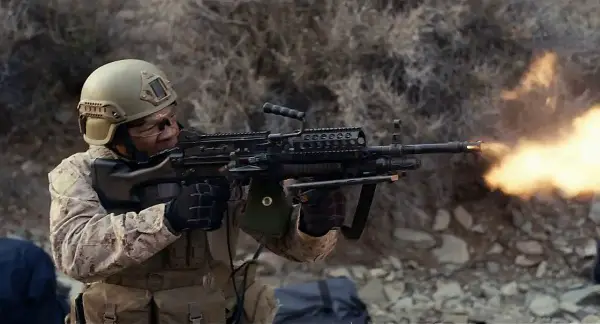
Navy SEALs rely heavily on their rifles to execute missions—be it hostage rescue, reconnaissance, or direct action. Their rifle choices emphasize versatility, accuracy, and adaptability to different battlefield conditions. The primary rifle used by SEALs is the M4A1 Carbine, a weapon renowned for its modular design and reliability.
The M4A1 Carbine – The Standard Issue for SEAL Operators
The M4A1 is an evolution of the legendary M16 family, optimized for tactical adaptability and close-quarters combat scenarios. Its popularity among SEALs stems from its lightweight construction, customizable features, and ability to fire in fully automatic mode. SEAL operators often modify their M4A1s with attachments that enhance targeting, stability, and operational utility.
The M4A1’s versatility allows for numerous configurations — from mounted optics and flashlight attachments for night operations to silencers for covert missions. The key strength of this firearm is its adaptability to dynamic combat environments, whether underwater, mountain terrain, or urban settings.
Technical specifications of the M4A1 include:
| Feature | Specification |
|---|---|
| Caliber | 5.56x45mm NATO |
| Fire Modes | Semi-automatic, Fully automatic |
| Effective Range | 500 meters |
| Muzzle Velocity | 915 m/s |
| Weight (unloaded) | 3.5 kg |
| Magazine Capacity | 30 rounds |
The M4A1’s user-friendly design, combined with its customizable nature, makes it a cornerstone of the SEAL arsenal. Its ability to be fitted with grenade launchers, laser sights, and suppressors adds tactical flexibility, which is essential for complex missions.
The MK18 CQBR – An Ideal Compact Rifle for Special Operations
While the M4A1 is the primary workhorse, Navy SEALs also frequently deploy the MK18 CQBR, a shorter variant of the M4 designed explicitly for close-quarters combat and urban warfare. Its shorter length makes it more maneuverable in tight spaces, a critical advantage during hostage rescues or stealth infiltration.
The MK18 brings the same core functionalities as the M4A1 but with a 10.3-inch barrel, considerably reducing its overall length. Its modularity allows operators to quickly adapt to different mission needs by swapping out attachments.
Features include:
- Increased maneuverability in confined spaces
- Enhanced control during rapid fire
- Compatible with various accessories, such as holographic sights and vertical grips
The compact design of the MK18 means it can be easily concealed and wielded with precision, providing SEALs with an indispensable tool for urban and special operations.
Sniper and Precision Rifles: Long-Range Engagements and Reconnaissance
While SEALs are often associated with fast-paced, close-quarters combat, their missions also demand precise long-range shooting capabilities. To this end, SEAL teams employ specialized sniper rifles for reconnaissance, overwatch, and eliminations.
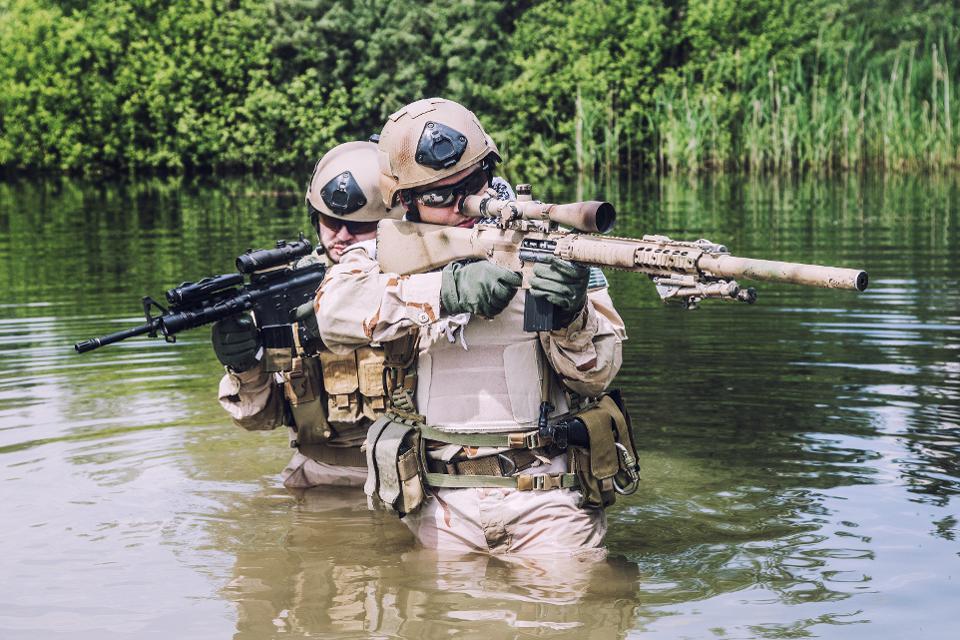
The McMillan TAC-338 and Mk 13 Mod 7 are among the sniper rifles used by SEALs, paired with high-powered scopes for pinpoint accuracy. These rifles enable operators to engage targets at 1,000 meters and beyond, critical for missions requiring stealth and precision.
The Role of Precision Rifles in SEAL Missions
These sniper rifles form an essential part of the team’s arsenal, especially during reconnaissance or when removing threats before entering a hot zone. Accuracy at long ranges minimizes collateral damage and allows SEALs to maintain a tactical advantage while remaining concealed.
Operators often customize these rifles with suppressors, advanced optics, and specialized ammunition to maximize their effectiveness. Due to the dynamic nature of SEAL missions, these precision firearms are as integral as their assault rifles.
Sidearms and Secondary Weapons – The Backup Firepower
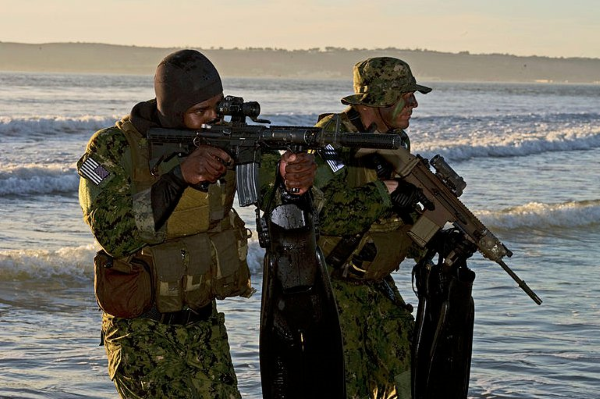
While rifles form the backbone of SEAL operations, sidearms are crucial for close combat or when rifles cannot be easily utilized. The standard-issue sidearm for Navy SEALs is the Glock 19.
Glock 19 – Reliability and Ease of Use in Combat
The Glock 19 is favored for its compact size, durability, and ease of maintenance. During high-stress situations, quick access to a reliable sidearm can be the difference between mission success and failure.
Its polymer frame makes it lightweight, reducing fatigue during extended operations, and its simple design allows for quick cleaning and repair in field conditions. Additionally, the Glock 19 supports a high magazine capacity for a firearm of its size, which is vital during prolonged engagements.
Features of the Glock 19 include:
- Caliber: 9mm
- Magazine Capacity: Up to 15 rounds
- Reliability: Known to operate flawlessly under extreme conditions
- Easy customization: Night sights, trigger enhancement, and silencers
The importance of a dependable sidearm cannot be overstated, especially when the primary weapon is temporarily unavailable or inaccessible.
Secondary Weapons and Accessories
In addition to the Glock 19, SEALs sometimes carry secondary weapons such as tactical shotguns or specialized firearms depending on mission requirements. Accessory gear like tactical lights, laser sights, and suppressors is frequently used on sidearms to aid in low-light conditions.
Having a versatile secondary weapon setup ensures that SEALs are prepared for any contingency, and their choice of sidearm exemplifies the importance placed on reliability, ease of use, and swift accessibility.
Supporting Weapons, Explosive Devices, and Vehicle Integration
Beyond their primary firearms, Navy SEALs utilize a range of support weapons, explosive devices, and integrations with vehicles that augment their capabilities and expand their tactical options.
Supporting Firearms and Heavy Weapons
Although SEALs are not typically equipped with heavy machine guns, they occasionally deploy lightweight machine guns and grenade launchers, such as the M249 SAW or the M203 grenade launcher attached to their primary rifles. These provide suppressive fire and explosive options, providing tactical advantage during assault or defensive operations.
Explosive Devices and Demolitions
Specialized Demolition kits and explosives like C4, claymore mines, and detonation charges are kept on hand for sabotage, breaching, or disabling enemy equipment. The ability to swiftly disable infrastructure or deny enemy access is crucial for covert and stealth operations.
Vehicle and Maritime Integration
SEALs often operate from specialized boats, submarines, or fast-moving land vehicles that are equipped with mounts and stabilization systems for mounted weapons like machine guns and grenade launchers. This integration allows rapid movement and firepower delivery during assault phases or extraction.
Final Thoughts: The Intersection of Technology and Tactics

The question of what guns do navy seals use opens up a window into the sophisticated blend of firearm technology, tactical necessity, and mission-specific customization. From the standard M4A1 Carbine to precision sniper rifles and reliable sidearms, each weapon is chosen and adapted based on precise operational roles. The Navy SEALs’ arsenal is a reflection of their multifaceted mission profiles—requiring agility, accuracy, and resilience under extreme conditions.
These weapons are more than just tools; they are extensions of the operator’s skill and adaptability, enabling Navy SEALs to perform complex and dangerous missions successfully. They integrate cutting-edge technology with tactical excellence, securing the reputation of the SEAL teams as some of the most formidable warriors in the world.
Conclusion
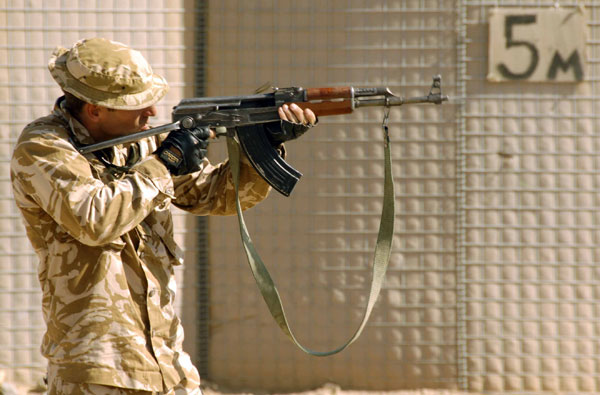
Understanding what guns do Navy SEALs use provides valuable insight into the advanced weaponry that underpins their operations. From the lightweight, customizable M4A1 to long-range precision rifles, sidearms, and support systems, each piece of equipment plays a strategic role in ensuring mission success. These firearms, complemented by specialized gear and tactical support, exemplify the SEALs’ commitment to technological superiority and operational excellence. Their weapon choices underscore a core principle: adaptability and precision are vital when operating at the highest levels of special warfare.