
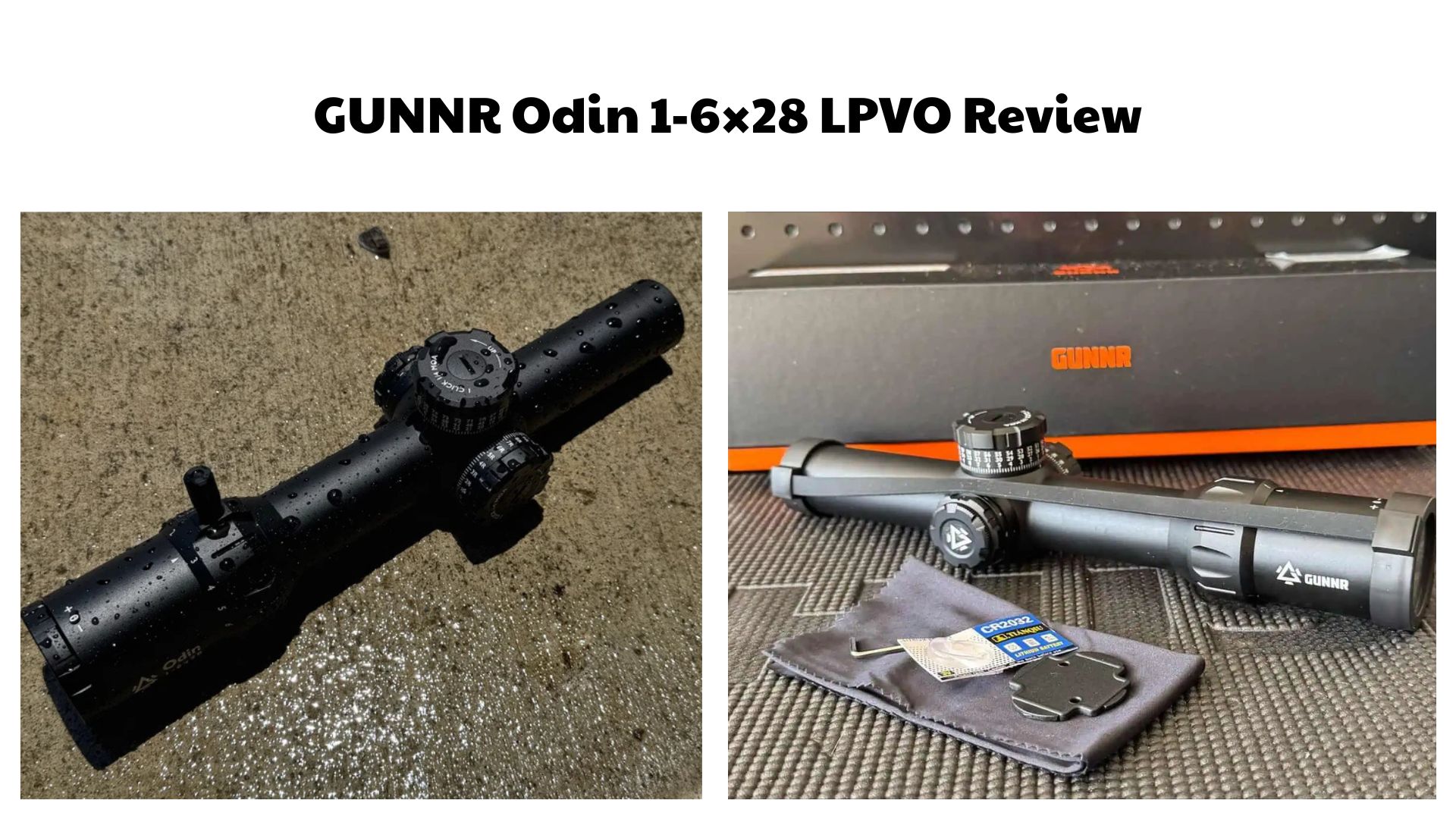

The GUNNR Odin 1-6×28 LPVO is a budget-friendly first focal plane rifle scope designed for AR-15s, general-purpose carbines, range rifles, and practical shooting setups. In this GUNNR Odin 1-6×28 LPVO Review, we will cover its specifications, build quality, glass clarity, reticle, illumination, turrets, mounting system, recoil handling, best use cases, limitations, comparisons, accessories, maintenance, and final verdict. The Odin stands out because it offers German Schott ED glass, a 34mm tube, first focal plane reticle, IP67 protection, and an included mount at a price that is far below many premium LPVOs. It is not perfect, especially at 1x illumination brightness, but it gives budget shooters a serious feature list for the money.
Quick Verdict
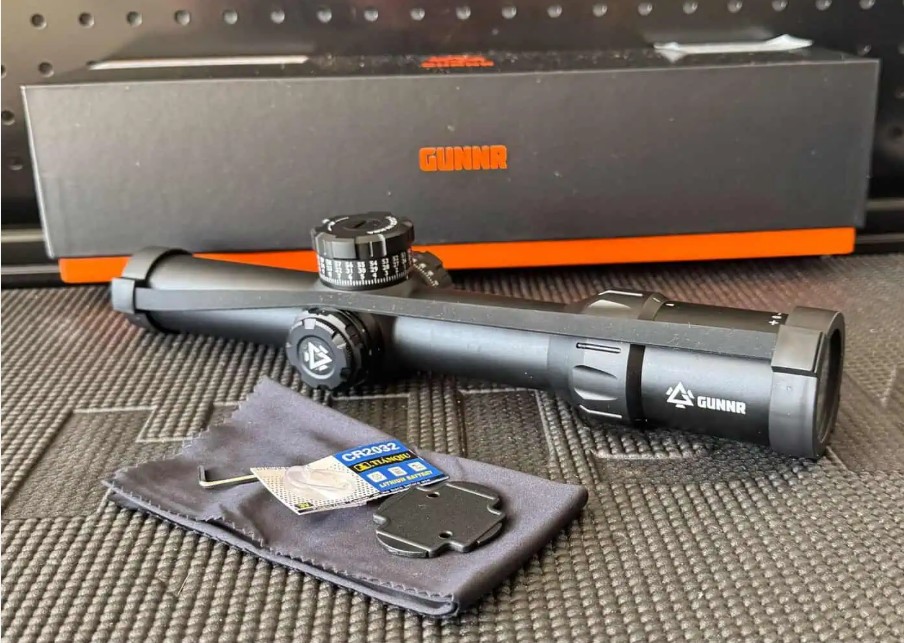
The GUNNR Odin 1-6×28 LPVO is a strong value optic for shooters who want a feature-rich LPVO without spending Vortex Razor, Nightforce, or Trijicon money. It offers clear glass, a useful magnification range, solid build quality, a first focal plane reticle, and an included mount. For a general-purpose rifle, range rifle, or budget “do-most-things” AR build, it is an interesting option.
The strongest points are glass quality, feature set, build material, and value. GUNNR advertises German Schott ED glass, fully multi-coated lenses, 7075 aluminum construction, IP67 waterproofing, and testing for recoil and impact durability. GunMade’s hands-on review also praised the Odin for surprisingly clear glass, good edge-to-edge clarity for the price, sturdy construction, a usable throw lever, positive turrets, and good performance on the range.
The main drawback is the illuminated reticle at 1x. GunMade noted that the illuminated center reticle can be extremely small and hard to pick up at 1x, even at maximum brightness. GUNNR customer reviews also mention that the illumination can nearly disappear in bright sunlight. That does not ruin the optic, but it matters if you expect red-dot-like brightness at close range.
What Is the GUNNR Odin 1-6×28 LPVO?
The GUNNR Odin 1-6×28 is a low-power variable optic, or LPVO. An LPVO is a rifle scope that starts at low magnification and increases to moderate magnification. In this case, the Odin starts at 1x and goes up to 6x. That makes it useful for close-range shooting at 1x and more precise target work at 4x to 6x.
The Odin uses a 28mm objective lens and a 34mm main tube. The 34mm tube is larger than the common 30mm tube found on many budget LPVOs. A larger tube can allow more internal adjustment travel and can contribute to a more robust optic design, although it also means you must use compatible 34mm rings or the included mount.
The Odin is also a first focal plane scope. This means the reticle changes size as magnification changes. At higher magnification, the reticle becomes larger and easier to use for holdovers. At lower magnification, it becomes smaller. This is useful for accurate holds at different magnification settings, but it also explains why the reticle can look small at 1x.
Key Specifications
| Feature | GUNNR Odin 1-6×28 LPVO Specification |
|---|---|
| Optic Type | Low-power variable optic / LPVO |
| Magnification | 1-6x |
| Objective Lens | 28mm |
| Focal Plane | First focal plane |
| Reticle | GRX-2B MOA reticle |
| Glass | German Schott ED glass |
| Lens Coating | Fully multi-coated anti-reflective lenses |
| Tube Diameter | 34mm |
| Eye Relief | 3.74 inches / 95mm |
| Exit Pupil | 4.6mm to 8mm listed |
| Parallax | Fixed at 100 yards |
| Diopter Adjustment | -3.00 to +2.00 |
| Material | 7075 aluminum alloy |
| Battery | CR2032 |
| Ingress Protection | IP67 |
| Mount | Picatinny-compatible 34mm mount package |
GUNNR’s official listing describes the Odin 1-6×28 as a first focal plane LPVO with German Schott ED glass, GRX-2B MOA reticle, 34mm tube, 7075 aluminum body, IP67 protection, CR2032 battery, 3.74-inch eye relief, and 100-yard parallax setting.
Design and Build Quality
The Odin is built like a serious budget LPVO rather than a toy-grade scope. The 7075 aluminum body is a notable feature because many lower-cost optics use 6061 aluminum. GUNNR specifically describes 7075 aluminum as stronger and more corrosion-resistant than 6-series aluminum.
The optic uses a 34mm tube, which gives it a larger and more substantial feel than many entry-level 1-6x scopes. This is good for durability and adjustment potential, but it also affects mounting. You need a 34mm mount, not a 30mm mount. GUNNR offers the Odin with a mount package, which helps reduce extra setup cost.
GunMade’s review described the Odin as solid and well-built for the price. The reviewer found the controls and overall construction better than expected for a budget LPVO. That is important because cheaper LPVOs sometimes feel mushy in the turrets, loose in the magnification ring, or dim through the glass. The Odin appears to avoid many of those immediate cheap-scope problems.
Glass Quality and Clarity
Glass quality is one of the Odin’s biggest selling points. GUNNR says the optic uses German Schott extra-low dispersion glass. ED glass is designed to reduce chromatic aberration, which is the color fringing that can appear around high-contrast edges. The company also says the lenses are fully multi-coated with anti-reflective layers to reduce glare and increase light transmission.
GunMade’s hands-on review was positive about the glass, describing it as surprisingly clear for the price with solid edge-to-edge clarity. The review did note slight edge distortion at 1x, but that is common in many budget LPVOs.
Customer feedback on GUNNR’s own product pages also frequently praises the glass. Several buyers describe the image as clear, especially at 6x, while some mention that the optic feels heavier than expected.
For the money, the Odin appears to perform well optically. It should not be expected to match premium LPVOs from Vortex Razor, Nightforce, Kahles, or Trijicon. But in the budget LPVO category, clear glass is one of the main reasons to consider it.
Reticle Design
The Odin uses a GRX-2B MOA reticle. It is a first focal plane reticle, so it grows and shrinks with magnification. That means holdovers remain consistent across the magnification range. If a reticle mark represents a certain MOA value, it remains useful whether the scope is set to 3x, 4x, or 6x.
This is useful for shooters who want to hold for distance rather than always dialing. It also helps when using the optic at intermediate magnification. A second focal plane reticle is usually only true at one magnification setting, often maximum power. A first focal plane reticle avoids that limitation.
The tradeoff is visibility at 1x. GunMade noted that the illuminated center of the reticle is very small at 1x and can be hard to see, even at maximum brightness. That is the classic FFP LPVO problem. At 6x, the reticle gives more detail. At 1x, it can feel less bold than a red dot.
This makes the Odin better for shooters who want a precision-capable general-purpose LPVO than for shooters who only want red-dot speed at close range.
Illumination Performance
The Odin has illumination powered by a CR2032 battery. GUNNR lists six brightness settings. Illumination helps the reticle stand out against dark targets, shaded backgrounds, and fast close-range targets.
The illumination is useful, but it is not the Odin’s strongest feature. GunMade found the reticle illumination at 1x small and difficult to pick up. A customer review on GUNNR’s own product page also said the illuminated reticle can nearly disappear in bright sunlight at 1x.
This does not mean the optic is bad. Many budget LPVOs struggle to achieve true daylight-bright illumination. The etched reticle remains visible without illumination, so the optic is still usable. But buyers should not expect Aimpoint-style or holographic-sight-style brightness.
For daylight close-range shooting, the Odin is more of a scope with an illuminated reticle than a red dot replacement. For low light, shaded areas, and intermediate distances, the illumination is more helpful.
Turrets and Adjustments
The Odin’s turrets are designed for practical zeroing and adjustment. GunMade described the turrets as tactile and usable, and GUNNR customer feedback mentions positive clicks in the knobs.
Most shooters using a 1-6x LPVO will zero the optic and then use reticle holds rather than constantly dialing elevation. That is especially true on AR-15s and general-purpose carbines. For this role, turret feel matters, but it is not as critical as on a precision long-range scope.
The more important question is whether the optic holds zero. GUNNR says the scope is tested to withstand 1,000 impacts at 1,000G and 2,000 live-fire rounds. User reports are mixed but generally useful: one Reddit user said a replacement Odin worked well after about 500 rounds, while another reported illumination issues and a frustrating customer-service experience.
That means buyers should inspect the optic, zero it properly, shoot it enough to verify function, and contact support quickly if there is a defect.
Mounting System
The Odin uses a 34mm tube. GUNNR sells the optic with a Picatinny-compatible integrated dual-ring mount. That is helpful because 34mm mounts are less common than 30mm mounts and can add cost if purchased separately.
The included mount is a practical advantage for budget buyers. If you buy a $250 to $400 LPVO and then need to spend another $100 to $200 on a mount, the value equation changes quickly. Including a mount makes the Odin easier to put directly onto an AR-style rifle.
Still, mounting should be done carefully. Use proper torque, level the scope, confirm eye relief, and check that the mount is secure on the rail. A good optic can perform poorly if mounted badly.
Eye Relief and Eye Box
GUNNR lists the Odin’s eye relief at 3.74 inches. That is comfortable for most AR-15 and general-purpose rifle setups. It also gives a reasonable safety margin on rifles with more recoil.
Customer feedback describes the eye relief and sight picture as generous and forgiving. One buyer said the sight picture felt huge and that the glass looked especially good at 6x.
As with most LPVOs, the eye box will be more forgiving at 1x and tighter at 6x. This is normal. Budget 1-8x and 1-10x scopes often suffer more at maximum magnification, which is one reason many shooters still prefer a quality 1-6x LPVO. Public LPVO discussions often note that cheaper 1-8x optics can have tighter eye boxes and worse clarity above 5x or 6x.
Recoil Resistance and Durability
GUNNR advertises the Odin as shock-resistant and tested against recoil and impacts. The official product page says it is tested to withstand 1,000 impacts at 1,000G and 2,000 live-fire rounds. It also carries an IP67 rating for dust and water resistance.
That makes it suitable on paper for AR-15s, PCCs, .308 rifles, and other practical rifle platforms. A Reddit user reported running the Odin 1-6×28 on a G3-pattern rifle and said it handled .308 recoil well in that user’s experience, though this is anecdotal feedback rather than controlled testing.
The fair position is this: the Odin appears durable enough for normal range use and general-purpose rifles, but it does not yet have the long public track record of Vortex, Primary Arms, Leupold, Trijicon, or Nightforce. Buyers who need a duty-proven optic may prefer a more established brand. Buyers building a range rifle may find the Odin’s value more appealing.
Accuracy and Practical Performance
An optic does not make a rifle mechanically more accurate, but it can help the shooter aim more consistently. The Odin’s 1-6x range gives the shooter flexibility. At 1x, it can be used for close targets. At 4x to 6x, it gives enough magnification for smaller targets, steel plates, and practical accuracy at intermediate distances.
GunMade framed the Odin as suitable for a “do-it-all” or SHTF rifle because a quality 1-6x LPVO can offer red-dot-like speed at 1x and enough magnification to push out a few hundred yards.
The biggest practical limitation is reticle visibility at 1x. If the center aiming point is too small or dim in bright light, the optic will not feel as fast as a red dot. At 6x, however, the reticle becomes more useful for precision. This means the Odin may be better for balanced range use than pure close-quarters speed.
Pros and Cons
Pros
- Strong feature set for the price.
- German Schott ED glass is impressive in this price class.
- Fully multi-coated lenses help clarity and light transmission.
- 1-6x magnification range is practical for general-purpose rifles.
- First focal plane reticle keeps holds valid across magnification settings.
- 34mm tube and 7075 aluminum construction feel substantial.
- IP67 water and dust resistance.
- Included Picatinny-compatible mount improves value.
- Good reported edge-to-edge clarity for a budget LPVO.
- Useful for AR-15s, range rifles, and budget LPVO builds.
Cons
- Illuminated center reticle can be small and hard to see at 1x.
- Not truly red-dot bright in harsh daylight.
- 34mm tube limits mount compatibility compared with 30mm optics.
- Limited independent long-term testing compared with major brands.
- Some user feedback mentions illumination or zeroing issues on individual units.
- Customer-service feedback is mixed in public discussions.
- Heavier than a red dot or microprism setup.
Best Use Cases
General-Purpose AR-15
The Odin is a natural fit for a general-purpose AR-15. A 1-6x LPVO gives the rifle flexibility for close-range drills, 100-yard groups, and intermediate-distance steel. It is especially useful on a 14.5-inch, 16-inch, or 18-inch rifle.
Range Rifle
For range use, the Odin makes sense. The glass is clear for the price, the reticle gives more precision than a red dot, and the 6x top end helps with target identification and shot placement at distance.
Budget LPVO Build
The Odin is most appealing as a value optic. It gives buyers a lot of features for the money, especially with the included mount. If your budget is under $400 and you want FFP, Schott ED glass, and a mount, the Odin is worth considering.
Hunting and Field Use
The Odin can work for close-to-medium-range hunting where a 1-6x scope is appropriate. It is better for daylight and supported shooting than for ultra-light mountain rifles or low-light hunting where premium glass and brighter illumination may matter more.
.308 Battle Rifle or G3-Style Rifle
The Odin may work on .308 rifles if mounted correctly. User feedback includes at least one positive report of use on a G3-pattern rifle, but buyers should test zero retention carefully.
Comparison With Similar LPVOs
| Optic | Main Strength | Best For |
|---|---|---|
| GUNNR Odin 1-6×28 LPVO | Schott ED glass, FFP reticle, included 34mm mount | Budget shooters wanting features and clear glass |
| Primary Arms SLx 1-6x | Proven budget LPVO with strong reticle support | Buyers who value brand reputation and ACSS reticles |
| Vortex Strike Eagle 1-6x | Popular budget LPVO with strong warranty support | Buyers who want an established brand and warranty |
| Vortex Viper PST Gen II 1-6x | Better glass and proven performance | Shooters who can spend more for a higher-tier LPVO |
| Sig Tango-MSR 1-6x | Good entry-level package with mount | Budget AR owners wanting a simple LPVO kit |
| Burris RT-6 | Good budget glass and lightweight design | Shooters who prefer a lighter SFP LPVO |
GUNNR Odin 1-6×28 vs Primary Arms SLx 1-6x
The Primary Arms SLx 1-6x is one of the most common budget LPVO recommendations. It has strong brand recognition, proven ACSS reticles, and a long track record. The Odin competes by offering a first focal plane design, Schott ED glass, and an included 34mm mount at an aggressive price.
Choose the Primary Arms if you value a better-known brand and reticle ecosystem. Choose the Odin if you want to try a feature-heavy FFP optic with very clear glass for the money.
GUNNR Odin 1-6×28 vs Vortex Strike Eagle 1-6x
The Vortex Strike Eagle is popular because it is widely available, affordable, and backed by Vortex’s strong warranty reputation. The Odin’s advantage is its Schott ED glass claim, FFP reticle, and included mount value.
Public LPVO discussions often suggest that budget 1-6x optics are more forgiving than budget 1-8x optics because they usually have better eye boxes and more usable top-end clarity. That supports the Odin’s 1-6x format as a practical choice.
GUNNR Odin 1-6×28 vs Vortex Viper PST Gen II 1-6x
The Vortex Viper PST Gen II 1-6x is a higher-tier optic. It typically offers better glass, brighter illumination, stronger reputation, and more proven durability. It also costs more.
The Odin is not trying to beat the Viper in every category. It is trying to offer good performance at a lower price. If budget allows, the Viper is safer. If budget is limited, the Odin provides a lot of features for less money.
Important Note: This Is Not a Shotgun Review
The requested outline included shotgun-specific sections such as capacity, loading system, barrel, sights, recoil, and KelTec KS7 vs KelTec KSG. Those sections do not directly apply because the GUNNR Odin 1-6×28 is a rifle scope, not a firearm or shotgun.
For accuracy and reader usefulness, this review adapts those topics into LPVO-relevant sections: glass quality, reticle, turrets, mounting system, eye relief, recoil resistance, durability, optic compatibility, maintenance, accessories, and comparison with similar LPVOs.
Maintenance and Care
The Odin should be cared for like any rifle optic. Keep the lenses clean, keep the scope mounted correctly, check screws periodically, and avoid unnecessary impacts. The IP67 rating gives confidence in wet or dusty conditions, but the optic should still be dried and cleaned after harsh use.
Use a blower, lens brush, microfiber cloth, and optic-safe cleaning solution. Do not wipe dry grit across the lens. Do not use harsh solvents on lens coatings, turret markings, rubber seals, or illumination controls.
Check the mount after the first range session and periodically after that. Even a good optic can lose zero if the mount loosens. Use proper torque and follow the mount’s instructions.
Accessories and Upgrade Options
Offset Red Dot
An offset red dot can help solve the Odin’s 1x illumination limitation. Use the LPVO at 3x to 6x and use the offset dot for close-range speed. This adds cost and weight, but it is a common setup for LPVO users.
Scope Level
A scope level is useful if you plan to shoot at distance. Cant can shift point of impact, especially when using reticle holds.
Lens Caps
Flip-up caps or quality lens covers protect the glass during transport and storage. This is useful for field rifles and range bags.
Spare CR2032 Battery
Keep spare CR2032 batteries in your range bag or rifle grip storage. The etched reticle remains usable without power, but illumination is still helpful.
Torque Driver
A torque driver is strongly recommended for mounting. It helps prevent loose screws and avoids overtightening the scope rings.
Who Should Buy the GUNNR Odin 1-6×28 LPVO?
The Odin is best for shooters who want a budget-friendly LPVO with clear glass, first focal plane reticle, durable construction, and an included mount. It is a good fit for AR-15 owners, range shooters, budget rifle builders, and people who want to experiment with LPVOs without spending premium money.
It also makes sense for shooters who mostly use 3x to 6x and want a clearer view than many entry-level scopes offer. If you care more about glass clarity and reticle detail than red-dot-bright 1x speed, the Odin becomes more appealing.
Who Should Avoid It?
Shooters who need true daylight-bright 1x performance should consider another optic. The Odin’s illuminated center reticle can be too small and dim for some users at 1x in bright conditions.
Buyers who demand proven duty-grade durability should also be cautious. GUNNR is still building its reputation, and public long-term data is limited. A more established optic from Vortex, Primary Arms, Trijicon, Leupold, or Nightforce may be a safer choice for hard professional use.
Finally, ultralight rifle builders may prefer a red dot, microprism, or lighter LPVO. A 34mm FFP LPVO with mount will add noticeable weight.
Final Verdict
The GUNNR Odin 1-6×28 LPVO is a feature-rich budget optic with surprisingly strong glass, a useful 1-6x magnification range, first focal plane reticle, 34mm tube, included mount, 7075 aluminum body, and IP67 protection. For the price, it offers a lot.
Its biggest weakness is close-range illumination. At 1x, the center reticle can be small and not bright enough for true red-dot-style speed in harsh daylight. Some user feedback also raises concerns about individual-unit defects and customer service, so buyers should test their optic early and keep purchase records.
For budget AR builds, range rifles, and shooters who want clear glass and FFP features without spending premium money, the Odin is worth a serious look. It is not the safest choice for duty use, but it may be one of the more interesting value LPVOs in its price class.
55 GUNNR Odin 1-6×28 LPVO FAQs
1. What is the GUNNR Odin 1-6×28 LPVO?
The GUNNR Odin 1-6×28 LPVO is a low-power variable rifle scope with 1x to 6x magnification. It is designed for general-purpose rifles, AR-15s, range shooting, and close-to-intermediate distance use. It uses a first focal plane reticle, German Schott ED glass, a 34mm tube, and an included Picatinny-compatible mount.
2. What does LPVO mean?
LPVO stands for low-power variable optic. It refers to a scope that starts at low magnification, usually 1x, and increases to a moderate magnification range such as 4x, 6x, 8x, or 10x. LPVOs are popular because they combine close-range speed with better distance capability than a red dot.
3. Is the GUNNR Odin a rifle or a scope?
The GUNNR Odin is a rifle scope, not a firearm. It mounts to a rifle using a compatible scope mount. Shotgun-specific topics such as loading systems, barrel length, and shell capacity do not apply directly to the Odin.
4. What magnification range does the Odin have?
The Odin has a 1-6x magnification range. At 1x, it can be used for close-range shooting. At 6x, it gives the shooter more precision for smaller targets and longer distances.
5. Is the Odin first focal plane?
Yes. The Odin is listed as a first focal plane LPVO. This means the reticle grows and shrinks with magnification, and holdover marks remain consistent across the magnification range.
6. What is the advantage of a first focal plane LPVO?
A first focal plane reticle keeps its holdover and ranging marks accurate at all magnification levels. This is useful if you do not always shoot at maximum magnification. It helps with practical holds at 2x, 3x, 4x, or 6x.
7. What is the downside of first focal plane at 1x?
The downside is that the reticle becomes very small at low magnification. GunMade noted that the illuminated center of the Odin’s reticle can be hard to see at 1x, even at maximum brightness.
8. What reticle does the Odin use?
The Odin uses GUNNR’s GRX-2B MOA reticle. It is designed for practical shooting and holdovers. Since it is first focal plane, the reticle subtensions remain valid across the magnification range.
9. Is the Odin reticle illuminated?
Yes. The Odin has an illuminated reticle with six brightness settings and uses a CR2032 battery. The illumination is helpful, but public reviews note that it is not extremely bright at 1x in direct sunlight.
10. Is the illumination daylight bright?
Not in the same way as a high-end red dot. GunMade and some customer feedback indicate that the illuminated center can be hard to see in bright daylight at 1x. The optic remains usable because the reticle is etched, but buyers should not expect red-dot-level brightness.
11. What battery does the Odin use?
The Odin uses one CR2032 battery for illumination. CR2032 batteries are common, inexpensive, and easy to keep in a range bag or rifle grip storage compartment.
12. Does the Odin work without a battery?
Yes. The reticle is etched, so the optic remains usable without illumination. A dead battery only removes the lit reticle, not the reticle itself.
13. What glass does the Odin use?
GUNNR advertises German Schott ED glass. ED glass helps reduce chromatic aberration and improve image quality. GunMade’s review described the glass as surprisingly clear for the price.
14. Is the Odin glass clear?
Based on available reviews, yes. GunMade praised the glass clarity and edge-to-edge performance for the price. GUNNR customer reviews also frequently mention clear glass and a strong sight picture.
15. Does the Odin have edge distortion?
GunMade noted slight edge distortion at 1x. This is common in many budget LPVOs and does not necessarily make the optic unusable. It is something to expect if you are comparing it with premium glass.
16. What tube size does the Odin use?
The Odin uses a 34mm main tube. This is larger than the common 30mm tube found on many budget LPVOs. Make sure any mount or rings are 34mm compatible.
17. Does the Odin come with a mount?
GUNNR sells the Odin with a Picatinny-compatible mount package. This is useful because 34mm mounts can be more expensive and less common than 30mm mounts.
18. Can I use a 30mm mount with the Odin?
No. The Odin has a 34mm tube, so it requires a 34mm mount or rings. A 30mm mount will not fit.
19. What is the eye relief?
GUNNR lists the Odin’s eye relief at 3.74 inches, or 95mm. This is comfortable for most AR-style rifles and gives reasonable clearance on rifles with more recoil.
20. Is the eye box forgiving?
Customer feedback describes the eye relief and sight picture as generous. Like most LPVOs, the eye box is most forgiving at 1x and becomes tighter at 6x. That is normal for this optic type.
21. What is the objective lens size?
The Odin uses a 28mm objective lens. This is slightly larger than many 1-6x LPVOs with 24mm objectives and can help with light transmission and image feel.
22. What is the parallax setting?
GUNNR lists the Odin’s parallax setting at 100 yards. This is typical for many LPVOs and works well for general-purpose rifle use.
23. Is the Odin waterproof?
Yes. GUNNR lists the Odin with IP67 protection against dust and water. This means it is built for rain, dust, and normal outdoor shooting conditions.
24. Is the Odin shockproof?
GUNNR states that the Odin is tested to withstand 1,000 impacts at 1,000G and 2,000 live-fire rounds. This suggests it is built for normal rifle recoil and field handling.
25. Can the Odin handle .308 recoil?
It should be able to handle .308 in normal use if mounted properly, and at least one Reddit user reported positive use on a G3-pattern rifle. That is anecdotal, so buyers should test zero retention with their own rifle.
26. Is the Odin good for AR-15s?
Yes. The Odin is well suited to AR-15s, especially 14.5-inch, 16-inch, and 18-inch general-purpose rifles. The 1-6x range matches the practical distances where many AR-15 owners train.
27. Is the Odin good for home defense?
It can work, but it is not ideal if you want maximum close-range speed. The reticle at 1x can be small and not as bright as a red dot. For home defense, a red dot or prism may be faster for many users. The Odin is better as a general-purpose optic.
28. Is the Odin good for competition?
It can work for entry-level practical rifle competition or range drills. Serious competitors may prefer brighter illumination, lighter weight, and a more proven optic. The Odin is better for budget-minded shooters than high-level competition use.
29. Is the Odin good for hunting?
Yes, for close-to-medium-range hunting where a 1-6x LPVO makes sense. The 6x top end helps with shot placement, while the 1x setting can help in closer cover. For low-light hunting, a higher-end optic may perform better.
30. Is the Odin good for long-range shooting?
It is not a dedicated long-range optic. The 6x top end is useful for intermediate distances, but long-range precision shooters usually prefer higher magnification, more turret travel, and more advanced reticles.
31. Is 1-6x better than 1-8x?
For many budget optics, yes. Public LPVO discussions often note that budget 1-8x scopes can suffer from tighter eye boxes and reduced clarity at higher magnification. A good 1-6x can be more usable than a mediocre 1-8x.
32. Is the Odin better than a red dot?
It depends on the role. A red dot is faster and lighter for close range. The Odin is better for shooters who want magnification and more precision at distance. For a general-purpose rifle, the Odin offers more flexibility.
33. Is the Odin better than a magnifier setup?
An LPVO gives variable magnification in one optic, while a red dot and magnifier setup gives excellent close-range speed with optional magnification. The Odin is cleaner and more precise at 6x. A red dot/magnifier may be faster at 1x.
34. Is the Odin better than the Primary Arms SLx 1-6x?
The Odin offers features such as FFP design, Schott ED glass, and a 34mm mount package. Primary Arms offers a stronger brand reputation and proven ACSS reticle ecosystem. The better choice depends on whether you prioritize features or established support.
35. Is the Odin better than the Vortex Strike Eagle?
The Odin may offer better glass value and FFP features, while the Vortex Strike Eagle has stronger brand recognition and warranty confidence. If warranty support is your top priority, Vortex is safer. If features per dollar matter most, the Odin is interesting.
36. Is the Odin better than the Vortex Viper PST 1-6x?
No, the Viper PST is generally a higher-tier optic with a more established reputation. The Odin is less expensive and feature-rich for the price, but the Viper is the safer performance choice if budget allows.
37. Does the Odin have a good warranty?
GUNNR advertises a lifetime warranty on its product pages. Buyers should review current warranty terms directly and keep proof of purchase. Public customer-service feedback is mixed, so documentation matters.
38. Are there customer-service concerns?
Some Reddit feedback mentions slow or frustrating customer-service experiences related to defective units, while other users report successful exchanges or positive outcomes. This is anecdotal but worth considering.
39. What are the most common complaints?
The most common complaints are dim or small illumination at 1x, weight, limited long-term reputation, and occasional user-reported issues with illumination or zeroing on individual units.
40. What are the biggest strengths?
The biggest strengths are clear glass, first focal plane reticle, included 34mm mount, durable 7075 aluminum construction, IP67 protection, and strong feature value for the price.
41. Should I use an offset red dot with the Odin?
An offset red dot can be useful if you want faster close-range aiming. This setup lets you keep the Odin at higher magnification and roll the rifle to the offset dot for close targets. It adds cost, weight, and complexity.
42. Should I use backup iron sights?
You can, but backup irons may be harder to use with an LPVO mount unless configured carefully. Many LPVO users rely on the optic and mount quality, while others add offset irons or an offset red dot.
43. How should I zero the Odin?
Zero it according to your rifle, ammunition, and intended distance. A 50/200-yard zero is common for AR-15s, while 100 yards is common for more precise work. After zeroing, confirm holds at several distances.
44. Does the Odin track accurately?
Available public information is limited. For most LPVO users, the turrets are mainly used for zeroing, not constant dialing. If you plan to dial often, run a box test or tall-target test to verify tracking.
45. How should I mount the Odin?
Use the included 34mm mount or another quality 34mm mount. Set proper eye relief, level the reticle, torque screws correctly, and check the mount after the first range session.
46. Do I need a torque wrench?
Yes, a torque wrench is strongly recommended. It helps avoid loose screws and prevents overtightening the scope tube. Follow the mount manufacturer’s torque recommendations.
47. How do I clean the Odin lenses?
Use a blower, lens brush, microfiber cloth, and optic-safe cleaning solution. Do not wipe dirt across the lens dry. Avoid household solvents that may damage lens coatings.
48. Can the Odin be used in rain?
Yes. The IP67 rating means it is designed to resist dust and water exposure. After use in rain, dry the exterior and inspect the mount and lenses before storage.
49. Is the Odin too heavy?
It depends on your rifle. It is heavier than a red dot, but that is normal for LPVOs. If you want the lightest rifle possible, choose a red dot or microprism. If you want magnification, the weight may be acceptable.
50. Is the Odin good for beginners?
It can be good for beginners who want to learn LPVO use. However, new shooters may find a red dot simpler. The Odin requires learning eye relief, magnification, reticle holds, and scope mounting basics.
51. Is the Odin good for SHTF builds?
It can be, especially because a 1-6x LPVO is versatile. GunMade discussed the Odin in the context of a do-it-all or SHTF rifle. Buyers should still test durability, zero retention, and mount security before trusting it for serious preparedness.
52. Is the Odin a duty-grade optic?
It is better described as a value-focused LPVO than a proven duty optic. It may be fine for personal use and training, but professional users may prefer brands with longer hard-use track records.
53. Who should buy the GUNNR Odin 1-6×28 LPVO?
Buyers who want a budget-friendly LPVO with clear glass, first focal plane design, included mount, and solid feature value should consider it. It is best for range rifles, AR-15s, and general-purpose builds.
54. Who should avoid the GUNNR Odin 1-6×28 LPVO?
Shooters who need red-dot-bright 1x performance, ultralight weight, premium warranty reputation, or proven duty-grade durability may want a different optic. The Odin is attractive, but it is not the safest choice for every role.
55. What is the final verdict on the GUNNR Odin 1-6×28 LPVO?
The GUNNR Odin 1-6×28 LPVO is a compelling budget LPVO with clear glass, FFP reticle, durable construction, IP67 protection, and an included 34mm mount. Its main weakness is 1x illumination brightness. For budget AR builds and range use, it is worth considering. For duty use or true red-dot speed, a more established optic may be better.