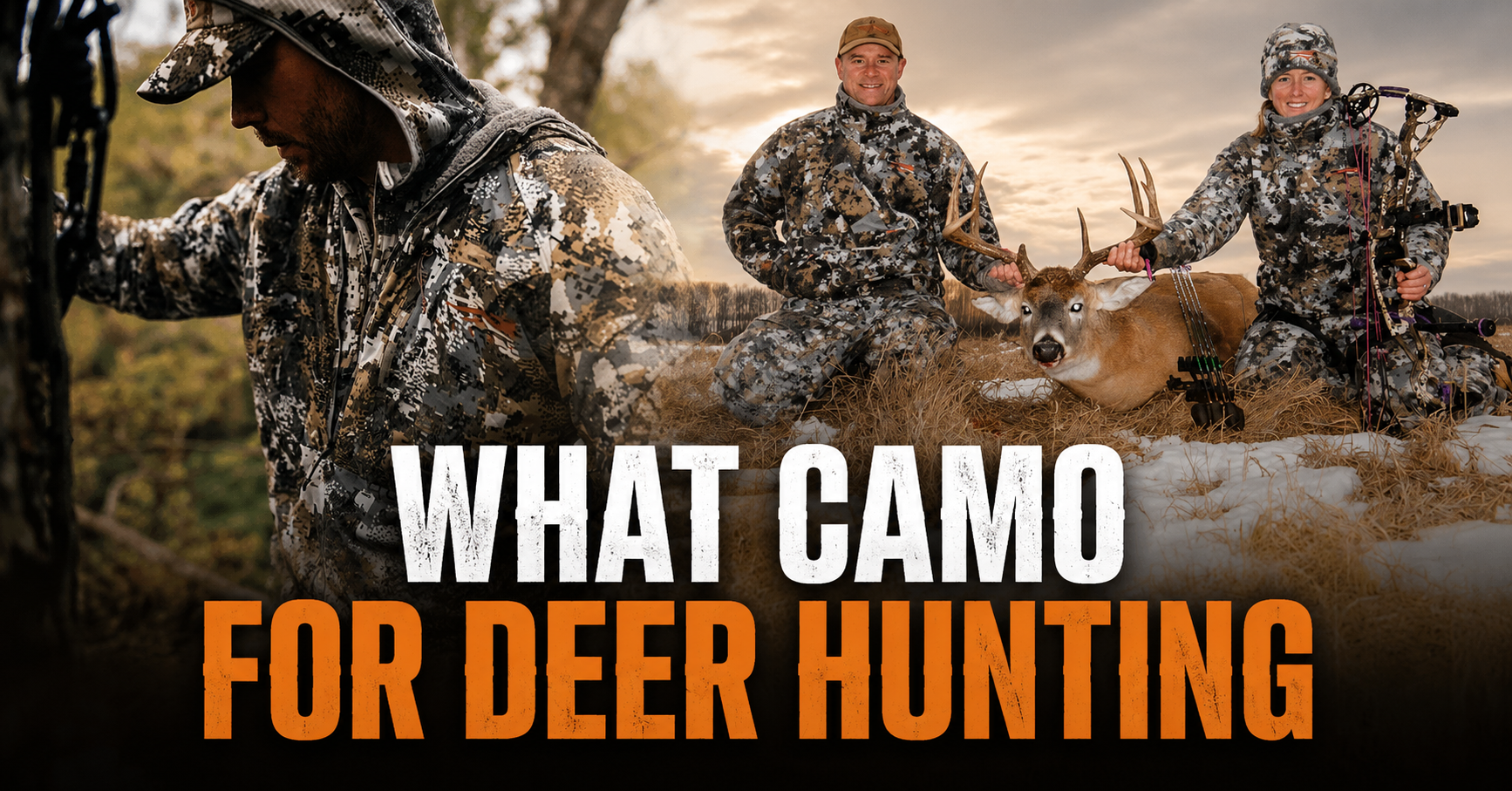
If you are asking what camo for deer hunting, the useful answer is not a single brand or pattern. Good deer-hunting camouflage matches the dominant brightness, colors, and shapes behind your setup while breaking up the outline of your head, shoulders, and torso. Your terrain, remaining foliage, snow cover, hunting method, weather, and local hunter-orange rules matter more than the name printed on the garment.
This guide helps whitetail and mule-deer hunters choose a practical pattern without assuming that camouflage makes a hunter invisible. Wind, movement, noise, safe positioning, legal visibility clothing, and positive target identification remain essential.
Quick Answer
For most deer hunting, choose a medium-to-large breakup pattern that matches the actual background at your stand, blind, or stalking area. Use muted green and brown patterns in leafy early-season woods, gray-tan-brown patterns in bare late-season timber, lighter tan-gray patterns in grassland or open country, and white-gray breakup only where snow truly covers the scene. A quiet, weather-appropriate fabric and controlled movement usually matter more than photorealistic detail. Before hunting, check the current wildlife-agency rules because required hunter orange or pink overrides concealment preferences, and camouflage orange is not legal everywhere.
Best Camo Choices at a Glance
| Hunting Background | Useful Color Family | Pattern Features | Common Mistake |
|---|---|---|---|
| Leafy early-season hardwoods | Muted green, olive, brown, and shadow tones | Mixed leaf shapes with medium and large breakup | Wearing a dark late-season pattern that forms one solid silhouette |
| Bare late-season hardwoods | Gray, tan, bark brown, and faded leaf tones | Open pattern with branches, vertical forms, and bold contrast | Using bright green camo after the leaves have dropped |
| Evergreen or mixed timber | Olive, gray-green, brown, and charcoal | Broken vertical shapes with varied light and dark areas | Choosing a uniformly black or very dark outfit |
| Dry grass, brush, or agricultural edges | Tan, straw, light brown, and soft gray | Grass-like or abstract macro breakup with a lighter base | Wearing dark woodland camo against pale cover |
| Rock, sage, or open western terrain | Light gray, tan, dusty olive, and muted brown | Large abstract shapes that break the outline at distance | Prioritizing tiny leaf detail that blends into one dark block |
| Patchy snow | White, gray, tan, and brown | Mixed light-and-dark breakup that reflects both snow and exposed cover | Wearing solid white where much of the ground and brush remains exposed |
| Continuous snow | White and light gray with sparse dark breakup | Open snow pattern appropriate to the surrounding trees or brush | Using snow camo before the landscape is actually snow-covered |
Important Safety and Legal Notice
Camouflage is never more important than hunter visibility and legal compliance. Hunter-orange or fluorescent-pink requirements vary by state, province, season, weapon, land designation, and overlapping hunt. Some jurisdictions accept camouflage orange if it contains enough fluorescent material; others require solid orange and do not count camo orange. Review the current official regulation booklet for the exact place, date, species, and hunting method, then check for property-specific rules immediately before the hunt.
When firearms are present, follow the four universal safety principles:
- Treat every firearm as if it is loaded.
- Keep the muzzle pointed in a safe direction.
- Keep your finger outside the trigger guard until ready to shoot.
- Be certain of the target and what is beyond it.
Never shoot at color, sound, antler-like shapes, or unidentified movement. Camouflage makes people harder for other hunters to see, so use required visibility clothing, identify your target positively, know the backstop, and communicate carefully with hunting partners.
What Camo for Deer Hunting Works Best?
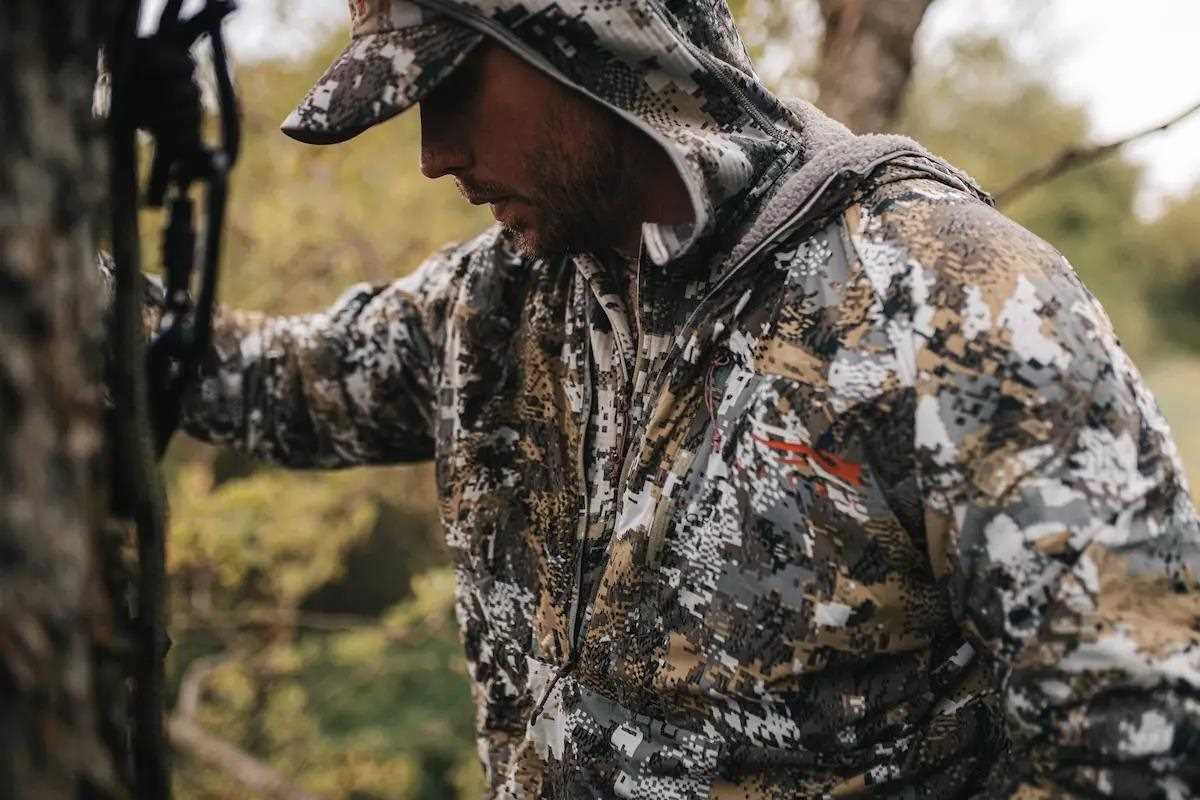
The best general-purpose choice is a pattern with a mid-tone base, strong light-and-dark contrast, and shapes large enough to break up the human outline at the distance deer are likely to view you. It should resemble the structure of your background rather than look impressive at arm’s length.
Fine photographic leaves and twigs can appear realistic in a store, but those details may merge into a single dark shape at distance. Larger abstract blocks, open areas, and contrasting lines can interrupt the recognizable head-and-shoulder silhouette more effectively. Neither style is universally superior; stand back from the garment and compare it with a photograph of your actual setup.
1. Early-Season Green Camo
Where hardwood foliage, green understory, and crops remain lush, choose muted greens mixed with brown, gray, and shadow. Avoid an outfit that is uniformly green; natural cover contains gaps, dead branches, shade, and changing light. Breathable, moisture-managing clothing may be more useful than heavy fabric because overheating encourages movement.
2. Mid-Season Transitional Camo
As vegetation fades and leaves begin to drop, use a balanced pattern containing dull olive, tan, gray, and brown. Transitional camo is useful for hunters moving between field edges, brush, and timber. A versatile neutral pattern can be more practical than buying a separate suit for every week of the season.
3. Late-Season Hardwood Camo
After leaf drop, the scene often becomes lighter and more open. Gray, tan, faded brown, and branch-like elements generally fit bare hardwoods better than dense green camo. A pattern with open negative space and vertical breakup can help against trunks and limbs, especially from an elevated position.
4. Evergreen and Dark-Timber Camo
Mixed conifer cover can support deeper olive and gray-green tones, but an entirely dark outfit may still form a distinct block. Look for contrast that imitates gaps between needles, branches, trunks, and filtered light. Judge the exact stand location because the same forest may be bright at an edge and very dark beneath the canopy.
5. Open-Country and Grassland Camo
For mule deer, spot-and-stalk hunting, dry grass, sage, or agricultural edges, a lighter tan-gray pattern usually fits better than dark eastern woodland camo. Large abstract shapes remain visible as breakup at longer distances. The garment must also allow quiet crawling, kneeling, and hiking without restricting movement or collecting excessive burrs.
6. Brush and Marsh-Edge Camo
Vertical grass, reeds, cattails, and brush call for linear elements and a straw, tan, olive, and brown palette. Match the height and density of cover behind you. A marsh-style pattern can be effective near tall grass but may look conspicuously pale against a shaded tree trunk.
7. Snow Camo
Snow camo is a specialty outer layer, not a universal late-season choice. Use a white or light-gray pattern only when snow dominates the background. In patchy conditions, include enough brown, gray, or tan breakup to match exposed brush, bark, and ground. Verify that any required hunter orange remains fully visible over the snow layer.
How Deer Vision Changes the Camo Decision
White-tailed deer do not see the world exactly as humans do. The University of Georgia Deer Lab explains that deer have strong short-wavelength perception, including blues, and reduced sensitivity to longer wavelengths such as orange and red. Their visual system is also highly capable of detecting changes in light and movement.
This does not mean deer see no color, nor does it mean an orange-clad hunter is invisible. It means brightness, contrast, silhouette, and motion deserve more attention than trying to reproduce every leaf color. Avoid bright blue as an outer layer when practical, particularly at dawn and dusk, but do not treat one color as the sole reason a deer notices a hunter.
Does Hunter Orange Ruin Camouflage?
Hunter orange is designed to be conspicuous to people. Deer are less sensitive to orange than humans, and wildlife agencies use that difference to improve hunter visibility. The New York State Department of Environmental Conservation hunter-education guidance, for example, explains deer color perception and the safety role of fluorescent orange. The exact legal garment, amount, placement, and accepted pattern still depend on your jurisdiction.
Wear all required orange as the outermost visible layer. Do not cover it with a camouflage backpack, harness, rain shell, or tree-stand accessory if doing so would reduce required visibility.
Treestand Camo Versus Ground Camo
| Setup | Background to Match | Useful Camo Traits | Priority Beyond Pattern |
|---|---|---|---|
| Treestand with leafy canopy | Leaves, limbs, filtered sky, and trunk | Mixed brightness, open breakup, muted green and brown | Full-body fall-arrest system and minimal upper-body movement |
| Treestand after leaf drop | Bare limbs, gray sky, bark, and distant ground | Lighter gray-tan base, vertical lines, bold macro breakup | Back cover and safe, continuous connection while climbing |
| Ground setup against a tree | Trunk, root flare, leaves, and low brush | Mid-tone bark and leaf pattern without a dark solid outline | Safe field of fire and a dependable backstop |
| Natural brush concealment | Grass, saplings, branches, or dead vegetation | Pattern and brightness matching the immediate background | Legal setup, clear shooting lanes, and no unsafe obstruction |
| Commercial ground blind | Dark blind interior rather than the external landscape | Dark, non-reflective clothing; a face covering may help with close archery shots | Required external blind marking and target identification |
| Spot-and-stalk | Terrain viewed from changing angles and distances | Lightweight, quiet, durable macro pattern suited to the broad landscape | Wind, skyline discipline, safe route, and proven shooting limits |
From a treestand, a hunter may be seen against pale sky rather than the trunk beside the platform. A very dark pattern can create a human-shaped silhouette. From the ground, the same light pattern may stand out against shaded bark. Select camo from the animal’s likely viewing angle, not only from your eye level.
Pattern Is Only Part of Deer-Hunting Clothing
Quiet Fabric
Brush a sleeve across the torso and bend the elbows and knees before buying. Stiff rain shells, hook-and-loop closures, loose zipper pulls, and abrasive fabrics can be noisy at close range. Weather protection still matters, so balance quietness with wind, rain, and cold exposure rather than choosing a silent garment that cannot keep you safe.
Layering and Temperature Control
A useful camo system fits over changing base and insulation layers without binding the shoulders or restricting a bow draw. Walk in with fewer layers when appropriate, then add insulation after settling to limit sweat. Follow a safe plan for cold, heat, rain, and changing conditions, and turn back when weather creates unacceptable risk.
Fit and Mobility
Clothing should allow climbing, kneeling, sitting, and shouldering a firearm or drawing a bow safely. Excess fabric can catch on brush, bowstrings, controls, or stand hardware. Tight clothing can compress insulation and restrict movement. Test the full system with unloaded equipment in a controlled setting.
Face and Hands
Exposed hands and a moving face can create noticeable flashes at close bowhunting distances. A brimmed cap, face covering, or face paint and lightweight gloves may help when legal and comfortable. Keep hearing, peripheral vision, breathing, anchor points, and equipment operation unobstructed. Never let a hood or mask interfere with safe firearm handling.
Footwear and Accessories
Boot color rarely matters as much as traction, warmth, dryness, and fit. Backpacks, safety harnesses, seat cushions, and binocular straps can cover or alter the visible pattern, so evaluate the complete hunting setup. Ensure accessories do not obscure legally required fluorescent clothing.
How to Test Camo Before Deer Season
- Photograph the actual setup: Take pictures from likely deer approach routes while staying within legal access and avoiding disturbance.
- Test the viewing angle: Check from ground level for a treestand and from several directions for a ground setup.
- Compare in grayscale: A grayscale photo can reveal whether the outfit is much lighter or darker than the background.
- Step back: View the images at realistic distances. Fine pattern detail may disappear while the overall silhouette remains.
- Wear the complete system: Include orange, backpack, harness, gloves, hat, rain shell, and insulation.
- Check movement: Have a partner observe small, safe practice movements such as turning the head or raising binoculars.
- Listen to the fabric: Test sleeves, knees, pockets, zippers, and layers in cool conditions, because some materials become noisier when cold.
- Confirm safety visibility: Make sure required fluorescent material is not hidden from any regulated direction.
Do this before the season rather than disturbing an active area repeatedly. A simple photo comparison often tells you more than a pattern name or studio image.
Do You Need Camo to Hunt Deer?
Not always. Hunters have long taken deer while wearing solid, muted earth tones and legally required orange. Camouflage becomes most useful when deer may approach at close range, especially during bowhunting, when the hunter must move to draw. At longer firearm-hunting distances, a stable position, a broken outline, wind awareness, quiet behavior, and safe target identification may matter more than a detailed pattern.
A solid olive, brown, tan, or gray outer layer can work if it matches the background and is paired with required visibility clothing. Avoid creating a large uniform block: a contrasting vest, jacket, branches behind the setup, or natural shadows can break the shape. Never cut live vegetation or alter public land unless regulations and land-manager rules permit it.
What Matters More Than Camo?
- Wind: Approach and set up with likely wind direction and thermals in mind. No pattern controls scent carried toward deer.
- Movement: Move slowly when the animal’s view is obstructed, and avoid unnecessary head and hand movement.
- Background: Sit in front of visual clutter or shade rather than silhouetted on a ridge, field edge, or open sky.
- Noise: Secure loose gear and choose fabrics that do not scrape loudly during essential movement.
- Legal visibility: Required orange or pink protects people and must not be sacrificed for concealment.
- Comfort: A hunter who is warm, dry, and able to remain still will generally conceal movement better than one wearing the perfect pattern but unsuitable clothing.
- Safe shot discipline: Positive identification, a safe backstop, and staying within proven ability always outrank concealment.
A Simple Camo Buying Checklist
You do not need the most expensive equipment to hunt responsibly. Choose gear based on the species, terrain, weather, local regulations, fit, safety, reliability, maintenance requirements, and your actual experience.
- Look at your hunting area first: Photograph the dominant backgrounds during the weeks you expect to hunt.
- Choose brightness before detail: Match whether the landscape is light, medium, or dark.
- Prefer usable breakup: Examine the pattern from across a room rather than inches away.
- Check fabric noise: Move the arms, shoulders, hips, and knees.
- Plan layers: Confirm the outer size accommodates safe movement and expected insulation.
- Verify weather protection: Select breathability, wind resistance, rain protection, or insulation for realistic conditions.
- Review orange rules: Determine whether solid orange, camo orange, a hat, a vest, blind marking, or other visibility equipment is required.
- Test with equipment: Wear the garment with your harness, backpack, binoculars, gloves, and other lawful gear.
- Avoid unnecessary duplicates: One versatile neutral set plus a light snow cover or green overshirt may cover several conditions.
Common Camo Mistakes
- Matching the catalog instead of the stand: A beautiful pattern may be too green, dark, or detailed for the actual background.
- Ignoring seasonal change: The setup photographed in summer may look completely different after leaf drop.
- Wearing one dark block: Dark gloves, jacket, pants, and headwear can merge into a recognizable silhouette.
- Choosing pattern over fabric: Noisy, restrictive, wet, or dangerously cold clothing is a poor trade for visual detail.
- Assuming deer cannot see color: Deer color perception differs from ours, but they are not limited to black and white.
- Relying on camo to defeat movement: A head turn or raised arm can be detected even when the pattern matches well.
- Hiding required orange: Backpack straps, a hood, or a tree-stand harness may reduce the visible area.
- Assuming camo orange is legal: Some regulations accept it; others require solid fluorescent material.
- Buying an entire system too soon: Test fit, noise, and the pattern in the field before committing to several garments.
Field Safety for Treestands, Ground Setups, and Stalking
In an elevated stand, use a properly fitted full-body fall-arrest system and remain connected according to the manufacturer’s instructions from ascent through descent. Inspect the stand, straps, lifeline, and harness before use. Maintain three points of contact and haul unloaded firearms, bows, and other equipment separately; never climb with a loaded firearm.
At ground level, choose a safe field of fire and know where roads, trails, homes, livestock, property boundaries, and other hunters may be. Mark a blind where required. During spot-and-stalk hunting, avoid skylining yourself, but never let concealment lead you onto unsafe terrain or across a property boundary. Tell someone your plan, carry navigation and communication tools, and stop when visibility or conditions become unsafe.
Final Answer
The practical answer to what camo for deer hunting is to match the overall brightness and structure of the background: muted green-brown for leafy woods, gray-tan-brown for bare timber, lighter tan-gray for open country, vertical grass tones for brush, and white-gray only for genuine snow cover. Favor medium-to-large breakup, quiet fabric, comfortable layering, and safe mobility over a particular logo. Control wind, movement, noise, and silhouette, and wear every piece of hunter orange or pink required by current local law. Test the full outfit at your actual setup before the hunt, then prioritize positive target identification, a safe backstop, and ethical shot decisions.
FAQs
1. What is the best all-around camo for deer hunting?
A neutral pattern combining tan, gray, muted brown, and some olive with clear macro breakup is the most versatile choice for mixed terrain. It will not perfectly match every scene, but it can work across field edges, timber, and transitional cover when its brightness fits the background.
2. What camo is best for whitetail deer hunting?
For whitetails in wooded habitat, choose according to foliage and viewing angle. Leafy early-season stands often suit muted green-brown patterns, while late-season hardwoods usually favor lighter gray, tan, bark, and branch-like breakup.
3. What camo is best for mule deer hunting?
Mule-deer country often calls for lighter tan, gray, dusty olive, and brown with large abstract shapes that remain effective at distance. Match the exact mix of sage, grass, rock, timber, or snow rather than assuming all western terrain looks alike.
4. Do I really need camouflage to hunt deer?
No. Solid, muted earth tones can work, especially when a hunter remains still against a broken background. Camo is more helpful at close range and during movements such as drawing a bow, but it cannot replace wind awareness or safe hunting practice.
5. Can deer see camouflage?
Deer can see the garment’s brightness, contrast, and movement even though their color perception differs from ours. Camouflage does not make a person invisible; it is intended to disrupt the recognizable outline and reduce contrast with the background.
6. Can deer see the color blue?
White-tailed deer are sensitive to short-wavelength light, which includes blue. Avoid bright blue outer layers when practical, but remember that movement, scent, sound, and silhouette also affect detection.
7. Can deer see blaze orange?
Deer have less sensitivity to orange than humans, so fluorescent orange does not appear to them as it does to us. It may still differ in brightness from the background. Its crucial purpose is making hunters visible to people, and legal requirements take priority.
8. Does camouflage hunter orange count as legal orange?
It depends on the jurisdiction. Some agencies accept camo orange that meets a fluorescent percentage or area requirement, while others require solid orange. Check the current official regulations for your season, method, and property.
9. Is green camo good for deer hunting?
Green camo can fit early-season foliage, evergreen cover, and some mixed timber. It may stand out after deciduous leaves turn brown or fall, so compare it with the background during the actual hunting period.
10. Is black clothing good for deer hunting?
Black may work inside a dark ground blind, but a full black outfit often creates a solid silhouette outdoors. Mixed mid-tones and breakup are usually more adaptable against natural cover.
11. Can I wear blue jeans deer hunting?
Blue denim is not the best visual choice because deer are sensitive to blue, and some denim is noisy or slow to dry. Muted, weather-appropriate pants are preferable. Legal orange and personal safety remain more important than replacing one garment color.
12. Is military camouflage good for deer hunting?
It can be if its brightness, colors, and scale match the hunting background. However, hunting-specific garments may offer quieter fabric, useful pockets, weather protection, and a cut designed for layering. Evaluate function rather than the label.
13. Is digital camo better than leaf camo?
Neither is automatically better. Large digital or abstract shapes can break up an outline at distance, while leaf patterns can fit complex woodland backgrounds. Compare both from realistic viewing distance and choose the one that matches the site’s brightness and structure.
14. Should deer camo be light or dark?
It should be close to the background’s overall brightness. Bare timber, sky-backed treestands, dry grass, and snow often favor lighter clothing; shaded evergreen cover or dark blind interiors may favor deeper tones. Avoid becoming one uniformly dark or bright block.
15. What camo works after the leaves fall?
Choose gray, tan, faded brown, and bark tones with open areas, branch-like elements, or bold macro breakup. Bright green, dense foliage patterns may look unnatural in bare hardwoods.
16. What camo is best for early-season deer hunting?
A breathable pattern with muted green, olive, brown, and shadow tones generally fits living foliage. Comfort and moisture control help reduce fidgeting, so select fabric appropriate for heat as well as color.
17. What camo is best for late-season deer hunting?
Late-season choices commonly shift toward gray, tan, brown, and pale bark patterns, with snow camo used only when snow dominates. Insulation, wind protection, quietness in cold temperatures, and fit over layers are major considerations.
18. Do I need snow camo for deer hunting?
Only when the landscape is substantially snow-covered. White clothing can stand out sharply in patchy snow, exposed soil, or dark brush. A removable snow overshell is more versatile than a complete dedicated system for occasional conditions.
19. What pattern works best from a treestand?
Use a pattern that accounts for limbs, sky, and the trunk from a deer’s lower viewing angle. Lighter bases, open space, vertical elements, and strong breakup can be useful after leaf drop, while leafy cover may call for a balanced green-brown pattern.
20. What pattern works best in a ground blind?
Inside a dark blind, subdued dark clothing may conceal movement better than landscape camo. Keep windows arranged for safe visibility and shots, and display hunter orange on the blind when required by local regulations.
21. Should my face and gloves match my camo?
They do not have to match exactly. Reducing contrast and flashes of movement matters more. Use a comfortable face covering, paint, brim, or gloves only if they do not impair vision, hearing, breathing, safe equipment operation, or a consistent bow anchor.
22. Does my backpack need to be camouflage?
No. A quiet pack in muted earth tones can work. Check that it does not create a dark block, make noise, snag equipment, or cover legally required orange or pink.
23. Do camouflage boots matter?
Boot camouflage is a low priority. Fit, traction, waterproofing, insulation, and safe movement matter far more. Choose boots for terrain and weather, and break them in before the hunt.
24. Is expensive deer camo worth it?
Price may reflect fabric, construction, weather protection, warranty, or specialized features, but it does not guarantee better concealment. A reasonably priced, quiet, well-fitting system matched to the background can be fully functional.
25. How many camo patterns do I need?
Many hunters can use one versatile neutral system and adapt it with a green overshirt, snow cover, or legally required orange. Buy additional patterns only when your environments differ enough to justify them.
26. Should I wash new camouflage before hunting?
Follow the garment manufacturer’s care instructions. Washing may reduce manufacturing odor or improve feel, but improper products and heat can damage water-repellent treatments, membranes, or fabrics. No laundry routine guarantees a deer will not detect you.
27. Do UV brighteners make hunters visible to deer?
Deer have sensitivity into short and ultraviolet wavelengths, but the field effect of a particular detergent, fabric, lighting condition, and viewing distance is not simple. Follow garment care instructions, avoid unsupported guarantees, and focus on proven basics such as wind, movement, background, and noise.
28. Is scent-control camo necessary?
No garment eliminates human scent or defeats an unfavorable wind. Clean, appropriate clothing and careful storage may help manage odors, but setup, access route, wind direction, and thermals remain fundamental.
29. Can I mix different camo patterns?
Yes. Matching pieces are not required. Mixing a lighter upper garment with darker pants may even break up the human form, provided both fit the environment and all required visibility clothing remains exposed.
30. Should bowhunters use different camo from firearm hunters?
Bowhunters often expect closer encounters and must move to draw, so outline breakup, quiet fabric, face and hand concealment, and unrestricted shoulders can matter more. Firearm hunters still benefit from concealment, but safe target identification and any orange requirement remain primary.
31. What should I wear if the weather changes during the hunt?
Carry or stage a weather-appropriate layer that can be added safely. A solid muted rain shell is better than becoming dangerously wet or cold. If conditions exceed your clothing, navigation, or physical limits, end the hunt.
32. How do I choose camo without visiting the hunting property?
Use recent legal scouting photos, satellite imagery for general habitat, and pictures from the landowner or manager when available. Choose a versatile mid-tone pattern, then refine the setup after an authorized scouting visit.
33. Can natural vegetation be added to my camo?
Only where land rules allow cutting or collecting vegetation, and only if it does not introduce insects, obstruct vision, catch on equipment, or compromise safety. Never damage habitat or public-land resources for concealment.
34. How can I tell whether my camo is too dark?
Photograph the complete outfit at the setup and view the image from a distance or in grayscale. If the body appears as one dark human-shaped mass compared with the background, choose a lighter outer layer or improve breakup and back cover.
35. What should a beginner buy first for deer-hunting clothing?
Start with legally required visibility clothing, supportive weather-appropriate boots, suitable base and insulation layers, and one quiet neutral outer layer. Add specialized camo only after learning the terrain, season, and hunting method.
Read more: