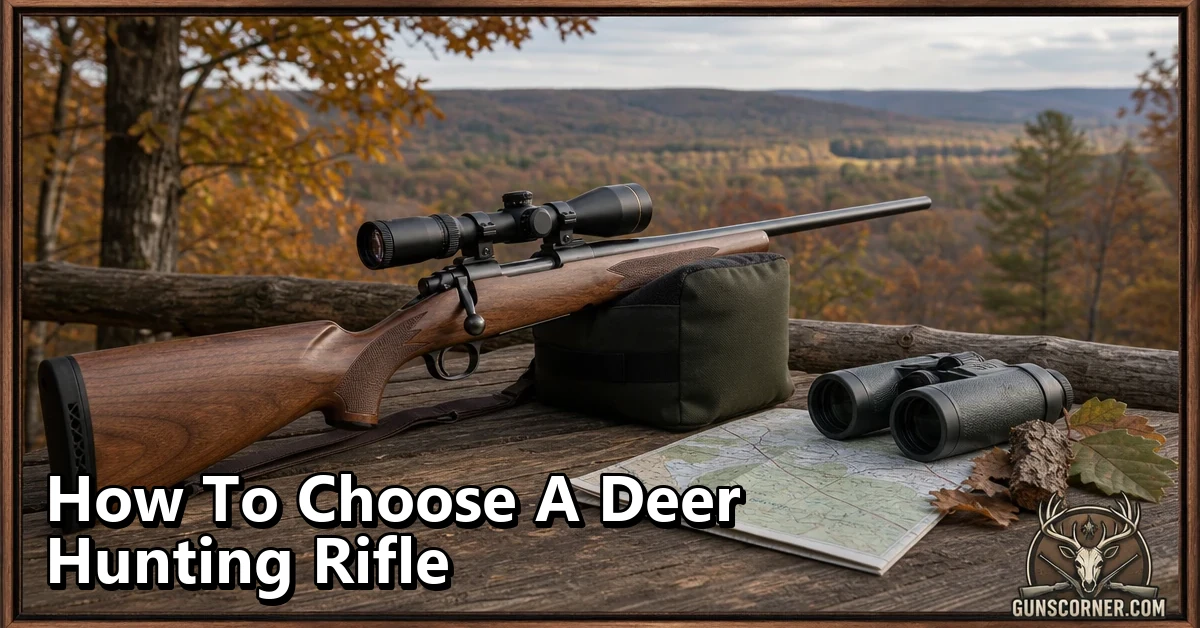
Choosing a deer hunting rifle involves more than picking a popular brand or the most powerful cartridge. The right setup should be legal where you hunt, comfortable to carry, appropriate for the terrain and deer species, and manageable enough for you to practice regularly. This guide explains how to compare cartridges, rifle actions, fit, optics, safety features, and total ownership costs without relying on unsupported “best rifle” claims.
To choose a deer hunting rifle, first check your local regulations, then match the rifle and legal cartridge to the deer species, terrain, expected range, and your ability to shoot accurately. Prioritize a rifle that fits comfortably, produces manageable recoil, and can be practiced with regularly. Choose an optic and mounting system as part of the complete package, and confirm the entire setup through safe training before hunting. No rifle guarantees success; ethical hunting depends on legal preparation, accurate identification, safe shot opportunities, and responsible recovery.
Important Legal and Safety Notice Before You Hunt
Hunting and firearm regulations vary by country, state, province, county, land type, season, and weapon category. Before buying or using a rifle, consult the current official wildlife agency and applicable firearms authority for:
- Hunting licenses, permits, tags, and hunter-education requirements
- Open seasons, legal hunting hours, and bag limits
- Permitted firearm types, cartridges, bullets, magazine rules, and projectile requirements
- Public-land, private-land, boundary, and discharge restrictions
- Blaze-orange or other required visibility clothing
- Transport, storage, and firearm-carry rules
- Harvest reporting and tagging requirements
Complete an approved hunter-education and firearm-safety course if you are new to hunting or firearms. Always identify the target and what lies beyond it. Never shoot toward people, roads, homes, livestock, vehicles, trails, or unclear movement. Follow the firearm manufacturer’s manual and seek instruction from a qualified instructor or range officer when needed.
Start with the Hunting Problem, Not the Rifle Brand
Identify the Deer Species, Hunting Method, Terrain, and Expected Range
Begin with the conditions in which you will actually hunt. A rifle for short-range hunting in dense cover may not need the same characteristics as one carried across open, steep terrain. Consider:
- The deer species and legal game category in your area
- Dense woods, brush, farmland, mountains, or open country
- Still hunting, blind hunting, stand hunting, or spot-and-stalk methods
- How far you normally expect to shoot after practicing safely
- How far and how often you must carry the rifle
- Whether local rules limit firearm or cartridge choices
Separate Realistic Shooting Distance from Maximum Cartridge Range
A cartridge may be capable of traveling much farther than a hunter can reliably place shots under field conditions. Your practical range is limited by your training, rifle fit, ammunition, visibility, wind, shooting position, target identification, and safe backstop.
Do not select a rifle simply because its cartridge is marketed as “flat shooting” or long range. A flatter trajectory does not compensate for poor judgment, inadequate practice, wind uncertainty, or an unsafe background.
Decide Whether You Need a Lightweight Carry Rifle, a General-Purpose Rifle, or a Specialized Setup
A lightweight rifle can be useful when carrying equipment over difficult terrain, but reducing weight may increase felt recoil or make the rifle less steady. A general-purpose rifle may offer a balanced compromise among weight, handling, recoil, and versatility.
A specialized setup can make sense for a specific environment, but beginners usually benefit from a simple, well-fitting rifle that encourages regular practice rather than a highly specialized configuration they do not yet understand.
Check the Rules Before Comparing Rifles
Confirm the Season, Permitted Firearm Type, Cartridge Restrictions, Magazine Rules, and Minimum Projectile Requirements
Some jurisdictions distinguish between firearm seasons, archery seasons, muzzleloader seasons, and special local zones. Rules may address cartridge design, projectile construction, caliber, magazine capacity, or firearm type. These requirements are not universal.
Check the current regulations before purchasing ammunition or a rifle. A rifle that is legal in one area may not be legal in another.
Check Restrictions on Public Versus Private Land and Local Discharge or Safety Zones
Public land may have additional restrictions involving roads, campgrounds, buildings, developed recreation areas, or nearby users. Private land still requires landowner permission and compliance with local discharge laws.
Use current maps to verify property boundaries and legal access. Never cross private property without permission, even if it appears to provide a convenient route.
Verify Current Regulations with the Relevant Wildlife Authority
Regulations can change between seasons. Confirm rules directly with the official state, provincial, territorial, or national wildlife authority. Also check official firearms guidance where transport, storage, or possession rules apply.
Understand Hunter-Education, Licensing, Blaze-Orange, Transport, and Storage Requirements
Many locations require specific training, licenses, tags, or visibility clothing. Transport and storage rules may also apply when traveling to and from hunting areas. Keep required documents accessible and follow the current wording of local regulations rather than relying on advice from an old forum post or past season.
Choose a Suitable Deer Cartridge
Prioritize Adequate, Legal Terminal Performance over Maximum Power
The cartridge should be legal for the deer species and jurisdiction and should support ethical shot opportunities at distances you can manage. “More powerful” is not automatically better if recoil reduces practice, accuracy, or confidence.
Terminal performance depends on several factors, including bullet construction, impact conditions, shot placement, range, and the animal involved. No cartridge guarantees a humane result.
Compare Recoil, Ammunition Availability, Bullet Selection, Trajectory, and Rifle Weight
Compare cartridges across the complete system rather than looking at one specification. Important considerations include:
- Whether you can practice comfortably and consistently
- Availability of suitable hunting and practice ammunition
- Availability of bullets appropriate for the legal game and cartridge
- Rifle weight and how it affects carrying and recoil
- Trajectory under the conditions and distances you actually practice
- Whether the cartridge is legal in your hunting area
Match Bullet Construction and Weight to the Intended Game and Legal Requirements
Use ammunition designed and approved for the intended game where required. Follow manufacturer information and local regulations for projectile type and construction. Avoid choosing ammunition solely because it is inexpensive, visually appealing, or recommended for a different species or firearm.
Evaluate Ammunition Cost Because Regular Practice Is Part of Ethical Hunting
The cost of practice ammunition affects how often you can train. A theoretically excellent cartridge is a poor practical choice if ammunition is difficult to obtain or too expensive for meaningful practice.
Include ammunition costs in your budget, along with range fees, instruction, cleaning supplies, and sight-in expenses.
Why “Flat Shooting” Alone Is Not a Sufficient Cartridge-Selection Criterion
Trajectory is only one part of a hunting system. A cartridge that produces more recoil may make it harder to maintain consistent form. A high-magnification optic may not help if the rifle does not fit or the hunter cannot identify the target clearly. Choose a balanced setup you can operate and practice safely.
Choose the Rifle Action and Operating System
Bolt-Action Rifles: Simplicity, Accuracy Potential, and Broad Suitability
Bolt-action rifles are common deer-hunting choices because their manual operation is straightforward, their controls are familiar to many hunters, and they are available in many configurations. Their suitability still depends on fit, condition, legal chambering, optic quality, and the individual rifle.
Lever-Action, Semiautomatic, Single-Shot, and Straight-Pull Options
Lever-action, semiautomatic, single-shot, and straight-pull rifles can also be suitable where legal. Each has a different manual of arms, loading procedure, maintenance routine, balance, and capacity.
Do not assume an action type is universally safer or more accurate. Safe handling depends on training, maintenance, and following the firearm’s instructions.
Compare Reliability, Loading Capacity, Manual of Arms, Maintenance, and Local Legality
Consider whether you can safely load, unload, cycle, carry, and store the rifle. Confirm that the action is legal for the intended season and area. Select a system whose controls you can operate without confusion while wearing hunting clothing and gloves.
When a Simpler Action May Be Better for a New Hunter
A simpler action can reduce the number of controls a beginner must learn. That does not eliminate the need for training. Practice must include safe muzzle direction, loading, unloading, cycling, carrying, and responding to common handling problems according to the manufacturer’s instructions.
Fit the Rifle to the Person
Check Length of Pull, Comb Height, Grip, Balance, and Overall Weight
A rifle should allow you to mount it consistently without stretching, crowding, or forcing your head into an awkward position. The stock should support a repeatable cheek position, and the grip should allow comfortable trigger access without disturbing the rifle’s alignment.
Balance matters as well. A rifle that feels excessively front-heavy or awkward may be harder to carry and position in the field.
Make Sure the Shooter Can Mount, Cycle, Unload, and Carry the Rifle Safely
Before buying, handle the unloaded rifle under supervision. Confirm that you can reach the controls, operate the action, maintain a safe muzzle direction, and carry the rifle without losing control.
Account for Clothing, Gloves, Physical Size, and Field Positions
Heavy clothing can change how a stock fits. Gloves may affect trigger access and control operation. Practice from the positions you may use legally and safely, such as supported sitting, kneeling, or standing positions, without forcing a shot from an unstable position.
Use Recoil Tolerance and Confidence—not Internet Popularity—to Guide the Choice
Recoil tolerance is personal. If recoil causes flinching, rushed shots, or avoidance of practice, the setup is not serving you well. An instructor or qualified range officer can help evaluate fit, technique, and possible alternatives.
Choose an Optic and Mounting System as Part of the Rifle Package
Select Magnification for the Actual Terrain and Shooting Distances
Choose magnification based on the distances and visibility conditions you can realistically encounter. Dense cover may favor a wider field of view and fast target acquisition, while open terrain may justify more magnification if you have the training to use it effectively.
Compare Eye Relief, Low-Light Performance, Reticle, Adjustment Range, and Durability
Pay attention to eye relief, reticle design, adjustment controls, low-light usability, and durability. Eye relief is especially important on rifles that produce substantial recoil. The optic should allow a clear sight picture without forcing an unsafe or uncomfortable head position.
Verify Ring Height, Mounting Compatibility, Torque Requirements, and Return-to-Zero Expectations
Confirm that the optic, rings, base, and rifle are compatible. Follow the mount and optic manufacturers’ torque instructions rather than guessing. After mounting, verify the rifle’s point of impact at the range.
Why More Magnification Does Not Automatically Improve Field Accuracy
Higher magnification can narrow the field of view, make movement more noticeable, and complicate target acquisition. It cannot correct poor rifle fit, bad shooting fundamentals, uncertain identification, or an unsafe background.
Evaluate a Rifle Before Buying
Confirm Manufacturer Specifications from Current Documentation
Specifications can vary by model, chambering, barrel length, stock, magazine, and production configuration. Check current manufacturer documentation for the exact model rather than relying on a retailer’s shortened listing.
Compare Unloaded Weight, Barrel Length, Chambering, Magazine Capacity, Stock Material, and Trigger Design
Compare the complete configuration, including:
- Exact chambering
- Unloaded weight and how the manufacturer defines it
- Barrel length and overall length
- Magazine type and capacity
- Stock material and dimensions
- Trigger adjustment information and safety design
- Compatibility with the intended optic and sling
Inspect Fit, Action Operation, Safety Operation, Bore Condition, Crown, and Scope Mounts on a Used Rifle
For a used firearm, have a qualified gunsmith inspect it when possible. Do not rely only on a visual check. Important areas include the bore, crown, action, safety, stock, fasteners, chamber, and scope mounts. Confirm safe function before firing.
Consider Warranty Support, Parts Availability, Serviceability, and Resale Value
Warranty support and service access may matter more than small differences in advertised specifications. Consider whether replacement parts, magazines, mounts, and professional service are reasonably available in your area.
Calculate the Total Purchase Cost
The rifle is only one part of the setup. Budget for:
- Optic and mounting system
- Sling and protective case
- Practice and hunting ammunition
- Cleaning and maintenance supplies
- Range fees or professional instruction
- Required licenses, tags, and hunter education
- Safe storage and transport equipment
Build a Safe and Ethical Setup
Use a Secure Backstop and Identify What Lies Beyond the Target
Before any shot, identify the deer, confirm that it is legal to harvest, and know what lies beyond it. A safe backstop is essential. Never shoot at movement, through uncertain cover, or toward roads, buildings, people, livestock, or other hunters.
Keep the Muzzle Pointed in a Safe Direction and Treat Every Firearm as Loaded
Keep your finger outside the trigger guard until you have made a lawful decision to shoot and are ready under safe conditions. Keep the muzzle pointed away from people and anything you do not intend to shoot.
Load and Unload According to the Firearm Manual and Local Rules
Use the manufacturer’s instructions for loading, unloading, chamber checks, storage, and malfunction procedures. Local regulations may require firearms to be unloaded or carried in a particular condition during transport.
Use a Sling and Carry Position Appropriate to the Terrain and Hunting Party
A sling can help control the rifle during movement, but it does not replace muzzle awareness. Use a carry position suitable for the terrain and keep the muzzle pointed in a safe direction, especially when climbing, crossing obstacles, or hunting with others.
Know When Not to Shoot
Pass on the shot when identification is uncertain, the background is unsafe, the animal is moving unpredictably, visibility is poor, the distance exceeds your practiced ability, or the shot angle does not provide a responsible opportunity. Restraint is part of ethical hunting.
Practice and Verify the Complete System
Zero the Rifle with the Exact Hunting Ammunition When Practical
Different ammunition can produce different points of impact. When practical, confirm the rifle’s zero with the ammunition you intend to hunt with. Follow safe range procedures and record the ammunition, environmental conditions, and sight settings.
Confirm Point of Impact from Realistic Field Positions
Bench shooting can help establish a baseline, but hunting rarely occurs from a perfect bench. Practice from stable, legal field positions and include safe use of rests, slings, and clothing you expect to wear.
Practice Safe Loading, Unloading, Cycling, Sling Use, and Malfunction Procedures
Practice these skills with qualified supervision and an unloaded firearm when appropriate. Follow the manual for malfunctions. If you are unsure how to address a problem, keep the muzzle in a safe direction and seek professional help rather than improvising.
Establish a Personal Maximum Range
Your maximum range should be based on repeatable, ethical performance under realistic conditions—not on a cartridge advertisement or a single successful shot. Include wind, visibility, position, time pressure, and the ability to identify the target and background.
Recheck Zero After Transport, Scope Adjustments, Ammunition Changes, or Hard Impacts
Verify the rifle after it has been transported roughly, the optic has been adjusted, ammunition has changed, or the rifle has received a significant impact. Do not assume a previous zero remains unchanged.
Practical Rifle-Selection Paths for Different Hunters
First-Time Deer Hunter on a Moderate Budget
Prioritize a legal, well-fitting rifle with widely available ammunition and a dependable optic. Reserve part of the budget for instruction, practice, safe storage, and necessary hunting documents rather than spending everything on the rifle itself.
Recoil-Sensitive or Smaller-Framed Hunter
Focus on proper fit, manageable recoil, and consistent practice. A qualified instructor can help distinguish between cartridge recoil, poor stock fit, and shooting technique. Avoid choosing a rifle solely because it is lightweight or powerful.
Dense-Cover Hunter Who Carries the Rifle Extensively
Handling, balance, field of view, and carry comfort may matter more than extreme range. Choose a setup that can be carried safely through the terrain and brought into position without snagging or excessive movement.
Open-Country Hunter Who Needs Greater Reach and Wind-Reading Discipline
Open terrain can require more careful range estimation, wind assessment, and supported shooting practice. Greater reach does not remove the need for a safe backstop, ethical shot discipline, and a personal range limit.
Hunter Choosing Between a New and Used Rifle
A used rifle may provide value, but condition and professional inspection are important. A new rifle may offer clearer warranty support. In either case, verify the exact configuration, legality, fit, and safe function before hunting.
Common Mistakes to Avoid
- Choosing a cartridge before checking current local regulations
- Buying the lightest rifle without considering recoil and stability
- Buying the most powerful cartridge without considering practice and fit
- Choosing an optic with unsuitable eye relief or excessive magnification
- Using an incompatible or poorly installed mounting system
- Judging accuracy from advertisements instead of personal practice
- Skipping hunter education or professional instruction
- Failing to recheck zero after transport or ammunition changes
- Ignoring safe backstops and what lies beyond the target
- Assuming a rifle is legal everywhere because it is legal in one jurisdiction
Troubleshooting Common Problems
| Problem | Possible Cause | What to Do |
|---|---|---|
| Groups are inconsistent | Poor fit, inconsistent technique, loose mounts, ammunition differences, or insufficient practice | Stop hunting with the setup, check mounting and rifle condition, and seek help from a qualified instructor or gunsmith. |
| Recoil causes flinching | Excessive recoil, poor fit, incorrect technique, or lack of familiarity | Work with a qualified instructor to evaluate fit and technique before changing equipment. |
| The scope picture is difficult to obtain | Incorrect eye relief, poor stock fit, improper mounting height, or excessive magnification | Have the optic and rifle fit checked, then practice from safe field positions. |
| The rifle is uncomfortable to carry | Excessive weight, poor balance, unsuitable sling setup, or inadequate clothing planning | Adjust the sling and carry method, and reassess the complete rifle package before replacing equipment. |
| You are unsure whether the setup is legal | Outdated information or confusing local rules | Contact the relevant official wildlife agency or firearms authority before hunting. |
| Zero changed after travel | Impact, loose mounts, damaged optic, or ammunition change | Inspect the setup and verify zero at a safe range before returning to the field. |
Ethical Hunting and Conservation
Responsible deer hunting depends on legal participation, sound judgment, and respect for wildlife and other land users. Practice before the season, obey seasons and bag limits, and pass on shots that are unsafe or beyond your reliable ability.
Use harvested game responsibly, follow tagging and reporting rules, and comply with meat transport and handling requirements. Respect landowners, public-land users, property boundaries, and other hunters. Conservation funding and wildlife management programs often depend on lawful hunting participation, licenses, and regulated harvest, but requirements differ by jurisdiction.
When to Get More Training or Professional Guidance
Seek additional help if you have never handled a firearm, have not completed hunter education, are uncertain about local regulations, or cannot confidently operate and carry the rifle safely.
Professional guidance is also appropriate when you need help with rifle fitting, recoil concerns, scope mounting, sight-in problems, used-firearm inspection, unfamiliar terrain, tracking, game recovery, or meat care. Useful resources include official hunter-education courses, certified instructors, qualified range officers, experienced ethical mentors, wildlife agencies, and reputable conservation organizations.
After the Hunt: Follow-Up, Gear Care, and Learning
- Unload, clean, store, and transport the rifle according to the manufacturer’s instructions and local law.
- Check the optic, mounts, sling, case, and other equipment for damage.
- Complete required tagging and harvest reporting promptly.
- Handle and cool harvested game responsibly according to local guidance.
- Record weather, terrain, animal sign, setup location, and what you learned.
- Review whether the rifle’s fit, weight, optic, and recoil supported safe decision-making.
Recommended Hunting Gear and Tools to Consider
You do not need expensive equipment to hunt responsibly. Choose gear based on local laws, hunting method, terrain, weather, safety needs, skill level, and budget.
- Legal deer rifle and suitable ammunition
- Compatible optic, rings, and mounting system
- Sling and protective firearm case
- Weather-appropriate clothing and required visibility gear
- Sturdy boots suited to the terrain
- Map, compass, GPS, or reliable navigation tool
- First-aid kit, water, food, and emergency communication
- Gloves, game bags, cooler, and meat-care supplies where applicable
- Safe storage equipment at home and during transport
Final Thoughts
Learning how to choose a deer hunting rifle starts with your hunting area, local regulations, realistic range, physical fit, and ability to practice. Select a legal cartridge and rifle that you can carry, operate, and shoot safely, then verify the complete system with proper training and field-position practice.
The best choice is not necessarily the most powerful, lightest, or most popular rifle. It is the setup that supports safe handling, accurate identification, ethical shot decisions, responsible recovery, and respect for wildlife and conservation.
Frequently Asked Questions
What is the best deer rifle for a beginner?
The best beginner rifle is a legal, reliable, properly fitted setup with manageable recoil, available ammunition, and an optic that is easy to use. The specific choice depends on local rules, deer species, terrain, and the hunter’s experience.
How much recoil is too much for deer hunting?
Recoil is too much when it causes flinching, pain, poor control, or avoidance of practice. Recoil tolerance varies by person and rifle fit. A qualified instructor can help identify whether the problem is equipment, technique, or both.
Should I choose a bolt-action or semiautomatic rifle?
Either may be suitable where legal. Compare the action’s controls, loading and unloading procedure, maintenance, capacity, fit, and your ability to operate it safely. A simpler action may be easier for some beginners to learn, but all firearms require training.
What scope specifications matter most for deer hunting?
Consider appropriate magnification, eye relief, field of view, reticle design, low-light usability, durability, and compatibility with the mounting system. More magnification is not automatically better in dense cover or for a new hunter.
How do I know my rifle is accurate enough for hunting?
Confirm its point of impact with the intended ammunition and practice from realistic, safe field positions. Your personal maximum range should be based on repeatable hits, clear identification, safe background conditions, and ethical judgment—not advertising claims.
Can I use the same rifle for different deer species and hunting areas?
Sometimes, but legality and suitability vary. Check the rules for each jurisdiction and species, then consider terrain, expected distance, rifle weight, bullet requirements, and your ability to shoot the setup accurately.
What should I do if my rifle or ammunition is not legal where I hunt?
Do not use it for that hunt. Contact the official wildlife agency or firearms authority, confirm the current requirements, and choose a compliant rifle and ammunition before entering the field.
Related posts:

8 Best Hiking Boots for Comfort, Traction, Waterproofing, and Trail Support

How to Build a DIY Glock 19: A Legal and Safety-Focused Guide

15 Best Wader Pants for Duck Hunting: Waterproof, Insulated, Bootfoot, and Breathable Picks
What Gear Do You Need for Goose Hunting? Complete Checklist
What Color Orange for Hunting? Blaze Orange Guide
