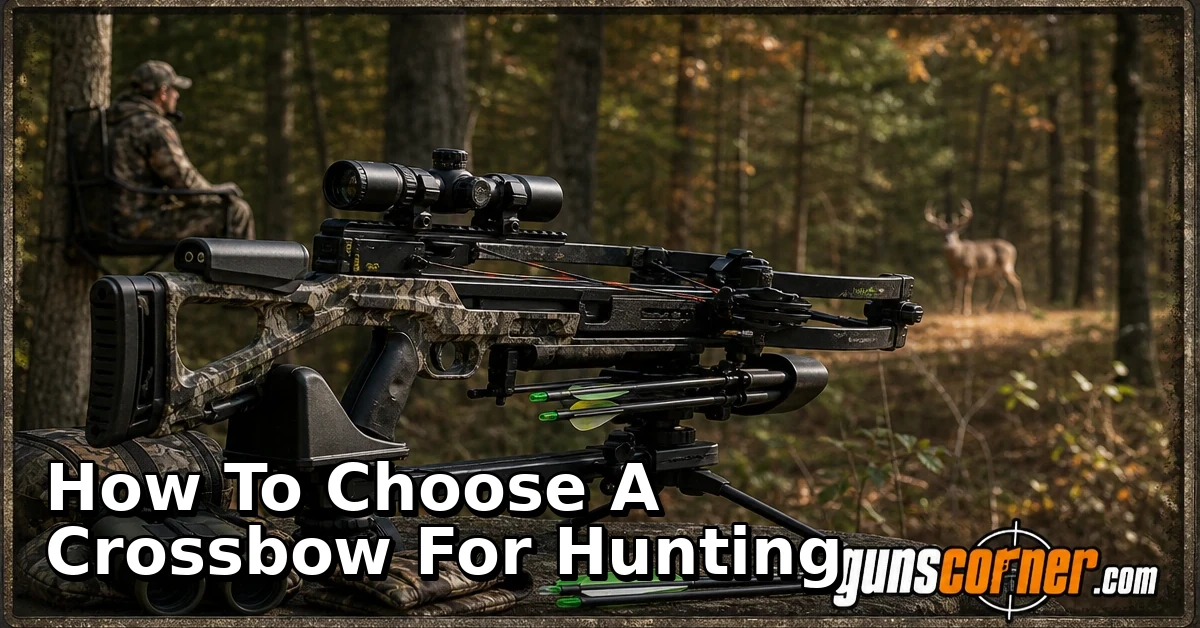
Choosing a hunting crossbow involves more than comparing advertised speed. The right setup must be legal for your hunt, comfortable to handle, compatible with approved bolts and broadheads, suitable for your terrain, and accurate within your ethical range. This guide explains how to choose a crossbow for hunting without overlooking safety, fit, maintenance, or total cost.
Start by checking your local regulations, then match the crossbow to the game, hunting environment, and shooting position. Compare fit, cocking method, cocked width, weight, safety features, compatible ammunition, optics, service support, and verified accuracy rather than relying on FPS alone. Practice with the exact bolt and broadhead combination you will hunt with, and set a maximum range based on repeatable, ethical accuracy.
Important Legal and Safety Notice Before You Hunt
Crossbow rules vary by country, state, province, species, season, and hunting zone. Before purchasing or hunting, consult the current regulations from your official wildlife agency.
- Confirm your hunting license, permits, tags, and hunter-education requirements.
- Check season dates, eligible species, hunting hours, and crossbow-specific restrictions.
- Verify rules for draw weight, dimensions, bolts, broadheads, and use during archery seasons.
- Confirm public-land boundaries or obtain private-land permission.
- Follow required visibility clothing rules.
- Learn safe cocking, loading, unloading, transport, and storage procedures.
- Never dry-fire or modify a crossbow outside the manufacturer’s instructions.
- Identify the target and what lies beyond it before loading or firing.
Start With the Hunt, Not the Crossbow
Define the game, hunting environment, and expected shooting distance
Begin with the species and terrain. A crossbow for whitetail deer in a ground blind may have different priorities from one used for larger game, thick cover, or open terrain. Consider the typical shooting lanes, expected distances, amount of walking, and whether you will carry the bow for extended periods.
Do not select a model based on a claimed maximum range. Your useful hunting range is the distance at which you can repeatedly place a properly selected hunting bolt in an ethical target area under realistic conditions.
Decide whether you will hunt from a blind, treestand, ground setup, or open terrain
- Treestand: Cocked width, balance, safe handling, and maneuverability matter in confined space.
- Ground blind: Overall length and limb clearance can affect shooting comfort.
- Still hunting: Lower weight and easy carrying may be more valuable than maximum speed.
- Open terrain: Optic quality, stable rests, and reliable accuracy deserve close attention.
Set a complete-system budget
Budget for more than the bare crossbow. A usable hunting system may require a cocking aid, scope or red dot, quiver, sling, case, compatible bolts, broadheads, target, rail lubricant, replacement strings, and professional setup.
Use a simple decision path
Use this order: game and law → fit → cocking → handling → accuracy → value. This prevents an attractive specification from overriding a poor fit or an illegal configuration.
Verify That Crossbow Hunting Is Legal for Your Hunt
Check the current state or provincial season, dates, zones, and eligible species
Some jurisdictions allow crossbows during specific seasons or dates, while others apply different rules by species, zone, or hunter category. Regulations can change, so do not rely on an old guide, retailer page, or product listing.
Confirm crossbow-specific rules
Check whether your jurisdiction specifies minimum draw weight, maximum or minimum dimensions, bolt length, broadhead design, cutting diameter, or other equipment requirements. Do not assume that a physically compatible setup is legally acceptable.
Check disability permits, hunter education, licensing, tagging, and transport requirements
Some locations have special permits or exceptions, while others require hunter education or specific authorization. Also verify tagging, harvest reporting, transport, and storage requirements before your hunt.
Use the wildlife agency’s current regulations
The official wildlife agency for your hunting area is the appropriate authority for legal requirements. Use retailer summaries only as general background, not as proof of current legality.
Choose the Crossbow Format That Fits the Situation
Compound versus recurve
| Format | Potential advantages | Trade-offs to consider |
|---|---|---|
| Compound crossbow | Often offers compact limbs, high advertised performance, and a broad selection of packages. | May have more components that require inspection, service, and correct adjustment. |
| Recurve crossbow | Generally has a simpler limb and string layout and may be easier to understand and service. | Can be wider and longer, which may matter in a blind or treestand. |
Neither format is automatically better for every hunter. A simpler recurve may be preferable when straightforward maintenance and field serviceability matter most. A compound may suit hunters who prioritize compact handling or a particular package, provided they can obtain proper service and compatible parts.
Standard versus compact or reverse-draw layouts
Compact and reverse-draw designs can change balance, width, and limb clearance. Evaluate how the bow handles in your actual blind, treestand, vehicle, and storage case rather than assuming a compact profile will suit every position.
Compare width, length, mass, balance, and limb clearance
Pay particular attention to axle-to-axle width when cocked. This is often more useful in the field than the manufacturer’s uncocked width. Also consider total mass, front-to-rear balance, stock length, and whether limbs or cams can clear your rest, blind window, or stand platform.
Match the Bow to the Hunter
Test the stock, grip, cheek weld, trigger reach, and shoulder position
Mount an unloaded crossbow as you would while hunting. Your cheek should contact the stock naturally, your trigger finger should reach the trigger without straining, and your shoulder should remain stable. Check both standing and supported positions if those reflect your hunting plans.
Choose a cocking method you can use consistently and safely
A crossbow that is difficult to cock may remain unused or be handled unsafely. The correct method depends on the model and manufacturer’s instructions.
Rope cocker, integrated crank, and manual cocking
- Rope cocker: Usually light and portable, but it requires controlled, symmetrical pulling.
- Integrated crank: Can reduce physical effort and help hunters with limited strength or mobility, but may add weight, cost, and complexity.
- Manual cocking: May be possible on some models, but should only be used exactly as directed by the manufacturer.
Account for strength, injury, mobility, or left-handed use
Choose a system that you can operate without pain, excessive strain, or loss of control. Check whether the safety, stock, scope, and cocking aid work comfortably for your dominant hand and physical needs.
Do not confuse advertised draw weight with cocking effort
Draw weight describes the bow’s limb resistance, but the practical effort you feel depends on the cocking system and design. Ask a qualified dealer to demonstrate the correct procedure for the exact model.
Evaluate Specifications Without Chasing Marketing Numbers
Draw weight
Draw weight may affect performance and may also be regulated. There is no universal hunting draw-weight requirement. Confirm the applicable law and follow the manufacturer’s complete specifications.
Advertised FPS
Feet per second is meaningful only when compared under similar test conditions. Manufacturer speed claims may depend on bolt mass, draw length, and testing method. A faster advertised speed does not automatically mean better hunting performance.
Arrow energy and momentum
Energy and momentum depend on more than speed. Bolt mass, construction, broadhead design, and impact conditions all matter. Do not infer penetration, lethality, or ethical range from FPS alone unless supported by reliable, species-appropriate evidence.
Power stroke, trigger quality, vibration, noise, and cocked width
Power stroke can be useful for understanding a design, but it should not replace practical testing. A predictable trigger, manageable vibration, reasonable noise, comfortable balance, and suitable cocked width may matter more in a real hunting position.
Why maximum speed alone does not establish hunting suitability
Accuracy, bolt compatibility, shot discipline, broadhead flight, and recovery ethics are more important than a headline number. Select a crossbow that helps you make consistent, safe decisions rather than encouraging shots beyond your ability.
Make the Complete Arrow-and-Broadhead System Compatible
Use manufacturer-specified bolts
Use only bolts that match the manufacturer’s specified length, weight, diameter, nock style, and spine or stiffness requirements. A bolt that fits the rail may still be unsuitable or unsafe.
Confirm broadhead compatibility
Verify that the broadhead type, cutting diameter, blade style, and total bolt weight are approved for your crossbow and legal for your hunt. Fixed-blade and mechanical broadheads can behave differently, so test the exact hunting configuration.
Understand how changes affect point of impact
Changing bolt weight, fletching, nock, or broadhead can alter point of impact and flight. Re-sight the crossbow after any equipment change and do not assume that a new component will match the previous setup.
Buy enough matched practice bolts
Have enough identical practice bolts for sight-in, repeated practice, and hunting preparation. Reserve clearly identified, undamaged bolts for hunting and inspect them before use.
Inspect Safety Features and Design Details
Anti-dry-fire mechanism, automatic safety, finger guards, and trigger operation
Look for safety features described in the manufacturer’s manual, including anti-dry-fire protection, an automatic safety, finger guards, and a predictable trigger. These features reduce some risks but cannot replace safe handling.
Safety is a complete system
Keep the crossbow pointed in a safe direction, know whether it is loaded or cocked, identify the target and background, and maintain a clear shooting zone. Never point it toward people, homes, roads, livestock, vehicles, or unclear movement.
No safety feature replaces training
Read the manual, complete hunter education where required, and practice under appropriate supervision. Learn how to cock, load, unload, transport, and store the specific model.
Never dry-fire or modify the crossbow
A dry fire can damage the bow and injure the user. Never bypass safety mechanisms, alter the trigger, or make unapproved modifications.
Inspect components before use
Before each use, inspect strings, cables, limbs, cams, rail, bolts, scope mounts, and fasteners for damage or looseness. Follow the manufacturer’s instructions for lubrication, replacement, and service intervals.
Compare the Scope and Accessories as Part of the Purchase
Scope or red dot
Evaluate reticle design, brightness control, eye relief, adjustment range, calibration, and visibility in the lighting conditions where you hunt. A clear sight picture is more useful than decorative features.
Confirm speed tapes or aiming marks
Speed tapes and reticles are only reliable when matched to the actual bolt setup and confirmed through shooting. Do not assume the manufacturer’s advertised speed matches your hunting configuration.
Included versus necessary accessories
Check whether the package includes a cocking aid, quiver, sling, case, scope, rail lubricant, and other required equipment. Also determine whether replacement strings, cables, and compatible bolts are readily available.
Warranty, service, parts, and recalls
Review warranty terms and identify authorized service providers. Confirm that replacement parts are available in your area and check the manufacturer’s current safety notices or recalls before purchasing.
Calculate the real cost
Add the crossbow, cocking system, optic, bolts, broadheads, case, target, maintenance supplies, and possible professional setup. A less expensive bow may become costly if essential accessories or service are unavailable.
Use a Repeatable Pre-Purchase Test
Handle the unloaded crossbow in hunting clothing
Wear the layers, gloves, and eye protection you expect to use. Check whether the stock, trigger, scope, and foregrip remain comfortable with your clothing.
Check cocking, loading, safety engagement, and unloading
Ask a qualified dealer to demonstrate each procedure. Follow the manual exactly and never experiment with an unfamiliar mechanism while the crossbow is loaded.
Measure fit in your hunting setup
Confirm that the crossbow fits through your blind window, can be maneuvered safely in your stand, and fits your case and vehicle without forcing limbs or accessories into contact with other equipment.
Compare accuracy and consistency
Whenever possible, compare group size and point-of-impact consistency using the intended hunting bolts. A model that produces impressive specifications but inconsistent groups is a poor hunting choice.
Reject unsupported equipment
Do not buy a model that lacks clear instructions, compatible ammunition, service support, or replacement parts in your area.
Prepare, Sight In, and Prove the Setup Before Hunting
Read the manual and use qualified setup help
Read the current manufacturer manual before assembly or shooting. Have initial setup completed by a qualified professional if you are unsure about scope mounting, string inspection, cocking equipment, or other technical procedures.
Use a suitable target and backstop
Use a target specifically rated to stop crossbow bolts and place it where the surrounding area is clear. Confirm that your backstop can safely contain a missed or passing bolt.
Sight in with the hunting setup
Use the same bolts, broadheads, scope, and accessories intended for the hunt. Mark damaged or questionable bolts and remove them from service.
Confirm broadhead flight
Broadheads can change point of impact and grouping. Test them at realistic practice distances and confirm that your groups remain suitable for your personal ethical standard.
Practice from the actual shooting position
Practice from a blind, treestand simulator, seated rest, or ground position as appropriate. Include realistic clothing, shooting rests, limited movement, and safe loading procedures.
Set a personal maximum range
Your maximum range should be based on repeatable accuracy, stable shooting positions, adequate visibility, animal presentation, and local conditions. If any factor is uncertain, do not take the shot.
Hunt Safely and Ethically With the Selected Crossbow
Identify the target and background
Before loading or firing, positively identify the legal target and what lies beyond it. Never shoot through uncertain vegetation or toward roads, houses, trails, livestock, vehicles, or people.
Keep body parts below the flight path
Keep fingers, hands, and other body parts below the rail and flight path. Follow the manufacturer’s loading procedure and use the approved bolt and nock.
Use a secure rest
Take shots only from a stable position. In a treestand, use a full-body safety harness and avoid leaning, twisting, or attempting an unstable shot.
Follow recovery and reporting rules
After a shot, follow local requirements for recovery, tagging, reporting, and dispatch. If the outcome is uncertain, seek help from an experienced mentor or qualified local guide rather than acting impulsively.
Unload and transport safely
Follow the manual for unloading. Transport the crossbow according to local law and manufacturer guidance, using a case when appropriate and keeping it inaccessible to unauthorized users.
Pros and Cons of Common Buying Priorities
Maximum speed
Potential benefit: A faster bolt may produce a flatter trajectory under comparable conditions.
Trade-offs: Higher cost, more noise or vibration, increased maintenance demands, and less tolerance for setup or aiming errors.
Compact width
Potential benefit: Easier maneuvering in blinds and treestands.
Trade-offs: Balance, handling, limb design, and service requirements may differ.
Recurve simplicity
Potential benefit: Straightforward design and potentially simpler service.
Trade-offs: Greater width or length may be inconvenient in confined hunting positions.
Premium package
Potential benefit: May include better fit, optics, support, or useful accessories.
Trade-offs: You may pay for speed or accessories that do not improve your actual hunting setup.
Crossbow Selection Checklist
- Is it legal for the intended species, season, and hunting area?
- Does it fit your shoulder, cheek, grip, trigger reach, and shooting position?
- Can you cock and unload it safely and consistently?
- Are compatible bolts and broadheads available and legal?
- Does it have suitable safety features and clear instructions?
- Can you obtain service, replacement parts, and warranty support?
- Does it group accurately at your ethical hunting distance?
- Does it fit your blind, treestand, case, vehicle, and storage space?
- Have you budgeted for the complete hunting system?
Common Mistakes to Avoid
- Buying based only on advertised FPS.
- Ignoring local crossbow regulations until after purchase.
- Choosing a model that is too heavy or difficult to cock.
- Using bolts or broadheads because they fit physically without checking specifications.
- Trusting unverified speed tapes or reticle marks.
- Failing to test broadheads with the hunting setup.
- Practicing only from a bench instead of the actual hunting position.
- Dry-firing, modifying, or bypassing safety mechanisms.
- Taking shots beyond repeatable accuracy.
- Forgetting the cost of targets, bolts, broadheads, a case, and maintenance.
Troubleshooting Common Problems
| Problem | Possible Cause | What to Do |
|---|---|---|
| Inconsistent groups | Loose mounts, damaged bolts, poor rest, inconsistent cocking, or unsuitable ammunition. | Inspect the equipment, use matched bolts, review the manual, and seek qualified service. |
| Broadheads group differently | Different flight characteristics from field points. | Re-sight with the exact hunting broadheads and confirm compatibility. |
| Cocking is uncomfortable | Unsuitable method, poor fit, or insufficient physical ability. | Use the approved rope cocker or crank and ask a qualified dealer for assistance. |
| Scope marks do not match impacts | Actual bolt speed differs from the scope calibration. | Confirm the setup at known distances and use verified adjustments. |
| Crossbow does not fit the blind | Excessive length, width, or limb clearance requirements. | Test the setup unloaded and choose a safer position or better-fitting model. |
| Unclear legality | Changing or jurisdiction-specific regulations. | Contact the official wildlife agency before hunting. |
Ethical Hunting and Conservation
Ethical crossbow hunting means selecting equipment that supports responsible decisions rather than encouraging marginal shots. Practice regularly, respect seasons and bag limits, and pass on any shot where the target, background, distance, or animal presentation is uncertain.
Respect landowners, other hunters, wildlife, and public-land users. Avoid trespassing, recover game responsibly, follow harvest-reporting rules, prevent waste, and leave your hunting area cleaner than you found it. Licenses and lawful participation also support wildlife management and conservation programs.
When to Get More Training or Professional Guidance
Seek additional instruction if you have never handled a crossbow, are unsure about local laws, cannot cock or unload the bow comfortably, lack confidence in safe shooting, or are unfamiliar with the terrain.
Useful sources of help include official hunter-education courses, certified archery instructors, qualified sporting-goods professionals, experienced ethical mentors, conservation organizations, and local hunting clubs.
After the Hunt: Follow-Up, Gear Care, and Learning
- Unload, inspect, and store the crossbow according to the manual.
- Check strings, cables, limbs, fasteners, bolts, and accessories for damage.
- Clean and dry equipment before storage.
- Complete required tagging and harvest reporting.
- Handle harvested game promptly and follow local transport and meat-care rules.
- Record weather, terrain, animal sign, shooting position, and lessons learned.
- Replace damaged or questionable bolts and maintain a clear separation between practice and hunting equipment.
Recommended Hunting Gear and Tools to Consider
You do not need the most expensive equipment to hunt responsibly. Choose equipment based on local law, terrain, hunting method, weather, physical ability, and skill level.
- Legal crossbow with the correct manufacturer-approved bolts
- Compatible broadheads approved for the hunt
- Rope cocker or integrated crank if required
- Scope or red dot matched to the setup
- Quiver, sling, and protective case
- Crossbow-rated target and safe backstop
- Weather-appropriate clothing and required visibility gear
- Map, compass, GPS, or navigation app
- First-aid kit, water, emergency communication, and flashlight
- Gloves, game bags, cooler, and meat-care supplies where applicable
Final Thoughts
Learning how to choose a crossbow for hunting starts with legality, fit, cocking ability, compatible ammunition, and realistic accuracy—not the biggest speed number. Test the complete system, practice from your actual hunting position, and set a personal range limit that supports ethical shot decisions. With careful preparation, safe handling, and respect for wildlife and regulations, you can choose equipment that suits your hunt and your abilities.
Frequently Asked Questions
What crossbow specifications matter most for deer hunting?
Prioritize legality, comfortable fit, safe cocking, compatible bolts and broadheads, manageable width and weight, reliable optics, service support, and consistent accuracy at your ethical range. No single specification guarantees suitability.
Is a faster crossbow automatically better?
No. Speed can affect trajectory, but it does not prove accuracy, penetration, reliability, or ethical range. Compare speed only when bolt mass and test conditions are disclosed.
Should I choose a recurve or compound crossbow?
Choose based on your hunting position, desired handling, maintenance preferences, service access, and budget. A recurve may offer simplicity, while a compound may provide a more compact layout, but neither is universally superior.
What cocking aid is best if I cannot comfortably cock the bow by hand?
Use the rope cocker or integrated crank approved for that specific model. A crank may reduce physical effort, while a rope cocker is generally lighter and simpler. Have a qualified dealer demonstrate safe use.
Can I use any bolt or broadhead that fits physically?
No. Use only ammunition that meets the manufacturer’s specifications and local legal requirements. Re-sight the crossbow after changing bolts or broadheads.
How do I know whether a scope’s speed marks are accurate?
Verify them at known distances using the exact bolt and broadhead setup intended for hunting. Adjust or replace the sight if the marks do not correspond to actual impacts.
How far should I practice before deciding my maximum hunting range?
Practice at several realistic distances and from your actual hunting position. Set your maximum range where you can repeatedly produce ethical groups under safe, practical conditions, then reduce it when wind, visibility, angle, or animal movement creates uncertainty.
What should I check before buying a used crossbow?
Inspect limbs, cams, strings, cables, rail, trigger, safety, scope mounts, and fasteners. Confirm that compatible bolts, cocking aids, replacement parts, manuals, and service support are available. If damage or dry-fire history is suspected, have it evaluated by a qualified professional.