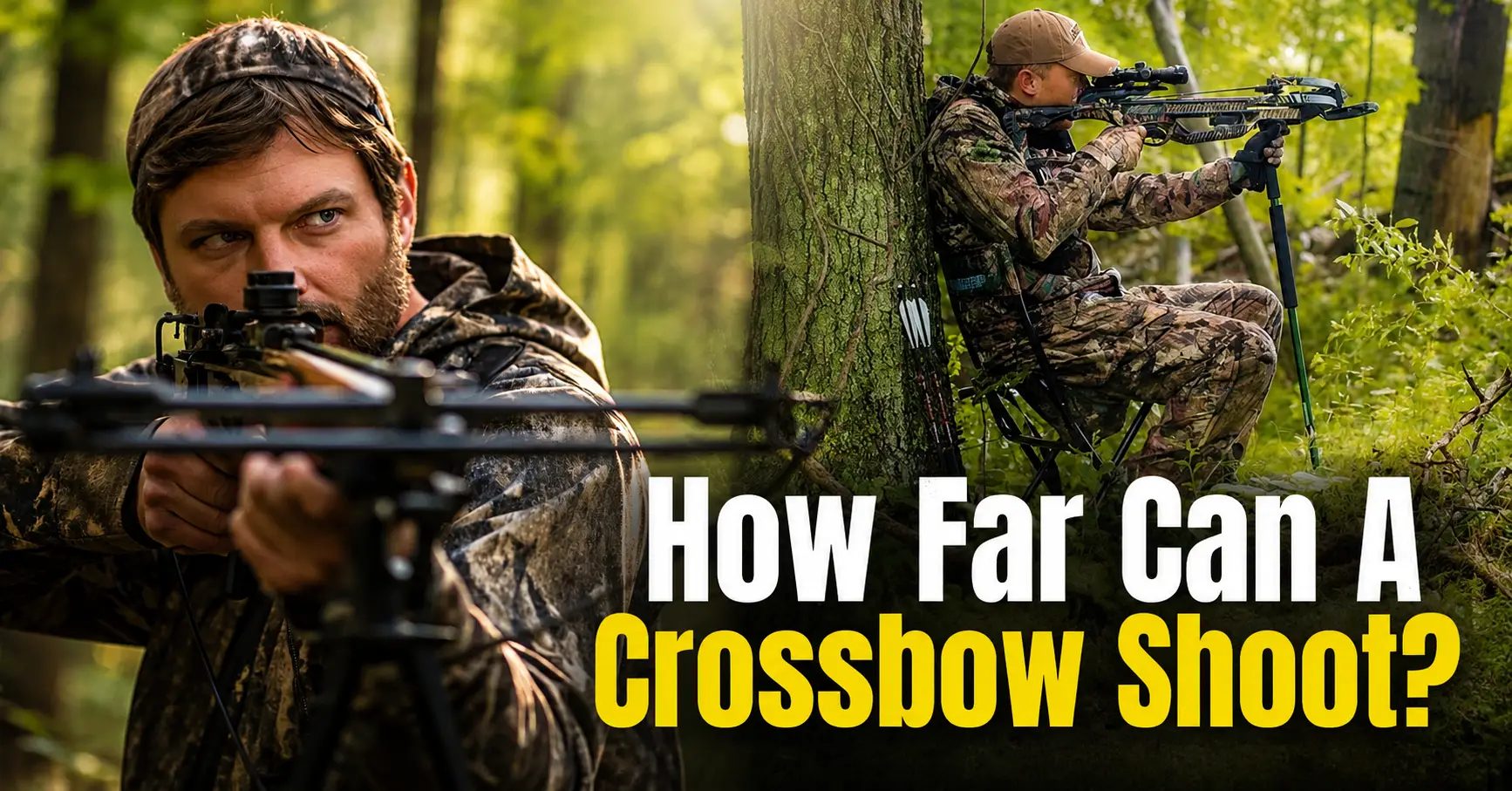
A modern crossbow can send a bolt much farther than most people should ever attempt to use it. That is why the question “how far can a crossbow shoot?” needs three different answers: how far the bolt can physically travel, how far a trained shooter can hit a controlled target, and how far a hunter can make a safe, legal, repeatable, and ethical shot under field conditions.
For most hunters, the third answer is the one that matters. Texas hunter education materials describe most crossbow hunting shots as short range, generally between 20 and 40 yards. Wisconsin crossbow-safety guidance warns against long shots at game and notes that many crossbows cannot overcome an animal’s reaction time beyond 50 yards. Your personal effective range may be shorter because terrain, wind, shooting position, target movement, visibility, equipment condition, and practice all reduce field accuracy.
Quick Answer
A crossbow bolt can physically travel hundreds of yards, so every shot requires a safe direction and a reliable backstop. Controlled target shooting may be possible at longer distances for trained users with suitable equipment, but that does not establish an ethical hunting range. Most crossbow hunting opportunities are kept around 20–40 yards, and many safety educators caution against shots beyond 50 yards. Hunt only within the distance at which you can repeatedly place every practice bolt in the intended target area from realistic field positions.
Important Legal and Safety Notice Before Using a Crossbow
Crossbow laws vary by country, state, province, tribe, county, season, species, land type, age, disability status, and equipment specification. Check the current official regulations for licensing, bowhunter or crossbow education, legal seasons, minimum draw weight, bolt length and weight, broadhead design, scopes, electronic devices, discharge setbacks, transport, tagging, reporting, and land access.
- Treat a cocked crossbow as a loaded hunting implement. Keep it pointed in a safe direction and keep the safety engaged until the shot is authorized.
- Keep fingers and hands below the rail. Never allow any body part to enter the string or cable path.
- Never dry-fire. Use only the manufacturer-approved bolt specifications and approved decocking procedure.
- Use a real backstop. A target alone may not stop a missed or pass-through bolt.
- Never shoot into the air. A crossbow bolt can travel hundreds of yards and remain dangerous.
- Identify the target and what lies beyond it. Never shoot toward roads, trails, homes, people, vehicles, livestock, buildings, or unclear movement.
- Handle broadheads as razor-sharp tools. Keep them covered in a rigid quiver during transport.
- Use a full-body harness in an elevated stand. Raise and lower an uncocked crossbow with a haul line after securing yourself.
Three Different Crossbow Ranges
Maximum Flight Range
The total distance a bolt might travel when launched at an elevated angle. This can be several hundred yards and is not a useful or safe hunting measure.
Target Range
The distance at which a shooter can hit a stationary target under controlled conditions. Support, target size, weather, optics, and skill strongly affect it.
Ethical Hunting Range
The shorter distance at which the hunter can identify a legal animal, confirm a safe background, account for movement, and place the bolt reliably.
Crossbow Range Comparison
| Range Type | Typical Context | Practical Distance | What Limits It | Responsible Takeaway |
|---|---|---|---|---|
| Physical bolt travel | Uncontrolled maximum-distance flight | Potentially several hundred yards | Launch angle, velocity, bolt mass, drag, wind, terrain | Never test by shooting skyward; use a controlled range and full backstop |
| Basic hunting opportunity | Common deer-sized-game field conditions | Often 20–40 yards | Target movement, reaction time, wind, angle, vegetation, shooter position | This is a common educational range, not an automatic permission to shoot |
| Upper hunting caution zone | Longer shot considered by an experienced user | Approaching 50 yards | Longer flight time, greater drop, more wind drift, less margin for movement | Many hunters should set a shorter personal limit; pass when uncertain |
| Controlled target practice | Stationary target, known range, safe backstop, stable support | May extend beyond ordinary hunting range | Target size, crossbow design, sight system, bolt consistency, support, weather | Target accuracy does not prove ethical hunting capability |
| Personal effective range | Your actual repeatable field performance | Different for every shooter and setup | Practice quality, physical ability, field position, equipment, confidence, conditions | Use the shortest limit established under realistic practice, not a manufacturer’s maximum |
Important: These are educational ranges, not universal legal standards. Your official wildlife agency and crossbow manufacturer control the applicable equipment and hunting rules.
Why a Bolt Can Fly Farther Than You Should Hunt
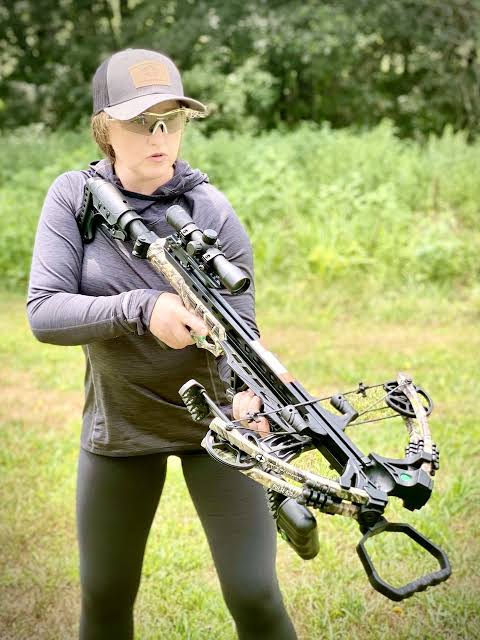
A crossbow stores substantial energy in its limbs and transfers part of that energy to a short arrow commonly called a bolt. Once released, the bolt continues beyond ordinary hunting distance even though it is losing speed and dropping rapidly.
The important distinction is that “still moving” does not mean “accurate, predictable, or suitable for hunting.” At longer distance:
- Flight time increases, giving an animal more opportunity to move.
- Small range-estimation errors cause larger vertical errors.
- Crosswinds and gusts have more time to move the bolt sideways.
- Minor differences between bolts become more visible.
- Broadheads may group differently from field points.
- Branches, grass, or unseen obstructions become harder to detect.
- Shooting from a stand, blind, kneeling position, or uneven ground changes stability.
- Low light makes precise target identification and background assessment harder.
What Determines How Far a Crossbow Can Shoot Accurately?
Crossbow Speed
Higher advertised feet-per-second figures can flatten trajectory, but speed alone does not determine accuracy or ethical range. The advertised number may be measured with a particular bolt weight under controlled conditions. Your actual bolt, broadhead, accessories, string condition, temperature, and crossbow can produce a different result.
Bolt Weight and Manufacturer Compatibility
Use only bolts that meet the manufacturer’s length, total-weight, nock, and construction requirements. An incompatible or excessively light bolt can damage the crossbow or create an unsafe firing condition. A heavier bolt normally travels more slowly but may retain momentum differently. Do not experiment outside the manual.
Broadhead and Field-Point Flight
Broadheads add aerodynamic surfaces that can expose alignment or tuning problems. A crossbow that groups field points well is not automatically ready for hunting. Confirm that legal hunting broadheads group with the intended point of impact, using an approved broadhead target and safe handling procedures.
Optic Calibration
Crossbow scopes may use fixed aiming lines, illuminated reticles, speed-adjustable systems, or distance marks. Every system must be set up according to its manual with the correct bolt. Do not assume that a line represents a specific range until it has been verified safely on a measured range.
Shooting Support
A bench rest can hide problems that appear when kneeling, seated, standing, or shooting from a blind. The stock position, grip pressure, rest contact, cant, and trigger control should remain consistent. Never place hands or a rest where they can contact moving limbs, strings, or cables.
Wind and Weather
Wind affects a crossbow bolt over time. Gusty or crosswind conditions reduce the reliable range, especially in open fields. Rain, snow, cold, heat, and changing light can also alter visibility, equipment handling, and shooter comfort.
Target Movement and Reaction Time
A stationary target does not move after the trigger breaks. An animal may step, turn, lower, or react to sound while the bolt is in flight. This is one reason an accurate target group at longer range does not establish an ethical hunting distance.
How to Find Your Personal Effective Range
Step 1: Read the Manual and Check Local Rules
Confirm the approved bolt specifications, cocking method, decocking procedure, scope setup, safety operation, maintenance intervals, and inspection points. Then check whether crossbows are legal for the species, season, zone, and land you plan to hunt.
Step 2: Inspect the Crossbow Before Practice
Look for damaged limbs, loose fasteners, serving wear, frayed strings or cables, cracked bolts, damaged nocks, loose inserts, bent components, or scope movement. Stop and contact the manufacturer or a qualified crossbow technician when damage is suspected.
Step 3: Use a Measured Range and Safe Backstop
Practice only where crossbows are allowed. Place an approved crossbow target in front of a backstop capable of stopping misses and pass-throughs. Confirm that no person, animal, road, trail, building, or vehicle is behind or beside the shooting area.
Step 4: Establish Close-Range Accuracy First
Begin at the manufacturer’s recommended setup distance. Verify the first aiming point and learn a consistent cocking, loading, safety, support, and trigger routine before moving farther back.
Step 5: Extend Distance Gradually
Move in small measured increments. At each distance, shoot enough groups to show repeatable performance rather than relying on one good bolt. Stop increasing distance when groups become inconsistent or when you cannot confidently call each shot.
Step 6: Confirm With the Hunting Bolt and Broadhead
Use the exact legal bolt and broadhead combination intended for hunting. Follow target and broadhead-safety instructions. If broadheads do not group with practice points, contact the manufacturer or a qualified archery professional rather than making unsafe modifications.
Step 7: Practice From Realistic Field Positions
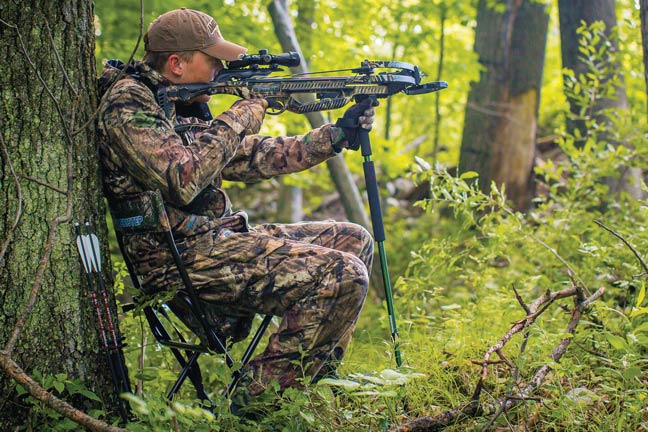
Repeat practice from the supported positions you will actually use, such as a blind chair, shooting rail, tripod, kneeling support, or elevated stand. Wear the same clothing and gloves, but keep loose fabric away from the string path.
Step 8: Add Realistic Conditions Conservatively
Practice in safe daylight under modest wind, colder clothing, and common field angles. Do not intentionally practice in dangerous weather. If accuracy changes, shorten your range.
Step 9: Set a Limit Below Your Best-Day Maximum
Your hunting limit should include a safety margin. Use the farthest distance at which every properly executed practice shot remains inside the target area selected with a qualified instructor, then shorten that limit for wind, low light, unstable support, animal alertness, or uncertain range.
Step 10: Pass on Any Shot That Does Not Meet Every Condition
Do not shoot unless the animal is legal and clearly identified, the path is unobstructed, the background is safe, the range is known, your position is steady, and the opportunity is within your demonstrated ability. Passing is a normal part of ethical bowhunting.
Crossbow Hunting Range Versus Target Range
Long-range target practice can improve understanding of trajectory, wind, equipment consistency, and shooting form. It can also make shorter shots feel easier. However, target practice has advantages that hunting does not:
- The target is stationary.
- The range is measured.
- The background and backstop are controlled.
- The shooter can wait for ideal timing.
- There is no need to identify species, sex, age class, or legal status.
- A poor hit damages a target rather than risking an unrecovered animal.
For that reason, a shooter who can group at 80 or 100 yards on a range may still maintain a 30- or 40-yard hunting limit.
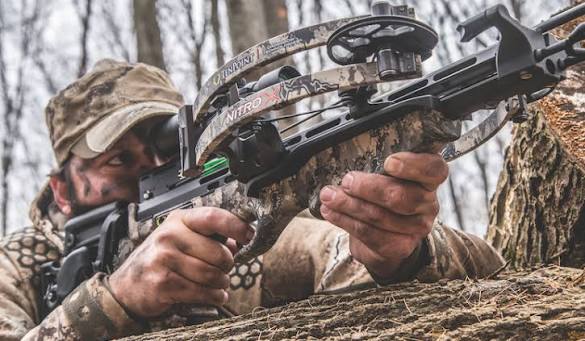
Safe Crossbow Handling Checklist
- Use a cocking aid exactly as directed to keep the string centered.
- Confirm the safety is engaged immediately after cocking.
- Keep the rail, string path, and limb area clear of fingers, clothing, rests, and blind material.
- Load the bolt fully against the string as the manual specifies.
- Use only approved nock style, bolt length, and total weight.
- Keep broadheads covered until preparation at a safe location.
- Never climb, cross an obstacle, or enter a vehicle with a cocked crossbow.
- Use a haul line for elevated stands and keep the crossbow unloaded and uncocked during raising or lowering.
- Never use a tree, bank, water surface, or unknown ground as the only backstop.
- Decock only by the approved discharge bolt, target, unloading device, or manufacturer procedure.
- Store the crossbow uncocked, secured from unauthorized users, and separate from bolts where required.
Common Mistakes That Make Shooters Overestimate Range
- Using advertised speed as a hunting-range promise. Speed does not account for the shooter, broadhead, wind, target movement, or terrain.
- Judging ability from one successful long shot. Ethical range requires repeatability, not a lucky hit.
- Practicing only from a bench. Field positions are less stable and should determine the real limit.
- Using field points without broadhead confirmation. Hunting points can change grouping and impact.
- Guessing distance. Range-estimation errors become more serious as distance increases.
- Ignoring the animal’s reaction time. The target can move while the bolt is in flight.
- Shooting through grass or branches. A small obstruction can deflect the bolt.
- Copying another hunter’s limit. Equipment, practice, vision, support, and judgment differ.
- Failing to inspect bolts. Cracks, damaged nocks, loose inserts, or bent components can create dangerous flight.
- Not reducing range in poor conditions. Wind, low light, cold hands, bulky clothing, and unstable footing require a shorter limit.
Troubleshooting Crossbow Accuracy and Range Problems
| Problem | Possible Cause | Safe Response |
|---|---|---|
| Groups spread rapidly as distance increases | Inconsistent support, loose optic, bolt variation, wind, shooter input, or equipment issue | Return to close range, inspect equipment, verify fasteners according to the manual, and seek professional help if the cause is unclear. |
| Broadheads hit differently from field points | Alignment, broadhead design, bolt inconsistency, optic setup, or crossbow tuning | Stop hunting use until the combination is verified. Use approved components and contact the manufacturer or a qualified pro shop. |
| Point of impact changes between sessions | Loose mount, temperature shift, damaged string or cables, inconsistent cocking, or scope movement | Inspect the complete system while uncocked. Do not continue if structural damage or scope movement is suspected. |
| String is not centered after cocking | Uneven manual cocking or incorrect cocking-aid use | Do not fire until the manual-approved procedure is followed. Use the recommended cocking device. |
| Bolt will not seat correctly | Wrong nock, incorrect bolt length, damaged rail, debris, or incompatible component | Remove it safely and verify the exact manufacturer specification. Never force a bolt into place. |
| Crossbow makes a new vibration or cracking sound | Loose component, limb damage, string issue, or internal failure | Stop immediately, unload or decock only as safely directed, and have the crossbow inspected. |
| Scope marks do not match measured distances | Incorrect speed setting, bolt mismatch, mount issue, or sight-in procedure | Return to the manual’s starting distance and setup procedure. Do not guess holdover in the field. |
| Accuracy is good from a bench but poor from a blind | Rest contact, chair height, clothing, limited movement, or awkward body position | Reconfigure the safe shooting position and shorten hunting range to the distance demonstrated from that position. |
| Bolts bury too deeply in the target | Target is not rated for the crossbow’s speed or has worn out | Replace it with a properly rated crossbow target. Do not pull aggressively in a way that damages bolts or causes injury. |
Maintenance That Protects Accuracy and Safety
- Follow the manufacturer’s lubrication and rail-care schedule without over-lubricating.
- Inspect strings, servings, cables, limbs, cams, axles, fasteners, trigger housing, and stock before each session.
- Check each bolt for straightness, cracks, splinters, loose inserts, damaged vanes, and correct nock orientation.
- Keep optics clean with approved lens tools and verify mount security.
- Replace strings and cables at the manufacturer’s interval or earlier when damage appears.
- Dry the crossbow after rain and store it in a cool, dry, secured location.
- Do not attempt limb, trigger, string, cable, or safety repairs without proper training.
- Record the bolt model, total weight, broadhead, sight settings, and maintenance date.
Ethical Crossbow Hunting and Conservation
Crossbow hunting supports conservation only when it is legal, safe, accurately reported, and consistent with wildlife-management rules. Buy the required license and tags, obey seasons and limits, respect public and private boundaries, report harvest as required, avoid waste, and participate in agency sampling when requested.
An ethical hunter does not use the longest possible shot merely because the crossbow is fast or the scope has another aiming mark. The correct decision is the one that gives the highest confidence in a clean, legal outcome and safe recovery. When any part of the opportunity is uncertain, do not shoot.
When to Get More Training or Professional Help
Seek assistance from an official hunter-education program, certified bowhunter instructor, crossbow manufacturer, or qualified archery professional when:
- You have not completed hunter or bowhunter education.
- You are unfamiliar with cocking, loading, unloading, decocking, or broadhead handling.
- You cannot produce repeatable groups at close range.
- You are unsure whether the bolt, nock, or broadhead is compatible.
- The string, serving, cable, limb, safety, trigger, or optic appears damaged.
- You are using an adaptive cocking device or accessibility equipment for the first time.
- You do not understand crossbow laws, land boundaries, tagging, or reporting.
- You plan to hunt from an elevated stand and have not completed stand-safety training.
FAQs
1. How far can a crossbow shoot?
A bolt can physically travel several hundred yards, but practical target and ethical hunting ranges are much shorter. Most hunting shots are commonly kept around 20–40 yards.
2. What is the maximum range of a modern crossbow?
The total flight range depends on speed, bolt weight, angle, wind, and terrain. It can be several hundred yards, which is why shooting into the air or without a backstop is dangerous.
3. What is an ethical crossbow hunting range?
It is the distance at which the hunter can repeatedly place every practice bolt in the intended target area from realistic positions while accounting for a live animal’s movement and a safe background.
4. Is 40 yards a long crossbow shot?
Forty yards is near the upper end of the common 20–40-yard hunting range taught by many hunter-education resources. It may be too far for a beginner or in poor field conditions.
5. Can a crossbow ethically hunt at 50 yards?
Some experienced hunters may demonstrate accuracy near 50 yards, but longer flight time and animal reaction reduce the margin for error. Many hunters should maintain a shorter limit.
6. Can a crossbow hit a target at 100 yards?
Some modern setups and skilled shooters can hit controlled targets at 100 yards. That does not make 100 yards an appropriate hunting distance.
7. Can a crossbow shoot 500 yards?
A bolt may travel that far under certain launch conditions, but accurate and responsible shooting at that distance is not realistic for ordinary hunting.
8. How far will a 400-fps crossbow shoot?
Advertised speed does not provide one reliable range. Bolt mass, drag, launch angle, wind, broadhead, and the shooter all affect distance and accuracy.
9. Does a faster crossbow increase ethical range?
It can reduce trajectory drop and flight time, but it does not remove wind, target movement, range-estimation error, shooter inconsistency, or legal limits.
10. How much does a crossbow bolt drop?
Drop depends on the actual launch speed, bolt configuration, sight setup, and distance. Use the manufacturer’s sight-in process and a measured range rather than a generic chart.
11. Why do crossbow bolts lose accuracy at distance?
Longer flight magnifies wind drift, range error, bolt inconsistency, vibration, broadhead steering, and shooter input.
12. Does bolt weight affect range?
Yes. Weight affects speed, trajectory, momentum, and crossbow safety. Use only the manufacturer-approved weight range.
13. Are lighter bolts better for long range?
Not automatically. An excessively light or incompatible bolt can damage the crossbow and may be unsafe. Never choose a bolt outside the manual to gain speed.
14. Do broadheads reduce accuracy?
They can expose alignment and tuning differences because their blades interact with airflow. Confirm hunting-broadhead grouping on an approved target.
15. Can I use field-point accuracy to set my hunting range?
No. Your final hunting limit should be verified with the exact legal bolt and broadhead combination you intend to use.
16. Does wind affect a crossbow bolt?
Yes. Crosswind and gusts can shift the bolt, especially as distance and flight time increase.
17. Should I use a rangefinder?
A lawful rangefinder can reduce distance-estimation error. Check local equipment rules and confirm the reading without delaying safe judgment.
18. Can branches deflect a crossbow bolt?
Yes. Never shoot through brush, grass, twigs, or an unclear opening. Move or wait for a completely clear path.
19. How far should a beginner practice?
Begin at the manufacturer’s setup distance and move back gradually only after producing repeatable close-range groups under qualified supervision.
20. How do I know my personal effective range?
Test repeatable accuracy with the hunting setup from realistic field positions, then choose a distance shorter than your best-day maximum.
21. Does hunting from a tree stand change range?
It changes the shooting angle, body position, and available support. Practice safely from an approved elevated setup while wearing a full-body harness.
22. Can I carry a cocked crossbow to a tree stand?
The safest practice is to raise and lower it uncocked and unloaded with a haul line after you are secured. Follow local law and the manufacturer’s instructions.
23. Can I decock a crossbow without firing?
Some models have approved decocking systems, while others require a discharge bolt or target. Use only the procedure in the manual.
24. What happens if I dry-fire a crossbow?
Dry-firing can cause severe equipment damage and injury. Stop using the crossbow and have it inspected according to the manufacturer’s guidance.
25. Is a crossbow safer than a compound bow?
Each has different hazards. A crossbow remains cocked, uses a trigger, stores high energy, and has a dangerous string path. Proper training is essential.
26. Can a crossbow bolt pass through a target?
Yes. Use a target rated for the crossbow’s speed and a reliable backstop behind it.
27. How far away should buildings and roads be?
Setback and discharge laws vary. Check the current local regulation and never depend only on the legal minimum when the background is unsafe.
28. Do crossbow scopes make long shots ethical?
No. A scope helps aim, but it does not control wind, animal movement, equipment condition, shooter ability, or safe background.
29. How often should I practice?
Practice regularly before the season and after any equipment change, maintenance, impact, or long storage period. Quality and realistic conditions matter more than a single long session.
30. When should I shorten my normal range?
Shorten it in wind, low light, rain, cold, awkward positions, heavy clothing, uncertain footing, animal alertness, or any condition that reduces confidence.
31. Are crossbows legal in every archery season?
No. Some jurisdictions treat crossbows differently from vertical bows or limit them by season, age, permit, or disability status.
32. What is the safest answer to an uncertain crossbow shot?
Do not shoot. Wait for a closer, clearer, steadier, legal opportunity or end the hunt without taking the shot.
Conclusion
How far can a crossbow shoot? Physically, a bolt can travel several hundred yards. On a controlled range, a skilled shooter may hit targets much farther than ordinary hunting distance. In the field, however, most responsible crossbow opportunities remain around 20–40 yards, with longer shots carrying rapidly increasing risk from bolt drop, wind, reaction time, range error, and unstable positions.
The correct limit is not the largest number printed on a scope or speed label. It is the shorter distance you have proven repeatedly with the exact hunting bolt, broadhead, support, clothing, and field position—while following local law, manufacturer instructions, safe background rules, and ethical shot discipline.