
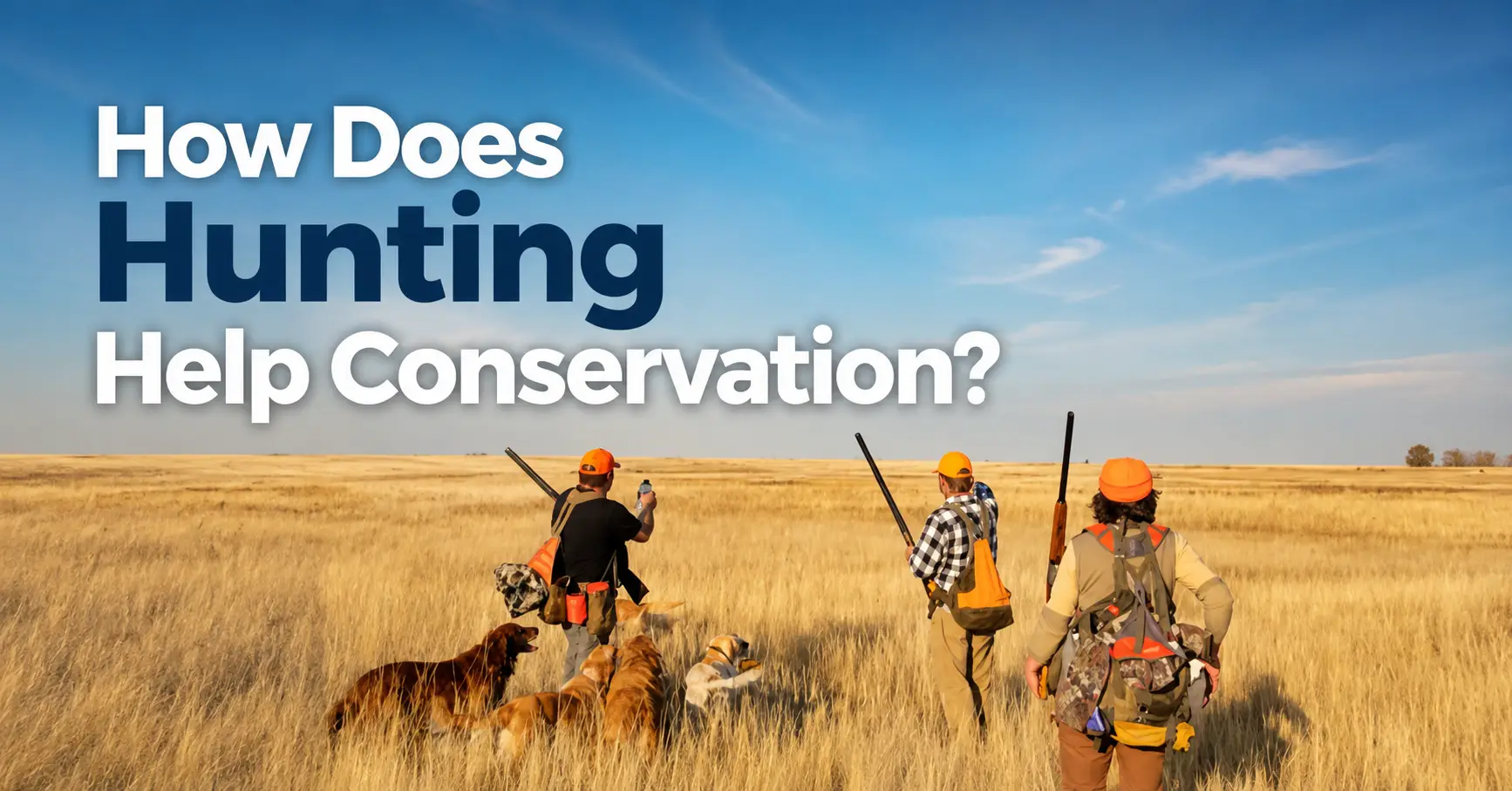

Hunting can help conservation, but only under the right conditions. The conservation benefit does not come simply from removing an animal from the landscape. It comes from a regulated system that uses scientific monitoring, legal seasons, harvest limits, protected areas, license revenue, equipment-tax grants, habitat work, law enforcement, hunter education, and public accountability.
This guide explains the main pathways through which lawful hunting can support wildlife and habitat in the United States. It also explains the limits of the claim. Poorly regulated hunting, poaching, illegal trade, inaccurate population estimates, weak enforcement, corruption, or harvest of vulnerable populations can harm conservation. A responsible answer to “how does hunting help conservation?” must cover both the potential benefits and the safeguards that make those benefits possible.
Quick Answer
Regulated hunting can help conservation by providing license and excise-tax revenue, funding wildlife research and habitat management, supplying harvest data, supporting conservation officers and hunter education, and helping agencies manage certain abundant wildlife populations. These benefits depend on science-based limits, effective enforcement, legal participation, accurate reporting, safe and ethical behavior, and protection of vulnerable species. Hunting is one conservation tool among many—not a universal solution for every species, habitat, or wildlife conflict.
Important Legal and Safety Notice Before You Hunt
Hunting laws vary by country, state, province, tribe, county, land type, species, season, and hunting method. Before hunting, check the current regulations published by the official wildlife agency responsible for the area. Never rely on a general article, an old regulation booklet, a social-media post, or another hunter’s memory as your final legal source.
- License and permits: Confirm the correct hunting license, species tag, stamp, validation, lottery permit, or land-use authorization.
- Season and legal hours: Verify exact opening and closing dates, legal shooting hours, and any zone-specific restrictions.
- Bag and possession limits: Know what may be harvested, how many, and what reporting or tagging is required.
- Legal equipment: Confirm permitted firearms, bows, ammunition, broadheads, magazine limits, methods, and transportation rules.
- Land access: Verify public-land boundaries and obtain clear permission before entering private property.
- Visibility rules: Wear blaze orange or other required clothing where the law or conditions call for it.
- Safe handling: Keep every firearm pointed in a safe direction, keep the action open and unloaded until authorized for use, and identify the target and what lies beyond it.
- Emergency planning: Share a trip plan, monitor weather, carry navigation, water, first aid, communication, lighting, and appropriate clothing.
The Six Main Ways Hunting Can Support Conservation
1. Dedicated Funding
Licenses, tags, stamps, and federal excise-tax grants help finance state wildlife agencies and eligible conservation projects.
2. Population Management
Regulated harvest can help agencies manage certain abundant populations when scientific data show that hunting is appropriate.
3. Wildlife Data
Harvest reports, biological samples, surveys, and field observations add information used in future management decisions.
4. Habitat Protection
Revenue and conservation partnerships can support wildlife areas, wetlands, grasslands, forests, access agreements, and restoration.
5. Enforcement and Education
Funding supports conservation officers, hunter education, ethical instruction, wildlife identification, and public safety.
6. Public Participation
Hunters can become long-term stakeholders who report violations, attend meetings, volunteer, and support science-based management.
How Does Hunting Help Conservation? A Step-by-Step Explanation
Step 1: Wildlife Agencies Measure Populations and Habitat
Responsible hunting begins with information. State, federal, tribal, provincial, or national wildlife agencies may use aerial surveys, camera surveys, observation routes, banding, telemetry, harvest data, disease testing, habitat mapping, population models, and public reports to estimate wildlife status.
The goal is not simply to produce the highest possible number of animals. Agencies may manage for healthy populations, genetic diversity, habitat capacity, predator-prey relationships, disease risk, human-wildlife conflict, agricultural damage, migration needs, and public values. Management objectives differ among species and regions.
Step 2: Managers Decide Whether Hunting Is an Appropriate Tool
Hunting should be authorized only when the responsible agency determines that a legal harvest is compatible with conservation objectives. Some populations can support regular seasons. Others may need highly limited permits, temporary closure, protected status, or no hunting at all.
The U.S. Fish and Wildlife Service describes managed hunting as one tool that can be used to address issues such as overabundance and habitat damage on certain public lands. For example, a carefully designed deer hunt may be used where high deer density contributes to heavy browsing and prevents forest regeneration. That example does not mean that every deer population is overabundant or that hunting is the correct response in every place.
Step 3: Seasons, Tags, and Bag Limits Control Harvest
Regulations translate management goals into legal limits. Agencies may adjust season length, hunting method, permit numbers, sex or age classes, geographic zones, legal hours, reporting requirements, and daily or annual limits.
These controls are essential. Without them, harvest could occur during sensitive periods, exceed sustainable levels, or concentrate in vulnerable locations. Ethical hunters support conservation by following the exact regulation rather than treating a general season as permission to take any animal encountered.
Step 4: Hunters Pay Into the Wildlife Management System
State hunting licenses, species tags, permit applications, habitat stamps, and related fees provide revenue to fish and wildlife agencies. That money may support wildlife surveys, habitat management, public access, law enforcement, disease work, data systems, land maintenance, and hunter education.
A separate funding stream comes through the federal Pittman-Robertson Wildlife Restoration Program. Manufacturer excise taxes on covered firearms, ammunition, and archery equipment are distributed to state and territorial agencies through grants. The U.S. Fish and Wildlife Service Wildlife Restoration Program lists wildlife and habitat management, research, public access, hunter education, and shooting-range projects among eligible uses.
License revenue commonly helps states provide the non-federal share for eligible federal grants. The two funding sources work together, but they are not the same: the price of a hunting license is state revenue, while Pittman-Robertson money comes from federal excise taxes.
Step 5: Conservation Funds Pay for Habitat and Wildlife Work
Conservation happens on the ground and in long-term agency programs. Hunting-related revenue may contribute to wetland restoration, grassland management, forest treatment, invasive-species control, water development, wildlife crossings, land acquisition, access leases, boundary work, and maintenance of wildlife management areas.
Habitat projects often benefit many species at once. A restored wetland may support waterfowl, amphibians, fish, reptiles, mammals, insects, and plants. A managed grassland may provide nesting cover for both hunted and non-hunted birds. It would be inaccurate to say that every license dollar directly funds nongame wildlife, but broad habitat benefits commonly extend beyond the species named on a hunting tag.
Step 6: Legal Harvest Can Reduce Certain Management Problems
When a population exceeds a management objective or local habitat capacity, regulated harvest can reduce pressure on vegetation, crops, sensitive habitats, or transportation corridors. It may also be used to address selected wildlife conflicts where other tools alone are insufficient.
Population control is not automatically conservation. Removing animals without reliable data, clear objectives, monitoring, and follow-up can fail or create unintended effects. Hunting works best as part of an adaptive management process: collect data, set a measured harvest, monitor results, and revise future rules.
Step 7: Harvest Reporting Improves Future Decisions
Many agencies ask hunters to report whether they hunted, where effort occurred, and whether an animal was harvested. Biological check stations or sampling programs may collect age, sex, health, disease, or reproductive information.
Accurate reporting helps managers estimate harvest rates, participation, distribution, and population trends. False reports, unreported take, and illegal harvest weaken the data used to set future seasons. Even an unsuccessful hunter can contribute useful information when the agency requests effort or observation data.
Step 8: Conservation Officers Protect Wildlife and Legal Access
License revenue and related conservation funds help support officers who investigate poaching, illegal trade, trespass, unsafe shooting, license fraud, protected-species take, and other violations. Enforcement helps ensure that carefully designed seasons are not undermined by illegal activity.
Ethical hunters strengthen this system by knowing the rules, documenting suspected violations safely, and reporting them through official channels. They should never confront an armed suspected poacher or place themselves in danger.
Step 9: Hunter Education Builds Safer Conservation Participants
The U.S. Fish and Wildlife Service Hunter Education Program supports state and territorial instruction in firearm and archery safety, wildlife management, conservation, ethics, game laws, outdoor survival, and wilderness first aid.
Hunter education reduces avoidable risk and helps new hunters understand why wildlife identification, lawful access, clean harvest reporting, restraint, and habitat respect matter. A course is a starting point, not a replacement for supervised practice and experienced mentorship.
Step 10: Hunters Can Support Conservation Beyond the Purchase
A license payment is only one contribution. Hunters can volunteer for habitat projects, participate in surveys, submit samples, attend commission meetings, support land trusts or wildlife groups, clean up public land, prevent invasive-species spread, respect seasonal closures, and share accurate safety information.
The strongest conservation benefit comes from ongoing responsible participation rather than from a single transaction.
Where Hunting-Related Conservation Money Comes From
| Source | Who Pays | Typical Conservation Connection | Important Limitation |
|---|---|---|---|
| Hunting licenses, tags, permits, applications, and habitat stamps | Hunters and applicants | State agency operations, wildlife management, habitat, access, enforcement, education, and project match | Fee structure and legal use vary by jurisdiction |
| Pittman-Robertson excise taxes | Manufacturers and importers of covered firearms, ammunition, and archery equipment | Federal grants for wildlife restoration, research, habitat, access, hunter education, and eligible ranges | This is not the same money as a state license fee |
| Federal Duck Stamp | Waterfowl hunters who are required to buy it and voluntary purchasers | Wetland and grassland habitat acquisition and conservation easements | It does not replace state licenses, permits, or validations |
| Conservation organizations and volunteers | Members, donors, volunteers, partners, and sponsors | Habitat projects, land protection, research support, advocacy, education, and access | Organizations vary in priorities, transparency, and effectiveness |
| General public funding and other grants | Taxpayers, governments, tribes, foundations, businesses, and the public | Endangered species, parks, watersheds, forests, wildlife action plans, research, climate resilience, and land programs | Hunters are important contributors, but not the only conservation funders |
What Wildlife Management Activities Can Hunting Support?
| Management Activity | How Hunting Can Contribute | Conservation Result Sought |
|---|---|---|
| Population monitoring | License revenue, harvest reports, biological samples, and hunter observations | Better estimates of population status and trends |
| Habitat management | Agency funding and partnerships support restoration, maintenance, and land protection | Improved habitat for game and nongame species |
| Overabundance response | Targeted, regulated harvest where science and law support it | Reduced browsing, crop damage, conflict, or habitat pressure |
| Disease surveillance | Samples and reports from legally harvested animals | Earlier detection and better understanding of wildlife health |
| Public access | Land acquisition, leases, wildlife areas, parking, maps, and maintenance | Managed access for hunting and other compatible recreation |
| Law enforcement | License-supported staffing, vehicles, equipment, training, and investigations | Reduced poaching and stronger compliance |
| Hunter education | State programs and federal excise-tax grants | Safer, more ethical, conservation-minded participation |
When Hunting Does Not Help Conservation
Hunting should not be called “conservation” merely because money changes hands or an animal is removed. The outcome depends on ecological science, governance, enforcement, transparency, and local conditions.
- Poaching and illegal trade: Unregulated take bypasses quotas, reporting, protected areas, and species safeguards.
- Weak population data: Seasons based on outdated or unreliable estimates can create excessive harvest risk.
- Vulnerable populations: Small, declining, isolated, slow-reproducing, or threatened populations may not support hunting.
- Poor enforcement: Regulations have limited value when violations are widespread and consequences are unlikely.
- Corruption or revenue leakage: Fees do not help wildlife if funds fail to reach management or local conservation needs.
- Wrong harvest structure: Removing too many animals from a particular sex, age group, or social structure may have ecological effects not captured by total numbers alone.
- Habitat loss remains unaddressed: Harvest regulation cannot replace protection of migration routes, breeding areas, food, water, and shelter.
- Human conflict is misdiagnosed: Garbage, feeding, land-use change, fencing, or attractants may need correction before or alongside population measures.
- Local communities receive no benefit: In some international systems, promised conservation revenue may not reach habitat protection or affected communities.
Conditions Required for Hunting to Be a Conservation Tool
- Clear legal authority: The hunt must be authorized by the responsible government or wildlife authority.
- Reliable population information: Managers need enough data to set a defensible harvest level.
- Defined objectives: The agency should explain whether the goal is sustainable recreation, population reduction, conflict management, habitat protection, or another outcome.
- Limited and enforceable harvest: Seasons, quotas, methods, and reporting must be practical to monitor.
- Protection for vulnerable wildlife: Closed seasons, protected classes, refuges, and no-hunt decisions remain essential.
- Transparent use of revenue: The public should be able to review budgets, projects, and results.
- Adaptive management: Rules should change when monitoring shows that objectives are not being met.
- Safe and ethical participation: Hunters must identify legal animals, respect effective range, avoid waste, and protect other land users.
- Habitat conservation: Population management must be paired with protection and restoration of the places wildlife needs.
How Ethical Hunters Increase the Conservation Benefit
- Buy every required license, tag, stamp, and permit through official channels.
- Complete hunter education and seek an experienced ethical mentor.
- Read the current regulations before each season and carry required documents.
- Identify the species, legal status, target, and background before considering any shot.
- Stay within a personal effective range established through realistic practice.
- Pass when the opportunity is unsafe, uncertain, obstructed, too far, or inconsistent with the management rule.
- Tag, report, transport, and process legally harvested game as required.
- Submit requested samples and truthful harvest or effort reports.
- Respect private property, gates, livestock, trails, other hunters, and non-hunting recreationists.
- Pack out litter and avoid damaging habitat with vehicles or camp activities.
- Report suspected poaching through official channels without direct confrontation.
- Support habitat, research, access, and conservation programs that publish measurable results.
Common Misunderstandings About Hunting and Conservation
- “Any hunting is conservation.” Only lawful, regulated, monitored hunting under suitable biological conditions can serve a conservation objective.
- “Hunters are the only people who fund wildlife.” Hunters are important contributors, but taxpayers, tribes, landowners, nonprofits, foundations, businesses, and other recreationists also fund conservation.
- “License money and equipment taxes are identical.” They are separate revenue streams that often work together through state programs and federal grants.
- “More harvest always means healthier wildlife.” The appropriate harvest can be zero, limited, stable, or increased depending on the species and data.
- “Predators or prey should always be reduced.” Predator-prey systems are complex, and broad assumptions can produce poor management.
- “A hunting season proves a population has no concerns.” A legal season may be narrow, carefully limited, and based on specific zones or classes.
- “Economic activity guarantees conservation.” Spending helps conservation only when adequate revenue and incentives reach habitat, science, enforcement, or communities responsible for stewardship.
Troubleshooting Conservation Claims
| Claim or Question | What May Be Missing | How to Verify It |
|---|---|---|
| “This hunt is needed because there are too many animals.” | Population estimate, habitat objective, conflict data, geographic scale, and alternatives | Read the agency management plan, survey report, commission materials, and harvest proposal. |
| “Every dollar goes directly to habitat.” | Agency operations, enforcement, research, education, and administrative costs | Review the official budget and special-fee statute. |
| “The species recovered because of hunting.” | Habitat protection, reintroduction, legal protection, predator control, private land, and other factors | Use official recovery histories and peer-reviewed or agency sources. |
| “Harvest will reduce disease.” | Disease transmission model, timing, density, movement, testing, and carcass rules | Check current wildlife-health guidance and disease-management plans. |
| “Trophy fees protect wildlife.” | Revenue distribution, population data, governance, community benefit, enforcement, and independent oversight | Look for audited finances, transparent quotas, monitoring, and credible local conservation outcomes. |
| “Hunters pay for all conservation.” | General taxes, federal land budgets, tribal programs, nonprofits, private landowners, and other grants | Compare multiple agency and land-management budgets. |
| “A legal hunt must be ethical.” | Personal ability, shot conditions, fair-chase standards, recovery plan, and respect for land users | Apply both the law and recognized hunter-education ethics. |
When to Get More Training or Official Guidance
Seek help from an official wildlife agency, certified hunter-education instructor, conservation officer, qualified shooting or archery instructor, experienced ethical mentor, land manager, tribal authority, or wildlife biologist when:
- You have never completed hunter education or handled hunting equipment safely.
- You are unsure whether a species, sex, age class, unit, or method is legal.
- You cannot confirm a public-land boundary or private access route.
- You do not understand tagging, reporting, sampling, transport, or meat-care rules.
- You are evaluating a controversial population-control hunt and need the official management evidence.
- You need to report poaching, an injured protected animal, unsafe shooting, or a wildlife emergency.
- You want to understand how license fees or special stamps are spent.
FAQs
1. How does hunting help conservation?
Regulated hunting can provide conservation funding, population data, habitat support, law enforcement, hunter education, and a controlled management tool for selected wildlife populations.
2. Does hunting always help conservation?
No. It helps only when harvest is lawful, biologically sustainable, monitored, enforced, transparent, and connected to clear conservation objectives.
3. How do hunting licenses support wildlife?
License, tag, permit, and stamp revenue generally supports state wildlife-agency work such as management, habitat, access, enforcement, research, and education.
4. What is the Pittman-Robertson Act?
It is the U.S. federal Wildlife Restoration law that directs excise-tax revenue from covered firearms, ammunition, and archery equipment into grants for eligible state and territorial conservation programs.
5. Are license fees the same as Pittman-Robertson taxes?
No. Hunters pay license fees to state agencies, while manufacturers and importers pay federal excise taxes on covered equipment.
6. Does hunting protect habitat?
Hunting-related revenue and partnerships can support land acquisition, access agreements, wetlands, forests, grasslands, wildlife areas, and habitat restoration.
7. Do non-hunted animals benefit from hunting revenue?
Often they do when habitat projects benefit entire ecological communities. The exact direct funding relationship varies by state and program.
8. Can hunting prevent overpopulation?
Regulated hunting can help manage some abundant populations, but “overpopulation” must be defined using local habitat, conflict, health, and management data.
9. Can hunting reduce crop damage?
It can be one tool where an agency authorizes targeted harvest, but fencing, attractant control, land-use practices, and other measures may also be needed.
10. Does hunting reduce wildlife disease?
Sometimes management agencies use harvest as part of a disease strategy, but results depend on the disease, timing, density, movement, testing, and compliance.
11. How do hunters provide wildlife data?
They submit harvest reports, effort surveys, biological samples, band returns, disease samples, and observations requested by wildlife agencies.
12. Why are hunting seasons limited?
Seasons help control total harvest, protect sensitive periods, distribute effort, reduce conflict, and align hunting with population objectives.
13. Why are bag limits important?
Bag and possession limits help prevent excessive take and allow managers to distribute harvest among participants.
14. What happens if hunters do not report harvest?
Missing or false reports weaken population models and can lead to less reliable future season decisions. Reporting may also be legally required.
15. Do conservation officers receive hunting-license funding?
In many states, license revenue supports conservation law enforcement in whole or in part. Funding structures vary by agency.
16. How does hunter education help conservation?
It teaches safety, wildlife identification, ethics, laws, survival, and responsible behavior, reducing accidents and improving compliance.
17. Is poaching conservation?
No. Poaching bypasses seasons, quotas, reporting, protected-species rules, and public accountability and can seriously harm wildlife populations.
18. Can hunting harm endangered species?
Illegal take and poorly regulated harvest can harm threatened populations. Protected species should not be hunted unless a lawful authority establishes a carefully justified program consistent with conservation law.
19. Do hunters fund all wildlife conservation?
No. Hunters are important funders, but conservation also relies on taxpayers, tribes, governments, nonprofits, landowners, foundations, businesses, and other recreationists.
20. What is adaptive management?
It is a process of setting a management action, monitoring the result, learning from the data, and adjusting future actions.
21. How can I tell whether a hunt is science-based?
Look for an official management plan, recent population data, clear objectives, transparent quotas, monitoring, public review, and published results.
22. Does trophy hunting help conservation?
It can produce conservation revenue in some tightly regulated systems, but outcomes vary greatly. Population sustainability, governance, local community benefit, enforcement, and transparent revenue use must be independently evaluated.
23. Is legal hunting automatically ethical?
No. Ethical hunting also requires safe handling, accurate identification, restraint, practiced ability, a safe background, responsible recovery, and avoidance of waste.
24. How can hunters help beyond buying a license?
They can volunteer, submit samples, report poaching, attend public meetings, support habitat programs, clean public land, and share accurate safety information.
25. Does the Federal Duck Stamp help conservation?
Yes. Federal Duck Stamp revenue supports acquisition and protection of wetland and grassland habitat within the National Wildlife Refuge System.
26. Can nonhunters support hunting-funded conservation programs?
Yes. Anyone can buy a Federal Duck Stamp, donate to agency programs, volunteer, support habitat organizations, or participate in public wildlife planning.
27. Why might a wildlife agency close a hunting season?
A closure may be needed because of population decline, disease, weather, habitat loss, low recruitment, uncertainty, legal requirements, or failure to meet management objectives.
28. Does hunting help predators?
Habitat and prey management can indirectly affect predators, but predator conservation is complex. Broad claims should be evaluated with local ecosystem data.
29. How does public-land hunting support conservation?
License revenue and federal grants can help maintain wildlife areas, habitat, roads, signs, access, education, and enforcement where hunting is compatible with the land’s purpose.
30. What is the most important conservation responsibility of a hunter?
Follow the law, act safely and ethically, report accurately, avoid waste, respect habitat and access, and support management decisions based on reliable evidence.