
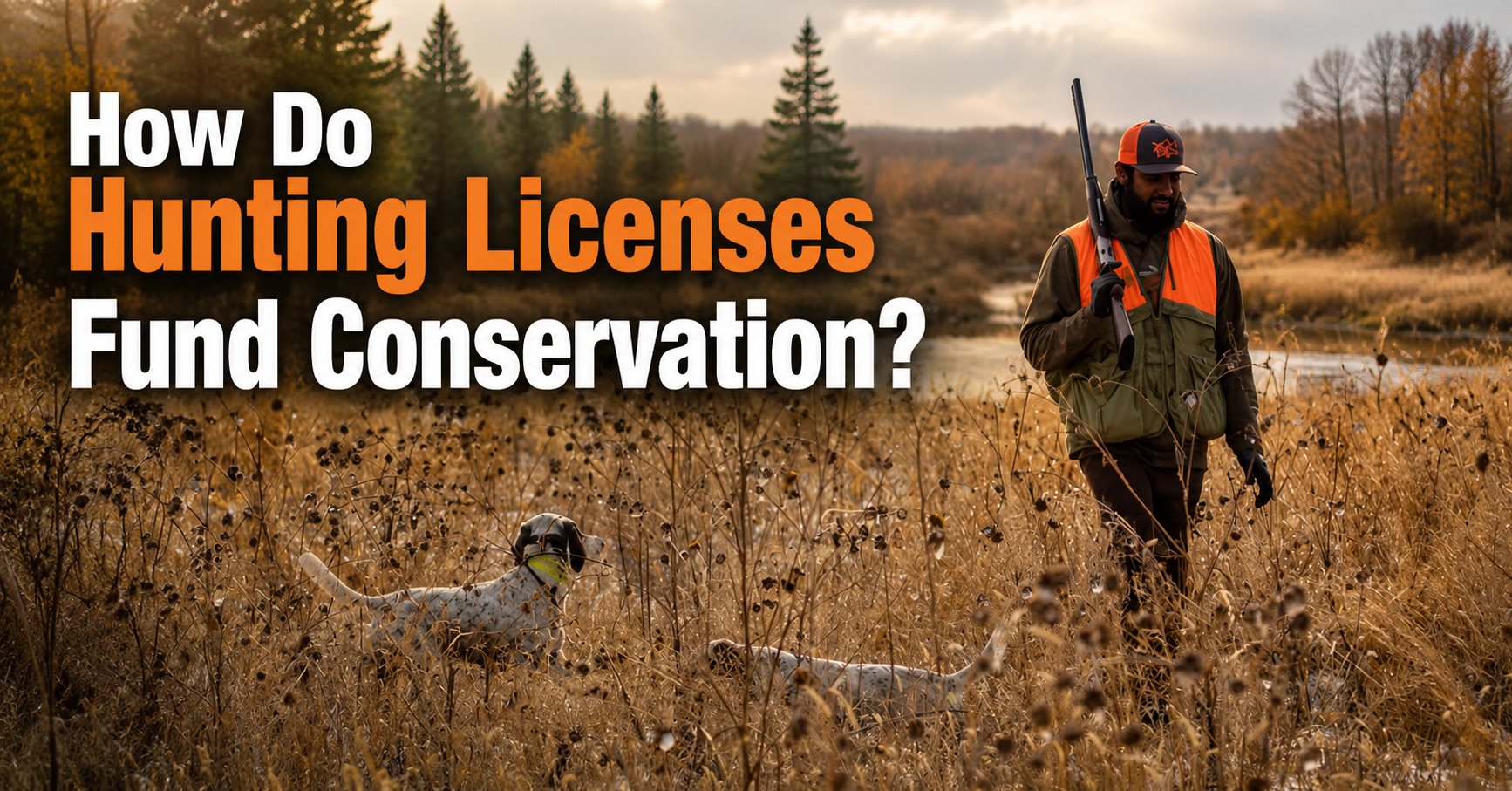

When a hunter buys a license, tag, permit, validation, or habitat stamp, the payment does more than authorize a legal activity. In the United States, those fees are an important source of operating revenue for state fish and wildlife agencies. They help pay for wildlife surveys, habitat projects, public access, law enforcement, disease monitoring, hunter education, land maintenance, and the staff required to manage wildlife for the public.
The full funding system is broader than license sales alone. Federal excise taxes on firearms, ammunition, and certain archery equipment support the Pittman-Robertson Wildlife Restoration Program, while license revenue often supplies the state share needed to unlock those federal grants. The number of hunting licenses sold also helps determine how federal wildlife-restoration money is divided among states. Understanding these separate but connected roles is the key to answering the question, “how do hunting licenses fund conservation?”
Quick Answer
Hunting license fees generally go to state fish and wildlife agencies, where they support wildlife management, habitat work, public access, research, enforcement, and hunter education. License revenue can also serve as the state’s required matching contribution for federal Wildlife Restoration grants, which commonly cover up to 75 percent of an eligible project. In addition, the number of certified hunting licenses sold is part of the formula used to apportion Pittman-Robertson funds among states. Exact spending rules vary, so hunters should check their own wildlife agency’s budget and license information.
Important Jurisdiction and Legal Note
This article explains the general U.S. conservation-funding model. License laws, fee structures, eligible uses, accounting systems, stamps, permits, federal matching arrangements, and public-reporting practices vary by state, territory, tribal jurisdiction, and country. Always verify current requirements and financial information with the official wildlife agency responsible for the place where you hunt.
- A hunting license does not automatically include every species, season, tag, stamp, or land-access permit.
- Special permits may be earmarked for a specific habitat, species, access program, or administrative purpose.
- Federal excise-tax revenue is separate from the fee paid directly for a state hunting license.
- A license authorizes hunting only under current laws, seasons, bag limits, legal hours, method restrictions, and land-access rules.
- Buying a license does not create ownership of wildlife; wildlife is managed as a public resource under applicable law.
The Conservation Funding Chain at a Glance
The buyer purchases a license, tag, permit, validation, or conservation stamp.
Funds are held and administered under state and federal eligibility rules.
Revenue supports management, habitat, research, access, enforcement, education, and operations.
License counts influence federal apportionments, and revenue often supplies non-federal project match.
How Do Hunting Licenses Fund Conservation? Step by Step
Step 1: A Hunter Buys a License, Tag, Permit, or Stamp
The conservation connection begins when a hunter pays for legal authorization. A basic hunting license may allow participation in certain seasons, while separate tags, species permits, habitat stamps, migratory-bird validations, applications, or access permits may be required for other opportunities.
The exact price is less important than the financial pathway. Unlike ordinary retail revenue, hunting-license money is generally directed to the state fish and wildlife agency or a dedicated fish-and-wildlife account. Federal Wildlife Restoration eligibility rules are designed to prevent states from taking hunting-license revenue away from the agency and spending it for unrelated purposes.
Step 2: The Wildlife Agency Builds a Dedicated Operating Budget
State wildlife agencies need year-round funding, not only during hunting season. Biologists conduct surveys, technicians maintain wildlife areas, conservation officers enforce regulations, veterinarians and laboratories investigate disease, educators teach hunter safety, and administrative staff issue licenses, process applications, manage data, and account for grants.
License revenue can support these functions directly or help fund the agency infrastructure required to carry out conservation projects. A project may be visible—such as restoring a wetland—or mostly behind the scenes, such as analyzing population data, maintaining databases, negotiating access agreements, or inspecting habitat work.
Step 3: Agencies Use Revenue for Wildlife Management
Wildlife management is the process of using research, monitoring, habitat information, public input, and legal authority to maintain wildlife populations and their habitats. License-funded activities may include:
- Population surveys and trend monitoring
- Harvest-data collection and analysis
- Wildlife health and disease surveillance
- Species restoration and recovery projects
- Habitat improvement and prescribed management
- Conflict prevention and response
- Development of seasons, quotas, and permit systems
- Scientific research and partnerships with universities or conservation groups
These projects can benefit hunted species and many non-hunted species that share the same grasslands, forests, wetlands, shrublands, migration corridors, or water sources.
Step 4: License Money Supports Habitat and Public Land Access
Healthy wildlife populations depend on habitat. States may use license-related revenue to acquire, lease, restore, manage, or maintain wildlife areas. Work can include invasive-species control, grassland management, forest treatment, wetland restoration, water development, erosion repair, controlled access, road maintenance, signs, parking areas, and boundary marking.
License funds may also support programs that open private land to regulated public hunting through leases, agreements, or incentives. These access programs vary widely. Hunters must still confirm current boundaries, parking rules, season restrictions, and landowner conditions.
Step 5: Revenue Helps Pay for Conservation Law Enforcement
Wildlife regulations have little value without fair enforcement. Conservation officers investigate poaching, illegal take, trafficking, trespass, unsafe activity, license fraud, and other wildlife-law violations. They may also assist with search and rescue, boating incidents, public-land safety, and wildlife conflicts, depending on the agency and jurisdiction.
Enforcement protects legal hunters as well as wildlife. It helps maintain public trust that seasons, bag limits, permits, and protected-species rules apply to everyone.
Step 6: License Fees Support Hunter Education and Public Safety
Hunter education teaches firearm and archery safety, wildlife identification, ethics, game laws, survival, first aid, and responsible decision-making. Some state instruction is supported by state license revenue, federal Hunter Education grants, or both.
The U.S. Fish and Wildlife Service Hunter Education Program provides federal grant support to states and territories. That federal money comes from excise-tax sources rather than directly from the price of a license, but the state agency and its license-supported structure help deliver the program.
Step 7: License Revenue Often Provides the State Match for Federal Grants
The Pittman-Robertson Wildlife Restoration Program reimburses eligible state projects with federal funds derived primarily from manufacturer excise taxes on firearms, ammunition, and certain archery equipment. Wildlife Restoration grants commonly cover up to 75 percent of eligible project costs, while the state supplies at least 25 percent.
States frequently use hunting-license revenue for that non-federal share. In simplified form, a state may contribute one dollar of eligible license-derived funding and receive up to three dollars of federal grant reimbursement for an approved project. Actual grant accounting is more detailed, and not every license dollar is automatically matched, but the arrangement helps license revenue support a larger total project budget.
Step 8: License Sales Affect How Federal Wildlife Restoration Funds Are Divided
The number of certified hunting licenses sold in each state is part of the statutory formula for apportioning federal Wildlife Restoration funds. According to the U.S. Fish and Wildlife Service apportionment and license data, Wildlife Restoration funding is divided using a formula based 50 percent on geographic area and 50 percent on each state’s share of hunting licenses sold nationally.
This means license participation has two different financial effects. The fee itself produces state revenue, and the certified license count influences the state’s share of a separate federal excise-tax fund. Buying duplicate licenses or unnecessary permits does not automatically produce unlimited federal funding because formulas include detailed rules, limits, and certification standards.
Step 9: Special Stamps and Permits May Fund Targeted Programs
Some fees have a more specific purpose than a general license. A state habitat stamp may support habitat improvement, land acquisition, access, or a designated species program. A migratory-bird permit may support wetlands or waterfowl management. An application fee may help administer limited-entry drawings.
The Federal Duck Stamp is a separate federal program rather than an ordinary state hunting license. The official Federal Duck Stamp conservation program states that 98 percent of stamp proceeds support wetland and grassland habitat conservation through the Migratory Bird Conservation Fund.
Step 10: Agencies Report Results and Remain Accountable
Wildlife agencies typically publish budgets, annual reports, commission meeting materials, license-sales data, project reports, grant information, or legislative documents. Federal grants also include eligibility, accounting, project-approval, audit, and performance requirements.
Hunters can improve accountability by reading agency reports, attending public meetings, reviewing proposed fee changes, commenting on management plans, and asking how special stamps or permit revenue is used. Constructive participation is part of the public wildlife-management process.
License Fees and Pittman-Robertson Taxes Are Not the Same
| Funding Source | Who Pays It | Where It Goes First | How It Supports Conservation | Important Distinction |
|---|---|---|---|---|
| State hunting licenses, tags, permits, validations, and stamps | Hunters and applicants | State fish and wildlife agency or dedicated state account | Agency operations, management, habitat, enforcement, education, access, research, and state grant match | Fee types and legal uses vary by state |
| Pittman-Robertson excise-tax revenue | Manufacturers and importers of covered firearms, ammunition, and archery equipment; costs may be reflected in the market | Federal Wildlife Restoration Trust Fund | Federal grants to eligible state and territorial wildlife agencies | It is not collected when a hunter clicks “buy license” |
| Federal Duck Stamp | Waterfowl hunters age 16 and older and voluntary purchasers | Migratory Bird Conservation Fund | Wetland and grassland habitat acquisition and protection | Separate from a state hunting license and state waterfowl permit |
| General tax revenue, appropriations, grants, donations, and partnerships | Taxpayers, governments, donors, organizations, and partners | Federal, state, tribal, local, nonprofit, or private programs | Broader conservation, parks, endangered species, land management, research, restoration, and public services | Hunters are important contributors, but they are not the only conservation funders |
What Conservation Work Can License Revenue Support?
| Program Area | Examples of Work | Who Benefits |
|---|---|---|
| Wildlife science | Surveys, tagging studies, population modeling, harvest analysis, disease monitoring, habitat mapping | Game and nongame wildlife, hunters, researchers, land managers, the public |
| Habitat management | Wetland restoration, prescribed habitat work, invasive-species control, grassland and forest treatment | Entire wildlife communities and ecosystem functions |
| Public access | Wildlife areas, leases, parking, roads, signs, maps, gates, boundary work, access agreements | Hunters, wildlife watchers, hikers, photographers, and other legal users where allowed |
| Law enforcement | Poaching investigations, license compliance, public safety, protected-species enforcement | Wildlife, legal hunters, landowners, and communities |
| Hunter education | Safety courses, instructor support, archery education, ethics, wildlife identification, first aid | New hunters, families, other land users, and the wider public |
| Wildlife health | Testing, laboratory work, surveillance, response planning, public guidance | Wildlife populations, livestock interests, hunters, and public health partners |
| Agency capacity | Biologists, technicians, data systems, permitting, grant administration, equipment, facilities | All programs that depend on a functioning wildlife agency |
Do License Dollars Help Nongame and Protected Species?
They can. Habitat projects rarely benefit only one species. Restored wetlands may support waterfowl, amphibians, fish, reptiles, shorebirds, mammals, plants, and water quality. Managed grasslands can provide nesting and feeding habitat for both hunted birds and species that are never legally harvested.
Agency structure and funding restrictions vary, so it would be inaccurate to say that every license dollar is spent directly on nongame species. Some programs are closely tied to game management or hunter services, while others have broad ecological benefits. States may also use separate State Wildlife Grants, general funds, donations, endangered-species funds, or partnerships for species of greatest conservation need.
Why License Revenue Is Protected From Unrelated Spending
Federal Wildlife Restoration rules require states to keep hunting-license revenue under the control of the state fish and wildlife agency and use it for administration of that agency. If revenue is diverted to unrelated purposes, the state can risk losing eligibility for federal Wildlife Restoration and Sport Fish Restoration assistance until the problem is corrected.
This protection is one reason license buyers can reasonably expect their fees to remain connected to fish-and-wildlife work. The exact definition of eligible agency administration is technical, so readers should consult official state financial documents and federal rules rather than assuming that every individual expense must be a visible habitat project.
Why Hunting License Sales Matter Beyond the Dollar Amount
- They demonstrate participation: License records show the size and distribution of the regulated hunting community.
- They influence federal apportionment: Certified hunting-license numbers are part of the Wildlife Restoration allocation formula.
- They support planning: Agencies use sales and participation information for staffing, communication, education, and program design.
- They create a conservation constituency: License holders often participate in public meetings, volunteer projects, data collection, and policy discussions.
- They can support long-term access: Reliable revenue helps agencies maintain lands, agreements, and facilities rather than funding only one-time projects.
Limits of the “Hunters Pay for Conservation” Statement
Hunters make a major, well-documented contribution to state wildlife conservation through licenses, tags, stamps, federal excise taxes, donations, volunteer work, and conservation organizations. That contribution should be explained accurately rather than exaggerated.
Conservation in the United States is also funded and carried out by federal appropriations, state general funds, tribal governments, local governments, private landowners, nonprofit organizations, foundations, businesses, universities, outdoor recreation users, and the wider public. National parks, endangered-species recovery, watershed programs, forests, wetlands, climate adaptation, and land acquisition may rely on funding systems that are separate from hunting licenses.
A balanced explanation is that hunting licenses are foundational to many state wildlife agencies and can leverage substantial federal support, while the larger conservation landscape has many contributors and funding sources.
How to See Where Your Hunting License Money Goes
- Open your official state wildlife agency website. Avoid relying only on retailer descriptions or social-media claims.
- Find the budget or funding page. Search for annual report, financial report, license revenue, federal aid, wildlife restoration, or commission budget.
- Separate funding sources. Look for license fees, Pittman-Robertson funds, general funds, federal grants, donations, and special stamps.
- Review program spending. Identify habitat, research, enforcement, access, education, health, and administration categories.
- Check special-purpose fees. Find the statute or agency explanation for habitat stamps, species permits, and conservation surcharges.
- Read commission meeting materials. Fee proposals and project budgets are often discussed publicly.
- Ask the agency directly. A budget office, federal-aid coordinator, or public-information officer can explain accounting terms.
Common Misunderstandings
- “The full license price buys animals for hunters.” License revenue funds management of a public resource; it is not a purchase price for an animal.
- “All conservation money comes from hunters.” Hunters are major contributors, but many other public and private funding sources support conservation.
- “Pittman-Robertson money is the same as license money.” The two sources are separate, although they work together through apportionment and matching grants.
- “Every license dollar is spent on habitat.” Agencies also need science, enforcement, education, access, administration, equipment, and facilities.
- “Only hunted species benefit.” Many habitat and ecosystem projects benefit broad wildlife communities.
- “A higher license count automatically gives a state unlimited federal money.” Federal allocations follow statutory formulas, certified data, minimums, maximums, and available trust-fund revenue.
- “Buying a license replaces ethical participation.” Conservation also depends on obeying laws, avoiding waste, reporting harvests, respecting habitat, and supporting sound management.
Ethical Hunting and Conservation Responsibilities
Paying for a license is one conservation contribution, not the end of a hunter’s responsibility. Ethical participation includes learning current laws, completing hunter education, identifying the target and what lies beyond it, using safe equipment, respecting landowners, avoiding protected species, reporting harvest when required, and using legally taken game responsibly.
Hunters can strengthen conservation by submitting accurate harvest reports, cooperating with biological sampling, cleaning equipment to prevent invasive-species spread, staying on legal routes, protecting wetlands and gates, packing out litter, reporting poaching, and supporting science-based habitat programs.
When to Seek Official Guidance
Contact the state wildlife agency, tribal wildlife authority, federal refuge office, conservation officer, or official hunter-education program when:
- You are unsure which license, permit, stamp, or tag is required.
- You cannot determine whether a fee is refundable, transferable, or species-specific.
- You need current season, bag-limit, reporting, access, or weapon information.
- You want to know how a habitat stamp or conservation surcharge is spent.
- You are reviewing a proposed license-fee increase.
- You need audited financial information or federal-grant details.
- You suspect misuse or diversion of wildlife-agency revenue.
FAQs
1. How do hunting licenses fund conservation?
License fees provide revenue to state fish and wildlife agencies for management, habitat, research, enforcement, access, education, and operations. They may also provide the state match for federal Wildlife Restoration grants.
2. Does all hunting-license money go to conservation?
It generally remains under the control of the state wildlife agency and supports agency administration, but exact categories vary. Administration includes conservation science, enforcement, education, access, facilities, licensing, and other necessary functions.
3. Are hunting licenses and Pittman-Robertson taxes the same?
No. License fees are paid to state agencies by hunters. Pittman-Robertson revenue comes from federal manufacturer excise taxes on covered firearms, ammunition, and archery equipment.
4. How do license fees unlock federal conservation funds?
Eligible federal Wildlife Restoration grants commonly reimburse up to 75 percent of project costs. States often use license revenue to supply the required non-federal share.
5. Does the number of licenses sold affect federal funding?
Yes. Certified hunting-license numbers are part of the formula used to divide federal Wildlife Restoration funds among states, together with geographic area.
6. What is the Pittman-Robertson Act?
It is the federal Wildlife Restoration law that directs excise-tax revenue from covered hunting and shooting equipment into grants for state and territorial wildlife agencies.
7. What percentage of a project can federal Wildlife Restoration funds cover?
Traditional Wildlife Restoration grants commonly cover up to 75 percent of eligible project costs, with the state providing at least 25 percent. Specific grant categories can have different rules.
8. What does a wildlife agency spend license revenue on?
Common uses include surveys, habitat work, public access, conservation officers, disease monitoring, hunter education, research, licensing systems, land maintenance, and grant administration.
9. Do license fees benefit animals that are not hunted?
They can. Habitat restoration and ecosystem management often benefit many nongame species, although the direct funding structure varies by program and state.
10. Do hunting licenses fund endangered species?
Some license-supported agency work or shared habitat projects may benefit listed species, but endangered-species programs also rely on separate federal, state, nonprofit, and private funding sources.
11. Do hunting licenses pay game wardens?
In many states, license revenue supports conservation law enforcement in whole or in part. Funding structures differ, so check the agency budget.
12. Do hunting licenses fund public hunting land?
They may support acquisition, leases, access agreements, roads, parking, signs, gates, maintenance, habitat work, and management of wildlife areas.
13. Do nonresident hunting licenses help more because they cost more?
Nonresident fees can provide substantial revenue, but the effect depends on the state’s pricing, sales volume, accounting, and federal license-certification rules.
14. Does buying a license without hunting still support conservation?
Yes. The fee can support agency work even if the buyer does not harvest an animal, and a qualifying certified license may be included in federal apportionment data.
15. Does a lifetime license provide conservation funding every year?
States account for lifetime licenses differently. Some use trust funds or annual transfers. Check the official state explanation rather than assuming the full purchase price is spent immediately.
16. What is a habitat stamp?
It is an additional fee created by a state or other jurisdiction for a designated habitat, access, or conservation purpose. Requirements and uses vary.
17. Is a Federal Duck Stamp a hunting license?
It is a required federal stamp for most waterfowl hunters age 16 and older, but it does not replace the required state hunting license, state permits, or other validations.
18. Where does Federal Duck Stamp money go?
The official program states that 98 percent of the purchase price supports wetland and grassland habitat conservation through the Migratory Bird Conservation Fund.
19. Can nonhunters buy hunting licenses to support conservation?
Generally, a person may purchase a license if eligible under state rules, but a Federal Duck Stamp or direct agency donation may provide a clearer voluntary conservation option.
20. Can a state use hunting-license money for unrelated expenses?
Federal eligibility rules restrict diversion of hunting-license revenue away from state wildlife-agency administration. A diversion can jeopardize federal aid until corrected.
21. Does hunting-license revenue fund shooting ranges?
Some state or federal hunter-education and public-range programs can support range development or operation. The exact funding source and eligibility vary.
22. Do application fees fund conservation if I do not draw a tag?
They may support application processing, agency administration, or other authorized programs. States differ, so review the fee description and refund rules.
23. Do harvest reports help conservation?
Yes. Accurate reports help agencies estimate participation, harvest, distribution, and management outcomes. Reporting may also be legally required.
24. Are hunting licenses the largest source of all U.S. conservation funding?
No single statement fits every definition of conservation. License revenue is foundational for many state wildlife agencies, while broader conservation also relies on public appropriations, land programs, grants, tribes, nonprofits, and private partners.
25. Why are license fees sometimes increased?
Agencies may propose increases because staff, equipment, land management, research, access, and enforcement costs rise. Any proposal should be evaluated through official budgets and public processes.
26. What happens if hunting participation declines?
Lower sales can reduce direct revenue, affect the license component of federal apportionment, and make it harder for some agencies to provide matching funds and maintain programs.
27. Can license money be used for private land?
It may support technical assistance, habitat agreements, leases, easements, or public-access programs on private property when authorized. The land remains subject to the agreement and applicable law.
28. How can I verify what my state spends?
Read the wildlife agency’s annual report, budget, federal-aid report, commission meeting documents, and special-stamp information. Contact the agency budget or federal-aid office for clarification.
29. Does buying hunting equipment fund conservation?
Covered firearms, ammunition, and archery equipment are subject to federal manufacturer excise taxes that support Wildlife Restoration. This is separate from state license revenue.
30. What is the most responsible way to support conservation as a hunter?
Buy required licenses, follow regulations, report harvest accurately, practice safe and ethical hunting, protect habitat, prevent waste, report violations, and participate constructively in wildlife-management decisions.
Read more:
How to Improve Hunting Skills: A Beginner-Friendly Field Guide