
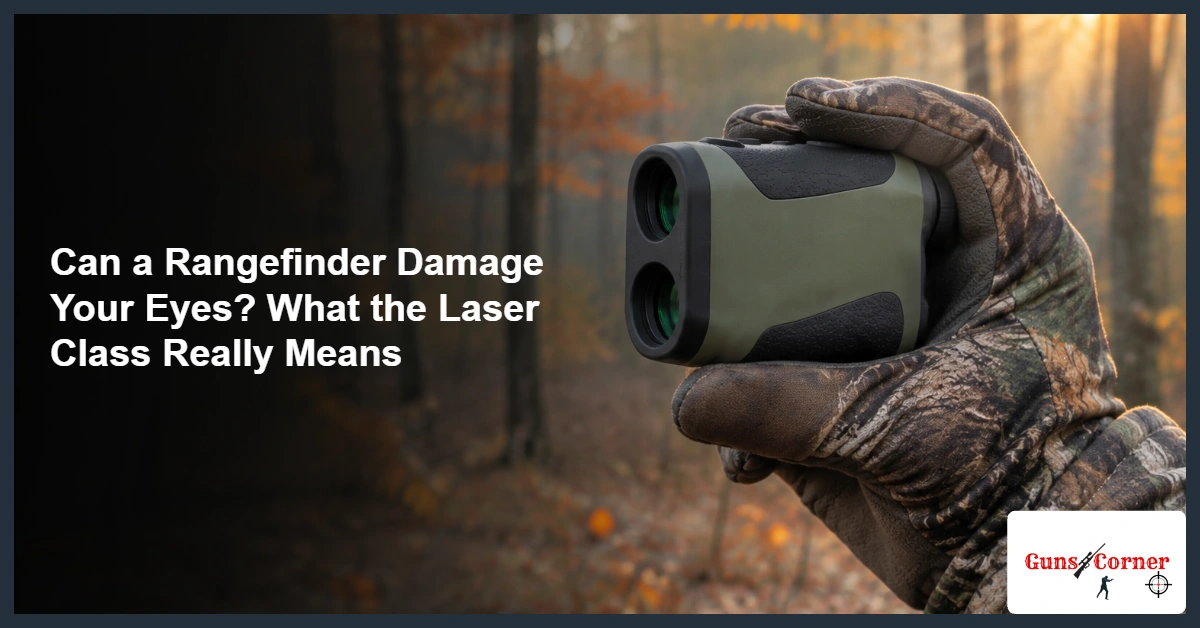

Can a rangefinder damage your eyes? A hunting rangefinder with a Class 1 laser is considered non-hazardous for normal use, according to the FDA. The risk climbs when you view the beam through binoculars or a spotting scope, when the housing is damaged, or when the laser isn’t a consumer Class 1 product.
Say you’re sitting in a ground blind at first light, ranging a stump across the field edge. You press the button and a number appears. Nothing flashes and nothing feels warm, which is exactly why people wonder whether something unseen is going on.
Three things decide the answer: the laser class on your unit, whether anything magnifies the beam between it and an eye, and whether the housing and lens are still as the factory shipped them. This article takes them in that order, then gives you five habits and a quick way to check your own gear.
Can a Rangefinder Damage Your Eyes? Three Things Decide It

An undamaged Class 1 rangefinder used the way its manual describes isn’t considered a hazard. That’s the FDA’s wording for its Class I category, and Pulsar, a maker of thermal optics with built-in rangefinders, states that its Class 1 laser is harmless to the eyes.
“Normal use” does a lot of work in that sentence. The same FDA table that calls Class I non-hazardous also says the hazard goes up when the beam is viewed with magnifiers, binoculars, or telescopes. And the one rangefinder injury report we read in the medical literature, published in the journal Retina in 1999, involved a military unit rather than a hunting model.
So the useful question is which laser you’re holding, and what sits between it and your eye. The sections below show you how to answer both.
What Does “Class 1” Actually Mean on a Rangefinder?
Class 1 means the laser’s accessible output stays low enough to be safe under all conditions of normal use, including a direct look with the naked eye. That’s how ERDILRF, a maker of rangefinder modules, summarizes the international standard.
A laser class is a rating of how much harm a beam can do. The international system, set by the International Electrotechnical Commission (IEC), runs from Class 1, the least hazardous, to Class 4. The FDA uses its own Roman-numeral version, Class I through IV, and says the higher the class, the greater the potential for serious injury if the laser is misused.
Here’s the part most guides skip: Class 1 is a design result, not a property of the light. A 905 nm rangefinder (905 nanometers is a near-infrared wavelength your eye can’t see) earns Class 1 by keeping each pulse’s energy low, leaving long gaps between pulses, and letting the beam spread out as it travels, according to ERDILRF. The maker controls those numbers. You don’t.
The table below uses the FDA’s classes. “Optical aids” means anything that magnifies or gathers light, such as binoculars or a spotting scope. Read the third column as what the FDA says about each class.
| FDA class | IEC class | What the FDA says | FDA’s examples |
|---|---|---|---|
| I | 1, 1M | Considered non-hazardous, though the hazard rises when viewed through magnifiers, binoculars, or telescopes | Laser printers, CD and DVD players |
| IIa, II | 2, 2M | Hazard rises with long direct viewing and with optical aids | Bar code scanners |
| IIIa | 3R | Can be momentarily hazardous when viewed directly, and the risk rises with optical aids | Laser pointers |
Class 1M deserves its own note. LightWare, a LiDAR sensor maker, says Class 1M lasers are eye-safe in every condition of use except when viewed through magnifying optics such as binoculars or telescopes. A manual that says 1M is telling you exactly where its limit sits.
Field check: Find the laser class line in your owner’s manual tonight. Pulsar lists Class 1 under IEC 60825-1:2014. If yours says 1M, add binoculars and spotting scopes to your do-not-use list.
Why Does an Invisible Beam Worry Eye Doctors?
Because you can’t see it, you can’t react to it. Many rangefinder modules and LiDAR sensors use near-infrared light at 905 nm, according to ERDILRF and LightWare, and that light is invisible. ERDILRF explains that the eye’s lens focuses it onto the retina (the light-sensing layer at the back of the eye) the same way it focuses visible light. The difference is that your blink and look-away reflex never triggers, because nothing looks bright.
The American Academy of Ophthalmology describes that reflex in a 2018 article on visible laser pointers. Below 5 milliwatts (a milliwatt is a thousandth of a watt), a person can usually blink or turn away before injury. Above that, the AAO says, the reflex can’t keep up, and severe retinal damage can happen even after a momentary exposure.
That’s why a rangefinder’s safety has to be built into the laser itself. The reflex can’t help, so the Class 1 limit does the protecting.
You’ll also see “eye-safe” on spec sheets and in reviews, usually as if it were one feature that every unit either has or lacks. In laser engineering, the term conventionally refers to wavelengths longer than about 1.4 micrometers. At that length, the cornea (the clear front surface of the eye) and lens absorb the light before it reaches the retina, according to ERDILRF’s summary of RP Photonics.
A 905 nm unit isn’t in that group, yet it can still be Class 1. Both kinds can be safe in use. They get there by different routes.
When Does a Rangefinder Become a Real Eye Risk?
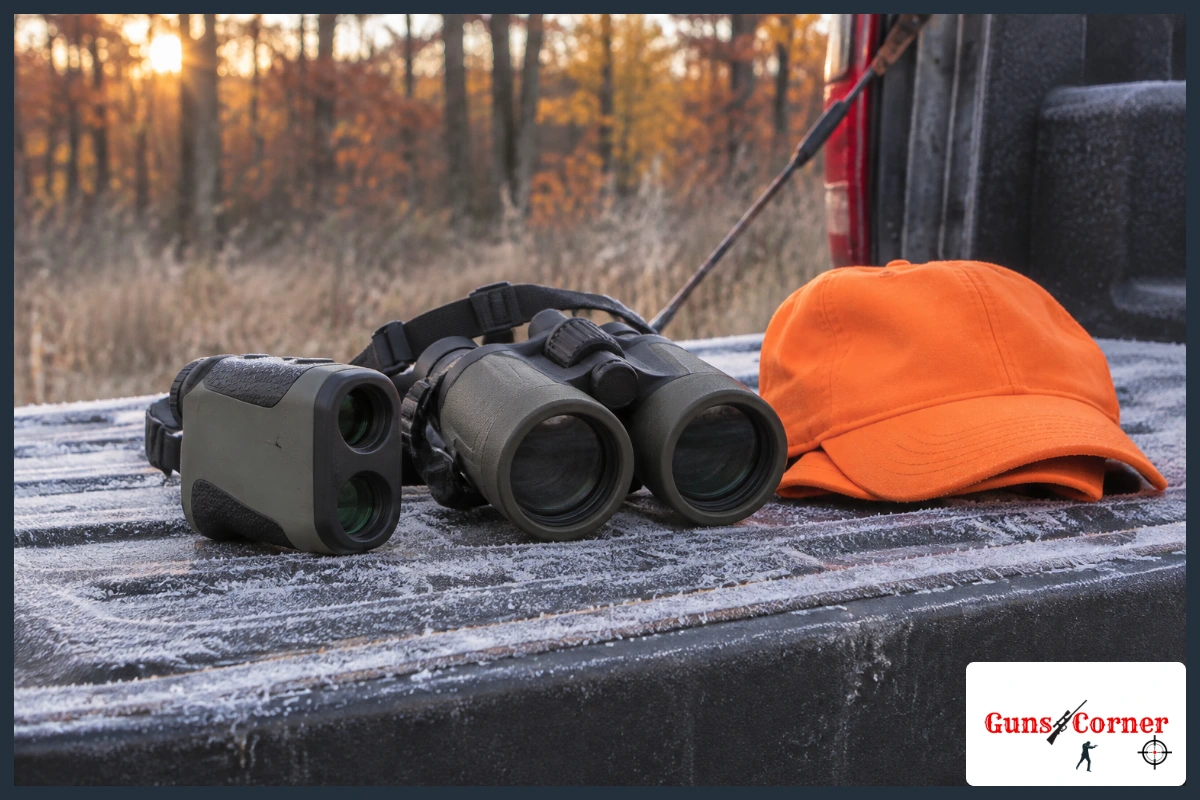
A rangefinder becomes a real risk in four situations, and each one has a clear fix. The table lays out the condition, why it matters, and what to do.
| Situation | Why it matters | What to do |
|---|---|---|
| Staring into the emitter lens of a Class 1 unit | The FDA treats Class I as non-hazardous in normal use, but Pulsar and LightWare both advise against looking into the lens | Keep the lens pointed away from your face |
| Viewing the beam through binoculars, a spotting scope, or a riflescope | The FDA says the hazard rises with optical aids, and LightWare says Class 1M isn’t safe through magnifying optics | Keep optics off the beam path unless your manual says otherwise |
| A cracked housing, a missing diffuser, or an opened unit | ERDILRF says the Class 1 rating depends on the housing and optics staying as shipped, and Garmin’s manual warns that changing a diffuser may risk permanent eye damage | Stop using the unit and contact the maker |
| A military, industrial, or unlabeled laser | The 1999 Retina case report involved a military rangefinder with a 10 mJ pulse | Don’t use it without the class and wavelength in writing |
Here’s how far apart these lasers can sit. The military unit in that report used an Nd:YAG laser (a solid-state laser type) at 1,064 nm and 10 mJ per pulse. A millijoule (mJ) is a thousandth of a joule, the unit of energy.
One publicly documented module, the discontinued Garmin LIDAR-Lite v3, uses 905 nm light and puts out under 280 nJ per pulse, according to ERDILRF’s reading of Garmin’s manual. It’s rated Class 1. A nanojoule (nJ) is a millionth of a millijoule.
That’s millijoules against nanojoules. One module isn’t every hunting rangefinder, so treat the comparison as a sense of scale and check your own manual for the real numbers.
What Does a Real Rangefinder Eye Injury Look Like?
Can a rangefinder damage your eyes badly enough to need treatment? In the best-documented case, yes. A civilian unintentionally looked into the beam of a military rangefinder, and Roider and colleagues reported it in the journal Retina in 1999. Two hours after exposure, doctors found bleeding beneath the retina and a damaged spot in the macula, the central area used for sharp vision.
Visual acuity (sharpness of vision) started at 20/100. It had improved to 20/63 after four weeks. At four months, abnormal blood-vessel growth, called choroidal neovascularization, had formed at the injured site. The authors described the damage as explosive disruption of tissue in the choroid, the blood-rich layer under the retina.
Treat that as one case, not a rate. In the sources we read, we found no published report of a comparable injury from a consumer hunting rangefinder used as directed, and a single report can’t tell you how common anything is. What it shows is that the word “rangefinder” covers very different lasers.
How Do You Check the Rangefinder You Already Own?
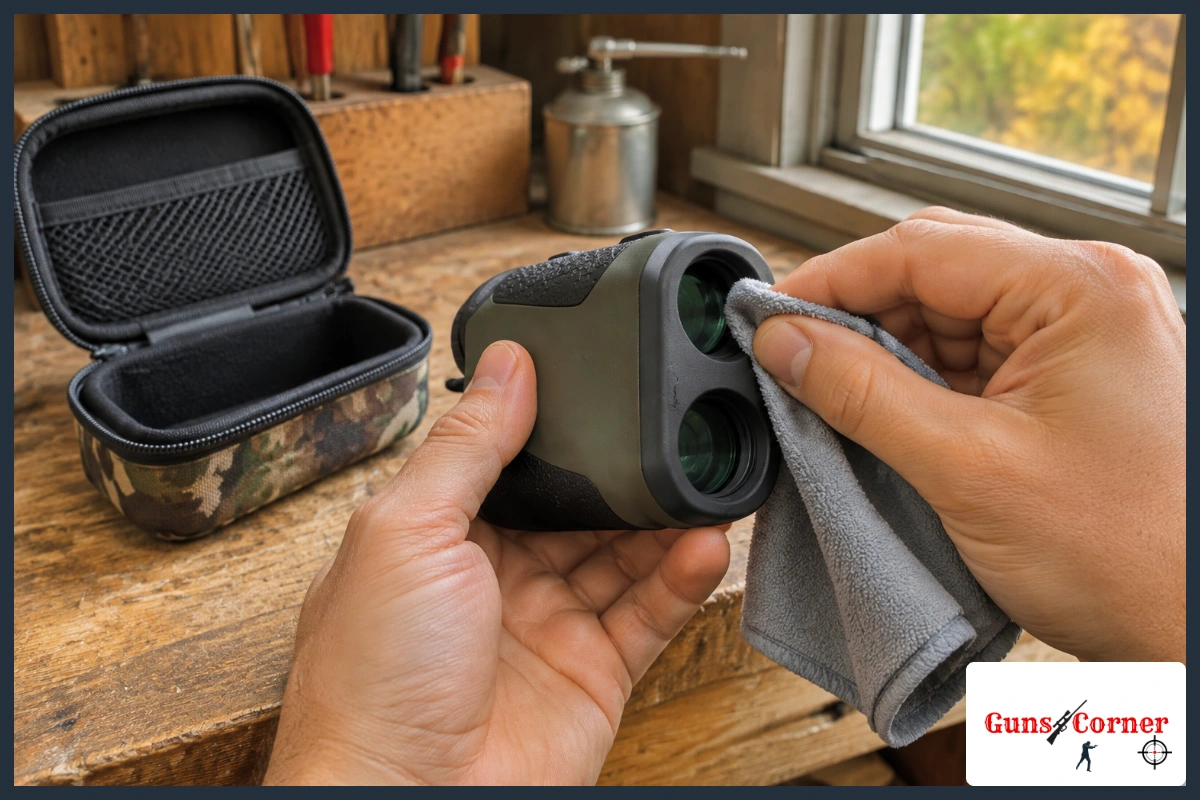
Start with the manual, then inspect the unit with the power off. It takes about two minutes and answers the two questions that matter: what class is it, and is it intact?
- Find the laser class in the manual. Look for “Class 1” or “IEC 60825-1.” A line that says 1M means binoculars and spotting scopes are off the table.
- Find the wavelength if it’s listed. Many units use 905 nm, and some designs use 1,550 nm, which typically cost more, according to ERDILRF.
- Inspect the front lenses. Look for cracks, a missing lens cover, or a loose housing, and keep the lens pointed away from your face while you do.
- Treat missing information as a warning. A unit with no class on the label or in the manual is unverified, so ask the maker or retire it.
Your own check beats any article, including this one. If the manual and this page disagree, the manual wins, because the maker knows what’s inside the unit.
What Are the 5 Simple Safety Rules for Using a Rangefinder?
Five habits cover what the FDA and manufacturers actually warn about. None needs special gear.
- Never aim it at a person. The FDA’s advice on laser pointers is to never aim one at anyone, and the same courtesy applies here. Range the animal, the tree, or the rock, not a hunting partner.
- Don’t look into the emitter lens. Pulsar advises against it, and LightWare doesn’t recommend staring into its emitter from less than 0.5 meters.
- Keep magnifying optics off the beam path. Binoculars, spotting scopes, and rifle scopes raise the hazard for Class 1M units, per the FDA’s table.
- Don’t open or modify it. The Class 1 rating assumes the housing and optics stay as shipped, according to ERDILRF.
- Store it like any other optic. Keep it in its case and out of a small child’s hands, because a rangefinder isn’t a toy.
What Mistakes Do Hunters Make With Rangefinder Safety?
The most common mistake is trusting the words “eye-safe” on the box. Hunters do it because the phrase sounds like a certification. It isn’t one, since the term conventionally describes wavelengths beyond about 1.4 micrometers, per ERDILRF. The fix is to read the class line in the manual instead.
The second is using the rangefinder as a pointer. It’s tempting to flash the beam toward a deer so a partner can find it, and it puts the beam where someone’s face might be. Describe a landmark instead, such as the leaning oak or the fence corner.
The third is opening the housing to clean it. A smudged lens is annoying, but ERDILRF notes the Class 1 rating depends on the housing staying as shipped. Wipe the outside of the lens and leave the rest alone.
The fourth is buying an unlabeled import because the price looks good. The AAO article found that laser pointers often lack required labels or carry wrong ones, and the same logic applies to any cheap laser device. Ask for the class in writing before you buy.
The fifth is never asking the question at all. Many owners never stop to wonder, can a rangefinder damage your eyes, because a quick button press and a small display feel harmless. Thirty seconds with the label in the manual settles it for good, and that is less time than it takes to range a single deer across a field.
What Should You Do If You Think the Beam Hit Your Eye?
See an eye doctor promptly and describe what happened, even if the eye feels fine. A brief exposure to a consumer Class 1 unit isn’t expected to injure you, so most people asking this have nothing to worry about. The 1999 case report is the reason not to wait, because a late complication appeared months after the exposure.
Blurred central vision, a dark or missing spot, or pain after exposure to any laser is worth an ophthalmologist’s time. Bring the class and wavelength from your manual so the doctor knows what the device is. We’re not medical professionals, and this isn’t medical advice.
So, Should You Worry About Your Rangefinder?
So, can a rangefinder damage your eyes during ordinary hunting? For a Class 1 unit in good shape, used without magnifying optics and never pointed at people, the FDA, Pulsar, and LightWare guidance says no.
The more useful question is whether yours is the kind that can’t. Your manual answers that in one line. Open it this week, find the class and the wavelength, and write both inside the case lid. Then check the lens, and keep the spotting scope away from the beam.
Frequently Asked Questions About Rangefinder Eye Safety
Can you use a rangefinder if you wear glasses?
Yes. Rangefinders such as the Vortex Razor HD 4000 GB include an eyepiece diopter adjustment that adjusts for differences in a user’s eyes, according to Vortex’s product page. Turn it until the display text looks sharp. Treat eyeglasses as vision correction, not laser protection.
Is a 1,550 nm rangefinder safer than a 905 nm one?
Not automatically. Both designs can be Class 1, so the class line in the manual matters more than the wavelength. ERDILRF says 1,550 nm designs typically cost more, which means a higher price doesn’t prove a safer beam. Compare the manuals, not the price tags.
How is a laser pointer different from a rangefinder?
A laser pointer is visible and sits in the FDA’s Class IIIa row, which can be momentarily hazardous when viewed directly. Daniel Hewett of the FDA, quoted in the AAO article, said about 60 percent of the pointers the agency samples are stronger than their labels say. That label problem is the reason to read your rangefinder’s class line instead of assuming.
Do thermal monoculars with a built-in rangefinder carry the same risk?
Pulsar says all of its products, including the Axion XQ LRF, use a Class 1 laser under IEC 60825-1:2014, and it still advises against looking into the emitting lens. Other brands set their own class, so confirm each model. A built-in rangefinder doesn’t change the rules above.
Does the beam hurt deer or other wildlife?
None of the sources we read measured how a rangefinder beam affects a deer’s eye. We found no study of rangefinder lasers and animal eyes, so there’s no number to give you. If you’d rather not wonder, range a tree or rock beside the animal, then judge the distance from that landmark.
Can kids use a rangefinder?
Yes, with supervision, since Class 1 is considered non-hazardous in normal use. Teach the first three rules first: no aiming at people, no looking into the lens, and no binoculars on the beam. Anything with a button invites play, so keep it in the case between uses.
Related posts:

How to Bow Hunt Deer: A Beginner-Friendly Guide

Best Caliber for Elk: Top Choices for Effective Hunting and Optimal Performance

How to Hunt a Bobcat: Beginner-Friendly Legal, Safe, and Ethical Guide

15 Best Hunting Packs for Backcountry: Frame Packs, Meat Haulers & Multi-Day Hunting Backpacks

Deer Hunting Tips for Beginners: A Safe, Simple First-Hunt Guide
