
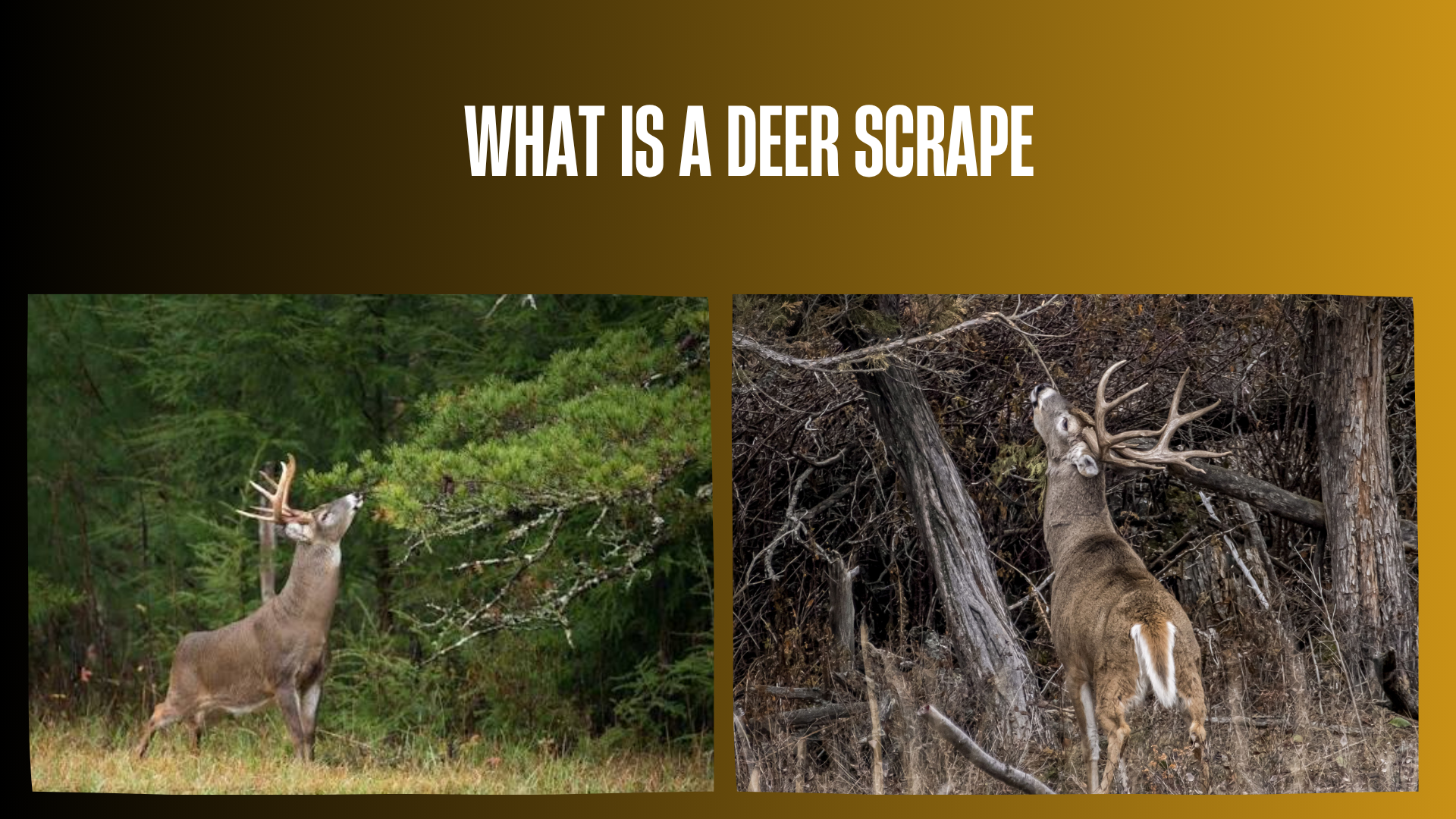

Quick Answer: What Is a Deer Scrape?
A deer scrape is an area where leaves and surface litter have been pawed away, commonly beneath a branch that deer lick, chew, nose, or rub with the forehead. Bucks may also rub-urinate so scent from urine and leg glands reaches the ground. The combined branch-and-ground site functions as a visual and chemical communication point used by more than one deer. A fresh scrape can reveal current use of an area, but it cannot by itself identify the deer, prove daylight movement, or guarantee a return; hunters should verify the pattern with tracks, trails, terrain, cover, food, wind, and legal camera observations.
Anatomy of a Typical Deer Scrape
| Part | What It Looks Like | Why It Matters | Common Misreading |
|---|---|---|---|
| Exposed ground | Leaves, needles, or debris pawed aside | Provides a visible site and can hold scent and tracks | Assuming every bare patch is a deer scrape |
| Licking branch | Low twig or branch hanging over the disturbed soil | Often receives repeated oral, nasal, or forehead contact | Focusing only on the dirt |
| Tracks | Hoof impressions in or around the scrape | Can confirm deer use and sometimes show multiple visits | Assigning a track to a particular buck without proof |
| Urine or damp soil | Darkened ground or odor, sometimes absent to human senses | May be part of scent marking | Assuming rain-darkened soil is urine |
| Nearby rubs | Bark damage on saplings or shrubs | Adds evidence of antlered-deer use in the area | Calling the rubbed tree itself a scrape |
| Approach trails | Faint or obvious paths entering the site | Connects the scrape to cover, food, and terrain | Assuming the most visible trail is used in daylight |
How Deer Make and Use Scrapes
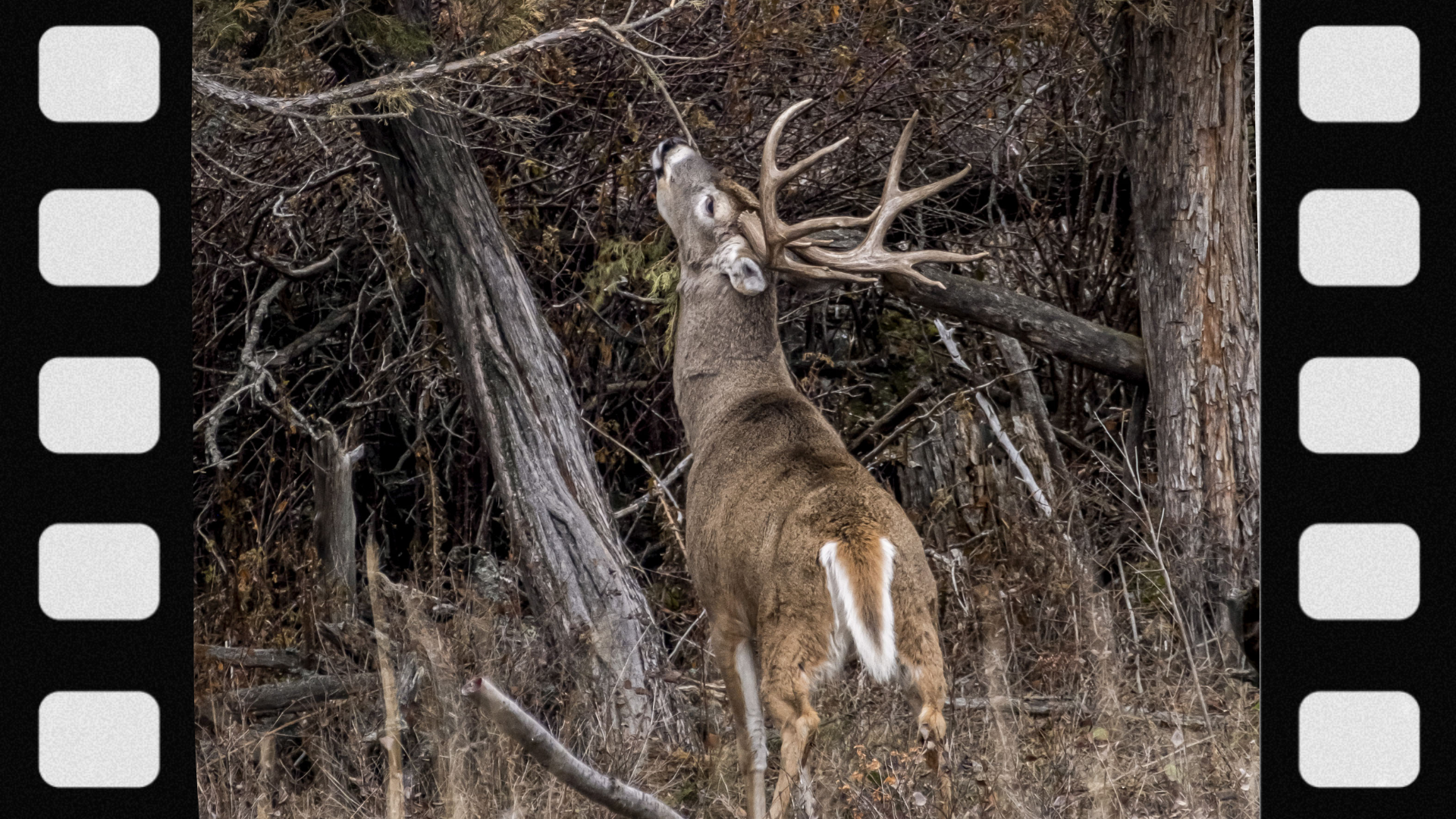
A buck typically works the overhead branch first or during the same visit, contacting it with his mouth, nose, face, forehead, or antlers. He then paws the ground with the front hooves, pushing leaves and loose material backward to expose soil. During rub-urination, urine runs over the tarsal area on the inner hind legs before reaching the ground. The precise sequence and behaviors vary among visits and deer.
The Illinois Natural History Survey’s white-tailed deer ecology information describes scrapes as important communication sites and emphasizes interaction with overhanging licking branches. Minnesota DNR’s bowhunting education page similarly identifies scrapes as bare areas of ground associated with buck activity as the autumn breeding season approaches.
Other deer may visit without pawing the ground. Does and younger deer can investigate or work the licking branch, and multiple bucks may use the same location. That is why a scrape is better understood as a message board than a personal signature. It can carry information among deer, but a human observer cannot decode the identity, reproductive status, age, and next move of every visitor from scent or appearance alone.
Why the Licking Branch Matters
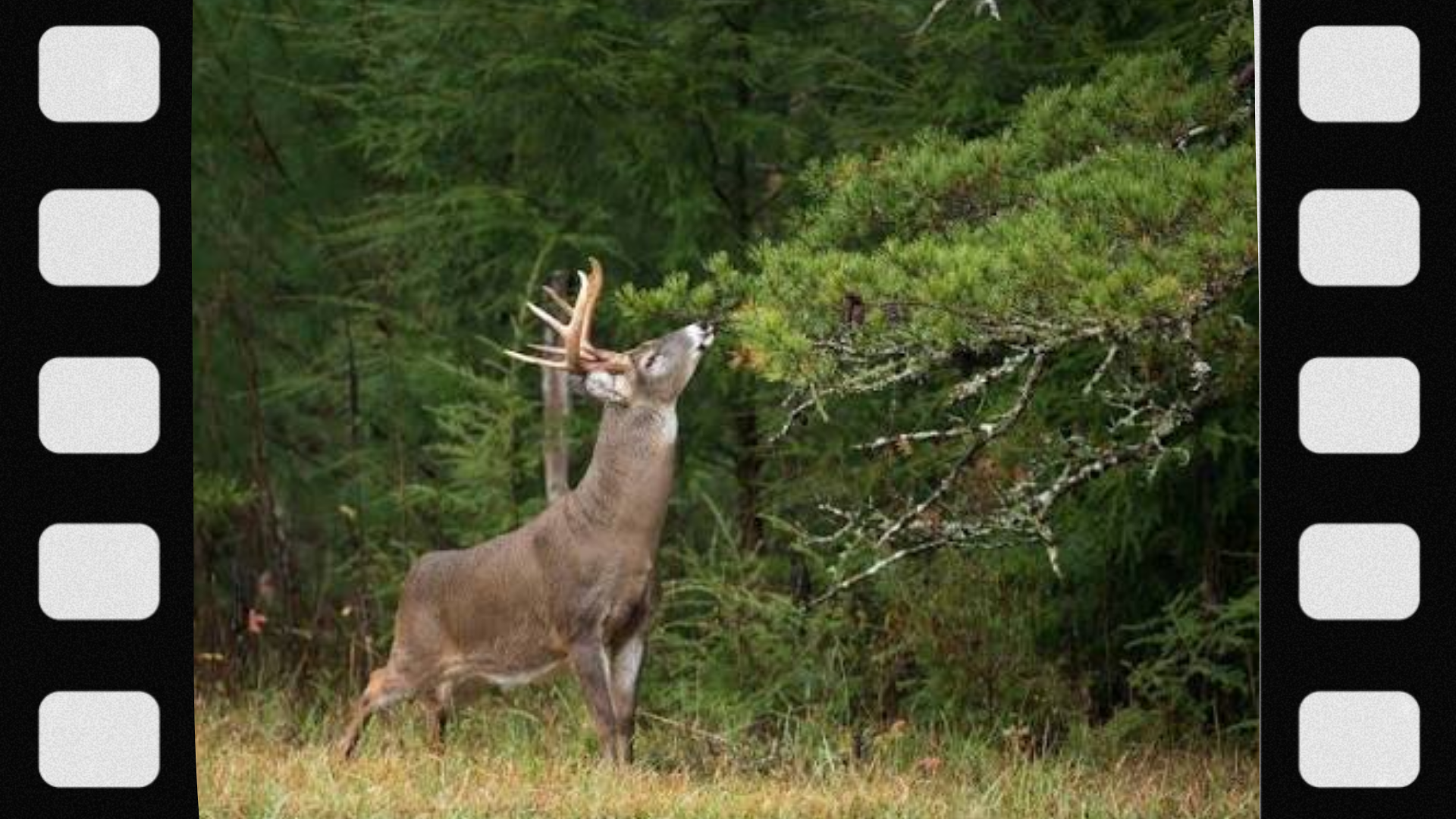
The ground disturbance is easy to see, so beginners often treat it as the entire scrape. The overhead branch may be the more consistently used part of the site. Deer can mouth, lick, chew, sniff, and rub against it even when the soil below has not been freshly pawed. A branch with broken tips, frayed bark, twisted leaves, or deer hair above a cleared patch strengthens identification.
A scrape without a suitable branch may be a temporary pawed area, a relocated site, or something other than deer sign. Conversely, a repeatedly used branch can remain meaningful after leaves blow back over the dirt. Evaluate the two components together and note whether the branch is positioned naturally for deer contact.
Do not handle the branch merely to test it. Touching leaves scent and changes its position. It may also violate rules if the vegetation is on public land or someone else’s property.
Why Do Bucks Make Scrapes?
Scrapes are primarily communication sites associated with the breeding season. Visual disturbance draws attention, while scent deposited on the branch, ground, hooves, or through rub-urination can be detected by other deer. The site may communicate that deer are using the area and allow later visitors to gather or leave information.
Calling every scrape a territorial marker oversimplifies whitetail behavior. Bucks often have overlapping home ranges, and multiple deer use prominent scrapes. A buck does not normally defend every scrape continuously like a fence around exclusive property.
Scraping can also reflect seasonal arousal, investigation, and repeated travel. Researchers and managers distinguish what is observed from what is inferred: the pawed soil, branch contact, and visits can be documented, while the exact message perceived by an individual deer cannot be read directly by a hunter.
When Do Deer Make Scrapes?
Whitetail scrape activity commonly becomes conspicuous in fall as bucks enter the hard-antler period and breeding behavior develops. Use often increases during the pre-rut, when bucks are checking areas and communicating frequently. During peak breeding, visible scrape use may become inconsistent as individual bucks search for or stay with receptive does. Some scrapes are revisited later, while others go dormant.
There is no universal scrape calendar. Breeding chronology varies by latitude, local deer population, habitat, genetics, weather patterns, and region. In parts of the South, local rut timing may differ sharply even between nearby areas. Northern dates should not be copied onto another region.
Scrapes and licking branches may receive some attention outside the classic fall window, particularly established community sites, but an old depression or bare patch does not prove current use. Follow local biological information and current evidence rather than a nationwide “best week.”
Types of Deer Scrapes Hunters Commonly Describe
These field labels are useful descriptions, not rigid biological categories. One site can fit more than one label.
Primary or Community Scrape
A community scrape is a repeatedly used communication site visited by multiple deer. It often has a durable licking branch, several approach trails, and evidence that reappears across weeks or years. Size alone does not prove community use; repeat observations or legal camera records are stronger evidence.
Field-Edge Scrape
These scrapes are easy to spot along crop fields, food plots, openings, or logging roads. They may collect nighttime activity because deer wait for darkness before entering exposed feeding areas. Their visibility to hunters does not necessarily make them the best daylight setup.
Interior or Cover Scrape
A scrape inside timber, brush, or transition cover may lie closer to bedding or staging habitat. It can offer better daylight potential but is also easier to ruin through intrusive scouting. Access and wind often matter more than the scrape’s visual size.
Scrape Line
A scrape line is a sequence of scrapes along a trail, edge, ridge, bench, or other corridor. Several deer can contribute, and the line may represent general travel rather than one buck walking the entire series in order.
Mock Scrape
A mock scrape is created or modified by a person to encourage deer investigation or position activity for observation. Its legality depends on land-management rules, vegetation alteration, scents, bait definitions, disease regulations, and camera restrictions. It never guarantees use.
Deer Scrape vs. Rub vs. Bed
| Sign | Main Appearance | How It Forms | Most Defensible Meaning |
|---|---|---|---|
| Scrape | Bare or pawed ground beneath a low branch | Hoof pawing plus branch and scent interaction | A deer communication site received use |
| Rub | Scraped or shredded bark on woody vegetation | Antlers and forehead work against the stem | An antlered deer contacted that tree |
| Bed | Flattened oval area in grass, leaves, snow, or other cover | A deer lies and rests there | At least one deer used that exact resting spot |
| Feeding sign | Browsed tips, tracks, shells, disturbed mast, or crop use | Deer consume available food | Deer fed there during the sign’s relevant period |
How to Tell Whether a Deer Scrape Is Fresh
Freshness is an estimate, not a timestamp. Combine several clues and account for weather:
- Clean exposed soil: Sharp edges and few newly fallen leaves can indicate recent pawing, unless wind or rain cleaned the patch.
- Fresh tracks: Crisp hoof edges in suitable soil support recent use. Drying, freezing, rain, and repeated traffic change them quickly.
- Newly displaced leaves: Damp undersides turned upward or fresh piles behind the scrape may help establish a short window.
- Worked licking branch: Moist broken tips, fresh fraying, green damage, or newly disturbed leaves can be useful clues.
- Odor or dampness: These may occur after scent marking, but rain, dew, and soil chemistry make them unreliable alone.
- Repeat photographs: A dated before-and-after comparison is stronger than trying to age one visit from appearance.
- Legal camera records: Time-stamped images can identify visit timing, though camera placement and use must comply with current rules.
A freshly cleaned scrape after a storm can narrow the timing more than a bright scrape during stable weather. Even then, it may have been visited at night by a deer other than the one a hunter hopes to see.
What a Deer Scrape Can—and Cannot—Tell You
What It Can Suggest
- Deer are using the location or used it during the current sign period.
- An antlered buck probably participated if the ground is actively pawed in typical scrape form.
- A durable licking branch may support repeated communication visits.
- A cluster or line can identify a broader travel or staging zone worth studying.
- Repeated daylight photos can identify a time-specific movement pattern for a limited period.
What It Cannot Prove
- The age, antler score, or identity of the deer without independent evidence.
- That only one buck owns or visits the scrape.
- That the scrape is part of an exclusive territory.
- The deer’s next travel direction.
- That a buck will return in daylight.
- That a large scrape was made by a large-antlered deer.
- That a human can identify the exact biological message from smell or appearance.
How to Scout a Deer Scrape Step by Step
- Confirm the pattern. Look for pawed soil, a reachable overhead branch, deer tracks, branch damage, and nearby trails.
- Record the baseline. Photograph the site, branch, tracks, and surrounding cover; note date, weather, and apparent freshness.
- Map the context. Mark likely bedding cover, seasonal food, water, terrain funnels, field edges, roads, buildings, and property lines.
- Find approach routes. Follow sign only as far as access permits and without pushing into suspected bedding cover unnecessarily.
- Check prevailing and thermal wind. Determine where scent will travel during both entry and expected deer movement.
- Assess pressure. Tracks, boot prints, cameras, stands, roads, or repeated disturbance may change deer timing.
- Recheck sparingly. Use distant observation, a careful return after suitable weather, or a legal camera rather than daily intrusion.
- Update the hypothesis. If evidence shows only nighttime use or the scrape goes inactive, shift attention to safer interior travel rather than forcing the original plan.
Do not clear excessive vegetation, break the licking branch, or stand inside the scrape while inspecting it. The best scout leaves the site and surrounding habitat nearly unchanged.
Should You Hunt Over a Deer Scrape?
A scrape can help select a hunting area, but hunting directly over the bare ground is not automatically the best choice. Field-edge scrapes may be visited mainly after dark. A setup between secure cover and the scrape—or along a terrain feature that shapes approach—may offer better daylight opportunity without crowding the sign.
Prioritize a clean entry and exit, a wind that carries scent away from likely deer locations, positive target identification, and a safe shooting lane and backstop. Avoid entering suspected bedding cover simply to reach an impressive scrape. One intrusive trip can change the pattern you hoped to use.
Patterns also expire. A food-source change, breeding phase, weather shift, agricultural activity, or hunting pressure can make last week’s active scrape less relevant. Continue reading current sign instead of treating a map pin as permanent.
Trail Cameras at Scrapes
Where legal, a trail camera can answer questions that soil cannot: which deer visited, whether the licking branch receives use without pawing, the time of day, direction of approach, and how activity changes through the season. A video mode may capture behavior that a single still image misses.
Position the camera to cover the branch and the approach rather than only the center of the dirt. Avoid placing it so close that infrared illumination, sound, odor, or frequent card checks dominate the site. Use secure, non-damaging attachment methods allowed by the land manager.
Camera restrictions vary by jurisdiction and land ownership, and rules can change. Some areas regulate transmission, timing, placement, retrieval, or use of information for taking wildlife. Verify current wildlife-agency and property rules before deployment.
Mock Scrapes: Useful Test, Not a Guarantee
A mock scrape can provide a standardized location for observation, particularly where a natural licking branch already crosses a travel route. But building one is not merely a hunting technique—it may involve altering vegetation, placing a branch or rope, applying scent, disturbing soil, or using a camera. Each action can be regulated separately.
Synthetic or natural urine products may be prohibited or restricted because of baiting definitions or chronic wasting disease precautions. Commercial labels do not establish legality. Public-land rules may prohibit cutting or attaching items to trees even when the wildlife regulation booklet says nothing about mock scrapes.
If legal and permitted, keep the experiment small, avoid entanglement hazards, do not contaminate shared habitat, and measure actual use rather than assuming success. A mock scrape should never replace understanding travel, cover, food, wind, and access.
Safety, Ethics, and Legal Considerations
A scrape does not create access rights. Confirm boundaries, obtain landowner permission, and follow public-land travel and equipment rules. Do not follow tracks across private property, modify a natural site without authorization, or crowd another hunter’s setup.
When hunting near a scrape, identify the entire animal—not antlers, movement, or sound alone—and know what is beyond the target. Treat every firearm as loaded, keep the muzzle in a safe direction, keep your finger outside the trigger guard until ready to shoot, and use only a safe shot with a suitable backstop. Archery and firearm hunters should remain inside their practiced accuracy limits and pass when angle, distance, visibility, or animal position is uncertain.
Elevated hunters should use a full-body fall-arrest system and lifeline as directed, inspect equipment, maintain three points of contact, and haul unloaded equipment separately. No scrape is worth an unsafe climb, a rushed shot, trespass, or ignoring changing weather.
Common Mistakes When Reading Deer Scrapes
- Ignoring the licking branch: Study the overhead contact point as carefully as the dirt.
- Assuming large means mature: Scrape size is influenced by repeated use, soil, leaf depth, and multiple deer.
- Calling every bare spot a scrape: Turkeys, livestock, machinery, water, people, and other wildlife disturb ground.
- Treating “fresh” as “daylight”: Recent activity may have occurred at night.
- Believing one buck owns it: Community sites can receive visits from bucks, does, and young deer.
- Overchecking: Repeated close inspection adds disturbance and can shift use.
- Hunting the scrape but ignoring access: Entry scent and noise may cross the very trail being monitored.
- Using the same plan all rut: Deer priorities and scrape activity change through breeding phases.
- Installing a camera without reading rules: Device and data-use restrictions are location-specific.
- Creating mock sign unlawfully: Vegetation damage, scents, bait, ropes, and public-land attachments may be regulated.
Final Answer: What Is a Deer Scrape?
A deer scrape is a ground-and-branch communication site where leaves are pawed away beneath a low licking branch. Bucks commonly create and refresh the exposed soil, work the branch, and may deposit scent through forehead contact, hoof contact, and rub-urination. Other bucks, does, and younger deer can investigate or use the same site.
The most useful scrape is not necessarily the largest or easiest to see. Look for repeat use, a durable licking branch, fresh tracks, secure cover, logical terrain, clean access, and verified daylight activity where legal. Treat every conclusion as a testable hypothesis, minimize disturbance, follow safe hunting practices, respect property boundaries, and confirm current regulations for cameras, scents, bait, vegetation alteration, and hunting equipment.
FAQs
1. What does a deer scrape look like?
A typical scrape is a roughly cleared patch of soil where leaves or needles have been pawed backward, usually beneath a low branch. Tracks, disturbed branch tips, nearby rubs, and approach trails can support identification.
2. Why do deer make scrapes?
Scrapes function mainly as communication sites. Deer leave and investigate visual and chemical information through the ground, licking branch, hooves, forehead contact, and urination behavior.
3. Do only bucks make scrapes?
Bucks are most associated with pawing and maintaining classic breeding-season scrapes. Does and younger deer can visit and interact with the licking branch, so a scrape is not necessarily used only by bucks.
4. Do does visit deer scrapes?
Yes. Camera and field observations show does can investigate scrape sites and work licking branches. That does not mean every doe visits every scrape or that the visit indicates immediate breeding readiness.
5. What is a licking branch?
It is the reachable branch, twig, vine, or similar overhead feature associated with a scrape. Deer may sniff, lick, chew, nose, or rub their forehead against it.
6. How high is a licking branch?
It is typically low enough for natural head and forehead contact, but height varies with terrain, branch flexibility, deer size, snow, and vegetation. A fixed measurement is less useful than observing whether deer can comfortably reach it.
7. What is rub-urination?
Rub-urination is behavior in which a deer urinates over the tarsal area on the inner hind legs so scent-bearing material reaches the legs and ground. It occurs more often among bucks during breeding season.
8. When do bucks start making scrapes?
Scraping commonly becomes noticeable in fall before peak breeding, but local timing varies greatly. Follow regional wildlife information and field observations rather than a single national date.
9. When is scrape activity highest?
It often increases during the pre-rut, though peaks differ by region and individual. Visible use may decline or become irregular when bucks spend more time seeking and tending receptive does.
10. Do bucks use scrapes during the rut?
They can, but patterns may change during peak breeding. Some scrapes stay active, some pause, and others are abandoned as deer movement and priorities shift.
11. How can you tell if a deer scrape is fresh?
Look for clean exposed soil, crisp tracks, newly overturned leaves, a freshly worked branch, and changes since known rain or wind. Combine clues because no single feature provides an exact time.
12. How long does a deer scrape stay active?
Some receive one visit, while community sites may be reopened for weeks or across seasons. Weather can cover the soil even while the branch continues receiving use.
13. Will rain ruin a deer scrape?
Rain can wash scent, soften tracks, and flatten the site, but deer may refresh it afterward. A newly opened scrape after rain can provide a useful relative time window.
14. What is a community scrape?
It is a repeatedly used communication site visited by multiple deer, often with a durable licking branch and several approaches. Repeat observations are better evidence than size alone.
15. What is a scrape line?
A scrape line is a series of scrapes along a trail, edge, ridge, or travel zone. It may reflect the activity of multiple deer and does not prove one buck follows the whole line.
16. What is the difference between a deer rub and a scrape?
A rub is bark damage caused when a buck works antlers and forehead against woody vegetation. A scrape is disturbed ground paired commonly with an overhead licking branch.
17. Does a big scrape mean a big buck?
No. Soil condition, leaf depth, repeated visits, and multiple deer influence size. A large scrape cannot reliably determine age, body size, or antler score.
18. Can you identify a buck from its scrape?
Not from the scrape’s appearance alone. Legal trail-camera images, sightings, or distinctive tracks combined with other evidence may identify visitors, but several deer can share the site.
19. Do bucks visit scrapes in daylight?
Some do, especially in secure cover, but many exposed scrapes receive mostly nighttime activity. Location, pressure, season phase, access, and individual behavior matter.
20. Should I hunt directly over a scrape?
Only when access, wind, current activity, safety, and regulations support it. A travel route downwind or between cover and the scrape may offer a better low-impact setup.
21. Should I place a trail camera over a scrape?
A camera can reveal visitors and timing, particularly when it covers both the licking branch and approaches. First confirm landowner permission and current camera rules.
22. Does touching a licking branch matter?
Touching can leave odor and alter the branch. Avoid unnecessary contact, both to preserve the site and to comply with vegetation and property rules.
23. What is a mock scrape?
A mock scrape is a person-created or modified ground-and-branch site intended to encourage deer investigation or provide a monitoring point. Results are variable and legality is location-specific.
24. Are deer urine products legal for mock scrapes?
Not everywhere. Product type, baiting definitions, CWD rules, land ownership, and wildlife regulations can restrict use. Check official current rules rather than relying on the label.
25. Do scrapes work after the rut?
Some continue receiving visits, but overall use can change as breeding ends, food patterns shift, and bucks recover. Current tracks and camera evidence matter more than the site’s earlier activity.
26. Do mule deer make scrapes?
Other cervids perform scent-marking and ground-disturbance behaviors, but the classic scrape-and-licking-branch system is discussed most often in whitetail hunting. Interpret sign using the local species’ biology.
27. Can more than one buck use the same scrape?
Yes. Prominent community sites may attract several bucks as well as does and younger deer. Shared use is why “ownership” claims require caution.
28. Does finding a fresh scrape guarantee a deer encounter?
No. It proves recent site use only to the degree supported by the evidence. Timing, wind, pressure, food, cover, rut phase, and individual movement still control whether a hunter sees deer.
Read more: