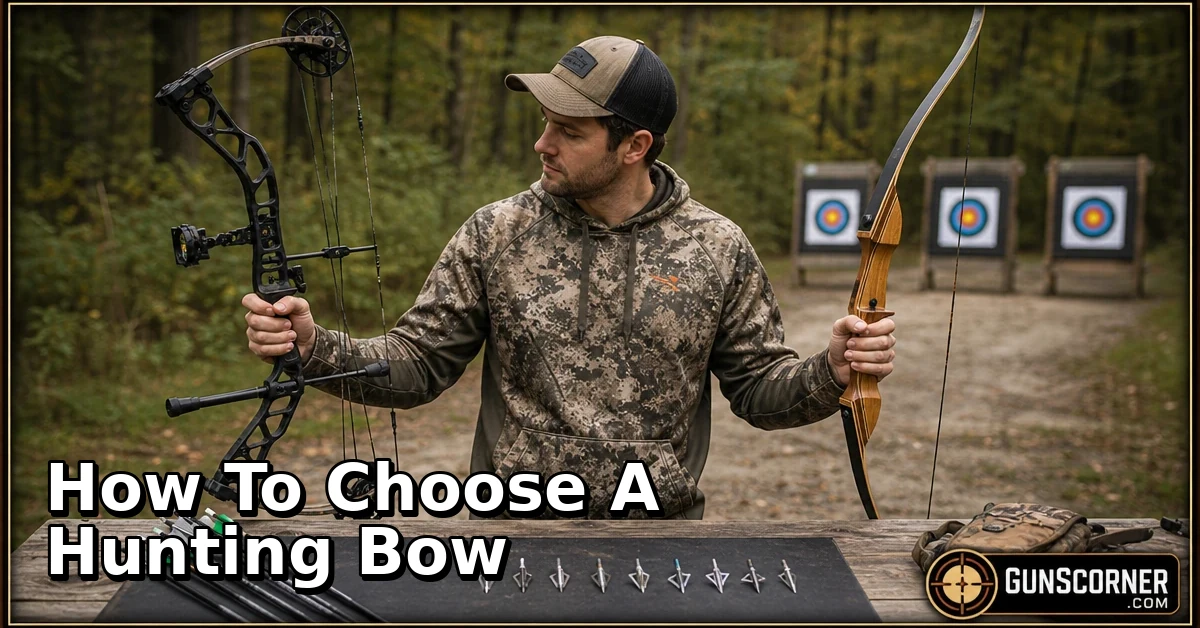
Choosing a hunting bow is less about buying the fastest model and more about finding equipment that fits your body, hunting plans, legal requirements, budget, and current shooting ability. This guide explains how to compare compound bows, traditional bows, and crossbows while preparing for safe, ethical hunting.
To choose a hunting bow, first check your local regulations and decide what game, terrain, and hunting season you will pursue. Then get professionally fitted for draw length, draw weight, hand orientation, and shooting form before comparing bow types and specifications. Choose equipment you can draw, aim, and let down smoothly, and budget for arrows, broadheads, accessories, tuning, practice, and maintenance. A suitable bow is one that supports repeatable accuracy and ethical shot decisions—not simply the highest advertised speed.
Important Legal and Safety Notice Before You Hunt
Hunting regulations vary by state, province, territory, tribal jurisdiction, species, season, and weapon category. Before purchasing or using a bow, check your official wildlife agency for current requirements involving licenses, tags, seasons, legal hunting hours, minimum draw weight, broadheads, arrows, crossbows, hunter education, harvest reporting, and land access.
- Carry the required hunting license, permit, and tags.
- Confirm whether a bowhunter or hunter-education course is required.
- Verify legal archery and crossbow seasons and weapon restrictions.
- Use only legal arrows and broadheads for the intended game.
- Follow public-land boundaries or obtain private-land permission.
- Never dry-fire a bow or shoot damaged equipment.
- Use a safe target and backstop that can stop your arrows.
- Wear required visibility clothing and plan for weather, navigation, first aid, and communication.
Start With the Hunt, Not the Bow
Identify the game, terrain, season, and expected shooting conditions
Your intended hunt should guide the bow choice. Consider the species, terrain, typical vegetation, hunting position, weather, and whether you will hunt from a ground blind, tree stand, or while moving through terrain.
A compact setup may be convenient in thick cover, while a different configuration may be more comfortable in open terrain. These are practical considerations, not universal rules. Your legal hunting method and personal ability remain more important than a specification sheet.
Match bow choice to realistic hunting distance and ethical shot opportunities
Bowhunting requires close-range discipline and a controlled shot opportunity. Choose a bow you can aim steadily and shoot accurately at the distances you can repeatedly manage during practice.
Do not select equipment based on a promised long-range capability. Your personal maximum range should be determined by repeatable accuracy, stable form, clear target identification, a safe background, and a realistic recovery plan.
Check local archery, crossbow, draw-weight, broadhead, and season regulations before buying
Some jurisdictions distinguish between vertical bows and crossbows, and rules may vary by species or season. Minimum draw weights, broadhead designs, arrow requirements, legal hunting hours, and crossbow eligibility can also differ.
Use your official wildlife agency as the final authority. Manufacturer pages and retailer listings cannot replace current local regulations.
Confirm whether a hunter-education course or bowhunting qualification is required
Many hunters benefit from formal education even where a separate bowhunting qualification is not required. A course can improve equipment handling, shot ethics, wildlife identification, recovery planning, and field safety.
Choose the Bow Type
Compound bows: adjustable performance and easier holding at full draw
Compound bows use cams and cables to change the force required during the draw cycle. Many hunters find that this makes it easier to hold at full draw than an equivalent traditional bow, but the bow must still be fitted and adjusted correctly.
Compound bows often offer adjustable draw length and draw weight within a manufacturer’s specified range. Those adjustments are not unlimited, and they should be made according to the manufacturer’s instructions or by a qualified technician.
Recurve and longbows: simplicity, practice demands, and traditional shooting technique
Recurve and longbows have fewer mechanical components and can provide a simple, traditional shooting experience. Their draw weight generally increases continuously as the string is drawn, so proper form and gradual practice are especially important.
These bows can be effective hunting tools when the hunter has sufficient practice, uses legal equipment, and maintains an ethical range. They are not automatically easier because they have fewer parts.
Crossbows: a separate legal and handling category
A crossbow is not automatically interchangeable with a vertical compound, recurve, or longbow. Crossbow laws may differ by season, species, hunter eligibility, minimum specifications, and permitted accessories.
Crossbows also require careful handling because they store energy while cocked. Follow the manufacturer’s instructions, keep fingers clear of the string and rail where applicable, and never point a loaded crossbow at anything you do not intend to shoot.
How experience, available practice time, portability, and maintenance affect the decision
Choose the system you can safely practice with and maintain. A more mechanically complex bow may require periodic tuning and professional service, while a traditional bow may demand more attention to shooting form.
Your available practice time matters. A bow that looks impressive but does not fit your schedule, strength, or shooting style is a poor hunting investment.
Get Professionally Fitted Before Comparing Models
Measure and verify draw length
Draw length affects anchoring, posture, comfort, aiming, and equipment selection. A bow that is too long or too short can encourage poor form and inconsistent shooting.
Because measuring methods can vary and compound bows have specified adjustment ranges, have your draw length checked by a qualified bow technician or instructor. Do not rely solely on an online calculator.
Choose draw weight that can be drawn smoothly without collapsing form
The correct draw weight is one you can draw smoothly, anchor consistently, aim under control, and let down safely. If you must jerk the string, lean backward, or lose your anchor point, the weight is too high for your current ability.
There is no single universal poundage that suits every hunter or jurisdiction. Local regulations may establish minimum requirements, while your body, bow type, and shooting technique determine what is manageable.
Evaluate eye dominance, stance, anchor point, and hand orientation
Eye dominance and hand orientation can affect whether a right- or left-handed bow feels natural. A professional fitting session should also evaluate your stance, grip, anchor point, shoulder position, and ability to maintain alignment.
Small fit problems can become larger accuracy and comfort problems after repeated practice.
Test grip comfort, balance, vibration, noise, and ability to hold steadily
Hold several bows if possible. Pay attention to whether the grip encourages a relaxed hand, whether the bow feels balanced, and whether you can hold it steadily without excessive tension.
Noise and vibration should be assessed with the bow properly set up, because accessories, arrows, draw weight, and tuning influence the final hunting configuration.
Why a shop fitting and supervised shooting session help
A supervised session allows you to compare actual draw-cycle feel and handling rather than relying on advertised specifications. It also gives a technician an opportunity to identify unsafe draw weight, incorrect draw length, poor grip pressure, or inconsistent anchoring.
Understand the Specifications That Actually Matter
Axle-to-axle length, brace height, mass weight, and maneuverability
Axle-to-axle length describes the distance between the cams on a compound bow. Mass weight is the bow’s weight before adding accessories. Brace height is the distance between the string and the deepest part of the grip when the bow is at rest.
These specifications can influence maneuverability, balance, forgiveness, and comfort, but they should not be judged in isolation. Compare them alongside your hunting position, body size, terrain, and shooting experience.
Cam systems, draw-cycle feel, let-off, and valley
Cam systems influence how a compound bow draws and holds. Let-off describes the reduction in holding weight near full draw. Valley refers to how much movement or effort is available around the point where the bow reaches its holding position.
These terms are useful for comparison, but the numbers do not tell the whole story. Two bows with similar specifications can feel very different when drawn.
Advertised speed versus controllability, noise, vibration, and hunting setup
Advertised arrow speed depends on the manufacturer’s testing conditions and setup. Actual performance changes with draw weight, draw length, arrow weight, accessories, and other factors.
Speed should not outweigh controllability, repeatable accuracy, comfort, noise, vibration, and legal arrow requirements. A manageable bow is generally more useful than a faster bow that damages your form.
Adjustability range and future changes
Review the manufacturer’s stated draw-length and draw-weight ranges. Adjustability can be useful if your strength, technique, or shooting needs change, but only within the approved range.
Do not assume every model can grow with the hunter. Confirm the exact specifications for the model and configuration you are considering.
Draw-weight adjustment limits and manufacturer instructions
Follow the manufacturer’s instructions for limb-bolt adjustments and maximum settings. If you are unsure, use a qualified technician rather than experimenting with unfamiliar adjustments.
Budget for a Complete, Safe Setup
Bow price versus the complete equipment cost
The bow is only one part of a hunting setup. Also budget for:
- Arrows matched to the bow and intended use
- A reliable arrow rest and sight where appropriate
- A release aid for a compound bow, if required by your shooting method
- Stabilizer, quiver, and bow case
- Legal broadheads and practice points
- Arm protection or other comfort equipment where useful
- Targets, tuning, maintenance, and replacement parts
- Safety equipment and field gear
Professional setup, paper tuning, and follow-up adjustments
Professional setup and tuning can be more valuable than spending the same money on a higher-performance bow. Ask what services are included and whether follow-up adjustments are available after you begin practicing.
Practice arrows and replacement-string costs
Arrows are consumable equipment. Plan for damaged or lost arrows, practice points, legal broadheads, replacement strings, cables, and periodic inspection.
Warranty, service network, replacement parts, and manufacturer support
Before buying, check the manufacturer’s warranty terms, service requirements, parts availability, and local technician support. A bow that cannot be serviced conveniently may become difficult to maintain.
When a package is useful
A beginner package can simplify buying by grouping a bow with common accessories. However, inspect each included component and confirm that the arrows, release, sight, rest, and other parts fit your draw length, draw weight, hunting method, and local regulations.
Buying New or Used
Questions to ask about ownership, storage, dry fires, repairs, and modifications
When considering a used bow, ask who owned it, how it was stored, whether it was ever dry-fired, and whether it has been repaired or modified. Also ask whether the bow was regularly inspected and serviced.
Inspect limbs, cams, strings, cables, axles, serving, grip, and fasteners
Look for cracks, splits, excessive wear, damaged serving, frayed strings or cables, bent or damaged cams, loose fasteners, and signs of improper modification. Do not shoot a bow if you see damage or are uncertain about its condition.
Verify model year, ranges, serial number, and parts availability
Confirm the exact model, model year, draw-length range, draw-weight range, serial number, and availability of replacement parts. Older equipment may be difficult or expensive to service.
Have a qualified technician inspect a used compound bow
A qualified bow technician should inspect a used compound bow before it is shot. Do not attempt to press or repair an unfamiliar compound bow without the proper equipment and training.
Red flags that justify walking away
- The seller cannot identify the model or specifications.
- There are visible cracks, severe corrosion, bent components, or damaged limbs.
- The bow has unexplained modifications.
- The seller claims it was dry-fired but says it is still safe without inspection.
- Replacement strings, cables, or parts are unavailable.
- The price is based on marketing claims rather than verified condition.
Safety and Ethical Readiness
Never dry-fire a bow or shoot damaged equipment
Dry-firing means releasing the string without a properly nocked arrow. It can damage the bow and create a serious safety hazard. Follow the manufacturer’s instructions and have questionable equipment inspected.
Use a target and backstop capable of stopping the arrow
Practice only where the target is designed for your arrows and the area behind it can safely stop a missed or passing-through arrow. Keep people, pets, roads, buildings, and livestock away from the shooting area.
Practice broadhead flight and confirm compatibility
Broadheads may fly differently from field points. Before hunting, confirm that your arrows, inserts, spine, broadheads, and bow setup are compatible, then practice with the legal hunting broadheads you intend to use.
Set a personal maximum range
Your maximum range should be based on repeatable accuracy under realistic conditions, not the bow’s advertised speed or another hunter’s ability. Reduce that range when wind, poor visibility, awkward footing, or elevated positions affect control.
Require a controlled shot angle and recovery plan
Only consider a shot when the animal is clearly identified, the angle is appropriate for your equipment and skill, the background and surrounding area are safe, and you have a realistic plan for tracking and recovery. Pass on uncertain opportunities.
Use a safety harness from an elevated stand
If you hunt from a tree stand, use a full-body safety harness, inspect the stand and attachment system, and follow the stand and harness manufacturer’s instructions. Plan safe entry and exit routes and avoid climbing while carrying a loose bow or arrows.
A Practical Bow-Selection Checklist
Record your legal requirements and intended quarry
Write down the species, season, hunting area, weapon category, minimum equipment rules, broadhead requirements, and any required education or qualification.
Set an all-in budget
Include the bow, arrows, broadheads, accessories, case, tuning, service, practice targets, replacement parts, and safety equipment.
Get fitted and test several bow types
Have your draw length, draw weight, eye dominance, hand orientation, stance, and anchor point checked. Shoot several suitable bows under supervision.
Compare verified specifications and service support
Use current manufacturer information for exact specifications and ask about local service, warranty coverage, parts, and tuning support.
Buy only after confirming safe control
Before buying, confirm that you can draw, aim, hold, and let down smoothly without losing form. If you cannot control the bow comfortably, choose a more manageable setup.
Common Mistakes to Avoid
- Buying based only on advertised speed.
- Choosing draw weight that is too difficult to control.
- Skipping a professional fitting.
- Ignoring total setup and maintenance costs.
- Assuming a crossbow is legal during every archery season.
- Using arrows or broadheads that are not matched to the bow.
- Practicing only with field points and never checking broadhead flight.
- Buying used equipment without a technician’s inspection.
- Taking practice shots beyond your repeatable ability.
- Failing to plan safe recovery, reporting, and meat care.
Troubleshooting Common Problems
| Problem | Possible Cause | What to Do |
|---|---|---|
| You cannot draw the bow smoothly | Draw weight is too high, draw length is incorrect, or technique needs help | Stop shooting and have a qualified instructor or technician check the fit and reduce the setting if appropriate. |
| Your arrows group inconsistently | Inconsistent anchor point, grip pressure, release, tuning, or mismatched arrows | Return to basic form practice and have the complete setup inspected and tuned. |
| The bow feels uncomfortable | Poor grip, incorrect hand orientation, improper draw length, or unsuitable balance | Test another setup and seek professional fitting rather than adapting to persistent discomfort. |
| A used compound bow has visible damage | Impact, dry fire, poor storage, or age-related wear | Do not shoot it. Have a qualified technician inspect it or walk away from the purchase. |
| Broadheads do not group with field points | Different flight characteristics, tuning issues, or arrow compatibility problems | Check arrow and broadhead compatibility, then seek professional tuning before hunting. |
| You are unsure whether the setup is legal | Rules differ by location, species, season, or weapon category | Contact the relevant official wildlife agency before hunting or purchasing specialized equipment. |
Ethical Hunting and Conservation
Ethical bowhunting depends on preparation, restraint, and respect for wildlife. Practice until your equipment and form are dependable, identify the target clearly, and pass on any shot that is unsafe or beyond your ability.
Follow seasons, bag limits, weapon rules, access permissions, tagging requirements, and harvest-reporting rules. Recover game responsibly, avoid waste, and handle meat in a clean and timely manner. Hunting licenses and lawful participation also support wildlife management and conservation programs in many jurisdictions.
Respect landowners, other hunters, hikers, and wildlife. Leave access areas cleaner than you found them and never trespass or create unsafe shooting conditions.
When to Get More Training or Professional Guidance
- You have never safely handled a bow or crossbow.
- You have not completed required hunter education.
- You are unsure about local regulations or land boundaries.
- You cannot draw, aim, or let down the bow smoothly.
- You need help selecting arrows, broadheads, or accessories.
- You are unfamiliar with tree stands, blinds, or local terrain.
- You need assistance with tracking, recovery, reporting, or meat care.
Useful sources of instruction include official hunter-education courses, certified archery instructors, qualified bow technicians, experienced ethical mentors, wildlife agencies, and reputable conservation organizations.
After the Hunt: Follow-Up, Gear Care, and Learning
Inspect the bow, strings, cables, arrows, broadheads, release, rest, and case after each outing. Store equipment according to manufacturer instructions and replace damaged components before the next practice session.
Record weather, wind, terrain, animal sign, shooting conditions, and what you learned. Complete any required harvest reporting and care for meat responsibly. Reviewing your decisions after each hunt helps improve future preparation without encouraging unnecessary risk.
Recommended Hunting Gear and Tools to Consider
You do not need the most expensive equipment to hunt responsibly. Choose gear based on local laws, hunting method, species, terrain, weather, safety needs, skill level, and budget.
- A properly fitted legal hunting bow or crossbow
- Matched arrows, field points, and legal broadheads
- Arrow rest, sight, release aid, stabilizer, and quiver as appropriate
- Bow case and basic maintenance supplies
- Weather-appropriate clothing and required visibility gear
- Binoculars for observation where useful
- Map, compass, GPS, or reliable navigation tool
- First-aid kit, water, food, and emergency communication
- Gloves, game bags, cooler, and meat-care supplies where relevant
Frequently Asked Questions
What draw weight should a beginner hunting with a bow choose?
Choose a draw weight you can draw, anchor, aim, and let down smoothly without losing form. The legal minimum may vary by location and species, so confirm local rules and have a qualified technician fit the bow.
Is a faster bow better for hunting?
Not necessarily. Advertised speed depends on testing conditions and setup. Controllability, accuracy, comfort, legal compliance, suitable arrows, and ethical shot discipline are more important than speed alone.
Should a first hunting bow be new or used?
Either can work, but a new bow may provide easier access to current parts, warranty, and setup support. A used compound bow should be inspected by a qualified technician before it is shot.
How do I know whether a bow fits my draw length?
A proper fit allows a consistent anchor, balanced posture, comfortable shoulder position, and controlled aiming. Have your draw length measured and verified while shooting under professional supervision.
Can I hunt with a crossbow during archery season?
That depends entirely on local regulations. Some jurisdictions allow crossbows during certain seasons or for specific hunters, while others classify them separately. Check your official wildlife agency before hunting.
What equipment must I buy besides the bow?
Most hunters need compatible arrows, practice points, legal broadheads, an arrow rest, a sight or aiming system, a quiver, and possibly a release aid, stabilizer, case, target, and tuning service. The exact setup depends on the bow type and local rules.
Final Thoughts
The best way to choose a hunting bow is to begin with the hunt, verify the law, get professionally fitted, compare complete setup costs, and select equipment you can control consistently. Practice with the arrows and broadheads you plan to hunt with, establish a realistic personal range, and pass on any unsafe or uncertain shot.
With patience, proper instruction, careful scouting, and respect for wildlife and other land users, you can build a safe and ethical bowhunting system suited to your skill level and hunting conditions.
Related posts:
What Is a Saddle on a Topo Map? How to Identify One
What Choke for Dove Hunting? IC vs Modified Explained
How to Buy a Gun Online: A Legal and Safety-Focused Guide
How to Brush In a Ground Blind: A Beginner-Friendly Hunting Guide

15 Best Hunting Bows for Deer, Elk, and Bowhunting in 2026
