
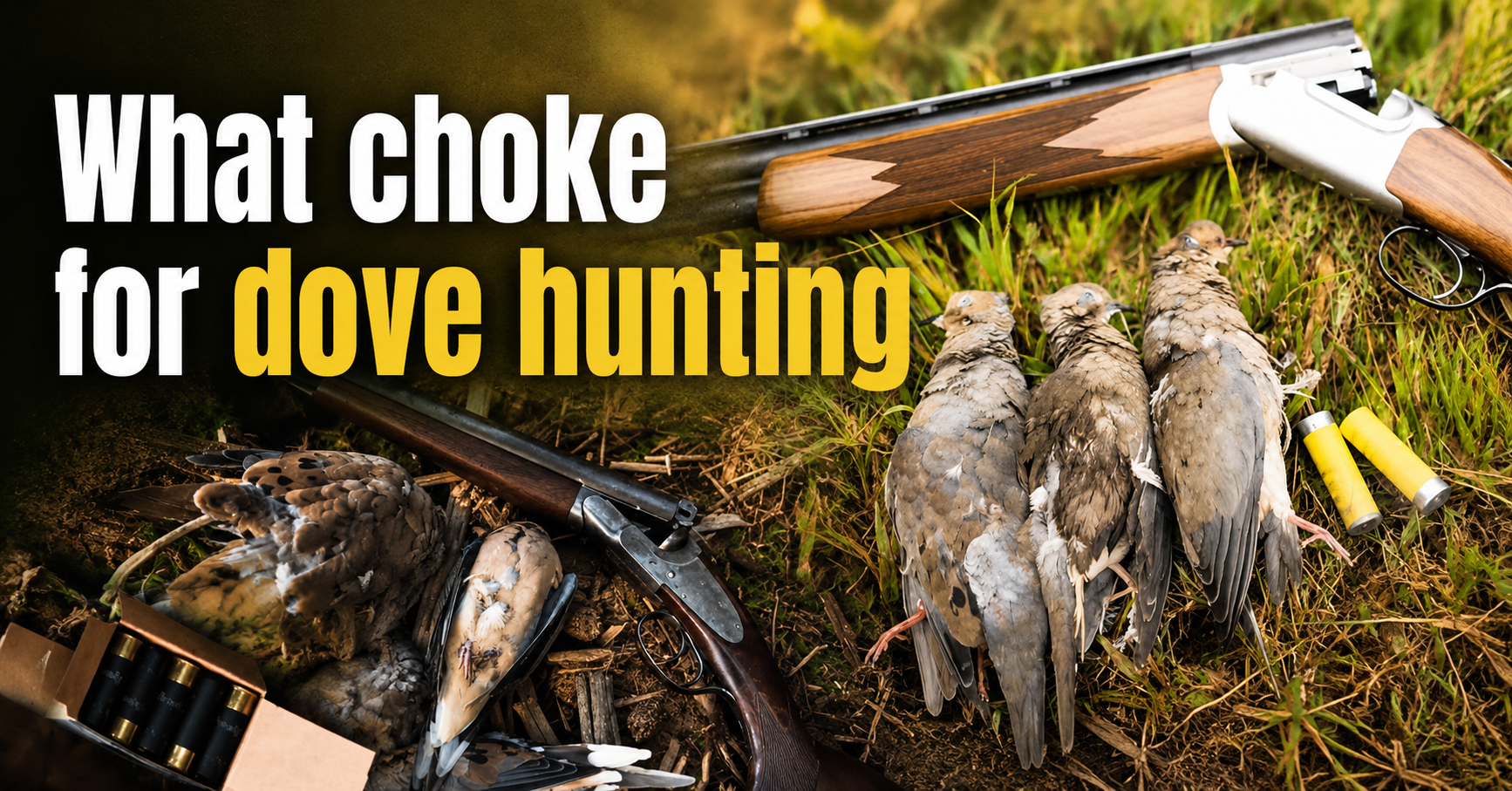

If you are wondering what choke for dove hunting gives the best balance of pattern width and pellet density, Improved Cylinder is the most useful starting point for many typical field situations. That answer changes when birds are consistently close, passing farther out, or when your ammunition patterns differently than expected.
This guide explains how to choose among Skeet, Cylinder, Improved Cylinder, Light Modified, and Modified without treating a choke label as a guarantee. It is written for hunters using a compatible sporting shotgun and lawful shotshells. Your firearm manual, ammunition instructions, and current federal, state, local, and property-specific regulations always override general guidance.
Quick Answer
For most dove hunting, begin with an Improved Cylinder choke because it provides a relatively open pattern for the close-to-moderate shots common around fields, water, and decoys. Choose Skeet or Cylinder when nearly all safe shots are close, and consider Light Modified or Modified when birds consistently present farther, ethical opportunities and your proven skill allow it. These are starting points, not fixed range promises: pattern your exact shotgun, choke, and legal load at the distances you expect to shoot. Verify that the choke is compatible with the firearm and shot material before firing.
Dove Choke Selection at a Glance
| Choke | Pattern tendency | Useful starting situation | Main limitation |
|---|---|---|---|
| Cylinder | Very open | Consistently close birds and short-range decoy setups | May lose useful pellet density sooner |
| Skeet | Open, designed for close crossing targets | Close, fast crossing shots | Not every shotgun includes or labels a Skeet tube the same way |
| Improved Cylinder | Open to moderately open | General dove hunting at close-to-moderate distances | May be too open for genuinely longer opportunities |
| Light Modified | Between Improved Cylinder and Modified | A flexible middle option when available | Must still be confirmed on paper |
| Modified | Moderately tight | More distant pass-shooting opportunities or a second barrel | A tighter pattern is less forgiving at close range |
| Full | Tight | Usually unnecessary for ordinary dove hunting | Can be excessively tight; may be incompatible with some shot materials or guns |
The table is a selection guide, not an effective-range chart. Pattern quality depends on the barrel, choke system, shell, pellet material and size, velocity, and individual firearm. A different tube with the same printed designation can produce a meaningfully different result.
Important Firearm Safety and Legal Notice
Before changing or inspecting a choke, point the muzzle in a safe direction, engage safe handling procedures, open the action, remove all ammunition, and physically and visually confirm that the chamber and magazine are empty. Follow the exact firearm and choke-tube manuals. Never install, tighten, remove, or inspect a tube in a loaded shotgun.
Apply the four core firearm safety rules at all times:
- Treat every firearm as if it is loaded.
- Keep the muzzle pointed in a safe direction.
- Keep your finger outside the trigger guard until ready to shoot.
- Be certain of the target and what is beyond it.
Doves are migratory game birds in the United States, so both federal and state rules apply. The U.S. Fish and Wildlife Service’s information for dove hunters explains federal requirements including lawful shooting hours, bag and possession rules, retrieval duties, HIP enrollment, and shotgun capacity. State rules, public hunting areas, and National Wildlife Refuges may add restrictions, including requirements for approved nontoxic shot. Check the current regulations for the exact place and date of your hunt.
Why Improved Cylinder Is the Best Starting Choke for Many Dove Hunts
Improved Cylinder applies only slight constriction compared with a Cylinder bore. It allows the pattern to open sooner than Modified while generally retaining more density than Cylinder at moderate field distances. That balance suits small, fast-moving birds that often cross, angle, climb, or descend rather than presenting a predictable straight path.
It is especially practical when birds approach decoys, fly a recognizable line over a field edge, or pass at varied but reasonable distances. The broader pattern can offer some margin for normal pointing error, although no choke compensates for poor gun mount, incorrect lead, or shots taken outside a hunter’s demonstrated ability.
Hunter-education guidance commonly pairs small, fast, close birds with Improved Cylinder or Modified. The Texas Parks and Wildlife Department’s choke and pattern guidance emphasizes that choke controls pattern density at a distance; it does not make shot travel farther. That distinction is central to ethical choke selection.
When to Choose a More Open Choke
Skeet for close crossing birds
A Skeet choke can be useful when doves consistently cross close to the shooter, such as around a well-positioned decoy setup. Its relatively open pattern reduces the risk of an unnecessarily small pattern at close distance. However, Skeet markings and actual constrictions vary among systems, so verify the manual and pattern it rather than assuming the name tells the whole story.
Cylinder for very close opportunities
Cylinder has no intentional muzzle constriction and opens quickly. It can work when nearly every safe opportunity is close. Its limitation is that the pattern may become too sparse sooner, depending on the shell and barrel. If birds begin using a wider flight line, Cylinder may no longer provide adequate density even though pellets can physically travel farther.
When an open choke becomes too open
Large holes in the pattern at your actual shooting distance are the clearest warning. A wide overall spread is not useful if the pattern lacks even coverage. Instead of guessing, compare a more constricted tube with the same load on paper and select the combination that gives consistent, centered coverage.
When Modified Makes More Sense
Modified constriction keeps pellets together longer than Improved Cylinder. It can be a better starting choice when doves are consistently passing farther out, late-season birds are avoiding close setups, or wind alters the flight line. It is also a common second-barrel choice in an over-under when the first shot is expected to be closer than a follow-up opportunity.
The tradeoff is a smaller, denser pattern at short range. That can make close crossing birds harder to hit cleanly and places more demand on a consistent mount and lead. A tighter choke should never be treated as permission to shoot farther than you can judge distance, place a centered pattern, and recover a bird responsibly.
Full choke is rarely the sensible default for dove hunting. It may create a pattern that is needlessly tight at common distances, and some firearms or tubes restrict its use with hard nontoxic shot. If your patterning suggests that only a very tight choke works at the opportunities you are taking, reconsider the setup and shot selection rather than automatically extending your range.
What Choke for Dove Hunting by Field Situation?
| Field situation | Starting choke | What to verify |
|---|---|---|
| Early season, birds using close flight lines | Skeet or Improved Cylinder | Pattern remains even at the closest expected shot |
| General field hunting with varied presentations | Improved Cylinder | Coverage at both close and moderate test distances |
| Birds working decoys closely | Skeet, Cylinder, or Improved Cylinder | Decoy placement does not create unsafe low shots |
| Consistent moderate pass shooting | Improved Cylinder, Light Modified, or Modified | The load still produces even, centered density |
| Late-season or pressured birds flying wider | Light Modified or Modified | Distance is within your proven ability and recovery is realistic |
| Over-under with near first shot and farther second shot | Improved Cylinder first, Modified second | Barrel selector and firing order are understood before loading |
| Nontoxic hard shot required | Start more open and pattern | Shot material, tube, and barrel are explicitly compatible |
These recommendations assume safe, positively identified birds with a clear zone of fire. Terrain, nearby hunters, roads, buildings, livestock, dogs, and the direction of low-flying birds can eliminate an otherwise possible shot.
Lead, Steel, Bismuth, and Other Nontoxic Shot Change the Answer
Shot material affects pattern behavior and choke compatibility. Steel commonly patterns tighter than lead through the same nominal choke, but the result varies by load and firearm. Browning’s shotgun choke pattern guidance notes this tighter tendency and directs users back to the owner’s manual. Some full or extra-full tubes are not approved for steel, particularly in certain older or specific choke systems.
Do not apply a universal “one choke more open” rule without testing. Use it only as a reason to begin conservatively, then pattern the exact load. Bismuth and tungsten-based loads can also behave differently, and not all tungsten alloys or choke tubes share the same limits. The ammunition box, firearm manual, and choke manufacturer’s current instructions should agree before use.
Federal nontoxic-shot rules nationwide focus on waterfowl and coots, but that does not mean lead is legal for every dove hunt. A state, wildlife management area, refuge, lease, or landowner can require nontoxic ammunition for doves. California has broader nontoxic requirements, and many public areas in other states impose their own rules. Verify both the species regulation and the property regulation; do not rely on a general federal summary alone.
How to Pattern a Dove Shotgun
Patterning is the only reliable way to see how your shotgun, choke, and chosen shell work together. Do it before the season at a lawful range or another location where shooting is permitted, with an adequate backstop and no people, animals, roads, buildings, or unsafe areas beyond the target.
- Read the manuals first. Confirm the shotgun is in safe operating condition and that the choke, shell length, gauge, load, pellet material, and pellet size are compatible.
- Use the exact hunting load. A target shell with different components may not represent the field load you intend to carry.
- Test realistic distances. Use the close, typical, and farthest distances at which you intend to take ethical shots rather than relying on a single conventional distance.
- Fire more than one pattern. One shell can mislead. Multiple clean sheets help reveal whether a result is repeatable.
- Find the pattern center. Draw a circle around the densest usable portion after the shot, not automatically around the aiming point. This also reveals a possible point-of-impact issue.
- Look for even coverage. Compare central density, large gaps, and consistency. The goal is not simply the highest pellet count; it is a useful, centered pattern at the intended distance.
- Compare one change at a time. Keep the load constant while comparing chokes, or keep the choke constant while comparing loads.
- Set a personal limit. If the pattern becomes sparse or inconsistent, that distance is outside the useful range of that combination regardless of what the choke label suggests.
Wear eye and hearing protection and follow all range commands. If the shotgun does not place the pattern near the point of aim, have a qualified gunsmith or instructor evaluate fit, mount, and equipment rather than attempting an unsafe modification.
Does Gauge Change the Best Choke?
Gauge alone does not determine choke choice. A 12-gauge, 20-gauge, 28-gauge, and .410 bore can each use different constrictions, but the smaller bores generally begin with fewer pellets in comparable dove loads. That can make pattern testing especially important because there may be less margin for gaps.
Choose a gauge and load that you can handle safely and shoot consistently. A well-fitted shotgun with manageable recoil supports a smooth mount and follow-through better than a larger gun that causes flinching. Equipment never replaces practice on safe clay targets.
Fixed-Choke and Double-Barrel Shotguns
Fixed-choke guns
If the barrel has a fixed choke, identify it from the manufacturer’s marking or have a qualified gunsmith measure it. Do not assume an older stamp perfectly predicts the current pattern, especially if the barrel may have been altered. Pattern the gun with compatible ammunition. Never attempt to ream, thread, or modify a barrel without a qualified professional.
Over-under and side-by-side shotguns
A common flexible setup is Improved Cylinder in the barrel fired first and Modified in the second. This assumes the first opportunity is likely closer and the second farther. Learn the barrel selector, safety, and trigger operation with the firearm unloaded before the hunt. Pattern both barrels because they may not place patterns in exactly the same location.
Older shotguns
Age alone does not determine compatibility. Chamber length, barrel condition, proofing, choke, and shot material all matter. Have an uncertain firearm inspected by a qualified gunsmith and follow the manufacturer’s current guidance. Do not fire modern hard shot or high-performance loads merely because the shell fits into the chamber.
Common Dove Choke Mistakes
- Choosing by season alone: early or late season can influence bird behavior, but actual flight distance and pattern results matter more.
- Assuming tighter is always better: an overly tight pattern can make close birds harder to hit and does not create unlimited ethical range.
- Never patterning the load: two shells with the same pellet size can produce different coverage from the same gun.
- Ignoring shot material: steel and other hard pellets may pattern tighter and may not be approved through every tube.
- Using a loose choke tube: install and maintain interchangeable tubes exactly as the manual directs, and check them only with the firearm unloaded.
- Changing several variables at once: this makes it difficult to learn whether the choke, load, or shooter caused the difference.
- Extending range to match a tighter tube: distance estimation, pattern quality, skill, background, and recovery prospects still limit the shot.
- Focusing on gear instead of fundamentals: inconsistent mount, cheek position, swing, and follow-through can matter more than a small choke change.
What Not to Do in the Dove Field
- Do not shoot at movement or silhouettes you cannot positively identify.
- Do not swing through another hunter’s position or fire outside your assigned safe zone.
- Do not take low shots toward people, dogs, vehicles, livestock, roads, homes, or inadequate backgrounds.
- Do not rely on the mechanical safety as a substitute for muzzle and trigger discipline.
- Do not hunt a baited area or assume an agricultural field is automatically legal; review current federal and state baiting guidance.
- Do not use a shotgun that exceeds lawful capacity for migratory bird hunting.
- Do not use lead where approved nontoxic shot is required.
- Do not leave wounded or downed birds without making every reasonable lawful recovery effort.
- Do not trespass during hunting or recovery; obtain landowner permission and follow local recovery rules.
A Simple Pre-Hunt Choke Checklist
- Confirm the expected flight line and realistic shot distances through scouting.
- Choose Improved Cylinder as the baseline unless the setup clearly favors closer or farther opportunities.
- Verify the choke system, tube, firearm, and shot material are compatible.
- Pattern the exact legal hunting load at several expected distances.
- Choose the most open choke that still gives dependable, even density at your personal maximum distance.
- Practice mounting, swinging, and following through on safe clay targets.
- Check current species, season, ammunition, property, shotgun-capacity, shooting-hour, and licensing rules.
- Agree on safe zones of fire with every hunter before loading.
Final Answer
For hunters asking what choke for dove hunting, Improved Cylinder is the best all-around starting point, with Skeet or Cylinder for consistently close birds and Light Modified or Modified for more distant opportunities. The correct choice is the most open compatible choke that still produces an even, centered, adequately dense pattern at your proven distance with the exact legal load. Pattern before hunting, follow the firearm and choke manuals, and never use tighter constriction as an excuse for a marginal shot. Current federal, state, local, and property rules determine which shotgun configuration and shot material are lawful.
FAQs
1. Is Improved Cylinder or Modified better for dove hunting?
Improved Cylinder is usually more versatile for close-to-moderate opportunities, while Modified can help retain density when birds consistently pass farther out. Pattern both with the same hunting load and choose based on actual coverage.
2. Is Improved Cylinder a good all-around dove choke?
Yes. It is a strong starting point because it balances useful spread with moderate-distance density. It is not automatically best in every barrel or with every shell, so confirm it on paper.
3. Can I use a Modified choke for doves?
Yes, if it is compatible with your firearm and ammunition. Modified is useful when opportunities are predictably farther, but its tighter close-range pattern demands accurate pointing and disciplined shot selection.
4. Is Full choke too tight for dove hunting?
It is usually tighter than needed for ordinary dove situations and can make close birds harder to hit cleanly. Some Full tubes are not approved for steel or other hard shot. Check the manual and do not use it without a clear pattern-based reason.
5. Is Skeet choke good for dove hunting?
Skeet can work well for close crossing birds or tight decoy setups. It may become too open as distance increases, so test it at both the closest and farthest shots you realistically expect.
6. Can I use Cylinder choke for doves?
Yes, for consistently close opportunities when it produces even coverage. Cylinder may lose adequate density sooner than Improved Cylinder, and the pattern target should determine its useful limit.
7. What choke should a beginner use for dove hunting?
Improved Cylinder is a practical baseline. A beginner should also prioritize a properly fitted shotgun, manageable recoil, hunter education, safe clay practice, and clearly limited zones of fire.
8. What choke should I use for early-season doves?
Skeet or Improved Cylinder often suits closer early-season flight lines, but season timing does not guarantee distance. Scout the field, observe where birds actually fly, and pattern for that setup.
9. What choke should I use for late-season doves?
Light Modified or Modified may help if pressured birds consistently stay farther away. Do not respond to distant birds merely by tightening the choke; remain within your patterned, practiced range.
10. What choke works best over dove decoys?
Skeet, Cylinder, or Improved Cylinder can suit birds that finish close to decoys. Set decoys and your position so safe shots remain clear of people, dogs, roads, and buildings.
11. What choke is best for pass-shooting doves?
Improved Cylinder, Light Modified, or Modified are useful options depending on the actual distance. Patterning is essential because “pass shooting” can describe very different ranges.
12. Does steel shot need a different choke for doves?
Often it does. Steel commonly patterns tighter than lead through the same nominal tube, and some chokes are not steel-rated. Start conservatively, check all manufacturer instructions, and pattern the exact steel load.
13. Is nontoxic shot required for dove hunting?
It depends on location. Federal nontoxic rules do not make it universally mandatory for all dove hunting, but states, wildlife areas, refuges, leases, and landowners may require it. Check every applicable rule before the hunt.
14. Can I shoot steel through a Full choke?
Only if the specific firearm and choke manufacturers explicitly approve that combination. Many systems restrict steel through Full or Extra Full tubes. Never infer compatibility from the tube fitting the barrel.
15. Does choke make shotgun pellets travel farther?
No. Choke changes how tightly pellets are distributed; it does not add velocity or power. A tighter pattern may retain useful density farther, but it does not eliminate ballistic, accuracy, safety, or ethical limits.
16. Does barrel length determine the best dove choke?
No. Barrel length can affect handling and sighting feel, but the choke and load combination determines the pattern. Pattern the actual barrel rather than selecting a tube from barrel length alone.
17. Does shotgun gauge change choke selection?
The same general choke categories apply across gauges, but pellet count and pattern behavior can differ. Smaller bores leave less room for sparse coverage, making careful load selection and patterning especially valuable.
18. What chokes should I use in an over-under for doves?
Improved Cylinder in the first barrel and Modified in the second is a flexible starting combination. Reverse or change it if your expected first shot is farther. Pattern both barrels and know the selector before loading.
19. Can I hunt doves with a fixed-choke shotgun?
Yes, when the shotgun and load are lawful, safe, and compatible. Identify the fixed constriction, inspect an older gun when necessary, and pattern it to learn where the combination performs reliably.
20. How far is Improved Cylinder effective on doves?
There is no universal distance. Shell design, pellet material, barrel, point of impact, pattern quality, and shooter skill all matter. Your repeatable paper patterns and safe field judgment establish the limit.
21. How far is Modified effective on doves?
Modified generally retains density farther than Improved Cylinder, but a choke name cannot establish an ethical maximum. Stop where patterns become inconsistent or where your ability to judge, hit, and recover birds is uncertain.
22. How many times should I pattern each choke and load?
Use multiple fresh targets for each combination because a single shell may not represent repeatable performance. Keep variables controlled and compare the centers, gaps, and consistency across the set.
23. Why does my dove pattern have large holes?
The choke may be too open for that distance, or the load may not pair well with the barrel. Test a slightly tighter choke and another compatible load one variable at a time. Also confirm point of impact.
24. Why am I still missing doves after changing chokes?
Choke cannot correct inconsistent mount, poor fit, stopping the swing, incorrect lead, target fixation, or taking birds beyond practiced distance. Work with a qualified shotgun instructor and practice on crossing clay presentations.
25. Should I change chokes during a dove hunt?
Only when conditions have clearly changed and you can do so safely. Unload completely, open the action, verify the chamber and magazine are empty, keep the muzzle safe, and follow the manual. Never change a tube in a loaded gun.
26. How tight should a choke tube be?
Install and tighten it exactly as the firearm or tube manual specifies, using the correct tool if required. Do not improvise a torque value. Inspect only while unloaded and address damaged threads or a tube that repeatedly loosens with a qualified gunsmith.
27. Do I need an aftermarket dove choke?
Not necessarily. A compatible factory Improved Cylinder or Modified tube may pattern very well. Buy another tube only when paper testing identifies a specific coverage problem that a different constriction or approved design may solve.
28. What should I check besides choke before a dove hunt?
Confirm licenses, HIP registration, season and shooting hours, bag limits, legal shot, shotgun capacity, land permission, baiting status, safe zones of fire, eye and ear protection, hydration, and a recovery plan.
Read more: