
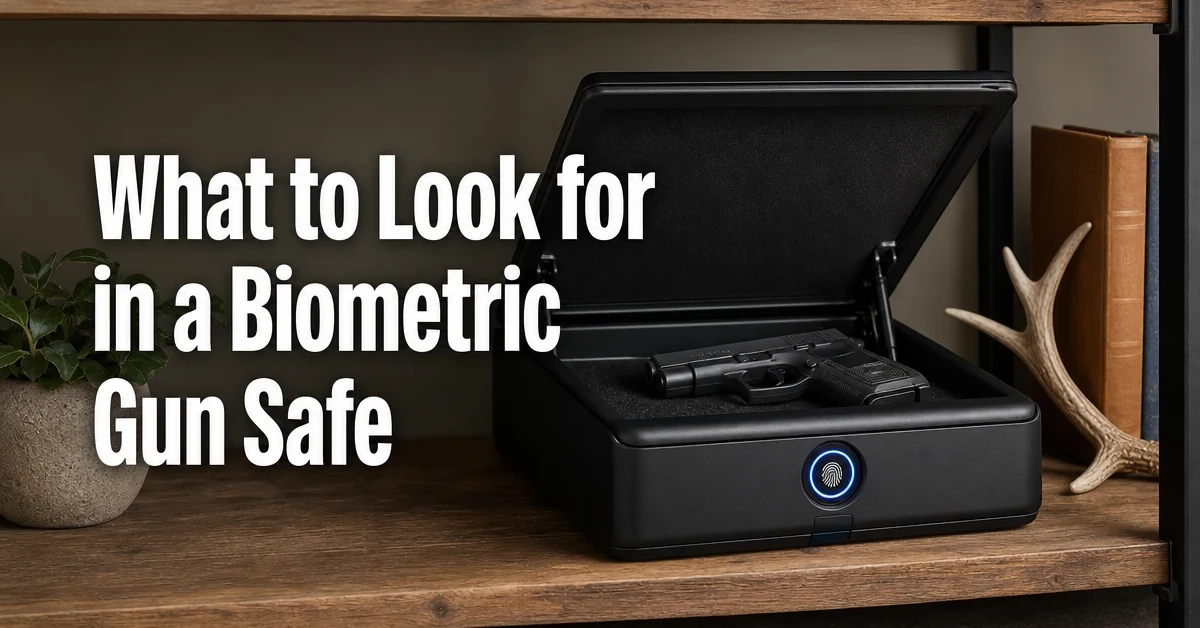

When deciding what to look for in a biometric gun safe, focus on reliable access, secure construction, sufficient capacity, backup entry, battery management, and proper mounting. A fingerprint reader can be convenient, but it should support—not replace—responsible firearm storage, regular testing, and compliance with local laws.
What to Look for in a Biometric Gun Safe
The best choice depends on where the safe will be installed, what firearm it must hold, how quickly you need authorized access, and how much protection you need from unauthorized users. Compare the complete locking system rather than choosing based only on the word “biometric.”
| Feature | Why It Matters | What to Check |
|---|---|---|
| Fingerprint reader | Controls biometric access | Enrollment process, recognition consistency, and user capacity |
| Backup entry | Provides another authorized access method | Keypad or physical key, stored securely and used according to the manual |
| Construction | Helps resist unauthorized access and physical abuse | Steel body, door fit, hinges, latch, and pry resistance |
| Power system | Electronic locks depend on adequate power | Battery type, low-battery warning, external power option, and replacement access |
| Mounting | Prevents the safe from being carried away | Anchor holes, included hardware, and a suitable mounting surface |
| Interior | Protects the firearm from scratches and improves organization | Padding, usable dimensions, and room for the unloaded firearm |
Important Safety and Legal Considerations
A biometric gun safe is one part of a responsible storage plan. Follow the safe manufacturer’s instructions, keep the firearm unloaded when appropriate for your storage situation, and prevent unauthorized access to both the firearm and ammunition.
Firearm storage laws vary by state and locality. Verify current requirements with your state law-enforcement agency, attorney general, or other official authority. A safe’s biometric feature does not automatically make it legally compliant in every jurisdiction or household circumstance.
Always follow the four basic firearm-safety rules:
- Treat every firearm as if it is loaded.
- Keep the muzzle pointed in a safe direction.
- Keep your finger outside the trigger guard until ready to shoot.
- Be certain of the target and what is beyond it.
Evaluate the Biometric Lock Carefully
Fingerprint enrollment and user access
Look for a clear enrollment process that allows you to register more than one finger. Enrolling multiple fingers may help if one finger is wet, dirty, injured, or positioned differently during an access attempt.
Check how many authorized users and fingerprints the safe can store. This matters if more than one responsible adult needs access. Do not register fingerprints for people who should not have access to the firearm.
Recognition consistency
Fingerprint readers can have difficulty with moisture, dirt, worn fingerprints, gloves, or poor finger placement. Before relying on the safe, test the registered fingers repeatedly under realistic household conditions.
Do not assume a marketing claim about fast access guarantees dependable operation. The practical question is whether the safe opens consistently for its authorized users and remains secure against unauthorized attempts.
Backup access methods
A quality biometric safe should provide a manufacturer-approved backup method, such as a keypad or physical key. A backup is important if the battery is depleted, the reader fails, or your finger cannot be recognized.
Store backup keys securely. Hiding a key near the safe, leaving it in an unlocked drawer, or sharing an access code defeats much of the safe’s purpose.
Check Construction and Physical Security
Body, door, and latch
Inspect the safe’s body and door for sturdy construction, a close-fitting door, and a latch that engages fully. Look for exposed gaps, weak seams, or components that appear easy to manipulate.
Do not rely solely on claims such as “heavy duty” or “high security.” Review the manufacturer’s specifications and instructions, and consider whether the safe is appropriate for the level of access prevention required in your home.
Protection against removal
A small safe can be carried away if it is not secured. Prefer a model with properly positioned mounting holes and install it on a suitable surface using hardware appropriate for that surface.
Follow the installation instructions. Incorrect mounting can damage the safe, weaken the structure, or create a false sense of security.
Fire and water claims
Do not assume that a biometric gun safe is fireproof or waterproof unless the manufacturer provides specific, verifiable testing information. Many compact handgun safes are designed primarily for access control and theft deterrence, not document or firearm fire protection.
Understand Battery Dependence and Maintenance
Electronic biometric locks require power. Before buying, determine the battery type, location, replacement procedure, low-battery warning, and whether the safe offers an external emergency power option.
- Install the battery specified by the manufacturer.
- Test the safe after replacing the battery.
- Do not wait for an emergency to learn the backup-entry procedure.
- Inspect the lock and latch periodically.
- Keep the fingerprint sensor clean according to the manual.
A battery backup or external power feature can be useful, but it does not eliminate the need for routine maintenance. Never modify the wiring or attempt an improvised electrical connection.
Choose the Right Size and Interior Layout
Measure the firearm, including its unloaded configuration and any approved accessories that must remain stored with it. Compare those measurements with the safe’s usable interior dimensions rather than its outside dimensions.
Consider whether the safe needs to hold:
- One handgun or multiple firearms
- Magazines or other lawful accessories
- A compact light or optic, if compatible with the safe’s interior
- Ammunition stored according to local law and manufacturer guidance
- Protective padding to prevent scratches
A crowded safe can make safe handling more difficult. Choose enough room to remove the firearm without catching the trigger, sights, or other components on the interior.
Compare Biometric, Keypad, and Mechanical Locks
| Lock Type | Strength | Limitation |
|---|---|---|
| Biometric | Convenient access without remembering a code | Depends on battery power and accurate fingerprint recognition |
| Electronic keypad | Does not depend on fingerprint recognition | Requires battery power and responsible code control |
| Mechanical combination | Does not require batteries | May require memorization and deliberate operation |
| Physical key | Simple backup or primary access method | The key must be controlled so unauthorized people cannot find it |
No lock type is automatically best for every household. A biometric model may suit someone who values convenient authorized access, while a mechanical lock may appeal to someone who wants to avoid batteries. The safest choice is the system that responsible users can operate reliably and maintain correctly.
Test the Safe Before Relying on It
- Read the complete manufacturer manual.
- Install the battery correctly.
- Register authorized fingerprints as instructed.
- Test each registered finger several times.
- Test the backup access method.
- Confirm that the firearm fits without pressing the trigger or damaging controls.
- Check that the door, latch, and hinges operate smoothly.
- Mount the safe securely if the design permits.
- Recheck access after battery replacement or a software reset.
Testing is not a substitute for safe handling. Keep the firearm pointed in a safe direction and follow the manufacturer’s unloading and handling instructions during setup.
Common Mistakes to Avoid
- Choosing a safe based only on scanner speed.
- Failing to test fingerprints with clean and damp hands.
- Ignoring the backup key or keypad until the battery dies.
- Leaving the backup key where children or unauthorized users can find it.
- Assuming biometric access prevents all forced entry.
- Buying a safe that is too small for the firearm and accessories.
- Failing to anchor a portable safe when appropriate.
- Assuming a safe has fire or water protection without verified documentation.
- Storing a loaded firearm without considering household risks and local law.
- Replacing the manufacturer’s battery with an unapproved type.
What to Look for in a Biometric Gun Safe: Practical Checklist
- Reliable fingerprint enrollment and recognition
- More than one authorized fingerprint option
- A secure, manufacturer-approved backup entry method
- Clear low-battery warnings
- Accessible but controlled battery replacement
- Strong body, door, latch, and hinges
- Appropriate interior dimensions and protective padding
- Mounting provisions suitable for the installation location
- Clear instructions and available manufacturer support
- Storage features that fit your household’s firearm and ammunition plan
- Compliance with current state and local storage requirements
FAQs
1. Are biometric gun safes reliable?
Reliability varies by design, maintenance, battery condition, and fingerprint-reading conditions. Test the safe repeatedly, maintain the sensor, and use the approved backup access method.
2. What happens if a biometric gun safe battery dies?
The result depends on the model. Many safes provide a physical key, keypad, or external power option. Confirm the procedure in the manual before purchase and test it during setup.
3. Should a biometric gun safe have a backup key?
A backup method is valuable, but it must be controlled securely. A key or code that unauthorized users can access undermines the storage system.
4. Can fingerprints be copied to open a biometric gun safe?
The risk depends on the specific lock design and security controls. Do not treat biometric identification as infallible. Prevent unauthorized access to the safe, backup key, code, and registered access information.
5. Is a biometric safe better than a mechanical gun safe?
Neither is universally better. Biometric locks offer convenient access but depend on electronics and fingerprint recognition. Mechanical locks avoid batteries but require a combination and deliberate operation.
6. Where should a biometric gun safe be installed?
Install it in a location that prevents unauthorized access and permits secure mounting, while following the manufacturer’s instructions. Avoid locations where moisture, heat, or unstable furniture could damage the safe or interfere with operation.
7. Does a biometric gun safe make a firearm storage setup legal?
No. Storage laws vary by jurisdiction and household circumstances. Check current official laws and follow any requirements for locked storage, child-access prevention, and ammunition.
Final Answer
When considering what to look for in a biometric gun safe, prioritize dependable fingerprint recognition, secure construction, backup entry, battery management, proper interior fit, and secure mounting. Test the safe before relying on it, follow the manufacturer’s instructions, and verify current firearm-storage laws through official local sources. Responsible storage also requires safe firearm handling and preventing unauthorized access to every part of the system.