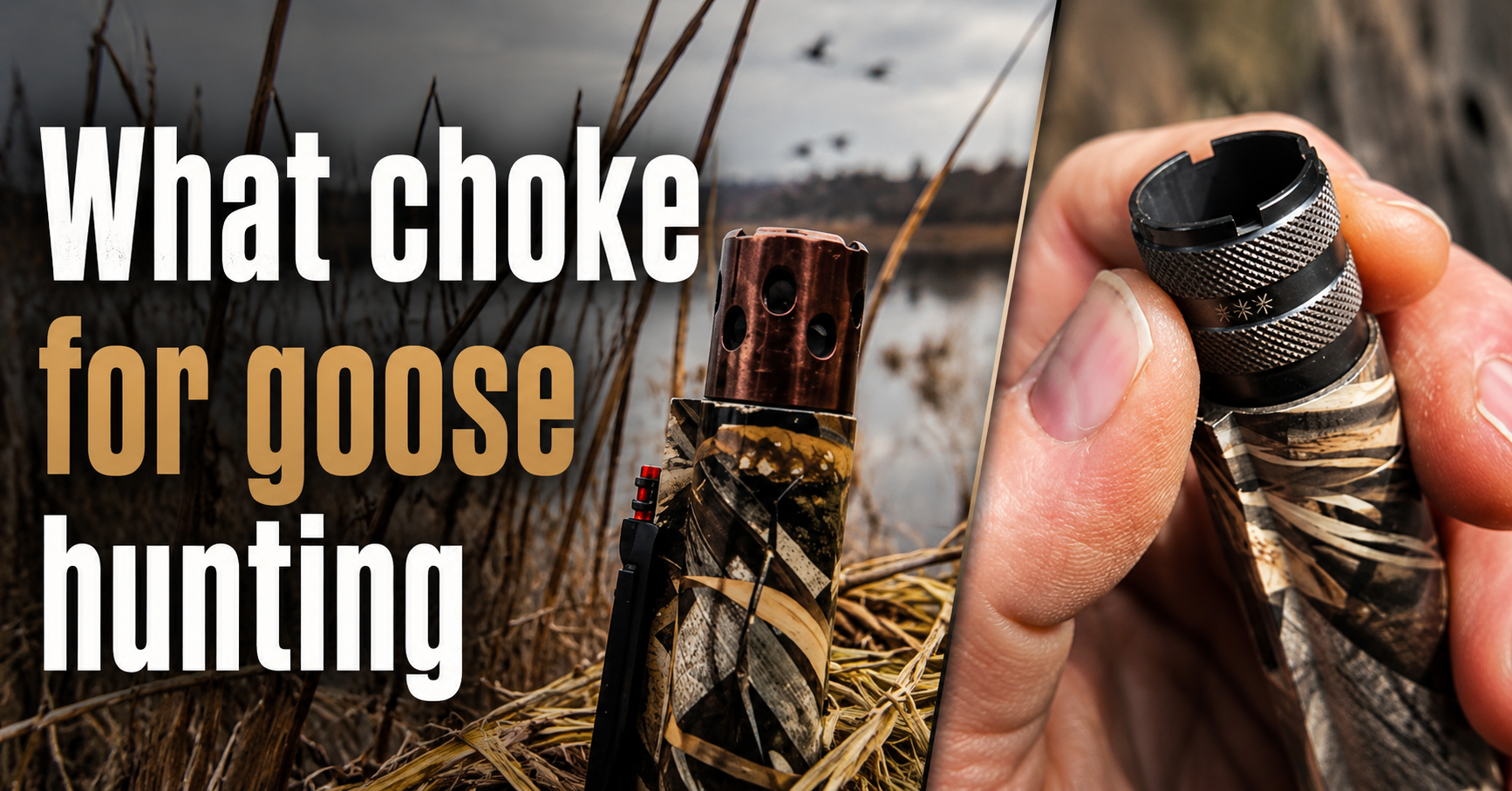

What choke for goose hunting is a practical question with no single answer for every shotgun and load. For many hunters using steel shot, a steel-rated Modified choke is the best starting point because it can provide useful pattern density for common decoying and moderate-distance opportunities. Improved Cylinder is often a better starting choice when geese consistently finish close over the decoys, while a tighter approved choke may be considered for more distant opportunities only after careful pattern testing.
The correct choice depends on the shotgun, choke system, pellet material, shot size, wad design, expected distance, and the way that exact combination prints on paper. A choke controls the spread and density of the pattern; it does not add pellet energy or make an unreasonable shot ethical.
Quick Answer
For hunters asking what choke for goose hunting, start with a Modified choke for general use with steel shot, then pattern the exact hunting load at the distances you honestly expect to shoot. Try Improved Cylinder if most birds are fully committed and close, or if Modified produces an excessively tight center with poor forgiveness. Consider a tighter choke only if the shotgun, choke tube, and ammunition manufacturers approve that combination and repeated patterns show an even, useful improvement. In the United States, use federally approved nontoxic shot for waterfowl and verify current state, refuge, and local rules before hunting.
What Choke for Goose Hunting by Situation?
| Hunting situation | Reasonable choke to test first | Why it may fit | Important qualification |
|---|---|---|---|
| Close, committed geese over decoys | Improved Cylinder | Provides a wider pattern with more margin for close birds | Confirm the pattern is still even and sufficiently dense with the chosen load |
| Mixed decoying distances | Modified | Useful all-around balance of spread and density with many steel loads | Modified is a starting point, not a universal answer |
| Moderate-distance pass opportunities | Modified, then compare a manufacturer-approved tighter tube | A denser pattern may reduce large gaps at the intended distance | Do not assume tighter is better; large hard pellets can pattern poorly when over-choked |
| Bismuth or other approved nontoxic load | Follow the load and choke maker’s guidance, then compare patterns | Pellet density, hardness, and wad design change choke response | Rules and compatibility cannot be inferred from steel-shot advice |
| Older shotgun or fixed-choke barrel | No recommendation until compatibility is confirmed | Older barrels may not be suitable for steel or modern hard pellets | Contact the firearm manufacturer or a qualified gunsmith before firing |
These are test starting points, not guaranteed field ranges. Your maximum responsible distance is the point at which your actual patterns, shooting skill, conditions, and target presentation still support a clean harvest. If the pattern becomes sparse, erratic, or off-center, move closer or change the combination rather than relying on the choke name.
Important Safety and Legal Notice
Before changing a choke or firing a new load, read the owner’s manual for the exact shotgun and the markings or instructions for the exact choke tube. Confirm the gauge, choke family, thread system, shell length, pellet material, and ammunition compatibility. A tube that threads into a barrel is not necessarily safe for the load you intend to fire.
In the United States, the U.S. Fish and Wildlife Service requires approved nontoxic shot for hunting waterfowl, including geese. Federal rules do not replace state regulations, refuge rules, shell limits, shot-size limits, season dates, permits, or area closures. Legal information in this article was checked on August 13, 2026; verify the current official regulations again immediately before hunting.
Apply the four universal firearm safety principles every time:
- Treat every firearm as if it is loaded.
- Keep the muzzle pointed in a safe direction.
- Keep your finger outside the trigger guard until ready to shoot.
- Be certain of the target and what is beyond it.
Unload the shotgun and visually and physically verify the chamber and magazine are empty before installing, removing, inspecting, or tightening a choke tube. Use the correct wrench when required and follow the manufacturer’s procedure.
Why Modified Is the Best General Starting Point
Modified sits between the wider spread of Improved Cylinder and the greater constriction of Improved Modified or Full. With many modern steel waterfowl loads, that middle position can provide enough density for ordinary goose opportunities without making close patterns unnecessarily small.
Hunter education guidance commonly identifies Modified as a useful choke for steel shot when hunting ducks or geese. Benelli’s current FAQ also recommends its Modified, Improved Cylinder, and Cylinder markings for steel shot and describes Modified as the pass-shooting option, with more open chokes for decoying birds. However, that advice applies to compatible Benelli equipment; another manufacturer’s manual may differ.
Modified is not automatically “best” because choke labels describe nominal constriction, not the finished pattern. Two shotguns with the same labeled choke can produce different point of impact, density, and gaps. The shell’s pellet size, payload, speed, wad, and pellet material can change the result again.
When Improved Cylinder Makes More Sense
Improved Cylinder is worth testing when geese consistently finish close to the decoys, when shots develop quickly over a small spread, or when a Modified pattern is so tight at the expected distance that small pointing errors lead to misses or damaged birds.
A wider pattern is not an excuse for imprecise shooting. It must still place enough evenly distributed pellets through the vital area at the tested distance. If the Improved Cylinder pattern has large empty spaces or loses useful density before the far edge of your normal opportunities, Modified may be the better choice.
Cylinder or Skeet can sometimes work for very close decoying birds, but these open constrictions should be tested rather than assumed. Large goose-sized targets do not make a thin pattern humane.
When a Tighter Choke May Be Appropriate
A hunter may compare a steel-rated Improved Modified, extended waterfowl tube, or another tighter approved design when geese are typically encountered farther out and Modified leaves large gaps. Three conditions must be satisfied before using it:
- The shotgun manufacturer permits the barrel and choke system to fire that pellet material through that constriction.
- The choke manufacturer rates the exact tube for the chosen load, pellet material, and pellet size.
- Repeated paper patterns at the intended distance are even, centered, and meaningfully better than the Modified pattern.
Do not assume Full is the logical “goose choke.” Some manufacturers specifically warn against firing steel through Full or Improved Modified tubes. For example, Benelli’s Nova 3 manual says its Full and Improved Modified chokes are not recommended for steel shot, and Beretta documentation warns that Full constrictions with steel may not increase density and can accelerate wear. Always follow the exact manual for your model rather than borrowing advice from another shotgun.
Hard, large pellets may resist deformation and respond unpredictably to excessive constriction. A tighter tube can produce a blown, patchy, or off-center pattern rather than a useful one. The paper target decides whether the combination works; the name stamped on the tube does not.
How Pellet Material Changes Choke Choice
Steel
Steel is hard, relatively light for its size, and widely used for waterfowl. It often patterns differently from traditional lead loads, and many shotguns limit which constrictions may be used with it. Start with a tube explicitly rated for steel, commonly Modified or Improved Cylinder, and test the exact shell.
Bismuth
Bismuth is denser and generally softer than steel, but modern bismuth loads vary in pellet alloy, buffering, plating, and wad design. Some are promoted for older shotguns, yet an older barrel should still be evaluated individually. Follow both the ammunition and firearm manufacturer’s guidance before selecting a choke.
Tungsten-Based Loads
Tungsten-based nontoxic loads can be much denser and harder than steel, but products differ substantially. Some require more open constriction or a specially rated tube. Never assume a choke marked “steel safe” is automatically compatible with every tungsten blend or pellet size.
Federal Premium’s guidance on selecting chokes for non-lead shot emphasizes that hunters should not rely solely on general rules because the gun, load, and choke interact. That is especially important when switching pellet materials.
Shot Size, Wad Design, and Load Matter Too
Choke choice cannot be separated from the shell. Larger pellets mean fewer pellets in a given payload, so even distribution becomes important. Smaller pellets increase pellet count but may not meet the hunter’s needs at the same conditions. The correct balance depends on goose species, presentation, distance, pellet material, and the ammunition maker’s intended use.
Wad design can strongly influence how long pellets remain together after leaving the muzzle. Buffered, plated, blended, or unusually shaped shot may respond differently from a standard round-steel load. Two shells carrying the same shot size can therefore pattern very differently through the same tube.
Use factory ammunition of the correct gauge and shell length that the firearm is chambered to accept. Never fire a longer shell than the chamber marking permits, and do not assume a heavier payload automatically produces a better or more humane pattern.
How to Pattern a Goose-Hunting Shotgun
Hunter education guidance on shotgun patterning explains that no two shotguns print identical patterns and that choke, shell brand, shot size, and pellet material all affect performance. Patterning should be done before hunting, not discovered on live birds.
Step One: Use a Safe Range and Large Paper
Pattern only at an approved range or another lawful location with a safe backstop and permission. Use hearing and eye protection. Place a clear aiming point near the center of a paper target large enough to capture the complete pattern.
Step Two: Test the Actual Hunting Combination
Use the shotgun, choke, and exact factory load you intend to carry. Pattern at several realistic distances, beginning with the closest common opportunity and working outward. Do not use one cheap target shell to judge a different hunting load.
Step Three: Fire More Than One Pattern
One shell can mislead. Fire at least three separate patterns with each combination, using a fresh target and allowing the barrel to cool when appropriate. Consistency across targets matters as much as the best single result.
Step Four: Find the Center of the Pattern
Draw a 30-inch circle around the densest portion of each pattern. The densest area may not surround the aiming point, which can reveal gun-fit or point-of-impact issues. Do not adjust the circle simply to hide a consistent off-center pattern.
Step Five: Evaluate Density and Distribution
Count pellet strikes and look for large gaps, a thin outer ring, or a dense central clump surrounded by empty space. Hunter education materials use a general benchmark of roughly 55% to 60% of the load in a 30-inch circle, but percentage alone does not establish an ethical goose pattern. Evenness, pellet material, shot size, impact location, and the quarry’s vital area also matter.
Step Six: Compare One Variable at a Time
If the pattern is inadequate, change either the choke or the load and retest. Changing both at once makes it hard to identify what improved the result. Stop tightening when patterns become patchy, excessively central, or less consistent.
Step Seven: Set a Personal Maximum Distance
Your responsible limit should be no farther than the distance at which the combination still patterns evenly and you can consistently place that pattern during realistic practice. Wind, cold, awkward footing, low light, and moving birds reduce field performance. Choose the closer, higher-percentage opportunity whenever possible.
Pattern Diagnosis Table
| What the paper shows | Possible cause | Responsible next step |
|---|---|---|
| Even pattern but too sparse at the intended distance | Too open a choke, too few pellets, or distance beyond the combination | Move closer, test Modified, or compare another compatible load |
| Very dense center with little margin | Too much constriction for the close opportunity | Test Improved Cylinder or a more open approved tube |
| Large random holes despite a high pellet count | Load and choke do not work well together | Test a different shell or less constriction |
| Pattern consistently left, right, high, or low | Gun fit, mount, sight picture, or point-of-impact issue | Confirm technique and seek help from a qualified instructor or gunsmith |
| Strong first pattern but inconsistent later patterns | Normal shell variation, mounting inconsistency, loose tube, or equipment issue | Unload, inspect according to the manual, retighten correctly, and repeat the test |
| Pattern worsens through a tighter choke | Over-constriction or incompatibility with hard or large pellets | Return to the more open tube that produced the better pattern |
Decoy Hunting Versus Pass Shooting
Decoying Geese
When geese are committed, feet down, and close over the decoys, a wider but still adequately dense pattern can make clean shooting more forgiving. Improved Cylinder is a logical comparison against Modified. Good hide placement, realistic decoys, disciplined calling, and waiting for a high-percentage presentation can matter more than tightening the choke.
Pass Shooting
For lawful pass shooting, Modified is a sensible starting point, with a tighter compatible tube tested only if the pattern requires it. Distance is easy to underestimate against open sky. Use known landmarks or range references before birds arrive, and do not fire merely because a goose appears visible.
Pass shooting is not permission for speculative shots. If repeated paper testing or realistic clay practice does not support the opportunity, let the birds pass. A denser choke does not restore pellet energy, eliminate wind effects, or replace accurate lead and sound judgment.
Over-Under and Side-by-Side Choke Strategy
A two-barrel shotgun can provide two pattern options if the firearm and both tubes are compatible with the load. For example, a hunter might test Improved Cylinder in the first barrel for a close initial opportunity and Modified in the second for a farther follow-up. The sequence should match the barrel selector and the way the gun actually fires.
Pattern each barrel separately. Different barrels can print to different points of impact, and the same choke label may not produce identical density in both. Never assume an older fixed-choke double is safe with steel; obtain manufacturer guidance or have it evaluated by a qualified gunsmith.
Common Goose Choke Mistakes
- Installing Full because geese are large. Target size does not prove Full is compatible or effective with steel.
- Using the choke name as a range guarantee. Constriction changes distribution, not pellet energy or shooter skill.
- Patterning a different shell. Brand, shot material, size, payload, speed, and wad can all change the pattern.
- Judging from one shot. Several targets are needed to reveal consistency.
- Ignoring point of impact. A dense pattern that consistently misses the aiming point still needs correction.
- Firing steel through an unverified barrel or tube. Compatibility must come from the manufacturer or a qualified professional.
- Leaving a choke loose. Inspect and maintain tubes according to the manual; stop shooting if a tube loosens or the barrel appears damaged.
- Mixing shells carelessly. Carry only ammunition legal for the hunt and compatible with the chamber and choke.
- Stretching distance after a few successes. Field conditions vary, and one result does not establish a reliable ethical range.
- Buying an expensive aftermarket tube before testing factory chokes. A factory IC or Modified may already produce the best pattern for the selected load.
What Not to Do
- Do not fire a shell until you have positively identified the species and confirmed a safe background and shooting lane.
- Do not shoot across people, dogs, roads, buildings, boats, blinds, or unsafe zones of fire.
- Do not rely on the mechanical safety as a substitute for muzzle and trigger discipline.
- Do not change or tighten a choke on a loaded shotgun.
- Do not use lead or another unapproved pellet material where nontoxic shot is required.
- Do not assume a shell or shot size is legal because it is sold as a waterfowl load.
- Do not continue firing if the choke loosens, the barrel is obstructed, the report sounds abnormal, or recoil feels unusual.
- Do not take marginal shots at the edge of visibility or beyond your tested pattern and demonstrated ability.
- Do not abandon a wounded bird; make every safe, legal, and reasonable recovery effort.
Choke Tube Care Before and After the Hunt
Follow the shotgun manual for removal, cleaning, lubrication, torque, and inspection. Waterfowl hunting exposes threads and tubes to water, mud, salt, vegetation, and temperature changes. Remove and clean the tube at the recommended interval so corrosion does not seize it in the barrel.
Inspect for damaged threads, dents, bulges, cracks, corrosion, or a deformed muzzle. Use only the lubricant or anti-seize product the manufacturer recommends and avoid excessive application that can collect grit. Replace a damaged tube rather than attempting to reshape or modify it.
Before loading in the field, confirm the tube is correctly seated and the bore is clear. During the hunt, keep the muzzle out of mud, snow, and water. If an obstruction is suspected, unload completely and clear it according to the manual before firing again.
Final Answer
For most hunters asking what choke for goose hunting with steel shot, a steel-rated Modified choke is the strongest general starting answer. Compare Improved Cylinder for close decoying geese, and consider a tighter manufacturer-approved option only when repeated patterns at the intended distance demonstrate a real advantage. Verify that the shotgun, choke, and exact nontoxic load are compatible, pattern several shells on paper, and set a personal limit inside the combination’s reliable performance. Current laws, safe target identification, sound firearm handling, and humane shot selection always override a desire for more distance.
FAQs
1. Is Modified choke good for goose hunting?
Yes. Modified is a practical starting point for many steel goose loads because it often balances useful density with a workable pattern width. It still must be rated for the load and tested through the individual shotgun.
2. Is Improved Cylinder good for geese over decoys?
It can be an excellent choice when birds consistently finish close. Pattern it at the actual decoying distances to confirm it does not leave large gaps, especially with large pellets and lower pellet-count loads.
3. Should I use Full choke for goose hunting?
Not automatically. Some Full chokes are not approved for steel, and excessive constriction can worsen patterns with hard pellets. Use Full only if every manufacturer involved permits it and paper patterns prove it performs safely and evenly.
4. Can I shoot steel through a Full choke?
It depends on the exact shotgun and choke tube. Some modern tubes are marked steel-compatible, while some firearm manufacturers prohibit or discourage steel through Full. Read the manual and tube markings or contact the manufacturer before firing.
5. Does steel shot require a more open choke?
Often, but not as a universal rule. Steel is hard and may produce dense patterns through a more open constriction than expected. Start with the manufacturer’s approved options and let repeated paper patterns determine the best tube.
6. What choke should I use for close geese?
Improved Cylinder is a sensible first test for close, committed geese. Cylinder or Skeet may also be evaluated at very close distances, provided the pattern remains even and adequately dense.
7. What choke should I use for pass shooting geese?
Modified is a good starting point. Compare a tighter compatible tube only after patterning shows Modified is too sparse at a realistic distance. Do not extend shots beyond your tested pattern and proven skill.
8. Does a tighter choke make pellets hit harder?
No. A choke changes pellet distribution, not the energy of each pellet. Pellet material, size, velocity, distance, and aerodynamic performance affect retained energy.
9. Does a choke increase shotgun range?
A tighter choke may maintain pattern density farther, but it does not add velocity or make every distant shot responsible. Range is limited by pattern quality, pellet performance, shooter ability, presentation, and conditions.
10. What is the difference between Modified and Improved Modified?
Improved Modified has more nominal constriction and generally aims to produce a denser pattern. The actual difference depends on bore dimensions, tube design, and load. Some Improved Modified tubes are not approved for steel.
11. Can I use a turkey choke for geese?
Do not assume so. Turkey chokes may be extremely tight and designed for different pellet sizes, loads, and target presentations. Use one only if the manufacturer explicitly approves the exact waterfowl load and pattern testing supports it.
12. Can I use a factory choke for goose hunting?
Yes, when it is compatible with the load and produces a good pattern. Test the factory Improved Cylinder and Modified tubes before buying an aftermarket option; higher price does not guarantee better performance.
13. Are aftermarket waterfowl chokes better?
Some provide useful patterns with particular loads, but none is automatically better in every shotgun. Compare them on paper against compatible factory tubes using the same shell and distance.
14. Do ported chokes pattern better?
Porting alone does not guarantee a better pattern. Tube geometry, wad interaction, load, and barrel matter. Ported tubes may also be louder to nearby hunters and can complicate cleaning.
15. What choke should I use with bismuth for geese?
Follow the ammunition and firearm manufacturers’ guidance, then compare likely options such as Modified and an approved tighter or more open tube. Bismuth loads vary, so advice for steel cannot simply be copied.
16. What choke should I use with tungsten-based goose loads?
Use only a tube specifically approved for that product’s pellet material and size. Dense, hard tungsten blends can require different constriction from steel or bismuth. Pattern the exact load.
17. Does shot size change the best choke?
Yes. Larger pellets reduce pellet count and may respond poorly to excessive constriction, while smaller pellets create different density and energy tradeoffs. Test the exact shot size you plan to hunt with.
18. How many shots should I fire when patterning?
Use at least three fresh targets for each choke-and-load combination. Multiple patterns reveal consistency and prevent one unusually good or bad shell from determining the decision.
19. At what distance should I pattern for geese?
Pattern at the closest, typical, and farthest distances at which you honestly expect to shoot. The farthest test is not permission to shoot that far; it shows where the pattern stops meeting your standard.
20. Why is my goose pattern off-center?
Possible causes include gun fit, inconsistent mount, sight picture, point of impact, or equipment issues. Repeat the test from a stable position and seek help from a qualified instructor or gunsmith if the offset is consistent.
21. Why does a tighter choke create a worse pattern?
Hard or large pellets can be disrupted by excessive constriction, and some wad designs do not respond well to a tight tube. Return to the more open tube if it produces a more even, repeatable pattern.
22. How do I know whether a choke is steel-rated?
Check the tube markings, packaging, current manufacturer documentation, and shotgun manual. If the information is unclear or conflicting, contact the manufacturer and do not fire steel until compatibility is confirmed.
23. Can I use steel shot in an older shotgun?
Not without verification. Older barrels, fixed chokes, rib attachments, and steel quality may not be suitable for modern hard shot. Consult the manufacturer or a qualified gunsmith familiar with that model.
24. Can I fire a 3½-inch goose shell through any 12-gauge shotgun?
No. The shotgun must be chambered and marked for that shell length, and the choke must be compatible with the load. Never fire a shell longer than the chamber marking permits.
25. Do I need 3½-inch shells for geese?
Not necessarily. Shell length alone does not determine pattern quality or responsible effectiveness. A compatible shorter shell that patterns well and that you shoot accurately may be the better choice.
26. Can the same choke work for ducks and geese?
Yes, especially Modified, but the best choice can change with shot size, load, distance, and target presentation. Pattern each hunting load rather than assuming a duck pattern applies to a goose shell.
27. What choke works for snow geese?
Start with Improved Cylinder for close decoying opportunities or Modified for mixed distances, then pattern the chosen snow-goose load. High-volume shooting does not reduce the need for safe zones of fire and positive target identification.
28. What choke works for Canada geese?
Modified is a sensible general starting point with steel, while Improved Cylinder may suit close decoying birds. Species size does not replace pattern testing, and local subspecies and conditions vary.
29. What choke works for small geese such as cacklers?
The same process applies: match the pattern to the load and expected distance. A more open choke may work for close birds, but do not choose solely by body size.
30. Can I switch chokes in the field?
Yes, if lawful and done safely. Fully unload the shotgun, visually and physically check the chamber and magazine, keep the muzzle safe, and follow the manual. Do not handle a choke on a loaded firearm.
31. How often should I check the choke tube?
Check that it is correctly seated before shooting and inspect it at the intervals specified by the manufacturer. Stop immediately if it loosens or if you notice damage, an abnormal report, or unusual recoil.
32. Should I lubricate choke-tube threads?
Use only the lubricant or anti-seize product and amount recommended by the shotgun or choke manufacturer. Too much product can collect grit, while neglected threads may corrode or seize.
33. Is lead shot legal for goose hunting?
Not for waterfowl hunting in the United States. Use federally approved nontoxic shot and check state and area rules, which may add restrictions. Other countries have their own requirements.
34. Do refuges have extra ammunition rules?
They can. A refuge may regulate shot size, shell possession, hunting zones, methods, or species beyond general state rules. Read the current refuge brochure and state regulations before arriving.
35. What matters more: choke or shooting skill?
Both matter, but equipment cannot replace a consistent mount, correct lead, target identification, and judgment. Choose a pattern that works, then practice realistic crossing targets within that verified limit.
36. What should I do after hitting a goose that does not fall cleanly?
Mark where it goes, maintain safe muzzle control, and begin a prompt legal recovery using a trained dog or partners when appropriate. Follow local rules for pursuing wounded birds and do not endanger people or trespass.
Read more: