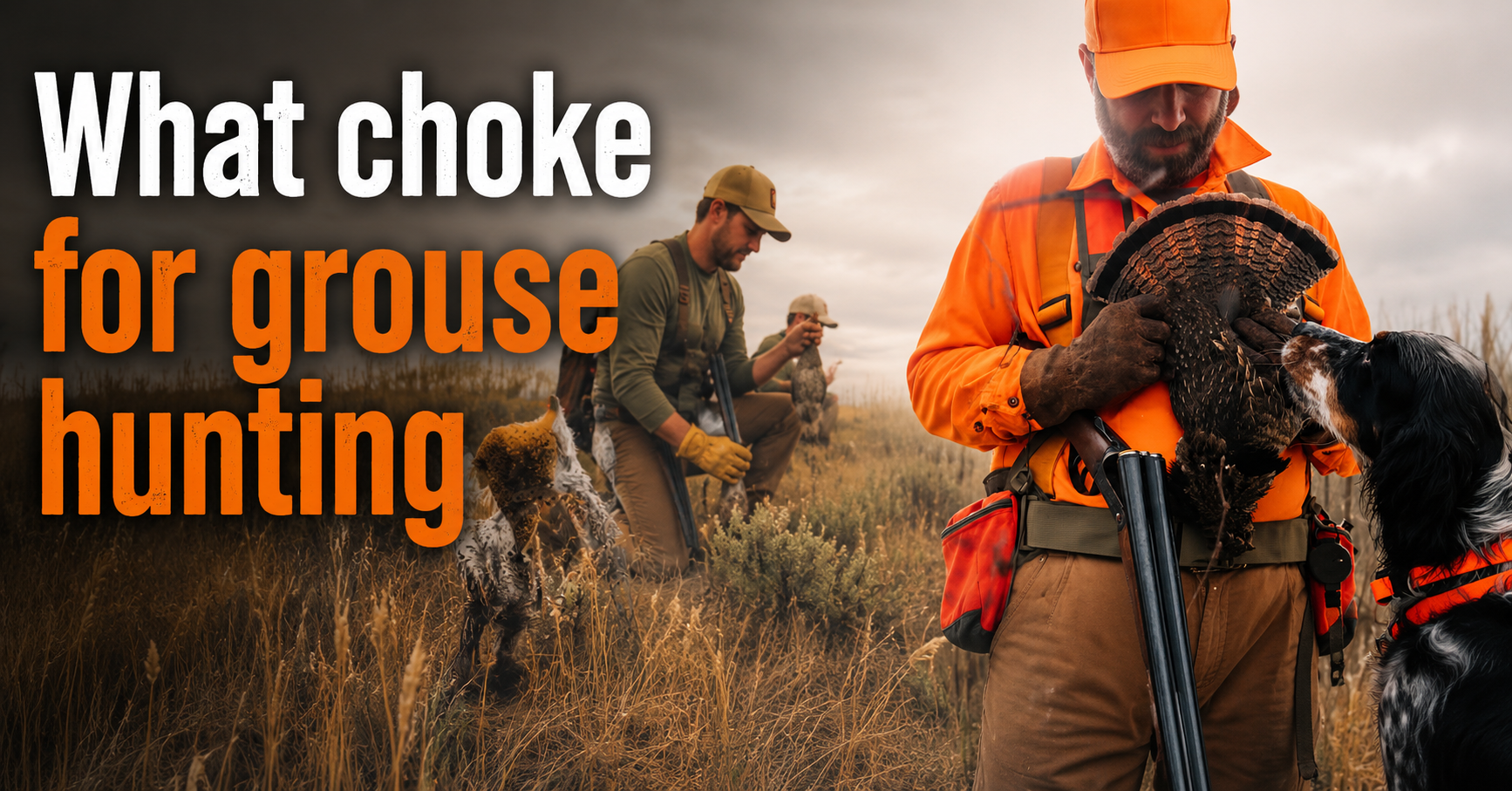

If you are wondering what choke for grouse hunting gives the best balance of pattern width and pellet density, start with the conditions in front of you rather than a universal label. Ruffed grouse often flush at close range in dense woods, while sharp-tailed and other prairie grouse may present longer shots in open country. Your shotgun, shell, shot material, cover, and demonstrated shooting ability all affect the final choice.
This guide gives you a dependable starting point, explains when to open or tighten the pattern, and shows how to confirm the result safely on a pattern board. It is equipment guidance, not a substitute for your shotgun manual, hunter education, or the current hunting regulations where you plan to hunt.
Quick Answer
Improved Cylinder is the best all-around starting choke for grouse hunting. For close ruffed grouse flushes in thick alder, aspen, or young forest, Cylinder or Skeet can provide a faster-opening pattern. For sharp-tailed grouse, prairie grouse, or later-season birds flushing farther in open cover, Light Modified or Modified may hold useful pattern density longer. Pattern the exact shotgun, choke, and legal load you will carry, and never take a shot beyond the range where you can identify the bird, see a safe background, and place an effective pattern consistently.
Grouse Choke Selection at a Glance
| Hunting Situation | Good Starting Choke | Why It Fits | What to Confirm |
|---|---|---|---|
| Ruffed grouse in very dense, leafy cover | Cylinder or Skeet | Opens quickly for close, fast flushes | Pattern still has even, adequate density at your expected distance |
| General ruffed grouse hunting | Improved Cylinder | Versatile balance of spread and density | No large gaps in the pattern with your field load |
| Mixed woodland and field edges | Improved Cylinder or Light Modified | Retains a little more density for varied distances | Close patterns are not excessively tight |
| Sharp-tailed or prairie grouse in open terrain | Improved Cylinder to Modified | Accommodates the possibility of a longer flush | Ethical range based on patterning and shooting skill, not the choke name |
| Double gun in thick grouse woods | Cylinder/Skeet first, Improved Cylinder second | Open first pattern with a somewhat denser follow-up option | Barrel selector and firing order are understood before hunting |
| Double gun in mixed or open cover | Improved Cylinder first, Light Modified or Modified second | Covers close and moderately longer opportunities | Both barrels pattern well with the chosen shell |
These are starting points, not guaranteed field ranges. Two chokes carrying the same marking can pattern differently, and changing the shell can change the result again.
Important Firearm Safety and Legal Notice
Regulation guidance was checked on August 14, 2026, but grouse seasons, legal shooting hours, licenses, bag limits, shotgun restrictions, hunter-orange rules, magazine limits, and nontoxic-shot requirements vary by country, state or province, wildlife unit, land type, and grouse species. Check the current regulation booklet and any property-specific rules immediately before the hunt. Official rules override all general online guidance.
Follow the four universal firearm safety principles every time you handle a shotgun:
- Treat every firearm as if it is loaded.
- Keep the muzzle pointed in a safe direction.
- Keep your finger outside the trigger guard until ready to shoot.
- Be certain of the target and what is beyond it.
Grouse flushes happen quickly, but speed never replaces positive identification. Do not fire through vegetation at sound or movement, across a road or trail, toward a person, dog, building, vehicle, or livestock, or when the background is uncertain. Wear eye and hearing protection, maintain safe spacing with partners, and agree on shooting zones before entering cover.
Why Improved Cylinder Is the Best General Starting Point
A shotgun choke is a constriction at the muzzle that influences how quickly the pellet pattern spreads. It does not add power, speed, or range to the shell. An open choke allows the pattern to spread sooner; a tighter choke tends to keep more pellets together farther downrange.
Improved Cylinder has mild constriction. That makes it useful for the short to moderate distances common in upland hunting without opening as quickly as Cylinder or holding as tightly as Modified. Hunter-education guidance on choke types describes Improved Cylinder as suitable for relatively close upland game, and Winchester’s choke overview uses roughly 20 to 30 yards as a general reference range for its Improved Cylinder tubes. Treat any published distance as a starting point because the actual pattern from your gun and load is what matters.
For a single-barrel pump or semiautomatic used across typical grouse cover, Improved Cylinder is the simplest versatile choice. It can handle many close woodland shots while preserving more density than a very open tube if a bird rises a little farther away.
When a More Open Choke Makes Sense
Cylinder and Skeet chokes are most useful when the expected opportunity is close and brief. This commonly describes early-season ruffed grouse hunting in thick foliage, especially when birds hold close for a pointing dog or flush near the hunter.
Cylinder
Cylinder has no intentional constriction and allows the shot cloud to open quickly. It can be effective at close range, but an open pattern is not automatically a forgiving pattern. If pellet density becomes too thin or develops large gaps, the setup may fail to deliver a clean, consistent result.
Skeet
Skeet is slightly tighter than Cylinder in many choke systems and is designed for close targets. Winchester gives approximately 15 to 25 yards as a general reference for its Skeet tubes. It is a common grouse-woods option when visibility closes quickly and most responsible opportunities occur near the hunter.
Do not choose an open choke merely to throw pellets through brush. Branches and leaves can disrupt a pattern, and no choke makes an obscured bird a safe target. Wait for a clear, positively identified bird with a safe background.
When Light Modified or Modified May Be Better
A somewhat tighter choke can make sense when cover is open, birds flush farther, or late-season leaves have dropped. Sharp-tailed grouse and other grouse hunted on prairie, grassland, or open mountain slopes may present a different problem from ruffed grouse in young forest.
Light Modified sits between Improved Cylinder and Modified in systems that offer it. It can be a useful compromise for mixed distances. Modified holds a denser pattern farther and may fit a second barrel or open-country hunt, but it can be unnecessarily tight for a close bird. Winchester gives roughly 30 to 40 yards as a general reference for Modified, yet that does not mean every combination is effective or ethical throughout that span.
A tighter choke is not permission to stretch a shot. If a grouse rises beyond the distance where your pattern and ability have been proven, let it go. Passing a marginal shot is part of ethical hunting.
Match the Choke to the Grouse and Habitat
Ruffed Grouse in Forest Cover
Ruffed grouse commonly occupy young forests, regenerating cuts, edges, and dense woody cover. Opportunities can be close and disappear quickly behind vegetation. Cylinder, Skeet, and Improved Cylinder are therefore the most practical starting choices. Improved Cylinder remains the most versatile if you expect both dense pockets and more open trails or edges.
Sharp-Tailed and Prairie Grouse
Open grasslands and prairie can produce longer, more visible flushes, especially after birds have experienced hunting pressure. Improved Cylinder may still work early or behind a pointing dog, while Light Modified or Modified can help maintain pattern density for moderately longer shots. Wind, group size, season stage, and cover height can change bird behavior, so pattern more than one sensible setup rather than assuming every prairie hunt requires a tight choke.
Dusky, Sooty, Spruce, and Other Forest Grouse
Habitat varies across these species and regions. An open choke may suit close shots in timber, while a somewhat tighter option may fit more open mountain or edge conditions. Species identification is critical because seasons and legal status can differ, and some grouse can occur near protected look-alike species or closed areas.
Early Season Versus Late Season
| Factor | Early Season Tendency | Late Season Tendency | Possible Choke Adjustment |
|---|---|---|---|
| Foliage | Thick leaves shorten visible lanes | Leaf drop may open sight lines | Open choke early; consider one step tighter only if patterns and actual distances justify it |
| Bird response | Some young or lightly pressured birds may hold closer | Surviving birds may flush earlier after pressure | IC may cover both; LM or Modified can be tested for consistently longer open shots |
| Companion species | Woodcock or other close-flushing birds may share cover where legal | Mixed opportunities may change | Choose a legal load and pattern that suits every species you may lawfully take |
| Weather and clothing | Warmer weather and lighter layers | Cold, wind, and bulky layers may affect gun mount | Practice in the clothing you will hunt in; a choke cannot correct poor fit or mount |
These are common possibilities, not rules. Some birds flush close late in the season, and some flush far early. Let observed conditions and pattern testing guide the setup.
Best Choke Combinations for a Double-Barrel Shotgun
A side-by-side or over-and-under lets you carry two different patterns. In thick ruffed grouse cover, Cylinder or Skeet in the first barrel and Improved Cylinder in the second is a practical combination. For mixed cover, Improved Cylinder followed by Light Modified or Modified offers more flexibility.
Confirm which barrel fires first, how the selector works, and whether opening the action automatically engages the safety on your specific shotgun. These features vary. Practice safe operation with an unloaded firearm before the hunt and never assume a mechanical safety replaces muzzle and trigger discipline.
If both barrels pattern well with the same open choke, matching chokes can also be sensible. Two different labels are not automatically better than two reliable, even patterns at the distances you actually encounter.
Choke Choice and Shot Size Work Together
Choke cannot be selected independently of the shell. Pellet material, shot size, payload, wad, velocity, and individual barrel all influence pattern density and consistency. A load that looks excellent through Improved Cylinder may show gaps through Skeet, while another load may behave differently.
No. 7 1/2 lead is a common traditional choice for ruffed grouse where lead is legal. No. 8 may suit very close early-season conditions, while No. 6 is sometimes chosen for later, more open, or mixed-bag situations. For nontoxic loads, available pellet sizes and material properties differ; steel often patterns tighter than lead through the same marked choke, while bismuth may behave more like lead. Do not use a simple pellet-number substitution without testing.
Use only the exact gauge, shell length, pressure class, shot material, and choke combination approved by the shotgun and choke manufacturers. Older fixed-choke guns may not be suitable for steel or other hard nontoxic shot. If the markings or history are uncertain, have a qualified gunsmith inspect the shotgun before firing it.
How to Pattern a Grouse Shotgun
Patterning is the only dependable way to learn what a specific gun, tube, and shell do together. Conduct the test only at a lawful shooting range or another approved location with a safe backstop and all required eye and hearing protection.
- Read the manuals first. Verify the shotgun is in safe condition and the choke tube is correct for the barrel, gauge, and shot material.
- Choose realistic distances. Test at the distances where you expect responsible grouse opportunities rather than relying only on a conventional long-range pattern test.
- Use the field shell. Pattern the same manufacturer, load, shot size, and material you intend to hunt with.
- Use a large clean target. Mark a central aiming point on pattern paper large enough to show the complete pellet distribution.
- Fire more than one shell. A single shot can be misleading. Use multiple fresh sheets to see whether the result is repeatable.
- Evaluate the center and gaps. Look for an even distribution around the actual point of impact, adequate density, and no bird-sized holes in the useful area.
- Compare one change at a time. Change the choke or shell, not both together, so you can tell what improved the pattern.
- Set a personal limit. Your maximum field distance should be shorter than any distance where pattern quality or your shooting becomes uncertain.
Pattern Quality Matters More Than Choke Labels
Choke names describe expected constriction or performance categories, not an identical result in every gun. Point of impact also matters. If the pattern is consistently off the aiming point, changing to a tighter choke will not fix gun fit, eye alignment, or a mechanical issue. A qualified shotgun instructor or gunsmith can help diagnose persistent problems.
Steel and Other Nontoxic Shot Considerations
Nontoxic ammunition may be required on certain public lands, wildlife areas, refuges, or other designated properties even when the target is an upland bird. Rules can also change. Check both the general grouse regulation and the rules for the exact property.
Steel is harder and less dense than lead and often produces a tighter pattern through a given choke marking. Do not assume a lead-based choke chart applies unchanged. Check the barrel, choke tube, and ammunition instructions for compatibility, particularly with older guns and chokes tighter than Modified. Never force a tube into the wrong choke system or fire a loose, damaged, obstructed, or incorrectly installed tube.
Bismuth and other approved nontoxic materials may offer different pattern behavior, but brand and load design still matter. Pattern the actual shell instead of choosing solely by material name or marketing claim.
What Choke for Grouse Hunting With a 12, 16, 20, or 28 Gauge?
The basic choke decision does not change simply because the gauge changes. Improved Cylinder remains a useful all-around starting point across common grouse gauges, with Cylinder or Skeet for close forest work and Light Modified or Modified for more open conditions.
Gauge influences payload choices, firearm weight, recoil, ammunition availability, and pattern density, but a smaller gauge is not automatically more sporting or less effective. A well-fitting shotgun you can carry safely and shoot accurately is more important than fashion. The smallest payloads may need careful pattern verification because an overly open choke can produce thin patterns sooner.
A .410 requires particular discipline because its smaller payload leaves less margin for pattern gaps and aiming error. It may suit an experienced shooter within a carefully proven range, but it is not automatically the easiest beginner option merely because the gun is light.
Common Grouse Choke Mistakes
- Choosing Full choke for every hunt: A very tight close-range pattern can reduce margin for a fast woodland bird and may damage meat if centered at very short distance.
- Believing open choke shoots through brush: Vegetation can disrupt pellets and hide an unsafe background. Wait for a clear shot.
- Skipping pattern work: The tube marking cannot reveal holes, point-of-impact problems, or poor shell performance.
- Changing shot material without checking compatibility: Steel and other hard shot can require different tubes or restrictions.
- Using a tighter choke to justify longer shots: Pattern density is only one part of an ethical shot; identification, pellet performance, skill, background, and recovery conditions also matter.
- Ignoring shotgun fit: A poor mount or stock fit causes more misses than choosing between two neighboring choke constrictions.
- Handling choke tubes with a loaded gun: Unload completely, open the action, and physically and visually verify the chamber and magazine before inspection or removal.
- Failing to check local rules: Legal shot material and property restrictions can differ even within one state or province.
Field Safety in Fast Grouse Cover
Dense cover can separate partners, hide roads and homes, and place dogs near the line of fire. Establish a safe formation and each hunter’s zone before moving. Keep track of every person and dog, and stop if you lose that awareness. A bell, high-visibility dog vest, or tracking collar may help locate a dog, but electronics never make an unsafe shot acceptable.
Carry the shotgun in a position that maintains muzzle control and fits the terrain and companions. Keep the action open or use another clearly safe status when crossing an obstacle, entering a vehicle, or circumstances require it. Never use the muzzle to push brush aside.
If a bird flushes low, crosses another hunter’s zone, disappears behind cover, or heads toward a road, building, dog, livestock, or uncertain ground, do not shoot. Mark the location of a downed bird, unload as appropriate before negotiating hazards, and make every reasonable legal recovery effort without trespassing.
A Simple Pre-Hunt Choke Checklist
- Identify the grouse species and likely habitat.
- Estimate realistic shot distances from scouting and local experience.
- Start with Improved Cylinder unless conditions clearly favor a more open or slightly tighter option.
- Verify the choke system, tube, shell, shot material, and firearm are compatible.
- Pattern multiple field shells at realistic distances.
- Practice mounting and swinging the unloaded shotgun safely in hunting clothing.
- Read the current species, property, ammunition, and hunter-orange regulations.
- Agree on partner positions, shooting zones, dog handling, and emergency communication.
- Carry licenses and required documents.
- Pass any shot that lacks positive identification, a clear line, a safe background, or high confidence.
Final Answer
For most hunters asking what choke for grouse hunting, Improved Cylinder is the best general starting point. Move to Cylinder or Skeet for consistently close ruffed grouse in dense woods, or test Light Modified to Modified for open-country and farther-flushing grouse. The winning setup is not the tightest tube; it is the legal, compatible combination that produces an even, effective pattern at your proven distance. Pattern before hunting, follow all four firearm safety rules, verify current regulations, and pass uncertain or obstructed shots.
FAQs
1. Is Improved Cylinder good for grouse hunting?
Yes. Improved Cylinder is the most versatile starting point for many grouse hunts because it opens relatively quickly while retaining more density than Cylinder or Skeet. Confirm it with your actual field load.
2. Is Skeet choke good for ruffed grouse?
Yes, especially for close flushes in dense woods. Skeet may become too open if opportunities are consistently farther away, so compare its pattern with Improved Cylinder at realistic distances.
3. Can I use Cylinder choke for grouse?
Yes, when birds usually flush very close and the load produces adequate, even density. Pattern testing is essential because a very open tube can develop gaps sooner than expected.
4. Is Modified choke too tight for grouse?
It is often tighter than necessary for close ruffed grouse, but it can fit open-country, late-season, or second-barrel use. Test the close pattern as well as the longer one before choosing it.
5. Should I use Full choke for grouse?
Full is rarely the best general choice for quick, close woodland shots. It may produce an unnecessarily small pattern at close range, and a tight label should never be used to justify a marginal long shot.
6. What choke is best for early-season grouse?
Cylinder, Skeet, or Improved Cylinder are sensible starting options where foliage is thick and flushes are close. Observed distance and pattern quality matter more than the calendar alone.
7. What choke is best for late-season grouse?
Improved Cylinder remains useful, while Light Modified or Modified may suit consistently longer, clearer shots after leaf drop. Do not tighten automatically; pattern and actual conditions should support the change.
8. What choke should I use for sharp-tailed grouse?
Start with Improved Cylinder for early or close work. Light Modified or Modified may be more appropriate when birds consistently flush farther across open prairie, provided the pattern and your skill are proven.
9. What choke should I use for ruffed grouse?
Improved Cylinder is the flexible default. Cylinder or Skeet can be excellent in very thick cover where safe opportunities are close and disappear quickly.
10. What choke combination works for a double-barrel grouse gun?
For dense woods, Cylinder or Skeet first and Improved Cylinder second is practical. For mixed cover, Improved Cylinder followed by Light Modified or Modified gives a broader range of patterns.
11. Does the first barrel on an over-and-under matter?
Yes. Know which barrel fires first and which choke is installed in each. Learn the selector and safety operation from the manual before carrying the shotgun afield.
12. Does shotgun gauge change the best choke?
Not by itself. The same open-to-moderate choke logic applies, but payload, pellet count, recoil, and individual pattern performance vary with gauge and load.
13. What choke is best for a 20-gauge grouse gun?
Improved Cylinder is a dependable all-around choice. Skeet can work in dense ruffed grouse cover, while Light Modified may be useful for more open conditions after pattern testing.
14. What choke is best for a 12-gauge grouse gun?
Improved Cylinder is the general default. The larger gauge does not require a tighter choke; choose the pattern that fits the actual distance and legal load.
15. Is a .410 suitable for grouse hunting?
It may be suitable for a skilled shooter within a carefully proven range, but its smaller payload can provide less margin for gaps and error. It is not automatically the easiest choice for a beginner.
16. What shot size goes with Improved Cylinder for grouse?
Where legal, No. 7 1/2 lead is a common ruffed grouse choice, with No. 8 or No. 6 used in some conditions. Nontoxic shot requires its own load selection and pattern testing.
17. Can I use steel shot for grouse?
Yes, if it is legal, the shotgun and choke are approved for it, and the load patterns effectively. Some lands require nontoxic ammunition, so check property-specific rules.
18. Does steel shot need a more open choke?
Steel often patterns tighter than lead through the same marked tube, so a more open option may work. Follow the firearm, choke, and ammunition manufacturers rather than a universal conversion rule.
19. Can I shoot steel through an older fixed-choke shotgun?
Do not assume it is safe. Have the model, barrel, choke, and condition evaluated using manufacturer information or a qualified gunsmith before using steel or other hard shot.
20. Is bismuth good for grouse?
Bismuth can be a useful nontoxic option in a compatible shotgun, including some situations where steel is unsuitable. Load availability and patterns vary, so verify approval and test the exact shell.
21. How far is Improved Cylinder effective on grouse?
Manufacturers often present Improved Cylinder as a close-to-moderate-range choke, but no fixed distance applies to every load. Your repeated patterns and shooting performance establish the responsible limit.
22. How far should I pattern a grouse shotgun?
Test the close and moderate distances you realistically encounter rather than only one conventional range. Multiple distances show where the pattern first becomes useful and where it becomes too thin.
23. How many shells should I fire when patterning?
Use more than one shell on separate sheets for each combination. Patterns vary shot to shot, and several samples give a more honest picture than one unusually good or bad result.
24. What does a good grouse pattern look like?
It should center reasonably around the point of aim and distribute pellets evenly without large grouse-sized gaps in the useful area. It also needs enough density for a clean result at the tested distance.
25. Can a choke make up for poor shotgun fit?
No. A choke changes pattern spread, not where you naturally point the gun. Persistent off-center patterns call for work on fit, mount, eye alignment, or mechanical inspection.
26. Does barrel length determine the choke pattern?
Barrel length can affect handling and balance, but the choke and load more directly influence pattern spread. Pattern the complete shotgun rather than predicting performance from barrel length.
27. Are fixed chokes still useful for grouse?
Yes, if the fixed choke produces an appropriate pattern with a compatible legal load. A fixed Improved Cylinder or open-choked gun can be an effective grouse setup.
28. Can I change choke tubes in the field?
Only in a safe location after completely unloading the shotgun and verifying the chamber and magazine are empty. Use the correct tool and installation method from the manufacturer.
29. How tight should a choke tube be?
Install it exactly as the manufacturer directs. A loose tube can damage the shotgun, while excessive force may damage threads; use the correct wrench and check the manual.
30. Do spreader loads replace an open choke?
Some specialized loads are designed to open patterns, but performance varies and compatibility must be confirmed. Pattern them rather than assuming they turn a tight fixed choke into a predictable open one.
31. Can I shoot through brush with an open choke?
No choke makes brush safe or predictable. Vegetation can deflect pellets and hide the target, people, dogs, property, or an unsafe background. Wait for a clear shot.
32. Should I tighten my choke when grouse start flushing farther?
You may test one step tighter if clear, ethical opportunities are consistently farther, but first consider hunting pressure, approach, wind, dog handling, and whether passing is safer. Choke is not the only variable.
33. What choke is best when hunting grouse and woodcock together?
Where both seasons are open and the load is legal for both, Skeet or Improved Cylinder commonly suits close woodland flushes. Verify species identification and every applicable migratory-bird rule for woodcock.
34. Do I need hunter education before grouse hunting?
Requirements vary by age and jurisdiction, but hunter education is strongly recommended and may be legally required. It teaches firearm handling, identification, ethics, regulations, and field safety.
35. Where should I check grouse hunting regulations?
Use the current official website and regulation booklet from the wildlife agency for the state, province, or country where you will hunt, plus rules for the exact public or private property.
36. Is nontoxic shot required for all grouse hunting?
No universal rule applies. Requirements can depend on jurisdiction and land designation, and some areas impose nontoxic rules beyond waterfowl hunting. Verify the exact location before carrying ammunition.
37. Can I use the same choke for practice and hunting?
Yes, and practicing with the field setup can build familiarity. Confirm that every practice load is compatible, and remember that a cheaper target shell may pattern differently from the hunting shell.
38. Why am I missing grouse even with an open choke?
Common causes include lifting the head, stopping the swing, poor gun fit, rushing, watching the cover instead of the bird, or shooting outside the proven range. A shotgun instructor can diagnose technique safely.
39. What if my Improved Cylinder pattern has large gaps?
Try another compatible shell first, then compare a neighboring choke while changing only one factor at a time. If patterns remain off-center or irregular, have the gun and fit evaluated.
40. What is the safest final rule for choosing a grouse choke?
Select a legal, manufacturer-approved setup that you have patterned and practiced with. Then shoot only after positive identification, within your proven ability, and with a clear line and safe background.
Read more: