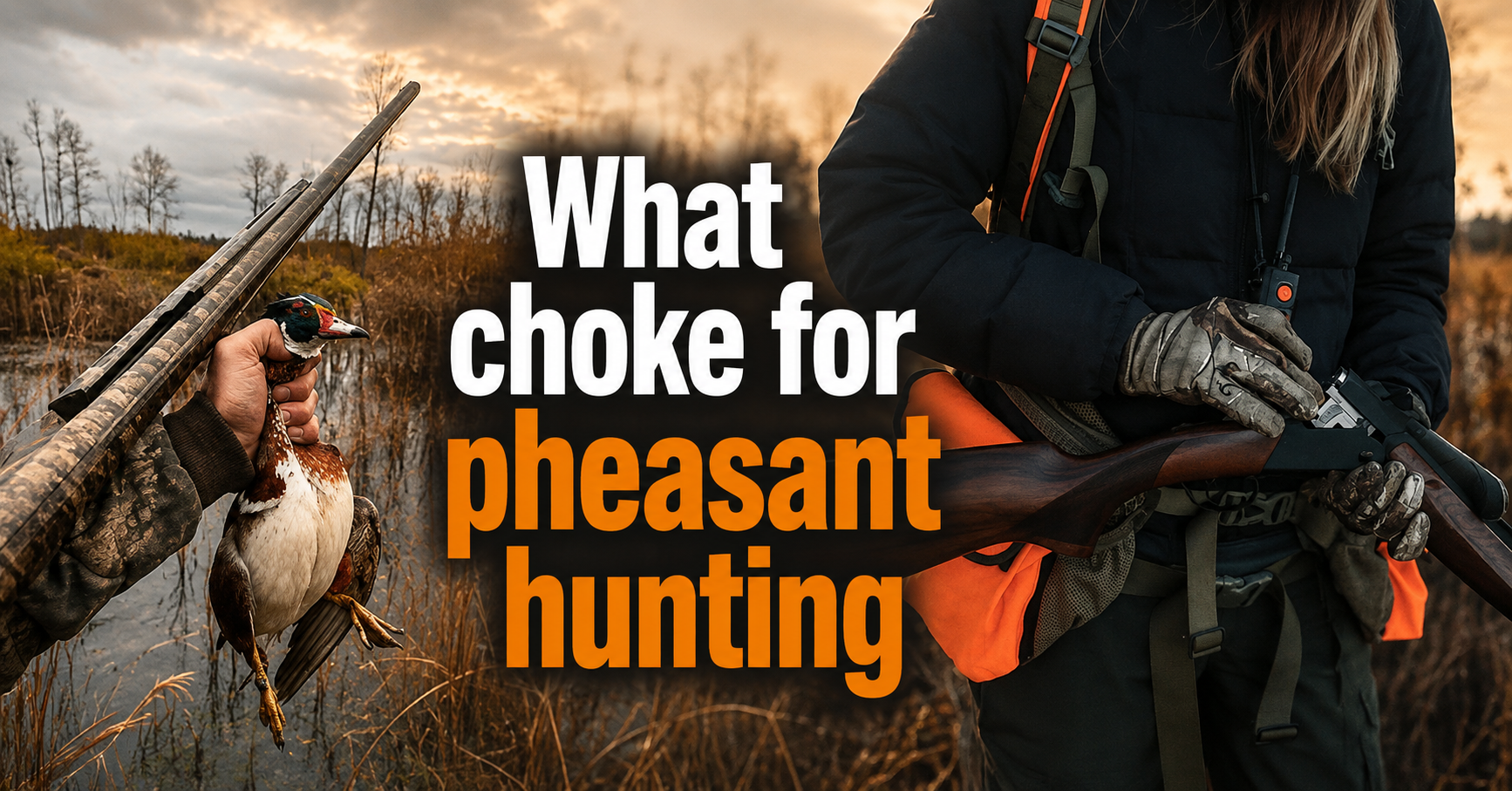

If you are wondering what choke for pheasant hunting gives the most useful balance, start with Modified. It is the strongest all-around choice for a single-barrel shotgun when cover and flush distance may change during the walk. Choose Improved Cylinder for close birds in thick cover or over a steady pointing dog, and consider Improved Modified only for consistently farther-flushing birds in open country after the exact gun, choke, and load have produced an effective pattern on paper.
Quick Answer: Use Improved Cylinder for mostly close shots, Light Modified for close-to-medium mixed cover, Modified for a versatile medium-range setup, and Improved Modified only when conditions truly require a denser pattern. Full choke is rarely the best default for pheasant because its tight close-range pattern leaves little aiming margin and may damage meat. A choke label is only a starting point: pattern the exact hunting load and establish a personal maximum distance at which pellet distribution, penetration, and your shooting remain reliable.
Important Firearm Safety and Legal Notice
A choke recommendation never makes a shot safe, legal, or ethical. Before hunting, verify the current pheasant season, license, bag limit, shooting hours, blaze-orange requirement, lawful firearm and magazine capacity, permitted shot sizes, nontoxic-shot rules, dog rules, and property restrictions with the wildlife agency and land manager for the exact place you will hunt. Regulations can differ between states, provinces, national wildlife refuges, wildlife management areas, and private properties. Legal and regulatory information in this guide was checked on August 15, 2026, but rules can change.
Apply all four universal firearm safety rules at all times:
- Treat every firearm as if it is loaded.
- Keep the muzzle pointed in a safe direction.
- Keep your finger outside the trigger guard until you are ready to shoot.
- Be certain of your target and what is beyond it.
Those rules are especially important in pheasant cover, where birds may flush low around dogs, partners, roads, homes, livestock, or unseen people. Never shoot merely at color, sound, or movement. Positively identify a legal bird and let any low or unsafe bird go.
What Choke for Pheasant Hunting in Common Conditions?
| Hunting condition | Useful starting choke | Why it may fit | Main caution |
|---|---|---|---|
| Early season, dense cover, close-flushing birds | Improved Cylinder | Opens sooner and provides useful width at close range | Pattern may become too sparse as distance grows |
| Pointing dog with consistently close, controlled flushes | Improved Cylinder or Light Modified | Matches quick close-to-medium presentations | A wider pattern does not correct poor gun mount or lead |
| Mixed cover and unpredictable flushes | Modified | Balanced density and usable spread across common field distances | Still must be tested with the actual load |
| Late season or open country with farther-flushing birds | Modified; possibly Improved Modified | Retains more density at the longer end of a proven range | Do not use a tighter choke to justify speculative long shots |
| Double-barrel gun, close first shot and farther second shot | Improved Cylinder first, Modified second | Two useful patterns without changing tubes in the field | Know barrel order and selector position before loading |
| Nontoxic steel load | Often one step more open than a comparable lead setup | Steel frequently patterns tighter than lead | Follow the gun, choke, and ammunition manufacturers, not a generic chart |
These are starting points, not guaranteed yardage ratings. Two tubes with the same marking can pattern differently, and a different shell can change the distribution substantially. Pellet material, shot size, velocity, payload, barrel, bore dimensions, forcing cone, choke geometry, weather, and individual ammunition lot can all affect the result.
Why Modified Is the Best All-Around Starting Point
Modified sits between the broader Improved Cylinder pattern and the denser Improved Modified pattern. That middle position is useful because a pheasant hunt rarely supplies one repeatable presentation. A rooster may rise close from cattails, run ahead before flushing at medium distance, or lift with another bird farther across the cover. Modified gives a single-barrel hunter a practical compromise when the expected distance is uncertain.
Hunter-education guidance identifies both Improved Cylinder and Modified as appropriate possibilities for pheasant and emphasizes matching choke to game, shot, and distance. The Hunter-ed choke guide describes Modified as the middle ground in pattern density and useful range. That supports Modified as a starting point, but it does not eliminate pattern testing.
Modified is not automatically superior if most birds are inside the close end of your effective range. At short distance, its core may be unnecessarily compact. Conversely, a weak or uneven Modified pattern may not be adequate at the farthest distance you intend to shoot. The right choice is the least constriction that produces an even, sufficiently dense pattern and dependable terminal performance at your real field distance.
When Improved Cylinder Makes More Sense
Improved Cylinder is often a better answer in early-season cover, shelterbelts, creek bottoms, cattails, or managed preserves where flushes tend to be close. It is also useful when a pointing dog consistently holds birds and the gunner approaches for a controlled, close presentation. The faster-opening pattern gives a little more width when a bird accelerates across the muzzle at short range.
That extra width should not be confused with a cure for aiming errors. A shotgun pattern is still small at very close range, and the shooter must mount smoothly, focus on the bird, maintain a safe swing, and follow through. Improved Cylinder may reduce severe meat damage compared with a tighter choke on a close bird, but any centered close-range pattern can still be destructive.
The limitation appears as distance increases. A pattern that looks even at 25 yards may develop large pheasant-sized gaps farther out. If the majority of birds flush beyond the effective pattern, changing cover strategy, working the dog differently, or declining the shot is often better than simply tightening the choke.
Where Light Modified Fits
Light Modified is a useful bridge for hunters who find Improved Cylinder too open but Modified denser than needed. It can suit mixed upland cover, a combination of pointing and flushing dogs, or an over-and-under setup where the first barrel needs slightly more reach than Improved Cylinder.
Not every factory supplies a Light Modified tube, and not every tube marked Light Modified produces the same constriction or pattern. Treat it as another option to test, not a necessary purchase. If your Improved Cylinder and Modified loads already cover your real conditions well, there may be no practical gap to fill.
When to Consider Improved Modified
Late-season pheasants often run, flush early, and use open edges where shots can begin farther away. In those conditions, Improved Modified may retain pattern density better than a more open choke. It can be reasonable for an experienced shooter whose pattern board confirms even coverage and whose field ability supports the distance.
The ethical boundary matters more than the tube name. A dense pattern does not solve poor range estimation, wind, an awkward body position, an obstructed bird, insufficient pellet energy, or uncertainty about what lies beyond. If you cannot identify the bird clearly, place the pattern consistently, and recover it promptly, do not shoot. Improved Modified is a specialized adjustment within a proven envelope, not a license to extend it.
Why Full Choke Is Usually Not the Default
Full choke can deliver a compact pattern at distance, but it brings disadvantages to the changing presentations typical of pheasant hunting. Close birds cross a small pattern quickly, leaving little timing margin. A centered close-range hit can cause excessive meat damage, while a slight pointing error can miss cleanly or wound with only the pattern edge.
Full choke also raises compatibility questions with hard nontoxic pellets. Some modern systems permit certain steel loads through particular Full tubes, while other guns, tubes, shot sizes, or loads do not. The word “Full” alone is not enough information. Consult the shotgun manual, choke markings, choke maker, and ammunition instructions. With an older fixed-choke barrel or uncertain tube, stop and obtain qualified manufacturer or gunsmith guidance before firing steel.
How Season, Cover, and Dogs Change the Choice
Early Season
Young, less-pressured birds may hold in thicker cover and rise nearer the hunter or dog. Vegetation can shorten the visual window, making a smooth mount and quick but deliberate decision important. Improved Cylinder or Light Modified commonly fits this setting. Modified remains sensible if the same walk includes open edges or variable flushes.
Late Season
After repeated pressure, surviving pheasants may run ahead or flush before hunters reach them. Modified often becomes the more dependable general choice. Improved Modified can be tested for open ground where most opportunities occur at the farther end of an already proven range. Weather clothing also matters: a heavy coat can alter mount and length of pull, so practice in the clothes you will actually wear.
Pointing Dogs
A steady pointing dog can make the likely flush location more predictable and often keeps the first shot relatively close. Improved Cylinder in the first barrel and Modified in the second is a classic flexible pairing. However, a dog that relocates, a running rooster, or strong wind can change the distance quickly.
Flushing Dogs
A close-working flushing dog may produce quick birds at short-to-medium distance, favoring Improved Cylinder, Light Modified, or Modified. The decisive factor is control. If the dog ranges too far, do not compensate by taking longer shots over or near it. Regain control, train within safe flushing distance, and pass unsafe presentations.
Best Choke Pairings for a Double-Barrel Shotgun
| Expected conditions | First barrel | Second barrel | Reasoning |
|---|---|---|---|
| Close cover or steady pointing dog | Improved Cylinder | Modified | Broad close pattern followed by greater density if the bird gains distance |
| Mixed cover | Light Modified | Modified | Small step between two versatile patterns |
| Mostly open, later season | Modified | Improved Modified | More density for farther presentations, if both patterns are proven |
Confirm which trigger or selector fires each barrel, and rehearse the controls with an unloaded firearm in a safe area. On some over-and-under guns, barrel selection and recoil-operated reset systems can affect the second shot. The owner’s manual governs. Never experiment with controls while a loaded muzzle is covering people, dogs, vehicles, or property.
Shot Material Can Change the Effective Choke
Lead, steel, bismuth, and tungsten-based pellets do not behave identically. Steel is harder and less dense than lead, so comparable loads commonly use a larger pellet and may produce a tighter pattern through the same nominal choke. Bismuth and tungsten-based products have their own density, hardness, payload, velocity, and manufacturer restrictions. Marketing labels such as “pheasant load” cannot replace pattern testing.
Winchester notes that lead and steel can perform differently through tubes with the same constriction and uses separate designations in some choke systems. Its Select shotgun manual is a useful example of why a hunter must follow the manual for the specific model. Beretta similarly explains that its compatible tubes carry identifying markings; those markings apply to Beretta systems, not every shotgun. Never assume a tube fits or is steel-safe because it looks similar.
A common starting adjustment is to try a more open tube with steel than with lead when seeking similar pattern behavior. That is only a testing hypothesis. The actual pattern may be tighter, uneven, or surprisingly open depending on the load. Fire only ammunition and choke combinations expressly approved by all applicable manufacturers.
Lead-Free and Nontoxic-Shot Requirements
Nontoxic shot is not universally required for pheasant on every parcel in the United States, but it is mandatory on many federal refuges and some other public or private lands. Requirements can apply to possession as well as firing. For example, the U.S. Fish and Wildlife Service page for Upper Souris National Wildlife Refuge expressly requires approved nontoxic shot for pheasant and other upland game on that refuge. This example must not be generalized to every property.
Check the current state or provincial regulation book, then check the specific refuge, wildlife area, walk-in area, outfitter, and landowner conditions. If rules conflict, follow the more restrictive applicable rule or ask the responsible agency before hunting. Carrying lead shells alongside legal nontoxic shells can itself be prohibited on some properties, so separate ammunition before leaving home.
Choosing Shot Size and Load
Common pheasant starting points include No. 5 or No. 6 lead and larger steel pellets such as No. 3 or No. 4, but no size is universally correct. The Minnesota Department of Natural Resources advises hunters to use a shotgun they have practiced with and notes that proficiency matters more than style or gauge. Its pheasant hunting guidance mentions No. 4 or No. 5 shot and keeping shots within 50 yards. Treat 50 yards as that agency page’s outer guidance, not a personal entitlement: many hunters, guns, loads, and presentations require a substantially shorter ethical limit.
Choose a lawful pellet material and size that produces adequate, even pattern density and sufficient penetration at your tested distance. Larger pellets generally offer fewer projectiles per payload but retain individual pellet energy better. Smaller pellets increase pellet count but may lose energy sooner. The balance changes with material density and velocity.
Heavy or high-velocity shells are not automatically better. Extra recoil can slow the second shot, disturb mount, encourage flinching, and reduce practice quality. Start with a load the shotgun is chambered and proofed to fire, that patterns reliably, and that you can control. Never fire a shell of the wrong gauge or a shell longer than the chamber marking permits.
Does Shotgun Gauge Change the Choke Answer?
The same selection logic applies to 12-, 16-, and 20-gauge pheasant guns: use a choke and load that produce an effective pattern at realistic distance. Gauge does not make Modified mean an identical pellet count because payload and load construction differ. A 20 gauge may be comfortable and effective in trained hands, while a poorly fitted 12 gauge with excessive recoil may reduce hits.
A .410 offers a smaller payload and less pattern margin, making exact load selection, patterning, and conservative distance especially important. It is generally a demanding choice for pheasant and not the easiest beginner setup. Whatever the gauge, gun fit, safe handling, practice, and pattern quality matter more than prestige or raw shell length.
How to Pattern a Pheasant Choke and Load
Patterning reveals what the gun actually does. It is not the same as firing one shell at a small target and judging the hole. Use an established shooting range or other lawful location with a safe backstop, follow all range rules, wear eye and hearing protection, and transport and handle the firearm lawfully.
- Inspect the setup. Confirm the gun is unloaded, the bore is clear, the tube is the correct system and fully seated, and the shell is the correct gauge, chamber length, material, and manufacturer-approved type.
- Choose realistic distances. Test at the close, typical, and farthest distances you genuinely expect, rather than relying on a choke chart.
- Use large paper. A large clean sheet lets you locate the true center of the pattern, which may not coincide perfectly with the aiming point.
- Fire multiple patterns. One shell can be unusually good or bad. Several patterns provide a more representative picture.
- Mark the densest center. Evaluate an appropriate circle around the true pattern center and look for pheasant-sized gaps, thin edges, clumps, and consistency.
- Change one factor at a time. Compare choke first while holding the load constant, or compare loads while holding the choke constant.
- Set a conservative field limit. Use the farthest distance where the pattern remains dependable and you can repeatedly place it on a moving target under realistic conditions.
For the most defensible assessment, record the gun, barrel, choke, tube maker, load, pellet material, shot size, velocity, distance, weather, and result. Keep the target or photograph it. Recheck after changing ammunition, replacing a tube, modifying the gun, or discovering an impact shift.
How to Read the Pattern
Do not judge only by how many pellets hit the paper. The central questions are whether the pattern is centered, even, dense enough throughout the vital area, and repeatable. Large empty spaces can let a bird pass through with inadequate strikes even when the total pellet count appears impressive. A very dense core with a thin fringe may also be less forgiving than an evenly distributed pattern.
Compare actual outcomes, not only conventional percentages assigned to choke names. Nominal choke standards are useful shorthand, but the bird encounters the real pellet cloud. If Modified from one load is patchy while Light Modified from another is even, the supposedly tighter label does not win automatically.
Establishing an Ethical Maximum Range
An ethical limit is the shortest of three limits: reliable pattern performance, adequate load performance, and the shooter’s demonstrated ability. It must also remain within every applicable legal restriction. Conditions can shorten that distance on a given shot. Wind, poor footing, thick branches, a quartering-away bird, low light, heavy clothing, fatigue, nearby dogs, or an uncertain background are all reasons to pass.
Range estimation in open fields is difficult. Use landmarks before entering cover and practice estimating distance, then verify with lawful non-hunting tools during training. In the moment, if the bird appears beyond your demonstrated range, let it go. A cleanly declined shot is always better than a preventable wound.
Recoil, Gun Fit, and Shooter Experience
Choke is only one part of performance. A shotgun that fits poorly may shoot high, low, or away from the natural line of sight. Heavy recoil can promote head lifting or flinching. New shooters often benefit more from professional instruction, a properly fitted gun, manageable ammunition, and practice on clay targets than from a tighter tube.
Patterning from a stable position evaluates the equipment, but pheasant practice should also include safe mounting and crossing targets. Start with low-recoil training where appropriate and advance gradually. Do not practice unsafe low-angle shots that would be unacceptable over dogs or partners in the field.
Field Safety With Partners and Dogs
- Agree on each hunter’s safe zone of fire before entering cover, and maintain spacing and visual contact.
- Keep every muzzle controlled when crossing fences, ditches, vehicles, or obstacles; unload as required by safe procedure and law.
- Know where every person and dog is before mounting the shotgun.
- Do not shoot at a low bird, a bird that crosses another hunter’s zone, or a bird with an uncertain background.
- Wear the required blaze orange or pink and consider more visibility than the legal minimum.
- Use only a positively identified legal bird; hens may be protected depending on the season and jurisdiction.
- After a hit, mark the fall location, unload or secure the firearm as circumstances require, and organize a prompt recovery effort.
- If a dog breaks or chases, withhold fire. Dog safety outranks the opportunity.
Common Choke-Selection Mistakes
Choosing by Season Alone
“Improved Cylinder early, Modified late” is a useful shortcut, not a rule. Habitat, dog style, hunting pressure, wind, group formation, and the individual property may matter more than the calendar.
Assuming Tighter Means More Lethal
A tighter choke changes distribution; it does not create skill or guarantee pellet performance. At close range it may reduce hit probability and increase meat damage. At excessive range even a dense-looking center may lack dependable terminal effect or placement.
Skipping the Pattern Board
Factory markings cannot reveal point of impact, holes, load inconsistency, or an incompatible combination. Patterning is the only practical way to compare the actual setups.
Using Steel Through an Unverified Choke
Some modern tubes are designed for steel; some are restricted by constriction, pellet size, or gun model. Older barrels can require special evaluation. Never rely on internet generalizations when the manufacturer’s model-specific instructions are available.
Changing Equipment During the Hunt
Handling small tubes and loaded firearms in cover creates avoidable risk. Make changes only in a safe location after completely unloading and checking the firearm, and use the correct wrench and installation procedure. Confirm the tube is seated according to the manual.
Troubleshooting a Poor Pheasant Pattern
| Observed problem | Likely possibilities | Safe next step |
|---|---|---|
| Large gaps at expected distance | Choke too open, incompatible load, inconsistent shells | Test a different approved load or one increment tighter |
| Extremely tight close pattern | Too much constriction for typical presentation | Try one increment more open and retest |
| Pattern consistently off-center | Point-of-impact or fit issue | Stop guessing; verify technique and consult a qualified gunsmith if persistent |
| Steel pattern tighter than expected | Material and choke interaction | Try an approved more-open tube and follow manufacturer guidance |
| Good paper pattern but poor field hits | Mount, lead, focus, footing, or range-estimation issue | Seek instruction and practice realistic crossing targets |
| Tube loosens or shows damage | Installation, thread, fouling, or compatibility problem | Unload immediately and have the system inspected before further firing |
A Simple Decision Process
- Confirm the exact hunting property’s current laws and ammunition restrictions.
- Predict the most common safe shot distance from habitat, dog style, and season.
- Select a manufacturer-approved starting tube: Improved Cylinder close, Modified mixed, or Improved Modified only for proven farther work.
- Choose a lawful load that fits the shotgun and produces manageable recoil.
- Pattern the exact combination at realistic distances.
- Practice with safe crossing targets and field clothing.
- Set a personal range limit from evidence, then shorten it whenever conditions deteriorate.
Final Recommendation
For most hunters asking what choke for pheasant hunting, Modified is the best single starting answer because it handles mixed cover and variable flushes without moving immediately to an overly tight pattern. Use Improved Cylinder when close birds are the norm, especially in early cover or over a steady pointer. Test Improved Modified only when open-country or late-season conditions consistently put birds near the farther end of your proven ethical range.
The final authority is not the tube label. It is the intersection of current law, manufacturer compatibility, an even pattern from the exact ammunition, reliable shooter performance, positive target identification, a safe background, and a prompt recovery plan. When any one of those conditions is missing, pass the shot.
Frequently Asked Questions
1. What is the best all-around choke for pheasant hunting?
Modified is the best all-around starting point for a single-barrel shotgun because it balances pattern width and density across the mixed distances common in pheasant cover. It is not universally best; pattern the exact gun and load before hunting.
2. Is Improved Cylinder good for pheasant?
Yes. Improved Cylinder is well suited to close-flushing pheasants in dense cover and controlled shots over a pointing dog. Its pattern may become too sparse farther out, so test it at your expected maximum distance.
3. Is Modified or Improved Cylinder better for pheasant?
Improved Cylinder usually favors close shots, while Modified better covers mixed or medium distances. Choose according to actual flush range and paper patterns, not preference alone. Modified is the safer default when distance is unpredictable.
4. Should I use Full choke for pheasant?
Usually not as a default. Full can be unforgiving on close birds and may cause excessive meat damage. It also requires careful compatibility checks with steel shot. A proven Modified or Improved Modified pattern normally offers more flexibility.
5. What choke should I use for early-season pheasant?
Improved Cylinder or Light Modified is a practical starting point when early birds hold closely in thick cover. If your property combines dense cover with open edges, Modified may handle the variation better.
6. What choke should I use for late-season pheasant?
Modified is a sound late-season default. Improved Modified may help when birds consistently flush farther in open country, but only after patterning proves it and the distance remains within your demonstrated shooting ability.
7. What choke works best over a pointing dog?
Improved Cylinder often works well because a steady pointer can produce close, predictable flushes. For a two-barrel gun, Improved Cylinder first and Modified second provides flexibility if the bird gains distance.
8. What choke works best with a flushing dog?
Improved Cylinder, Light Modified, or Modified can work, depending on how closely the dog hunts. A dog ranging too far is a training and control problem, not a reason to attempt longer, riskier shots.
9. What chokes should I put in an over-and-under for pheasant?
Improved Cylinder in the first barrel and Modified in the second is a versatile combination. For mixed cover, Light Modified and Modified can work; for proven farther presentations, Modified and Improved Modified may fit.
10. Does steel shot require a different choke?
Often it does. Steel commonly patterns tighter than lead, so a more open choke may create the desired pattern. Always verify that the exact firearm and tube are approved for the steel pellet size and load.
11. Can I shoot steel through a Full choke?
Only if the shotgun and choke manufacturers explicitly approve that exact combination. Some modern systems allow limited steel use, while others prohibit it. Older fixed-Full barrels require especially careful professional or manufacturer guidance.
12. Is Modified safe for steel shot?
Many modern Modified tubes are steel-rated, but not all tubes and firearms are. Read the model-specific manual and tube markings, and check any restrictions on pellet size or velocity before firing.
13. Does bismuth pattern like lead?
Bismuth can behave more like lead than steel in some loads, but it is not identical. Pellet hardness, payload, velocity, buffering, wad, and choke all influence distribution. Pattern the exact bismuth shell you will carry.
14. What shot size is best for pheasant?
No. 5 or No. 6 lead and No. 3 or No. 4 steel are common starting points, subject to local law and manufacturer guidance. Select by verified pattern density, pellet performance, realistic distance, and manageable recoil.
15. Is No. 6 shot enough for pheasant?
No. 6 lead is commonly used at appropriate distances with an effective pattern. It is not a universal answer, and pellet material matters. As range grows, smaller pellets shed energy sooner, so set a conservative tested limit.
16. Is No. 4 shot too large for pheasant?
No. 4 is used for pheasant in some loads, but it supplies fewer pellets than a smaller size at the same payload. Check local shot-size restrictions and ensure the combination patterns evenly enough at your chosen distance.
17. Does a 20 gauge need a tighter choke than a 12 gauge?
Not automatically. A 20 gauge may carry fewer pellets, but tightening can create an uneven or overly compact pattern. Compare actual patterns from approved loads and choose the least constriction that meets your needs.
18. Is a 20 gauge enough for pheasant hunting?
Yes, a properly fitted 20 gauge with an effective lawful load can be suitable in practiced hands. Gun fit, pattern quality, recoil control, safe distance, and shot placement matter more than gauge alone.
19. Can I hunt pheasant with a .410?
Where legal, it may be possible, but the smaller payload leaves limited pattern margin. It demands careful load testing, high proficiency, and conservative distances. It is generally not the easiest option for a new pheasant hunter.
20. How far is Modified choke effective on pheasant?
There is no guaranteed distance. Effectiveness depends on the gun, load, pellet material, pattern distribution, bird presentation, and shooter. Use paper patterns and realistic practice to set a personal limit rather than adopting a chart’s yardage.
21. How far should I shoot at a pheasant?
Only within the shortest limit set by law, reliable pattern performance, adequate pellet performance, and your demonstrated field ability. Wind, poor footing, low birds, dogs, partners, or uncertain backgrounds should shorten that limit further.
22. Does a tighter choke increase pellet energy?
No. Choke primarily changes pellet distribution, not the energy of each pellet. Velocity, pellet size, density, shape, and distance drive individual pellet energy. Tighter distribution cannot rescue an unsuitable or excessively distant shot.
23. Will a wider choke make pheasants easier to hit?
At close range, a wider pattern can provide more timing margin, but it still requires correct mount, lead, and follow-through. Farther out, the same pattern may become too thin for reliable results.
24. Can a choke reduce meat damage?
Using a more open choke for close birds can reduce an excessively dense center, but distance and point of impact also matter. Avoid very close centered shots when the presentation is unsafe or likely to destroy usable meat.
25. Do factory choke markings guarantee pattern percentage?
No. Markings identify nominal constriction or intended performance, but barrels, tubes, and shells vary. Paper testing is necessary to see point of impact, density, gaps, and consistency from your exact setup.
26. How many pattern shots should I fire?
Fire several with each combination because one shell may not represent typical performance. Change only one variable at a time, record the conditions, and follow range rules and the ammunition manufacturer’s cooling or maintenance guidance.
27. What distance should I use for patterning?
Test at the close, normal, and farthest distances you truly expect in the field. A single conventional distance cannot show how quickly a pattern opens or where it becomes too sparse for your standards.
28. Should I pattern from a rest?
A stable position helps isolate the gun and load’s point of impact and distribution. Afterward, practice safe gun mounting and crossing targets to evaluate shooter performance. Use a lawful range and a proper backstop.
29. Why does my Modified choke pattern poorly?
The shell, wad, pellet material, barrel, tube geometry, or point of impact may not work well together. Try another approved load or adjacent choke, one variable at a time. Have persistent off-center results professionally evaluated.
30. Should I change chokes during a pheasant hunt?
Only when conditions change materially and you can do so in a safe location with the firearm completely unloaded and checked. Many hunters are better served by a versatile pretested setup than frequent field changes.
31. Can I use an aftermarket choke for pheasant?
Yes, if it is made for the exact choke system and approved for the intended load. Follow both firearm and tube instructions. An aftermarket tube still needs pattern testing and periodic inspection.
32. How tight should a choke tube be?
Install it exactly as the owner’s manual and choke maker direct, using the correct wrench if specified. Do not improvise torque. A loose, cross-threaded, damaged, or incompatible tube can damage the firearm and injure people.
33. Can I shoot with no choke tube installed?
Not in a barrel designed to use removable tubes unless its manufacturer explicitly allows it. Firing without the required tube can damage exposed threads or the barrel. Keep the firearm unloaded until the correct tube is installed.
34. Is Cylinder choke suitable for pheasant?
Cylinder may work for very close presentations with a load that patterns adequately, but it often opens too quickly for variable pheasant distances. Improved Cylinder usually offers a more practical close-cover starting point.
35. Is Light Modified worth buying?
It can fill a useful gap between Improved Cylinder and Modified, especially for mixed cover. Buy only after patterning shows a real need; a compatible load may improve an existing tube’s pattern without adding another choke.
36. Do cold weather and wind change choke choice?
They can affect ammunition performance, bird behavior, range, balance, and shooter mount. Rather than tightening automatically, test cold-weather performance when feasible and shorten shots in strong wind or compromised footing.
37. Should beginners use a tighter choke?
No. Beginners generally benefit more from a fitted shotgun, manageable recoil, instruction, and practice. An unnecessarily tight pattern reduces close-range margin. Start with a condition-appropriate tube and confirm it on paper.
38. Are choke notches universal?
No. Notch and star systems vary by manufacturer and choke family. Read the markings and model-specific manual. Never identify compatibility or steel rating by visual resemblance alone.
39. Do I need nontoxic shot for pheasant?
It depends on jurisdiction and property. Many refuges and some public or private lands require approved nontoxic shot for upland hunting. Check both the current wildlife regulations and the exact land manager’s rules before packing ammunition.
40. What is the safest final answer on pheasant choke?
Begin with Modified for mixed conditions or Improved Cylinder for reliably close birds, then pattern the exact lawful load. Follow manufacturer compatibility instructions, establish a conservative personal range, identify the bird and background, and pass every unsafe shot.
Read more: