
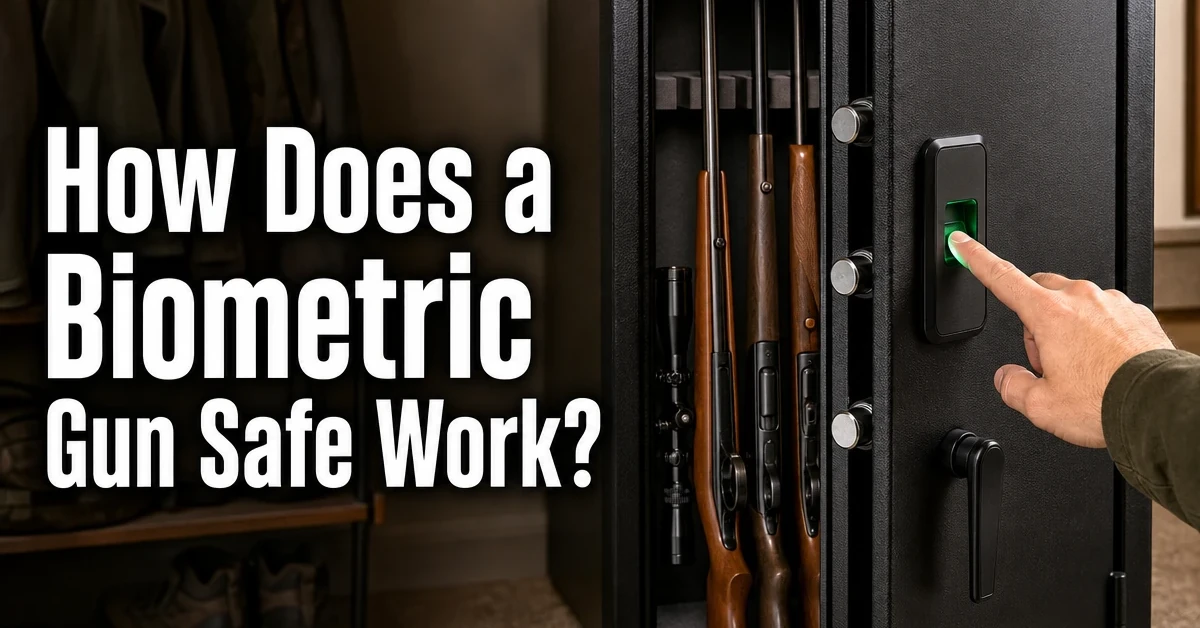

How does a biometric gun safe work? It uses a fingerprint sensor to compare your fingerprint with authorized prints stored in its memory. If the scan matches, an electronic lock releases and allows access; if it does not, the safe remains locked. These safes can provide convenient access, but proper setup, backup entry methods, secure mounting, battery maintenance, and responsible firearm storage remain essential.
What Is a Biometric Gun Safe?
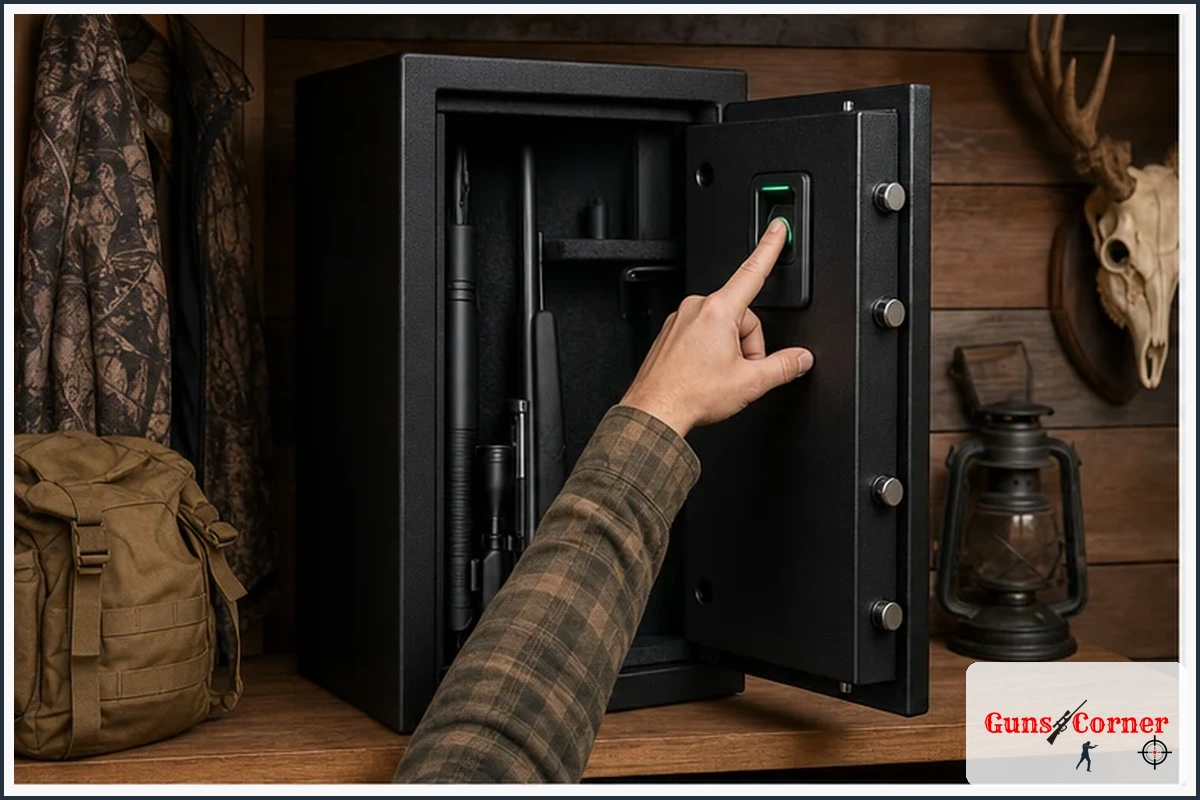
A biometric gun safe is a lockbox or cabinet that uses biological identification—usually a fingerprint—to authorize entry. Instead of relying only on a key or combination, the safe stores one or more enrolled fingerprint templates and compares a new scan with them.
Most models are designed to prevent unauthorized access to firearms and may also accept a keypad code, backup key, or emergency power source. Features vary considerably, so the owner should read the specific manufacturer’s manual before relying on the safe.
How Does a Biometric Gun Safe Work?
- Enrollment: The owner places a finger on the sensor several times so the safe can record identifying features.
- Scanning: When the safe is locked, the sensor reads the presented fingerprint.
- Matching: The internal processor compares the scan with authorized fingerprint data stored in the safe.
- Authorization: If the scan meets the safe’s programmed matching criteria, the electronic lock releases.
- Access: A spring-loaded lid, motor, or solenoid may open the locking mechanism, depending on the design.
- Relocking: The safe locks again when closed, either automatically or after the owner activates the lock.
The safe normally stores a mathematical representation of fingerprint characteristics rather than a photograph of the entire fingerprint. The exact technology, storage method, recognition threshold, and number of permitted users depend on the model.
What Parts Make Up a Biometric Safe?
| Component | Purpose | What to Check |
|---|---|---|
| Fingerprint sensor | Reads the presented finger | Placement, surface size, and performance with clean or damp fingers |
| Control processor | Compares the scan with stored enrollment data | Manufacturer instructions and user capacity |
| Electronic lock | Releases or secures the locking mechanism | Lock design, relocking behavior, and manual override |
| Power source | Runs the scanner and lock | Battery type, low-power warning, and replacement procedure |
| Backup entry system | Provides access if the biometric system cannot operate | Key, keypad, external power, or another manufacturer-approved method |
| Housing and mounting hardware | Protects the contents and helps prevent removal | Construction, anchor points, and compatible installation surfaces |
Why a Fingerprint May Fail to Unlock the Safe
Biometric recognition is not guaranteed to work every time. A scan can fail because of dirt, moisture, dry or damaged skin, an incomplete enrollment, an awkward finger position, a dirty sensor, low battery power, or an electronic fault.
Common Troubleshooting Steps
- Place the same part of the finger on the sensor that was used during enrollment.
- Clean and dry the finger and sensor according to the manufacturer’s instructions.
- Enroll the same authorized finger more than once if the manual permits it.
- Register more than one finger for each authorized user when supported.
- Replace weak batteries with the correct type specified by the manufacturer.
- Test the safe repeatedly while it is empty before storing a firearm inside.
- Keep the approved backup entry method available in a secure location.
Do not force the lid, pry the lock, modify the electronics, or defeat the safe’s security features. Contact the manufacturer or a qualified locksmith when the safe remains unreliable.
Advantages and Limitations of Biometric Gun Safes
| Potential advantage | Important limitation |
|---|---|
| Quick access without remembering a combination | Recognition may fail under poor finger or battery conditions |
| Can restrict access to enrolled users | Enrollment must be completed correctly and kept private |
| Some models automatically relock | Not every model relocks in the same way |
| Useful for households seeking controlled firearm access | Small portable units may be vulnerable to theft if not secured |
| May also offer a keypad or key backup | Backup methods must be protected from unauthorized users |
A biometric lock is an access-control feature, not a substitute for a strong safe body, secure installation, maintenance, or safe firearm handling.
How to Set Up a Biometric Gun Safe Safely
- Read the manual first. Confirm the battery type, enrollment procedure, backup access method, and mounting requirements.
- Install the batteries correctly. Check polarity and use only the recommended batteries.
- Enroll authorized users privately. Do not enroll children or anyone who should not have firearm access.
- Register multiple fingers when allowed. This can help when one finger is wet, dirty, injured, or difficult to position.
- Test every access method with the safe empty. Confirm that authorized entry works and unauthorized fingers are rejected.
- Secure the safe to an appropriate structure. Follow the manufacturer’s anchoring instructions and avoid improvised mounting.
- Store the firearm according to the manual and local law. Follow any required unloaded-storage, transport, or ammunition-storage rules.
- Retest periodically. Verify the scanner, batteries, lock, hinges, and mounting hardware.
Biometric, Keypad, and Key Locks Compared
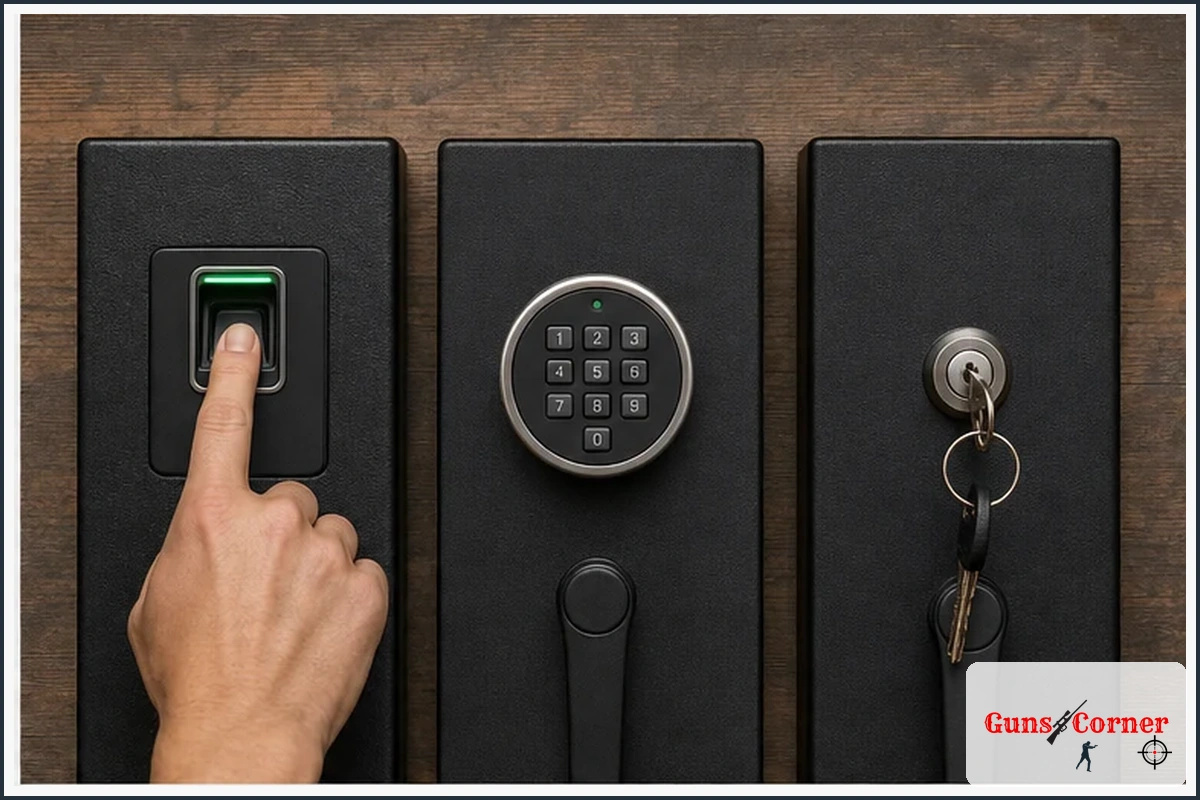
| Lock type | Strength | Limitation | Maintenance concern |
|---|---|---|---|
| Biometric | Fast entry without entering a code | Depends on a reliable fingerprint scan and power | Sensor cleanliness and battery condition |
| Keypad | No fingerprint-reading issue | Code can be forgotten, observed, or entered incorrectly | Battery and keypad condition |
| Mechanical key | Does not rely on electronics | Key can be lost, copied, or mishandled | Key control and mechanical wear |
The best choice depends on the household, the people authorized to access the firearm, the safe’s installation location, and the owner’s ability to maintain and test the system.
How to Choose a Biometric Gun Safe
Check the Safe’s Intended Use
A compact handgun lockbox, a bedside access safe, and a full-size firearm cabinet serve different purposes. Confirm that the interior dimensions fit the unloaded firearm and any required protective equipment without preventing the safe from closing correctly.
Evaluate Backup Access
Look for a clearly documented backup method, such as a keypad, mechanical key, or approved external power connection. Backup access should not be treated as a reason to ignore battery replacement or sensor testing.
Consider Secure Installation
A portable safe that can simply be carried away may provide less protection than a properly anchored unit. Check the manufacturer’s instructions for acceptable mounting surfaces, fasteners, and weight limits.
Review Construction and Maintenance
Consider the locking mechanism, hinges, door or lid fit, tamper resistance, battery access, warranty, and availability of manufacturer support. Do not rely solely on marketing terms such as “instant,” “fail-proof,” or “unbreakable.”
Firearm Safety Still Applies
A biometric safe controls access; it does not make a firearm safe by itself. Always follow the four basic firearm safety rules:
- Treat every firearm as if it is loaded.
- Keep the muzzle pointed in a safe direction.
- Keep your finger outside the trigger guard until ready to shoot.
- Be certain of the target and what is beyond it.
Follow the firearm manufacturer’s instructions for unloading, storage, ammunition compatibility, and maintenance. A mechanical or electronic lock should never replace safe handling.
Legal and Responsible Storage Considerations
Firearm-storage requirements vary by country, state, and local jurisdiction. Some rules may address child access, unattended firearms, transport, locking devices, or storage in vehicles. Verify current requirements with the relevant government authority before relying on any general online guidance.
Consider the circumstances of everyone in the household, including children, visitors, unauthorized users, and anyone who may be impaired or unable to handle a firearm safely. Keep access credentials and backup keys controlled, and do not share them casually.
What Not to Do
- Do not store a firearm in a safe that has not been tested.
- Do not assume a fingerprint lock will work without charged or fresh batteries.
- Do not leave the backup key where an unauthorized person can find it.
- Do not mount the safe with unsuitable hardware or in an unstable location.
- Do not force the lock or bypass the biometric system.
- Do not rely on a safe’s marketing claims instead of reading its manual.
- Do not permit unauthorized users to enroll fingerprints or learn the access code.
FAQs
1. Does a biometric gun safe use a picture of my fingerprint?
Many systems store a digital template based on fingerprint characteristics rather than a conventional photograph, but the exact method depends on the manufacturer. Review the privacy and technical information for the specific model.
2. Can a biometric gun safe open if the batteries die?
Some models provide a mechanical key, keypad, or external emergency power feature. The available method varies, so learn and test the approved backup procedure before storing a firearm inside.
3. Are biometric gun safes completely tamper-proof?
No. A biometric lock is not completely tamper-proof. Security also depends on the safe’s construction, mounting, location, maintenance, and protection of backup access methods.
4. How many fingerprints should be registered?
Register the number allowed by the manufacturer for authorized users only. Adding multiple fingers for an authorized adult may improve usability, but every enrolled print increases the number of people or entries permitted to access the safe.
5. Should I keep ammunition in a biometric gun safe?
That depends on the safe’s design, household circumstances, firearm-storage requirements, and local law. Follow the manufacturer’s instructions and verify current regulations rather than assuming all safes or jurisdictions have the same requirements.
6. Is a biometric safe better than a combination safe?
Neither is universally better. A biometric model may be convenient for an authorized user who maintains the sensor and batteries, while a keypad or mechanical lock may be more dependable for someone who prefers not to rely on fingerprint recognition.
Final Answer
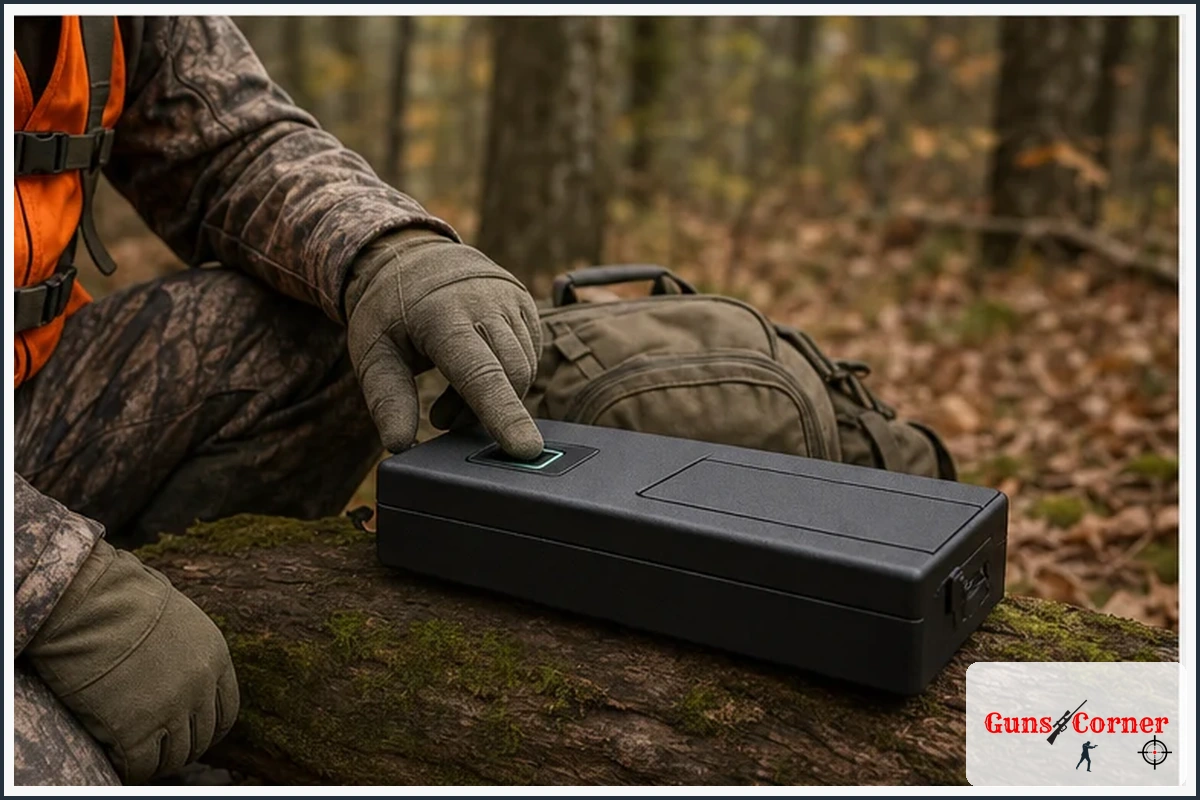
How does a biometric gun safe work? It scans a fingerprint, compares it with authorized enrollment data, and releases an electronic lock when the scan matches. Reliable use depends on proper enrollment, clean sensors, functioning batteries, a tested backup method, secure mounting, and compliance with local storage laws. Choose a safe that fits your firearm and household, test it while empty, and continue following all firearm-safety rules.