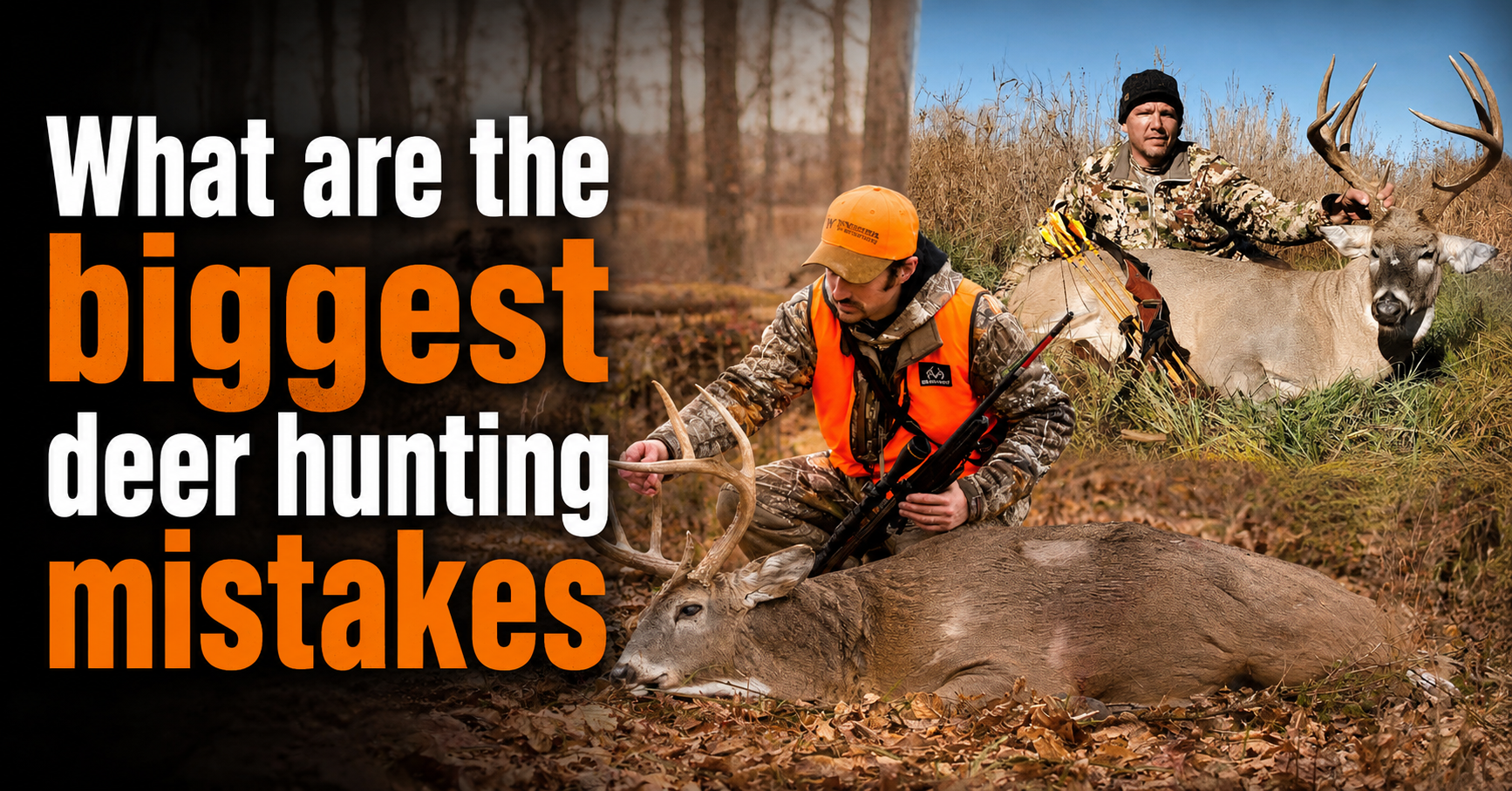

The biggest deer hunting mistakes usually happen before a deer appears. Hunters enter with an unverified zero, approach from the wrong direction, overuse one stand, misunderstand current regulations, forget essential safety equipment, or fail to plan recovery and meat care.
Other mistakes occur during a brief opportunity: reacting before identifying the animal, stretching beyond a practiced distance, allowing excitement to replace a familiar shot process, or leaving the impact area without marking important details.
This guide answers what are the biggest deer hunting mistakes, why they matter, and how beginners and experienced hunters can correct them. The guidance applies broadly to white-tailed and mule deer hunting, but local laws, terrain, deer behavior, equipment rules, disease-management requirements, and hunting methods vary.
Quick Answer
The biggest deer hunting mistakes are failing to check current regulations, neglecting practice, ignoring wind and access, placing stands without safe entry and exit routes, overpressuring one location, taking uncertain shots, abandoning a consistent shot process, following up without a recovery plan, and delaying meat care. The most serious errors involve unsafe firearm or bow handling, poor target identification, tree-stand falls, trespassing, and failing to make a reasonable legal recovery effort. A written pre-hunt checklist, verified equipment, recent scouting, disciplined range limits, and a complete recovery plan prevent many of these problems.
Biggest Deer Hunting Mistakes at a Glance
| Mistake | Why It Matters | Better Approach |
|---|---|---|
| Using outdated regulations | Seasons, legal animals, equipment rules, reporting, and access can change | Read the current official regulations for the exact unit and land type |
| Insufficient practice | Poor accuracy and unfamiliar handling can create unsafe or unethical opportunities | Practice with the complete hunting setup from realistic positions |
| Uncertain target or background | Movement, color, or sound can be another person, livestock, or a protected animal | Act only after complete identification and confirmation of a safe background |
| Ignoring wind | Scent can reach bedding areas, trails, or feeding locations before the hunter arrives | Plan the setup, access, and exit for the forecast wind and changing thermals |
| Poor access route | Crossing active deer areas can disturb the location before legal hunting begins | Use concealed routes that avoid bedding, feeding, and expected travel |
| Overhunting one location | Repeated disturbance can alter deer movement | Rotate setups and rest sensitive areas when conditions are unfavorable |
| Relying only on trail cameras | A camera captures a narrow location and limited moment | Combine images with tracks, droppings, browse, terrain, weather, and observation |
| Hunting old sign | Food, cover, pressure, and breeding activity change through the season | Prioritize recent sign connected to current resources |
| Unsafe stand placement | Falls and obstructed shooting directions can cause serious injury | Use a full-body harness, lifeline, haul line, and predetermined safe zone |
| Skipping equipment checks | Loose optics, damaged arrows, moisture, or impacts can change performance | Inspect and verify the complete system before hunting |
| Stretching personal range | Field conditions are less controlled than practice conditions | Remain inside a conservative, demonstrated effective range |
| Rushing the opportunity | Excitement can cause poor identification, aim, or trigger control | Use a short, repeatable shot process |
| Losing the impact location | Recovery becomes harder when landmarks and movement direction are forgotten | Mark the position, observe carefully, and record details before moving |
| Recovering without a plan | Rushing or waiting blindly can reduce recovery chances | Assess all available evidence and seek qualified help when uncertain |
| Trespassing during recovery | A recovery obligation does not automatically authorize entry | Obtain permission or contact the appropriate authority |
| No meat-care plan | Warm temperatures and contamination can reduce food quality and safety | Prepare clean tools, transport help, cooling equipment, and a processor |
| Ignoring CWD guidance | Testing and carcass-transport rules vary in affected areas | Review current wildlife and health-agency recommendations |
| Failing to evaluate the hunt | The same access, wind, setup, or equipment error may be repeated | Record conditions, observations, decisions, and corrective actions |
Important Safety and Legal Notice
Deer-hunting regulations vary by country, state, province, county, wildlife-management unit, land type, season, residency, weapon, ammunition, deer sex, antler status, age class, and disease-management zone. Always verify current official rules before scouting, carrying equipment onto hunting land, or beginning a recovery.
- License, permit, tag, and hunter-education requirements.
- Season dates and legal hunting hours.
- Legal deer definitions and harvest limits.
- Weapon, caliber, ammunition, broadhead, and magazine restrictions.
- Hunter-orange or other visibility rules.
- Baiting, feeding, attractant, and mineral restrictions.
- Public-land permits, boundaries, closures, and vehicle access.
- Private-land permission and retrieval procedures.
- Tagging, harvest reporting, evidence-of-sex, and transport rules.
- CWD testing, carcass-movement, and disposal requirements.
Hunter-education standards teach safe firearm handling, field practices, wildlife management, responsible hunting, survival, and game care. Beginners should complete an approved course and hunt with an experienced, ethical mentor when possible.
Four Basic Firearm-Safety Rules
- Treat every firearm as if it is loaded.
- Keep the muzzle pointed in a safe direction.
- Keep your finger outside the trigger guard until ready to shoot.
- Be certain of the target and what lies beyond it.
These rules apply while loading, unloading, walking, climbing, crossing obstacles, sitting in a blind, using a vehicle, and recovering game. A mechanical safety does not make unsafe handling acceptable.
What Are the Biggest Deer Hunting Mistakes?
1. Failing to Read the Current Regulations
Using last season’s rulebook is one of the easiest ways to create a preventable violation. Season boundaries, antler restrictions, weapon rules, reporting deadlines, public-land access, baiting restrictions, and CWD requirements can change.
Read the official regulations from beginning to end. Confirm the exact wildlife unit, season segment, legal animal, weapon type, land classification, and reporting process. Carry the required documentation in the accepted format.
Do not assume that advice from a neighboring state, a sporting-goods counter, a social-media group, or a hunting partner accurately describes your location.
Correction
- Download the current regulation booklet.
- Save the wildlife agency’s contact information.
- Check emergency orders shortly before hunting.
- Review property-specific rules separately.
- Ask the wildlife agency when wording remains unclear.
2. Practicing Too Little With the Actual Hunting Setup
Practice should include more than firing a few shots from a bench. A hunter may need to operate the safety, control breathing, obtain a stable position, judge a known distance, and complete a smooth trigger press while wearing gloves and layered clothing.
Bowhunters should practice with the legal hunting arrows, release, sight, broadheads or matched practice heads, and clothing they intend to use. Firearm hunters should verify the actual rifle, scope, mounts, ammunition, zero, and field support.
Beginner-focused deer guidance consistently identifies insufficient weapon practice as a major error. Equipment cannot compensate for poor familiarity or an uncertain personal range.
Correction
- Practice from kneeling, seated, standing, and supported positions.
- Use eye and hearing protection.
- Confirm the zero after transportation, maintenance, or an impact.
- Practice range estimation where legal and safe.
- Establish a conservative personal limit before the season.
3. Failing to Identify the Target and Background Completely
Never fire at sound, antlers, color, brush movement, a partial body, or an assumed deer shape. Identify the complete animal, verify that it is legal, and understand what lies in front of and beyond it.
People, pets, livestock, vehicles, houses, roads, trails, farm equipment, and other deer may be hidden by vegetation or low light. Binoculars are appropriate for identification; a firearm-mounted optic must never be used to investigate an uncertain object.
Correction
- Wait for an unobstructed view.
- Use binoculars before raising a firearm or bow.
- Confirm the safe direction before the hunt.
- Do not fire toward a skyline or uncertain slope.
- Pass whenever identification or background is incomplete.
4. Ignoring Wind Direction and Changing Airflow
Wind affects more than the location of the stand. The hunter’s entry route, parking area, waiting position, and exit path can send scent toward deer before the hunt begins.
Airflow may also change as temperatures rise or fall. A wind that appears acceptable at the parking area may swirl along a creek, ridge, hollow, field edge, or steep slope. Deer-hunting guidance recommends monitoring wind throughout the hunt rather than relying only on the morning forecast.
Correction
- Choose setups for specific wind directions.
- Check wind at the stand and along the access route.
- Anticipate rising and falling thermal currents.
- Leave when the wind creates an unacceptable risk to the location.
- Do not expect scent-control products to overcome poor positioning.
5. Using an Access Route That Disturbs Deer
A promising stand can fail because the hunter crosses the feeding area, bedding cover, trail, or downwind side while entering. Disturbance may happen long before legal light.
The shortest path is not always the best path. A longer route behind terrain, vegetation, a ditch, or an established farm lane may reduce noise, visibility, and scent exposure.
Correction
- Scout entry and exit routes during daylight.
- Avoid crossing the expected deer approach.
- Use legal parking areas that do not announce your arrival.
- Clear only necessary vegetation.
- Prepare different routes for different wind directions.
6. Hunting the Same Stand Regardless of Conditions
Repeatedly hunting one stand can increase human scent, ground disturbance, noise, and deer encounters along the entry route. The problem is not simply the number of visits; it is whether each visit exposes the location to deer.
Some setups can tolerate repeated use when access, wind, and deer movement remain favorable. Other sites close to bedding cover may be sensitive after one poorly timed entry. The decision should be based on conditions rather than a universal rotation schedule.
Correction
- Classify stands by sensitivity.
- Use lower-impact observation stands during poor conditions.
- Rest a location after significant disturbance.
- Maintain multiple legal options.
- Avoid entering simply to check whether deer are present.
7. Checking Trail Cameras Too Often
A trail camera can help identify timing, direction, and seasonal changes, but every visit may leave scent, noise, tracks, and visual disturbance. Checking cameras frequently can pressure a sensitive area.
Another mistake is treating a photograph as proof that the same animal will return under hunting conditions. A camera observes only a narrow area, and the image may represent nighttime movement, unusual weather, or a one-time event.
Current deer-hunting mistake lists repeatedly warn against both excessive camera checks and relying on camera data without interpreting habitat and pressure.
Correction
- Place cameras where access is low impact.
- Check them during another necessary trip.
- Use remote transmission only where legal.
- Compare photographs with tracks, browse, droppings, and terrain.
- Verify current restrictions on camera use and timing.
8. Hunting Old Sign Instead of Current Deer Use
A large rub, trail, track, or dropping proves that a deer used the area at some point. It does not prove that the location remains active during the current season phase.
Deer movement can change when crops are harvested, mast begins falling, vegetation dies, snow arrives, water changes, breeding activity develops, or hunting pressure increases. A productive early-season feeding pattern may be nearly irrelevant several weeks later.
Correction
- Distinguish fresh sign from weathered sign.
- Connect sign to a current food or cover source.
- Look for multiple forms of recent use.
- Recheck from a distance after major seasonal changes.
- Do not remain loyal to a location after the evidence changes.
9. Placing a Stand for the View Instead of Deer Movement and Safety
A wide field view may feel productive but can provide poor access, no safe exit, difficult wind, and limited opportunities during legal light. Conversely, a stand directly on a food plot may require the hunter to disturb feeding deer when leaving.
Stand placement should account for deer direction, wind, background, neighboring property, other hunters, roads, houses, expected shooting distance, and recovery access.
Correction
- Choose the safe shooting direction first.
- Plan entry and exit before installation.
- Confirm property boundaries.
- Avoid locations requiring a rushed or awkward shot.
- Use a ground setup when an elevated position is unnecessary or unsafe.
10. Treating Tree-Stand Safety as Optional
Tree-stand incidents can happen while installing, climbing, entering, sitting, or descending. Experience does not eliminate the risk.
Official guidance recommends a full-body fall-arrest harness, a short tether, three points of contact, a haul line for unloaded equipment, and a lifeline that keeps the hunter connected from the ground through the entire hunt.
Correction
- Inspect straps, cables, steps, fasteners, welds, and platforms.
- Follow the manufacturer’s capacity and installation requirements.
- Stay connected from the ground upward.
- Raise and lower unloaded equipment with a haul line.
- Never use an improvised platform or damaged stand.
- Carry an accessible communication device.
11. Wearing the Wrong Clothing or Ignoring Visibility Rules
Overdressing for the walk can soak base layers with perspiration and cause rapid cooling after the hunter stops. Underpacking can leave the hunter exposed to wind, precipitation, heat, or an unexpected delay.
Visibility-clothing rules vary. Camouflage may be useful for concealment, but it must never cover legally required fluorescent orange or pink. Check the current requirements for the season and land type.
Correction
- Dress in adjustable layers.
- Vent or remove insulation during the approach.
- Carry rain protection and emergency warmth.
- Use required visibility clothing correctly.
- Pack dry gloves, socks, or a base layer when conditions warrant.
12. Failing to Inspect the Complete Weapon System
A rifle or bow may have been accurate months earlier but changed after an impact, loose screw, damaged arrow, altered rest, removed scope, new ammunition, or improper storage.
An equipment impact should be treated seriously. Continuing to hunt after a scope, sight, rest, or barrel has been struck can create an unexplained shift.
Correction
- Inspect the firearm or bow before every hunt.
- Confirm optic, sight, rest, and mount security.
- Check arrows, broadheads, strings, cables, slings, and supports.
- Verify zero after any significant impact.
- Stop using equipment with a recurring malfunction.
- Contact the manufacturer, bow technician, or qualified gunsmith when needed.
13. Taking an Opportunity Beyond Proven Ability
A clear view does not make a shot ethical. Distance, wind, visibility, animal position, support, branches, fatigue, excitement, and equipment stability all affect the decision.
A hunter’s effective range should be based on repeatable practice under conditions that resemble the field. It should usually be shorter than the farthest distance achieved once on a calm range.
Correction
- Set a conservative limit before hunting.
- Reduce the limit when support or visibility is poor.
- Wait for a high-percentage opportunity.
- Do not attempt to shoot through vegetation.
- Pass when the animal is moving quickly or identification is incomplete.
14. Abandoning a Repeatable Shot Process
Excitement can cause a hunter to forget the safety, rush the mount, grip too tightly, hold the breath too long, misread distance, or press the trigger before settling.
A simple mental sequence slows the decision without causing unnecessary delay:
- Identify the legal animal.
- Confirm the foreground and background.
- Check the personal range.
- Establish a stable position.
- Settle the sight.
- Complete a controlled trigger press or release.
- Continue observing after the shot.
Using a consistent process can also improve the hunter’s memory of the event, including the animal’s position and direction of travel.
15. Moving Before Marking the Impact Area
Excitement can make the woods look different after the hunter leaves the stand. The apparent point of impact may shift because distance, elevation, and viewing angle change.
Before moving, identify at least two fixed landmarks. Record where the deer stood, the direction it traveled, the last place it was visible, and any reaction observed. Do not assume a specific result from behavior alone.
Correction
- Remain composed and continue watching.
- Mark the location from the shooting position.
- Use a map pin or compass bearing when helpful.
- Write or record observations immediately.
- Approach the area without trampling possible evidence.
16. Following Up Without Interpreting the Evidence
Beginning too soon can push a deer farther, while delaying unnecessarily can expose meat to heat, precipitation, predators, or spoilage. The correct response depends on the observed opportunity, reaction, sign, weather, terrain, and legal tracking options.
Blood color, bubbles, hair, tracks, and behavior may suggest possibilities, but none always proves the exact result. Experienced recovery help or a trained tracking dog may be valuable where legal.
Correction
- Begin at the marked impact location.
- Protect sign from unnecessary foot traffic.
- Mark the trail as you progress.
- Stop and reassess when evidence becomes unclear.
- Contact a legal tracker or mentor before contaminating the area.
- Do not continue alone into dangerous terrain or severe weather.
17. Trespassing to Recover a Deer
Ethical hunters make every reasonable legal recovery effort, but that responsibility does not automatically grant access to neighboring property. Entering without permission can violate the law, damage landowner relationships, and create unsafe conflicts.
Correction
- Know the boundaries before setting up.
- Carry neighboring landowner information when available.
- Make the weapon safe before approaching a residence.
- Ask for permission calmly and respectfully.
- Contact a conservation officer or local authority when appropriate.
- Document the recovery route when regulations require it.
18. Harvesting Without a Meat-Care and CWD Plan
A successful opportunity can become a logistical problem when the hunter has no clean tools, gloves, vehicle access, cooling equipment, transport help, or processor plan. Warm weather makes preparation especially important.
Hunters in areas with chronic wasting disease should review current testing and carcass-transport guidance. CDC recommends avoiding animals that appear sick or were found dead, wearing gloves during handling, limiting contact with brain and spinal tissues, using dedicated tools, and following state testing recommendations. If an animal tests positive for CWD, CDC advises against eating the meat.
Clean handling and prompt cooling reduce contamination and quality problems. USDA-supported venison guidance recommends planning ahead with gloves, clean barriers, hand-cleaning materials, and methods that limit contact between meat, soil, and contaminated tools.
Correction
- Carry disposable gloves and dedicated clean tools.
- Know the closest legal processor or cooling location.
- Arrange extraction help before hunting remote terrain.
- Review CWD testing and transport rules.
- Keep edible meat clean and cool it promptly.
- Do not consume meat from an animal that tested positive for CWD.
Why Hunters Keep Repeating the Same Mistakes
Confirmation Bias
A hunter may interpret every rub, track, or photograph as support for a preferred stand while ignoring evidence that deer have shifted. A written log makes it easier to compare expectations with actual observations.
Overconfidence After One Successful Hunt
A strategy that worked once may have depended on a particular wind, crop, weather event, breeding phase, or neighboring pressure. Treat success as one data point rather than a permanent rule.
Equipment Distraction
New cameras, scent products, optics, calls, and clothing can be useful, but they cannot replace regulations, access planning, weapon proficiency, safe identification, and current scouting.
Fear of Missing an Opportunity
Hunters may hunt a poor wind, remain in unsafe weather, rush a shot, or crowd another hunter because they fear losing a day. Passing or leaving can be the most responsible decision.
Failure to Review the Hunt
Without notes, a hunter may blame “bad luck” and repeat the same entry route, stand choice, range error, or equipment problem.
Pre-Hunt Mistake-Prevention Checklist
Legal Preparation
- Current license, permit, and tag obtained.
- Correct wildlife unit and season confirmed.
- Legal deer definition understood.
- Weapon and ammunition rules verified.
- Hunter-orange requirements checked.
- Baiting and feeding restrictions reviewed.
- Harvest reporting procedure saved.
- CWD rules reviewed.
Land and Access
- Ownership and boundaries verified.
- Private-land permission documented.
- Legal parking location confirmed.
- Primary and backup access routes mapped.
- Neighboring houses, roads, livestock, and trails identified.
- Recovery-permission plan prepared.
Weapon and Equipment
- Firearm or bow inspected.
- Zero or tuning confirmed.
- Ammunition or arrows verified as compatible and legal.
- Optics, sights, mounts, sling, and support inspected.
- Broadheads covered during transport.
- Rangefinder and communication equipment checked.
- Spare batteries packed where appropriate.
Stand and Field Safety
- Full-body harness inspected.
- Lifeline and haul line prepared.
- Stand capacity and installation checked.
- Safe shooting directions established.
- Weather and wind reviewed.
- Trip plan shared with a responsible person.
- Return time and emergency procedure established.
Recovery and Meat Care
- Clean gloves and tools packed.
- Game bags or clean containers prepared.
- Extraction equipment matched to terrain.
- Processor or cooling location confirmed.
- CWD testing location identified where applicable.
- Transportation and reporting requirements understood.
Troubleshooting Unproductive Deer Hunts
| Problem | Possible Causes | What to Check | Safer Next Step |
|---|---|---|---|
| No deer sightings | Old sign, wrong timing, poor access, pressure, or unsuitable wind | Fresh tracks, current food, recent camera data, and entry route | Observe from a lower-impact location before moving the stand |
| Deer appear only after dark | Pressure, stand too close to food, unsafe exit, or bedding distance | Entry and exit disturbance plus daytime staging cover | Move toward a legal travel corridor without entering bedding cover blindly |
| Deer repeatedly detect the hunter | Wind, thermals, movement, silhouette, or noisy equipment | Scent path, background cover, clothing, and stand height | Rest the site and return under better conditions |
| Camera activity suddenly stops | Food change, pressure, camera disturbance, breeding activity, or malfunction | Battery, time settings, fresh sign, and nearby resources | Avoid repeated visits and scout from a distance |
| Shot opportunity feels rushed | Poor equipment placement or no practiced process | Where the weapon, release, rangefinder, and binoculars are stored | Rehearse the sequence before the next hunt |
| Zero has changed | Impact, loose mount, altered ammunition, or equipment damage | Mounting screws, optic, barrel, stock, and ammunition lot | Stop hunting until the setup is inspected and verified |
| Blood trail becomes unclear | Rain, sparse sign, disturbed evidence, or uncertain impact | Last confirmed sign, tracks, travel direction, and terrain | Stop, mark the location, and seek qualified legal tracking help |
| Recovery crosses private property | Setup near a boundary or unexpected deer movement | Ownership map and landowner contact | Obtain permission before crossing |
| Hunter becomes cold after the walk | Perspiration, poor layering, wind, or damp clothing | Base layer and insulation condition | Change damp layers, add protection, or end the hunt |
| Hunter loses confidence | Unrealistic expectations or repeated unexamined mistakes | Hunt log, scouting quality, practice, and decision process | Work with a mentor and focus on one correctable issue |
What Not to Do While Deer Hunting
- Do not hunt without current licenses, tags, and permission.
- Do not fire at sound, movement, color, or an unidentified silhouette.
- Do not use a firearm optic to identify an uncertain object.
- Do not take a shot without a safe background.
- Do not hunt beyond your practiced ability.
- Do not climb with a loaded firearm or uncovered broadhead.
- Do not use an elevated stand without a full-body harness.
- Do not hunt a location when the wind creates unacceptable disturbance.
- Do not cross private property without permission.
- Do not continue after equipment has been damaged or knocked out of zero.
- Do not pursue into terrain or weather that exceeds your preparation.
- Do not abandon a reasonable legal recovery effort.
- Do not transport a deer before completing required tagging or validation.
- Do not ignore CWD testing or carcass-transport requirements.
- Do not allow edible meat to remain warm or contaminated unnecessarily.
Ethical Hunting and Conservation
Ethical deer hunting involves more than making a legal harvest. It includes practicing beforehand, selecting high-percentage opportunities, making every reasonable legal recovery effort, preventing waste, respecting property, and cooperating with wildlife-management requirements.
- Harvest only a deer that is legal under current regulations.
- Pass on obstructed, uncertain, or distant opportunities.
- Respect the hunter’s demonstrated effective range.
- Make recovery part of the original hunt plan.
- Use edible meat responsibly.
- Submit required biological samples or reports.
- Follow disease-management and carcass-disposal rules.
- Respect other hunters and public-land visitors.
- Leave gates, roads, fields, and campsites as instructed.
- Remove litter, flagging, spent cartridges, and damaged equipment.
Occasional honest mistakes do not make someone an unethical hunter. The responsible response is to acknowledge the error, complete all legal duties, learn from it, and change the process that allowed it to happen.
When to Seek Training or Professional Help
Additional instruction is appropriate when:
- You have not completed hunter education.
- You cannot operate the firearm or bow confidently and safely.
- You are uncertain how to verify zero or bow tuning.
- You are unfamiliar with tree-stand or saddle systems.
- You do not understand current regulations.
- You cannot interpret land boundaries reliably.
- You are unsure how to evaluate a shot or begin recovery.
- You need a trained tracking dog where legal.
- You lack experience with field care or venison processing.
- Your equipment has a malfunction, impact, or structural defect.
Appropriate resources include official hunter-education programs, certified firearm or archery instructors, experienced ethical mentors, qualified gunsmiths, bow technicians, wildlife-agency personnel, land managers, legal tracking-dog handlers, meat processors, and medical or emergency professionals.
FAQs
1. What is the most dangerous deer hunting mistake?
Firing without complete target identification and a safe background is among the most dangerous mistakes. Tree-stand use without a full-body harness is another major preventable risk.
2. What is the most common beginner deer hunting mistake?
Many beginners practice too little with the complete hunting setup. This creates unfamiliarity with the safety, support, range, clothing, and shooting position.
3. Why am I not seeing deer from my stand?
Possible causes include outdated sign, poor access, unsuitable wind, excessive pressure, food changes, wrong timing, or a stand located outside current travel.
4. Can hunting one stand too often ruin it?
Repeated disturbance can alter deer use, especially when the route exposes the hunter to bedding or feeding areas. Some low-impact stands tolerate more frequent use.
5. How do I know when a stand needs rest?
Consider resting it after deer detect you, the wind contaminates key cover, access disturbs animals, or repeated visits produce declining daylight activity.
6. Is checking trail cameras frequently a mistake?
It can be in sensitive locations. Each visit may add scent, noise, and disturbance. Combine camera checks with other necessary trips when possible.
7. Can I rely entirely on trail-camera photographs?
No. Cameras show a narrow location and limited period. Interpret them with current sign, habitat, weather, seasonal food, terrain, and hunting pressure.
8. How fresh should deer sign be?
Prioritize sign that appears recent and connects to current food, cover, water, or travel. Weathered sign may describe a previous seasonal pattern.
9. How important is wind direction?
It affects whether scent reaches deer before or during the hunt. Consider both the stand and the entire entry and exit route.
10. Are scent-control products enough for a poor wind?
No. They may reduce some odors but cannot prevent air from carrying human scent toward expected deer movement.
11. What are thermals in deer hunting?
Thermals are local air currents influenced by temperature. Air often rises as slopes warm and falls as they cool, although terrain and weather can complicate the pattern.
12. Is the shortest route to a stand the best route?
Not always. A longer concealed route may avoid bedding cover, feeding areas, trails, and downwind exposure.
13. Should I enter my stand before daylight?
It depends on current legal access rules, terrain, deer patterns, and safety. Allow enough time to move slowly without disturbing the area.
14. Is arriving late always a serious mistake?
No. A quiet late entry can be better than a rushed early one. Legal hunting hours and the current deer pattern should guide the plan.
15. How often should I practice before deer season?
Practice frequently enough to operate the equipment safely and produce repeatable accuracy from realistic positions. Continue short verification sessions during the season.
16. Should I verify my rifle zero every season?
Yes. Also verify it after an impact, scope removal, mounting change, ammunition change, maintenance issue, or unexplained result.
17. How do I know my ethical shooting range?
It is the distance at which you can repeatedly achieve accurate results with the complete hunting setup under comparable field conditions.
18. Should my field range be shorter than my range-practice distance?
Usually. Wind, fatigue, clothing, unstable support, excitement, vegetation, and animal movement make field conditions less controlled.
19. Is taking a moving shot at a deer a mistake?
It is usually a low-percentage choice for most hunters. Wait for a stable, legal opportunity inside your practiced ability.
20. Should I shoot through light brush?
No. Vegetation can obstruct the target, deflect projectiles or arrows, hide other objects, and prevent complete identification.
21. What should I do when I feel rushed?
Return to a familiar shot process. If you cannot complete it without forcing the opportunity, do not take the shot.
22. Why do hunters forget details after a shot?
Excitement and stress can disrupt memory. A practiced process and immediate notes help preserve the impact location, reaction, and travel direction.
23. What should I mark before leaving the stand?
Mark where the deer stood, its direction of travel, its last visible position, and at least two fixed landmarks.
24. Should I begin tracking immediately?
Not automatically. The appropriate response depends on the observed opportunity, evidence, weather, terrain, and legal recovery resources.
25. Does blood color prove where a deer was hit?
No. Blood appearance may suggest possibilities but does not always confirm the exact result. Evaluate all available evidence cautiously.
26. When should I call a tracking-dog handler?
Contact one early when the evidence is uncertain, the trail becomes difficult, or weather may remove sign. Confirm that tracking dogs are legal.
27. Can I cross private property to recover a deer?
Do not enter without permission unless an applicable law or authorized official specifically permits it. Contact the landowner or relevant authority.
28. Is hunting close to a property boundary unethical?
Not automatically, but it requires careful shot direction, accurate maps, good neighbor communication, and a realistic recovery-permission plan.
29. What is the biggest public-land deer hunting mistake?
Common errors include assuming boundaries, crowding another hunter, blocking access, ignoring pressure, and choosing easy-to-reach sign without evaluating human activity.
30. What is the biggest private-land hunting mistake?
Taking permission for granted. Clarify boundaries, parking, guests, gates, livestock, equipment, recovery, and cleanup expectations.
31. Do I need a full-body harness in every tree stand?
Use a properly fitted full-body fall-arrest system whenever hunting or working from an elevated stand, following the stand and harness manufacturers’ instructions.
32. When should I connect to the tree-stand lifeline?
Connect before leaving the ground and remain connected throughout the climb, hunt, and descent.
33. Can I carry my firearm while climbing?
Do not climb with a loaded firearm. Use a haul line to raise or lower unloaded equipment after you are secured.
34. Is hunting alone a mistake?
Not necessarily, but solo hunters need a detailed trip plan, reliable communication, navigation, first aid, weather preparation, and conservative turnaround decisions.
35. What should be included in a trip plan?
Include the property, parking location, intended route, stand or area, companions, vehicle details, emergency contacts, and expected return time.
36. What is the biggest cold-weather mistake?
Overheating during the walk and then remaining still in damp clothing. Adjust layers before sweating heavily and carry dry insulation.
37. What is the biggest warm-weather mistake?
Underestimating hydration, heat illness, insects, and the need to recover and cool venison promptly.
38. Should I hunt during severe weather?
Do not continue when lightning, high wind, flooding, extreme heat, dangerous cold, poor visibility, or falling-tree hazards make conditions unsafe.
39. What should I do if my optic receives a hard impact?
Stop relying on it until the mount, optic, firearm, and zero have been inspected and verified safely.
40. Is changing ammunition without rezeroing a mistake?
Yes. Different ammunition can produce a different point of impact. Verify every hunting load before using it in the field.
41. Is aiming at the entire deer instead of a precise area a mistake?
Yes. Use a clear aiming reference and take only a high-percentage opportunity taught through hunter education and practiced with your equipment.
42. What is the biggest bowhunting mistake?
Common errors include inadequate practice, poorly tuned equipment, unsafe broadhead handling, excessive range, and failing to rehearse from the actual stand or blind position.
43. Can expensive gear prevent hunting mistakes?
No. Reliable gear can help, but it cannot replace training, regulations, scouting, judgment, safe identification, and disciplined recovery.
44. Should I process my own deer as a beginner?
Only when you understand safe handling and have clean tools, cooling, space, and guidance. A reputable processor or experienced mentor may be more appropriate.
45. Do I need to test deer for CWD?
Testing may be required or recommended depending on the location. Check the current wildlife-agency and health-department guidance.
46. Can I eat venison before receiving a CWD result?
CDC recommends strongly considering testing in areas with CWD activity and advises against eating meat from an animal that tests positive.
47. What should I do if a deer appears sick?
Do not shoot, handle, or eat an animal that appears sick or behaves abnormally. Report it to the wildlife agency.
48. How quickly should venison be cooled?
Begin clean handling and cooling as promptly as practical, particularly in warm weather. Follow official food-safety and wildlife-agency guidance.
49. How can I learn from an unsuccessful season?
Review wind, access, fresh sign, timing, pressure, equipment, stand locations, opportunities, and recovery decisions. Change one evidence-based factor at a time.
50. Does not harvesting a deer mean the hunt was a failure?
No. A legal, safe hunt that improves field knowledge and avoids a poor opportunity can be a responsible and valuable experience.
Final Answer
The answer to what are the biggest deer hunting mistakes begins with safety and preparation. The worst mistakes are hunting without current legal knowledge, handling a firearm or bow carelessly, failing to identify the target and background, using an elevated stand without a fall-arrest system, and taking an opportunity beyond proven ability.
The most common strategic mistakes are ignoring wind, using poor access, overhunting one location, relying too heavily on cameras, hunting old sign, and failing to adapt to changing food, cover, weather, breeding activity, and pressure.
After an opportunity, avoid losing the impact location, rushing an uncertain recovery, trespassing, and delaying meat care. Build each hunt around a checklist, a conservative shot process, a safe recovery plan, current CWD guidance, and an honest review of what happened. Official regulations and manufacturer instructions always override general online advice.
Read more: