
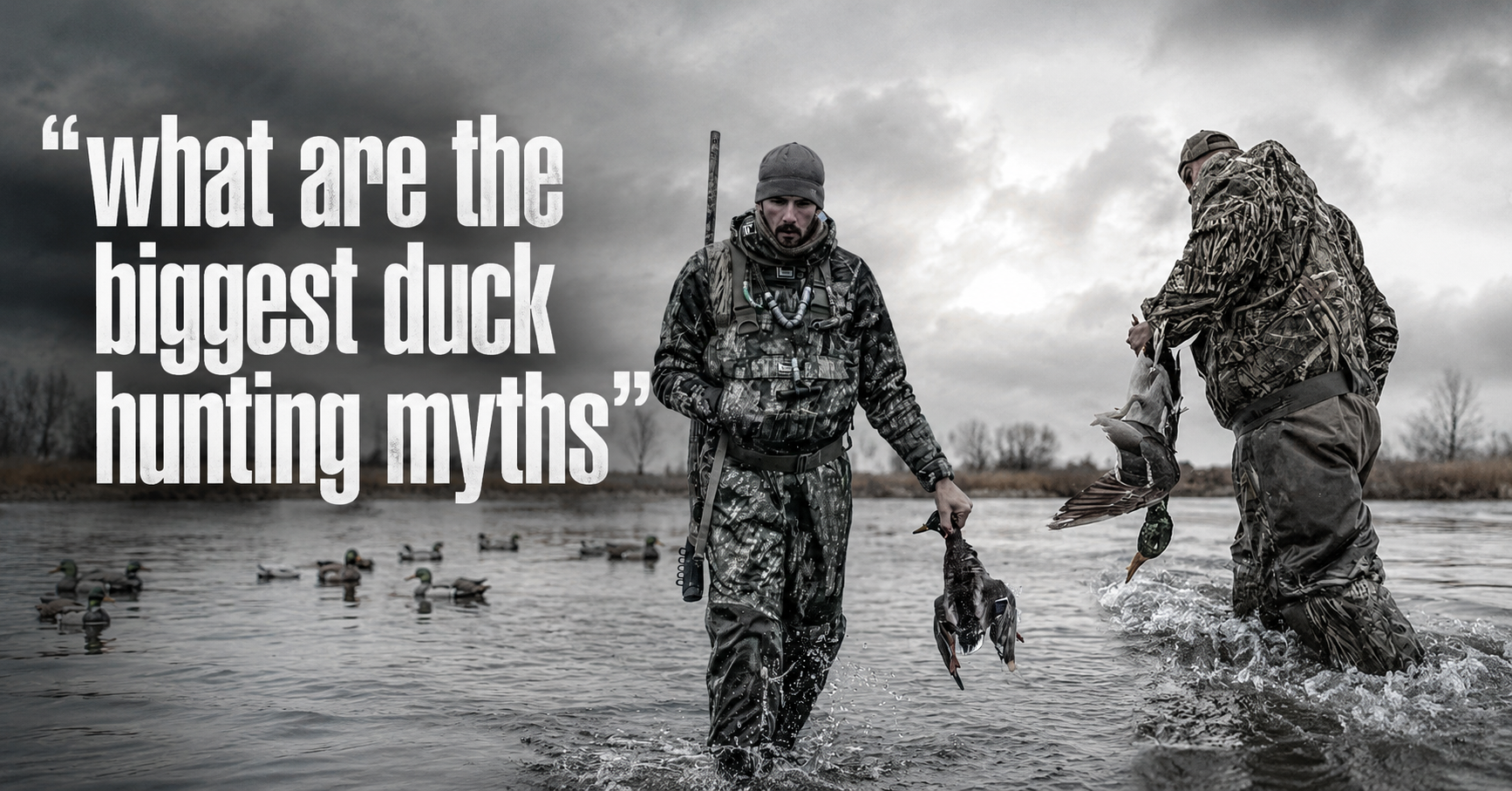

Duck hunting traditions are often passed from one blind to another as absolute rules: wait for a major cold front, use as many decoys as possible, call constantly, choose the tightest choke, and stay home when the sky is clear. Some of that advice may have worked during one hunt, but a single successful morning does not establish a universal rule.
The answer to what are the biggest duck hunting myths involves more than correcting harmless campfire opinions. Some misconceptions waste time or cause birds to flare, while others can lead to wildlife violations, unsafe boating, poor target identification, preventable losses, or improperly handled game meat.
This guide separates common observations from unsupported absolutes. It explains how migration, habitat, hunting pressure, weather, calling, decoys, shotgun performance, federal rules, boat safety, retrievers, and field care actually interact. Local regulations and conditions always override general online guidance.
Quick Answer
The biggest duck hunting myths are that ducks migrate only after severe cold fronts, warm days are useless, bigger decoy spreads are always better, every spread needs a U or J shape, aggressive calling always improves results, expensive camouflage matters more than movement, and one shotgun load works equally well in every firearm. Dangerous legal myths include believing that lead shot is allowed on private water, that HIP and Duck Stamp requirements apply only to public land, or that shallow water makes life jackets unnecessary. Successful and responsible waterfowl hunting depends on current regulations, recent scouting, species identification, adaptable setups, practiced shooting, safe retrieval, and honest evaluation—not one universal trick.
Duck Hunting Myths at a Glance
| Myth | Reality | Practical Response |
|---|---|---|
| Good hunters always shoot a limit | A limit is a legal maximum, not a measurement of safety, ethics, or skill | Judge the hunt by preparation, identification, decisions, recovery, and compliance |
| Ducks migrate only after hard cold fronts | Weather matters, but day length, food, habitat, snow, ice, rainfall, and species biology also influence movement | Use migration reports with recent local scouting |
| Warm, sunny days are not worth hunting | Ducks still feed and move in warm weather, although locations and timing may change | Hunt current food and resting patterns rather than waiting only for cold weather |
| All duck species behave the same way | Dabblers, divers, sea ducks, teal, and woodland ducks use different habitats and vocalizations | Learn the species expected in the hunting area |
| More decoys are always better | Small, realistic spreads can work well in many habitats | Match spread size to bird numbers, water, pressure, transport, and visibility |
| A U or J spread is mandatory | Spread shape should reflect wind, habitat, bird behavior, and safe shooting zones | Create a natural landing area rather than copying one diagram |
| Spinning-wing decoys always help | Bird response varies with species, pressure, light, distance, and local rules | Observe reactions and remove motion when birds flare |
| More calling brings more ducks | Excessive or poorly timed calling can discourage approaching birds | Read the birds and reduce volume as they close |
| Every duck responds to mallard quacks | Waterfowl species use different calls and social sounds | Use species-appropriate sounds or let the decoys work |
| Camouflage pattern is everything | Movement, glare, silhouette, exposed skin, and an unnatural blind outline often matter more | Stay still and match the blind to the immediate background |
| Lead shot is legal on private property | Approved nontoxic shot is required for waterfowl hunting throughout the United States | Carry only legal, compatible nontoxic ammunition |
| A regular hunting license is enough | HIP, Federal Duck Stamp, state stamps, permits, or property authorizations may also be required | Verify every federal, state, and property requirement |
| Private land is exempt from federal methods rules | Federal migratory-bird rules can apply on both public and private property | Review baiting, shotgun-capacity, motorboat, and electronic-call rules |
| Patterning is unnecessary | Different shotgun, choke, and load combinations produce different patterns | Pattern the exact hunting setup at realistic distances |
| The longest shell and tightest choke are best | More recoil or constriction does not guarantee a useful pattern | Select a compatible combination based on tested performance |
| Shallow water makes a PFD unnecessary | Mud, cold, current, waves, injury, and overloaded boats can prevent self-rescue | Wear an appropriate life jacket while boating |
| A trained retriever can handle any conditions | Cold water, heat, current, ice, debris, fatigue, and disease can endanger dogs | Limit retrieves according to the dog and conditions |
| Wild duck always tastes bad | Species, diet, field care, storage, preparation, and cooking method affect flavor | Identify, cool, handle, and cook birds responsibly |
Important Legal and Safety Notice
Waterfowl hunting laws vary by country, state, province, zone, species, season, age, land type, and managed property. In the United States, federal migratory-bird regulations operate alongside state seasons and limits. National wildlife refuges and state-managed wetlands may add reservations, shell limits, blind assignments, boat restrictions, check-in procedures, or closed areas.
Before hunting, verify:
- State hunting license and waterfowl privileges.
- Migratory Bird Harvest Information Program registration.
- Federal Duck Stamp and state stamp requirements.
- Season dates, zones, legal species, and shooting hours.
- Daily limits, possession limits, and species-specific limits.
- Approved nontoxic ammunition.
- Shotgun gauge, capacity, and ammunition restrictions.
- Baiting and agricultural-practice rules.
- Electronic-call and motorized-decoy restrictions.
- Motorboat, sailboat, retrieval, and access rules.
- Public-property permits and private-land permission.
- Transportation, gifting, identification, and reporting requirements.
Four Basic Firearm-Safety Rules
- Treat every firearm as if it is loaded.
- Keep the muzzle pointed in a safe direction.
- Keep your finger outside the trigger guard until ready to shoot.
- Be certain of the target and what lies in front of and beyond it.
Hunter education covers safe firearm handling, wildlife identification, responsible hunting, field care, and landowner relations. Beginners should complete an approved course and seek supervised practice with a qualified instructor or experienced ethical mentor.
What Are the Biggest Duck Hunting Myths?
Myth 1: The Best Duck Hunters Always Shoot Limits
A daily limit is the maximum number of birds a hunter may legally take under the applicable regulations. It is not a score that proves who scouted best, shot best, or behaved most responsibly.
A hunter can reach a limit through favorable migration timing, access to highly productive habitat, or a brief period of excellent conditions. Another hunter may identify birds carefully, pass marginal opportunities, recover every bird, and finish below the limit. The second hunt is not a failure.
Modern myth-focused waterfowl coverage has specifically challenged the assumption that limit totals define the quality of the hunter.
What to Do Instead
- Measure success by legal compliance and safe decisions.
- Identify every bird before firing.
- Stop when a species-specific or daily limit is reached.
- Prioritize prompt recovery.
- Record what the hunt taught you about habitat and movement.
Myth 2: Ducks Migrate Only After a Severe Cold Front
Cold fronts, falling temperatures, snow, and freezing water can cause major movements, but migration is more complicated than one weather event. Day length, food availability, wetland conditions, rainfall, drought, ice, species, age, body condition, and the location of suitable habitat all affect distribution.
Some early migrants respond to subtle seasonal and habitat changes. Larger ducks may remain farther north while open water and food are available. Birds can also move locally between feeding and resting areas without making a major southward migration.
What to Do Instead
- Watch regional weather rather than one local thermometer.
- Monitor snow and ice north of the hunting area.
- Track rainfall and wetland availability.
- Scout immediately before hunting.
- Separate local bird movement from a major migration event.
Myth 3: Warm, Sunny Weather Makes Duck Hunting Pointless
Warm weather may alter duck movement, but it does not stop ducks from feeding, resting, and traveling. Birds may fly earlier, later, less visibly, or over shorter distances. They may concentrate around dependable food, shade, shallow water, springs, moving water, or low-disturbance areas.
Ducks Unlimited notes that warm-weather hunting can remain productive when hunters adapt to current conditions instead of waiting exclusively for cold fronts.
What to Do Instead
- Scout feeding areas close to resting water.
- Look for brief morning or evening movements.
- Use lighter clothing and carry more drinking water.
- Cool harvested birds promptly.
- Do not remain exposed when heat becomes unsafe for hunters or dogs.
Myth 4: All Ducks Behave and Sound Basically the Same
“Duck” is a broad category. Dabbling ducks, diving ducks, sea ducks, woodland species, teal, and whistling ducks differ in habitat, feeding method, flock behavior, flight style, migration timing, and vocalization.
Many hunters focus heavily on mallard calls, but species such as pintails, wigeon, teal, wood ducks, and diving ducks produce different whistles, squeals, grunts, or contact sounds. A mallard hen call may attract attention in some mixed-flock situations, but it is not a universal language.
What to Do Instead
- Study the legal species likely to use the area.
- Learn silhouettes and wing patterns.
- Observe how each species feeds and lands.
- Carry a whistle when it matches local species.
- Do not call when identification remains uncertain.
Myth 5: Bigger Decoy Spreads Are Always Better
Large spreads can provide visibility, imitate large concentrations, and help in broad open water or fields. They also add weight, setup time, boat load, wind resistance, retrieval work, and opportunities for tangled lines.
Small spreads can be more natural on ponds, creeks, timber holes, potholes, and heavily pressured wetlands. Ducks Unlimited provides several examples of effective downsized spreads and notes that hunters do not always need large numbers of decoys.
What to Do Instead
- Match decoy numbers to the birds normally using the location.
- Consider how many decoys can be transported safely.
- Use fewer decoys in tight or heavily pressured water.
- Increase visibility when hunting large open areas.
- Prioritize placement and realism over total quantity.
Myth 6: Every Spread Must Be Shaped Like a U or J
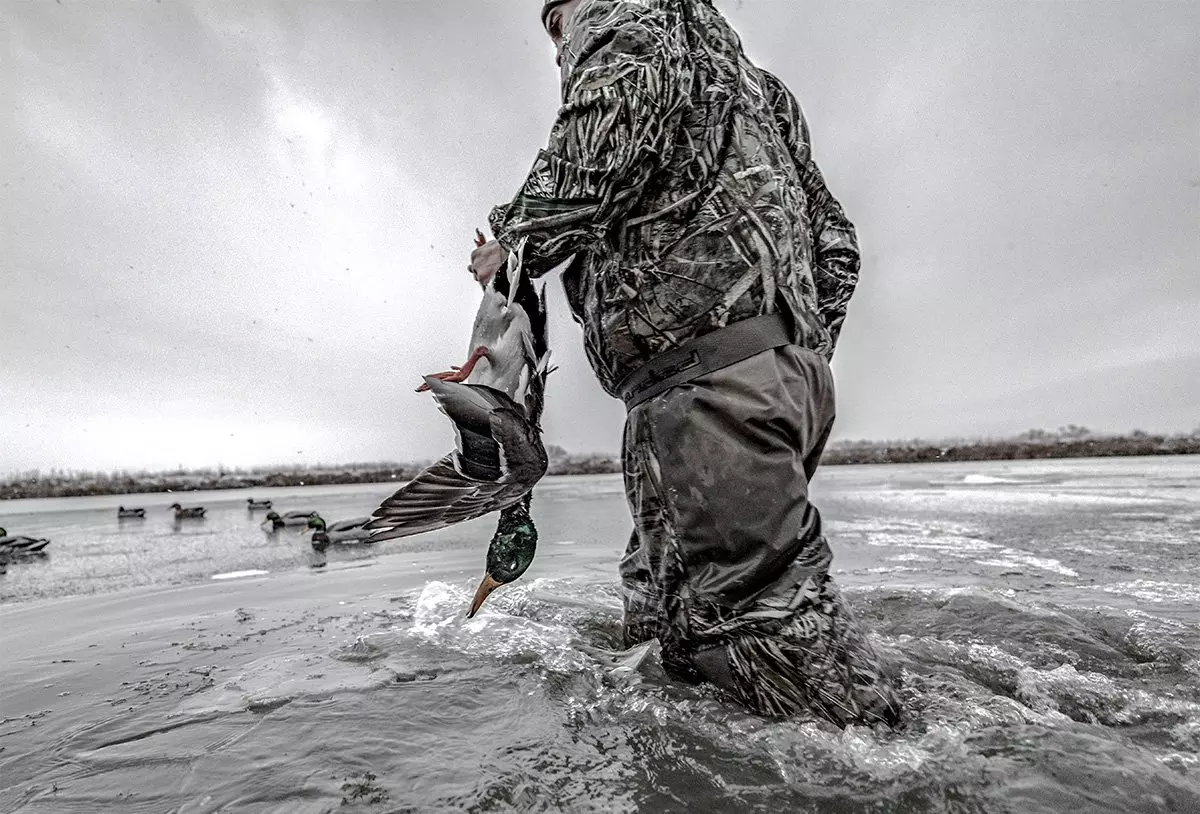
U-, J-, C-, X-, and horseshoe spreads are useful starting concepts, not fixed laws. Wind direction, current, shoreline shape, vegetation, water depth, bird approach, sun position, and the safe zone of fire can make a textbook diagram unsuitable.
Experienced hunters often create an open landing area without forcing the decoys into a sharply defined letter. Even Ducks Unlimited guidance includes multiple spread shapes for different habitats and wind conditions.
What to Do Instead
- Establish safe shooting directions first.
- Use wind and current to predict the landing approach.
- Place the landing space where birds can be identified clearly.
- Watch where real birds try to land.
- Adjust the spread after observing repeated reactions.
Myth 7: Spinning-Wing Decoys Work on Every Hunt
Spinning-wing decoys can attract attention, especially under certain light conditions or with less-pressured birds. They can also cause flaring, particularly when ducks have experienced repeated hunting pressure or when the motion appears unnatural.
Modern discussions of duck-hunting myths commonly reject the idea that a spinner is mandatory on every hunt. Its usefulness varies by species, season phase, weather, distance, hunting pressure, and local legality.
What to Do Instead
- Verify motorized-decoy rules for the state and property.
- Watch the first birds carefully.
- Move, lower, cover, or remove the device when birds flare.
- Do not let the device replace natural decoy placement.
- Carry a nonmotorized motion option where appropriate.
Myth 8: More Calling Always Brings More Ducks
Calling can help birds notice a spread, turn toward the blind, or remain interested. Calling too loudly, too frequently, or at the wrong moment can also make the setup sound unnatural.
One repeated mistake identified by experienced callers is continuing aggressive calling while ducks are already approaching. Duck response should determine whether the hunter calls again, changes volume, or becomes silent.
What to Do Instead
- Call to get attention when necessary.
- Reduce volume as birds approach.
- Stop when birds are committed.
- Use soft single notes for cautious birds.
- Allow silence, decoy movement, and natural marsh sounds to work.
Myth 9: The Best Call Is Always a Loud Mallard Call
A loud mallard call can be useful in wind, over large water, or when distant mallards need to locate the spread. It may be excessive on quiet water or for species that normally communicate with whistles and softer calls.
Different weather, habitat, flock mood, and hunting pressure require different volume and rhythm. Ducks Unlimited calling guidance recommends adjusting to the birds rather than using the same routine throughout the season.
What to Do Instead
- Match call volume to wind and distance.
- Learn one soft call before attempting complex routines.
- Use whistles for species that respond naturally to them.
- Listen to live ducks whenever possible.
- Put the call down when the birds respond negatively.
Myth 10: The Most Expensive Camouflage Pattern Makes Hunters Invisible
Ducks have strong vision, but the exact brand or print on a jacket is only one part of concealment. Movement, exposed faces, shiny equipment, an unnatural blind outline, bright boat interiors, shadows, and poor background matching can reveal hunters.
Waterfowl-biologist guidance emphasizes that hunters can remain highly visible from above when clothing and blind materials do not match the immediate surroundings. Remaining still while birds circle is also critical.
What to Do Instead
- Match the blind to the vegetation at that location.
- Break up straight edges and large dark openings.
- Cover reflective equipment.
- Keep faces and hands concealed appropriately.
- Remain still even when birds appear to be flying away.
Myth 11: Lead Shot Is Legal When Hunting Ducks on Private Land
The nationwide restriction on lead shot for waterfowl hunting is not limited to national wildlife refuges or public marshes. Waterfowl hunters in the United States must possess and use approved nontoxic shot, subject to current federal regulations and any stricter state or property rules.
The nationwide lead-shot ban for waterfowl took effect in 1991, and the U.S. Fish and Wildlife Service maintains the approved nontoxic-shot list.
What to Do Instead
- Separate lead target or upland ammunition from waterfowl loads.
- Verify that the shot material is currently approved.
- Confirm that the barrel and choke are compatible with the load.
- Check whether the property requires nontoxic shot for additional species.
- Inspect every shell before placing it in a blind bag.
Myth 12: A Basic Hunting License Is All You Need
A state hunting license may be only one part of the legal requirements. Waterfowl hunters may also need HIP registration, a Federal Duck Stamp, a state migratory-bird or waterfowl stamp, a property permit, a reservation, or proof of hunter education.
U.S. Fish and Wildlife Service guidance states that hunters must enroll in HIP unless exempt under the applicable state rules, and hunters age 16 or older generally must possess a valid Federal Duck Stamp.
What to Do Instead
- Check both federal and state requirements.
- Complete HIP in every state where required.
- Validate or carry the Duck Stamp as current instructions require.
- Review managed-property permits separately.
- Keep accepted proof accessible while hunting.
Myth 13: Federal Hunting-Method Rules Do Not Matter on Private Land
Federal migratory-bird restrictions can apply regardless of whether the wetland is publicly or privately owned. Private ownership does not automatically permit baiting, unplugged shotguns, electronic calls, or shooting from a moving motorboat.
Federal guidance prohibits hunting migratory game birds over baited areas when the hunter knows or reasonably should know the area is baited. It also generally restricts shotguns to three shells and limits hunting from boats under power or resulting forward motion.
What to Do Instead
- Ask how grain or seed reached a flooded field.
- Install a compliant shotgun plug when required.
- Verify motorboat and sailboat rules.
- Check restrictions on recorded or electronic calls.
- Contact a conservation officer when the legality of a site is unclear.
Myth 14: You Do Not Need to Pattern a Waterfowl Shotgun
A shotgun does not distribute pellets identically with every load and choke. Point of impact, pattern density, gaps, ammunition lot, barrel, shot material, constriction, and distance all affect performance.
Patterning guidance recommends testing more than one shot with each gun, choke, and load combination because individual patterns vary.
What to Do Instead
- Use a safe range and suitable backstop.
- Wear eye and hearing protection.
- Test the exact hunting load.
- Fire multiple patterns at realistic distances.
- Confirm that the pattern centers where the shotgun points.
- Select a conservative personal range based on demonstrated results.
Myth 15: The Longest Shell and Tightest Choke Are Always Better
A longer shell can carry a larger payload, but it may also increase recoil, slow recovery between shots, and encourage flinching. A tighter choke may produce a denser pattern at one distance while creating a small, unforgiving pattern at another.
Choke-and-load performance depends on the exact hunting situation. More open constrictions may be suitable for close timber or teal, while tighter combinations may be appropriate for longer opportunities only after pattern testing.
What to Do Instead
- Use only shell lengths approved for the chamber.
- Verify choke compatibility with the shot material.
- Choose recoil that allows accurate practice.
- Match pattern width to expected distance.
- Do not use ammunition marketing as an ethical-range guarantee.
Myth 16: Shallow Water Makes a Life Jacket Unnecessary
Shallow water can still be dangerous. A hunter may fall into a channel, become trapped in mud, strike the boat, lose consciousness, suffer cold shock, or be unable to stand because of waves, current, injury, vegetation, or heavy clothing.
The U.S. Coast Guard advises boaters to wear an approved, properly fitted life jacket. A life jacket supplies buoyancy when fatigue, injury, or cold prevents a person from staying afloat.
What to Do Instead
- Wear a suitable life jacket while the boat is underway.
- Count hunters, dogs, decoys, fuel, batteries, motors, and gear in the total load.
- Stay within the boat’s capacity plate.
- Distribute weight evenly and low.
- Case and unload firearms during hazardous travel.
- Carry communication and emergency equipment in waterproof storage.
Myth 17: A Good Retriever Can Safely Handle Any Water
Training does not make a dog immune to cold water, heat, current, ice, waves, submerged debris, harmful algae, exhaustion, poor visibility, or illness. A driven retriever may continue working after conditions have become unsafe.
Current research has also found evidence of H5N1 exposure in some hunting dogs with wild-bird contact, reinforcing the need to avoid visibly sick or dead birds and follow veterinary and public-health advice.
What to Do Instead
- Condition the dog before the season.
- Carry clean drinking water.
- Use a properly fitted canine flotation aid when conditions warrant.
- Limit retrieves during heat, cold, current, or ice.
- Keep the dog behind the muzzle line.
- Contact a veterinarian after unusual exposure or illness.
Myth 18: Wild Duck Always Tastes Muddy, Fishy, or Tough
Wild ducks differ by species, age, diet, habitat, field care, storage, and preparation. Diving ducks feeding in marine or fish-rich environments may taste different from grain-fed dabblers, but no single description applies to every bird.
Poor cooling, contamination, freezer damage, overcooking, or leaving strong-tasting fat and skin in a preparation where they are unsuitable can affect flavor. Wild duck breast meat is naturally darker than domestic chicken because ducks use their flight muscles extensively.
What to Do Instead
- Identify each species before processing.
- Keep birds clean and cool them promptly.
- Separate raw birds from food and clean equipment.
- Trim or retain skin and fat according to species and recipe.
- Use a food thermometer and official safety guidance.
- Do not handle birds that appeared sick or were found dead.
The CDC advises hunters to use appropriate precautions when handling wild birds because birds can carry avian influenza without appearing sick. USDA guidance recommends cooking duck and other poultry to a safe minimum internal temperature of 165°F as measured with a food thermometer.
Myth Versus Variable: Why Duck Hunting Advice Conflicts
Many duck-hunting arguments occur because hunters mistake a variable for a rule. A tactic may work under one combination of habitat, species, weather, migration stage, hunting pressure, wind, and water level but fail when one of those conditions changes.
Species
Mallards in flooded timber do not necessarily respond like scaup on open water, teal in a shallow marsh, or wood ducks along a creek. Advice that omits the species may be incomplete.
Hunting Pressure
Recently arrived birds may respond differently from ducks that have encountered blinds, calling, boats, and decoys repeatedly. Research summaries note that frequent disturbance can reduce the hunting quality of otherwise productive water.
Scale of the Water
Six decoys may be highly visible on a small pond and almost invisible on a large bay. A blind that disappears against cattails can stand out on an open mudflat.
Wind and Weather
Wind affects flight paths, decoy movement, sound, boat safety, and the direction birds prefer to land. Weather may change bird distribution without producing a continent-wide migration.
Available Food and Water
Ducks may remain farther north or move to another local wetland while food and open water remain available. Flooding, drought, harvest, ice, and habitat disturbance can change distribution quickly.
How to Evaluate Duck Hunting Advice
- Ask where it worked. A timber tactic may not transfer to open coastal water.
- Ask which species were present. “Ducks” is often too broad.
- Ask when it worked. Early-season and late-season birds may respond differently.
- Check the wind and weather. A setup can succeed because of conditions rather than the decoy shape.
- Consider hunting pressure. Birds with different experience may react differently.
- Separate observation from proof. One hunt shows what happened once.
- Verify legal claims officially. Regulations are not matters of opinion.
- Test equipment safely. Patterning and practice are more reliable than advertising.
- Watch the birds. Their reactions provide better feedback than blind loyalty to a tactic.
- Keep notes. Long-term records reveal patterns more clearly than memory.
What Not to Do While Duck Hunting
- Do not hunt without current licenses, stamps, HIP registration, and permits.
- Do not possess or use unapproved shot while hunting waterfowl.
- Do not hunt a site that may be illegally baited.
- Do not fire at an unidentified bird or mixed flock.
- Do not shoot toward people, dogs, boats, roads, buildings, livestock, or uncertain cover.
- Do not allow hunters’ muzzle zones to overlap.
- Do not use a shotgun that exceeds applicable capacity restrictions.
- Do not fire from a powered or moving boat contrary to federal or local rules.
- Do not overload a boat with hunters, dogs, decoys, motors, batteries, and gear.
- Do not treat waders as flotation equipment.
- Do not enter unfamiliar current, deep channels, unstable mud, or unsafe ice.
- Do not force a dog into dangerous water.
- Do not continue during lightning, high wind, dangerous cold, severe heat, or poor visibility.
- Do not abandon a reasonable legal recovery effort.
- Do not allow game birds to remain warm or contaminated unnecessarily.
Troubleshooting Myth-Based Duck Hunting Problems
| Problem | Possible Myth Behind It | What to Check | Better Response |
|---|---|---|---|
| No ducks are using the spread | More decoys automatically create success | Recent bird use, location, wind, food, and disturbance | Scout before adding equipment |
| Ducks circle but do not finish | The spread must remain in one fixed shape | Landing space, glare, blind outline, motion, and wind | Make one small change and observe the next flock |
| Birds flare when close | Camouflage pattern alone hides hunters | Movement, faces, boat interior, dog, shadows, and reflective gear | Improve concealment and remain still |
| Birds turn away after calling | More calling is always better | Timing, volume, species, and flock reaction | Reduce calling or stop completely |
| Warm weather produces little movement | Ducks simply do not move when warm | Local feeding times, nearby resting water, and pressure | Scout closer to current food and shorten the hunt window |
| A cold front produces no new ducks | Every front creates a major migration | Snow, ice, habitat north of the area, front strength, and species | Use local observations rather than the forecast alone |
| Shotgun results are inconsistent | All legal loads work equally well | Pattern, point of impact, choke, load, and firearm fit | Pattern several compatible combinations safely |
| Recoil causes flinching | Longer, heavier shells are always superior | Gun fit, load, action type, posture, and practice | Use a manageable compatible load that patterns well |
| The boat feels unstable | Flat-bottomed or shallow-water boats cannot capsize | Total load, weight distribution, wind, waves, and water intrusion | Return to shore and correct the load |
| The dog becomes exhausted | A trained retriever always knows when to stop | Water temperature, current, heat, distance, and conditioning | End retrieves and protect the dog |
| Duck meat tastes unusually strong | All wild duck naturally tastes bad | Species, diet, cooling, fat, freezer storage, and preparation | Improve field care and use a suitable recipe |
| Regulations seem contradictory | One online summary applies everywhere | Federal, state, zone, and property-specific rules | Contact the wildlife agency or land manager |
Ethical Hunting and Conservation
Responsible waterfowl hunting requires more than avoiding citations. Hunters should identify birds accurately, take only controlled opportunities within their demonstrated ability, retrieve birds promptly, prevent waste, respect refuge and sanctuary areas, and participate honestly in harvest surveys.
HIP and federal harvest surveys provide information used by wildlife managers to estimate hunting activity and species-specific harvest. Duck Stamp revenue supports wetland habitat conservation.
- Learn waterfowl identification before the season.
- Keep an accurate count by species.
- Stop when any applicable limit is reached.
- Plan retrieval before firing.
- Use trained dogs only within safe conditions.
- Report bands through the official system.
- Remove shells, line, batteries, blind material, and other litter.
- Avoid unnecessary disturbance of resting birds.
- Respect private property and managed-area closures.
- Handle harvested birds carefully and use edible meat responsibly.
FAQs
1. What is the biggest duck hunting myth?
One of the most consequential myths is that one tactic works everywhere. Duck behavior changes with species, habitat, weather, migration, food, and hunting pressure.
2. Do ducks migrate only during cold fronts?
No. Cold fronts can trigger movement, but day length, snow, ice, food, rainfall, wetland conditions, and species biology also influence migration.
3. Do all ducks migrate south for winter?
No. Migration distances vary among species and populations. Some ducks remain year-round where suitable food and open water are available.
4. Does one cold night cause every duck to leave?
No. Some birds move, while others remain if water and food stay accessible. Species and regional conditions matter.
5. Is duck hunting bad during warm weather?
Not necessarily. Ducks still feed and travel, but movements may be shorter or occur during narrower periods.
6. Are cloudy days always better than sunny days?
No. Cloud cover affects visibility and concealment, but wind, bird numbers, pressure, food, and location may matter more.
7. Is wind required for duck hunting?
Wind can create decoy motion and predictable landing approaches, but ducks can still be hunted on calm days with adjusted concealment and spread placement.
8. Do ducks always land into the wind?
They often prefer to, but terrain, obstacles, flock position, current, and local conditions can produce other approaches.
9. Do I need dozens of decoys?
No. Small spreads can be effective on ponds, creeks, timber holes, potholes, and pressured wetlands.
10. Are expensive decoys necessary?
No. Visibility, natural placement, condition, movement, and location are usually more important than price.
11. Must a decoy spread form a J?
No. The shape should create a safe and natural landing area under the current wind, water, and habitat conditions.
12. Do spinning-wing decoys always work?
No. Some ducks respond positively, while pressured birds may avoid them. Regulations also vary.
13. Is calling always necessary?
No. Birds may enter a well-positioned spread without calling. Calling is most useful when it improves the birds’ response.
14. Can calling too much scare ducks?
Yes. Excessive volume or poor timing can cause approaching birds to turn away.
15. Should I call when ducks are already committed?
Usually not. Continued calling can create unnecessary risk when birds are already approaching naturally.
16. Do all ducks quack?
No. Duck species use a range of whistles, grunts, squeals, growls, and other vocalizations.
17. Will a mallard call attract every duck species?
It may gain attention in some situations, but species-appropriate calls or silence may be more realistic.
18. Is camouflage more important than staying still?
No. A good pattern cannot hide sudden movement, exposed skin, glare, or an unnatural blind outline.
19. Can ducks see color?
Waterfowl have highly developed vision. Hunters should control contrast, reflection, silhouette, and movement rather than relying on color pattern alone.
20. Is face paint required?
No. A face covering, blind shadow, or suitable concealment can work. Whatever method is used should not interfere with vision, communication, or safe firearm handling.
21. Is lead shot legal for ducks on private land?
No. Approved nontoxic shot is required for waterfowl hunting throughout the United States.
22. Do I need HIP on private land?
Private ownership does not normally remove HIP requirements. Verify the current state and federal exemptions.
23. Do I need a Federal Duck Stamp on private land?
Hunters age 16 or older generally need one in the United States regardless of public or private ownership, subject to current exemptions.
24. Can my shotgun hold more than three shells?
Federal migratory-bird rules generally require the shotgun to be limited to three shells unless a specific exception applies. Property rules may be stricter.
25. Are electronic calls legal for ducks?
Recorded or electronically amplified calls are generally prohibited for migratory-game-bird hunting, subject to limited exceptions. Check current rules.
26. Can I hunt from a motorboat?
Rules generally require the motor to be shut off and resulting forward movement to stop before hunting. Verify federal, state, and property requirements.
27. Is patterning really necessary?
Yes. Different firearms, loads, and chokes can produce substantially different patterns and points of impact.
28. Is a full choke always best for ducks?
No. The best constriction depends on distance, species, load, shot material, and actual pattern testing.
29. Are 3½-inch shells always better?
No. They can increase payload and recoil but do not guarantee better patterns or shooting.
30. Is faster ammunition always better?
No. Velocity is only one factor. Pellet size, material, pattern density, recoil, and firearm compatibility also matter.
31. Can I use steel through every shotgun and choke?
No. Follow the firearm and choke manufacturers’ compatibility instructions, especially with older barrels or tight constrictions.
32. Are flat-bottomed boats impossible to tip?
No. Any boat can capsize when overloaded, poorly balanced, struck by waves, operated improperly, or affected by sudden movement.
33. Do I need a life jacket in knee-deep water?
A life jacket is still important while boating. Mud, channels, current, cold, injury, and heavy clothing can make apparently shallow water dangerous.
34. Will waders pull me underwater?
Water-filled waders can impair movement, but the larger safety issue is relying on them instead of a properly fitted life jacket and safe wading practices.
35. Can a retriever work all day in cold water?
Not safely in every condition. Monitor temperature, fatigue, current, wind, ice, and the dog’s physical condition.
36. Do duck dogs naturally know how to retrieve?
Breed tendencies can help, but dependable retrieving, steadiness, recall, and safe blind behavior require training and conditioning.
37. Is public-land duck hunting always overcrowded?
No. Pressure varies by property, day, access, weather, and habitat. Maps, scouting, backup locations, and respectful spacing can improve public-land experiences.
38. Do ducks become impossible to hunt late in the season?
No. Pressured birds may require better concealment, different timing, quieter calling, realistic spreads, or less-disturbed locations.
39. Does resting a wetland improve hunting?
It can. Repeated disturbance may cause ducks to shift their resting and feeding activity to quieter areas.
40. Does wild duck always taste gamey?
No. Species, diet, field care, fat, storage, cooking method, and personal preference all affect flavor.
Final Answer
The answer to what are the biggest duck hunting myths is that most myths turn a useful observation into an absolute rule. Cold fronts can move ducks, large spreads can attract attention, aggressive calling can work, and tight chokes can produce dense patterns—but none of those choices is correct in every habitat, season, species, or weather condition.
The most dangerous misconceptions involve laws and safety. Lead shot is not permitted for waterfowl hunting in the United States, private land does not eliminate federal migratory-bird rules, and a basic license may not satisfy HIP, Duck Stamp, state stamp, or property requirements. Shallow water does not make boats harmless, waders do not replace life jackets, and a trained dog should not be sent into unsafe conditions.
Use recent scouting, identify every bird, adjust calling and decoys according to observed reactions, pattern the exact shotgun setup, establish safe zones of fire, wear appropriate flotation, recover birds responsibly, and handle meat carefully. Official regulations and manufacturer instructions always override general hunting advice.
Read more: