
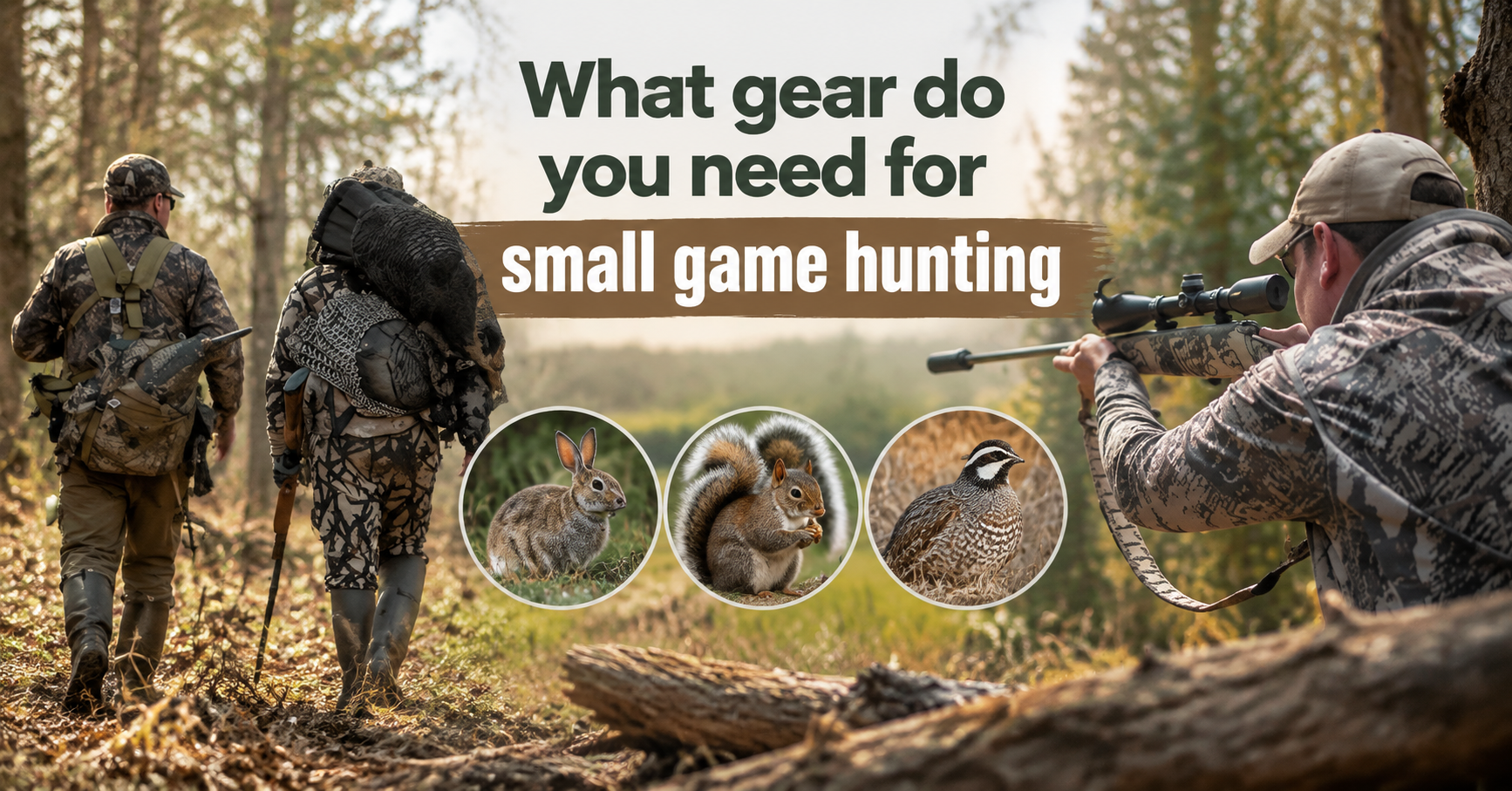

A morning looking for squirrels in open woodland calls for a different setup from walking thorny rabbit cover or following a dog through upland bird habitat. The useful starting point is a compact kit that supports your chosen species, keeps you prepared outdoors, and lets you recover and care for game responsibly.
This guide answers “what gear do you need for small game hunting” by separating core equipment from optional extras. It focuses on rabbits, hares, squirrels, and commonly hunted upland birds, primarily in the United States. Legal classifications, permitted equipment, and clothing requirements vary by location.
Quick Answer
What gear do you need for small game hunting? Bring required hunting documents, a lawful hunting implement with compatible ammunition or arrows, suitable footwear and clothing, visibility garments where required, and hearing and eye protection for firearm use. Carry water, food, navigation, communication, a headlamp, first aid, and weather protection in a comfortable vest or small pack. Add protective gloves, a safely carried knife, suitable game storage, and a cooling plan. Binoculars, brush chaps, calls, and dog equipment depend on the hunt; check current regulations and practice with your equipment before going afield.
Before Packing: Identify the Species and Check Its Rules
Official guidance reviewed September 7, 2026. “Small game” is not one nationwide legal category. An animal’s size does not establish that it is huntable, and equipment allowed for one species may be prohibited for another.
For example, New York distinguishes among species when regulating rifles, air guns, and other hunting methods. Those rules illustrate why a general small-game equipment list cannot establish legality for your destination. [New York DEC small-game hunting regulations](https://dec.ny.gov/things-to-do/hunting/small-game).
- Identify the exact species. Check protected look-alikes and any sex or identification requirements.
- Select the location and date. Verify the state, wildlife unit, property, season, and legal hours.
- Check participation requirements. Confirm licenses, hunter education, permits, registrations, and applicable youth or supervision rules.
- Check your equipment. Verify permitted hunting methods, ammunition restrictions, visibility clothing, and dog rules.
- Confirm access and recovery. Obtain permission and check boundaries, closures, transport rules, and reporting requirements.
Migratory birds can have additional requirements beyond those for rabbits or squirrels. Do not assume that a license covering one species authorizes every animal encountered during the same walk. Recheck the current official regulations immediately before your hunt.
What Gear Do You Need for Small Game Hunting? Core Equipment Table
| Equipment Group | What to Bring | Priority | Main Check |
|---|---|---|---|
| 1. Documents and access information | Required licenses, identification, permits, permission details, and saved regulations | Required as applicable | Correct species, location, date, and accepted document format |
| 2. Hunting implement and compatible supplies | Lawful firearm or archery equipment, suitable ammunition or arrows, and transport protection | Essential for the chosen method | Compatibility, fit, condition, and demonstrated proficiency |
| 3. Visibility and protective equipment | Appropriate visibility clothing, protective eyewear, and hearing protection for shooting | Safety priority; clothing rules vary | Visibility remains unobstructed by your pack or outer layers |
| 4. Footwear and clothing | Suitable boots, socks, adjustable layers, and weather protection | Essential | Walking terrain, brush, temperature, and precipitation |
| 5. Carrying system | Comfortable daypack, hunting vest, or combination | Practical necessity | Room for supplies and game without interfering with movement |
| 6. Navigation, communication, and lighting | Offline maps, navigation backup, phone, headlamp, and appropriate spare power | Essential field preparation | Coverage, battery condition, route knowledge, and return plan |
| 7. Water, food, first aid, and emergency protection | Drinking water, snacks, personal medication, first-aid supplies, and emergency shelter | Essential | Trip duration, conditions, and possible delays |
| 8. Recovery and hygiene tools | Protective gloves, safely stored knife, hand-cleaning supplies, and suitable game carrier | Essential for a harvest-oriented hunt | Clean handling, safe access, and species identification requirements |
| 9. Cooling and transport supplies | Cooler, cooling material, clean containers, and labels where needed | Essential harvest plan | Time to refrigeration and lawful transport |
Build a Kit You Can Walk With Comfortably
Documents Belong Somewhere Accessible and Dry
Carry required documents in a form accepted by the responsible agency. Protect paper copies from moisture, and download reference material before losing reception. A photograph of a license is not automatically an accepted substitute for the required document.
Save the landowner or property-office contact, permitted entry points, and your planned route. Keep emergency information separate from material that requires an internet connection to open.
Choose a Hunting Method Before Buying Accessories
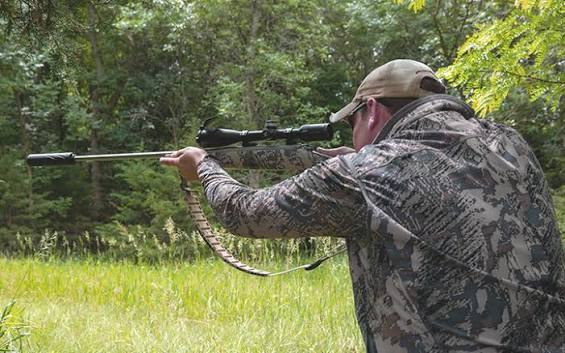
For some lawful squirrel or rabbit hunts, hunters use a rimfire rifle; shotguns are another common small-game option and are widely associated with upland bird hunting. Air guns and archery equipment may be permitted for particular species in particular jurisdictions. These are equipment categories to investigate, not universal recommendations.
Choose around the legal species, terrain, available safe shot opportunities, equipment fit, and your ability. Consider manageable recoil, dependable operation, practice opportunities, and the cost and availability of suitable ammunition. Small game still requires precise, humane decisions.
- Rifle: Confirm the exact cartridge and rifle are suitable and lawful. A small cartridge still requires a safe projectile path and backstop.
- Shotgun: Confirm gauge, chamber, load, and choke compatibility. Pattern the actual combination before hunting.
- Air gun: Verify legality and hunting suitability. Do not assume that a recreational air gun is adequate for humane harvest.
- Bow or crossbow: Use compatible arrows and legal points, inspect components, and practice within your demonstrated limits. Never dry-fire the equipment.
Do not select ammunition from a generic pellet-size or caliber recommendation alone. Follow manufacturer instructions and species-specific regulations, including any nonlead requirements. If compatibility is unclear, consult the manufacturer or a qualified professional.
Use a suitable case or protective carrier for transport and follow applicable transport and secure-storage rules. Keep different ammunition types clearly separated to reduce mix-ups.
Prioritize Visibility, Hearing, and Eye Protection
Choose hunter-orange or other legally specified visibility garments according to your destination’s requirements. Check the required color, coverage, placement, and any season-dependent exceptions. Make sure a backpack or rain jacket does not conceal the required visible area.
For firearm hunting, use hearing protection and protective eyewear that fit with your hat and clothing. Electronic hearing protection is an optional convenience; ordinary earbuds are not automatically protective equipment.
Check that gloves permit safe handling without crowding the trigger guard. If you cannot maintain control with the clothing you plan to wear, change the setup before hunting.
Match Boots and Layers to Walking Conditions
Footwear should fit your intended socks and provide traction for the route. Dry woodland, thorny edges, snow, and saturated grass create different demands. Waterproof construction can help with wet conditions, while breathability and comfort become especially important during prolonged walking.
Use layers you can adjust as activity changes. Avoid becoming heavily perspired during a brisk walk and then sitting in damp clothing. Carry a weather shell and additional insulation appropriate to the forecast and potential delays.
Brush pants, chaps, and gaiters are conditional extras. They may help with vegetation or debris, but ordinary boots and brush clothing should not be described as snake-proof or impact-protective without documented ratings.
Pick the Vest or Pack After Laying Out Your Supplies
A hunting vest can keep frequently used items accessible and may include a game compartment. A small backpack often provides more room for water, layers, and emergency equipment. Choose the arrangement that fits your actual load rather than a fixed pack-capacity recommendation.
Try it while walking, bending, and wearing your hunting clothing. Straps should not interfere with safe firearm handling or an unobstructed shooting position. Keep raw game separate from food, drinking equipment, and clean clothing.
A large game pocket is not refrigeration. Plan how harvested animals will cool rather than leaving them compressed against your body throughout a long outing.
Adjust the Kit for Rabbits, Squirrels, or Upland Birds
| Hunt Type | Useful Additions | What Can Often Wait | Special Consideration |
|---|---|---|---|
| Woodland squirrels | Compact binoculars, a light seat pad if sitting, and suitable game storage | Specialized calls and elaborate concealment equipment | Never assume foliage or open sky provides a safe rifle backstop |
| Rabbits in brush | Brush-resistant clothing, protective gloves, and an accessible carrier | Heavy optics and large packs for a short local route | Dense vegetation can hide people, dogs, and unsafe backgrounds |
| Hares in cold or remote country | Extra insulation, traction appropriate to the route, and stronger navigation backups | Convenience items that displace emergency supplies | Distance and weather can matter more than the animal’s size |
| Upland birds | Comfortable walking vest, eye protection, additional water, and bird-identification reference | A personal dog or specialized electronics for an initial mentored hunt | Know companion positions and distinguish legal birds from protected species |
| Migratory birds included in a mixed outing | Required registrations or permits, suitable lawful ammunition, and identification information | Equipment bought before checking the species rules | Additional federal and state requirements may apply |
A dog can assist some rabbit and upland hunts, but owning one is not a prerequisite for every small-game outing. If bringing a dog, carry water, a leash, identification, and appropriate canine first-aid supplies. Confirm dog-use rules and discuss conditioning, parasite prevention, and weather exposure with your veterinarian.
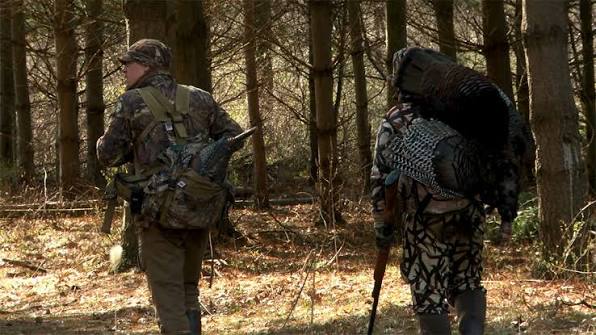
Binoculars can help identify wildlife without pointing a firearm at it. Calls, rangefinders, shooting supports, and specialized camouflage are optional tools whose usefulness depends on the method. None replaces appropriate access, observation, practice, or restraint.
Navigation and Emergency Supplies Still Matter Close to Home
A familiar trail can look different after following game, moving through dense vegetation, or encountering a closed route. Download maps, mark your entry point, and carry a navigation backup you know how to use. Property boundaries displayed by an app should be checked against permission and official information.
Bring a charged phone and suitable spare power. Where mobile coverage is unreliable, assess whether a satellite communicator is appropriate. Share your destination, route, companions, expected return time, and overdue plan with someone staying behind.
Carry a headlamp even when planning to finish before dark. Add drinking water, extra food, personal medication, first aid, and emergency protection against the weather. The National Park Service’s Ten Essentials provides a useful outdoor-preparation framework that can be adapted to a hunting route; it does not establish permission to hunt on park land. [National Park Service Ten Essentials](https://www.nps.gov/articles/10essentials.htm).
A compact first-aid kit should include supplies relevant to your training and foreseeable problems, such as cuts and blisters. Keep critical items accessible. Do not remove essential supplies simply because the intended quarry is small.
Pack for Ticks, Clean Handling, and Prompt Cooling
Tick Protection Belongs in the Clothing Plan
Brush and leaf litter can expose hunters to ticks. Use an EPA-registered repellent according to its label, consider appropriately treated clothing, and check your body, clothing, equipment, and dogs after the outing.
Permethrin products intended for clothing and gear must be used as labeled, not applied directly to skin. Pack fine-tipped tweezers and learn proper tick removal before the trip. [CDC tick-bite prevention guidance](https://www.cdc.gov/ticks/prevention/index.html), [CDC guidance on permethrin use](https://wwwnc.cdc.gov/travel/page/avoid-bug-bites).
Use Gloves When Handling Rabbits and Other Game
Carry several pairs of disposable protective gloves rather than relying on one pair. CDC recommends gloves when handling animals, particularly rabbits and rodents, to help reduce tularemia exposure. Avoid touching your face while handling game and clean your hands and tools afterward. [CDC tularemia prevention guidance](https://www.cdc.gov/tularemia/prevention/index.html).
Do not collect found-dead animals for food or harvest animals that appear sick. Contact the wildlife agency about unusual illness or mortality. Gloves reduce some exposure risks but do not make an unhealthy animal safe to handle or eat.
If hunting birds, check current bird-flu advisories and carry the protective equipment recommended for dressing game, including respiratory and eye protection where advised. [CDC guidance for hunters handling wild birds](https://www.cdc.gov/bird-flu/risk-factors/hunters-and-bird-flu.html).
Keep the Cleaning Kit Small and Controlled
A manageable knife with a secure sheath or appropriate locking design is generally more useful than a large collection of cutting tools. Add hand-cleaning supplies and clean containers suited to your game-care plan. Follow local knife rules and cut away from your body on a stable surface.
Before processing, check whether identifying parts must remain attached and whether labeling, tagging, or possession records are required. A mentor or hunter-education workshop can help you learn species-appropriate field care without unnecessary waste.
Have Cooling Ready Before the First Harvest
Arrange a cooler and adequate cooling material before leaving. Keep meat clean, cool it promptly, and separate raw game from ready-to-eat food. Breathable game bags can assist clean carrying, but they do not provide refrigeration.
For rabbit, USDA recommends refrigeration at 40°F or below and cooking to an internal temperature of at least 160°F, checked with a food thermometer. That rabbit guidance should not be treated as a universal temperature for every small-game species. [USDA rabbit handling and cooking guidance](https://www.fsis.usda.gov/food-safety/safe-food-handling-and-preparation/meat-fish/rabbit-farm-table).
Never use cooking as a reason to keep spoiled or improperly handled meat. Shorten the outing when conditions prevent adequate cooling or when you cannot responsibly care for additional game.
Small-Game Safety: The Background Matters as Much as the Target
- Treat every firearm as if it is loaded.
- Keep the muzzle pointed in a safe direction.
- Keep your finger outside the trigger guard until ready to shoot.
- Be certain of the target and what is beyond it.
A squirrel above you does not make an upward rifle shot safe. Open sky, leaves, and an assumed tree trunk are not reliable substitutes for evaluating the projectile’s path and a safe backstop. Pass on shots when you cannot establish what lies beyond the target. [Hunter Ed guidance on safe backstops](https://www.hunter-ed.com/national/studyGuide/Importance-of-Safe-Backstops/201099_93174/).
For moving rabbits or flushing birds, know where companions, dogs, roads, buildings, and other land users are located. Agree on safe shooting directions before starting. Do not fire at movement obscured by brush or swing through another hunter’s position.
Unload before crossing obstacles or handling equipment in ways that compromise control. Follow manufacturer instructions for checking chamber status, and remember that a mechanical safety does not replace safe handling.
Mark where an animal was last seen, communicate before anyone retrieves, and make reasonable legal recovery efforts. Obtain permission before crossing property boundaries. Stop when visibility, weather, fatigue, or unfamiliar conditions prevent sound decisions.
What Can You Leave Off a Beginner Shopping List?
You do not need the most expensive equipment to hunt responsibly. Choose gear based on the species, terrain, weather, local regulations, fit, safety, reliability, maintenance requirements, and your actual experience.
- Specialized camouflage: Suitable existing outdoor clothing may work, provided visibility requirements and conditions are addressed.
- Multiple optics: Begin with the observation and sighting equipment your method actually needs.
- Electronic calls: They are unnecessary for many outings and require separate legal checks.
- A large knife or saw: Add tools only when your planned processing method requires them.
- A large-capacity pack: Choose around your laid-out supplies, clothing, water, and anticipated game.
- A new hunting dog: Join a mentored hunt before making a long-term animal-care commitment.
Borrow suitable nonregulated gear where practical and try it on a short walk before hunting. Keep essential emergency supplies; reduce duplicate accessories and convenience items first.
Common Gear Problems and Practical Fixes
| Problem | What to Check | Practical Response |
|---|---|---|
| Pack interferes with firearm handling | Shoulder straps, loose webbing, and load placement | Adjust or change the carrying system before hunting |
| Feet become sore early | Boot fit, socks, moisture, and unfamiliar footwear | Address discomfort promptly and shorten the route if necessary |
| Visibility clothing disappears beneath layers | Rainwear and pack coverage | Reconfigure clothing to meet the applicable requirement |
| Phone map will not load | Missing offline download or insufficient power | Use the prepared navigation backup; do not continue into uncertainty |
| Game compartment becomes warm and crowded | Time since harvest and available cooling | Return for proper cooling rather than extending the hunt |
| Gloves interfere with controls | Bulk, fit, and restricted hand movement | Choose suitable gloves and verify safe handling before departure |
| Equipment gets wet or muddy | Protective storage, moving parts, and manufacturer care instructions | Clean and dry appropriately; stop using unreliable equipment |
Before Leaving, Before Hunting, and After Returning
Before Leaving Home
- Confirm species identification, current regulations, permission, and weather.
- Inspect hunting equipment and verify compatible supplies.
- Pack required documents, visibility clothing, protective equipment, and suitable layers.
- Check water, food, lighting, maps, communication, and first aid.
- Prepare recovery gloves, cleaning supplies, game storage, and a cooler.
- Share the trip plan and expected return time.
At the Access Point
- Confirm the route, boundaries, and turnaround time.
- Check pack fit, visible clothing, footwear, and accessible emergency supplies.
- Review safe shooting directions and companion or dog positions.
- Confirm that recovery will be possible without unsafe or unauthorized access.
After the Hunt
- Unload, check, transport, and secure hunting equipment appropriately.
- Complete required harvest records and care for game promptly.
- Inspect yourself, clothing, gear, and dogs for ticks.
- Clean and dry equipment according to its instructions.
- Replace used first-aid and hygiene supplies.
- Tell your trip contact that you have returned.
FAQs
1. What should I buy first for small-game hunting?
Start with hunter education where applicable, required documents, suitable protective clothing, and equipment you can use safely. Plan recovery and emergency supplies before buying optional accessories.
2. Can I use outdoor clothing I already own?
Often, yes. Check weather suitability, durability, movement, and visibility requirements. A complete matching camouflage outfit is not a prerequisite for every small-game hunt.
3. Is hunter orange required everywhere?
No single rule applies everywhere. Requirements can depend on species, method, season, and property. Verify the exact color, coverage, and placement specified for your hunt.
4. Does a small-game license cover all small animals?
No. Legal categories and protected species differ by jurisdiction. Additional licenses, registrations, or permits may apply, and some animals may not be hunted at all.
5. Can I carry my license on my phone?
Only if the issuing authority accepts that format and you meet its conditions. Prepare for a flat battery and do not assume a screenshot is an accepted license.
6. Is a rimfire rifle always legal for squirrels?
No. Check the species regulations, property rules, and any restrictions affecting the date or area. Legal ownership of the rifle does not establish permission to hunt with it there.
7. Is a shotgun suitable for a beginner?
It can be when lawful, properly fitted, and used after appropriate training. Manageable recoil and demonstrated competence matter more than choosing a particular gauge by reputation.
8. Is a .410 automatically the easiest shotgun to use?
No. Gauge alone does not determine fit, recoil, or the difficulty of achieving suitable patterns. Try appropriate equipment with a qualified instructor before deciding.
9. Can an air gun be used for small game?
Only where permitted and when the exact equipment is suitable for humane harvest. Check species-specific rules and seek knowledgeable instruction rather than relying on a general velocity claim.
10. Can I hunt small game with a bow?
Some jurisdictions allow it for specified species. Confirm legal equipment and points, inspect arrows, and practice carefully. Small targets do not justify extending your proven range.
11. What ammunition should I pack?
Choose ammunition compatible with the firearm, lawful for the species and property, and suitable for the intended use. Verify it through practice rather than relying solely on packaging or a generic gear list.
12. Is nonlead ammunition required for all small-game hunting?
Requirements vary by location, species, and land designation. Check both general hunting regulations and property-specific restrictions before packing.
13. How much ammunition do I need?
Bring a reasonable amount for the planned outing in protected storage. There is no universal quantity, and additional ammunition does not change ethical shot selection or legal limits.
14. Do I need a scope?
Not for every hunting method. Any sighting system should suit the equipment, your vision, and your practiced use. Magnification does not remove the need for a safe background.
15. Are binoculars essential?
They are a useful optional tool, particularly for observing squirrels or checking identification. Use them instead of a firearm-mounted optic when simply examining uncertain wildlife or movement.
16. Should I use a vest or a backpack?
A vest offers accessible storage; a backpack may carry layers and water more comfortably. Choose whichever handles your full load without obstructing movement, visibility garments, or safe handling.
17. Do I need a dedicated game bag?
You need a clean, suitable way to carry harvested game. A dedicated bag or compartment can help, but it must work with your cooling and contamination-control plan.
18. Are waterproof boots necessary?
They are useful when wet vegetation, mud, or shallow water is expected. For dry routes, comfortable, breathable footwear with suitable traction may be sufficient.
19. When are brush chaps worth carrying?
Consider them for thorny vegetation or cover that repeatedly damages ordinary trousers. Check comfort and mobility, and do not assume they provide protection beyond their documented design.
20. How much water should I bring?
Plan for exertion, temperature, route length, and unexpected delays. Include additional water for a dog if present. Do not rely on finding untreated surface water.
21. Why bring a headlamp for a daytime hunt?
Navigation problems, recovery efforts, or an injury can delay your return. A dedicated light preserves phone power and is easier to use while walking or handling supplies.
22. Can my phone handle all navigation?
It is useful with downloaded maps and adequate power, but damage or battery failure can leave you without guidance. Carry an appropriate backup and learn to use it.
23. Do I need a satellite communicator?
Consider one for remote locations without dependable mobile coverage. For any device, understand its limitations, service requirements, and emergency functions before departure.
24. What should a beginner’s first-aid kit contain?
Include supplies appropriate to your training, personal medication, and likely problems such as cuts or blisters. Take first-aid training rather than assuming a larger kit provides the necessary skills.
25. Should I carry a large hunting knife?
Usually the priority is control, sharpness, and safe storage rather than blade size. Choose a manageable tool suited to the planned processing task and local law.
26. Why are disposable gloves important?
They help reduce direct contact with animal tissues and contaminants during handling. Carry replacements, avoid touching clean supplies with dirty gloves, and wash afterward.
27. Does cold weather remove rabbit-disease risks?
Do not treat frost or winter temperatures as a substitute for protective handling and current health guidance. Continue using gloves and avoid animals that appear sick.
28. What should I do if an animal looks unhealthy?
Do not harvest it for food or handle it unnecessarily. Note the location and contact the wildlife agency for guidance, particularly if several animals are affected.
29. What if I feel ill after handling game or receiving a tick bite?
Contact a healthcare professional and explain the wildlife exposure or tick bite. Seek prompt care rather than trying to diagnose the illness from an online hunting article.
30. Is a cooler necessary on a cold day?
You still need reliable temperature control. Conditions inside a vehicle or a packed game compartment can differ from outdoor air temperature, so prepare cooling equipment in advance.
31. Can I process game before transporting it?
Check applicable identification, tagging, and transport requirements first. Some processing choices can remove evidence that must remain with the harvest.
32. Do I need a hunting dog?
No. Many small-game outings can be conducted without one when recovery is practical. A dog adds training, welfare, veterinary, and equipment responsibilities.
33. Can I cross a fence to retrieve game?
Do not assume recovery authorizes entry onto another property. Obtain permission and follow local rules; unload and use safe obstacle-crossing procedures when crossing is authorized.
34. What gear should a youth hunter carry?
Use properly fitted protective equipment and clothing, manageable hunting equipment, and an age-appropriate load. Follow youth licensing and supervision rules, with an adult coordinating emergency and recovery supplies.
35. Where can I learn before my first hunt?
Look for wildlife-agency hunter education, mentored hunts, and species-specific workshops. A qualified instructor can help with safe equipment use, while experienced mentors can teach access, identification, and game care.
Final Answer
What gear do you need for small game hunting? Prepare required documents, lawful and familiar hunting equipment, protective and visibility clothing, comfortable footwear, and a carrying system for water, navigation, lighting, communication, first aid, and weather protection.
Complete the kit with gloves, safe cutting tools, suitable game storage, and reliable cooling. Add species-specific extras only when they solve a real need. Check current official regulations, practice beforehand, respect property boundaries, and pass on any opportunity that does not allow safe, humane hunting and responsible recovery.
Read more:
- What Gear Do You Need for Snow Goose Hunting? 12 Essentials
- Best Lightweight Hunting Knee Pads: 11 Options Compared