
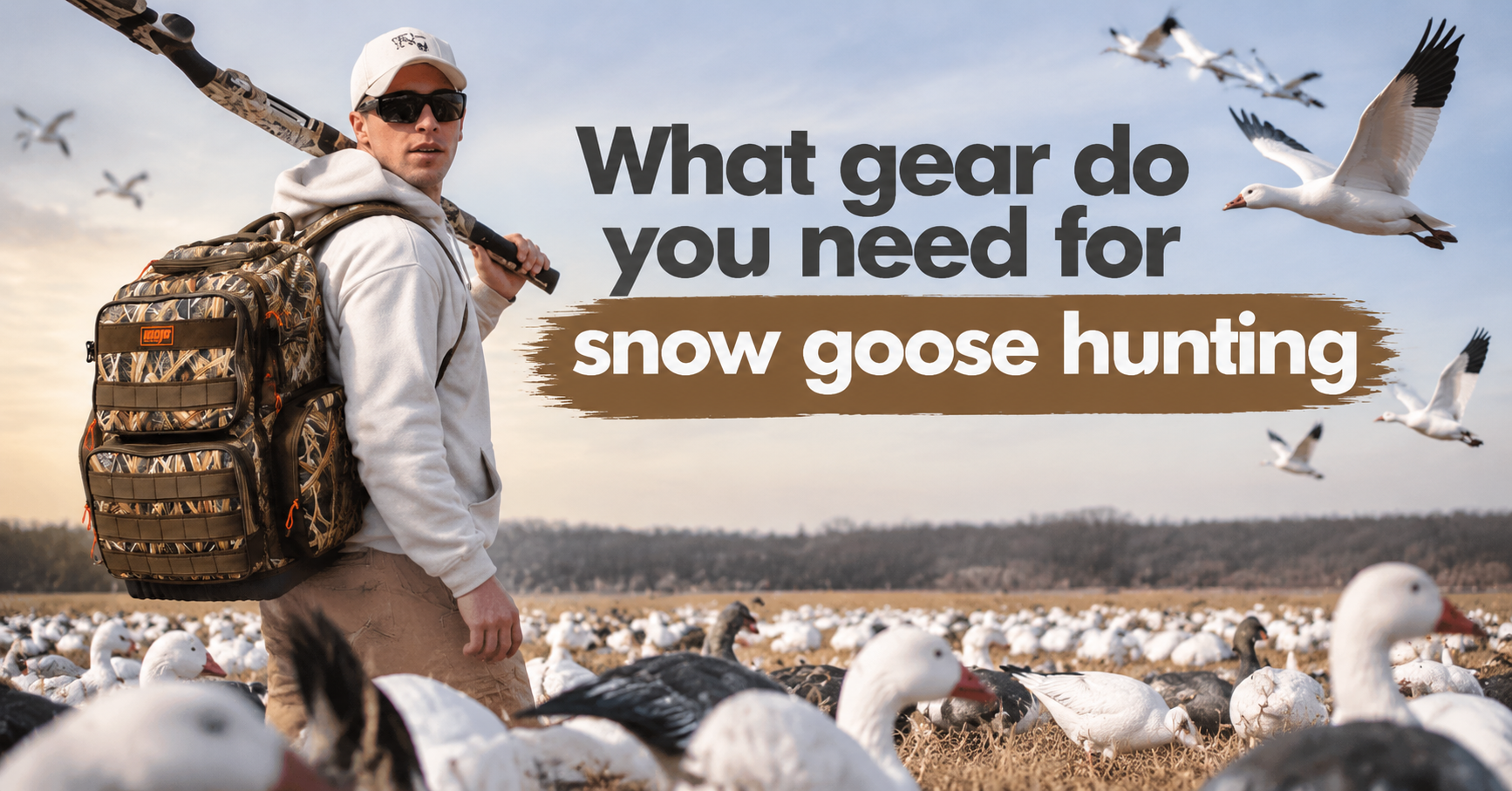

Snow goose hunting can involve a muddy field before sunrise, a long walk carrying decoys, or a guided hunt with most equipment already waiting. Those differences matter when deciding what to pack—and what you can leave at home.
If you are asking, “what gear do you need for snow goose hunting,” begin with personal safety, suitable clothing, legal equipment, and a recovery plan. Then add the concealment, decoys, and calling equipment required by your particular hunt. This guide primarily addresses U.S. hunting; hunters elsewhere must check their own national and regional requirements.
Quick Answer
What gear do you need for snow goose hunting? You need the required hunting documents, a lawful and familiar shotgun with compatible approved nontoxic ammunition, hearing and eye protection, weather-appropriate layers, suitable boots, navigation, communication, and first-aid supplies. A field decoy hunt also needs concealment and a shared decoy spread; calls, transport equipment, and spare power depend on the setup. Pack bird-recovery equipment, protective gloves, and enough cooling capacity for your harvest. Electronic callers and other special allowances depend on the exact season or conservation order, so verify current regulations and ask who supplies the group equipment before buying anything.
First Check: Regular Season or Light Goose Conservation Order?
Regulatory and health sources checked September 7, 2026. Confirm the rules for your actual hunting date, state, zone, property, and season segment. A light goose conservation order is a special management authorization, and its equipment permissions must not be assumed to apply during ordinary waterfowl seasons.
For example, Minnesota’s conservation-order guidance permits electronic calls and an exception to the usual shotgun-capacity restriction while retaining other applicable restrictions. That is a jurisdiction-specific example, not nationwide permission. Check your state’s current authorization before selecting equipment. [Minnesota DNR light goose conservation order guidance](https://www.dnr.state.mn.us/hunting/waterfowl/lightgoose/index.html).
- Confirm hunting-license, hunter-education, stamp, registration, and special-permit requirements.
- Check legal species, dates, shooting hours, bag and possession limits, and reporting duties.
- Verify rules for electronic calls, motorized decoys, shotgun capacity, and ammunition.
- Check public-land permits, access hours, vehicle restrictions, and temporary closures.
- Obtain landowner permission and confirm where you may park, walk, and retrieve birds.
Do not assume a harvested agricultural field is automatically legal to hunt. Grain placement and agricultural practices can affect its status. If something appears questionable, ask the wildlife agency before hunting; landowner permission does not resolve a baiting violation. [U.S. Fish and Wildlife Service waterfowl hunting and baiting guidance](https://www.fws.gov/story/2021-12/information-waterfowl-hunters).
What Gear Do You Need for Snow Goose Hunting? The Packing Table
| Gear Category | Purpose | Priority | Who Usually Supplies It? | What to Check |
|---|---|---|---|---|
| Required documents and permission | Establish lawful participation and access | Essential as applicable | Each hunter | Correct date, location, residency, and season segment |
| Shotgun, compatible ammunition, and case | Hunting equipment and protected transport | Essential for a shotgun hunt | Each hunter or an explicitly arranged provider | Fit, lawful configuration, ammunition compatibility, and transport rules |
| Hearing and eye protection | Protection during shooting | Essential safety equipment | Each hunter | Fit with hat, glasses, and firearm stock |
| Layered clothing and weather shell | Manage exertion, wind, rain, and stationary cold | Essential | Each hunter | Forecast, sitting duration, and freedom of movement |
| Boots and spare socks | Foot protection and traction | Essential | Each hunter | Mud, standing water, temperature, and walking distance |
| Blind or suitable concealment | Conceal hunters and provide a usable sitting position | Setup-dependent | Group or guide | Fit, visibility, muzzle clearance, and anchoring |
| Snow goose decoys and bags | Create the planned decoy presentation | Needed for a decoy hunt | Group or guide | Available labor, carrying volume, and ground conditions |
| Calls and power supply | Provide calling where appropriate | Optional or setup-dependent | Designated caller or guide | Legality, controls, connections, and charge |
| Binoculars, maps, and headlamp | Scouting, identification, navigation, and setup | Core field equipment | Personal or shared as appropriate | Offline access and backup lighting |
| Communication and emergency kit | Request help and manage unexpected delays | Essential | Each hunter plus shared supplies | Coverage, emergency contact, and accessible storage |
| Recovery and cooling supplies | Retrieve, identify, clean, and preserve birds | Essential planning category | Assigned group members | Safe access, hygiene, transport requirements, and cooler space |
| Sled, cart, or other permitted transport | Move bulky equipment and retrieved birds | Optional | Group or guide | Terrain, landowner approval, and access restrictions |
The 12 Gear Categories Explained
1. Documents, Permission, and an Offline Regulation Copy
Carry the documents required for your hunt in an accepted format. Keep paper items protected from water and download relevant information before leaving mobile coverage. A saved regulation page is useful reference material, but it does not replace a required license or permit.
Save the property contact, meeting location, legal access route, and any instructions about gates or field traffic. Ask whether conditions could change vehicle access overnight. A field that is firm in the evening may be unsuitable for driving after rain or thawing.
2. A Familiar Shotgun, Compatible Nontoxic Loads, and a Case
Choose a lawful shotgun you can handle confidently while wearing your hunting layers. Fit, manageable recoil, dependable operation, and practice matter more than buying a larger or more expensive firearm specifically for one trip.
U.S. waterfowl hunting requires approved nontoxic shot. Verify the load’s approval and its compatibility with your firearm and choke; the word “tungsten,” “steel,” or “bismuth” alone is not a complete compatibility check. [U.S. Fish and Wildlife Service approved nontoxic-shot guidance](https://www.fws.gov/story/2022-04/nontoxic-shot-regulations-hunting-waterfowl-and-coots-us).
Confirm gauge, chamber requirements, and manufacturer restrictions. Pattern your selected combination at an appropriate range before hunting, and stay within distances supported by your results and demonstrated ability. No single choke, pellet size, or advertised range is appropriate for every hunter.
Bring ammunition in protected storage, a suitable firearm case, and the manufacturer-recommended supplies for basic care. Inspect old hunting bags and pockets so unsuitable ammunition is not accidentally carried into the field.
3. Hearing and Eye Protection That Fit Your Clothing
Pack hearing protection and protective eyewear for every shooter. Electronic hearing protection is an optional convenience; its ability to amplify conversation does not replace checking its protective rating, fit, and instructions.
Try the complete combination before the trip. Thick hats, spectacle arms, and face coverings can interfere with earmuff fit. Eyewear should allow a clear view in the expected light without obstructing a comfortable shooting position.
Carry spare batteries if your protection requires them. Ordinary earbuds are not automatically hearing protection.
4. Layers for Both Decoy Setup and Long Periods of Sitting
Dress for two different activity levels: carrying and setting equipment, followed by sitting still. A useful system includes a moisture-managing base layer, adjustable insulation, and an outer layer chosen for wind and precipitation.
Vent or remove insulation during strenuous setup, then add warmth before settling into the blind. Include a warm hat, appropriate gloves, and a protected spare layer when cold or wet conditions are possible.
Do not choose white clothing simply because the quarry is a snow goose. Match concealment to the actual surroundings and the group’s setup. Snow covers or white oversuits are conditional items, while required visibility clothing must follow local rules.
5. Boots for the Field, with Waders Only When Needed
For a dry agricultural field, suitable boots may be all you need. Mud, slush, and standing water change the decision. Select footwear around traction, fit, expected water exposure, walking distance, and the time spent stationary.
Try boots with your intended socks. An excessively tight combination can be uncomfortable even when both items are marketed for cold weather. Pack dry replacement socks and, where practical, spare footwear at the vehicle.
Waders are conditional equipment. They do not make deep water, moving water, weak ice, or a hidden ditch safe to cross, and they do not replace a life jacket.
6. Concealment You Can Enter, Exit, and Use Safely
A layout blind is a low-profile enclosure used while reclining near ground level. Depending on the site, an upright blind or another lawful concealment arrangement may be more appropriate.
Before buying, check usable space while wearing your layers, ease of getting up, ground insulation, and visibility. Confirm that doors, fabric, and nearby equipment will not obstruct safe firearm handling.
Anchor the blind according to its instructions and manage loose straps. Any vegetation used for camouflage should be gathered only where permitted. An insulated pad may improve comfort when the blind provides little separation from cold ground.
7. A Manageable Decoy Spread
You need decoys for a decoy hunt, but every hunter does not need to own a separate spread. Choose a group setup that you can transport, deploy, inspect, and collect without exhausting the team.
| Decoy Type | Practical Appeal | Trade-Off to Evaluate |
|---|---|---|
| Windsocks | Fabric bodies generally pack compactly and can provide wind-driven movement | Shape and movement in calm conditions depend on the design |
| Silhouettes | Flat profiles simplify storage and carrying | Appearance changes with viewing angle |
| Full-body decoys | Three-dimensional form remains visible from different angles | More storage space and handling effort |
| Shell decoys | Some designs stack for transport | Ground contact and movement vary by model |
| Motion decoys | Add movement where permitted | Extra legal checks, power requirements, and maintenance |
There is no universal minimum number that guarantees results. Location, recent bird use, weather, hunting pressure, concealment, and available help all affect the decision. Borrowing or sharing an existing spread is a sensible way to learn before committing to a large purchase.
Include stakes or bases specified for your decoys, suitable bags, and a small number of compatible spare parts. Do not force components into frozen ground in a way that risks breakage or injury.
8. Calls, with Electronics Only Where Authorized
A manual snow goose call is a useful learning tool, but not every group member needs to operate one. Decide who will call and who will coordinate the hunt.
If the exact hunt permits an electronic caller, check the caller, recordings, speakers, leads, remote, and battery as a complete system. Keep cables clear of feet, blind doors, and firearm-handling areas.
A caller is optional equipment, not permission to hunt outside authorized dates or conditions. If its legality is unclear, leave it unused until the responsible agency confirms the rule.
9. Binoculars, Offline Maps, and Reliable Lighting
Binoculars help with scouting and observing birds without using a firearm as a viewing device. Add a bird-identification reference you can access offline.
Snow geese include white and blue color forms, so identification cannot depend on seeing a white bird. Learn the species likely to occur together and pass on uncertain opportunities. [Cornell Lab Snow Goose identification guide](https://www.allaboutbirds.org/guide/Snow_Goose/id).
Download maps and save the vehicle location, permitted access route, and boundaries. Mapping apps are useful aids, but displayed boundary lines are not a substitute for confirmed permission.
Bring a headlamp for setup and packing, plus backup lighting or batteries. A remote hunt also calls for a navigation backup you know how to use.
10. Communication, First Aid, Food, Water, and Emergency Protection
Carry a charged phone in weather-protected storage and save emergency numbers. Where mobile coverage is unreliable, consider a suitable satellite communication device and learn its operation before departure.
Share your location, route, companions, expected return time, and overdue plan with someone who is not hunting. Group radios can help coordination where lawful, but they may not provide a way to contact emergency services.
Pack a first-aid kit matched to your training, personal medication, drinking water, food, and emergency weather protection. Keep critical supplies accessible rather than buried beneath decoy bags. Hand warmers can improve comfort but do not replace adequate clothing or a plan to leave deteriorating conditions.
11. Bird-Recovery, Hygiene, Identification, and Cooling Supplies
Decide how you will retrieve birds before hunting. Identify property boundaries, drainage channels, water, fences, and other obstacles. A bird carrier or sled can help on land, but no piece of equipment justifies an unsafe crossing.
Your recovery and care kit should include protective gloves, dedicated cleaning tools, hand-cleaning supplies, appropriate containers, labels, a pen, and sufficient cooler capacity. Confirm which identifying parts must remain attached and what tagging or documentation is required before processing birds.
Cool harvested birds promptly and keep raw game separate from ready-to-eat food. A cold morning does not guarantee that birds piled in a sunny vehicle will remain adequately chilled. [North Dakota State University Extension game-bird handling guide](https://www.ndsu.edu/agriculture/extension/publications/pocket-guide-care-and-handling-game-birds-field-table).
For bird-flu precautions, CDC advises avoiding obviously sick or found-dead birds and using protective equipment when dressing game, including gloves, respiratory protection, and eye protection. Pack these items with your cleaning kit and follow current local advisories. CDC recommends cooking game birds to an internal temperature of 165°F, checked with a food thermometer. [CDC guidance for hunters and bird flu](https://www.cdc.gov/bird-flu/risk-factors/hunters-and-bird-flu.html).
12. Transport and a Small, Purposeful Repair Kit
A sled, cart, trailer, or permitted vehicle can simplify a bulky setup. Choose around access restrictions and terrain: wheels may struggle in soft mud, and a heavily loaded sled can be difficult to move over bare, uneven ground.
Confirm vehicle access with the landowner or land manager. Park where instructed and avoid damaging crops, field entrances, or wet ground.
Useful spares include compatible decoy components, approved blind fasteners, charging leads, and batteries actually used by your equipment. Keep the kit selective. Firearm faults or damaged safety equipment require manufacturer guidance or a qualified professional, not an improvised field repair.
Guided Hunt or DIY Hunt: What Should You Personally Bring?
On a guided hunt, ask for a written packing list. Confirm whether the operator supplies decoys, blinds, calling equipment, transport, dog work, and bird processing. Never assume that ammunition, licenses, or personal protective equipment are included.
| Personal Responsibilities | Confirm with the Guide or Group |
|---|---|
| Required documents and identification | Exact season segment, meeting point, and access arrangements |
| Suitable clothing, footwear, and personal medication | Blind type, seating, and anticipated walking distance |
| Hearing and eye protection | Group briefing and communication procedures |
| Firearm and compatible ammunition unless otherwise arranged | Any equipment supplied and its suitability for you |
| Personal food, water, and communication | Shared emergency kit and evacuation plan |
| Plan for taking your birds home lawfully | Recovery, cleaning, identification, and cooler arrangements |
For a DIY hunt, assign ownership of shared tasks. Name who brings decoys, who brings the blind, who checks access, and who supplies cooling equipment. “Someone will bring it” is not a packing plan.
When Water, Boats, Dogs, or Ice Change the List
Water and Boat Access
Add a properly fitted life jacket, protected communication, dry replacement clothing, and the equipment required for your vessel and location. Wear the life jacket rather than leaving it beneath the decoys.
Cold-water immersion can rapidly impair breathing and movement, even when the air feels mild. Check water conditions and choose an alternative route when necessary. [National Weather Service cold-water safety guidance](https://www.weather.gov/safety/coldwater).
Count people, dogs, decoys, batteries, fuel, and other gear in the boat’s load. Follow capacity limits and navigation requirements. Establish safe firearm handling during boarding and unloading, and never direct fire across people, dogs, or other boats.
A Retrieving Dog
A trained retriever can assist recovery, but a dog is not mandatory for every field hunt. If bringing one, pack drinking water, a leash, identification, a dry resting surface, and suitable canine first-aid supplies.
Discuss weather exposure, conditioning, and local disease concerns with your veterinarian. Do not send a dog into hazardous ice, current, or inaccessible terrain, and keep it away from sick or found-dead birds.
Ice and Severe Weather
Do not treat visible ice as a reliable access route or assume a previous crossing remains suitable. Choose another location if the hunt depends on conditions you cannot assess safely.
Stop when visibility, weather, footing, or a participant’s condition makes continued hunting unsafe. Additional gear cannot remove every environmental hazard.
A Short Firearm-Safety Briefing for the Whole Group
- Treat every firearm as if it is loaded.
- Keep the muzzle pointed in a safe direction.
- Keep your finger outside the trigger guard until ready to shoot.
- Be certain of the target and what is beyond it.
Before loading, agree on safe shooting directions, hunter positions, dog location, and a clear stop command. A flock overhead does not make every direction safe. Do not swing through another person’s position or shoot toward roads, buildings, livestock, or an unsafe background.
Follow manufacturer instructions for loading, unloading, and checking chamber status. Unload before crossing obstacles or adjusting equipment in ways that compromise safe handling. A mechanical safety does not excuse poor muzzle control.
Complete hunter education and obtain supervised practice when needed. Practice with your actual clothing and equipment at an appropriate range; keep all live ammunition away from any at-home handling rehearsal.
Spend and Carry Less Without Omitting Essentials
You do not need the most expensive equipment to hunt responsibly. Choose gear based on the species, terrain, weather, local regulations, fit, safety, reliability, maintenance requirements, and your actual experience.
- Confirm what is supplied. A guided or group hunt may eliminate the need to purchase decoys, a blind, or calling equipment.
- Use suitable gear you already own. Familiar clothing, binoculars, and a reliable headlamp may meet the need.
- Borrow before expanding. Try a blind or decoy type before committing to its storage and transport requirements.
- Assign shared equipment. Avoid carrying several bulky duplicates while forgetting a cooler or emergency kit.
- Delay convenience purchases. Extra motion decoys, elaborate electronics, and dedicated trailers should solve a demonstrated problem.
- Protect the essentials. Reduce optional bulk before cutting water, weather protection, navigation, or first aid.
Common Packing Mistakes and Their Fixes
| Mistake | Why It Matters | Better Preparation |
|---|---|---|
| Buying an electronic caller before checking the season | Its use may not be authorized | Verify the exact hunt’s rules first |
| Wearing maximum insulation during setup | Perspiration can leave clothing damp for the stationary period | Adjust layers with activity |
| Taking more decoys than the group can manage | Setup and recovery become unnecessarily demanding | Match the spread to labor, access, and transport |
| Assuming a white oversuit fits every field | Concealment may mismatch the surroundings | Check the actual ground cover and blind plan |
| Relying entirely on mobile service | Maps and emergency contact may become unavailable | Download information and plan communication backups |
| Bringing a cooler with too little usable space | Birds may not cool adequately | Allow room for both the harvest and cooling material |
| Removing identification features too early | Transport requirements may not be met | Check applicable rules before processing |
| Driving into a wet field without permission | Creates property damage and access problems | Confirm vehicle use and an alternative carrying route |
Printable-Style Final Packing Checklist
Each Hunter
- Required documents, identification, and permission information
- Familiar lawful shotgun, compatible approved nontoxic ammunition, and case
- Hearing and eye protection
- Base layer, insulation, weather shell, hat, and gloves
- Suitable boots and spare dry socks
- Headlamp and backup lighting or batteries
- Phone, offline maps, and suitable backup communication
- Drinking water, food, medication, and accessible first-aid supplies
- Emergency weather protection appropriate to the location
Assigned Group Equipment
- Blinds or other suitable concealment and ground insulation
- Decoys, bags, stakes or bases, and compatible spares
- Calls and any legally permitted electronics with tested power
- Binoculars and bird-identification reference
- Recovery carriers or permitted transport equipment
- Protective gloves, cleaning tools, hygiene supplies, labels, and pen
- Coolers and sufficient ice or other cooling material
- Confirmed emergency plan and trip contact
Only When the Hunt Requires Them
- Waders and manufacturer-specified belt
- Worn life jackets and required boating equipment
- Snow covers or oversuits appropriate to the setup
- Dog equipment and canine care supplies
- Remote-area navigation and communication backups
- Additional lawful reporting, transport, or border-crossing documents
FAQs
1. What should a beginner buy first?
Begin with required documents, suitable clothing and footwear, hearing and eye protection, and familiar hunting equipment. Confirm the group’s shared gear before purchasing a personal decoy spread.
2. Do I need to own a shotgun for a guided hunt?
Not necessarily, but any supplied firearm must be explicitly arranged, lawful, and suitable for you. Ask the operator what is available and what familiarity or practice is expected.
3. Do I need a new shotgun specifically for snow geese?
No automatic upgrade is required. Your existing firearm may be suitable if it is lawful, compatible with the intended ammunition, dependable, and comfortable for you to use.
4. Is one gauge best for every snow goose hunter?
No. Firearm fit, recoil tolerance, suitable loads, practice, and local rules matter. Choose a combination you can use responsibly rather than selecting by gauge alone.
5. Do longer shells automatically improve results?
No. They may change recoil and load characteristics without improving your performance. Use only compatible ammunition and evaluate it through practice and patterning.
6. What choke should I pack?
Use a choke approved for your firearm and selected load that produces suitable patterns during testing. Do not assume the tightest available choke is the correct choice.
7. How much ammunition should I bring?
Ask your guide or group about the planned hunt, then bring a practical amount in protected storage. There is no universal daily quantity, and extra ammunition does not justify marginal shots.
8. Can I use lead shot for snow geese?
For U.S. waterfowl hunting, use federally approved nontoxic shot and follow applicable possession restrictions. Check your equipment bags for leftover lead ammunition before departure.
9. Do I need a large decoy spread?
Not for every situation. Start with the group’s hunting method, observed bird use, carrying ability, and available help. A large spread is an equipment commitment rather than a guarantee.
10. Are windsocks suitable for beginners?
They can be convenient when storage volume and carrying effort matter. Check the design’s ground attachment and performance in the wind conditions you expect.
11. Should I choose full-body decoys instead?
Full-body decoys provide three-dimensional form but generally require more storage and handling. Their value depends on whether those trade-offs suit your access and transport arrangements.
12. Do I need blue goose decoys?
They are not a universal requirement. Base any mix on your chosen setup and local observations, while learning to identify both white and blue snow goose forms.
13. Is a motion decoy essential?
No. It is an optional addition with extra transport, maintenance, and sometimes battery requirements. Verify its legality before use.
14. Can I use an electronic caller during any snow goose hunt?
No. Authorization depends on the season or conservation order and the jurisdiction. Do not transfer permissions from another state or a previous hunt.
15. Does every hunter need a manual call?
No. One designated caller may be enough for the group. Beginners can first learn the hunt’s communication and safety procedures.
16. Are white coveralls necessary?
Only if they suit the actual concealment plan. Ground cover, blind type, visibility requirements, and local rules should guide clothing choices.
17. Do I need a layout blind?
It is one option, not a universal requirement. A guide may provide another blind type, or the location may support a different lawful concealment arrangement.
18. What if I cannot comfortably get up from a layout blind?
Discuss upright seating or another accessible arrangement before booking or buying equipment. Safe movement and clear firearm handling take priority over a particular blind style.
19. Should I wear waders in an agricultural field?
Only when the conditions justify them. Appropriate boots may be more comfortable for a dry field, while standing water requires a separate access and safety assessment.
20. How should I choose boot insulation?
Consider temperature, wind exposure, sitting time, walking effort, and personal experience. More insulation is not automatically better if the boot becomes tight or causes excessive sweating.
21. What belongs in my dry-clothing bag?
Prioritize socks, gloves, and layers that would be difficult to replace during the hunt. For water access, arrange a more complete dry change in protected storage.
22. Is a rangefinder essential?
No. It can help assess distances to stationary reference points, but it cannot replace pattern testing, judgment, or positive identification of a moving bird.
23. Can my phone replace binoculars?
A phone camera may document observations, but it is not necessarily a practical substitute for binoculars during scouting. Neither device should encourage taking an uncertain shot.
24. Do I need a satellite messenger?
Consider one where mobile coverage is unreliable and help is distant. Check service requirements, test it, and ensure someone understands your trip plan.
25. Are group radios enough for emergencies?
Usually they should be treated as local coordination tools. Their range and access to outside assistance are limited, so maintain a separate emergency communication plan.
26. What should I ask an outfitter before packing?
Ask about supplied gear, walking distance, blind type, weather exposure, legal documents, ammunition, recovery, processing, and transport home. Request a written list.
27. Is a trailer necessary for DIY hunting?
No. It becomes useful only when your equipment volume and lawful access justify it. A smaller shared spread may fit existing transport.
28. Can I drive a cart or ATV across the field?
Only where permitted by the landowner and applicable land-use rules. Confirm the route and ground conditions rather than assuming permission to hunt includes vehicle access.
29. Do I need a retriever?
Not for every land-based hunt, but you do need a workable recovery plan. Avoid setups where retrieving birds would require unsafe or unauthorized access.
30. How many coolers should the group bring?
Plan around usable capacity, expected lawful harvest, cooling material, and travel duration. Stop hunting if you cannot responsibly recover and care for additional birds.
31. Can I fully process birds before driving home?
Check identification, tagging, and transport rules first. Processing that removes required identifying features may create a legal problem even when the birds were lawfully harvested.
32. What changes if I cross an international border?
Verify firearm travel, wildlife import and export, customs, and animal-health requirements for both countries. Disease-related restrictions can change independently of hunting regulations.
33. What protective equipment should I pack for cleaning birds?
Include disposable gloves, suitable respiratory and eye protection, dedicated tools, and hand-cleaning supplies. Follow current public-health guidance and local wildlife advisories.
34. How should I maintain gear after a muddy hunt?
Clean and dry clothing, blinds, bags, and decoys according to their instructions. Inspect damaged parts and follow firearm-manufacturer guidance before storing equipment securely.
35. When should I get professional help?
Use a qualified instructor for unfamiliar firearm handling, a gunsmith for firearm faults, a veterinarian for dog-health planning, and the wildlife agency for unclear regulations. Seek emergency assistance when conditions exceed your ability to manage them safely.
Final Answer
What gear do you need for snow goose hunting? Start with legal documents, a familiar lawful shotgun and compatible approved nontoxic ammunition, hearing and eye protection, suitable layers and boots, navigation, communication, first aid, and a complete bird-recovery and cooling plan.
Add concealment and decoys for your chosen method, and use calls or powered equipment only where authorized. Share bulky items, confirm what a guide provides, practice beforehand, and verify current official regulations. The right kit is one your group can use, carry, and maintain responsibly—not simply the largest collection of equipment.
Read more:
- What Gear Do You Need for Turkey Hunting? Essential Checklist
- What Gear Do You Need for Small Game Hunting? 9 Essentials