
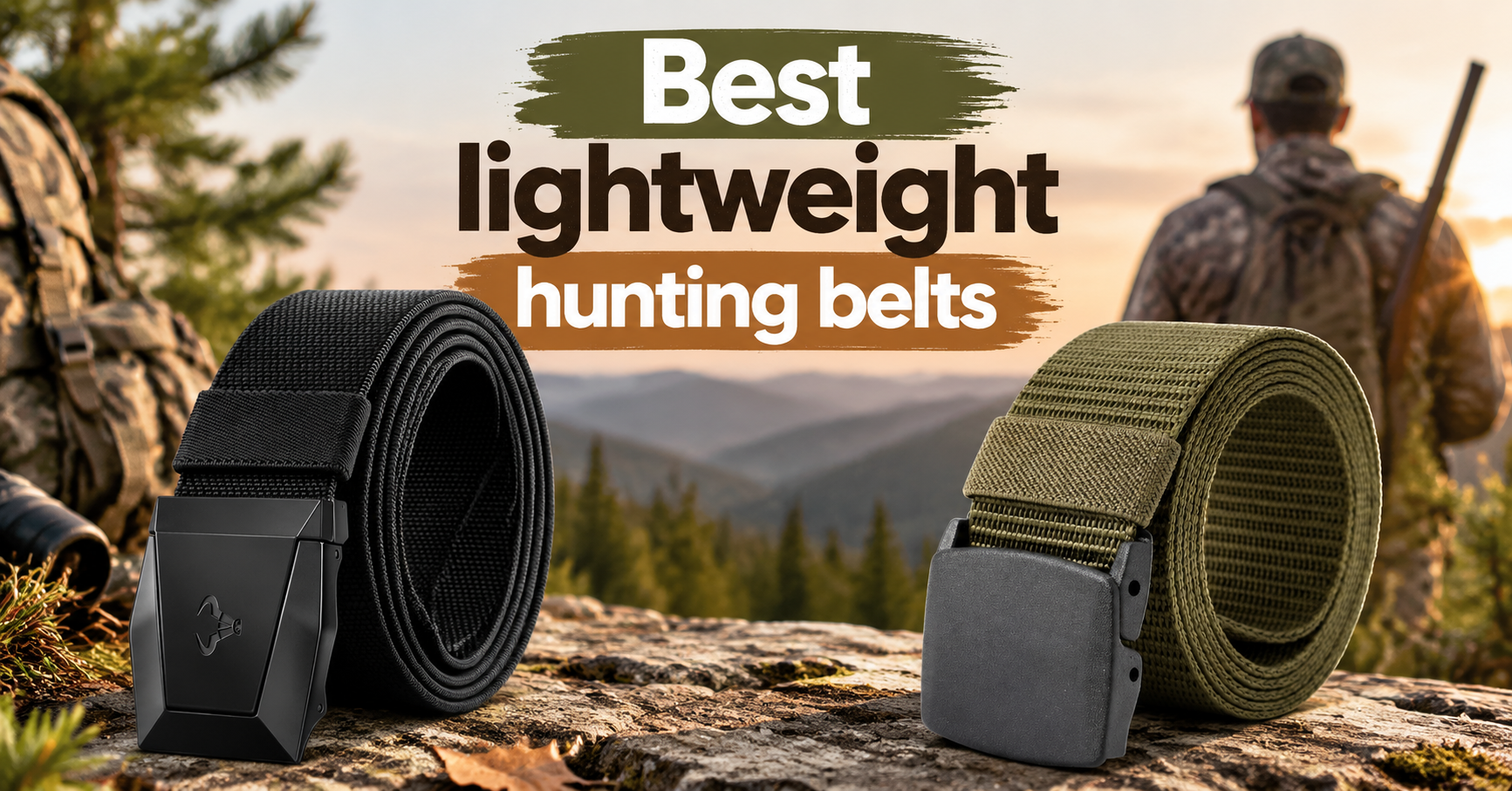

A belt can feel comfortable at home and become an irritation once a loaded backpack presses its buckle into your waist. Add cold-weather layers, long uphill steps, or a pouch that pulls unevenly, and choosing a hunting belt becomes more about the complete setup than the strap alone.
This guide compares the best lightweight hunting belts from the supplied selection by intended use, adjustment, stretch, and potential interference with other equipment. Most are trouser belts; one is a dedicated shell-and-game carrying system. Verified, comparable belt weights were unavailable, so these recommendations concern design and suitability—not a measured ranking from lightest to heaviest.
Quick Picks
- Best Overall for General Trouser Support: JUKMO Tactical Belt, Military Hiking Rigger 1.5″ Nylon Web Work Belt — Stretch webbing and a quick-release buckle offer a practical starting point, provided the hardware clears your pack belt.
- Best Simple Option: Mile High Life Nylon Web Belt — A straightforward adjustable web belt for hunters who primarily need their trousers supported; confirm the selected buckle variation.
- Best for Dove-Hunting Storage: DynoGoods Dove, Field and Game Belt, Adjustable, Camo — Two shell pouches and a game bag provide a different function from an ordinary pants belt.
Affiliate disclosure: Gunscorner.com may earn a commission from qualifying purchases through these links.
What This Comparison Covers
Seven identifiable, distinct products are reviewed individually below. Repeated links to the same product are counted once. The supplied JUKMO ratchet-belt entry identified as B0H5HYTKVR could not be reliably matched to a product listing and is excluded rather than replaced with another model.
These are specification-based evaluations, not hands-on field tests. Recommendations reflect documented designs and practical implications; buckle noise, long-term durability, loaded stability, and comfort under a particular backpack remain untested. No cheapest-product award is assigned because current, comparable Amazon pricing could not be confirmed.
Best Lightweight Hunting Belts: Comparison at a Glance
| Product | Primary Role | Webbing or Construction | Closure or Adjustment | Most Relevant Buyer | Main Check Before Buying |
|---|---|---|---|---|---|
| JUKMO Tactical Belt — B08277N9KL | Trouser support | 1.5-inch stretch nylon | Quick-release aluminum-alloy buckle | Hunter seeking an adjustable everyday outdoor belt | Buckle clearance beneath the backpack hip belt |
| CHAOREN Tactical Belt — B0G6KBDKP2 | Trouser support | 1.5-inch stretch nylon | Quick-release buckle | Hunter wanting one belt for outdoor and everyday wear | Selected size and buckle operation with gloves |
| Mile High Life Nylon Web Belt — B08219G9ZR | Simple trouser support | Nylon webbing | Adjustable, cut-to-fit design | Buyer prioritizing a straightforward belt | Exact buckle material and trimming instructions |
| JUKMO Stretch Tactical Belt — B0DFLBKKCX | Adjustable trouser support | 1.5-inch elastic nylon | Listed as ratchet quick release | Buyer specifically interested in this JUKMO adjustment design | Exact closure layout and pack compatibility |
| DynoGoods Dove, Field and Game Belt — B07SRF1YM6 | Shell-and-game storage | Belt with two shell pouches and one game bag | Adjustable waist strap | Dove or field hunter needing accessible storage | Loaded pouch placement and overlap with other equipment |
| FAIRWIN Men’s Tactical Belt — B07K2YZVGK | Utility-style trouser support | Nylon webbing | Quick-release buckle with V-ring design | Buyer who specifically wants this hardware arrangement | Extra hardware contact, bulk, and noise |
| BULLIANT Tactical Belt for Men — B0B9XGQK7D | Adjustable trouser support | 1.5-inch stretch nylon webbing | Listed with quick-release and cut-to-fit features | Buyer wanting stretch with length customization | Exact variation and instructions before cutting |
Weight comparison: No dependable set of like-for-like net weights was available. Shipping weights, different belt lengths, and a pouch-equipped game belt should not be treated as directly comparable measurements.
1. JUKMO Tactical Belt, Military Hiking Rigger 1.5″ Nylon Web Work Belt — Best Overall for General Trouser Support
This JUKMO combines stretch nylon webbing with an aluminum-alloy quick-release buckle. It is the strongest overall starting point here for a hunter seeking an adjustable trouser belt that can also serve during ordinary outdoor activities.

The practical appeal is movement: a little give can accommodate sitting, stepping over obstacles, and bending without requiring constant manual adjustment. That is a design-based advantage, not a guarantee of comfort or resistance to sagging.
The buckle deserves as much attention as the strap. Before keeping the belt, wear it with your hunting trousers and loaded backpack. A closure that feels unobtrusive alone may create a pressure point beneath a padded hip belt.
Pros
- Stretch webbing accommodates changes in waist position.
- Quick-release closure provides an alternative to a conventional pin buckle.
- Documented 1.5-inch strap width makes belt-loop compatibility easier to check.
Cons
- Metal buckle placement requires checking beneath a backpack hip belt.
- Heavy accessory support is not established by the stretch construction.
- No verified weight advantage over the other trouser belts.
2. CHAOREN Tactical Belt Men — 1.5″ Nylon Stretch Military Mens Belt
The CHAOREN offers another stretch-webbing option with a quick-release buckle. Its clearest role is supporting trousers during outdoor activity while remaining suitable for everyday use.
There is insufficient verified comparative evidence to claim that it stretches more comfortably, weighs less, or holds adjustment better than the JUKMO. Choose between them through fit and closure preference rather than an unsupported performance ranking.

For cold-weather hunting, practice fastening and releasing the actual buckle while wearing your gloves. Also check that the selected length leaves adjustment room for your intended layers.
Pros
- Stretch nylon can accommodate bending and seated positions.
- Quick-release buckle supports convenient opening and closing.
- Listed 1.5-inch width gives buyers a concrete compatibility check.
Cons
- Gloved operation has not been independently verified.
- No documented comparative advantage in weight or buckle profile.
3. Mile High Life Nylon Web Belt — Best Simple Option
The Mile High Life is worth considering when the job is uncomplicated: keep hunting trousers in place without buying an integrated pouch system or seeking additional utility hardware.
Its adjustable, cut-to-fit webbing design allows length customization. However, product listings reference plastic and metal buckle options, so confirm the exact variation instead of assuming every version has the same closure, weight, or profile.

Try the belt with your thickest intended clothing before trimming it, and follow the supplied instructions. Removing excess length is permanent. This is a simplicity recommendation; current pricing does not support calling it the cheapest option.
Pros
- Straightforward design suits basic trouser support.
- Cut-to-fit construction allows excess length to be reduced.
- Adjustable webbing supports fitting between fixed belt-hole positions.
Cons
- Buckle variation must be confirmed before ordering.
- Over-trimming can leave insufficient length for additional layers.
- Heavy-load carrying capability is not established.
4. JUKMO Stretch Tactical Belt for Men, Military Work Rigger Hiking 1.5″ Elastic Nylon Web Ratchet Quick Release Belt
This separately listed JUKMO model combines elastic nylon webbing with a closure described as ratchet quick release. It should be evaluated as its own product; specifications from the earlier JUKMO belt should not automatically be transferred to it.

Its potential appeal is adjustable waist tension with stretch during movement. Buyers interested in this closure should inspect the exact listing images and instructions, especially the release action and how the strap threads through the buckle.
The available information does not establish that its hardware is thinner, quieter, or easier to use with gloves than the other options.
Pros
- Elastic nylon offers movement allowance at the waist.
- Listed ratchet adjustment provides an alternative closure format.
- Documented 1.5-inch width helps with belt-loop checks.
Cons
- Closure details require careful verification for this exact model.
- No verified advantage in buckle thickness or operating noise.
5. DynoGoods Dove, Field and Game Belt, Adjustable, Camo — Best for Dove-Hunting Storage
The DynoGoods serves a different purpose from the trouser belts above. Its two shell pouches and central game bag provide accessible storage around the waist, making it the most directly hunting-specific option in this selection.

The manufacturer lists an adjustable belt spanning 29–60 inches, a game-bag flap secured by hook-and-loop patches, and elastic bands for retaining excess strap. These features support organization, but they do not establish a tested carrying limit.
Consider the fully loaded arrangement rather than the empty belt. Pouches can compete for space with a backpack hip belt or interfere with sitting. Hook-and-loop opening can also be audible, making access noise a consideration where quiet movement matters.
For a smaller waist, check how much usable adjustment remains with every pouch installed. The advertised strap range alone does not prove that the complete pouch arrangement will fit comfortably.
Pros
- Two shell pouches separate readily accessible supplies.
- Dedicated game bag adds storage absent from plain trouser belts.
- Elastic retainers help manage excess strap.
- Manufacturer publishes an adjustable waist range.
Cons
- Pouches add bulk beyond that of a basic trouser belt.
- Hook-and-loop bag access may be audible.
- Loaded fit can interfere with a backpack hip belt or seat.
6. FAIRWIN Men’s Tactical Belt, Rigger Belt, Utility Nylon Web Belt
The FAIRWIN uses nylon webbing with a quick-release buckle and V-ring hardware. That arrangement may interest someone who specifically prefers a utility-style belt, but additional hardware is not automatically useful for lightweight hunting.

Evaluate whether the ring serves a manufacturer-approved purpose in your setup. If it does not, it becomes another possible contact point against equipment. Check the belt for interference while crouching and while wearing a pack.
The words “rigger” and “tactical” do not establish climbing or fall-arrest certification. Do not use this belt or its ring as a substitute for properly rated life-safety equipment.
Pros
- Quick-release buckle offers convenient closure access.
- Nylon webbing provides a conventional utility-belt construction.
Cons
- V-ring hardware may add unnecessary contact points for basic trouser support.
- Hardware noise and pack interference require checking.
- No verified basis for treating the ring as a life-safety attachment.
7. BULLIANT Tactical Belt for Men, Stretch Nylon Web Belt
The supplied BULLIANT is associated with a 1.5-inch stretch-webbing design and quick-release, cut-to-fit features. It is a candidate for hunters who want movement allowance while reducing an unnecessarily long strap tail.

Confirm the selected variation and its adjustment instructions before buying or trimming. Listing titles and variation descriptions are inconsistent enough that exact buckle mechanics should not be inferred from a different BULLIANT model.
For ordinary trouser support, concentrate on secure adjustment and comfortable tension. If accessories cause the strap to roll or bounce, reducing the load is more useful than repeatedly tightening the belt.
Pros
- Stretch webbing offers waist movement allowance.
- Cut-to-fit design permits length customization when used as instructed.
- Listed 1.5-inch width supports a straightforward belt-loop check.
Cons
- Variation details need confirmation before relying on specific buckle features.
- Trimming reduces future adjustment allowance.
- Heavy accessory stability is not verified.
Choose Around Your Trousers, Pack, and Actual Load
Start with the belt’s job
If you only need trouser support, begin with a plain webbing or stretch belt. If you need waist-mounted shell and game storage, evaluate a pouch system separately. A game belt does not necessarily replace the belt threaded through your trousers.
Measure the clothing you will actually wear
Measure around the belt line over your intended layers and compare that measurement with the selected size chart. Trouser size, body-waist measurement, and total strap length are not interchangeable. Check both strap width and whether the buckle can pass through the loops according to its instructions.
Test the whole pack interface
Put on your loaded backpack and fasten its hip belt normally. Walk, sit, bend, and step up onto a low, stable surface. Look for buckle pressure, overlapping adjustment hardware, folded webbing, and pouches trapped beneath the pack belt. A lighter trouser belt is not useful if its closure causes persistent pressure.
Match stretch to the load
Stretch can accommodate movement, but accessory weight may pull an elastic strap downward or encourage bouncing. Keep a trouser belt focused on trouser support unless its documented design supports your intended accessories. A purpose-built carrying system may be more appropriate for substantial loads.
Evaluate noise before the hunt
In a quiet room, operate the buckle, open any pouch closures, and move in your complete clothing system. Listen for metal contact, hook-and-loop separation, and a loose strap tapping other gear. These checks reveal problems in your own setup; they do not establish that a belt is universally silent.
Fit Problems and Mistakes to Correct Before Leaving Home
| Problem | Likely Issue to Check | Practical Response |
|---|---|---|
| Buckle digs in under the pack | Overlapping hardware or incompatible buckle profile | Check permitted positioning adjustments; choose a different belt if pressure remains. |
| Trousers gradually slip | Incorrect threading, poor fit, contamination, or worn closure | Follow the threading instructions and inspect the closure; replace unreliable equipment. |
| Accessories bounce while walking | Too much load for the strap or uneven distribution | Reduce the belt load or move items to an appropriate carrying system. |
| Belt will not pass through loops | Buckle dimensions exceed loop clearance | Follow the manufacturer’s buckle-removal procedure if provided; do not force it. |
| Trimmed belt is too short over insulation | Length was set with lighter clothing | Replace with the correct size; retain layering allowance on the next belt. |
| Game pouches interfere with sitting | Pouch placement conflicts with the seat or thighs | Reposition only as the design allows and test with a representative load. |
| Release becomes stiff or unreliable | Dirt, damage, or incorrect operation | Clean as directed; stop using a faulty buckle and contact the manufacturer. |
Cleaning, Inspection, and Storage
Follow the care instructions for the exact belt. Remove loose dirt, use only approved cleaning methods, and allow the webbing and hardware to dry fully before storage. Do not assume that a belt with a metal buckle is machine-washable or suitable for high heat.
Inspect stitching, webbing edges, buckle engagement, and strap retention before each outing. On a game belt, inspect pouch attachment points and remove debris from hook-and-loop closures. Clean game residue promptly according to the manufacturer’s directions.
Avoid unapproved lubricants, solvents, or modifications. Contact the manufacturer about persistent slipping, cracked components, or damaged release mechanisms. A buckle that no longer holds reliably should be replaced rather than trusted for another hunt.
Hunting-Belt Safety: Keep Clothing Support Separate from Fall Protection
None of the belts reviewed here should be treated as a climbing harness, rescue anchor, tree-stand tether, or fall-arrest system. Product names and metal rings are not proof of a life-safety rating.
For elevated hunting, use the appropriate full-body fall-arrest system and follow its instructions. Remain connected throughout climbing and hunting as directed, inspect stand components, and never climb with a loaded firearm. Review the [Hunter Ed fall-arrest safety guidelines](https://www.hunter-ed.com/national/studyGuide/Fall-Arrest-System-Safety-Guidelines/201099_93036/) before elevated use.
Before any hunt, confirm current seasons, licenses, permits, tags, bag limits, equipment requirements, and land access with the responsible wildlife agency or land manager. Check conditions, share your trip plan, and carry navigation, water, first aid, communication, lighting, and suitable weather protection. A comfortable belt supports the outing; it does not replace preparation.
Frequently Asked Questions
1. What should a lightweight hunting belt do well?
It should support your trousers, hold adjustment, and work comfortably with your clothing and pack. Low buckle bulk and compatible fit can matter as much as the belt’s measured weight.
2. Which reviewed belt is the lightest?
A defensible answer is unavailable because comparable net weights were not verified. Request the weight of the exact size and buckle variation, including all components you intend to wear.
3. Is a dedicated hunting belt necessary?
Not always. An ordinary outdoor trouser belt may be sufficient if it fits properly and does not interfere with your equipment. Dedicated pouch storage becomes useful when you need its carrying function.
4. How is a game belt different from a trouser belt?
A game belt carries supplies or harvested game in attached pouches. A trouser belt primarily supports clothing. They can be worn together if their placement remains comfortable and compatible.
5. Is stretch desirable for walking hunts?
Some give may help accommodate bending and large steps. Too much movement under an accessory load can be distracting, so evaluate the belt with what you actually plan to carry.
6. Does “tactical” indicate a better hunting belt?
No. The term does not establish low weight, quiet operation, weather resistance, or comfort. Compare the actual strap, buckle, fit, and documented intended use.
7. What belt width should I choose?
Choose a width that fits your trousers and any approved accessories. Several reviewed belts are listed at 1.5 inches, but your belt loops and buckle clearance still need checking.
8. Should I buy my normal trouser size?
Use the belt manufacturer’s size chart and measure at the intended belt position over your clothing. Clothing labels can differ from the measurement needed to select a belt.
9. How much extra length is useful for winter layers?
Leave enough adjustment for your thickest planned combination without creating an unmanaged strap tail. There is no universal allowance because clothing thickness and belt designs differ.
10. Can one belt fit both summer and winter hunting clothing?
Yes, if its adjustment range covers both setups. Check the lightest and thickest combinations before committing to a size or shortening a cut-to-fit strap.
11. Are cut-to-fit belts a good choice?
They can reduce excess strap length. Fit the belt over your intended layers first, confirm the product permits trimming, and follow its instructions because removed length cannot be restored.
12. What if the buckle does not fit through my belt loops?
Some designs permit the strap to be separated from the buckle for threading. Follow the supplied procedure; if the design does not support that approach, choose a compatible belt.
13. Are metal buckles uncomfortable beneath packs?
They can be, but shape and placement matter. Test the actual belt under your loaded pack rather than assuming that every metal buckle—or every plastic buckle—will feel the same.
14. Can I move the buckle away from the center?
A small repositioning may help if the belt and clothing allow it. Make sure the change does not create rubbing elsewhere or interfere with the buckle’s operation.
15. Does a quick-release buckle mean quick size adjustment?
Not necessarily. Releasing the closure and changing the strap length may be separate operations. Check the exact buckle instructions rather than relying on the feature name.
16. Which buckle is easiest with gloves?
No comparative glove test was verified for these products. Try the buckle with your actual gloves and check whether you can identify and operate the release without forcing it.
17. Are ratchet buckles silent?
Do not assume so. Adjustment and release can produce sound depending on the mechanism. Test the exact belt in quiet conditions if access noise matters to your hunting style.
18. How do I stop a loose belt tail from moving?
Use the belt’s supplied keeper or another manufacturer-approved retention method. Trim only a design intended for trimming, and preserve sufficient length for your clothing range.
19. Can a stretch belt carry heavy pouches?
Only rely on carrying capabilities documented for the exact product. If the strap rolls, stretches downward, or allows bouncing, reduce the load or use an appropriate carrying system.
20. Can a belt replace my backpack’s hip belt?
No. A backpack hip belt is part of the pack’s load-transfer system. A trouser belt does not provide the same connection or function.
21. Can I wear the DynoGoods belt with a backpack?
Possibly, but pouch position and the pack’s hip belt may overlap. Test the combined setup while loaded, including sitting and bending, before relying on it during a hunt.
22. Is a game belt preferable to a hunting vest?
It depends on storage needs and where you prefer to carry weight. A belt places its load around the waist; a vest uses a different support arrangement. Compare complete loaded comfort and access.
23. Are these belts waterproof?
No verified waterproof rating is established here. Nylon webbing or a metal buckle alone does not prove waterproof construction or performance after prolonged exposure.
24. What should I do after a belt becomes wet?
Clean it if needed using the approved method, then dry it fully before storage. Check that the buckle engages properly and that the strap holds adjustment before using it again.
25. Can mud affect buckle operation?
Debris may interfere with moving parts or strap retention. Clean according to the instructions and replace or seek support for a closure that remains unreliable.
26. When should I replace a hunting belt?
Replace it when damaged webbing, failed stitching, cracked hardware, or persistent slipping prevents dependable use. Cosmetic wear alone is different from a defect affecting closure or support.
27. Can a rigger belt protect me from a tree-stand fall?
Do not use an ordinary trouser or utility belt for fall protection. Elevated hunting requires the appropriate full-body fall-arrest system and correct use of its components.
28. Does a V-ring mean a belt is approved for climbing?
No. Ring shape and appearance do not establish certification, system compatibility, or a safe working load. Use equipment specifically approved for the activity.
29. Which product is the best budget choice?
A cheapest comparable option could not be confirmed. Compare current offers for equivalent sizes and buckle variations, checking whether a listing contains one belt or a multipack.
30. Who should I contact when product information is unclear?
Ask the manufacturer about sizing, buckle operation, care, replacement parts, or intended carrying use. Contact the responsible wildlife agency or land manager for current hunting and access requirements.
Conclusion
The best lightweight hunting belts fit your clothing, clear your pack hardware, and support the load you actually carry. Among this selection, the JUKMO Tactical Belt, Military Hiking Rigger 1.5″ Nylon Web Work Belt is the strongest overall starting point for general trouser support because it combines stretch webbing with a quick-release closure. Its main trade-off is buckle compatibility beneath a backpack hip belt.
The Mile High Life Nylon Web Belt is the best simple alternative for buyers who want adjustable trouser support and length customization. Confirm the buckle variation before ordering. It is not a verified cheapest pick; comparable current pricing was unavailable.
For shell-and-game storage, the DynoGoods Dove, Field and Game Belt, Adjustable, Camo provides a more relevant arrangement, with the added bulk of its pouches. Confirm current specifications, variation, availability, and price, test your complete setup, follow local hunting requirements, and keep ordinary belts separate from life-safety equipment.
Read more:
- Best Lightweight Hunting Knee Pads: 11 Options Compared
- What Gear Do You Need for Snow Goose Hunting? 12 Essentials