
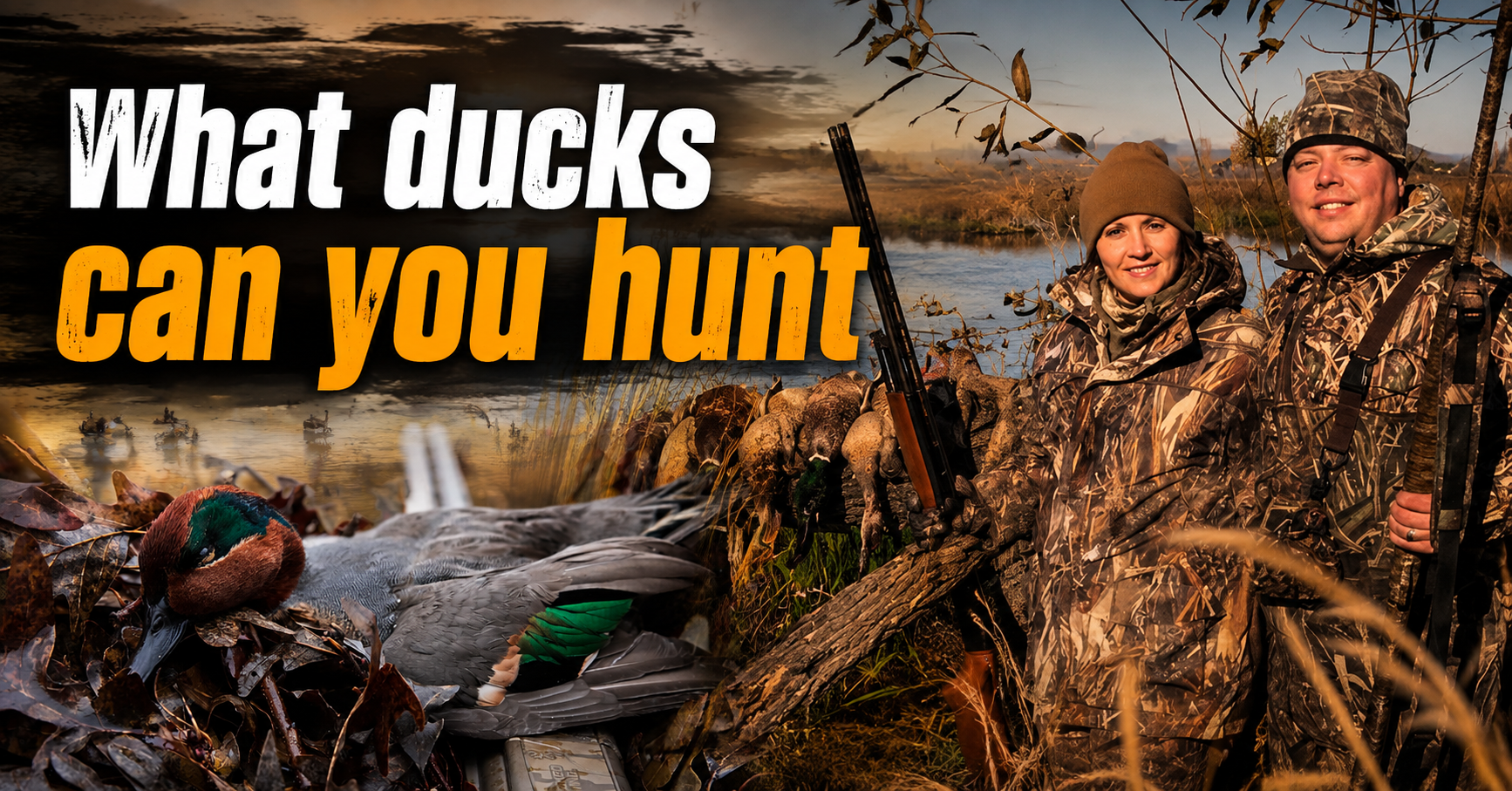

If you are wondering what ducks can you hunt, the practical answer depends on more than recognizing a bird as a duck. Many mallards, teal, wood ducks, pintails, wigeon, gadwall, divers, sea ducks, and mergansers are managed as game birds in parts of the United States, but an open species in one state or season segment may be restricted or closed in another. This guide explains the common legal categories, the ducks that require extra caution, and the regulation checks every waterfowl hunter should complete before taking a shot.
Quick Answer
In the United States, the answer to what ducks can you hunt commonly includes authorized dabbling ducks such as mallards, teal, gadwall, wigeon, shovelers, pintails, and wood ducks; diving ducks such as canvasbacks, redheads, ring-necked ducks, scaup, buffleheads, goldeneyes, and ruddy ducks; and certain sea ducks and mergansers. That is a category overview, not permission to shoot every species on the list. The exact legal species, season, zone, daily limit, species sublimit, sex restriction, and possession limit come from the current state regulations and any rules for the specific refuge or property. Positively identify the bird before firing, and pass on an uncertain bird.
Important Legal and Safety Notice
Migratory-bird regulations change by country, state, flyway, zone, season segment, public area, species, and population status. The legal information and linked examples in this article were checked on August 24, 2026. Review the current official hunting digest again immediately before your hunt because emergency closures or area-specific rules may supersede a printed summary.
Complete hunter education and follow the four universal firearm safety principles: treat every firearm as if it is loaded; keep the muzzle pointed in a safe direction; keep your finger outside the trigger guard until ready to shoot; and be certain of the target and what is beyond it. A mechanical safety never replaces safe handling. Wear eye and hearing protection while practicing, use ammunition approved for the exact shotgun and choke, and follow every manufacturer instruction.
What Ducks Can You Hunt in the United States?
The groups below contain species commonly authorized somewhere in the United States during an open season. Inclusion does not mean that a species is open today, open in your state, or available under the same bag limit as another duck.
| Duck group | Commonly hunted examples | What requires extra attention |
|---|---|---|
| Dabbling ducks | Mallard, American black duck, mottled duck, Mexican duck, gadwall, American wigeon, northern pintail, northern shoveler, wood duck | Hen restrictions, dusky-duck rules, and small species sublimits may apply |
| Teal | Blue-winged teal, green-winged teal, cinnamon teal | Early teal seasons may permit only teal even when other ducks are present |
| Whistling ducks | Black-bellied whistling duck and fulvous whistling duck where specifically authorized | Range and legal treatment vary; never assume a local whistling duck is included |
| Diving ducks | Canvasback, redhead, ring-necked duck, greater and lesser scaup, bufflehead, common goldeneye, Barrow’s goldeneye, ruddy duck | Scaup dates and limits may change within a season; some regional populations have special protection |
| Sea ducks | Common and king eider, surf scoter, white-winged scoter, black scoter, long-tailed duck where open | Separate sea-duck zones, dates, and aggregate limits are common; some eiders are protected |
| Mergansers | Hooded, common, and red-breasted merganser | They may be inside the general duck limit or managed under a separate limit |
The U.S. Fish and Wildlife Service bird-identification resources include the Ducks at a Distance guide and wing-identification materials. Learn the birds expected in your region in eclipse, hen, and juvenile plumage rather than relying only on colorful breeding-season photographs.
Common Dabbling Ducks Hunters Encounter
Mallard
Mallards are widespread and commonly included in regular duck seasons. Limits often distinguish between drakes and hens, so identifying sex can matter after species identification. During eclipse plumage, early migration, and low light, a drake may not show the familiar bright green head.
Wood duck
Wood ducks use wooded wetlands, beaver ponds, swamps, and river corridors. They are legal game ducks in many states but often have a species sublimit within the total duck bag. Their fast flight through timber makes target identification and a safe shooting lane especially important.
Teal
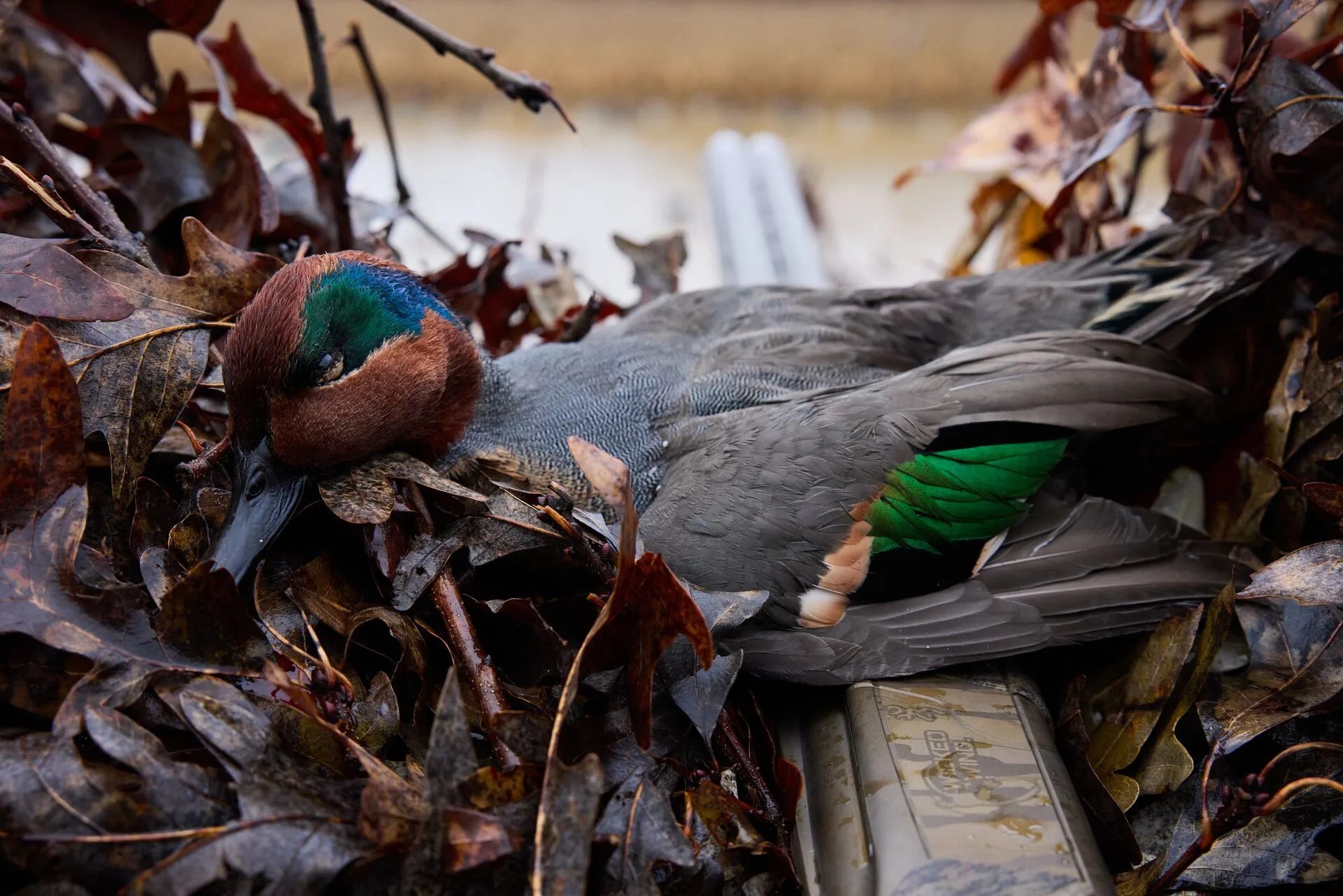
Blue-winged, green-winged, and cinnamon teal may be legal during regular seasons, and some states offer an earlier teal-only season. During a teal-only period, a mallard, wood duck, shoveler, or other non-teal duck remains off-limits even if a regular duck season will open later. Small size alone is not enough for identification.
Gadwall, American wigeon, and northern shoveler
These dabblers are frequently covered by an aggregate duck limit when the season is open. Gadwall can appear plain gray-brown, wigeon show distinctive wing and head patterns, and shovelers have a broad spatulate bill. Learn silhouette, wing pattern, flock behavior, and voice as well as color.
Northern pintail
Pintails are commonly huntable but frequently receive a smaller sublimit than the overall duck bag. A state may change the pintail allowance between seasons as population and harvest strategies change, so last year’s number is unreliable.
American black, mottled, and Mexican ducks
These dark or “dusky” mallard-like ducks can be difficult to separate from hens and hybrids. Some states combine them into a special category, delay their opening, or impose a low sublimit. Study the exact state definition because a regulation may cover hybrids as well as named species.
Common Diving Ducks Hunters Encounter
Canvasback and redhead
Both are commonly listed game ducks, but they can have restrictive sublimits. Hens and young birds require careful study. Head profile, bill shape, body color, wing pattern, and flock behavior are more dependable together than any single feature.
Scaup
Greater and lesser scaup are often referred to as bluebills. States may combine them under one scaup limit, and that limit can change during the season. The USFWS Duck Wing Identification guide shows why even biologists use several wing features to distinguish similar species.
Ring-necked duck
Ring-necked ducks are common inland divers and are often included under the general duck limit. The pale bill rings and peaked head profile can be more useful than the faint neck ring that gives the species its name.
Bufflehead, goldeneyes, and ruddy duck
These divers may be authorized under a general or regional duck limit. Barrow’s goldeneye deserves special attention because some populations or jurisdictions may be closed or tightly restricted. Never transfer a rule for common goldeneye to Barrow’s goldeneye without checking the species line in the current digest.
Sea Ducks and Mergansers Need a Separate Regulation Check
Common and king eiders, scoters, long-tailed ducks, and certain other sea ducks can be legal quarry where a state opens them. Coastal zones may have special dates, locations, aggregate limits, sex restrictions, or access rules. Sea conditions also make recovery and cold-water safety more demanding than a sheltered marsh hunt.
Hooded, common, and red-breasted mergansers are waterfowl but may be treated differently in state tables. For example, current Texas 2026–2027 county regulations include mergansers within the aggregate duck limit, while other states may publish a separate merganser allowance. Read the heading and footnotes rather than assuming the word “duck” includes or excludes them.
Ducks You Must Not Assume Are Legal
A duck-shaped bird is not automatically legal game. If the current official rules do not clearly authorize the species, do not shoot.
- Steller’s eider: the Alaska-breeding population is federally listed as threatened. The USFWS Steller’s eider profile describes its protected status.
- Spectacled eider: federally listed as threatened and closed in the Alaska subsistence example published by USFWS.
- Laysan duck: an endangered Hawaiian species, not a game duck.
- Hawaiian duck or koloa: a federally listed Hawaiian species, not a general hunting target.
- Harlequin duck: legal status varies sharply. Massachusetts explicitly lists no open harvest for 2026–2027, and other jurisdictions may be closed or highly restrictive.
- Unfamiliar vagrants and hybrids: an unusual duck is not automatically included under “all other ducks.” Confirm the agency’s definition before taking it.
- Domestic or feral ducks: local nuisance or property rules are separate from migratory-duck seasons. Do not treat a feral Muscovy or domestic mallard as ordinary public-land quarry.
Loons, grebes, cormorants, pelicans, herons, and many other water birds are not ducks and are not made legal by an open duck season. Coots are not ducks either, although many states publish a separate coot season and limit alongside waterfowl regulations.
Why the Legal List Changes by Location
The USFWS establishes annual federal frameworks covering outside dates, maximum season length, and harvest boundaries. States select their seasons and limits within those frameworks, and may create zones, split seasons, special management units, and species restrictions. Refuges, wildlife management areas, tribal lands, and private properties can add access or method rules.
| Current example checked August 24, 2026 | What it demonstrates | Official source |
|---|---|---|
| Texas 2026–2027 | The aggregate duck limit includes mergansers, several named ducks have sublimits, and “dusky” ducks have a delayed opening in each zone | Texas Parks and Wildlife Department |
| Massachusetts 2026–2027 | Sea ducks and mergansers have additional limits, and harlequin duck harvest is closed | Massachusetts Division of Fisheries and Wildlife |
| Federal framework | Flyways, population status, and harvest pressure influence annual season structures and species limits | U.S. Fish and Wildlife Service |
These are examples, not rules for other states. A species can be open in both places but subject to different dates, sublimits, or definitions.
How to Verify a Duck Is Legal Before Hunting
- Name the jurisdiction: identify the country, state or province, county if relevant, and the exact public or private property.
- Find the current season year: use the official wildlife agency’s current migratory-game-bird booklet or live regulation page.
- Confirm the zone: locate the property on the official duck-zone or management-unit map.
- Check the date and segment: regular duck, early teal, youth, military, sea-duck, and falconry seasons can authorize different birds.
- Read the species table: note the total daily bag plus every species, sex, and aggregate sublimit.
- Check possession and season limits: these are separate from the number allowed today.
- Verify credentials: confirm licenses, stamps, HIP registration, hunter education, permits, reservations, and identification documents.
- Check methods and area rules: review shooting hours, nontoxic shot, firearm capacity, blind rules, access times, boats, dogs, and retrieval boundaries.
- Recheck before departure: look for emergency closures, weather restrictions, or updated refuge notices.
Understand the Numbers in a Duck Regulation Table
| Regulation term | Meaning | Common mistake |
|---|---|---|
| Daily bag limit | The maximum legal take during one day | Treating it as a limit for each hunting location |
| Aggregate limit | Several species count together toward one total | Adding each species maximum together |
| Species sublimit | A smaller maximum inside the overall bag | Reaching the total bag with too many of a restricted species |
| Sex sublimit | A restriction on hens or drakes within a species allowance | Identifying species but not sex when the rule requires it |
| Possession limit | The maximum birds a hunter may lawfully possess after the hunt under the applicable rules | Assuming every processed or stored bird immediately stops counting |
| Season limit | A maximum for the entire season where specified | Resetting the count each day |
| Closed species | No lawful harvest under that season | Assuming one bird is allowed because it resembles an open species |
Read all footnotes. A scaup limit, for example, may differ between the first and second portion of the season. A dusky-duck definition may combine multiple species and hybrids. When the table is unclear, contact a state waterfowl biologist or conservation officer before hunting.
Licenses, Duck Stamps, and HIP
Most U.S. hunters need a valid state hunting license and any state migratory-bird endorsement or waterfowl stamp. Hunters age 16 or older who hunt migratory waterfowl generally need a current Federal Duck Stamp or valid E-Stamp; the USFWS Federal Duck Stamp program explains current validity and carrying requirements. State age rules and exemptions can differ.
Most migratory-game-bird hunters must also be registered through the Harvest Information Program, commonly called HIP, unless a state exemption applies. HIP is not merely a survey after the hunt; it is a credential to verify before hunting. Special areas may additionally require a draw, reservation, daily permit, parking pass, refuge brochure, or check-in.
Nontoxic Shot and Legal Firearm Setup
Approved nontoxic shot is required for waterfowl and coot hunting in the United States. Steel is one option, but the USFWS maintains the official approved nontoxic shot list; do not assume every metal blend or old shell is legal. Confirm the gauge, shell length, shot material, pressure, and choke compatibility in the shotgun, choke, and ammunition manufacturers’ instructions.
Federal rules generally prohibit a shotgun capable of holding more than three shells in the magazine and chamber combined for ordinary migratory-bird hunting, unless a specific authorized exception applies. State and area rules may be more restrictive. Verify that the plug is compliant and functional before entering the field.
Species Identification Is Part of Legal Shot Selection
Do not identify a duck by one color patch. Light, distance, molt, age, sex, and wet plumage can change appearance. Use a combination of:
- Overall size and body shape
- Head and bill profile
- Wing beat and flock formation
- Wing bars, speculum, and upperwing pattern
- Tail length and shape
- Voice
- Habitat and feeding behavior
- Whether the bird springs from shallow water or runs across deeper water to take off
Practice with an official identification guide before the season and review the locally restricted species every morning. If one bird in a mixed flock cannot be separated confidently, do not fire into the group.
Ethical Shooting and Recovery
Pattern the legal hunting load through the exact shotgun and choke combination at measured distances. Establish the range at which you can keep an effective, even pattern on a duck-sized target and identify the bird with confidence. Equipment does not justify shooting beyond proven ability.
Select an individual bird with a safe background. Avoid flock shooting, which can wound birds outside the center of the pattern. Mark where a downed bird lands, unload or make the firearm safe as circumstances require, and begin recovery promptly without endangering people, dogs, or other hunters. Federal rules require a reasonable effort to retrieve killed or crippled waterfowl and count retrieved wounded birds toward the bag.
Baiting and Location Rules
Waterfowl may not be hunted over bait. A site can remain legally baited after grain or feed has been removed, and there is no universal safe distance from bait because attraction depends on the circumstances. The USFWS Information for Waterfowl Hunters explains the federal 10-day rule and advises leaving when unexplained grain or feed creates uncertainty.
Normal agricultural operations and manipulation of natural vegetation are defined carefully in federal rules. Do not rely on a landowner’s assurance, social-media post, or the legality of deer baiting at the same property. Waterfowl baiting law is distinct.
Boat, Wader, and Cold-Water Safety
- Wear a properly fitted personal flotation device when boating and whenever cold, deep, or moving water creates a drowning risk.
- Stay within the boat’s capacity and distribute hunters, dog, decoys, batteries, fuel, and gear securely.
- Keep the muzzle controlled and establish a safe zone of fire for every occupant.
- Unload before boarding, crossing obstacles, or changing positions when required by hunter education and local rules.
- Use a wading belt, test depth and footing, and do not wade beyond your safe ability.
- Carry waterproof communication, navigation, lights, first aid, dry insulation, and an emergency plan.
- Do not travel on ice without current local safety information, proper equipment, and a conservative turnaround decision.
- End the hunt when wind, waves, fog, lightning, cold, visibility, fatigue, or mechanical problems make recovery unsafe.
What Not to Do
- Do not shoot a bird you cannot positively identify.
- Do not use last year’s season dates or bag limits without checking the current rules.
- Do not add every species sublimit together to create a larger aggregate bag.
- Do not shoot non-teal ducks during a teal-only season.
- Do not possess lead or other unapproved shot while waterfowl hunting.
- Do not hunt over grain, feed, or an uncertain baited area.
- Do not fire across a person, dog, boat, road, building, or unsafe background.
- Do not shoot indiscriminately into a flock.
- Do not rely on a shotgun’s safety instead of muzzle and trigger discipline.
- Do not leave wounded or downed birds without making every reasonable legal recovery effort.
- Do not trespass to retrieve a bird; obtain permission or contact the appropriate authority.
- Do not overload a boat or continue when weather and water conditions become unsafe.
Beginner Pre-Hunt Checklist
- Current state hunting license and hunter-education credential
- Federal Duck Stamp or E-Stamp when required
- State stamp or migratory-bird endorsement when required
- Current HIP registration and proof
- Current zone map, season table, bag limits, and area permit
- Official identification guide for likely and restricted birds
- Unloaded, inspected shotgun with compliant capacity
- Compatible approved nontoxic ammunition
- Eye and hearing protection for practice and appropriate field use
- Personal flotation device, wading belt, and cold-water clothing as conditions require
- First-aid kit, waterproof communication, navigation, light, and emergency contact plan
- Reliable retrieval method and safe equipment for the dog, if used
- Bird-counting method, tags, and transport plan
FAQs
1. What is the most commonly hunted duck in North America?
The mallard is one of the most widespread and commonly harvested ducks. That does not give it a universal limit; many regulations restrict the total number of mallards and the number of hens.
2. Can you hunt mallards?
Mallards are legal game ducks in many jurisdictions during an open season. Confirm the local zone, dates, total duck bag, mallard sublimit, and hen restriction.
3. Can you hunt wood ducks?
Wood ducks are commonly authorized where present, but they often have a sublimit inside the aggregate duck bag. Check public-area rules because some wooded wetlands or refuges have limited access.
4. Can you hunt teal?
Blue-winged, green-winged, and cinnamon teal can be legal during authorized seasons. An early teal-only season permits only the teal species named by the state, not every small brown duck.
5. Can you hunt northern pintails?
Often yes, but pintails commonly have a species sublimit that can change between years. Use the current-season table, not an old screenshot or remembered number.
6. Can you hunt canvasbacks?
Canvasbacks are open in many regular duck seasons but may have a restrictive sublimit or a closure in a particular year or area. Identify them carefully from redheads.
7. Can you hunt redhead ducks?
Redheads are commonly managed as game ducks and often carry a named sublimit. Hens can resemble other brown diving ducks, so learn head shape, bill, wing, and body pattern.
8. Can you hunt scaup?
Greater and lesser scaup are often legal, usually under a combined scaup limit. Some states change that limit during different portions of the season.
9. Can you hunt ring-necked ducks?
Ring-necked ducks are commonly legal during regular duck seasons and may fall under the general aggregate limit. Confirm the state table and avoid confusing them with scaup or other divers.
10. Can you hunt buffleheads?
Buffleheads can be legal where the duck season includes them. They are small diving ducks, but small size does not make a bird legal during a teal-only season.
11. Can you hunt goldeneyes?
Common goldeneyes may be open in many areas. Barrow’s goldeneye can be subject to different regional restrictions, so identify and verify the exact species.
12. Can you hunt ruddy ducks?
Ruddy ducks are often included among legal diving ducks during an open regular season. Check the state’s “all other ducks” language and any area-specific closure.
13. Can you hunt sea ducks?
Certain eiders, scoters, and long-tailed ducks may be hunted in designated areas and seasons. Sea-duck limits, zones, sex restrictions, and boat-safety demands require a separate check.
14. Can you hunt eiders?
Common and king eiders may be legal in some coastal jurisdictions. Spectacled eiders and the protected Alaska-breeding population of Steller’s eider are not general game targets, so positive identification is critical.
15. Can you hunt harlequin ducks?
Only where a current regulation explicitly opens them. Some jurisdictions, including Massachusetts for 2026–2027, prohibit harvest, while other areas may impose severe limits.
16. Can you hunt mergansers?
Hooded, common, and red-breasted mergansers may be legal where open. A state may place them within the duck aggregate or publish a separate merganser limit.
17. Can you hunt whistling ducks?
Black-bellied and fulvous whistling ducks may be legal in parts of their range, but rules vary. Confirm that the exact species appears in or is clearly covered by the current state regulation.
18. Can you hunt black ducks?
American black ducks are legal in many eastern seasons but often have a lower sublimit. They can resemble hen mallards and mottled ducks, so regional identification matters.
19. Can you hunt mottled or Mexican ducks?
They may be legal where specifically authorized, often under a low “dusky duck” limit or delayed opening. Hybrids may be included in the same regulatory definition.
20. Can you shoot an unusual or vagrant duck?
Do not assume so. If the bird is not clearly covered by the current official rules and you cannot identify it confidently, pass the shot.
21. Are coots ducks?
No. Coots belong to a different bird family, although their season and bag limit often appear beside duck regulations. A duck limit does not automatically describe the coot limit.
22. Are geese and brant counted as ducks?
No. They are waterfowl but have separate species groups, seasons, and limits. Do not count a goose or brant under a duck allowance unless an official rule explicitly creates a combined category.
23. Can you hunt any duck on private property?
No. Federal and state migratory-bird laws still apply, along with season, bag, method, and shooting-hour rules. You also need landowner permission and must follow local discharge restrictions.
24. If a duck is not named in the state table, is it legal?
Not necessarily. Some states use “all other ducks” language, but definitions and exclusions matter. Ask the wildlife agency when a rare species or unclear category is involved.
25. What ducks are legal during early teal season?
Only the teal species authorized by that state’s current early-season rule. Mallards, wood ducks, shovelers, and other non-teal ducks remain illegal during a teal-only segment.
26. Do I need a Federal Duck Stamp?
In the United States, migratory-waterfowl hunters age 16 or older generally need a current Federal Duck Stamp or valid E-Stamp. Verify carrying and validation requirements plus any state exemptions or additional stamps.
27. What is HIP certification?
The Harvest Information Program registers migratory-game-bird hunters and supports harvest surveys. Most hunters must obtain current HIP registration through the state licensing system unless exempt.
28. Do I also need a state duck stamp?
Many states require a waterfowl stamp or migratory-bird endorsement in addition to the federal stamp and hunting license. The exact age and license exemptions vary.
29. Can you use lead shot for ducks?
No. U.S. waterfowl hunters must use shot approved as nontoxic by the USFWS. Confirm that the exact shell material is on the current list and compatible with the firearm and choke.
30. How many shells may a duck-hunting shotgun hold?
Ordinary U.S. migratory-bird rules generally limit the shotgun to three shells in the chamber and magazine combined, subject to specifically authorized exceptions. State or area rules can be stricter.
31. What is the difference between a daily bag and a possession limit?
The daily bag controls how many birds may be taken in one day. The possession limit controls how many may be possessed under the applicable regulation after the hunt; tagging, gifting, storage, and transport rules still apply.
32. Can I take the full limit of every listed duck species?
No. Species maximums usually sit inside one aggregate duck limit. Reaching one sublimit does not enlarge the total daily bag.
33. Does the sex of a duck affect legality?
Sometimes. Mallard and certain sea-duck rules may restrict hens or females, so hunters need enough identification skill to comply before and after the shot.
34. How can I identify brown ducks in low light?
Study size, silhouette, bill and head profile, wing pattern, voice, flight, and habitat before the hunt. If legal light or identification quality is inadequate, wait or pass.
35. Is it ethical to shoot into a flock?
No. Select one identified bird with a safe background. Flock shooting increases the risk of wounding additional birds and losing track of what was hit.
36. When can you legally shoot ducks?
Only during the open dates and legal shooting hours for the exact zone and season segment. Early teal, regular duck, youth, sea-duck, and special seasons may use different hours.
37. Can you hunt ducks near bait?
Not when bait is present or the area remains baited under federal law. There is no fixed safe distance; leave and seek official guidance if unexplained grain or feed could attract waterfowl.
38. Can you hunt ducks from a motorboat?
Federal rules generally require the motor to be shut off, the sail furled, and forward progress from them to cease before hunting, subject to specific rules and exceptions. Review state and area boat regulations too.
39. Must you retrieve every duck you hit?
Hunters must make a reasonable effort to retrieve killed or crippled waterfowl and include retrieved birds in the bag. Plan a safe recovery method before shooting and never trespass during retrieval.
40. Must a wing or head remain attached during transport?
Federal field-transport rules generally require the head or one fully feathered wing to remain attached until the bird reaches the hunter’s home or a qualifying processing facility. Check the current federal and state wording.
41. What should I do after accidentally taking a protected duck?
Do not hide, abandon, or misidentify the bird. Make the firearm safe, preserve the facts, and promptly contact the state wildlife agency or local conservation officer for instructions.
42. Where is the best place to check current duck rules?
Start with the current state fish and wildlife agency’s migratory-bird regulations, then check the exact refuge, wildlife area, tribal land, or property rules. Use the USFWS framework and waterfowl pages for federal requirements.
Final Answer
The practical answer to what ducks can you hunt is that many familiar dabblers, teal, divers, sea ducks, and mergansers may be legal somewhere in the United States, but only the current local regulation can authorize a specific bird on a specific day. Identify the species and sex where required, confirm the total bag and every sublimit, carry the correct license, stamps, and HIP proof, and use only approved nontoxic shot. Pass on unfamiliar birds, mixed flocks, unsafe backgrounds, or conditions that make recovery doubtful. Official regulations always override a general online list.
Read more: