
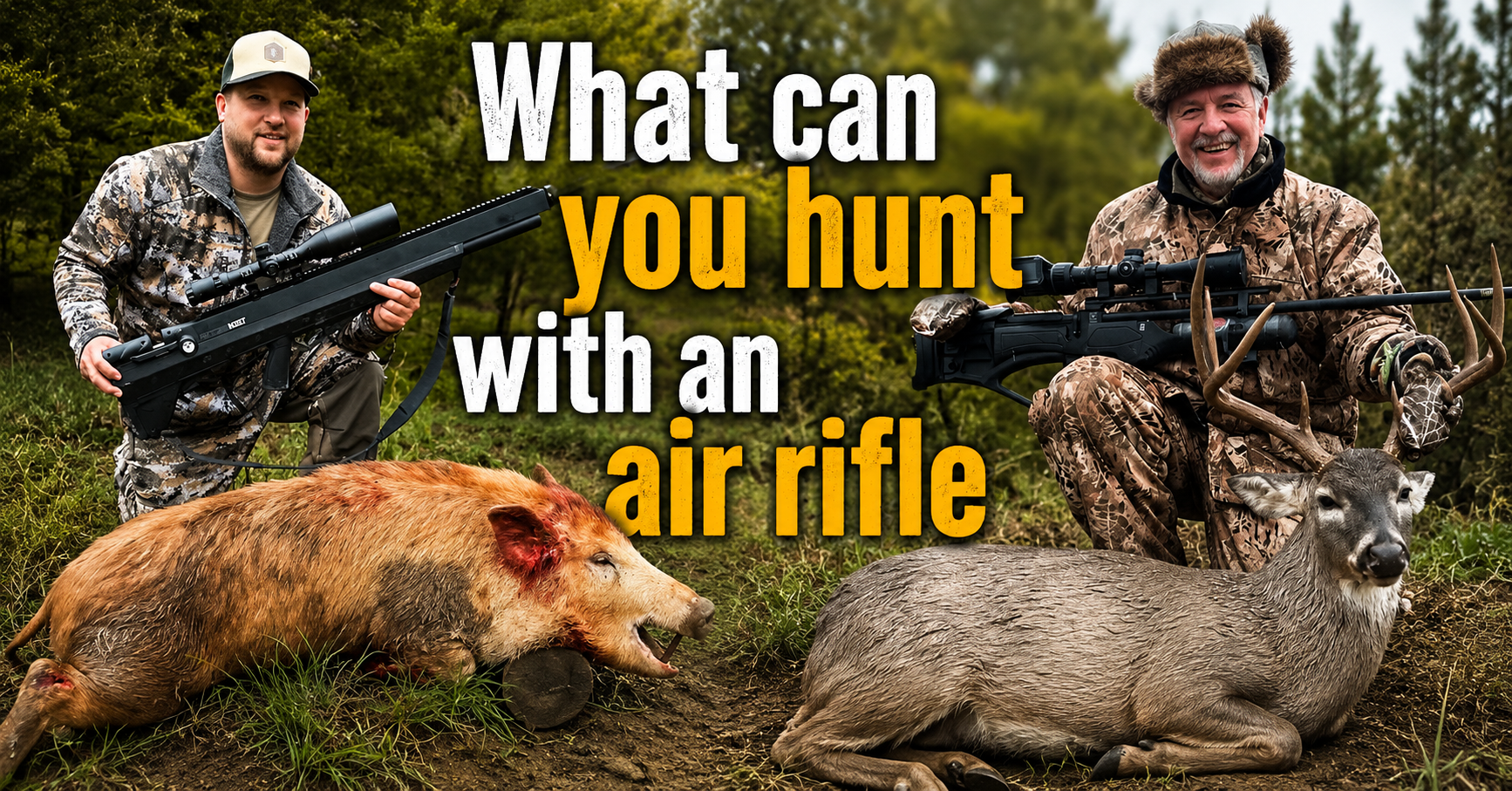

If you are asking what can you hunt with an air rifle, the broad answer is small game such as rabbits and squirrels in many jurisdictions, selected furbearers or pest species in some places, certain resident game birds where specifically permitted, and turkey or big game only in a limited number of jurisdictions with qualifying pre-charged pneumatic equipment. An ordinary target pellet rifle is not automatically a legal or humane hunting tool.
The exact answer depends on the country, state or province, species, season, land, projectile, air-rifle type, minimum equipment rule, local discharge ordinance, and your demonstrated accuracy. This guide explains the categories without treating one region’s law as universal.
Quick Answer
In many places, appropriately powered air rifles may be used for legal small game such as squirrels, rabbits, or hares and, in some jurisdictions, certain furbearers, unprotected species, or resident upland birds. Turkey, deer, javelina, feral hogs, predators, and other larger animals are legal with air rifles only in some locations, often with specific pre-charged pneumatic, caliber, projectile, or energy requirements. Waterfowl, migratory birds, protected wildlife, and big game are commonly restricted or prohibited. Before hunting, confirm the species, season, method of take, equipment minimums, ammunition rules, land rules, and local discharge laws with the current official wildlife regulations.
Important Safety and Legal Notice
An air rifle can cause fatal injury and must be handled with the same discipline as any hunting firearm. Follow these four universal safety principles:
- Treat every air rifle as if it is loaded.
- Keep the muzzle pointed in a safe direction.
- Keep your finger outside the trigger guard until ready to shoot.
- Be certain of the target and what is in front of it and beyond it.
A mechanical safety is not a substitute for safe handling. Use a backstop capable of stopping the actual projectile without causing a ricochet. Wear eye protection during filling, maintenance, and practice, and hearing protection when appropriate. Store the air rifle unloaded and secured against unauthorized access, with projectiles and high-pressure filling equipment managed safely according to the manufacturer’s instructions.
Hunting regulations change. The legal examples in this article were checked on August 11, 2026 and are included only to illustrate variation. Recheck the current regulation booklet, emergency orders, property rules, and local ordinances immediately before hunting.
What Can You Hunt With an Air Rifle by Category?
| Category | Examples Readers Commonly Ask About | General Answer | Essential Check |
|---|---|---|---|
| Small-game mammals | Squirrels, rabbits, hares, ground squirrels, woodchucks | Often legal with a suitable air rifle during an open season, but species and equipment rules vary | Minimum caliber or performance, season, bag limit, license, and land rules |
| Furbearers and predators | Raccoon, opossum, fox, coyote, bobcat | Allowed in some jurisdictions; prohibited or equipment-restricted in others | Species classification, season, legal method, night-hunting and artificial-light rules |
| Resident game birds | Quail, pheasant, grouse, chachalaca | Some locations allow air rifles for selected resident birds; many impose species-specific restrictions | Bird identification, projectile or method rule, season, bag limit, and nontoxic requirement |
| Unprotected or invasive species | Species classified locally as unprotected, invasive, or nuisance wildlife | May be allowed, but “pest” is a legal classification, not a personal judgment | Protected status, landowner permission, control permit, discharge ordinance, and humane method |
| Wild turkey | Spring or fall turkey where an air rifle is listed as a method | Legal only in selected jurisdictions, usually with specific equipment rules | Season segment, public-land rules, air-rifle type, minimum specification, and hunter orange |
| Big game | Deer, javelina, pronghorn, bear, alligator | Permitted in a limited number of jurisdictions with qualifying large-bore PCP rifles; prohibited in many others | Species-specific method, caliber, projectile, energy or velocity rule, tag, and season |
| Migratory birds and waterfowl | Ducks, geese, doves, rails, snipe, woodcock | Often governed by federal and state rules that restrict methods; do not assume an air rifle is legal | Federal migratory-bird regulations, state rules, legal shot type, and land-specific methods |
1. Small-Game Mammals
Small game is the most common lawful hunting role for air rifles. Depending on local rules, the list may include tree squirrels, cottontail rabbits, hares, ground squirrels, or woodchucks. The fact that a species is physically small does not automatically make every air rifle suitable. A low-powered plinking gun, a youth target rifle, and a hunting-rated PCP rifle have very different capabilities.
Confirm that the exact species is open, the air rifle is a listed method of take, the projectile is legal, and your equipment meets any minimum standard. Seasons, bag limits, license requirements, public-land restrictions, and retrieval duties still apply.
For example, New York’s current small-game guidance lists air guns as lawful for squirrels, rabbits, hares, ruffed grouse, huntable furbearers, and certain unprotected species, while excluding waterfowl, pheasant, turkey, and big game. This is a New York example, not a nationwide rule.
2. Furbearers and Predators
Some jurisdictions permit air rifles for certain furbearers or predators, which may include raccoons, opossums, foxes, coyotes, or bobcats. These animals differ greatly in size, anatomy, behavior, and legal status. A setup appropriate for one small-game species should not be assumed adequate for a larger predator.
Check whether the animal is classified as a game animal, furbearer, predator, nongame species, or protected wildlife. That classification may change the season, license, tagging, electronic-call, artificial-light, night-hunting, public-land, and ammunition rules. A legal minimum is only a regulatory threshold; it does not prove that a hunter or rifle can make an ethical shot in the actual conditions.
3. Resident Upland Game Birds
Selected resident game birds may be taken with air rifles in some areas. Examples can include quail, grouse, pheasant, or region-specific species, but rules are inconsistent. A state may allow an air rifle for one resident bird while prohibiting it for another.
Positive species identification is especially important because protected birds and legal game birds may share habitat. Do not fire at a bird on shape, color, movement, or sound alone. Confirm the season, bag limit, legal projectile, nontoxic requirements, land rules, and whether the method is restricted on a wildlife management area.
4. Unprotected, Invasive, or Damage-Causing Wildlife
Readers often assume that rats, invasive birds, feral animals, or wildlife damaging crops can be shot with an air rifle at any time. That assumption can lead to illegal take or unsafe discharge. “Pest,” “nuisance,” “invasive,” “unprotected,” and “depredation” have specific legal meanings that vary by jurisdiction.
Before any control action, identify the species positively and check whether a license, permit, landowner authorization, damage-control permit, trapping rule, municipal discharge restriction, or professional wildlife-control service is required. Many songbirds, raptors, and other native species are protected even when they gather around buildings or crops.
An air rifle must never be discharged in a yard, barn, orchard, or neighborhood without a safe backstop and a legal firing location. Thin fencing, brush, sheet metal, water, hard ground, and tree branches are not dependable backstops and may cause deflection or ricochet.
5. Wild Turkey
Air-rifle turkey hunting is legal in some jurisdictions and prohibited in others. Where allowed, rules may specify PCP operation, minimum caliber, projectile type, season, zone, or land category. Some public areas restrict hunters to shotguns or archery even when statewide rules list a PCP air rifle.
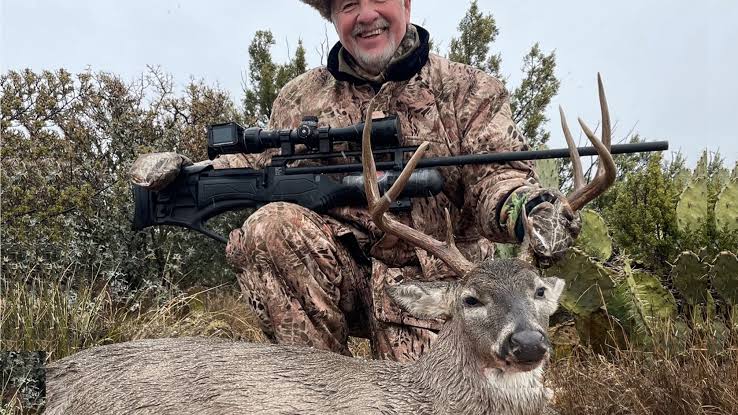
Florida, for example, currently permits qualifying PCP air guns for turkey under statewide resident-game rules but notes that shotguns are the only firearm allowed on most wildlife management areas during spring turkey season. Massachusetts prohibits air or pellet guns for turkey. These differences show why a general equipment recommendation is unsafe without a location and property rule.
Turkey hunting also demands precise target identification, a clear safe background, and knowledge of where other hunters may be. Never stalk a turkey sound, carry an uncovered decoy through an active hunting area, or shoot toward movement you cannot fully identify.
6. Deer and Other Big Game
Some modern large-bore PCP air rifles can meet legal big-game standards in selected jurisdictions. Texas and Florida currently allow qualifying PCP equipment for deer under specific rules. California and Ontario prohibit air rifles for big game. Other states may list deer but exclude bear, allow air rifles during a general firearms season but not an archery or muzzleloader season, or impose different equipment minimums by species.
The Texas Parks and Wildlife Department’s air-gun rules illustrate how detailed these requirements can be: operation type, projectile diameter, projectile weight, velocity or muzzle energy, species, zone, and season all matter. Do not use those specifications outside Texas as a universal recommendation.
Big-game legality does not guarantee field suitability. Hunters must know how their exact rifle, projectile, reservoir pressure, temperature, and distance affect point of impact and performance. Stay inside the distance at which you can consistently place the chosen hunting projectile under realistic conditions. Pass on quartering, obstructed, moving, poorly lit, or otherwise low-percentage opportunities. Make every reasonable legal recovery effort after the shot.
7. Feral Hogs and Other Nongame Animals
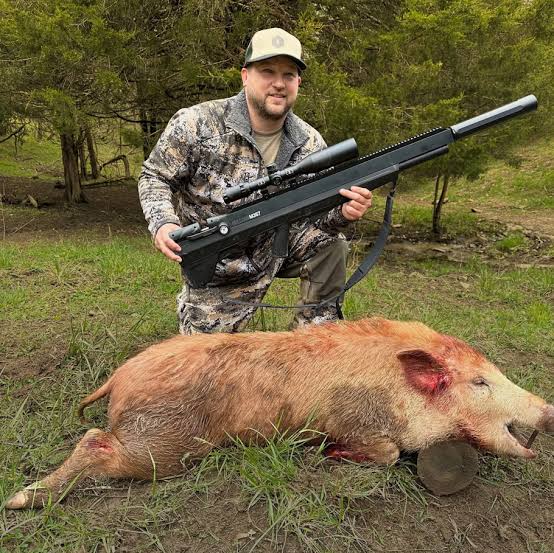
Feral hog rules vary widely. They may be classified as nongame, invasive, or regulated differently on public and private land. Some jurisdictions allow qualifying PCP air rifles; others restrict the method, season, nighttime use, lights, thermal equipment, bait, transport, or land access.
Do not interpret “nongame” as “no rules.” Verify the landowner’s permission, local discharge law, public-land policy, legal hunting hours, required license or exemption, tagging or reporting rule, and whether the air rifle meets any equipment standard. Hogs can be dangerous when wounded or approached, so plan recovery conservatively and do not pursue into unsafe cover alone.
Animals You Generally Should Not Assume Are Legal
- Migratory birds: Ducks, geese, doves, rails, snipe, and woodcock are governed by federal and local rules. Legal methods are tightly controlled.
- Protected songbirds: Native songbirds are commonly protected and are not target practice or pest animals.
- Raptors: Hawks, eagles, owls, and other birds of prey are protected.
- Threatened or endangered wildlife: These species may not be taken except under narrowly defined official authority.
- Big game where air rifles are omitted: If the regulation lists lawful methods and air rifles are not included, do not assume a large-bore model creates an exception.
- Domestic animals or unidentified animals: Never shoot at pets, livestock, or wildlife you cannot identify positively.
Federal, state, provincial, local, tribal, and property rules can overlap. The most restrictive applicable rule controls.
How Air-Rifle Type Changes the Answer
| Air-Rifle Type | General Characteristics | Typical Hunting Relevance | Important Limitation |
|---|---|---|---|
| Spring-piston or gas-ram | Self-contained powerplant operated for each shot | Commonly considered for lawful small game where performance is adequate | Technique-sensitive recoil and model-to-model power differences |
| Multi-pump pneumatic | Power is created by pumping before a shot | Some models may suit close-range small-game use where legal | Performance depends on the approved pump range and model |
| CO2 | Uses carbon-dioxide cartridges or a reservoir | Some hunting-rated models may suit limited small-game roles | Velocity and consistency can change with temperature |
| Pre-charged pneumatic | Uses a reservoir filled from an external high-pressure source | Available from small-caliber models to qualifying large-bore hunting rifles | Shot count, pressure curve, fill equipment, and legal specifications matter |
| Air bow or arrow gun | Launches an arrow or bolt with compressed gas | Legal for certain species in some jurisdictions | It is legally distinct from an air rifle and may have separate season rules |
Do not identify a rifle’s legal role from its appearance or caliber alone. Read the manual, current regulations, and verified specifications for the exact model and projectile.
How to Decide Whether an Air Rifle Is Suitable
1. Confirm the Exact Species and Legal Classification
Identify the animal by species, not by a general label such as pest, rabbit, bird, or hog. Check whether it is game, nongame, furbearer, migratory, protected, invasive, or subject to a control permit.
2. Find the Current Method-of-Take Rule
Open the official regulation for the current season and locate the species-specific lawful methods. Search separately for air gun, air rifle, pneumatic, PCP, pellet, bullet, and arrow gun because agencies may define them differently.
3. Check Every Equipment Minimum
Confirm operation type, caliber, projectile type and weight, muzzle energy or velocity if specified, magazine limits, nontoxic rules, and any prohibited projectile. Use the agency’s definition rather than a retailer’s marketing category.
4. Check Season and Land Restrictions
A method allowed statewide may be prohibited during archery-only, muzzleloader, special-permit, youth, or wildlife-management-area hunts. Federal refuges, forests, municipal lands, and private properties may impose additional restrictions.
5. Verify Local Possession and Discharge Laws
Some legal systems treat air rifles as firearms for hunting, licensing, transport, or discharge even when other laws do not. Municipal ordinances may prohibit firing within town limits or near dwellings. Landowner permission does not override a discharge prohibition.
6. Prove Accuracy With the Hunting Projectile
Practice from field positions at known distances with the exact legal projectile. Confirm point of impact across the usable reservoir pressure range and in expected temperatures. Your ethical range ends where consistent, precise placement ends, even if a regulation or manufacturer advertises a greater capability.
7. Plan Recovery Before Taking a Shot
Know property boundaries, terrain, access permission, daylight, weather, and local tracking rules. Do not take a shot if a wounded animal could immediately cross into land you cannot legally enter or into terrain you cannot search safely. After a shot, mark the location, observe the animal’s direction, and make every reasonable legal recovery effort.
Legal Examples That Show Why Location Matters
| Jurisdiction | Current General Position | Lesson |
|---|---|---|
| Texas | Allows air guns for specified game, with detailed PCP standards for listed big game and turkey | A species may be legal only with a qualifying powerplant and projectile |
| Florida | Allows qualifying PCP air guns for deer and turkey under statewide rules, with separate public-area restrictions | Statewide permission does not guarantee use on every wildlife management area |
| California | Allows air rifles for small-game mammals and resident game birds but not big game or migratory game birds | A large-bore rifle does not create big-game legality where the method is excluded |
| New York | Allows air guns for selected small game, huntable furbearers, and unprotected species; excludes waterfowl, pheasant, turkey, and big game | Rules may differ among similar-size birds and mammals |
| Ontario | Allows air or pellet guns for small game but not big game | Country or provincial firearm accreditation and transport rules may also apply |
These summaries are not substitutes for the complete current rules. Boundaries, season segments, permits, ammunition rules, land designations, and emergency changes may alter the answer.
Air-Rifle Hunting Safety Checklist
- Complete hunter education and seek supervised instruction if you are new to air rifles or high-pressure PCP equipment.
- Read the exact rifle, magazine, projectile, optic, moderator, and fill-system manuals.
- Confirm the rifle is unloaded before transport, maintenance, or crossing an obstacle, following the manual’s unloading procedure.
- Use only manufacturer-approved fill equipment and never exceed rated pressure.
- Keep the muzzle controlled during filling and loading.
- Wear eye protection during filling and practice; use hearing protection as appropriate.
- Use a solid, non-ricocheting backstop capable of containing the projectile.
- Never shoot toward roads, trails, buildings, vehicles, livestock, people, hard water, rocks, or an unknown background.
- Identify the animal positively and confirm that no protected or non-target wildlife is behind or near it.
- Know the point of impact and remaining useful air charge before hunting.
- Keep fingers away from the trigger and loading port until the loading procedure requires otherwise.
- Do not dry-fire unless the manual specifically permits it.
- Use a secure case and storage method that prevents unauthorized access, especially by children.
Ethical Range and Humane Harvest
There is no universal ethical distance for an air rifle. Range depends on the animal, law, rifle, projectile, air pressure, weather, rest, shooter, angle, and ability to place a shot accurately. An advertised muzzle velocity or caliber does not determine ethical range by itself.
Practice from the positions you will use in the field, not only from a bench. Establish a personal maximum distance at which every practice shot stays in the intended vital target area under realistic conditions. Reduce that limit for wind, poor light, unstable footing, cold hands, steep angles, vegetation, or an alert or moving animal. If anything is uncertain, do not shoot.
Choose high-percentage shot opportunities based on hunter-education guidance for that species and equipment. Legal minimums are not guarantees of adequate penetration or a quick harvest. If your rifle or skill is marginal, use a more suitable lawful method or do not hunt that species.
Common Mistakes to Avoid
- Assuming caliber alone decides suitability: Projectile, energy, accuracy, construction, and law also matter.
- Using a target rifle for game: A gun that punctures paper may not meet legal or humane hunting requirements.
- Relying on a retailer’s species chart: Only the current wildlife authority can define legal methods.
- Calling wildlife a pest without identifying it: Protected species can be mistaken for unprotected ones.
- Ignoring municipal discharge rules: A legal hunting method may still be illegal at a specific address.
- Practicing with a different projectile: Point of impact and consistency may change with the hunting projectile.
- Ignoring reservoir pressure: A PCP rifle can produce different performance as pressure changes.
- Shooting without a safe backstop: Pellets and bullets can pass through small animals or ricochet.
- Extending range based on a marketing claim: Your demonstrated field accuracy determines your limit.
- Forgetting land-specific rules: Wildlife management areas and refuges may prohibit a method allowed elsewhere.
- Approaching wounded game carelessly: Plan recovery, use safe muzzle control, and follow local dispatch rules.
- Leaving an air rifle accessible: Secure storage is necessary even if local law does not classify it as a firearm.
What to Check Before Every Hunt
- Current species season and legal shooting hours.
- License, tag, permit, stamp, hunter-education, and reporting requirements.
- Air rifle, PCP, pellet, projectile, caliber, energy, and velocity rules.
- Public-land, refuge, wildlife-area, or private-property restrictions.
- Local possession, transport, and discharge ordinances.
- Hunter-orange or visibility requirements.
- Bag and possession limits.
- Nontoxic projectile or ammunition requirements.
- Night hunting, artificial light, thermal, bait, call, and electronic-equipment rules.
- Legal recovery, tagging, validation, and transport procedures.
Save the current official regulations offline and carry required documentation. If the rules are unclear, contact a conservation officer or the wildlife agency before hunting rather than relying on a forum or retailer.
Final Answer
The most accurate answer to what can you hunt with an air rifle is: commonly selected small game where legal; sometimes resident birds, furbearers, predators, invasive animals, or turkey; and big game only in jurisdictions that expressly authorize qualifying equipment. The species name, current season, method-of-take rule, land designation, local discharge law, and exact rifle specifications must all agree. Use a safe backstop, stay within demonstrated accuracy, take only high-percentage ethical shots, and make every reasonable legal recovery effort. If official rules do not clearly authorize the air rifle for that species and location, do not use it.
FAQs
1. Can you hunt squirrels with an air rifle?
Many jurisdictions allow a suitable air rifle for squirrels during an open season, but caliber, velocity, license, bag limit, land, and species rules may apply. Confirm the current small-game regulations.
2. Can you hunt rabbits with an air rifle?
Often, yes, where air rifles are listed as a lawful small-game method. Use equipment appropriate to the species, stay within proven accuracy, and follow season, bag, license, and property rules.
3. Can you hunt hares with an air rifle?
Some jurisdictions allow it, but hare and rabbit seasons can differ. Identify the species and verify the air-rifle method, season, bag limit, and land restrictions.
4. Can you hunt deer with an air rifle?
Only in jurisdictions that specifically permit it, usually with qualifying large-bore PCP equipment and species-specific minimums. California and Ontario prohibit air rifles for big game, while Texas and Florida allow certain PCP setups under detailed rules.
5. Can you hunt turkey with an air rifle?
Some locations permit qualifying PCP air rifles for turkey; others prohibit air or pellet guns. Public-land rules may be more restrictive than statewide rules, so verify the exact property and season.
6. Can you hunt feral hogs with an air rifle?
It depends on the jurisdiction, land, classification, and equipment rule. Where legal, the rifle must be suitable and the hunter must account for night, light, bait, public-land, and recovery restrictions.
7. Can you hunt coyotes with an air rifle?
Some jurisdictions allow air rifles for coyotes or other furbearers, but a small-game setup may be inadequate. Check legal methods, equipment minimums, night-hunting rules, and your demonstrated accuracy.
8. Can you hunt raccoons with an air rifle?
Air rifles are legal for raccoons in some places. Confirm furbearer licensing, season, night-hunting, artificial-light, dog-use, land, and equipment rules before hunting.
9. Can you hunt ducks or geese with an air rifle?
Do not assume so. Waterfowl are migratory birds governed by federal and local rules that generally specify lawful methods and nontoxic shot requirements. Check the current migratory-game-bird regulations.
10. Can you hunt doves with an air rifle?
Doves may be regulated as migratory game birds, making method-of-take rules more restrictive than for resident birds. Use an air rifle only if federal, state, and property rules clearly permit it.
11. Can you hunt pheasants with an air rifle?
Some jurisdictions allow air rifles for pheasants, while others prohibit them. Confirm the species-specific rule, season, projectile, nontoxic requirement, and public-area method.
12. Can you hunt quail with an air rifle?
It is legal in selected jurisdictions under specific equipment standards. Because several bird species can share habitat, positive identification and a safe background are essential.
13. Can you shoot rats with an air rifle?
Only where the species, property use, and discharge are lawful. Obtain landowner permission, check municipal rules, use a secure backstop, and consider professional pest control in buildings or populated areas.
14. Can you hunt woodchucks with an air rifle?
Some areas allow air rifles for woodchucks or groundhogs. Verify species classification, season, license, landowner permission, local discharge rules, and equipment suitability.
15. Can you hunt bear with an air rifle?
Only where regulations expressly allow qualifying air rifles for bear. Many jurisdictions prohibit the method, and some that allow air rifles for deer do not allow them for bear. Never infer legality from caliber alone.
16. Can you hunt alligators with an air rifle?
Selected jurisdictions may authorize qualifying PCP equipment within tightly regulated alligator hunts. Permits, tags, methods, projectile standards, and dispatch rules are location-specific.
17. What is the best air-rifle caliber for hunting?
There is no universal best caliber. The lawful and ethical choice depends on species, regulation, projectile, rifle performance, distance, accuracy, and manufacturer guidance. Meet every legal minimum without treating it as a guarantee.
18. Is a .177 air rifle enough for hunting?
Some jurisdictions allow suitable .177 air rifles for selected small game or resident birds, while others set different minimums. Model performance, projectile, accuracy, range, and species all matter.
19. Is a .22 air rifle good for small game?
Many hunters use hunting-rated .22 air rifles for lawful small game, but caliber alone does not prove suitability. Confirm legal requirements and test the exact rifle and projectile at realistic distances.
20. Do you need a PCP air rifle for hunting?
Not always. Spring-piston, gas-ram, multi-pump, or CO2 rifles may be legal and suitable for certain small-game roles. Big-game and turkey rules that allow air rifles often specifically require PCP operation.
21. What is a big-bore air rifle?
It is a large-caliber air rifle, commonly a PCP, designed to fire heavier projectiles than typical small-game pellet rifles. The term is not itself a legal authorization or proof of humane capability.
22. Is an air bow the same as an air rifle?
No. An air bow or arrow gun launches an arrow or bolt, while an air rifle launches a pellet or bullet. Regulations may define them separately and allow them in different seasons.
23. Do you need a hunting license to hunt with an air rifle?
Often, yes, depending on the species and jurisdiction. Some unprotected or landowner-control situations have exemptions, but never assume one applies without checking the official rules.
24. Is an air rifle legally considered a firearm?
The definition changes by country, state, and legal context. It may be treated differently for ownership, hunting, transport, school zones, discharge, or criminal law. Check every applicable authority.
25. Can you hunt on public land with an air rifle?
Only if the managing agency and species regulations permit it. A wildlife area, forest, park, or refuge may restrict air guns even when the statewide method is legal.
26. Can you fire an air rifle in your backyard?
Not automatically. Municipal discharge laws, dwelling-distance rules, property boundaries, landowner permission, noise, and safe-backstop requirements may prohibit it. A fence or row of trees is not a reliable backstop.
27. Do air-rifle hunters need hunter orange?
They may. Visibility rules can depend on season, species, overlapping firearms seasons, land, and whether local law classifies an air rifle as a gun. Check current requirements for everyone in the hunting party.
28. Can you use lead pellets for hunting?
Lead rules vary by jurisdiction, species, and land. Some areas require nontoxic projectiles or encourage them, while others exempt pellet rifles from certain ammunition rules. Verify the exact regulation.
29. How far can you ethically hunt with an air rifle?
There is no universal distance. Your limit is the shorter of the legal limit and the distance at which you can consistently place the hunting projectile under realistic conditions with adequate equipment performance.
30. Do air rifles need a safe backstop?
Always. Pellets and bullets can pass through an animal, miss, or ricochet. Use a solid backstop designed to capture the projectile and never rely on water, brush, thin wood, or hard angled surfaces.
31. Should you practice with the same pellet or bullet used for hunting?
Yes. Different projectiles can change point of impact and consistency. Confirm zero and accuracy with the exact legal hunting projectile, while following range and backstop safety.
32. Can cold weather change air-rifle performance?
It can, especially with CO2 systems, and temperature may affect seals, pressure, lubricant behavior, and point of impact in other systems. Test safely in expected conditions and follow the manual.
33. How many shots can a PCP air rifle make before refill?
It depends on the exact model, fill pressure, power setting, projectile, temperature, and acceptable consistency. Use the manufacturer’s information and verify the useful pressure range during practice; do not invent a remaining shot count in the field.
34. What should you do after shooting game with an air rifle?
Observe the animal’s reaction and direction, mark the shot location, keep the rifle safe, follow species-specific waiting and tracking guidance, respect property boundaries, and make every reasonable legal recovery effort.
35. Where can you verify air-rifle hunting laws?
Use the current official website and regulation booklet of the state, provincial, territorial, or national wildlife agency, plus the land manager and local government. Contact a conservation officer when wording is unclear.
Read more: