
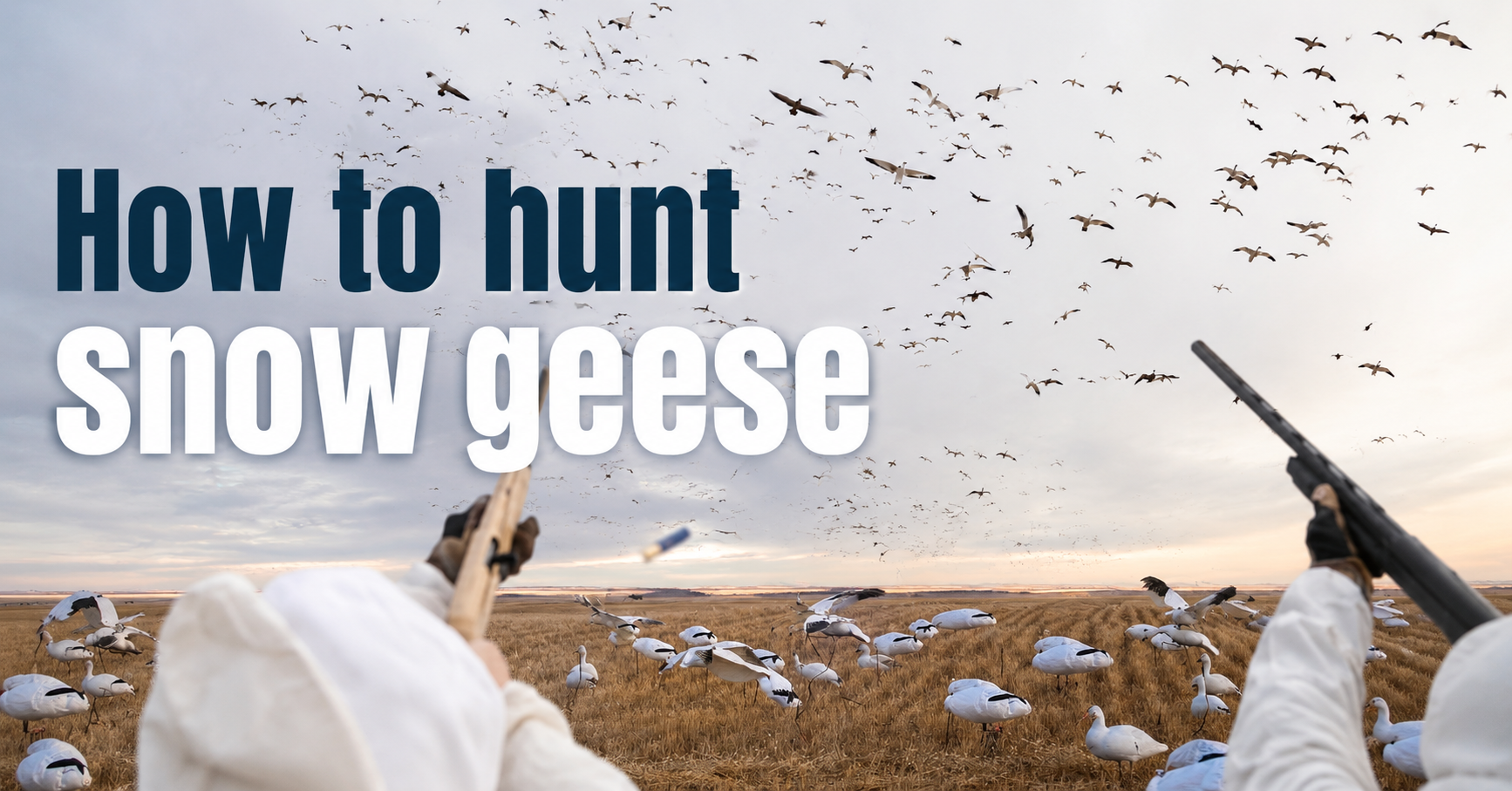

A distant flock of snow geese can look easy to locate. Thousands of white birds may cover a field, rise together, and remain visible for miles. Getting those same geese to approach a legal hunting setup is much harder. Mature birds may have encountered decoy spreads, electronic callers, layout blinds, vehicles, and hunting pressure throughout several migrations.
Learning how to hunt snow geese begins with current regulations and fresh scouting—not simply buying the largest decoy spread possible. You need to identify the birds correctly, understand their movement between roosting and feeding areas, secure lawful access, hide hunters and equipment, adapt the spread to wind and terrain, and plan safe shooting and recovery before the first flock arrives.
This guide is designed for beginners pursuing snow geese during a regular waterfowl season or an authorized light-goose conservation order. Those two opportunities can have significantly different rules, so every hunter must verify the exact requirements for the state, province, wildlife zone, public property, and season segment being hunted.
Quick Answer
To hunt snow geese, locate a recently used feeding field or legal travel corridor, secure permission, and build a concealed decoy setup that gives birds an open approach with the wind. Use realistic movement and legal calling methods, remain still while flocks circle, and let one experienced person coordinate the group. Positively identify every bird and take only safe opportunities within your practiced ability. Before hunting, confirm licenses, stamps, HIP registration, season dates, limits, approved nontoxic ammunition, firearm restrictions, electronic-call rules, land access, and reporting requirements.
Regular Season or Conservation Order?
Before planning equipment or tactics, determine which legal framework applies. A normal fall or winter waterfowl season is not the same as a special light-goose conservation order.
| Issue | Regular Waterfowl Season | Authorized Light-Goose Conservation Order |
|---|---|---|
| Primary purpose | Regulated recreational harvest under normal season frameworks | Additional management harvest of qualifying light-goose populations |
| Species | Species listed in the current local regulations | Usually qualifying light geese, which may include snow, blue-morph snow, and Ross’s geese |
| Electronic calls | Generally prohibited for migratory waterfowl | May be permitted where specifically authorized |
| Shotgun capacity | Generally limited to three shells | An unplugged shotgun may be permitted where specifically authorized |
| Shooting hours | Standard waterfowl shooting hours apply | Some orders may authorize extended hours |
| Bag limit | Current state or provincial limit applies | Limits may be liberalized or removed, depending on local implementation |
| Required documents | State license, applicable validations, HIP, and Federal Duck Stamp where required | Requirements vary; a separate conservation-order permit or registration may apply |
Federal regulations normally prohibit electronic bird calls and shotguns holding more than three shells while hunting waterfowl. Certain authorized light-goose-only opportunities may create exceptions, but hunters must follow the rules adopted by the individual state or jurisdiction rather than assuming every conservation order has identical provisions.
Regulatory information was reviewed on July 26, 2026. Official regulations and emergency orders always override general online guidance.
Important Legal and Safety Notice Before You Hunt
Snow geese are migratory waterfowl protected and managed through federal, state, provincial, tribal, and international systems. Rules can change by flyway, zone, property, season segment, and hunting method.
In the United States, hunters age 16 or older generally must possess a current signed Federal Duck Stamp or qualifying electronic stamp while hunting migratory waterfowl during seasons when that requirement applies. Licensed migratory-bird hunters are also generally required to enroll in the Harvest Information Program and carry proof of registration.
Verify all of the following before setting decoys:
- State, provincial, tribal, or territorial hunting license.
- Federal and local waterfowl stamps or validations.
- Harvest Information Program registration.
- Conservation-order permit or registration where applicable.
- Open season and legal shooting hours.
- Daily and possession limits.
- Species included in the opportunity.
- Legal shotgun gauge, capacity, and ammunition.
- Electronic-caller and motion-decoy rules.
- Baiting and agricultural-field regulations.
- Public-land permits, check-in procedures, and shell limits.
- Private-land permission and property boundaries.
- Required visibility clothing.
- Tagging, reporting, transportation, and species-identification rules.
Approved nontoxic shot is required for waterfowl hunting in the United States. The U.S. Fish and Wildlife Service maintains the current list of approved shot materials; hunters should not assume that every non-lead-looking load is approved.
Waterfowl baiting rules are especially important in agricultural country. A harvested field may be legal when grain is present through normal agricultural operations, but deliberately distributed or improperly manipulated grain can make the area illegal. Hunters are responsible for investigating the site rather than assuming the landowner, outfitter, or previous hunting group handled it lawfully.
Identify Snow Geese Before Planning the Hunt
Snow geese occur in white and dark “blue” color morphs. The white morph has a mostly white body with black wingtips, while the blue morph has a dark body and white head. Both commonly show a pink bill with a noticeable dark grin patch. The blue goose is a color form of the snow goose, not a separate species.
Ross’s geese frequently mix with snow geese and are commonly included in the regulatory term “light geese.” Ross’s geese are generally smaller and have a shorter, stubbier bill with a less prominent grin patch. Identification can become difficult when birds are overhead, mixed in large flocks, or viewed in poor light.
| Feature | Snow Goose | Ross’s Goose |
|---|---|---|
| Overall build | Larger, longer-bodied goose | Smaller and more compact |
| Bill | Longer pink bill with a pronounced grin patch | Shorter bill with a straighter-looking base and less obvious grin patch |
| White morph | White body with black wingtips | White body with black wingtips |
| Dark morph | Blue morph is common in some populations | True dark morph is exceptionally rare |
| Flock behavior | Often found in very large feeding and migration concentrations | Frequently associates with snow geese |
Do not shoot merely because a bird appears white. Swans, domestic geese, protected birds, and other species can occupy the same region. Wait until the species, legal status, and background are clear.
Understand Snow-Goose Movement
Snow geese breed in Arctic and subarctic areas and use open agricultural fields, marshes, lakes, ponds, rivers, sandbars, and coastal habitats during migration and winter. Large flocks commonly feed on waste grain, crop growth, roots, tubers, grasses, and other vegetation.
A typical daily pattern may include:
- Leaving a lake, marsh, river, or refuge used as a nighttime roost.
- Flying to an agricultural field or other feeding area.
- Moving progressively across the field as the flock feeds.
- Returning to water or another resting area.
- Making an additional feeding movement later in the day.
This pattern is not fixed. Weather, food availability, hunting pressure, migration timing, disturbance, snow cover, water conditions, and the age structure of the flock can change when and where birds move.
The Roost
A roost is the water or protected area where geese rest, particularly overnight. Avoid disturbing the main roost unless hunting is explicitly allowed and doing so fits the local management plan. Repeated disturbance can move birds away from the entire area and reduce opportunities for other hunters.
The Feed
The feed is the field or habitat the geese are actively using for food. Hunting the precise portion of the field where geese landed and fed is commonly called hunting “the X.” Fresh access to the X usually offers a stronger starting point than attempting to pull migrating birds into an unrelated field.
The Traffic Line
Traffic hunting means setting up beneath or near a regular flight route without occupying the flock’s chosen feeding destination. It can work, but it normally requires greater visibility, convincing sound, suitable wind, and strong concealment.
What You Need for a Snow-Goose Hunt
A first-time hunter does not need to own a commercial trailer full of decoys. Joining an experienced group, attending an agency-sponsored hunt, or hiring a lawful guide can provide a safer and less expensive introduction to the equipment and logistics.
Legal and Safety Essentials
- Current licenses, permits, stamps, and HIP documentation.
- Offline copies of current regulations.
- Legal shotgun and approved nontoxic ammunition.
- Eye and hearing protection for patterning and range preparation.
- Required blaze orange or other visibility clothing.
- First aid kit and personal medication.
- Map, compass, GPS, or offline navigation application.
- Charged phone, radio, or satellite communication device.
- Weather protection, drinking water, food, and emergency insulation.
- Properly fitted life jacket when using a boat or entering hazardous water.
Hunting Equipment
- Snow-goose windsocks, silhouettes, shells, or full-body decoys.
- Legal blind, layout blind, low-profile concealment, or white concealment clothing.
- Legal mouth call or authorized electronic-calling system.
- Speaker cables, batteries, chargers, and spare connectors.
- Decoy stakes, anchors, bags, and field-repair supplies.
- Binoculars or spotting scope for scouting.
- Headlamp with backup batteries.
- Game straps, clean bags, disposable gloves, and cooler space.
- Trained retriever and appropriate dog-safety equipment when used.
How to Hunt Snow Geese: Step-by-Step
Step 1: Select the Exact Legal Opportunity
Determine whether you are hunting a regular snow-goose season, a late season, or a conservation order. Read the entire regulation section rather than relying on a summary that mentions only season dates.
Confirm which rules apply to:
- Electronic calls.
- Shotgun plugs and shell capacity.
- Shooting hours.
- Federal and state stamp requirements.
- Bag and possession limits.
- Harvest reporting.
- Public-land access.
Step 2: Study the Migration
Snow geese move in response to seasonal conditions rather than a fixed calendar date. During spring migration, northbound flocks often advance as snow and ice retreat, while weather changes can temporarily hold or reverse movement. National wildlife refuges and bird-observation databases can help show broad migration progress, but local scouting is still necessary.
Track:
- Reports from the official wildlife agency.
- Refuge bird counts and observation updates.
- Changes in snow cover and thaw lines.
- New concentrations in nearby agricultural areas.
- Movement between known roosts and feeding fields.
Step 3: Scout at the Right Times
Observe the area during both morning and evening movement when possible. Use binoculars or a spotting scope from a lawful location without repeatedly driving at or flushing the birds.
Record:
- The roost location.
- The direction birds leave and return.
- The exact field and section they use.
- Approximate arrival and departure times.
- The number of family groups and large flocks.
- Where birds enter the field.
- Wind direction during the observation.
- Nearby roads, buildings, livestock, and neighboring property.
Scouting should be as current as practical. A field used several days ago may become unproductive after weather changes, agricultural work, migration, or hunting pressure.
Step 4: Secure Lawful Access
Snow-geese frequently concentrate on private agricultural land. Obtain permission from the person authorized to grant access and discuss the hunt clearly.
Ask about:
- Which field may be hunted.
- Where vehicles and trailers may travel.
- Whether wet ground must be avoided.
- Gate and fence procedures.
- Livestock and farm workers.
- Nearby homes and buildings.
- Other hunting groups.
- Decoy setup and removal times.
- Recovery near property boundaries.
- Any concern about crop damage or ruts.
Do not drive onto soft fields merely because permission was granted to hunt. Use the access route the landowner approves and leave the property cleaner than you found it.
Step 5: Confirm the Field Is Not Baited
Inspect the field and ask how the crop was planted, harvested, and managed. Waterfowl may generally be hunted over grain present because of normal agricultural planting or harvesting, but deliberately scattered feed and certain manipulations can create a baited area.
Do not rely on statements such as “everyone hunts here” or “the farmer said it was okay.” ‘ a conservation officer before hunting if the field condition is unclear.
Step 6: Choose the Right Spread Size and Decoy Type
Large spreads are common because snow geese naturally gather in large concentrations. However, the best spread is not automatically the largest one. It is the spread that the hunting group can transport, position, conceal, maintain, and remove safely.
Common decoy options include:
| Decoy Type | Main Advantage | Main Limitation | Best Beginner Use |
|---|---|---|---|
| Windsocks | Lightweight, packable, and provide wind-driven movement | Can collapse or move unnaturally in poor wind | Building an affordable, transportable spread |
| Silhouettes | Flat, durable, and easy to transport | May visually disappear from some approach angles | Adding numbers and structure to a spread |
| Shell decoys | More three-dimensional than silhouettes | Bulkier than windsocks | Creating visible feeding groups near the blind |
| Full-body decoys | Detailed three-dimensional appearance | Expensive, heavy, and storage-intensive | Placing realistic decoys near the landing area |
| Mixed spread | Combines visibility, movement, and realism | Requires more organization and equipment | Groups sharing equipment |
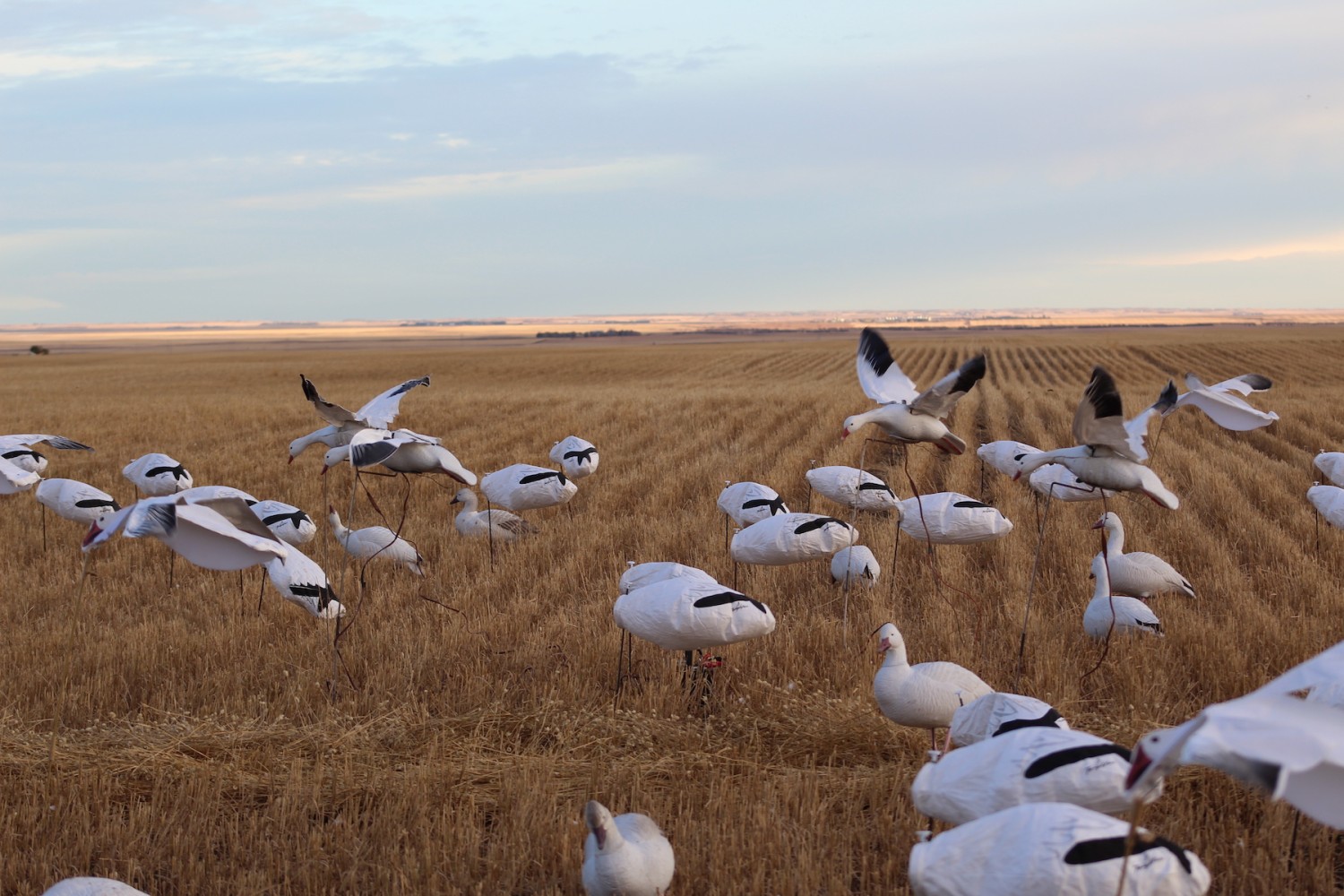
Recent beginner guidance from Ducks Unlimited notes that windsocks can provide an effective, relatively accessible entry into spring snow-goose hunting. Other guidance explains that smaller spreads can work under favorable conditions, even though many dedicated hunters use hundreds or more than a thousand decoys.
Step 7: Build the Spread Around the Wind
Snow geese commonly prefer a controlled approach into the wind, but field shape, terrain, flock direction, obstacles, and shifting air can alter the final approach. Start with the wind, then adjust according to how birds respond.
A useful spread normally includes:
- A visible body of feeding geese.
- Natural spacing rather than perfect rows.
- Small groups extending toward the expected approach.
- An open area where birds can approach safely.
- More visual concentration around the upwind feeding zone.
- A blind position that remains concealed from circling birds.
Traditional teardrop, J-shaped, U-shaped, and irregular feeding spreads can all work. The correct layout depends on the wind and field rather than the name of the pattern.
Step 8: Make Motion Look Natural
Snow geese are active feeders, so a completely motionless spread can appear unnatural. Windsocks, flexible stakes, flags, kites, and legal mechanical devices may add movement.
More motion is not always better. Remove or reposition equipment that spins violently, collapses, flashes, or moves differently from the rest of the spread. Frost, freezing rain, and very strong wind can also change how windsocks behave.
Step 9: Hide Every Hunter and Piece of Equipment
Concealment is often more important than adding another hundred decoys. Large flocks may circle repeatedly, giving many birds time to inspect the spread from different angles.
Hide:
- Layout blinds and blind edges.
- Faces and hands.
- Dogs and dog blinds.
- Electronic callers and speakers.
- Battery boxes and cables.
- Decoy bags and carts.
- Vehicles and trailers.
- Shiny hardware, shotgun surfaces, and phone screens.
Some hunters use white clothing or white blind covers to blend into a snow-goose spread. This can reduce visibility to other people, so coordinate the group carefully and wear any legally required high-visibility clothing while walking to and from the setup.
A “white stripe” created by several exposed blinds placed tightly together can become obvious from the air. Spreading blinds naturally and using lower-profile concealment may help reduce that problem.
Step 10: Use Calling Legally and Realistically
Electronic callers are commonly used during authorized spring light-goose conservation orders, but they are not automatically legal during every snow-goose season. Verify the exact rule first.
When electronic calling is legal:
- Use recordings appropriate to snow and Ross’s geese.
- Spread speakers so sound does not come from one unnatural point.
- Keep wires and battery boxes concealed.
- Use enough volume for the wind and distance without automatic maximum volume.
- Listen for distortion from weak batteries or damaged speakers.
- Carry spare power and weatherproof connectors.
Mouth calls can supplement the recording and help respond to individual flocks. Electronic-caller guidance from Ducks Unlimited emphasizes treating the system as a calling tool rather than relying on volume alone.
Step 11: Assign Group Roles Before Loading
Large snow-goose flocks can create confusion. Decide before hunting:
- Who watches approaching birds.
- Who operates or adjusts the caller.
- Who calls the shooting opportunity.
- Which direction each hunter may safely fire.
- Who handles the dog.
- Who marks birds for recovery.
- How the group will stop shooting.
Hunters must never swing through another person’s position or fire outside an assigned safe zone. Reconfirm everyone’s location after anyone leaves the blind to retrieve a bird or repair a decoy.
Step 12: Let the Birds Work
Snow geese may approach in layers, with smaller groups circling below a much larger flock. Movement inside the blind can turn the entire concentration away.
Keep heads and hands down while maintaining safe awareness. Do not repeatedly sit up to check the flock. A designated observer can quietly describe the birds’ position.
Patience does not mean allowing unsafe congestion. If birds, dogs, hunters, vehicles, or non-target species enter an unsafe location, do not shoot.
Step 13: Take Only Safe, Controlled Opportunities
Use a legal, properly patterned shotgun and approved nontoxic ammunition. Pattern the exact shotgun, choke, and hunting load before the season to understand how the combination performs at realistic distances.
A hunter should proceed only when:
- The bird is positively identified.
- The species is legal.
- The hunter remains within the legal limit.
- The bird is within the hunter’s demonstrated ability.
- The background is safe.
- No person, dog, building, road, livestock, or vehicle is endangered.
- Recovery is reasonably possible.
Do not fire indiscriminately into a dense flock. Select controlled opportunities and stop when birds move beyond your practiced range.
Step 14: Recover Birds Promptly
Snow geese may continue traveling after being hit. Watch each bird separately rather than assuming every bird fell in the main landing area.
Use an organized recovery method:
- Mark where each bird last appeared.
- Assign hunters or a dog to separate birds.
- Keep unloaded firearms controlled during retrieval.
- Avoid walking through active shooting lanes.
- Do not cross property boundaries without permission.
- Report bands according to the applicable program.
- Record every recovered bird toward the legal limit.
A trained retriever can be valuable, but it must be conditioned and controlled. Do not send a dog into dangerous current, unstable ice, heavy traffic, severe weather, or tangled decoy lines.
Step 15: Report and Handle the Harvest Correctly
Follow all tagging, recording, transportation, possession, and conservation-order reporting rules. Some special light-goose opportunities require hunters to report their total harvest even when daily limits are liberal.
Keep enough identification attached to birds when regulations require it during transportation. Do not mix birds among hunters in a way that violates tagging or possession rules.
Field Hunting, Water Hunting, and Pass Shooting
| Method | Main Strategy | Advantages | Main Risks or Limitations |
|---|---|---|---|
| Feeding-field setup | Decoy birds where they recently fed | Matches the flock’s chosen destination | Requires permission, extensive setup, and careful baiting review |
| Traffic-field setup | Pull birds from a regular flight route | Can work when the feeding field is unavailable | Usually demands more visibility and convincing calling |
| Water-edge setup | Hunt legal loafing or travel water | May require fewer field decoys | Cold water, current, boat use, and retrieval increase risk |
| Pass shooting | Position under a legal low flight route | Requires fewer decoys | Distance judgment, background, property lines, and pressure are major concerns |
Pass shooting must be conducted only from a legal location with a safe background. Do not shoot from or across roads, crowd another group, or position yourself to intercept geese actively working another hunter’s spread.
Boat and Water Safety
Wear a properly fitted life jacket when using a boat or hunting around hazardous water. The U.S. Coast Guard advises wearing an approved life jacket whenever a vessel is underway and requires an accessible wearable device for each person aboard under federal carriage rules.
- Count hunters, dogs, decoys, batteries, fuel, motors, firearms, and harvested birds toward the total load.
- Do not overload the boat.
- Distribute weight according to the manufacturer’s directions.
- Keep firearms unloaded and controlled during travel and difficult boarding.
- Check wind, current, wave height, visibility, and water temperature.
- Carry waterproof communication, navigation, lighting, and emergency equipment.
- Turn back before conditions exceed the crew’s experience or equipment.
Best Conditions for Snow-Goose Hunting
Wind
Moderate, steady wind helps orient birds, produces decoy movement, and can make the likely approach easier to predict. No wind can leave windsocks limp, while extreme wind can create unnatural movement and difficult shooting or retrieval.
Cloud Cover
Clouds may reduce glare and strong blind shadows. Bright sun can expose faces, equipment, and blind edges but may also help hunters use natural shadows. Inspect the setup as lighting changes.
Cold Fronts and Migration Weather
Weather fronts can create new migration activity or hold birds in an area. A productive day is not guaranteed simply because temperatures fall. Use current refuge observations and direct scouting rather than relying on a weather rule alone.
Fresh Snow
White ground can improve camouflage for a white spread, but it can also make dark equipment and muddy access routes obvious. Ice, wind chill, poor roads, and hypothermia become greater concerns.
Rain and Mud
Wet fields may prevent vehicle access and make layout blinds difficult to conceal. Respect landowner restrictions and avoid damaging agricultural ground.
Helpful Tips for Better Results
- Scout the evening before the hunt whenever possible.
- Confirm permission again if weather may affect field access.
- Hide vehicles and trailers well beyond the likely approach.
- Use mixed decoys instead of relying only on greater numbers.
- Place the most realistic decoys near the intended approach.
- Carry spare batteries, cables, stakes, and basic repair tools.
- Inspect windsocks for frost or collapse during weather changes.
- Choose one person to coordinate calling and shooting.
- Practice shouldering and handling the unloaded shotgun from the blind.
- Keep the hunting group small enough to maintain safe muzzle control.
- Record which direction birds approach and where they repeatedly turn.
- Be willing to move or stop when the setup is unsafe or clearly ineffective.
Common Beginner Mistakes
Using Old Scouting Information
Snow geese can move quickly with weather, pressure, or changing food. Confirm that the field is still active shortly before the hunt.
Believing Decoy Count Solves Every Problem
A large spread in the wrong field with visible blinds remains a poor setup. Location and concealment generally deserve attention before adding more decoys.
Parking Too Close
Vehicles and trailers can be visible from a great distance in open country. Follow landowner instructions and hide them without damaging fields or blocking roads.
Creating a Visible Blind Line
Several blinds brushed identically in one straight row can create an unnatural stripe. Break up the outline and inspect it from the expected approach.
Using Excessive Caller Volume
Maximum volume can distort recordings and make sound appear artificial. Match volume to wind, distance, and flock reaction.
Ignoring Speaker Placement
One loud speaker can make the flock sound as though it occupies a tiny point. Distributed speakers can create more natural sound when legal and properly concealed.
Assuming Conservation-Order Rules Apply Everywhere
Electronic calls, extended hours, unplugged shotguns, and liberal limits are legal only where the current regulations authorize them.
Failing to Pattern the Shotgun
Different nontoxic loads and chokes can produce different patterns. Patterning helps establish realistic limits and reveals equipment problems before hunting.
Shooting Without Group Coordination
Large flocks can cause several hunters to move at once. Establish zones of fire and one clear person responsible for calling the opportunity.
Neglecting Recovery and Meat Care
Plan enough people, dog support, cooling space, and clean handling supplies for the possible harvest allowed under the season.
Troubleshooting Snow-Goose Setups
| Problem | Possible Causes | What to Check | Practical Next Step |
|---|---|---|---|
| Geese ignore the field | Wrong location, stale scouting, stronger destination elsewhere | Current roost-to-feed route | Return to scouting rather than adding random calling |
| Flocks turn at long distance | Visible vehicles, weak spread visibility, excessive pressure | Field position and approach direction | Hide equipment and improve the spread’s visual footprint |
| Geese circle but will not descend | Exposed blinds, unnatural motion, poor landing space | Blind line, windsocks, decoy spacing, wind | Fix concealment before changing every decoy |
| Birds flare at the same point | Face, dog, shiny object, caller, cable, or blind edge | The precise location birds are viewing | Cover or relocate the suspected problem |
| Birds land outside the spread | Field contour, crosswind, more attractive open ground | Actual wind and preferred landing location | Move the legal landing area toward the birds’ chosen line |
| Caller sounds distorted | Weak batteries, damaged speaker, excessive volume | Power, connections, and individual speakers | Replace or isolate the faulty component |
| Windsocks do not move | Insufficient wind, frost, unsuitable stakes | Sock openings and wind direction | Use silhouettes or remove collapsed decoys |
| Windsocks spin violently | Excessive or turbulent wind | Stake position and terrain | Reduce unnatural motion and widen the setup |
| Shotgun performance is inconsistent | Loose choke, unsuitable load, maintenance issue | Manufacturer instructions and range pattern | Stop hunting and have the system inspected |
| Recovery becomes unsafe | Water, ice, darkness, private boundaries, severe weather | Risk, access, and legal authority | Stop and request authorized assistance |
What Not to Do
- Do not hunt without checking current waterfowl and conservation-order regulations.
- Do not assume electronic calls or unplugged shotguns are legal.
- Do not hunt a field when baiting legality is uncertain.
- Do not trespass to scout, set decoys, or recover a bird.
- Do not shoot at unidentified white birds.
- Do not fire toward roads, homes, livestock, vehicles, people, dogs, or buildings.
- Do not rely on the firearm’s mechanical safety instead of muzzle control.
- Do not overload a boat or travel unstable ice.
- Do not drive into a wet field without landowner approval.
- Do not crowd another hunting party or interfere with birds working its spread.
- Do not abandon decoys, shell hulls, wires, batteries, or other trash.
- Do not continue when weather, visibility, fatigue, or group confusion makes the hunt unsafe.
Ethical Hunting and Conservation
Light-goose conservation orders were created as wildlife-management tools in response to concerns about overabundant populations and damage to sensitive Arctic habitats. That management purpose does not remove the hunter’s responsibility to identify birds, shoot within demonstrated ability, recover game, obey local rules, and use the harvest responsibly.
Ethical participation includes:
- Following season, species, and reporting requirements.
- Taking only recoverable opportunities.
- Stopping when the group loses control of safe zones.
- Making a reasonable legal recovery effort.
- Using edible meat instead of treating birds as disposable.
- Respecting landowners, farm operations, and neighboring hunters.
- Answering harvest surveys accurately.
- Removing every piece of hunting equipment and litter.
After the Hunt: Health, Meat Care, and Equipment
Handling Birds Safely
Do not handle birds that were found dead or appeared obviously sick before harvest. The CDC recommends good hygiene, dedicated game-cleaning tools, cleaning and disinfecting work surfaces, and avoiding eating, drinking, or touching the face while processing birds.
- Wear disposable gloves.
- Cover cuts and broken skin.
- Keep cleaning tools away from domestic poultry and pet-bird equipment.
- Wash hands with soap and water afterward.
- Clean and disinfect tools and work surfaces.
- Keep dogs and pets from eating raw birds or discarded tissues.
- Follow wildlife-agency disease advisories.
Cooling and Cooking
Keep harvested birds clean and cool them promptly. The CDC advises cooking game birds to an internal temperature of 165°F, measured with a food thermometer. Proper cooking to 165°F also destroys avian-influenza viruses that may be present in poultry or game-bird meat.
Equipment Cleanup
- Unload and secure firearms before cleaning.
- Remove mud from decoys, stakes, boots, trailers, and vehicles.
- Dry layout blinds and fabric decoys completely.
- Inspect caller cables, speakers, plugs, and batteries.
- Repair torn windsocks and damaged stakes.
- Charge or remove batteries before long-term storage.
- Clean coolers, game bags, knives, and gloves.
- Restock first aid and emergency supplies.
When to Seek More Training or Professional Guidance
Consider an official course, experienced mentor, qualified guide, firearms instructor, wildlife officer, or boating instructor when:
- You have never hunted migratory waterfowl.
- You are unfamiliar with shotgun handling.
- You cannot distinguish snow geese from similar birds.
- You are uncertain about conservation-order regulations.
- You cannot determine whether a field may be baited.
- You lack permission or reliable boundary information.
- You have never operated an electronic-calling spread.
- You are hunting unfamiliar public land.
- You plan to use a boat in cold water.
- You need help patterning a shotgun safely.
- You are uncertain about recovery or meat handling.
FAQs
1. Are snow geese difficult to hunt?
They can be challenging because mature birds may have encountered many spreads and callers during previous migrations. Fresh scouting and concealment are usually more important than one special piece of equipment.
2. What is the best way for a beginner to hunt snow geese?
Join an experienced, safety-conscious group or lawful guide. This allows the beginner to learn regulations, identification, large-spread logistics, calling, firearm coordination, and recovery without buying a complete rig immediately.
3. What is a light goose?
In many U.S. regulations, light geese include snow geese, blue-morph snow geese, and Ross’s geese. Confirm the definition in the current regulations for the hunting area.
4. Is a blue goose a separate species?
No. A blue goose is a dark color morph of the snow goose.
5. How can I distinguish a snow goose from a Ross’s goose?
Snow geese are generally larger and have a longer pink bill with a prominent dark grin patch. Ross’s geese are smaller with shorter bills and less obvious grin patches.
6. When is snow-goose season?
There is no nationwide date. Seasons vary by state, province, zone, flyway, property, and whether the opportunity is a regular season or conservation order.
7. What is a light-goose conservation order?
It is a management framework that allows participating jurisdictions to offer additional harvest opportunities for qualifying light-goose populations outside or beyond some normal season provisions.
8. Are electronic calls legal for snow geese?
They may be legal during an authorized conservation order or special light-goose season. They are generally prohibited during normal migratory-waterfowl seasons unless regulations specifically provide an exception.
9. Can I remove the shotgun plug during snow-goose season?
Only when the applicable conservation-order or special-season rules explicitly allow an unplugged shotgun. The normal federal waterfowl limit generally restricts a shotgun to three shells.
10. Do I need a Federal Duck Stamp?
U.S. waterfowl hunters age 16 or older generally need a current Federal Duck Stamp during applicable migratory-waterfowl seasons. Conservation-order requirements can differ, so check the state’s current rules.
11. Do I need HIP registration?
Licensed migratory-bird hunters in the United States are generally required to enroll in the Harvest Information Program unless a specific exemption applies.
12. Can I use lead shot for snow geese?
No. U.S. waterfowl hunters must use shot materials approved as nontoxic by the U.S. Fish and Wildlife Service.
13. What shotgun is best for snow geese?
Use a lawful, reliable shotgun that fits the hunter and is approved for the chosen nontoxic load. Proper fit, safe handling, pattern performance, and familiarity matter more than a brand name.
14. What choke should I use?
No choke is universally best. Pattern manufacturer-approved chokes with the exact legal ammunition and select the combination that performs consistently at realistic hunting distances.
15. How many decoys do I need?
There is no required number. Dedicated groups often use hundreds or more, but smaller well-positioned spreads can work under favorable conditions. Start with equipment you can manage safely.
16. Are windsock decoys effective?
Yes. They are lightweight, packable, and provide wind-driven motion. They work poorly when collapsed, frosted, or spinning unnaturally.
17. Are full-body decoys necessary?
No. They add three-dimensional realism but are expensive and bulky. Many effective spreads combine windsocks, silhouettes, shells, and a smaller number of full bodies.
18. What is the best snow-goose decoy pattern?
No pattern works everywhere. Build a natural feeding spread around the wind, blind location, field shape, and direction from which birds are arriving.
19. What is a teardrop spread?
It is a decoy arrangement with a wide feeding body tapering into a narrower tail. Hunters adapt it to wind and blind position rather than following a rigid diagram.
20. Do snow geese always land into the wind?
They commonly prefer an into-wind approach, but terrain, flock direction, obstacles, and shifting air can change the final path.
21. Where should the blinds go?
Place them where they can be hidden while keeping the likely approach inside safe zones of fire. Avoid creating a straight, obvious line of exposed blinds.
22. Why do snow geese circle without landing?
Possible causes include visible blinds, vehicles, unnatural motion, unsuitable wind, poor landing space, excessive caller volume, or a stronger feeding destination elsewhere.
23. Why do geese flare at the same location?
They may see a hunter’s face, a dog, reflective hardware, a battery box, a cable, an exposed blind edge, or unnatural decoy movement.
24. How loud should an electronic caller be?
Use enough volume to be heard in the current wind without causing distortion. Observe flock reactions and reduce volume when birds repeatedly turn away as sound increases.
25. How many speakers should I use?
That depends on the system and spread. Multiple properly placed speakers can distribute sound more naturally, but every component must remain legal, concealed, and weather-protected.
26. Can I hunt snow geese without an electronic caller?
Yes. Mouth calls and good positioning can work, particularly during regular seasons or in areas where electronic calls are prohibited.
27. What is hunting the X?
It means setting up at the precise field location where geese recently chose to feed or land.
28. What is traffic hunting?
Traffic hunting means trying to draw passing geese into a field along their regular route rather than hunting their chosen feeding destination.
29. Should I hunt the roost?
Roost hunting may be prohibited or counterproductive. Disturbing a major roost can move birds away from the area. Follow local regulations and management guidance.
30. Can I hunt snow geese on public land?
Yes, where the property is open to the species and season. Check permits, reservations, check-in procedures, blind assignments, shell limits, closed zones, and decoy-removal rules.
31. How do I obtain private-land permission?
Contact the landowner or authorized manager, explain the date and group size, and ask about vehicles, gates, crops, livestock, buildings, other hunters, and retrieval boundaries.
32. Can I hunt over a harvested crop field?
Potentially, when grain is present through a normal agricultural operation and all other rules are satisfied. Do not hunt when the field’s baiting status is uncertain.
33. What weather is best?
Moderate wind can orient birds and move decoys, while migration fronts may produce new activity. No weather condition guarantees a productive hunt.
34. Should I wear white camouflage?
White clothing can blend into a snow-goose spread, particularly over snow or white windsocks. Coordinate the group carefully because it can also make hunters difficult for other people to see.
35. How do I keep blinds from looking obvious?
Reduce their height, avoid straight rows, match local ground conditions, cover dark edges, conceal occupants, and inspect the setup from the expected approach.
36. Are snow geese safe to eat?
Properly handled snow-goose meat can be used as food. Avoid birds that appeared sick, follow disease advisories, maintain clean handling practices, cool the meat promptly, and cook it to 165°F.
37. Should I wear gloves while cleaning snow geese?
Yes. Disposable gloves reduce direct contact with blood, tissues, feces, and potentially contaminated surfaces.
38. What should I do if a goose appears sick?
Avoid unnecessary contact, do not consume it, keep dogs away, and contact the wildlife or public-health agency for instructions.
39. Can I use a retriever?
Yes, where dogs are allowed. The dog should be trained, conditioned, identifiable, controlled around firearms, and protected from cold, ice, traffic, and decoy lines.
40. What is the most important snow-goose hunting tip?
Use fresh scouting to hunt a lawful location the geese already want to use. A large spread cannot reliably compensate for the wrong field, visible hunters, or unsafe decisions.
Final Thoughts
Learning how to hunt snow geese requires more than purchasing decoys and an electronic caller. Begin by identifying the exact season, reviewing the current regulations, and learning to distinguish snow geese from Ross’s geese and other white birds.
Scout current feeding areas, obtain lawful access, verify that agricultural fields comply with baiting rules, and arrange the spread around wind, terrain, concealment, and safe shooting directions. Use calling and special conservation-order methods only when authorized.
During the hunt, maintain muzzle control, stay within practiced limits, coordinate the group, and recover birds promptly. Afterward, complete reporting requirements, handle the harvest hygienically, cool the meat, clean the equipment, and leave the property in good condition.
Snow-geese do not respond predictably every day. Careful observation, patience, safety, legal compliance, and respect for wildlife are more dependable than any promise of guaranteed success.
Read more: