
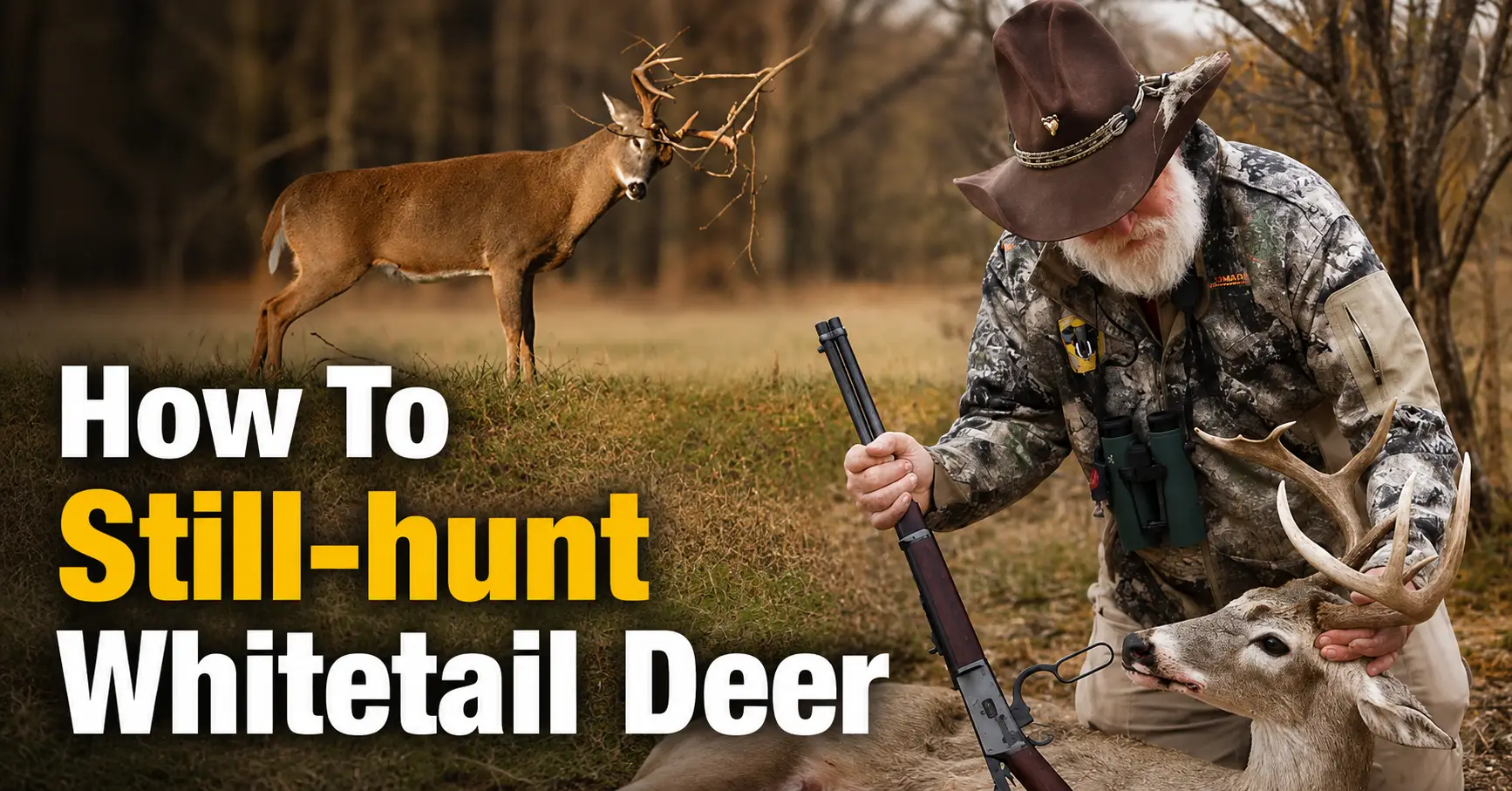

Plan the wind, read cover, move with purpose, observe longer than you walk, and take only legal, clearly identified, ethical opportunities.
Introduction
Learning how to still-hunt whitetail deer means learning to slow down. Instead of waiting in one fixed stand, a still-hunter moves deliberately through legal deer habitat, pauses frequently, studies cover, and tries to detect a deer before the deer detects the hunter.
The method can be productive in timber, brush, broken terrain, fresh snow, damp leaves, and windy conditions. It is also demanding. A moving hunter must manage changing wind, uncertain backgrounds, other land users, property boundaries, noise, fatigue, and close encounters in thick cover.
This guide is for beginners who want a practical, safety-focused approach. No technique guarantees success. Results depend on current regulations, habitat, weather, deer behavior, hunting pressure, preparation, field skill, patience, and ethical decision-making.
Quick Answer
To still-hunt whitetail deer, first verify all current licenses, tags, seasons, legal
weapons, access rules, visibility-clothing requirements, and hunting hours. Scout a route
with fresh deer sign, safe boundaries, useful terrain, and a headwind or manageable
crosswind. Move one or two quiet steps, stop near cover, and scan for small pieces of a
deer before moving again. Take an opportunity only after positively identifying a legal
deer and confirming a safe foreground, background, and shooting direction within your
practiced ability.
Important Legal and Safety Notice Before You Hunt
Deer-hunting laws vary by country, state, province, county, wildlife unit, land type, season, and hunting method. Consult the official wildlife agency and the land manager immediately before the hunt. Never treat a regulation from another location or a prior
season as current.
- Carry every required hunting license, deer tag, permit, and land-access document.
- Verify season dates, legal hours, bag limits, antler rules, legal weapons, and ammunition rules.
- Confirm public-land boundaries, private-land permission, safety zones, road restrictions, and parking rules.
- Wear fluorescent orange or pink whenever required and consider high visibility when sharing woods with others.
- Treat every firearm as loaded, control the muzzle, keep the finger outside the trigger guard, and know the target and beyond.
- Never shoot toward roads, trails, buildings, vehicles, livestock, people, or unidentified movement.
- Never use a riflescope to identify an unknown object; use binoculars instead.
- For bows, protect broadheads, follow legal equipment rules, and stay within a practiced effective range.
- Carry navigation, first-aid, hydration, weather, and emergency-communication essentials.
- Follow tagging, harvest reporting, carcass transport, CWD, meat-care, and disposal rules.
Complete hunter education and hunt with an experienced, ethical mentor when possible.
Stop whenever visibility, fatigue, weather, other users, or uncertainty makes the situation unsafe.
What Still-Hunting Really Means
Still-hunting is not ordinary walking through the woods. The hunter spends more time
stopped than moving. Each movement is planned from one piece of cover to another, and
every pause is used to study habitat from close range to the farthest visible opening.
Still-Hunting
Moving slowly through likely habitat before a specific deer has been located.
Stalking
Closing distance after a particular deer has been seen and evaluated.
Stand Hunting
Waiting from a fixed ground or elevated position near expected deer movement.
Why the Method Is Difficult
Whitetails detect movement, sound, and scent extremely well. At ground level, the hunter
also has fewer safe shooting angles than from some elevated setups. Branches, terrain,
vegetation, and other users can enter the foreground or background quickly. The method
rewards restraint more than speed.
Understanding Whitetail Behavior and Habitat
A useful still-hunt route connects places deer are likely to use while giving the hunter
safe visibility and wind control. Deer commonly move among food, water, bedding cover,
thermal cover, and secure travel corridors, but the exact pattern changes with season,
weather, hunting pressure, habitat, and local disturbance.
Key Habitat Features
- Bedding cover: thick vegetation, sheltered slopes, benches, young timber, marsh edges, and other secure areas.
- Feeding areas: natural browse, mast, agricultural edges, openings, and seasonal food sources where legal access permits.
- Travel corridors: creek bottoms, saddles, benches, fence gaps, edge cover, and narrow terrain features.
- Transition cover: boundaries between mature timber, brush, young growth, wetland, and open ground.
- Wind shelter: lee slopes, hollows, conifers, and dense vegetation that may offer relief during harsh conditions.
Read Sign as a Pattern, Not a Promise
Tracks, droppings, trails, beds, rubs, scrapes, browse, and crossings show use, but they
do not prove a deer is currently present. Compare freshness, quantity, location, wind,
nearby food and cover, and evidence of other hunters before choosing the route.
How to Scout a Safe Still-Hunt Route
- Start with a current map. Mark legal access, boundaries, roads, trails, homes, structures, water, steep slopes, and closed areas.
- Identify likely deer zones. Note bedding cover, food, travel funnels, crossings, and recent sign.
- Find observation corridors. Favor routes with intermittent openings where a deer can be identified safely.
- Plan for wind options. Build a primary route and at least one alternate for a different wind.
- Mark exit routes. Include a direct way out before dark or if weather, fatigue, or hunting pressure changes.
- Check the route on the ground. Confirm map accuracy, boundary signs, fences, water crossings, and hazards before relying on it.
the thickest sign. It is the route that combines likely deer use with legal access, safe
identification, a dependable background, controlled wind, and a responsible exit.
Still-Hunting Gear and Preparation Checklist
Expensive gear is not required. Every item should support safety, quiet movement,
navigation, observation, legal compliance, or responsible handling of a harvest.
- Current hunting license, tags, permits, and regulation guide
- Legal firearm, bow, or hunting method you can use safely
- Required fluorescent orange or pink visibility clothing
- Quiet, weather-appropriate layered clothing
- Supportive boots suitable for wet leaves, snow, slopes, or mud
- Compact binoculars for identifying objects without pointing a weapon
- Paper map and compass, plus GPS or a hunting app as a supplement
- First-aid kit and emergency communication
- Water, food, weather protection, and a small light
- Legal wind indicator that leaves no litter
- Drag, pack, or retrieval plan appropriate to terrain and local rules
- Gloves, game bags, cooler, and clean meat-care supplies
Prepare the Hunting Tool Before the Season
Confirm function and accuracy at an approved range. Follow the manufacturer’s manual,
use only correct ammunition or legal archery equipment, and know your effective range
from realistic practice. Still-hunting is not the time to test unfamiliar equipment.
How to Still-Hunt Whitetail Deer: Step-by-Step Guide
-
Check Laws, Tags, Hours, and Access
Verify the exact season, deer tag, legal animal, hunting hours, method, blaze-color
requirements, reporting rules, CWD restrictions, and land access. Download or carry
the current official information rather than relying on memory. -
Choose the Route for Today’s Wind
Select a route that keeps the wind in your face or safely across your path while
avoiding scent flow into likely deer cover. Account for terrain-driven swirls and
thermal changes. Cancel or change the route when the wind cannot be managed. -
Tell Someone the Plan
Share the access point, route area, expected return time, vehicle description, and
communication plan. Carry emergency equipment suited to the remoteness and weather. -
Enter Without Disturbing the Area
Park respectfully, close gates as directed, avoid unnecessary lights and noise, and
stay on the legal approach. Do not cross private parcels, closed roads, crops, or
uncertain boundaries to shorten the walk. -
Begin in Low-Probability Cover
Use the approach to settle into a quiet pace. Confirm the wind, secure loose equipment,
and slow down before entering fresh sign, edge cover, trail junctions, or likely bedding terrain. -
Move From Cover to Cover
Choose the next tree, brush clump, terrain fold, or shadow before stepping. Stop where
your outline is broken and where a stable, safe position would be possible if a deer appears. -
Take One or Two Deliberate Steps
Lift each foot clear of sticks, place it softly, transfer weight gradually, and keep
the upper body controlled. Use wind gusts or natural background noise to cover
unavoidable sound, but never rush merely because the woods are noisy. -
Stop and Let the Scene Settle
Freeze in a balanced position. Let branches stop moving, listen for footfalls or
movement, and allow your eyes to adjust. The pause should be much longer than the movement. -
Scan Near, Middle, and Far Cover
Search close cover before looking through distant openings. Examine horizontal lines,
color changes, ears, legs, antler curves, tails, and small movements. Use binoculars
to identify objects without aiming a firearm at them. -
Read Fresh Sign Without Fixating on It
Tracks and trails may guide the route, especially in snow, but keep your eyes ahead.
A hunter looking only at the ground may walk into deer, another hunter, a boundary,
or an unsafe shooting situation. -
Recheck Wind and Position Frequently
Wind can change at creek bottoms, ridge points, openings, and sun-warmed slopes.
Reassess before entering each major cover type. Back out when scent is being carried
into the area you intend to hunt. -
Prepare Before Reaching the Highest-Probability Zone
Quietly settle clothing, check footing, adjust optics, and identify safe shooting
directions before approaching a trail crossing, bedding edge, bench, saddle, or fresh sign.
Do not manipulate equipment after a deer appears unless it can be done safely. -
Identify the Entire Animal and the Background
Do not react to a patch of hair, antler-like branch, sound, or unclear movement.
Confirm species, legal status, nearby animals, foreground vegetation, background,
roads, trails, buildings, livestock, and people. -
Take Only a Safe, Legal, Ethical Opportunity
Act only when the deer is clearly legal, the path is unobstructed enough for a
responsible opportunity, the background is safe, and the distance and position are
within your practiced ability. Passing is the correct choice whenever anything is uncertain. -
Follow Responsible Recovery Procedures
Keep control of the firearm or bow, observe carefully, mark the location, and follow
your hunter-education training and local recovery rules. Do not cross property
boundaries without required permission. -
Tag, Report, Transport, and Care for the Harvest
Complete tagging or validation promptly as required, submit harvest reporting on time,
follow CWD and transport rules, keep tools clean, cool the meat appropriately, and avoid waste.
The Still-Hunter’s Movement and Observation Rhythm
A useful rhythm is simple: plan, step, settle, listen, scan, and repeat. The exact timing
changes with cover, but the sequence prevents normal walking habits from taking over.
Use Your Eyes in Layers
- Near layer: thick brush, deadfalls, trail edges, and cover immediately around you.
- Middle layer: trunks, lanes, benches, creek bends, and patches of contrasting vegetation.
- Far layer: ridge shoulders, field edges, open timber, and distant crossings.
Stop Where a Safe Decision Is Possible
Whenever practical, pause beside a tree or terrain feature that breaks your outline and
offers stable footing. Avoid stopping where a sudden deer appearance would leave you
off-balance, silhouetted, or unable to confirm a safe background.
Best Time, Terrain, and Conditions for Still-Hunting
| Condition | Potential Advantage | Main Caution |
|---|---|---|
| Damp leaves or light rain | Quieter footing and reduced clothing noise | Slippery roots, wet optics, hypothermia, and changing wind |
| Fresh snow | Visible tracks and quieter movement | Cold exposure, glare, difficult travel, and track fixation |
| Moderate steady wind | Masks small sounds and vegetation movement | Falling limbs, swirling terrain wind, and reduced hearing |
| Broken terrain | Ridges, folds, and ditches conceal movement | Unsafe backgrounds and sudden close encounters |
| Thick edge cover | Deer sign and short observation lanes | Obstructed views and other users hidden nearby |
| Calm, dry leaves | Good hearing and visibility in open timber | Every step may carry; stationary hunting may be wiser |
Avoid forcing the method in dangerous weather. High winds with falling limbs, thunderstorms,
flooding, dangerous heat or cold, fog, smoke, and very poor visibility can make a planned
route unsafe.
Public Land and Private Land Considerations
Public Land
- Use the land manager’s current map and verify every boundary and seasonal closure.
- Expect hunters, hikers, workers, pets, cyclists, and vehicles even away from marked trails.
- Wear required visibility clothing and never investigate movement with a weapon-mounted optic.
- Give stationary hunters wide space and do not walk through another person’s setup.
- Park without blocking gates, roads, emergency access, or other vehicles.
Private Land
- Obtain explicit permission and understand which parcels, dates, methods, and guests are allowed.
- Know homes, barns, livestock, equipment, roads, and landowner safety zones.
- Follow instructions for gates, crops, vehicles, parking, and harvest communication.
- Do not cross onto neighboring land during the hunt or recovery without required permission.
- Leave the property cleaner than you found it and report damage or concerns promptly.
Common Still-Hunting Mistakes to Avoid
- Moving at normal walking speed through productive cover.
- Looking only for a complete deer instead of small visible parts.
- Ignoring close cover while glassing distant openings.
- Following tracks with eyes fixed on the ground.
- Letting the wind carry scent into bedding or travel cover.
- Stopping in openings where the human outline is obvious.
- Using a riflescope to inspect unidentified movement.
- Assuming a branch-free view also has a safe background.
- Entering land without clear permission or crossing uncertain boundaries.
- Failing to wear required high-visibility clothing.
- Hunting unfamiliar terrain without a reliable map and exit plan.
- Continuing after fatigue reduces balance, muzzle control, or judgment.
- Pushing into dense bedding cover without safe visibility.
- Taking a rushed or uncertain opportunity at a moving or obscured animal.
- Failing to plan tagging, reporting, recovery, transport, and meat care.
Troubleshooting Common Problems
| Problem | Likely Cause | Responsible Adjustment |
|---|---|---|
| Deer repeatedly detect you first | Fast movement, poor pauses, silhouette, wind, or noisy gear | Slow down, extend observation time, stay beside cover, and change the route for the wind. |
| Fresh sign but no sightings | Sign is old, nocturnal, seasonal, or affected by pressure | Compare freshness, scout adjacent cover, vary timing, and avoid repeatedly disturbing one route. |
| Dry leaves are too loud | Calm weather and poor foot placement | Use wind gusts, move fewer steps, select softer ground, or choose a stationary method. |
| Wind begins swirling | Terrain, sun, openings, or changing weather | Stop, test the wind, retreat or use an alternate route rather than contaminating the cover. |
| Visibility is too limited | Dense vegetation or poor light | Move to an edge or opening where identification and background are safe; otherwise leave. |
| Other hunters are nearby | Shared access or concentrated pressure | Make your presence known safely, create distance, and change areas without entering their shooting lane. |
| You are unsure of the boundary | Inaccurate map, weak signal, or missing markers | Stop before crossing, confirm with authoritative maps or the landowner, and turn back if uncertain. |
| A deer appears suddenly at close range | Thick cover and ground-level movement | Remain controlled. Do not swing through unknown background or act before full identification. |
| Fatigue is affecting control | Long route, heat, cold, steep terrain, or heavy pack | Unload or secure equipment as trained, rest safely, hydrate, and end the hunt if judgment declines. |
| Recovery may cross private land | The deer traveled beyond legal access | Do not trespass. Follow local procedures and obtain permission or agency assistance as required. |
Ethical Hunting and Conservation
Responsible still-hunting is measured by decisions, not distance covered or opportunities
taken. Ethical hunters respect wildlife, legal limits, habitat, landowners, other hunters,
and every person sharing the landscape.
- Practice until you know your safe, effective range from realistic positions.
- Pass any opportunity involving uncertain identification, legal status, foreground, or background.
- Do not crowd, chase, or intentionally interfere with other hunters.
- Use legal access and protect gates, crops, livestock, roads, and private property.
- Tag and report accurately, follow disease-management rules, and cooperate with wildlife monitoring.
- Plan responsible recovery and meat care before entering the field.
- Avoid waste and use the harvest respectfully.
- Pack out litter and leave habitat cleaner than you found it.
Hunting licenses and responsible participation can support wildlife management and hunter
education, but conservation also requires obeying limits, protecting habitat, reporting
disease concerns, and adapting to official management guidance.
After the Hunt: Follow-Up, Gear Care, and Learning
- Complete every required tag, validation, and harvest report.
- Follow current carcass-transport, CWD testing, disposal, and meat-handling rules.
- Clean and store firearms, bows, broadheads, optics, and knives according to manufacturer instructions.
- Dry clothing and boots, inspect emergency supplies, and replace used first-aid items.
- Record route, wind, weather, sign, deer observations, other users, and problem areas.
- Compare the planned route with what actually happened and identify safer alternatives.
- Thank the landowner where applicable and report damaged gates, fences, or hazards.
When to Get More Training or Professional Guidance
Seek additional help when:
- You have not completed hunter education.
- You are unfamiliar with the firearm, bow, ammunition, or broadhead system.
- You cannot confidently identify safe field carries and obstacle-crossing procedures.
- You are unsure about local law, tags, legal animals, boundaries, CWD rules, or reporting.
- You cannot produce consistent accuracy from realistic hunting positions.
- You are hunting unfamiliar, remote, steep, wet, snowy, or navigation-challenging terrain.
- You need help with legal recovery, meat care, processing, or transport.
Recommended Authority Resources
U.S. Fish & Wildlife Service Hunter Education Program
New York State Department of Environmental Conservation Hunter Education
Pennsylvania Game Commission Deer Hunting Resources
Pennsylvania Game Commission Chronic Wasting Disease Information
Use the official wildlife agency for the jurisdiction where you will actually hunt.
The links above are educational examples, not universal regulations.
Frequently Asked Questions: Numbered Q&A
The following 40 questions cover legal preparation, wind, movement, deer sign,
public and private land, firearm and bow safety, ethical decisions, recovery, and conservation.
1. What does still-hunting whitetail deer mean?
Still-hunting is a ground-based method in which the hunter moves very slowly through suitable deer cover, pauses often, and tries to see a deer before being detected. Despite the name, the method combines careful movement with long periods of standing still and observing.
2. Is still-hunting the same as stalking a visible deer?
Not exactly. Still-hunting usually begins before a deer has been seen and focuses on moving through likely habitat while searching. Stalking begins after a specific deer has been located and the hunter tries to close distance without being detected.
3. Is still-hunting legal everywhere?
No method should be assumed legal everywhere. Verify current seasons, licenses, tags, legal weapons, hunting hours, access rules, safety zones, blaze-color requirements, and any method restrictions with the official wildlife agency for the exact area.
4. Do beginners need hunter education before still-hunting?
Beginners should complete an approved hunter education course and learn from a responsible mentor. Still-hunting adds movement, changing backgrounds, limited visibility, and possible encounters with other land users, so strong safety habits are essential.
5. What is the best wind direction for still-hunting deer?
A headwind is usually easiest because scent is carried behind the hunter. A steady crosswind can also work when the route keeps expected deer cover on the upwind side. Avoid knowingly carrying scent into bedding cover or toward deer travel corridors.
6. How fast should I move while still-hunting?
Move much slower than normal walking speed. In productive cover, take one or two deliberate steps and then pause long enough to scan the nearby and distant cover. The goal is not to cover a fixed distance; it is to examine habitat without advertising your presence.
7. How long should I pause between steps?
Pause long enough for the woods to settle and for small details to become visible. Thirty seconds to several minutes can be appropriate depending on cover, wind, deer sign, and visibility. Longer pauses are useful near bedding cover, trail junctions, and fresh sign.
8. Where should I look first after stopping?
Scan the closest cover first, then mid-range openings, and finally the farthest visible terrain. Look for small pieces rather than a whole deer: an ear, horizontal back line, leg, antler curve, tail, or a patch of hair that differs from the surroundings.
9. What habitat is best for still-hunting whitetails?
Useful habitat often combines deer sign, security cover, terrain that hides movement, and occasional openings for observation. Examples include timbered ridges, creek bottoms, brushy edges, wooded benches, cutovers with lanes, and transitions between bedding and feeding cover.
10. Are bedding areas good places to still-hunt?
They can hold deer, but they demand extreme caution. Entering core bedding cover can educate deer, disrupt future hunts, and create close, unclear encounters. Many beginners are better served by moving along downwind or crosswind edges where visibility and background are safer.
11. What deer sign should I look for?
Look for tracks, droppings, beds, trails, rubs, scrapes, browsing, crossings, and fresh disturbed vegetation. No single sign guarantees deer are present at that moment, so evaluate freshness, concentration, wind, food, cover, and hunting pressure together.
12. How do I know whether a deer track is fresh?
Freshness depends on soil, moisture, temperature, wind, and recent precipitation. A sharp-edged track in soft ground may be recent, while one filled with debris or softened by weather may be older. Compare it with your own footprint and other known-age marks when possible.
13. Should I follow fresh deer tracks?
Tracking can help in snow or soft ground, but do not stare only at the track. Follow slowly while repeatedly scanning ahead and to both sides. Stop if the route approaches a road, property boundary, occupied area, unsafe shooting direction, or cover too dense for positive identification.
14. What weather is best for still-hunting?
Light rain, damp ground, fresh snow, and moderate steady wind can reduce foot noise and mask small movements. Severe wind, lightning, flooding, dangerous cold, poor visibility, and falling limbs create unacceptable risk and should change or end the plan.
15. Can I still-hunt on dry leaves?
Yes, but movement must be exceptionally slow and selective. Place each foot carefully, use wind gusts to cover unavoidable sound, and spend more time observing than moving. On very calm, dry days, a stationary setup may be more practical.
16. Is morning or evening better for still-hunting?
Both can work, but the plan should reflect legal hours, deer movement, wind, visibility, access, and a safe exit. Morning routes may intersect deer returning toward cover, while evening routes may approach travel toward food. Do not crowd bedding or feeding areas without a safe, legal plan.
17. Can still-hunting work at midday?
Yes. Midday can be useful when deer are in cover, during changing seasonal behavior, or when hunting pressure alters movement. Success is never guaranteed, and midday routes should be chosen from current sign and safe wind conditions rather than a fixed rule.
18. What clothing is best for still-hunting deer?
Wear quiet, weather-appropriate layers that allow deliberate movement without overheating. Use legally required fluorescent orange or pink where applicable, plus supportive boots and moisture management. Avoid loose gear that catches brush or creates repeated noise.
19. Do I need camouflage for still-hunting?
Camouflage can help break up the human outline, but wind, movement control, safe visibility clothing, and use of terrain matter more. Never reduce legally required visibility in an attempt to hide from deer.
20. What optics are useful for still-hunting?
Compact binoculars can help examine cover without pointing a firearm at unidentified objects. Use optics only from a stable position and never use a riflescope as a general scanning tool. Keep magnification appropriate for close woodland conditions and follow manufacturer instructions.
21. Should I use a firearm or bow for still-hunting?
Use only a legal method you can handle safely and accurately. Firearms may offer more practical opportunities in some terrain, while bows demand closer range and more movement to prepare. Local rules, visibility, background, skill, and personal effective range should decide.
22. How should I carry a firearm while moving?
Use a recognized safe field carry that keeps the muzzle controlled, the trigger protected, and the firearm under direct control. The correct carry changes with companions, terrain, obstacles, and local hunter-education guidance. Never cover another person with the muzzle.
23. Should a round be chambered while still-hunting?
This depends on firearm design, local law, terrain, range policy, and official hunter-education guidance. Follow the firearm manual and your training. When crossing obstacles, entering vehicles, approaching buildings, or handling a fall, unload as required and verify the firearm’s condition.
24. How can bowhunters still-hunt safely?
Keep broadheads protected during transport, move with the bow under control, and never nock an arrow where doing so is unsafe or prohibited. Practice drawing from kneeling and standing positions at a range, know your effective range, and pass shots blocked by vegetation.
25. How do I plan a still-hunting route?
Use a current map to mark legal access, property boundaries, roads, trails, homes, livestock areas, safety zones, steep hazards, likely deer cover, and exit options. Then choose a route that favors the wind and provides safe observation points rather than simply following the shortest path.
26. Is still-hunting suitable for public land?
It can be, but public land may have other hunters, hikers, vehicles, and changing access rules. Wear required visibility clothing, avoid crowding, identify every movement, never shoot toward trails or parking areas, and use a map to stay within legal boundaries.
27. What should I do when I see another hunter?
Keep the muzzle in a safe direction, make your presence known calmly, and create space. Do not continue toward the person’s setup or suspected shooting lane. Change the route when necessary and follow local rules for shared public land.
28. How do I still-hunt private land responsibly?
Obtain clear permission, know the exact boundaries, follow the landowner’s conditions, protect gates and livestock, avoid crops and equipment, park where directed, and remove all trash. Never assume adjoining parcels are included in the permission.
29. How can I avoid getting lost while moving slowly?
Carry a map and compass, use a GPS or hunting app as a supplement, mark legal access and exit points, and check position before entering confusing cover. Tell a responsible person where you will be and when you expect to return. Carry emergency communication appropriate to the area.
30. What should I do if the wind changes?
Stop and reassess before continuing. A small route change may restore a safe crosswind or headwind, but a swirling or unfavorable wind may require backing out entirely. Do not push deeper merely because time has already been invested.
31. What if deer keep detecting me first?
Slow down, lengthen pauses, reduce unnecessary head and hand movement, improve foot placement, and reconsider the wind. Also examine whether your route puts your silhouette in openings or repeatedly enters cover from the direction deer are watching.
32. Why am I not seeing deer despite finding sign?
The sign may be old, nocturnal, seasonal, or connected to a different wind and pressure pattern. Scout for fresher evidence, compare several routes, change timing, and avoid repeatedly disturbing the same cover. Legal hunting success depends on many conditions and is never guaranteed.
33. Should I use deer calls while still-hunting?
Calls may be legal and useful in some seasons, but they can also alert deer or other hunters. Verify local rules, use them sparingly, and be especially cautious because another hunter may approach the sound. Never imitate deer movement in a way that makes your location unsafe.
34. Can scent-control products replace wind planning?
No. Clothing care and clean habits may reduce human odor, but no product eliminates it. Wind direction, thermal currents, entry route, and distance from expected deer cover remain the primary scent-management tools.
35. How do thermals affect still-hunting?
Air often rises as slopes warm and sinks as they cool, but terrain, vegetation, cloud cover, and wind can change the pattern. Use a legal wind indicator and observe conditions frequently. Do not assume the morning or evening thermal will behave identically every day.
36. What makes a shot opportunity ethical while still-hunting?
The deer must be positively identified as legal, the background and foreground must be safe, and the shot must be within the hunter’s practiced ability. The animal should be unobstructed enough for a responsible opportunity, and uncertainty should always result in passing.
37. What if only part of a deer is visible?
Do not shoot at unidentified or partially obscured movement. Wait until the animal, legal status, foreground, background, and surrounding area are all clear. Vegetation can deflect projectiles, hide another animal, or conceal a person.
38. What should I do after a successful shot?
Keep the firearm or bow under control, observe carefully, mark the location, and follow your hunter-education training and local recovery rules. Tag or validate the harvest as required, report it on time, and handle the meat promptly and cleanly without graphic or wasteful practices.
39. How do CWD rules affect whitetail hunting?
Chronic wasting disease rules can affect testing, carcass transport, disposal, baiting, and movement of high-risk parts. Check the official wildlife agency for current disease-management zones and requirements before the hunt and before transporting any harvested deer.
40. When should I stop still-hunting and choose another method?
Stop or change methods when the wind is consistently wrong, footing is too noisy, visibility prevents safe identification, weather becomes hazardous, other users crowd the route, fatigue affects control, or legal access is uncertain. Good judgment matters more than finishing a planned route.
Final Thoughts
The foundation of how to still-hunt whitetail deer is deliberate restraint:
verify the law, choose a route for the wind, move only a few quiet steps, observe far longer
than you walk, and use binoculars to identify what you see. Terrain, damp ground, fresh snow,
and moderate wind may help, but no condition replaces safe muzzle or broadhead control,
positive identification, and a clear background.
Hunt within your practiced ability, leave uncertain opportunities alone, respect every
boundary and land user, and complete all recovery, reporting, disease-management, transport,
and meat-care responsibilities. Patience and sound judgment make the method safer and more
ethical, whether or not a deer is harvested.
Read more: How to Hunt Mallards: A Beginner-Friendly Guide