
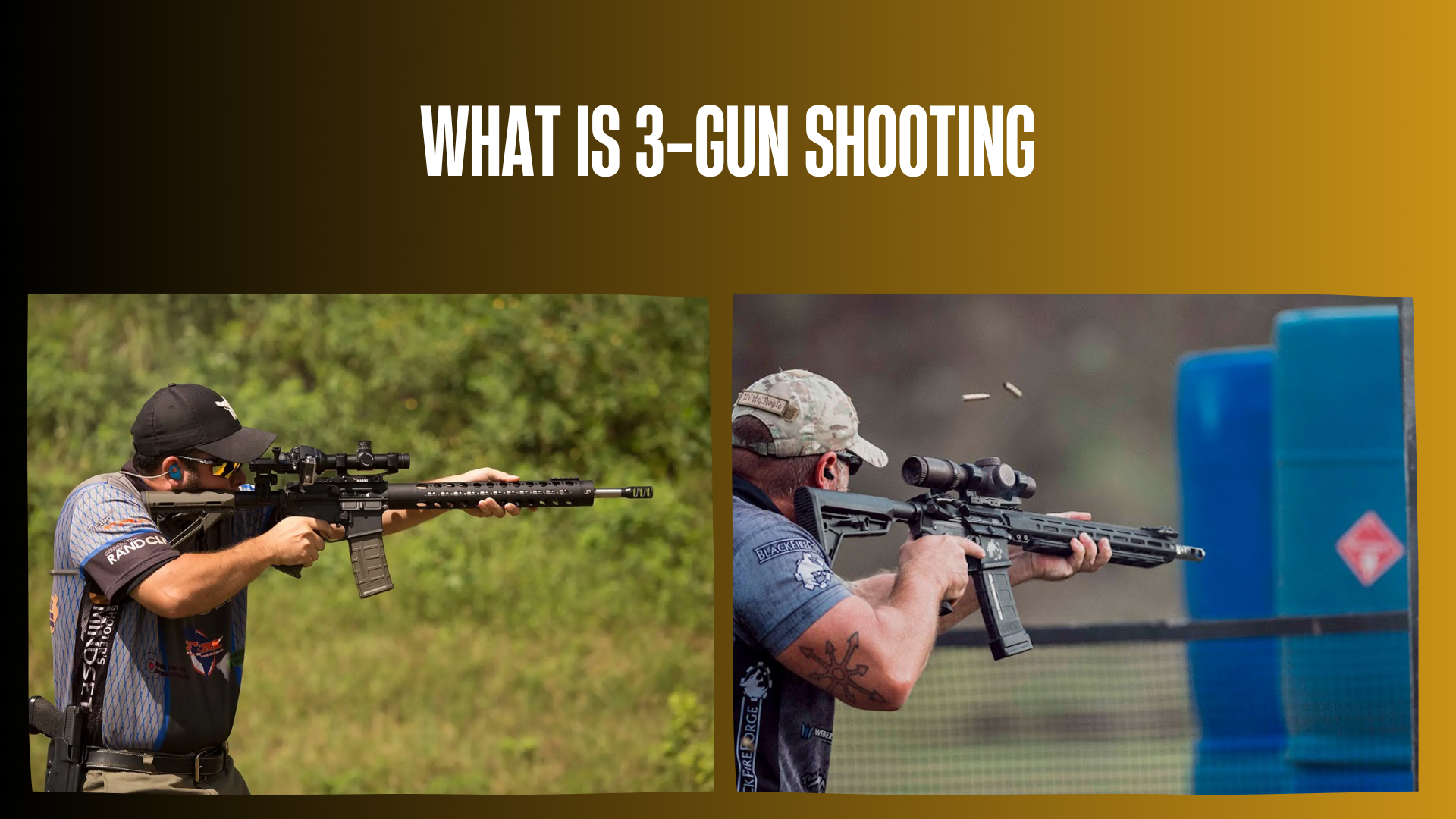

If you have heard competitors mention a match that combines a rifle, pistol, and shotgun, you may be wondering, what is 3-gun shooting? It is a practical shooting sport in which participants complete timed stages that may require one, two, or all three firearm categories. Success depends on safe gun handling, accuracy, efficient decision-making, and speed—but safety always takes priority over the clock.
This guide explains the basic match format, scoring, divisions, equipment, range commands, safety procedures, and first-match expectations. It describes common practices rather than one universal ruleset. Match directors and sanctioning organizations can use different rules, so the current official rulebook and written stage briefing always control.
Quick Answer: What Is 3-Gun Shooting?
3-Gun shooting is a timed competition built around a rifle, a handgun, and a shotgun. Competitors engage designated paper, cardboard, clay, and steel targets while moving through courses of fire under a Range Officer’s supervision. Results usually combine elapsed time with accuracy requirements and penalties, although the exact scoring system varies. New participants should first observe a local match, read its current rules, complete the required safety orientation, and approach their first event as a safe learning experience rather than a race.
3-Gun Shooting at a Glance
| Feature | Typical 3-Gun Format | What Can Vary |
|---|---|---|
| Firearm categories | Rifle, handgun, and shotgun | Some stages use one firearm; others use two or three |
| Course of fire | Multiple target types, positions, and shooting areas | Target presentation, distance, movement, and start condition |
| Scoring | Time plus accuracy requirements and penalties | Time-plus, total-time, stage-point, or organization-specific systems |
| Equipment divisions | Competitors are grouped by permitted equipment | Division names, optics, capacity, caliber, and configuration limits |
| Supervision | A Range Officer controls each attempt and issues commands | Command wording and procedures depend on the rulebook |
| Beginner goal | Complete stages safely and learn the match process | Local orientation, classification, and equipment requirements |
Important Safety and Legal Notice
3-Gun is a supervised shooting sport involving live firearms. It should take place only on an authorized range, under the applicable match rules, with qualified officials and appropriate backstops. A written article is not a substitute for hands-on instruction, a match safety briefing, the owner’s manual for each firearm, or direction from the Range Officer.
Apply these four primary firearm-safety rules at all times:
- Treat every firearm as if it is loaded.
- Keep the muzzle pointed in a safe direction.
- Keep your finger outside the trigger guard until you are ready to shoot.
- Be sure of your target and what is beyond it.
The NSSF firearm-safety guidance also stresses learning how a particular firearm operates, using correct ammunition, wearing eye and hearing protection, and storing firearms so unauthorized people cannot access them. Never rely on a mechanical safety in place of safe muzzle direction and trigger-finger discipline.
Firearm possession, transport, storage, magazine capacity, ammunition, suppressors, age limits, and range use are regulated differently across countries, states, provinces, and municipalities. Verify the laws for your residence, route, destination, and event. Transport firearms unloaded and secured as required by law, keep ammunition as required, and use locked storage that prevents unauthorized access. The match rulebook does not override local law.
What Is 3-Gun Shooting, Exactly?
3-Gun is a form of multigun competition. A match consists of several stages, and each stage is a problem the competitor must solve within defined boundaries. The written stage briefing identifies the targets, scoring method, start position, firearm conditions, shooting areas, and special procedures. After reviewing that information, the competitor plans a safe route and target order.
At the start signal, the participant engages only the required targets from legal positions. Some stages emphasize the rifle, handgun, or shotgun; a multigun stage may require transitions between categories. Those transitions occur only in the manner specified by the rules and stage briefing, using designated staging locations or retention devices. They are not informal firearm swaps.
The sport rewards a balance of accuracy and efficiency. A very fast run can lose value through misses or penalties, while a careful run may be competitive if it avoids costly errors. A safety violation can result in disqualification regardless of score. That hierarchy—safety first, correct procedure second, performance third—is the right mindset for every newcomer.
How a 3-Gun Match Works
1. Registration and rule confirmation
Competitors register for a match and select an equipment division. Before arriving, they should read the event information and the rulebook named by the organizer. The match announcement may include round-count estimates, allowed ammunition, prohibited ammunition, chamber-flag requirements, equipment rules, start time, and a mandatory new-shooter briefing.
2. Check-in and safety briefing
At check-in, staff may verify registration and direct participants to a safety area, equipment inspection, or briefing. Range-specific rules can be stricter than the sanctioning rulebook. Eye and hearing protection may be mandatory throughout designated areas, including while spectating.
3. Squadding
Competitors are divided into squads that rotate through the stages. Squad members help reset targets and keep the match moving when officials say it is safe. New shooters should identify themselves to the squad leader and Range Officer so instructions can be clarified before—not during—a run.
4. Stage walkthrough
The Range Officer reads or posts the written stage briefing. Competitors receive a limited walkthrough period to inspect legal shooting areas, locate targets, and make a plan. Firearms should not be handled during a walkthrough unless the rules and Range Officer expressly allow a specific procedure.
5. The course of fire
When called, the competitor follows the Range Officer’s commands and assumes the specified start position. The timer signal begins the scored attempt. The competitor engages targets while complying with muzzle-direction limits, shooting-area boundaries, target-engagement rules, and firearm-handling requirements. The Range Officer follows closely enough to observe safety and record the time.
6. Unload, show clear, and scoring
Finishing the last target does not make the range safe. The competitor stops and follows the Range Officer’s end-of-course instructions for each firearm. Only after the official declares the range clear may people move forward to score, paint, paste, or reset targets. The competitor normally has an opportunity to review the recorded time, hits, and penalties before acknowledging the score.
The Three Firearm Categories
The name “3-Gun” refers to firearm categories, not three required shots or three shooting positions. It also should not be confused with Olympic three-position rifle, which involves prone, standing, and kneeling positions with a rifle.
Rifle
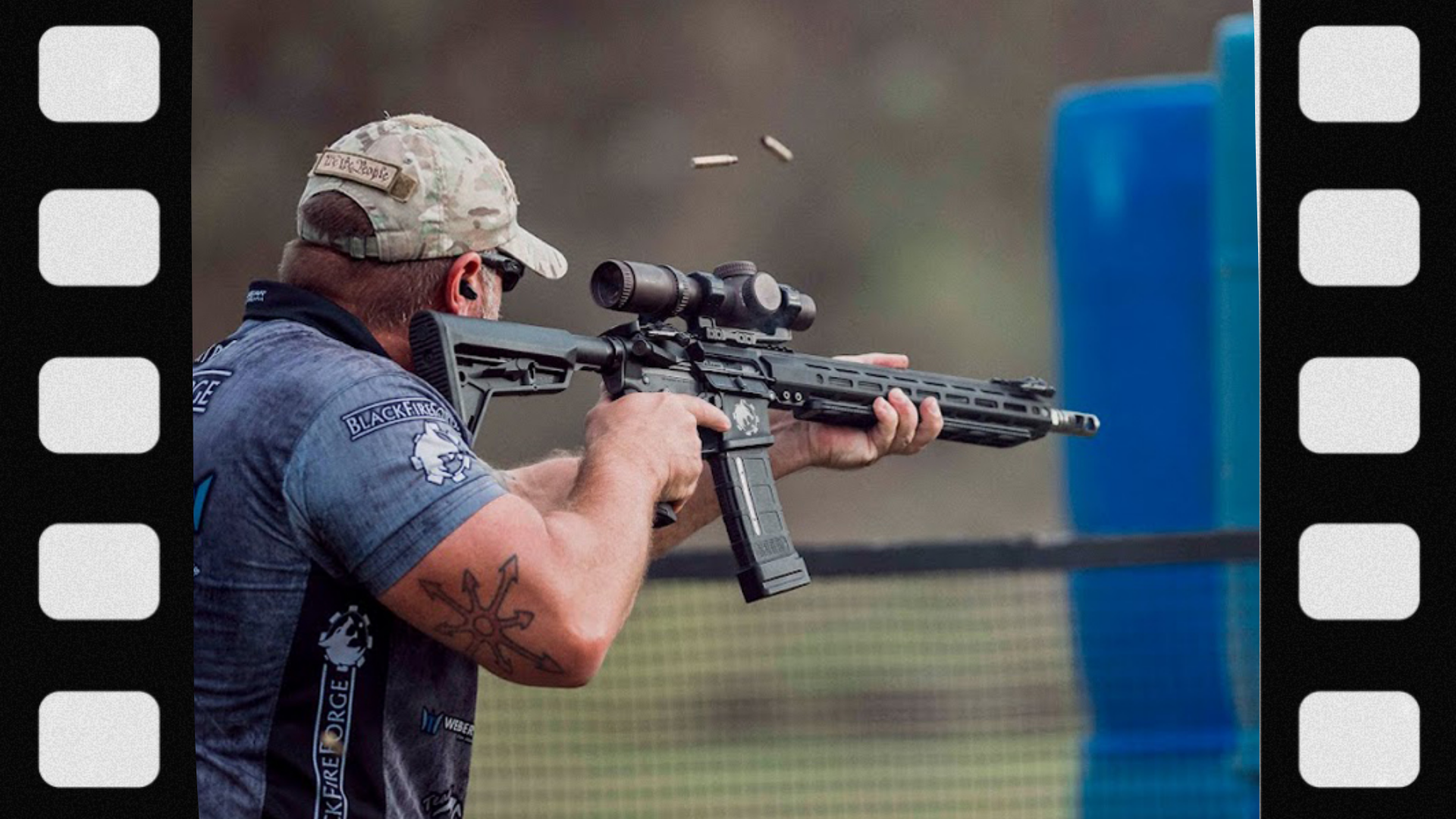
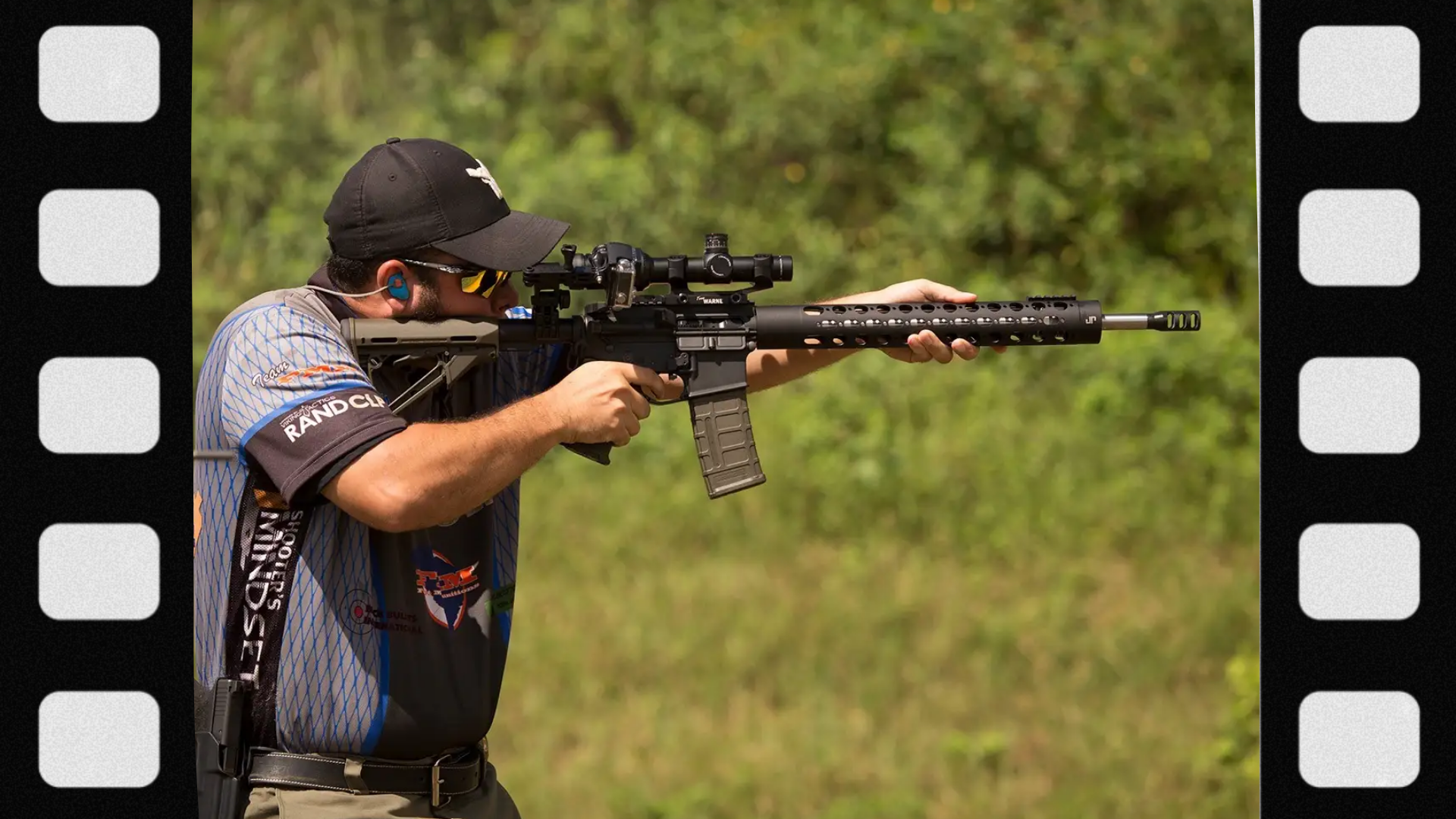
Rifle targets may appear at short, intermediate, or longer distances, depending on the range and match. The rules can regulate caliber, optics, supporting devices, magazine capacity, and other features. A competitor needs a lawful, reliable firearm that fits the selected division and can be operated safely—not the most elaborate setup available.
Handgun
The handgun portion typically uses paper or steel targets and a secure, rules-compliant holster. The division may regulate action type, optics, caliber, magazine dimensions, capacity, and equipment placement. A holster that does not adequately retain the handgun or cover the trigger as required may be rejected.
Shotgun
Shotgun arrays often include clay and steel targets. The written briefing and event rules determine permitted shell types and how different targets must be engaged. Match organizers commonly restrict ammunition that could damage targets or create unsafe conditions. Never assume that a shell allowed at one range is allowed at another.
Do not purchase equipment solely from a generic online checklist. First identify a nearby match, obtain its current rulebook, choose a division, and ask the match director whether your existing equipment is compliant. This prevents expensive mistakes and keeps the equipment decision connected to actual local rules.
How Firearm Transitions Are Controlled
Multigun stages may require a competitor to stop using one firearm and continue with another. Rules govern the approved condition and location of the firearm being set aside. A stage may use a designated container, table, rack, or another approved retention method. The competitor must follow the written stage briefing and Range Officer instructions exactly.
Safe transitions depend on muzzle direction, trigger-finger discipline, the prescribed firearm condition, and correct use of the designated staging device. Because requirements can differ by firearm type and ruleset, transition procedures should be learned in person from qualified match staff. If the competitor is uncertain, the safe choice is to stop, keep the muzzle in a safe direction, keep the finger outside the trigger guard, and ask the Range Officer—not improvise.
How 3-Gun Scoring Works
Many people describe 3-Gun scoring as “time plus penalties.” That is a useful introduction, but it is not universal. Some matches use total-time or time-plus scoring; others convert performance into stage points or apply organization-specific methods. The official rules explain how hits, target values, power factors, stage weighting, and ties are handled.
| Scoring Element | General Meaning | Why It Matters |
|---|---|---|
| Elapsed time | Time from the start signal to the final recorded shot or stage endpoint | Lower time is generally beneficial |
| Required hits | Hits meeting the target and ruleset requirements | Incomplete or low-value hits can reduce the result |
| Miss | A required target without the necessary hit | Usually adds a significant penalty or loses points |
| Failure to engage | A required target that was not engaged as defined | May produce an additional penalty |
| Procedural error | Failure to follow a stage requirement | Can add time or subtract points |
| Safety disqualification | A serious safety-rule violation | Can end the competitor’s match regardless of score |
The current searchable USPSA Rifle, Shotgun & Multigun Rules include a dedicated Time Plus Scoring section. At the time this guide was reviewed, USPSA identified its multigun rules as updated March 1, 2026. Rules change, so verify the current edition before relying on any scoring explanation.
3-Gun Divisions Explained
Divisions allow competitors with broadly similar equipment to be compared. Depending on the organization, a match may offer limited-style, optics-oriented, open, heavy, manual-action, or other categories. The labels are not consistent across all matches, and familiar division names can have different definitions.
Division rules may control:
- The number and type of optics permitted on each firearm
- Rifle, handgun, and shotgun caliber or gauge requirements
- Magazine or tube capacity and starting capacity
- Firearm action types and allowable configurations
- Compensators, bipods, supporting devices, and other accessories
- Holster, magazine pouch, and ammunition-carrier placement
- How equipment changes or failures affect division status
A beginner should select the simplest division that accepts safe equipment they already own or can borrow lawfully through the match’s approved process. Ask the match director to confirm compliance in writing when possible. Showing up with equipment that crosses division boundaries can mean moving divisions, shooting for no official score, or not being allowed to participate.
Common Range Commands
Range commands establish when the competitor may prepare, begin, stop, and clear firearms. Common command concepts include “Make Ready,” “Are You Ready?,” “Standby,” the start signal, “Stop,” an instruction to unload and show clear, a command confirming the firearm is clear, and “Range Is Clear.” Multigun end-of-stage procedures may include separate instructions for more than one firearm.
The exact wording and sequence depend on the active ruleset, firearm category, and stage. Listen to the Range Officer instead of anticipating a command. Do not touch or load a firearm merely because the previous competitor did so. “Stop” means stop immediately, maintain safe muzzle direction and trigger-finger discipline, and await instructions. “Range Is Clear” is the official signal that authorized people may proceed downrange; finishing a run or hearing the timer is not that signal.
If a firearm behaves unexpectedly, do not turn toward the Range Officer or spectators. Stop, keep it pointed in the designated safe direction, keep your finger outside the trigger guard, and request the Range Officer’s direction. Follow the firearm manufacturer’s instructions and match rules; do not attempt an unfamiliar remedial procedure under pressure.
Core Safety Rules in a 3-Gun Match
Muzzle control
The match defines safe muzzle directions and may use a maximum angle relative to the backstop. Props, walls, and movement do not excuse allowing the muzzle to leave the permitted area. Competitors must understand the applicable limits before starting.
Trigger-finger discipline
The finger stays outside the trigger guard except when the sights are on an intended target and the competitor is ready to fire. Movement, loading, unloading, clearing a malfunction, and changing firearms can require the finger to be visibly outside the guard under the applicable rules.
Safe firearm handling areas
Many matches permit handling unloaded firearms only in designated safety areas or under a Range Officer’s direct command. Ammunition handling may be prohibited in a safety area. Learn the signs and local boundaries before opening a case.
Target and background identification
Competitors engage only designated targets and must account for no-shoot targets, hard-cover markings, props, and the backstop. A stage plan never justifies firing without a verified target and safe background.
Eye and hearing protection
Appropriate eye and hearing protection should be worn wherever the range requires it. Spectators, helpers, and staff need protection too. Double hearing protection may be prudent in especially loud environments, but it must still allow the competitor to understand range commands; ask the Range Officer if communication is difficult.
Disqualification rules
Serious safety violations can cause immediate match disqualification. Examples may include unsafe muzzle direction, an unintended discharge as defined by the rulebook, dropping a firearm, prohibited firearm handling, or failing to obey a stop command. Definitions matter, so read the actual rule rather than relying on an abbreviated social-media explanation.
What Equipment Does a Beginner Need?
The match director should be the first source for an equipment list. A typical list includes the following categories, but every item must comply with the event rules and local law:
- A division-compliant rifle, handgun, and shotgun in safe operating condition
- The correct, manufacturer-approved ammunition permitted by the match
- A secure, compliant handgun holster and approved ammunition carriers
- Firearm cases and chamber flags where required
- Impact-rated eye protection and suitable hearing protection
- A sturdy belt and clothing that does not interfere with safe equipment use
- Closed-toe footwear suited to gravel, mud, uneven ground, and weather
- Water, food, sunscreen, rain protection, and basic first-aid supplies
- Simple maintenance tools and manufacturer-approved supplies
- A wagon, cart, or case system if permitted for safe transport between stages
Use the match’s estimated round count only for planning. Bring the ammunition types the organizer specifies and confirm whether steel-core, armor-piercing, tracer, incendiary, buckshot, slugs, or other loads are restricted. Never mix cartridges of different calibers or gauges in unmarked containers. Inspect package and firearm markings each time.
What Happens at Your First 3-Gun Match?
The best first step is often to attend as a spectator. The USPSA recommends finding a local club, observing a match, learning its safety protocols, and then participating. Contact the match director in advance because some ranges restrict where spectators can stand or require them to sign a waiver and wear protection.
For a first competition, expect a check-in, safety briefing, squad assignment, stage walkthrough, and several hours outdoors. Tell officials that you are new. Most clubs would rather answer a basic question before a run than correct a misunderstanding after the start signal.
Your first-match goals should be modest:
- Follow every Range Officer command without rushing.
- Maintain safe muzzle direction and trigger-finger discipline.
- Complete only actions you understand and have practiced safely.
- Accept coaching only when and where match rules allow it.
- Help reset targets after the range is declared clear.
- Record questions to ask after the stage.
- Finish safely, even if the score is slow or incomplete.
It is normal to feel overloaded by targets, props, commands, equipment, and the timer. Deliberately slow execution gives your attention room to stay on safety. Speed is a later result of sound fundamentals, not a first-day objective.
Beginner Checklist Before Registering
- Find the organizer’s official event page and current contact information.
- Ask whether the event accepts first-time competitors.
- Confirm the sanctioning rules, local rules, and rulebook version.
- Ask about required orientation, membership, waiver, and age policies.
- Confirm available divisions before selecting or changing equipment.
- Verify every firearm and ammunition type against match restrictions.
- Review lawful possession, transport, and storage for the complete trip.
- Read the owner’s manual for every firearm.
- Obtain qualified instruction in basic handling and range commands.
- Check cases, chamber flags, holster retention, and protective equipment.
- Ask whether a pre-match equipment or skills check is available.
- Plan for hydration, weather, food, and the event’s expected duration.
Skills That 3-Gun Tests
3-Gun combines several sporting skills. Accuracy is necessary across target sizes and distances. Safe movement requires awareness of the muzzle, trigger finger, footing, props, and other people. Stage planning asks competitors to remember target locations and comply with engagement requirements. Equipment management rewards reliability and familiarity rather than novelty.
The sport also tests composure. A missed target or equipment problem can tempt a competitor to hurry. Experienced judgment means accepting lost time, keeping the firearm safely oriented, and following the correct rule-based response. Physical conditioning can help with long match days and uneven terrain, but fitness never replaces safe technique.
3-Gun Compared With Other Shooting Sports
| Sport | Main Equipment | Typical Emphasis |
|---|---|---|
| 3-Gun | Rifle, handgun, and shotgun | Multigun stages, accuracy, time, and safe transitions |
| 2-Gun | Usually rifle and handgun | Multigun problem-solving without the third category |
| USPSA handgun | Handgun | Dynamic courses balancing speed, accuracy, and power |
| Steel Challenge | Handgun or rimfire rifle in recognized divisions | Timed strings on standardized steel-target arrays |
| Trap or skeet | Shotgun | Clay targets on defined presentations |
| Olympic three-position rifle | Rifle | Precision from kneeling, prone, and standing positions |
A local 2-Gun or single-firearm competition can be a practical introduction when 3-Gun equipment and procedures feel overwhelming. It reduces the number of systems a beginner must manage at once while still providing experience with briefings, range commands, scoring, and squad etiquette.
Common Beginner Mistakes
- Racing the timer: Speed magnifies unsteady fundamentals and can create unsafe decisions.
- Buying before reading the rules: Equipment that is popular online may not fit the local division.
- Assuming every match is the same: Division names, scoring, ammunition, and procedures vary.
- Anticipating commands: Handling a firearm before the Range Officer authorizes it can be a serious violation.
- Forgetting distant or obscured targets: A rushed walkthrough leads to misses and procedural penalties.
- Using unfamiliar equipment: Competition is not the place to discover how a firearm or carrier operates.
- Ignoring footwear and hydration: Fatigue and poor footing make safe movement harder.
- Handling ammunition in a safety area: Many rulesets prohibit it even when firearms there are unloaded.
- Failing to help reset: Squads rely on shared work after the range is declared clear.
- Hiding confusion: Officials cannot clarify a question they do not know you have.
What Not to Do
- Do not handle, uncase, load, or unload a firearm except where and when the rules permit.
- Do not turn around with a firearm to speak to an official or spectator.
- Do not place a finger inside the trigger guard while moving or performing non-firing actions.
- Do not continue after a “Stop” command.
- Do not go forward of the firing line until the Range Officer declares the range clear.
- Do not attempt to catch a dropped firearm; follow the official’s instructions.
- Do not use unverified ammunition or ammunition prohibited by the range.
- Do not copy another competitor’s transition method without confirming that it is legal for your ruleset and stage.
- Do not alter protective or safety equipment merely to gain time.
- Do not argue a ruling while holding or standing near an uncleared firearm.
How to Prepare Safely
Start with a qualified instructor who understands both basic firearm safety and the competition rules you will use. Build familiarity with each firearm separately before attempting a multigun stage. Practice at an authorized range, obey all local commands, and use targets with a safe backstop.
Dry practice should occur only where it is lawful and with a deliberate safety protocol: no live ammunition in the practice area, a verified unloaded firearm, a safe direction and backstop, and strict control of interruptions. Because mistakes can have severe consequences, beginners should learn the process in person from a qualified instructor and follow the manufacturer’s guidance.
Study skills away from firearms too. Read sample written stage briefings, learn scoring terms, practice remembering target sequences with inert diagrams, improve balance and mobility, and organize equipment so calibers and gauges cannot be mixed. Mental preparation is valuable because it reduces rushed decisions on the range.
How to Find a 3-Gun Match
Start with recognized shooting-sport organizations, established ranges, and local clubs. The NSSF overview of 3-Gun provides a broad introduction, while organization and club sites can identify current events. Online match-registration services may list events, but the host club or match director remains the authority for rules and entry requirements.
Before traveling, ask these questions:
- Which rulebook and edition governs the match?
- Is there a separate local-rules document?
- Are new competitors accepted, and is orientation mandatory?
- Which divisions are offered?
- What firearms, optics, capacities, and ammunition are allowed?
- What eye, hearing, chamber-flag, case, and holster requirements apply?
- Can a newcomer watch a match before registering?
- Who should be contacted if equipment compliance is uncertain?
Final Answer: What Is 3-Gun Shooting?
What is 3-gun shooting? It is a competitive multigun sport in which participants use a rifle, handgun, and shotgun to complete timed, accuracy-based stages under direct range supervision. A match may use one, two, or all three firearm categories on a stage, and scoring usually balances elapsed time, target results, and penalties.
The precise divisions, scoring method, firearm conditions, transition procedures, and commands are not universal. Read the current official rulebook and every written stage briefing, comply with the Range Officer, and verify all applicable laws. For a newcomer, the best path is to observe a reputable local match, obtain qualified instruction, confirm existing equipment with the match director, and make safe completion—not speed—the first goal.
FAQs
1. What does 3-Gun mean?
It refers to three firearm categories used in the sport: rifle, handgun, and shotgun. It does not mean competitors fire only three shots.
2. Is 3-Gun an organized sport?
Yes. Clubs and sanctioning bodies publish rules, approve stages, train officials, record scores, and host matches. The exact structure varies by organizer.
3. Does every stage use all three firearms?
No. A stage may use one firearm, two firearms, or all three. The written stage briefing identifies what is required.
4. How is a 3-Gun match scored?
Many matches use elapsed time adjusted for target results and penalties, but some use stage points or another system. Read the current match rulebook for the exact calculation.
5. Is the fastest competitor always the winner?
No. Misses, incomplete targets, procedural errors, and other penalties can outweigh a fast raw time. Safety violations can result in disqualification.
6. What targets are used in 3-Gun?
Matches may use paper or cardboard targets, steel, and clays. Target type, distance, scoring, and the firearm used are defined by the rules and stage briefing.
7. How far away are 3-Gun targets?
Distances vary greatly with the range and stage design. Some targets are close, while rifle targets can be much farther away. The organizer should describe unusual distance requirements in advance.
8. What is a stage?
A stage is one scored course of fire within a match. It has a written briefing, defined start condition, targets, boundaries, procedures, and scoring method.
9. What is a written stage briefing?
It is the official description of a stage. It normally identifies targets, scoring, start position, firearm conditions, shooting areas, and any special requirements.
10. What does a Range Officer do?
The Range Officer controls the competitor’s attempt, issues commands, watches safety and rule compliance, records the time, and helps administer scoring.
11. What should I do if I hear “Stop”?
Stop immediately, maintain safe muzzle direction, keep your finger outside the trigger guard, and await the Range Officer’s instructions.
12. Can I handle my firearm while waiting for my turn?
Only where and when the active rules allow it, such as a designated safety area or under direct Range Officer command. Never assume casual handling is permitted.
13. Can ammunition be handled in a safety area?
Many rulesets prohibit ammunition handling in designated safety areas. Check the posted range rules and ask an official before using the area.
14. What eye and hearing protection is required?
Use protection meeting the match and range requirements. Protection may be mandatory for competitors, spectators, and staff throughout designated areas.
15. Is a mechanical safety enough to make a firearm safe?
No. Mechanical devices can fail or be used incorrectly. Safe muzzle direction, trigger-finger discipline, correct handling, and target awareness remain essential.
16. What happens if a competitor breaks a safety rule?
Consequences depend on the rule, but a serious violation can cause immediate match disqualification. Safety rulings apply regardless of competitive standing.
17. What are 3-Gun divisions?
Divisions group competitors according to permitted equipment. Rules may regulate optics, action types, calibers, capacities, accessories, and equipment placement.
18. Are division names the same at every match?
No. Similar labels can have different requirements, and some organizations offer unique divisions. Always use the definitions in the announced rulebook.
19. Do I need expensive equipment to begin?
Not necessarily. Safe, reliable, compliant equipment is more important than premium equipment. Confirm what you already own with the match director before buying anything.
20. Can a beginner borrow equipment?
Possibly, if lawful and permitted by the organizer, range, and owner. Arrange it in advance and obtain supervised familiarization before the match.
21. How much ammunition does a 3-Gun match require?
It depends on the number and design of stages. Use the organizer’s published estimate, confirm permitted ammunition types, and ask how much contingency is reasonable.
22. Can any ammunition be used on steel targets?
No. Ranges commonly restrict ammunition that can damage targets or increase hazards. Follow the match ammunition policy and never substitute an unapproved load.
23. Do I need a special holster?
You need a holster that meets the applicable safety and division rules, securely retains the handgun, and protects the trigger as required. Ask for approval before the event if uncertain.
24. What is a chamber flag?
It is a visible device used to help indicate an open, empty chamber. Many matches require chamber flags during transport or storage, but a flag never replaces verification and safe handling.
25. Are firearm transitions the same at every event?
No. Approved firearm conditions, staging devices, and procedures vary. Follow the written stage briefing and Range Officer rather than copying a video or another match.
26. Can I practice transitions at home?
Only if lawful and under a rigorous safety protocol, preferably after qualified instruction. Beginners should learn the applicable procedure in person before attempting independent practice.
27. Is 3-Gun suitable for a first shooting competition?
It can be, if the club welcomes beginners and the participant already has safe foundational skills. Some people benefit from starting with a single-firearm or 2-Gun event.
28. Should I attend a match as a spectator first?
Yes. Spectating helps you understand commands, squadding, resets, stage briefings, and local culture without managing three firearms under a timer.
29. How do I find a beginner-friendly match?
Contact established ranges and recognized clubs. Ask the match director directly about new-shooter orientation, equipment checks, coaching, and spectator access.
30. Do I need to join an organization?
Membership requirements vary. A club match may accept nonmembers, while championships or classifications may require membership. Verify before registering.
31. Is 3-Gun the same as military or law-enforcement training?
No. It is a regulated sporting competition with defined targets, scoring, boundaries, and range procedures. Sporting participation should not be confused with professional operational training.
32. Is 3-Gun the same as Olympic three-position shooting?
No. Olympic three-position shooting is a precision rifle discipline using kneeling, prone, and standing positions. 3-Gun uses rifle, handgun, and shotgun.
33. Can minors compete in 3-Gun?
Age, supervision, legal possession, waiver, and skill requirements vary by jurisdiction and organizer. A parent or guardian should contact the club before registration.
34. How should firearms be transported to a match?
Transport them unloaded, secured, and separated or stored as required by every applicable law and range policy. Check rules for the origin, route, destination, and any overnight stop.
35. What is the best goal for a first 3-Gun match?
Complete the day safely, follow commands, learn the procedures, and meet other competitors. Score and speed should be secondary to sound, repeatable safety habits.
Read more: