

The best goose hunts often begin hours or days before anyone sets a decoy. Careful scouting, legal access, realistic concealment, disciplined calling, safe firearm handling, and a setup that matches what local birds are already doing usually matter more than owning a large trailer full of equipment.
This guide answers what are the best goose hunting tips for beginners and experienced hunters who want a more organized approach. It covers Canada geese, light geese, white-fronted geese, field setups, water hunts, decoy placement, calling, weather, hunting pressure, firearm safety, boat safety, recovery, and responsible game care.
There is no single setup that works everywhere. Goose behavior changes with species, migration stage, food availability, weather, wind, hunting pressure, flock size, habitat, and local disturbance. Treat every tactic as a starting point, then adjust according to current observations.
Quick Answer
The best goose hunting tips are to scout birds before hunting, obtain legal access, set up where geese already want to feed or rest, conceal every hunter thoroughly, and arrange decoys around a clear landing area that accounts for the wind. Use simple, realistic calling rather than calling continuously, remain still when birds approach, and take only positively identified, legal birds within your practiced ability. Check current federal, state, provincial, tribal, refuge, and property-specific regulations before every hunt because seasons, limits, equipment rules, access conditions, and permitted methods vary.
Goose Hunting Tips at a Glance
| Priority | Practical Tip | Why It Matters | Beginner Action |
|---|---|---|---|
| Legal preparation | Review current regulations | Seasons, limits, licenses, shot rules, and methods vary | Save an offline copy of the official regulations |
| Scouting | Find the birds before placing decoys | Location usually matters more than spread size | Watch evening and morning movements from a distance |
| Access | Obtain permission and verify boundaries | A productive field is useless without lawful access | Discuss parking, gates, livestock, and retrieval |
| Wind | Build a safe landing area | Geese commonly prefer an into-wind approach when conditions allow | Place the opening within a safe, practiced range |
| Concealment | Hide hunters before refining the spread | One exposed face or blind can turn an entire flock | View the setup from the birds’ expected approach |
| Decoys | Match local flock behavior | Natural spacing often looks better than a rigid pattern | Use small groups and leave open landing space |
| Calling | Match the birds’ volume and mood | Overcalling can discourage pressured or quiet flocks | Learn a few clean notes before adding complexity |
| Shooting safety | Identify the bird and background | Other hunters, buildings, roads, livestock, and protected birds may be nearby | Establish safe zones of fire before loading |
| Recovery | Plan retrieval before the hunt | Water, ice, property boundaries, and wounded birds can complicate recovery | Carry legal retrieval equipment and know the limits |
| Learning | Record what the geese actually did | Local patterns are more useful than universal formulas | Keep notes about wind, weather, calling, and approach |
Important Legal and Safety Notice
Goose-hunting regulations vary by country, state, province, tribal jurisdiction, flyway, management zone, species, season segment, land type, age, and hunting method. Before hunting, verify the current license, migratory-bird validation, Harvest Information Program requirements, stamps, permits, season dates, shooting hours, species limits, possession limits, shotgun restrictions, approved ammunition, baiting rules, access rules, tagging, and reporting requirements.
In the United States, federal frameworks apply to migratory birds, while states establish seasons and limits within those frameworks and may impose more restrictive rules. Waterfowl hunters must use approved nontoxic shot, and hunters aged 16 or older generally need a valid Federal Duck Stamp in addition to applicable state requirements. Refuge and public-land rules may add separate permits, ammunition limits, access procedures, shooting zones, or equipment restrictions.
Waterfowl baiting regulations apply to geese. Hunters are responsible for determining whether an area is legally huntable; the presence of grain or other attractants can make an area illegal even when the hunter did not personally place them. State rules may be stricter than federal requirements.
- Complete hunter education and obtain every required license, stamp, permit, and validation.
- Use only legal firearms, shotguns, ammunition, calls, decoys, blinds, and electronic equipment.
- Confirm legal shooting hours and species-specific daily and possession limits.
- Learn to distinguish legal goose species from protected or restricted birds.
- Obtain private-land permission and verify public-land boundaries.
- Establish safe zones of fire before anyone loads a firearm.
- Wear an appropriate life jacket when using a boat or hunting around hazardous water.
- Do not cross private property, unsafe ice, deep current, or closed areas during recovery.
Regulatory information in this article was reviewed on July 24, 2026. Official regulations override general online guidance.
What Are the Best Goose Hunting Tips?
1. Scout Before You Choose a Setup
Spend time locating geese before the hunt. Watch where flocks roost, where they feed, which direction they travel, when they leave, where they land, and how long they remain. A modest setup in a field the geese have chosen will often be more convincing than a large spread placed along an approximate flight path.
Use binoculars from a legal road, observation area, or property where you have permission. Avoid repeatedly driving directly at the birds, walking into the feeding area, or disturbing the roost. Note the exact section of the field where they concentrate rather than recording only the property name.
Experienced waterfowl writers repeatedly emphasize that being where geese want to land is more important than trying to pull every flock away from its established destination.
2. Learn the Daily Roost-Feed-Loaf Pattern
Geese commonly move among nighttime roosts, feeding locations, and daytime loafing or resting areas. The exact pattern changes with species, weather, disturbance, food, season, and migration pressure.
Rather than assuming all geese leave at sunrise and return at sunset, record what the local birds do. Some may feed once, while others make multiple trips. Warm, calm weather may produce different timing than a cold, windy day. Hunting pressure can also cause birds to leave earlier, arrive later, or use alternative fields.
Avoid unnecessarily disturbing the primary roost. Repeated pressure can alter the pattern and move birds away from the entire area.
3. Secure Access Before Planning the Hunt
Ask permission as soon as you identify a promising private property. Be clear about the date, number of hunters, vehicles, dogs, blinds, and retrieval plan. Discuss where to park, which gates to use, whether livestock are present, and which neighboring boundaries must be avoided.
Do not assume that permission to scout, fish, hike, or hunt another species includes permission to hunt geese. Do not enter an adjacent field to recover a bird without the required permission or legal authority.
On public land, verify legal access points, parking rules, blind assignments, daily drawings, refuge permits, motor restrictions, decoy-removal rules, and closed zones. Individual refuges can require documentation or impose rules beyond statewide requirements.
4. Hunt the Most Recent Reliable Information
A productive observation from a week ago may no longer matter after harvest, snow, flooding, a wind shift, migration, or several days of hunting pressure. Scout as close to the planned hunt as access and regulations permit.
Confirm that the geese used the location recently and determine whether another party has already secured access. Arrive with an alternative location rather than forcing a poor or unsafe setup when circumstances change.
5. Use the Wind to Shape the Landing Zone
Geese often prefer to approach and land into the wind because it helps them control speed, although local terrain, obstacles, flock behavior, and changing air currents can alter the final approach.
Position the landing opening so approaching birds remain visible and enter a safe shooting area without directing shots toward roads, homes, livestock, vehicles, other blinds, or neighboring properties. Increase the amount of open landing room during stronger winds rather than crowding the intended approach with decoys.
Do not place the ideal visual landing hole in an unsafe direction simply because the wind favors it. Safety and legal shooting boundaries come first.
6. Make Concealment the First Setup Priority
Geese can detect exposed faces, shiny equipment, straight blind edges, unnatural shadows, movement, and fresh vegetation that does not match the surroundings. Conceal every hunter before spending extra time perfecting minor decoy positions.
Walk away from the blind and inspect it from the expected approach. Check it again from a low angle and from the side. A blind that looks hidden while standing beside it may appear as a dark rectangular object from above.
Inadequate concealment is one of the most frequently repeated causes of geese circling without finishing.
7. Match the Blind to the Existing Cover
Use blinds, pits, fence lines, cattails, crop residue, shadows, shoreline vegetation, or other legal cover appropriate for the location. Brush portable blinds with natural material from the immediate area only when collecting vegetation is permitted.
Avoid creating a blind that is much taller, darker, greener, or denser than everything around it. In open fields, a low profile may be more convincing than a heavily brushed mound.
In sunny conditions, existing shadows can help break up the blind, but hunters must also consider how the shadow changes as the sun moves.
8. Hide Faces, Hands, and Reflective Equipment
Keep exposed skin and shiny surfaces concealed when birds approach. A face covering, brimmed hat, gloves, and dull equipment can reduce visual contrast, provided none of these items interfere with vision, hearing, communication, or safe firearm operation.
Cover bright thermos bottles, metallic blind hardware, glossy shotgun surfaces, phone screens, watches, and reflective eyewear. Keep dogs inside the blind or otherwise concealed until retrieval begins.
9. Match the Spread to the Flock You Observed
There is no universal decoy number or shape. Match the species, flock size, feeding behavior, and spacing you observed during scouting. Early family groups may appear different from large migrating flocks, and pressured late-season birds may respond differently from recently arrived geese.
A small spread can work when placed exactly where geese already want to land. Larger spreads can be useful for visibility, traffic hunting, or imitating large feeding concentrations, but they also require more transport, setup time, concealment, and cleanup.
10. Arrange Decoys in Natural Family Groups
Rather than placing every decoy at identical intervals, create loose clusters with realistic space between them. Include feeding, resting, and alert postures when available, but avoid making the spread look mechanically uniform.
Multiple small groups with openings between them can look more natural than one dense mass, particularly when real birds are traveling in family groups.
11. Leave a Clear but Realistic Landing Pocket
Give approaching geese an obvious area where they can land without flying directly into a wall of decoys. Place the pocket within a distance you have patterned and practiced, not at the maximum range claimed for a shotgun or ammunition load.
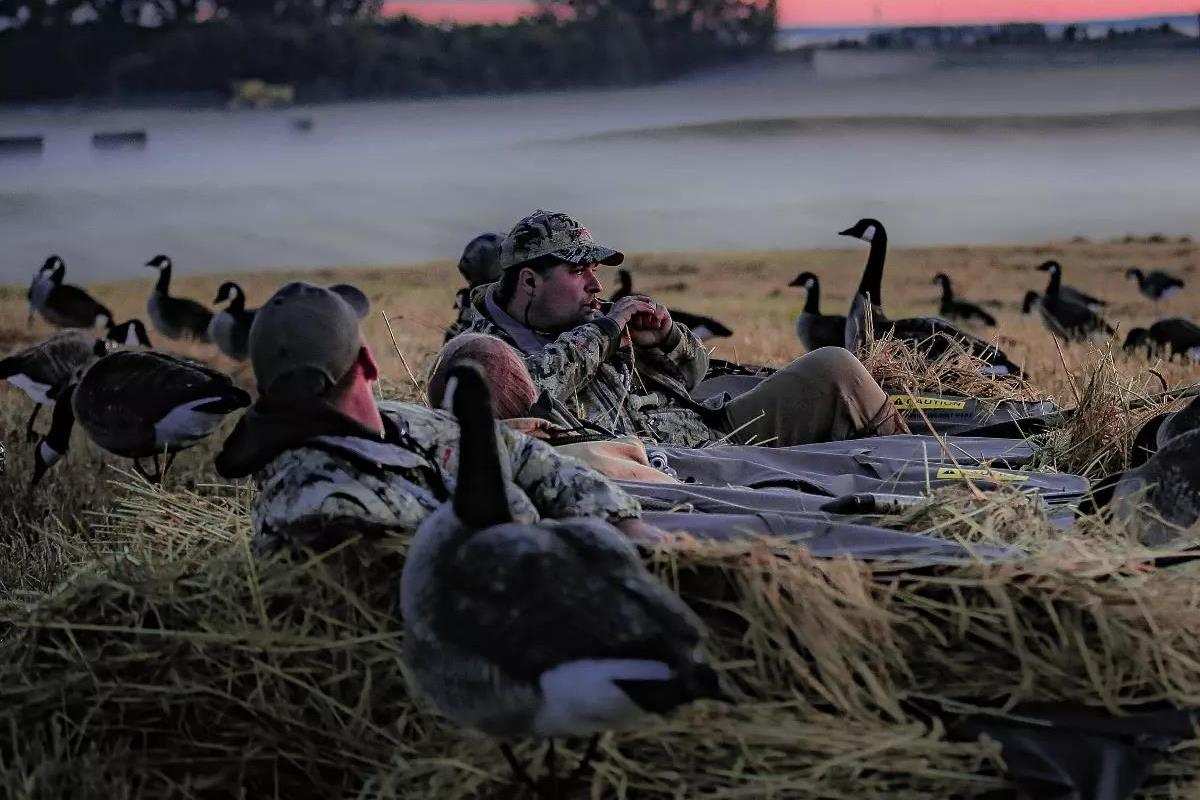
A landing zone that is too narrow may cause birds to slide to one side. A huge empty hole may also look unnatural if the surrounding decoys do not guide birds toward it. Adjust the opening after watching how the first flocks respond.
12. Position the Blind in Relation to the Birds, Not Only the Spread
Some hunters automatically place the blind at the center of every spread. That may work, but it is not always the least visible or safest location. Consider the sun, wind, field contour, available cover, expected approach, other hunters, neighboring property, and likely retrieval route.
When an edge, depression, ditch, or natural shadow provides better concealment, design the decoys around that safe location rather than moving into an exposed position merely to preserve a familiar pattern.
13. Use Motion Only When It Looks Natural
Wind-driven movement can make a spread appear active, particularly when real geese are moving and feeding. Windsocks, flags, or other legal motion devices may help distant birds notice the setup, but uncontrolled spinning, flapping, or repetitive mechanical movement can appear unnatural.
Electronic decoy and calling rules vary by jurisdiction and season. Some methods allowed during a light-goose conservation order may be prohibited during a regular season. Verify the exact current rules before using electronic equipment.
14. Learn a Few Clean Goose Calls First
A beginner does not need a long sequence of competition-style notes. Start by producing clear basic sounds appropriate for the target species. Consistent clucks, honks, moans, murmurs, or greeting sounds are more useful than a complicated routine that lacks rhythm and control.
Practice before the season, preferably outdoors where you can hear how the call carries. Record yourself and compare the rhythm and tone with real geese rather than relying only on indoor volume.
Experienced callers commonly emphasize mastering basic notes before adding complexity.
15. Let the Geese Tell You How Much to Call
Listen before reacting. If an approaching flock is vocal, answering with appropriate energy may keep its attention. If the birds are quiet, heavily pressured, or already committed, softer and less frequent calling may be more effective.
Calling harder is not always better. Strong wind may require more volume, while calm conditions and experienced birds may favor restraint. If a flock begins sliding away each time the caller increases volume, reduce the calling or stop temporarily.
16. Coordinate Calling in a Group
Choose one person to direct the calling unless the group has practiced together. Several callers competing at different rhythms can create unnecessary volume and confusion.
The lead caller should also communicate when hunters need to remain still and when the group should prepare. Avoid sudden whispered arguments or movements as birds make the final approach.
17. Stay Still While Geese Are Looking at the Setup
Movement inside a blind can be more damaging than a minor decoy-placement mistake. Prepare equipment before the first flock arrives. Keep firearm muzzles controlled, secure loose gear, and avoid repeatedly sitting up to watch distant birds.
Use a designated observer when practical. The observer can quietly describe the birds’ direction and prevent everyone from exposing their faces simultaneously.
18. Establish Safe Zones of Fire
Before loading, identify where each hunter may safely point and fire. Account for nearby homes, roads, vehicles, livestock, farm workers, dogs, public trails, boats, and neighboring hunting parties.
Hunters should never swing across another person or fire outside the agreed zone. Stop immediately when a person, dog, vehicle, or non-target bird enters the area. Reconfirm everyone’s position after hunters move, retrieve birds, or change blinds.
Follow the four fundamental firearm-safety principles:
- Treat every firearm as if it is loaded.
- Keep the muzzle pointed in a safe direction.
- Keep your finger outside the trigger guard until ready to shoot.
- Be certain of the target and what is beyond it.
Recent state hunter-safety guidance continues to emphasize these same principles for waterfowl and other hunting situations.
19. Identify the Species Before Firing
Learn goose size, head and bill shape, wing pattern, body color, voice, flock formation, and local range. Confirm whether different limits apply to dark geese, light geese, white-fronted geese, brant, or other species in the hunting area.
Do not fire at an unidentified silhouette merely because it enters the decoys. Protected birds, swans, cranes, and other non-target species may use the same habitat. The U.S. Fish and Wildlife Service provides identification resources covering numerous goose, duck, and swan species.
20. Pattern the Shotgun Before the Season
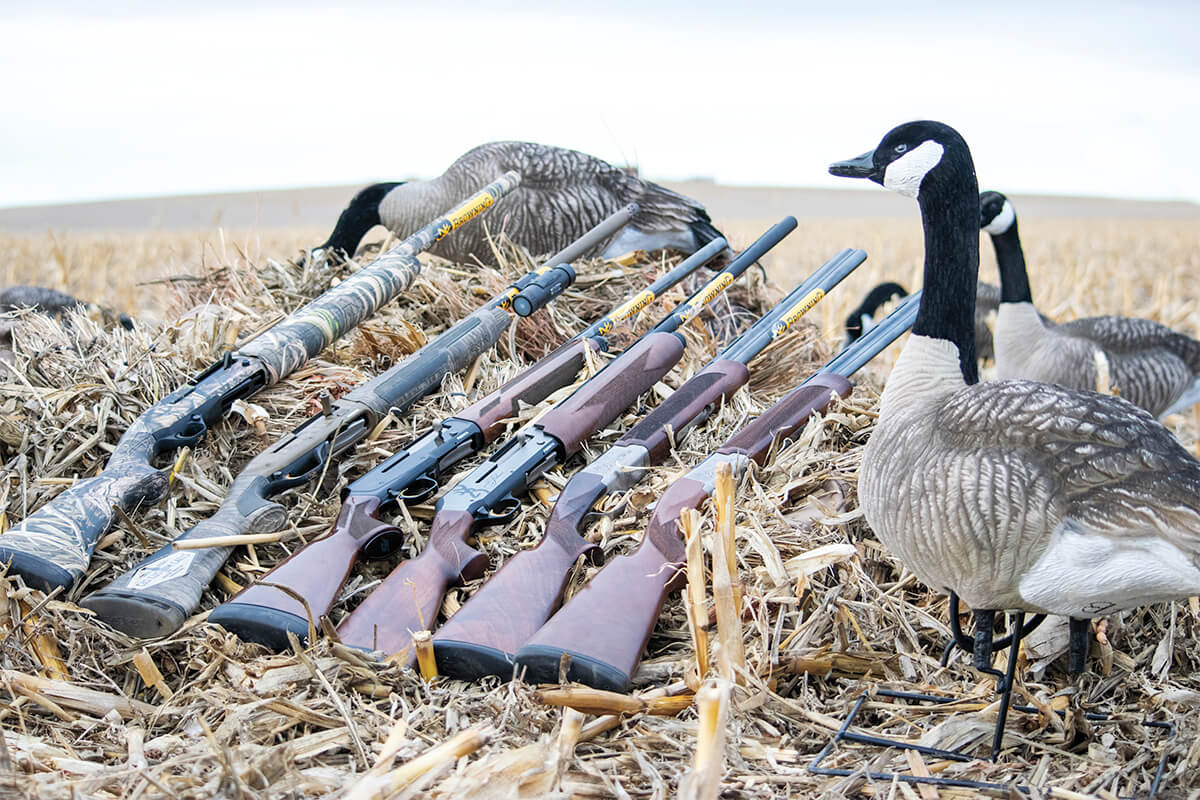
Pattern the unloaded and safely transported shotgun at an authorized range using the same legal nontoxic ammunition and choke combination planned for the hunt. Confirm that the ammunition is compatible with the firearm and choke by consulting manufacturer instructions.
Evaluate whether the pattern is reasonably centered and sufficiently consistent at realistic hunting distances. Do not assume that a choke label or ammunition advertisement guarantees performance from a particular shotgun.
Use only approved nontoxic shot for waterfowl hunting in the United States and verify any additional state, refuge, or property-specific ammunition rules.
21. Take Close, Controlled Opportunities
Let working geese approach rather than firing merely because they are visible. Take shots only within your demonstrated ability, from a stable position, with a safe background and clear species identification.
Avoid shooting at birds directly over another hunter, dog, boat, roadway, building, or livestock. Do not continue firing after the flock has moved beyond your effective range.
22. Plan Retrieval Before Shooting
Decide how birds will be recovered from fields, shorelines, marshes, rivers, or open water. Account for property boundaries, deep mud, current, ice, low visibility, cold water, and closed areas.
A trained retriever can be valuable, but the dog must be conditioned, controlled, visible, and protected from current, ice, cold, decoy lines, boats, and other hunters. Do not send a dog into conditions beyond its training or physical ability.
Mark every bird’s last location and make a reasonable legal recovery effort. Recovery responsibilities do not authorize trespassing or unsafe travel.
23. Adjust Quickly When Birds Repeatedly Refuse
When several flocks react in the same way, assume the setup is communicating something useful. Birds that turn at long range may be reacting to location, pressure, unnatural movement, or a highly visible blind. Birds that approach and flare at the same point may be seeing a specific hunter, dog, reflective object, blind edge, or problematic decoy.
Change one or two variables at a time:
- Improve concealment.
- Move the landing pocket.
- Reduce or change calling.
- Remove unnatural motion.
- Adjust the spread to match the observed flock.
- Move the blind to available natural cover.
- Leave the location when birds clearly want another destination.
24. Keep Notes and Build Local Knowledge
After the hunt, record the wind, temperature, cloud cover, field condition, crop, water level, number and species of geese, flight direction, timing, calling response, decoy arrangement, and reasons birds appeared to finish or refuse.
These notes help distinguish a repeatable local pattern from a single successful morning. Goose hunting changes throughout the season, so continued observation is more valuable than relying permanently on one spread diagram or calling routine.
Field Hunting Versus Water Hunting
| Factor | Field Hunting | Water Hunting |
|---|---|---|
| Primary scouting question | Where are geese feeding within the field? | Where are geese resting, traveling, or feeding on the water? |
| Concealment challenge | Open terrain and visible blind outlines | Shoreline contrast, boats, dogs, and movement |
| Decoy priority | Natural feeding groups and an open landing area | Species-appropriate floaters, spacing, and safe retrieval lanes |
| Major safety concern | Roads, buildings, workers, livestock, and property boundaries | Cold water, boat loading, current, waves, ice, and hypothermia |
| Recovery concern | Neighboring property and standing crops | Deep water, current, vegetation, weather, and boat access |
| Best beginner approach | Hunt with permission and an experienced mentor | Use a suitable craft and hunt with an experienced waterfowler |
Additional Boat-Safety Rules
Wear a properly fitted life jacket rather than merely carrying one. The U.S. Coast Guard explains that a life jacket provides buoyancy when a person is affected by injury, fatigue, cold, or an unexpected fall into the water. Recreational vessels generally must carry an approved wearable flotation device for each person, while state rules may impose additional requirements.
- Do not overload the boat with hunters, dogs, decoys, motors, batteries, fuel, blinds, and harvested birds.
- Distribute weight according to the boat manufacturer’s instructions.
- Unload and secure firearms appropriately during travel and difficult boarding.
- Keep the dog’s movement from destabilizing the boat.
- Check wind, current, wave height, water temperature, fog, and launch conditions.
- Carry waterproof communication, navigation, lights, and emergency equipment.
- Do not stand suddenly or have several hunters move to one side simultaneously.
- Return early when conditions begin exceeding the crew’s training or equipment.
Waterfowl-safety guidance identifies overloading and lack of life jackets as major contributors to fatal incidents involving hunting boats.
Goose Hunting Gear Checklist
You do not need the most expensive equipment to hunt responsibly. Choose gear according to the species, terrain, weather, legal requirements, hunting method, fit, safety, reliability, and your experience.
Legal and Safety Essentials
- Current hunting license and required migratory-bird documents
- Federal and state stamps or validations where applicable
- Offline copy of current regulations
- Legal shotgun and compatible approved nontoxic ammunition
- Required hunter-visibility clothing
- First aid kit and personal medication
- Map, compass, GPS, or offline navigation application
- Charged phone, radio, or satellite communication device
- Water, food, weather protection, and emergency insulation
- Properly fitted life jacket for boat or hazardous-water use
Core Goose Hunting Equipment
- Species-appropriate decoys
- Legal blind or concealment system
- Goose call suitable for the target species
- Binoculars for scouting and identification
- Gloves and nonrestrictive face covering
- Decoy bags, stakes, anchors, and lines
- Headlamp with backup batteries
- Retrieval equipment suitable for the terrain
- Game straps or breathable transport bags
- Disposable gloves and cleaning supplies
Optional Equipment
- Legal motion decoys or flag
- Rangefinder for confirming decoy and shooting distances
- Portable seat or back support
- Trained retriever and suitable protective equipment
- Spare dry clothing stored in a waterproof bag
- Field repair kit for decoys and blinds
Common Goose Hunting Mistakes
Hunting Without Fresh Scouting
Old information can place hunters in an empty field while geese feed nearby. Scout close to the hunt and carry a lawful backup plan.
Focusing on Decoys Before Concealment
A convincing spread cannot compensate for exposed hunters or an obvious blind. Finish the hide before making small cosmetic decoy adjustments.
Calling Continuously
Constant loud calling can sound unnatural, especially around pressured birds. Watch how geese react and reduce volume when they begin drifting away.
Using One Spread for Every Situation
Change the number, spacing, posture, and landing pocket according to species, flock size, wind, season, and local behavior.
Setting the Landing Hole Too Far Away
The decoys should encourage close, controlled opportunities rather than placing birds at the edge of the hunter’s ability.
Ignoring Sun and Shadow
Changing sunlight can expose faces, blinds, vehicles, and glossy equipment that appeared hidden before sunrise.
Failing to Identify the Bird
Never assume every large bird approaching a goose spread is legal. Confirm species and applicable limits before firing.
Standing Up Too Early
Wait for clear group communication and a safe opportunity. Early movement can flare the flock and create confusion among hunters.
Failing to Plan Recovery
Know how birds will be retrieved before hunting near deep water, private boundaries, current, mud, or ice.
Ignoring Local Baiting Rules
A harvested agricultural field is not automatically legal. Review federal and local guidance and investigate how the crop or grain reached the area.
Troubleshooting Goose Hunting Problems
| Problem | Possible Causes | What to Check | Safer Next Step |
|---|---|---|---|
| Geese ignore the spread completely | Wrong location, strong destination preference, poor visibility, stale scouting | Current flight line and recent feeding location | Move only with permission and within legal access rules |
| Flocks approach but turn far away | Visible blind, vehicles, unnatural spread, excessive movement | View the setup from the expected approach | Improve concealment before adding more decoys |
| Geese circle repeatedly | Unsafe or blocked landing zone, changing wind, hidden visual problem | Landing pocket, wind and blind outline | Adjust one variable and observe the next flock |
| Birds flare at the same point | Exposed face, dog, glossy object, blind edge or abrupt movement | The exact area birds are viewing when they turn | Cover the suspected object and remain still |
| Birds turn when calling increases | Overcalling, wrong rhythm, excessive volume | Whether geese are vocal or quiet | Reduce calling or stop briefly |
| Birds land outside the decoys | Landing pocket position, crosswind, natural feature attracting birds | Actual wind at bird level and field contour | Move the safe landing area toward the preferred location |
| Decoys spin or collapse | Strong or inconsistent wind, unsuitable stakes or anchors | Equipment setup and manufacturer instructions | Remove unnatural movement or use suitable supports |
| Hunters cannot agree when to shoot | No designated caller or poor communication | Group roles and zones of fire | Unload, pause and establish a clear plan |
| Recovery enters unsafe conditions | Deep water, current, ice, darkness or private property | Legal boundary and environmental risk | Stop and seek authorized experienced assistance |
| Bird activity disappears | Migration, pressure, weather, changed food source or disturbance | Alternative roost-feed routes | Return to scouting rather than forcing the old setup |
What Not to Do While Goose Hunting
- Do not hunt without confirming current federal, state, provincial, tribal, refuge, and local rules.
- Do not hunt over grain or other material without determining whether the area is legal.
- Do not shoot at sound, shadows, partial silhouettes, or unidentified movement.
- Do not fire toward roads, buildings, vehicles, livestock, people, boats, or unsafe terrain.
- Do not swing a firearm through another hunter’s position.
- Do not assume a mechanical safety replaces safe muzzle and trigger control.
- Do not trespass to set decoys or recover a bird.
- Do not overcrowd or overload a hunting boat.
- Do not rely on waders as personal flotation devices.
- Do not send a dog into dangerous current, ice, waves, or extreme cold.
- Do not use electronic calls or prohibited equipment without checking the exact season rules.
- Do not leave decoys, hulls, trash, line, or other equipment where removal is required.
- Do not continue hunting when visibility, weather, cold, fatigue, or confusion makes decisions unsafe.
Ethical Goose Hunting and Conservation
Ethical goose hunting means following seasons and limits, identifying species accurately, using appropriate equipment, staying within a practiced range, recovering birds responsibly, and using the harvest without unnecessary waste.
Licenses, stamps, harvest surveys, and reporting systems contribute information and funding used in migratory-bird management and habitat conservation. Federal harvest surveys use information from hunters to estimate harvest by species, age, and sex.
- Respect roosting and refuge areas.
- Avoid unnecessary disturbance to non-target wildlife.
- Follow bag and possession limits.
- Retrieve every bird when legal and reasonably safe.
- Do not waste edible meat.
- Remove empty hulls, decoy line, flagging, and litter.
- Clean boats, waders, dogs, decoys, anchors, and trailers to reduce the spread of aquatic invasive species.
- Report suspected wildlife violations to the appropriate authority rather than confronting people.
Waterfowl equipment can transport mud, plants, and aquatic organisms between locations. State conservation guidance recommends removing vegetation, animals, and mud from boats, motors, trailers, waders, decoy lines, dogs, anchors, and other equipment.
After the Hunt: Bird Care and Equipment Cleanup
- Complete all required tagging, reporting, and possession documentation.
- Keep species identifiable as required during transportation.
- Wear disposable or washable gloves while handling harvested birds.
- Avoid handling birds that appeared sick or were found dead.
- Keep meat clean and cool it promptly.
- Wash hands, knives, surfaces, bags, and reusable gloves.
- Cook wild game birds to the safe internal temperature recommended by current official food-safety guidance.
- Dry blinds, decoys, waders, life jackets, and dog equipment before storage.
- Inspect firearm, boat, trailer, anchors, decoy cords, and batteries.
- Record the hunt while details are fresh.
The CDC recommends protective gloves, careful hygiene, avoiding obviously sick or dead birds, and cooking game birds to an internal temperature of 165°F. USDA guidance also recommends using a food thermometer when cooking wild game birds.
Final Answer
So, what are the best goose hunting tips? Begin with current legal information and fresh scouting. Secure permission, set up where geese already want to be, use the wind to create a safe landing area, conceal every hunter, and match the decoy spread to the birds you observed. Call according to the flock’s behavior, stay still during the approach, identify the species positively, and take only close, controlled opportunities within your proven ability.
Plan recovery before the hunt, wear a life jacket around hazardous water, respect boundaries, care for harvested birds promptly, and keep notes about what worked. The most valuable goose-hunting skill is not memorizing one spread—it is learning to observe birds and adjust without compromising safety, legality, or hunting ethics.
FAQs
1. What is the most important goose hunting tip?
Scout before hunting. Knowing exactly where geese are feeding, resting, and traveling usually matters more than owning a large number of decoys or making advanced calls.
2. What time should I scout geese?
Observe both morning and evening movements when possible. The goal is to identify where birds begin, where they travel, when they arrive, and exactly where they land.
3. Should I hunt a goose roost?
Many hunters avoid pressuring primary roosts because disturbance may move birds from the area. Access and hunting rules also vary, so confirm that the location is legally open.
4. Is it better to hunt a feeding field or a flight path?
A field geese are actively using generally provides a stronger starting point. Flight-path or traffic hunting can work, but it usually requires greater visibility, effective calling, and a convincing spread.
5. How recent should scouting information be?
As recent as practical. Harvest, snow, changing water, wind, migration, and pressure can alter goose behavior within a day.
6. How many goose decoys does a beginner need?
There is no universal minimum. A modest spread can work in the exact location birds want, while traffic hunts or large migrating flocks may justify more decoys.
7. Are full-body decoys necessary?
No. Full bodies, shells, silhouettes, windsocks, and floaters can all be useful in suitable conditions. Choose according to terrain, wind, transport capacity, species, and budget.
8. Can silhouettes work for goose hunting?
Yes. Silhouettes are portable and can create the appearance of a larger group, but they must be angled and spaced so approaching birds see realistic profiles.
9. When are windsock decoys most useful?
They are most effective when enough wind keeps them filled and moving naturally. In calm conditions, collapsed or poorly oriented windsocks may look unrealistic.
10. What is the best goose decoy pattern?
No pattern is always best. Use loose groups and a visible landing pocket that fits the wind, blind location, field shape, and behavior of local geese.
11. Should goose decoys face into the wind?
Many feeding geese orient generally into the wind, but a perfectly uniform spread can look artificial. Use the wind as a guide while maintaining natural variation.
12. How large should the landing pocket be?
It should provide enough open space for birds to approach without being crowded while keeping the likely opportunity within your practiced range. Stronger wind may require more room.
13. Where should the blind be placed?
Place it where it can be concealed safely without directing shots toward prohibited or hazardous areas. The center of the spread is not automatically the best location.
14. Why do geese circle but not land?
Possible causes include visible hunters, an unnatural blind, changing wind, a blocked landing area, excessive calling, unusual decoy motion, or a stronger destination elsewhere.
15. Why do geese flare at the last second?
They may see a face, dog, reflective object, blind edge, movement, or unnatural decoy. Note where they turn and inspect the setup from that direction.
16. Does adding more decoys always help?
No. More decoys increase visibility but also add setup time, bulk, and concealment challenges. Location and realism often matter more than total quantity.
17. Do I need a goose call?
No. Hunters can succeed without one when positioned where geese want to land. A call is useful for gaining attention, maintaining interest, and adding realism when used appropriately.
18. What goose call should a beginner learn first?
Learn a clean basic note appropriate for the target species, then build simple clucks, honks, moans, or greeting sequences. Clarity and rhythm matter more than complexity.
19. Can calling too much scare geese?
Yes. Pressured or quiet birds may react poorly to constant loud calling. Match the flock’s behavior and reduce calling when birds are already committed.
20. Should I call when geese are directly overhead?
That depends on their response and the setup. Sudden loud calling may expose the blind or cause birds to climb, while soft calling may maintain interest. Watch the birds closely.
21. Do geese always land into the wind?
They commonly prefer an into-wind approach, but terrain, obstacles, shifting air, flock behavior, and destination can change the final direction.
22. What weather is best for goose hunting?
No single weather condition guarantees success. Wind can help define an approach and move decoys, while cold fronts, snow, fog, rain, and temperature changes can affect feeding and migration differently by region.
23. Is a strong wind good for goose hunting?
It can create predictable approaches and decoy motion, but it may also complicate calling, boat control, shooting, and retrieval. Increase the landing area and shorten expectations when conditions are difficult.
24. Can I hunt geese in calm weather?
Yes. Use realistic spacing, avoid unnatural motion devices, reduce calling when appropriate, and pay extra attention to concealment because birds may approach slowly.
25. What should goose hunters wear?
Wear weather-appropriate layers, waterproof footwear when needed, gloves, head protection, and any legally required hunter-visibility clothing. Clothing must not interfere with safe firearm handling.
26. Do I need camouflage for goose hunting?
Camouflage can help, but shape, shadow, motion, and blind placement are equally important. Required high-visibility clothing may take priority during certain seasons or on particular lands.
27. How can I conceal a layout blind?
Use legal vegetation matching the immediate area, reduce its profile, cover straight edges, and inspect it from the expected approach. Do not harvest vegetation where prohibited.
28. How far should goose decoys be from the blind?
Set the most likely landing area within a distance at which you have demonstrated consistent accuracy. Do not use a universal number without considering the firearm, pattern, wind, and individual ability.
29. What choke is best for goose hunting?
No choke is universally best. Pattern the specific legal nontoxic load through chokes approved by the firearm and choke manufacturers, then choose the combination that performs consistently at realistic distances.
30. What shot size is best for geese?
The appropriate legal nontoxic shot depends on goose species, ammunition material, expected range, firearm compatibility, and pattern performance. Check local rules and manufacturer guidance rather than selecting by size alone.
31. Is lead shot legal for goose hunting?
In the United States, approved nontoxic shot is required when hunting waterfowl, including geese. Additional restrictions may apply on refuges and other lands.
32. Do I need a Federal Duck Stamp to hunt geese?
In the United States, waterfowl hunters aged 16 or older generally need a valid Federal Duck Stamp, along with applicable state licenses, validations, and permits. Verify current requirements.
33. What is HIP registration?
The Harvest Information Program collects migratory-bird hunting information used to estimate harvest and manage populations. Requirements and validation procedures vary by state.
34. Can geese be hunted over harvested crops?
Sometimes, but the area must comply with federal and state baiting rules. The legality depends on how grain was planted, harvested, manipulated, or distributed.
35. Are electronic goose calls legal?
They are prohibited in many regular-season situations but may be authorized during certain light-goose conservation orders. Confirm the exact species, location, and season rules.
36. How do I identify different goose species?
Study size, head and bill shape, neck markings, body color, wing pattern, voice, range, and flock behavior. Use an official identification guide before hunting.
37. What should I do if a swan or protected bird approaches?
Do not fire. Keep the firearm controlled and wait until every intended target is positively identified and legal.
38. Is public-land goose hunting difficult?
It can involve more pressure, access rules, competition, and shared use. Scout multiple locations, follow parking and blind rules, and communicate respectfully with other hunters.
39. How do I ask a landowner for goose-hunting permission?
Be polite, identify yourself, explain when and how many people would hunt, and ask about parking, gates, livestock, boundaries, and retrieval. Accept a refusal respectfully.
40. Can I retrieve a goose from neighboring property?
Do not assume you may enter. Stop at the boundary, contact the landowner, and follow local recovery laws or conservation-officer guidance.
41. Are layout blinds safe?
They can be used safely when hunters establish muzzle directions, keep fingers outside trigger guards, communicate clearly, and rise only when the safe opportunity is called.
42. Should I wear a life jacket while goose hunting?
Wear a properly fitted life jacket when traveling or hunting from a boat and whenever cold, deep, or moving water creates an immersion risk.
43. Are waders a substitute for a life jacket?
No. Waders provide clothing and water protection but are not designed to replace an approved personal flotation device.
44. How can I keep a retriever safe?
Condition the dog gradually, provide water and rest, use identification, avoid dangerous ice or current, control it around firearms, and check for cuts, cold stress, overheating, and tangled lines.
45. What should I do with harvested geese?
Follow tagging and transportation rules, keep birds identifiable where required, wear gloves, cool the meat promptly, prevent contamination, and follow current food-safety guidance.
46. How should goose meat be cooked safely?
Current CDC and USDA guidance recommends cooking game birds to an internal temperature of 165°F measured with a food thermometer.
47. What should I do if a goose appears sick?
Avoid unnecessary contact and contact the wildlife or public-health agency. Do not consume a bird that official guidance advises testing or discarding.
48. How can I improve after an unsuccessful hunt?
Review whether the location was current, concealment was complete, the landing zone matched the wind, calling matched the birds, and the spread reflected local behavior. Return to scouting before buying more equipment.
Read more: