
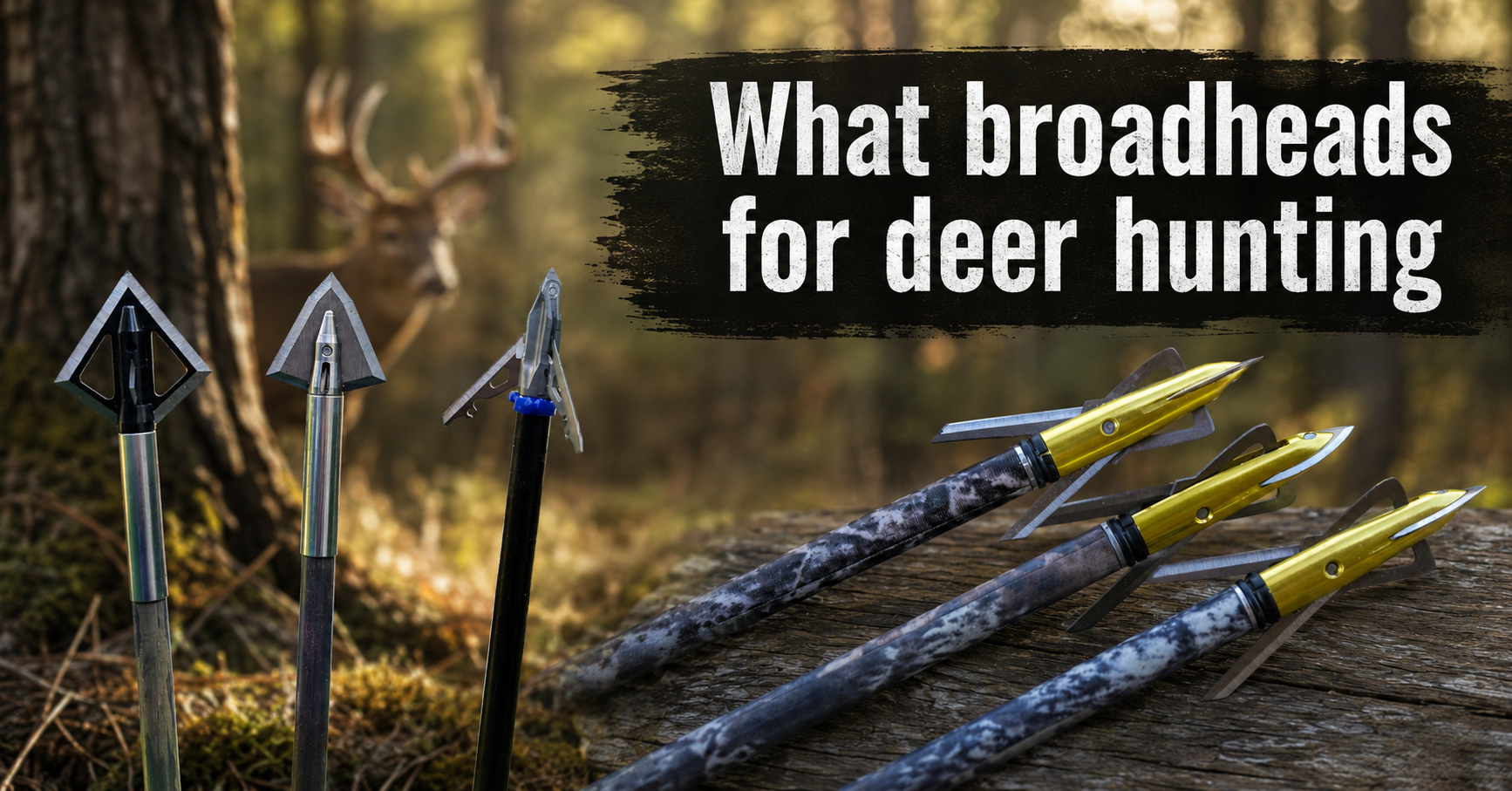

What broadheads for deer hunting should you choose? A sharp, durable fixed-blade or mechanical broadhead can be suitable for whitetail, mule deer and blacktail deer when it is legal, correctly matched to the bow and arrow, and consistently accurate from your setup.
A compact fixed-blade head is a strong starting choice for lower-energy bows, heavier arrows, traditional equipment and hunters who prioritize simple construction. A bow-rated or crossbow-rated mechanical broadhead can be a practical option for a well-tuned, sufficiently powerful setup when the blades remain securely closed in flight and deploy reliably on impact. Hybrid heads combine fixed and expandable blades but still require careful compatibility testing.
The broadhead itself is only one part of the system. Arrow spine, total arrow weight, insert alignment, front-of-center balance, fletching, bow tune, shot distance and shot angle all affect performance. Hunter-education guidance emphasizes matching the broadhead to the bow, arrow and game rather than choosing by blade size alone.
Quick Answer
For most deer hunters using a vertical bow, choose either a compact fixed-blade broadhead or a properly rated mechanical broadhead in the point weight recommended for your arrow system. Fixed blades offer simple construction and no deployment mechanism, while mechanical heads normally present less blade surface during flight and may group more easily with field points. Crossbow hunters should use broadheads specifically approved for their crossbow’s speed and arrow system. Test every hunting arrow with the actual broadhead, use fresh razor-sharp blades and verify current local regulations before hunting.
Key Takeaways
- Both fixed and mechanical broadheads can work for deer when they are legal, sharp, compatible and accurate.
- A compact fixed blade is often the more forgiving option for lower-energy or penetration-focused setups.
- Mechanical heads must be rated for the bow or crossbow and have an undamaged blade-retention system.
- Use the point weight recommended by the bow and arrow manufacturers rather than choosing weight by trend.
- Changing broadhead weight changes total arrow weight, front-of-center balance, dynamic spine and point of impact.
- Broadheads must be tested separately from field points, even when the packaging claims field-point-like flight.
- Shot placement and a high-percentage shot opportunity matter more than brand name or maximum cutting diameter.
Important Safety and Legal Notice
Broadhead laws vary by state, province, species, season and equipment type. Some jurisdictions specify a minimum cutting width, minimum number of cutting edges, permitted materials or whether barbed and mechanical heads are legal. New York, for example, currently prohibits deer-hunting arrowheads under 7/8 inch at their widest point, heads with fewer than two sharp cutting edges and barbed designs as defined by the state. Pennsylvania’s 2025–2026 digest specifies a minimum width of 7/8 inch and a maximum broadhead length of 3.25 inches for applicable archery equipment. These examples demonstrate why one state’s rules should never be treated as universal. Regulations were checked on August 2, 2026.
Check the official regulation booklet again immediately before hunting. Confirm the rules for the specific state or province, wildlife-management unit, deer species, weapon season and public or private property. The Association of Fish & Wildlife Agencies state-agency directory can help locate the appropriate official authority.
Broadheads are razor-sharp equipment. Keep them covered in a sturdy quiver, use a broadhead wrench or protective installation tool and shoot only into a target rated for broadheads. Never carry an uncovered broadhead in a pocket or loose gear compartment.
Fixed, Mechanical and Hybrid Broadheads Compared
| Broadhead Type | How It Works | Main Advantages | Main Limitations | Useful Starting Application |
|---|---|---|---|---|
| Fixed blade | The cutting blades remain exposed and locked in place during flight and impact. | Simple construction, no deployment mechanism, immediate cutting and commonly available replaceable or resharpenable blades. | Exposed blades can steer the arrow when the bow, arrow or broadhead is not aligned correctly. | Lower-energy setups, traditional bows, heavier arrows and hunters prioritizing penetration and simplicity. |
| Mechanical or expandable | The blades remain folded or retained during flight and open on impact. | Lower flight profile and often easier point-of-impact matching with field points. | Moving parts must remain closed during launch and deploy correctly; wider designs may require more energy through the target. | Well-tuned compound bows and crossbows with sufficient energy and manufacturer approval. |
| Hybrid | Uses one or more fixed cutting surfaces plus expandable blades. | Begins cutting with the fixed portion and adds cutting width when the expandable blades open. | More components to inspect and potential legal or equipment-compatibility restrictions. | Hunters wanting both a fixed initial cut and expandable blade system. |
Fixed-Blade Broadheads for Deer Hunting
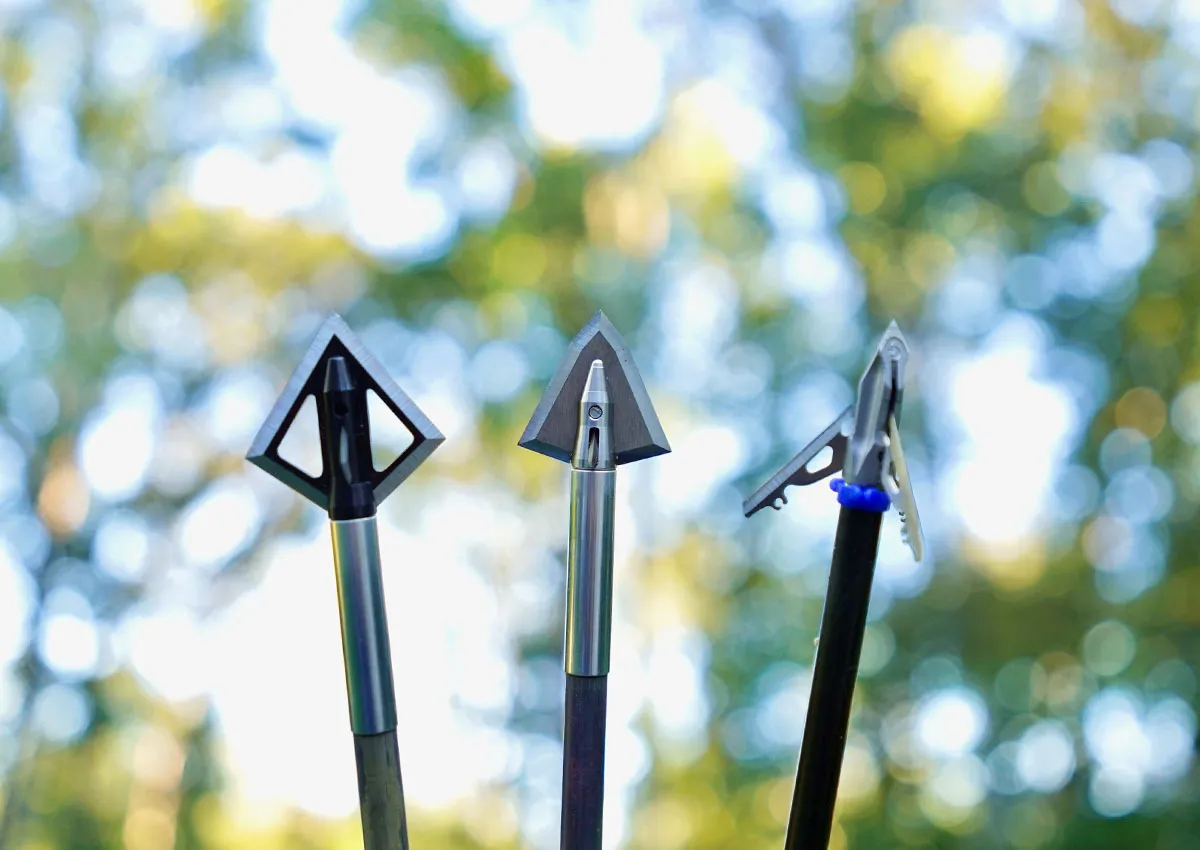
A fixed-blade broadhead has no opening mechanism. Its cutting edges remain in their hunting position from launch through impact. Fixed heads may use solid one-piece construction, replaceable blades or a main blade with smaller bleeder blades.
Fixed blades are widely chosen for deer because they are mechanically simple. There is no collar, band or blade-retention mechanism that must remain secure during launch and then release on impact. Hunter-education materials classify fixed, removable-blade and mechanical heads as the main broadhead categories and stress that every design must be sharp, durable and matched to the equipment and game.
Advantages of fixed-blade broadheads
- The blades are already open and ready to cut.
- Compact designs have relatively little exposed surface area.
- There are fewer moving components to inspect.
- Many models can be resharpened or fitted with replacement blades.
- They are available for traditional bows, compound bows and crossbows.
- They are often preferred when the bow-and-arrow system has limited available energy.
Limitations of fixed-blade broadheads
- The exposed blades act like small steering surfaces during flight.
- Bow-tuning or arrow-alignment errors become easier to see.
- A large fixed head may plane more than a compact design.
- Fixed heads may group differently from equal-weight field points.
- Every completed arrow should be checked for broadhead wobble.
Easton explains that fixed blades can act like rudders and magnify poor flight when the broadhead is not aligned with the shaft. Bowhunter-education guidance recommends spinning a broadhead-equipped arrow and watching the point for wobble before using it.
Who should start with a fixed blade?
A compact fixed head is a sensible starting option when you use a traditional bow, a lower draw-weight compound, a relatively short draw length or a setup intended to maximize penetration rather than cutting width. It is also appropriate when local regulations do not permit expandable heads.
Fixed blades still require a properly spined arrow and a tuned bow. Their simple construction does not compensate for an arrow that leaves the bow sideways or oscillates excessively.
Mechanical Broadheads for Deer Hunting
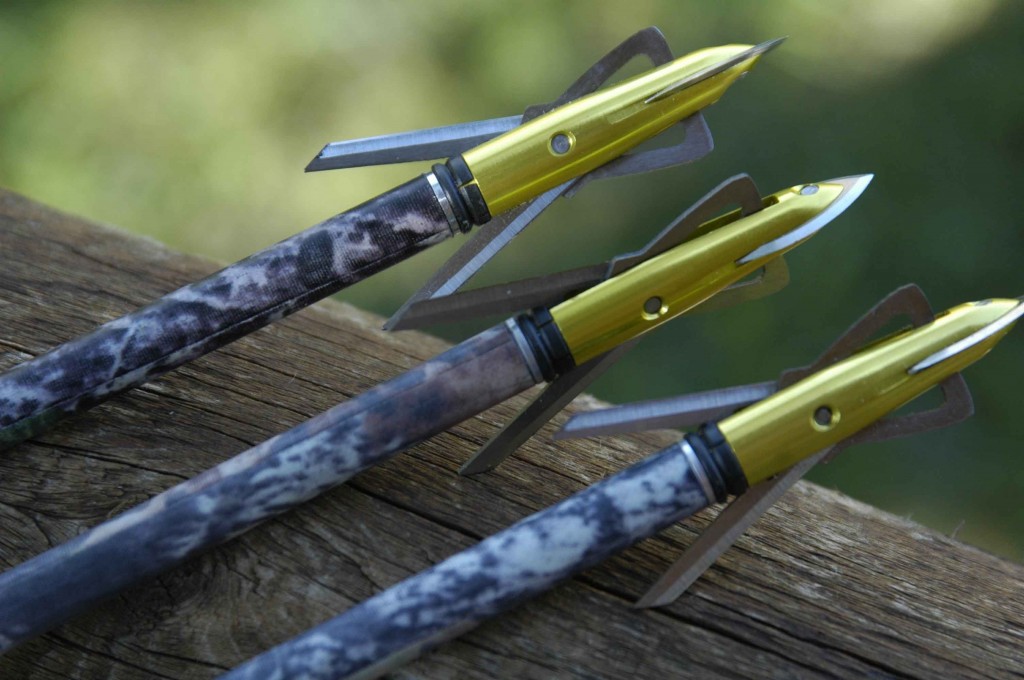
Mechanical broadheads carry their blades in a closed, folded or swept-back position during flight. The blades deploy when the head contacts the deer. With less exposed blade surface in the air, a properly rated mechanical head may group closer to equal-weight field points than a large fixed head.
Advantages of mechanical broadheads
- The lower flight profile can reduce aerodynamic steering.
- Many designs provide a wider deployed cutting diameter than compact fixed heads.
- They may require fewer bow-tuning adjustments to group near field points.
- Practice heads are available with some models.
- They can be effective from compatible compound bows and crossbows.
Limitations of mechanical broadheads
- The blades must remain securely retained before impact.
- The deployment mechanism must function properly.
- Collars, clips, bands or retainers may need replacement.
- Larger cutting diameters generally create more resistance through the target.
- Some mechanical heads are not rated for crossbow speeds.
- Expandable broadheads are restricted in some jurisdictions.
Bowhunter-education guidance notes that expandable heads require sufficient energy because the blades must open during penetration. That does not establish one universal draw-weight threshold for every modern head; follow the broadhead and bow manufacturers’ requirements for the exact system.
Who should consider a mechanical broadhead?
A mechanical head can be a practical choice for a well-tuned compound bow or crossbow that produces enough energy with the selected hunting arrow. It is particularly useful when the hunter wants a low-profile head in flight and can confirm that the model is approved for the bow’s speed.
Do not choose a mechanical only because its advertised cutting diameter is larger. A consistently accurate moderate-cut head is more useful than an oversized head that opens prematurely, groups poorly or is not compatible with the setup.
Hybrid Broadheads for Deer Hunting
Hybrid broadheads combine fixed and expandable cutting surfaces. A fixed blade or fixed cutting tip starts the wound channel, while additional blades deploy during impact.
This design can provide some characteristics of both categories, but it also requires more inspection. The hunter must examine the fixed cutting edges, moving blades, retention components, ferrule and tip. The exact model must also be legal and approved for the bow or crossbow.
What Broadheads for Deer Hunting by Bow Type?
| Bow or Setup | Reasonable Broadhead Direction | Primary Consideration |
|---|---|---|
| Traditional recurve or longbow | Compact fixed blade | Simple construction, sharp blade angle and an arrow correctly matched to the bow. |
| Lower draw-weight compound | Compact fixed blade or conservative mechanical specifically approved for the setup | Available energy, total arrow weight and reliable penetration. |
| Average modern hunting compound | Fixed, mechanical or hybrid | Accuracy, bow tune, legal compliance and demonstrated broadhead flight. |
| High-energy compound | Any approved type that groups consistently | Do not let speed substitute for arrow tuning or good shot selection. |
| Modern crossbow | Crossbow-rated fixed or mechanical head approved by the manufacturer | Speed rating, blade retention, arrow weight, nock compatibility and owner’s manual. |
| Heavy-arrow penetration-focused setup | Compact fixed blade or moderate-cut mechanical | Arrow spine, trajectory, point of impact and complete-system testing. |
What Grain Broadhead Should You Use for Deer?
Use the point weight recommended for the arrow and bow system. Many hunting setups use 100- or 125-grain points, but neither weight is automatically superior. Changing point weight changes the complete arrow’s mass, balance, trajectory and dynamic spine.
Match practice-point weight to broadhead weight. A 100-grain broadhead should initially be compared with a 100-grain field point, while a 125-grain broadhead should be compared with a 125-grain field point. Equal listed weight does not guarantee identical flight, so the actual broadheads must still be tested. Bowhunter-education material recommends using big-game broadheads that match the weight of the practice points and checking their point of impact separately.
| Point Weight | Common Reason for Choosing It | Potential Advantage | Important Caution |
|---|---|---|---|
| 100 grains | The arrow system or manufacturer is designed around a common standard point weight. | Wide availability and usually easier replacement of matching field points. | Do not assume it provides the correct spine or total arrow weight for every bow. |
| 125 grains | The hunter wants more front weight or the arrow system is designed for it. | Increases total arrow mass and moves the balance forward. | Can weaken dynamic spine and change trajectory and sight marks. |
| Heavier than 125 grains | A specialized heavy-arrow system or traditional-bow setup calls for it. | Can produce a high-mass, forward-weighted arrow when properly engineered. | Requires arrow-spine verification, new sight information and full compatibility testing. |
Easton notes that increasing front weight affects total arrow mass and front-of-center balance. It also warns that excessive front-of-center weight can weaken the arrow’s dynamic spine and create tuning problems.
Arrow Spine Matters More Than Broadhead Brand
Arrow spine describes how much the shaft bends under load. A shaft that is too weak or too stiff for the bow can leave the bow inconsistently, making broadhead flight difficult to control.
Point weight affects dynamic spine. Installing a heavier broadhead makes the shaft behave dynamically weaker. Before moving from 100 to 125 grains—or adding a heavier insert—check the current arrow-selection chart from the arrow manufacturer. Do not shorten or modify an arrow merely to correct spine unless you understand the manufacturer’s instructions and use suitable archery equipment.
A qualified archery shop can check draw weight, draw length, arrow length, shaft spine, insert weight, nock fit and total arrow weight as one system. Bowhunter-education guidance recommends matching the arrow type, fletching, length, weight and spine to the bow.
Front-of-Center Balance and Broadhead Weight
Front-of-center, commonly shortened to FOC, describes how far the arrow’s balance point sits in front of its physical midpoint. Broadheads and inserts contribute to front weight.
Moderate forward balance can help the arrow stabilize, but extreme front weighting is not automatically better. Excess front weight changes dynamic spine, trajectory and the stress placed on the shaft and components. Easton advises treating FOC as part of the complete arrow system rather than pursuing an extreme number.
Cutting Diameter: Bigger Is Not Always Better
Cutting diameter is the width of the cut made by the open blades. Mechanical heads often advertise a wider cut than compact fixed blades, but cutting width is only one factor.
A broadhead with more blade surface generally experiences greater resistance through hide, muscle and other tissue. A large fixed head also presents more surface to the air and may magnify poor arrow flight. A compact, razor-sharp head that reaches the intended vital area is more useful than a very wide head that the setup cannot deliver consistently.
Current deer-broadhead comparisons describe the basic tradeoff this way: mechanicals commonly provide wider cuts and lower-profile flight, while fixed heads generally use a smaller profile and eliminate blade deployment. These tendencies vary by model and should not be treated as guaranteed performance.
Two-Blade, Three-Blade or Four-Blade Broadheads?
Two-blade heads
A two-blade fixed head often has a narrow profile and simple construction. Some designs use a continuous main blade, while others include a replaceable blade secured within a ferrule.
Two-blade heads can be useful in lower-energy or traditional setups, but blade count alone does not guarantee penetration. Sharpness, blade angle, ferrule strength, arrow flight and shot angle remain important.
Three-blade heads
Three-blade broadheads create three cutting paths and are widely available in fixed and mechanical forms. Compact three-blade fixed heads may fly well when aligned correctly, while large models may require more fletching control and careful tuning.
Four-blade heads
Four-blade designs may contain four primary blades or two main blades with smaller bleeder blades. They create additional cutting surfaces but also increase the amount of blade passing through the target.
No blade count is universally best for deer. Evaluate the complete design, including profile, blade angle, strength, sharpness, cutting width and proven accuracy.
Cut-on-Contact, Chisel and Trocar Tips
| Tip Style | General Construction | Potential Benefit | What to Check |
|---|---|---|---|
| Cut-on-contact | A sharpened leading edge begins cutting as soon as it touches the animal. | Simple entry profile and common in compact fixed-blade designs. | Leading-edge sharpness and protection inside the quiver. |
| Chisel tip | A solid tip reaches the target before the cutting blades. | Durable point construction in many replaceable-blade heads. | Tip alignment, ferrule strength and blade sharpness. |
| Trocar tip | A multi-sided pointed tip leads the ferrule. | Common in both fixed and mechanical broadheads. | Tip damage and concentric alignment with the shaft. |
Tip style is less important than the overall integrity and accuracy of the broadhead. A durable tip cannot compensate for dull blades, damaged threads or a poorly flying arrow.
Broadhead Selection for Whitetail, Mule Deer and Blacktail
Whitetail, mule deer and blacktail deer are similar enough in broadhead requirements that the bow-and-arrow system usually matters more than the species name. A legal fixed, mechanical or hybrid head can be suitable for each when it is sharp, durable and accurate.
| Hunting Situation | Reasonable Starting Choice | Why |
|---|---|---|
| Close-range woodland whitetail hunting | Compact fixed blade or approved mechanical | Either can work at ordinary woods distances when the arrow path is clear. |
| Open-country mule deer hunting | Low-profile fixed or mechanical head that groups consistently in wind | Open terrain can make trajectory, wind and broadhead profile more noticeable. |
| Traditional-bow deer hunting | Sharp compact fixed blade | Simple construction and suitability for a carefully matched traditional-arrow system. |
| Tree-stand whitetail hunting | Fixed or mechanical head proven from an elevated practice position | Hunters must account for shot angle and actual stand posture. |
| Crossbow deer hunting | Crossbow-rated fixed or mechanical broadhead | Blade retention and construction must tolerate crossbow acceleration. |
| Lower-energy compound setup | Compact fixed blade | Reduces dependence on an expandable mechanism and very wide cutting surfaces. |
Shot Placement Matters More Than Broadhead Style
Broadside and moderate quartering-away positions are generally considered the highest-percentage bowhunting opportunities for deer. These angles expose a useful path into the vital chest area. Head-on, rear-end, hard quartering-toward and obstructed shots carry a greater risk of wounding and should be passed. Bowhunter-education guidance specifically identifies broadside and quartering-away positions as high-percentage opportunities and advises against intentionally shooting through brush or at the head or neck.
Do not rely on a fixed head to “break through anything,” and do not rely on a wide mechanical to correct a marginal hit. Wait for a calm deer, a clear arrow path and an angle you have practiced. Sometimes the most responsible decision is not to shoot.
How Far Should You Shoot a Deer With a Broadhead?
There is no universal ethical distance. Your maximum hunting distance should be shorter than the farthest range at which you can consistently place broadhead-equipped arrows into the intended vital area under realistic conditions.
Consider:
- Your broadhead group size rather than your best single shot
- Wind and vegetation
- The deer’s alertness and likelihood of moving
- Your body position in the stand, saddle or blind
- Lighting and visibility
- Range-estimation accuracy
- Arrow flight time
- The angle of the deer
- Whether the entire arrow path and background are clear
Practice from the positions you will use while hunting. Elevated hunters should practice from a safe platform, and ground hunters should practice while seated, kneeling or wearing their normal cold-weather clothing. Mathews notes that elevated angles, terrain and tuning can all affect field impact and should be addressed during preseason practice.
How to Test Deer-Hunting Broadheads
- Verify legality. Check the current cutting-width, blade and equipment rules.
- Read the bow manual. Confirm permitted arrow and point specifications.
- Use the arrow manufacturer’s spine chart. Include actual draw weight, draw length, arrow length and point weight.
- Inspect every shaft. Remove cracked, bent or otherwise damaged arrows from service.
- Match field-point weight. Start with practice points of the same listed weight as the broadhead.
- Install the head with a wrench. Keep fingers away from exposed blades.
- Spin the completed arrow. Watch the broadhead point for wobble.
- Use a broadhead-rated target. Place it in front of a safe backstop.
- Begin close. Confirm safe and predictable impact before increasing distance.
- Compare groups. Shoot several field points and broadheads without damaging arrows already in the target.
- Test every hunting arrow. Mark arrows that group consistently.
- Correct the cause of poor flight. Check bow tune, arrow spine, insert alignment, fletching and broadhead profile.
- Install fresh blades. Do not hunt with blades dulled during repeated target testing.
Bowhunter-education guidance recommends checking broadhead alignment by spinning the arrow and confirms that even a properly tuned fixed head may not land at precisely the same point as a matched field point.
Broadhead Tuning for Fixed Blades
Broadhead tuning is the process of correcting bow or arrow inconsistencies until fixed broadheads group predictably. It is not simply moving the sight to follow scattered arrows.
Before making adjustments, confirm:
- The arrow spine is correct.
- The shafts are straight and undamaged.
- The inserts are aligned.
- The broadheads spin without wobble.
- The fletching is undamaged and adequate for the head.
- The rest and nocking point are secure.
- The bow is timed and tuned according to its manufacturer.
- The archer’s grip and release are consistent.
Easton’s current arrow-ballistics material explains that shaft diameter, arrow length, vane configuration, broadhead type, point design, drag and stability all influence broadhead flight. This is why changing only the sight may hide an equipment problem without correcting it.
Why Broadheads and Field Points May Group Differently
| Problem | Possible Causes | What to Check | Next Step |
|---|---|---|---|
| Broadheads group together but away from field points | Normal aerodynamic difference or minor tune issue | Arrow spine, rest alignment, nocking point and broadhead profile | Follow the bow manufacturer’s tuning process before adjusting the final hunting sight setting. |
| Broadheads scatter in different directions | Wobble, inconsistent arrows, damaged vanes, poor tune or form inconsistency | Spin every arrow and inspect shafts, inserts and fletching | Correct component problems and test again at close range. |
| One arrow repeatedly misses | Damaged shaft, bent insert, loose broadhead or nock problem | The complete arrow from point to nock | Remove it from hunting use until corrected. |
| Mechanical blades open in flight | Wrong retainer, damaged components or head not rated for the setup | Blade collars, bands, clips and manufacturer rating | Stop using the head and contact the manufacturer. |
| Arrow impacts lower after increasing point weight | Greater total arrow weight and changed trajectory | Actual component weights and sight marks | Re-tune and re-zero the approved hunting setup. |
| Arrow enters the target at an angle | Unstable flight, damaged vane or poor alignment | Bow tune, arrow spine, broadhead concentricity and target position | Do not hunt until stable flight is restored. |
Broadhead Sharpness and Maintenance
Sharp blades are essential for effective cutting. Bowhunter-education guidance stresses that sharper broadheads cut more efficiently and support penetration, bleeding and recovery.
Before the season
- Inspect the ferrule for bends or cracks.
- Check replaceable blades for secure installation.
- Examine mechanical retainers and pivot points.
- Remove rust or replace corroded components.
- Confirm that the head spins concentrically.
- Practice with a separate practice head where available.
- Install fresh hunting blades after final verification.
After a target shot
Inspect the tip, blades, ferrule and threads. Broadhead targets can dull edges and place stress on blade-retention systems. Do not assume a head remains hunt-ready because it looks intact from a distance.
After hitting an animal, bone, soil or wood
Clean the broadhead carefully and inspect every component. Replace bent ferrules, damaged tips, chipped blades, loose screws and questionable mechanical components. Follow the broadhead manufacturer’s reuse instructions.
Broadhead Safety
- Keep broadheads covered in a quiver that fully encloses the blades.
- Use a broadhead wrench for installation and removal.
- Point cutting edges away from your hands and body.
- Do not test sharpness by running a finger along the edge.
- Never leave broadhead arrows loose in a vehicle.
- Use a target specifically rated for broadheads.
- Provide a safe backstop beyond the target.
- Never climb into a tree stand while carrying an exposed or nocked broadhead arrow.
- Use a haul line for unloaded archery equipment after attaching the full-body fall-arrest system.
- Remember that a broadhead may remain inside a deer during field dressing.
Pennsylvania’s Game Commission advises carrying broadhead-tipped arrows in a protective quiver, while national bowhunter-education materials recommend a sturdy quiver that fully covers the blades.
Common Broadhead Buying Mistakes
| Mistake | Why It Causes Problems | Better Approach |
|---|---|---|
| Choosing the widest cutting diameter | Large blades may increase drag in flight and resistance during penetration. | Prioritize accuracy, strength and compatibility. |
| Buying by celebrity endorsement or packaging | The promoted setup may differ from your bow, arrow and draw length. | Use manufacturer charts and test the complete system. |
| Changing point weight without checking spine | A heavier point changes dynamic spine and point of impact. | Consult the arrow-selection chart before changing components. |
| Assuming every mechanical works in a crossbow | Crossbow acceleration may defeat an unsuitable blade-retention system. | Use a crossbow-rated head approved for the bow’s speed. |
| Practicing only with field points | The broadheads may group differently. | Shoot the actual hunting heads or exact matching practice heads. |
| Hunting with repeatedly used practice blades | The edges may be dull or damaged. | Install fresh, inspected hunting blades. |
| Ignoring broadhead wobble | A misaligned point can steer the arrow unpredictably. | Spin-test every completed hunting arrow. |
| Using an under-spined arrow | The shaft may flex inconsistently and broadhead flight can become unstable. | Follow the current arrow-manufacturer spine chart. |
| Assuming broadhead laws are nationwide | Width, blade and equipment rules vary. | Check the official rules for the exact hunting location. |
| Expecting equipment to correct a marginal shot | No broadhead guarantees recovery after poor shot placement. | Wait for a clear, high-percentage opportunity. |
What Not to Do
- Do not use a dull, rusty, bent or loosely assembled broadhead.
- Do not use a mechanical head that is not rated for the bow or crossbow.
- Do not switch broadhead weight without rechecking arrow spine and sight marks.
- Do not hunt without testing broadhead-equipped arrows.
- Do not shoot broadheads into a field-point-only target.
- Do not handle exposed blades without an installation tool.
- Do not use damaged carbon arrows.
- Do not shoot through brush or at an unidentified animal.
- Do not take head, neck, rear-end or hard quartering-toward shots at deer.
- Do not exceed the distance at which you can consistently place broadheads accurately.
- Do not climb with nocked or exposed broadhead arrows.
- Do not trespass while tracking or recovering a deer.
Planning for Deer Recovery
After releasing the arrow, remain observant. Note the deer’s position, direction of travel and reaction without assuming those signs identify the exact hit. Mark the point where the deer stood and the last place it was visible.
Follow the applicable hunter-education guidance for waiting, tracking and recovery. Avoid trampling the initial sign. When permitted, consider contacting an experienced tracker or trained tracking-dog team. Obtain landowner permission before entering neighboring property and never enter unsafe terrain without suitable lighting, navigation and communication.
Broadhead type does not eliminate the responsibility to make every reasonable legal recovery effort. Shot selection, patience and careful tracking remain part of ethical deer hunting.
Final Answer
What broadheads for deer hunting should you use? Choose a legal, razor-sharp fixed, mechanical or hybrid broadhead that is compatible with your bow, arrow spine, total arrow weight and hunting method. Compact fixed blades are a dependable starting point for lower-energy and penetration-focused setups, while properly rated mechanical heads can provide low-profile flight from well-tuned compound bows and crossbows.
Use the point weight recommended for your equipment, match field-point and broadhead weight, spin-test every hunting arrow and verify actual broadhead groups at realistic distances. Do not choose by cutting diameter alone. A correctly tuned arrow, a high-percentage broadside or quartering-away opportunity and disciplined shot selection matter more than the logo on the broadhead package.
FAQs
1. What broadhead is best for deer hunting?
There is no universal best head. The right broadhead is legal, sharp, compatible with your bow and arrow, and consistently accurate from your hunting setup.
2. Are fixed or mechanical broadheads better for deer?
Fixed heads offer simple construction and no deployment mechanism. Mechanical heads normally have a lower flight profile and may provide a wider cut. The better option is the one your setup delivers accurately and reliably.
3. Are fixed-blade broadheads good for whitetail deer?
Yes. Compact fixed blades are widely used for whitetails and are especially useful when the hunter prioritizes simple construction, sharpness and dependable penetration.
4. Are mechanical broadheads good for deer?
Yes, when they are legal, rated for the bow, properly assembled and supported by sufficient arrow-system energy. Test blade retention and actual point of impact before hunting.
5. Can mechanical broadheads fail to open?
A damaged or improperly assembled mechanism can malfunction. Inspect blades, collars, bands, clips and pivots according to the manufacturer’s directions.
6. Can a mechanical broadhead open during flight?
It can happen when the retention system is damaged, incorrectly installed or unsuitable for the bow’s acceleration. Stop using any head that does not remain securely closed during testing.
7. What is a hybrid broadhead?
A hybrid broadhead combines fixed cutting edges with blades that expand on impact. It requires inspection of both the stationary and moving components.
8. What grain broadhead should I use for deer?
Use the grain weight specified for your arrow and bow setup. One hundred and 125 grains are common, but the correct choice depends on arrow spine, inserts, total weight and manufacturer guidance.
9. Is a 100-grain broadhead enough for deer?
Yes, when it is part of a correctly matched arrow system and the broadhead is sharp and accurate. Point weight alone does not determine hunting effectiveness.
10. Is a 125-grain broadhead better for deer?
Not automatically. It increases front and total arrow weight but also changes dynamic spine, trajectory and point of impact. Use it only after confirming compatibility.
11. Can I switch from 100- to 125-grain broadheads?
You can when the arrow remains correctly spined and the bow manufacturer permits the setup. Re-tune and re-sight the bow after changing weight.
12. Should field points and broadheads weigh the same?
Yes. Start with field points that have the same listed weight as the hunting broadheads, then test the actual heads because equal weight does not guarantee equal flight.
13. Why do my broadheads hit differently from field points?
Broadheads have different aerodynamic surfaces. Bow tune, arrow spine, insert alignment, vane size, broadhead profile and shooting form can all influence the difference.
14. Why do fixed broadheads plane?
The exposed blades can steer an arrow when it is not leaving the bow cleanly or when the broadhead is misaligned. Larger fixed heads usually present more steering surface.
15. How do I check broadhead alignment?
Spin the completed arrow and watch the point. A visible wobble can indicate a bent ferrule, misaligned insert or damaged component.
16. Do I need to broadhead-tune my bow?
Fixed heads often reveal tuning problems that field points do not. Correct arrow and bow issues before making the final sight adjustment for the hunting group.
17. How sharp should a deer broadhead be?
It should be razor-sharp and free from chipped, rolled or corroded edges. Install fresh blades or correctly resharpen reusable blades before hunting.
18. Can I hunt with a broadhead used for target practice?
Only after confirming that every part remains undamaged and the blades are restored to hunting sharpness. Using a separate practice head and fresh hunting blades is generally safer.
19. Can I reuse a broadhead after harvesting a deer?
Some fixed heads can be reused after cleaning, inspection and blade replacement or sharpening. Replace any head with a bent ferrule, damaged tip or questionable mechanical system.
20. What cutting diameter is best for deer?
Use a legal diameter that your setup can deliver accurately and reliably. Larger is not automatically better because wider blades may create more drag and resistance.
21. Is a two-inch mechanical broadhead good for deer?
It may be suitable for a compatible high-energy setup, but the wide cut should not be selected without considering arrow weight, bow energy, blade retention and legal requirements.
22. Are two-blade broadheads good for deer?
Yes. A sharp, structurally sound two-blade head can be effective when matched to the arrow system and placed through the vital chest area.
23. Are three-blade broadheads good for deer?
Yes. Three-blade heads are available in fixed and mechanical designs. Choose according to profile, strength, sharpness and demonstrated accuracy.
24. Are four-blade broadheads better?
Not necessarily. Additional blades create more cutting surfaces but also increase resistance. Blade count should not be considered separately from the entire design.
25. What broadhead is best for a traditional bow?
A compact, razor-sharp fixed-blade head is a common starting choice. Arrow spine, total weight and the archer’s tuning method remain important.
26. What broadhead is best for a compound bow?
Fixed, mechanical and hybrid heads can all work. Select one that matches the bow’s draw weight, arrow specifications and your proven accuracy.
27. What broadhead is best for a crossbow?
Use a crossbow-rated fixed or mechanical head approved for the speed and arrow system of the exact crossbow. Do not assume every vertical-bow mechanical is crossbow compatible.
28. Can I use the same broadhead in a bow and crossbow?
Only when the broadhead manufacturer approves both uses and the head matches each system’s point weight and speed. Check both owner’s manuals.
29. Do heavier arrows work better with mechanical broadheads?
Additional arrow mass may help support a wide mechanical head, but excessively heavy or poorly spined arrows create other problems. Build the complete system according to manufacturer guidance.
30. Does front-of-center balance matter?
Yes. Front weight affects arrow stability and dynamic spine. More FOC is not automatically better, and excessive front weight may complicate tuning.
31. What is the best shot angle for bowhunting deer?
Broadside and moderate quartering-away positions are generally the highest-percentage opportunities. Avoid head-on, rear-end, hard quartering-toward and obstructed shots.
32. Can a broadhead shoot through brush?
An arrow may be deflected by grass, branches or leaves. Do not intentionally shoot through vegetation; wait for an unobstructed path.
33. Should I aim for a deer’s head or neck with a bow?
No. Hunter-education guidance advises against intentional head and neck shots because the target is small and the risk of severe wounding is high.
34. How far should I shoot a deer with a bow?
Limit shots to a distance where you can repeatedly place broadhead-equipped arrows accurately under comparable field conditions. There is no universal ethical maximum.
35. Are mechanical broadheads legal in every state?
No. Regulations vary and may address blade movement, barbs, cutting width and equipment type. Check the current official rules for the exact hunting location.
36. What broadhead width is legally required?
The requirement varies. Some jurisdictions use a 7/8-inch minimum, while others apply different rules. Never assume one state’s measurement applies elsewhere.
37. How should broadheads be transported?
Keep them fully enclosed in a sturdy protective quiver. Do not transport uncovered heads in pockets, backpacks or vehicle storage areas.
38. Can I shoot broadheads at a public archery range?
Only when the range permits them and provides a designated broadhead target. Some public ranges prohibit broadheads on ordinary target butts.
39. When should I replace a broadhead?
Replace it when the ferrule bends, the tip is damaged, the blades cannot be restored, threads loosen, corrosion weakens it or a mechanical retention system becomes unreliable.
40. Does an expensive broadhead guarantee better deer recovery?
No. Price does not replace bow tuning, sharp blades, correct arrow selection, responsible shot distance, good shot placement and careful tracking.
Read more: