
The right deer-hunting arrow is not determined by one universal spine number, shaft weight, material, or broadhead. It must match your bow type, measured draw weight, arrow length, point weight, release method, and the manufacturer’s current selection chart.
For most modern compound-bow hunters, a properly spined carbon hunting arrow fitted with a sharp, legal broadhead is the most practical starting point. Many adult compound setups finish somewhere around 400 to 500 grains after the shaft, insert, nock, vanes, and broadhead are included, but that range is not a rule or substitute for proper spine selection and tuning.
Traditional bows and crossbows require different selection methods. A recurve or longbow arrow should be chosen using the bow’s actual draw weight at the archer’s draw length, while a crossbow must use bolts or arrows that meet the exact length, nock, weight, and construction requirements in the crossbow manual.
Quick Answer
For deer hunting, choose a carbon, aluminum, or properly made traditional arrow with the correct spine for your bow, enough length for safe clearance, and a legal fixed-blade or mechanical broadhead. Match the shaft by using the arrow manufacturer’s chart with your measured draw weight, finished arrow length, point-and-insert weight, and bow type.
A 100-grain or 125-grain broadhead is common in compound-bow setups, but changing point weight can change the arrow’s effective spine and point of impact. Build the complete hunting arrow first, tune the bow with that configuration, and practice with broadheads before hunting. Never shoot an arrow that is cracked, bent, splintered, improperly sized, or lighter than the bow manufacturer’s minimum.
Deer-Hunting Arrow Summary
| Bow type | Practical starting arrow | Most important selection factors | What not to assume |
|---|---|---|---|
| Compound bow | Properly spined carbon or aluminum hunting arrow | Peak draw weight, arrow length, point weight, bow speed, release method | A 340 or 400 spine fits every adult compound bow |
| Recurve bow | Carbon, aluminum, or wood arrow selected from a traditional-bow chart | Actual draw weight at your draw length, arrow length, string type, point weight, release | The marked limb weight equals your actual draw weight |
| Longbow | Matched traditional arrow with adequate length and correct dynamic spine | Actual draw weight, center-shot characteristics, release style, point weight | A compound-bow spine recommendation will work unchanged |
| Crossbow | Manufacturer-approved crossbow bolt or arrow | Required length, minimum finished weight, nock shape, diameter, component compatibility | Ordinary compound-bow arrows are interchangeable with crossbow bolts |
Important Archery Safety and Legal Notice
Arrow, broadhead, bow, and crossbow requirements vary by state, province, species, season, and hunting method. Some jurisdictions regulate minimum broadhead width, number of cutting edges, whether barbed heads are permitted, arrow or bolt length, and the use of mechanical broadheads.
For example, Minnesota states that deer-hunting arrowheads must have at least two metal cutting edges, be barbless, and measure at least 7/8 inch in diameter. Oregon requires unbarbed broadheads at least 7/8 inch wide for game mammals, while Alabama also specifies a minimum 7/8-inch cutting diameter and two sharpened edges. These are examples, not nationwide rules.
Legal information in this article was checked on July 30, 2026. Regulations can change, so read the current hunting proclamation or regulation booklet for your exact jurisdiction immediately before hunting.
- Use only arrows approved for your bow’s type, draw weight, and configuration.
- Never dry-fire a bow or crossbow.
- Keep broadheads covered in a secure quiver or protective case.
- Inspect every shaft, nock, insert, vane, and broadhead before shooting.
- Use a suitable broadhead target and a safe backstop during practice.
- Do not shoot at unidentified movement, through uncertain cover, or beyond your demonstrated accuracy.
- Follow manufacturer instructions for assembly, cutting, tuning, cocking, decocking, and maintenance.
What Arrows for Deer Hunting Work Best?
A properly matched hunting arrow should leave the bow cleanly, remain stable in flight, group consistently, carry the selected broadhead accurately, and stay within the bow manufacturer’s arrow-weight limits. The brand name and advertised straightness tolerance matter less than choosing a safe spine and producing repeatable broadhead flight.
A practical deer arrow normally includes:
- A shaft matched to the bow’s dynamic requirements
- A secure nock compatible with the string or crossbow
- Intact vanes or feathers with enough steering for the broadhead
- A correctly installed and aligned insert or outsert
- A sharp broadhead legal for the hunting area
- A finished weight that meets the bow manufacturer’s minimum
- Components that remain consistent across every hunting arrow
Start With Arrow Spine
Arrow spine is a measurement of shaft stiffness. For common carbon arrows, a lower numerical spine generally means a stiffer shaft: a 300-spine arrow is stiffer than a 400-spine arrow, and a 400 is stiffer than a 500.
Easton describes static spine as the amount a supported shaft bends when a standardized weight is suspended from its center. Static spine provides a consistent label, but the arrow’s behavior when shot—its dynamic spine—also changes with bow energy, shaft length, point weight, inserts, release style, and other setup details.
Factors that usually require a stiffer shaft
- Higher draw weight
- A longer finished arrow
- A faster or more aggressive compound bow
- More weight in the point, broadhead, insert, or outsert
- Certain high-energy cam designs
Factors that can make an arrow behave stiffer
- Shortening the shaft
- Reducing point or insert weight
- Reducing bow draw weight
- Using a less aggressive bow configuration
Gold Tip’s current selector requires the archer to account for arrow length and the combined weight of the point, insert, collar, and added front components. Easton’s hunting chart also adjusts its recommendation when point and insert weight increase.
A spine-number example
Archery 360 gives a useful illustration using Gold Tip’s chart: a 50-pound compound bow with a 27-inch arrow and 100-grain point may call for a 500 spine, while extending that arrow to 30 inches may move the recommendation to 400. Raising the bow to 60 pounds or increasing point weight can require a stiffer selection again. This example shows why draw weight alone cannot identify the correct arrow.
How to Use an Arrow Spine Chart
- Identify the bow type. Use the compound, recurve, longbow, or crossbow guidance intended for your equipment.
- Measure actual draw weight. For a compound, use the measured peak weight. For a traditional bow, determine the actual weight at your personal draw length.
- Determine safe finished arrow length. Do not use draw length alone as the finished shaft length.
- Add the front-component weight. Count the broadhead or field point, insert, outsert, collar, and added weights.
- Account for bow speed and release method. Follow the adjustments stated on the specific manufacturer’s chart.
- Select the shaft group. Do not mix charts from one arrow brand with another unless the manufacturer confirms that method.
- Confirm with tuning. A chart is a starting recommendation, not proof that the completed hunting setup is tuned.
Easton and Gold Tip both provide current online selectors. A qualified archery shop can measure draw weight, establish a safe arrow length, identify compatible components, and help verify broadhead flight.
How Long Should Deer-Hunting Arrows Be?
The arrow must be long enough to remain safely supported by the arrow rest at full draw and to keep the broadhead away from the bow hand and equipment. Finished arrow length is not automatically equal to the archer’s draw length.
Arrow length also affects spine. Cutting a shaft shorter makes it dynamically stiffer, while leaving it longer makes it behave weaker. Archery 360 notes that fixed-blade broadheads can magnify tuning problems caused by inappropriate length or spine.
Do not cut a hunting arrow to the shortest possible length merely to reduce weight or increase speed. Gold Tip warns that selecting proper arrow length is the shooter’s responsibility and that an overdraw configuration requires additional safety clearance in front of the rest.
How Heavy Should a Deer-Hunting Arrow Be?
Total arrow weight means the weight of the completed projectile, including:
- Shaft
- Nock and nock bushing
- Vanes or feathers
- Arrow wrap
- Insert, outsert, or half-out
- Protective collar
- Broadhead
- Any internal or external added weight
Many adult compound deer setups use finished arrows in the general 400-to-500-grain area, but lighter and heavier tuned configurations are also used. A hunter should not pursue a particular total weight until the arrow has the correct spine and remains above the bow manufacturer’s minimum arrow mass.
An arrow that is too light may fail to absorb enough of the bow’s stored energy, increasing noise, vibration, stress, and the risk of equipment damage. Archery 360 recommends following the bow manufacturer’s arrow-weight guidance rather than treating minimum arrow mass as a number to guess.
Advantages of a moderately heavier arrow
- Often produces less bow noise and vibration
- Retains momentum well
- May be more forgiving when conditions are less than perfect
- Can support durable inserts and stronger front components
Trade-offs of a heavier arrow
- Slower speed
- A more pronounced trajectory
- Greater sensitivity to range-estimation errors
- Different sight marks that require fresh practice
Advantages of a lighter arrow
- Flatter trajectory within its useful range
- Less vertical error from a small range-estimation mistake
- Potentially faster arrival at the target
Trade-offs of a lighter arrow
- More bow noise and vibration may be produced
- It can fall below the bow manufacturer’s safe minimum
- Light components may provide less structural durability
- Speed does not compensate for poor tuning or poor shot selection
Should You Use a 100-Grain or 125-Grain Broadhead?
Both weights are commonly used successfully for deer hunting. The better choice is the one included in a correctly spined, tuned, accurate, and legal arrow system.
Switching from a 100-grain to a 125-grain broadhead adds weight to the front of the arrow. That increases finished weight and changes dynamic spine, potentially requiring a stiffer shaft or additional tuning. Field points used for ordinary practice should match the hunting broadhead’s nominal weight.
| Broadhead weight | Potential advantage | Possible complication |
|---|---|---|
| 100 grains | Widely available and often reflected in manufacturer spine-chart baselines | May provide less front weight than a particular build requires |
| 125 grains | Adds front weight and may suit a heavier finished-arrow plan | Can weaken dynamic spine and change sight marks |
| Heavier specialty head | Can support a high-front-weight traditional or compound build | May require a substantially stiffer shaft and extensive retuning |
Fixed-Blade Versus Mechanical Broadheads
| Broadhead type | Advantages | Limitations | Often best suited to |
|---|---|---|---|
| Fixed blade | No blade-deployment mechanism; available in durable simple designs | Exposes tuning and alignment problems more readily | Hunters who prioritize simplicity or use lower-energy setups |
| Mechanical | Compact flight profile before impact; may tune more easily on some bows | Must deploy correctly and may have minimum-energy or compatibility requirements | Properly tuned setups that meet manufacturer and legal requirements |
| Replaceable-blade fixed | Allows replacement of damaged or dull blades | Small screws and components require careful inspection | Hunters wanting fixed-blade simplicity with serviceable blades |
| Single-bevel or specialty fixed | Can be part of a durable high-front-weight system | Requires compatible sharpening, tuning, and arrow construction | Experienced archers building a specific matched system |
Broadhead legality differs by jurisdiction. Verify cutting diameter, number of cutting edges, barbed-blade restrictions, mechanical-head rules, and any species-specific requirements before purchasing or hunting.
Carbon, Aluminum, or Wood Arrows for Deer?
Carbon arrows
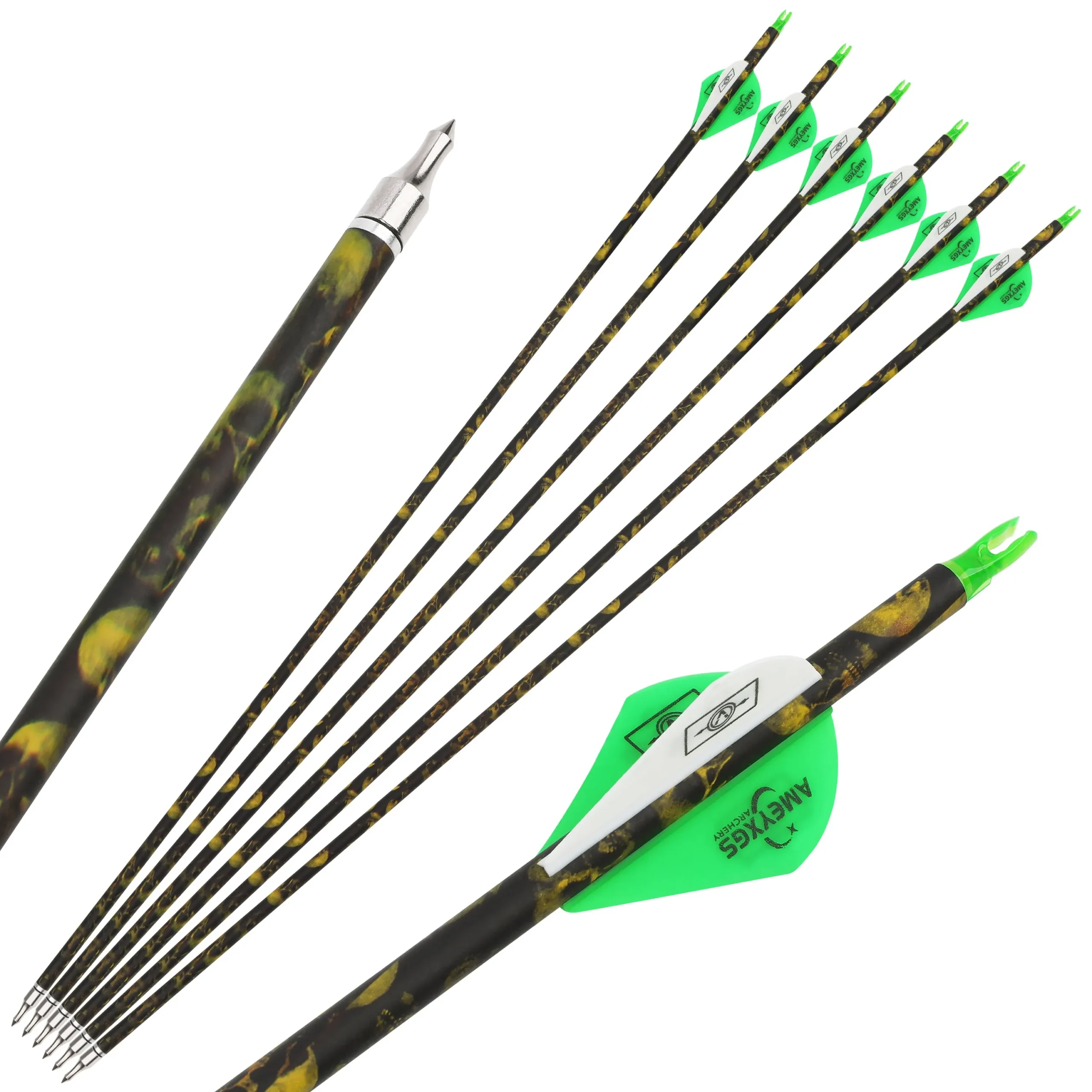
Carbon is the most common practical choice for modern compound bows because it provides consistent spine options, useful durability, and a broad range of diameters and component systems. Carbon shafts can be damaged internally or develop fine splits, so they must be inspected carefully after hard impacts.
Aluminum arrows
Aluminum arrows offer consistent construction and can be easier to identify as bent after an impact. They may dent or bend and should not be straightened casually and returned to hunting use without following manufacturer guidance.
Wood arrows
Wood remains appropriate for many traditional bows when shaft spine, grain orientation, straightness, length, nock fit, and finished weight are matched carefully. Wood arrows require individual inspection and may vary more from shaft to shaft.
Carbon-aluminum composite arrows
Composite designs combine materials to achieve specific diameter, durability, and weight characteristics. They are not automatically more accurate or suitable; component availability, correct spine, and consistent assembly remain essential.
Standard-Diameter Versus Small-Diameter Arrows
Smaller-diameter hunting shafts may experience less crosswind influence and can use robust insert or outsert systems. Standard-diameter shafts often provide broad component availability and simpler replacement options.
Diameter alone does not determine penetration or accuracy. Shaft weight, wall construction, component alignment, broadhead design, tune, impact angle, and shot placement all affect field performance.
How Much Front-of-Center Balance Do You Need?
Front of center, commonly shortened to FOC, describes how far the completed arrow’s balance point sits forward of its physical midpoint. Broadheads, inserts, collars, vanes, nocks, and shaft weight all affect it.
FOC is useful as a tuning and arrow-design measurement, but it should not replace correct spine or accurate broadhead flight. Gold Tip provides a calculator that estimates finished weight and FOC from the shaft and component values.
Avoid adding heavy front components solely to reach an internet FOC target. Increasing front weight weakens dynamic spine and may force a change in shaft stiffness, sight settings, and tuning.
How Many Vanes Should a Deer Arrow Have?
Three vanes are common on compound hunting arrows, while four-vane configurations are also used when additional steering or clearance advantages are desired. The correct arrangement depends on vane size, broadhead profile, arrow diameter, bow clearance, and tune.
Fixed-blade broadheads generally need enough rear steering to control the aerodynamic influence of the blades. Archery 360 identifies 2- to 3-inch vanes as a practical middle-ground choice for many fixed-blade compound setups.
How to Tune Deer-Hunting Arrows
- Set up the bow correctly. Confirm cam timing, rest position, nocking-point height, center shot, and draw settings.
- Use matched arrows. Every hunting arrow should use the same shaft model, spine, length, nock, insert, broadhead weight, and fletching configuration.
- Begin with field points. Establish consistent shooting form and grouping.
- Paper tune or use the manufacturer’s recommended tuning procedure. Make small adjustments rather than changing several variables at once.
- Check broadhead alignment. Spin the assembled arrow and investigate visible wobble.
- Compare broadheads with matching-weight field points. They should group closely from the distances at which you intend to hunt.
- Practice with the hunting configuration. Confirm every arrow individually before placing it in the hunting quiver.
Bowhunter education guidance recommends tuning the bow to the actual hunting equipment and checking broadhead-to-shaft alignment. A broadhead that wobbles during a spin check may indicate an insert, shaft, or component-alignment problem.
How to Inspect a Hunting Arrow Safely
Inspect arrows before every shooting session and after any impact with another arrow, hard target edge, tree, rock, ground, or other object.
- Check the nock for cracks, deformation, looseness, or damaged ears.
- Examine every vane or feather for tears, separation, or interference.
- Look along the shaft for bending, dents, cuts, splinters, or surface changes.
- Follow the manufacturer’s procedure for checking carbon shafts.
- Inspect the insert or outsert for looseness or misalignment.
- Confirm that the broadhead is tight, aligned, sharp, and undamaged.
- Remove any questionable arrow from service rather than testing it by shooting.
NASP safety guidance warns that damaged shafts and nocks can injure the archer or damage equipment. It advises inspecting new and used arrows and immediately discarding a shaft with cracks.
Compound-Bow Arrow Recommendations
For a modern compound bow, begin with a carbon hunting shaft selected from the manufacturer’s current compound-bow spine chart. Use the bow’s measured peak weight, finished arrow length, point-and-insert weight, release method, and speed category.
A broadly practical compound setup often includes:
- Correctly selected 300-, 340-, 350-, 400-, or 500-class spine, depending on the bow
- A finished hunting length established by a qualified technician
- A 100- or 125-grain legal broadhead
- Three or four durable vanes
- A finished weight that meets the bow’s minimum and tunes consistently
These spine numbers are examples of common categories, not direct recommendations. A 400-spine shaft may be appropriate for one hunter and unsafe or poorly tuned for another.
Recurve and Longbow Arrow Recommendations
Traditional bows require the bow’s actual draw weight at the archer’s draw length. A recurve marked 45 pounds at 28 inches may produce less weight for a shorter draw or substantially more weight for a longer draw.
Traditional-arrow selection should also consider:
- Whether the bow is cut to, before, or past center
- Finger release rather than a mechanical release
- String material
- Arrow length
- Point and insert weight
- Wood, aluminum, or carbon shaft construction
- The planned broadhead and fletching
Easton advises using actual bow weight measured at the correct draw length and recommends a dedicated bow scale or assistance from a qualified shop.
Crossbow Bolt and Arrow Recommendations
Use only the crossbow bolt or arrow specifications listed in the exact crossbow manual. Crossbows can require a particular:
- Minimum length
- Minimum finished weight
- Nock shape and orientation
- Shaft diameter
- Insert system
- Broadhead weight
- Fletching clearance
Using a bolt that is too short, too light, incorrectly nocked, or otherwise incompatible can damage the crossbow and injure the shooter. Bowhunter education guidance warns that shorter or lighter-than-approved crossbow arrows can create a safety hazard.
Common Deer-Arrow Mistakes
| Mistake | Why it matters | Better approach |
|---|---|---|
| Choosing spine from draw weight alone | Length and front weight can change the required stiffness | Use the full manufacturer chart or selector |
| Confusing spine with arrow weight | A 340 spine does not mean the arrow weighs 340 grains | Calculate finished weight from every component |
| Changing broadhead weight without retuning | Point weight alters dynamic spine and impact location | Recheck the chart, tune, and resight |
| Hunting with untested broadheads | Field-point accuracy does not guarantee broadhead accuracy | Practice with the hunting head on an appropriate target |
| Cutting arrows excessively short | The broadhead may create a clearance and injury hazard | Have safe finished length established professionally |
| Using different components across the quiver | Weight and balance variation can change impact points | Build and weigh arrows consistently |
| Shooting a damaged carbon shaft | A cracked shaft can fail during release | Inspect and remove questionable arrows from service |
| Choosing maximum speed over control | A light arrow cannot compensate for poor flight or uncertain range | Prioritize safe weight, tuning, and demonstrated accuracy |
| Assuming every broadhead is legal | Cutting-width and blade rules vary | Check the current official regulations |
Pre-Hunt Arrow Checklist
- Current hunting license, deer tag, and any required archery certification are valid.
- The arrow and broadhead comply with current local regulations.
- The shaft model and spine match the bow and complete component system.
- Every arrow has the same finished length and component configuration.
- Finished weight remains above the bow manufacturer’s minimum.
- Nocks, shafts, vanes, inserts, and broadheads pass inspection.
- Broadheads spin without visible wobble.
- Broadheads and field points group acceptably.
- Every hunting arrow has been individually verified.
- Broadheads are sharp and protected in a secure quiver.
- Your effective range is based on demonstrated groups under realistic conditions.
- The target, path, and area beyond the animal must be positively identified before any shot.
When to Ask an Archery Professional for Help
Visit a qualified archery shop or instructor when:
- You do not know the bow’s actual draw weight or draw length
- You cannot determine a safe arrow length
- Two manufacturer charts appear to give conflicting recommendations
- You are changing to a substantially heavier broadhead or insert
- Broadheads and field points will not group together
- Arrows show persistent fishtailing, porpoising, or unexplained impact changes
- You are setting up a first hunting bow
- You are switching between compound, traditional, or crossbow equipment
- You need arrows cut, squared, indexed, or assembled
- You are unsure whether a damaged arrow remains safe
You do not need the most expensive arrow to hunt responsibly. Correct fit, safe construction, consistent assembly, broadhead accuracy, regular inspection, and practiced shot judgment matter more than premium branding.
Final Answer
For deer hunting, use a hunting arrow with the correct spine for your bow, adequate safe length, consistent components, and a sharp broadhead that complies with current local law. Carbon shafts are the most practical choice for many compound hunters, while aluminum and wood remain valid when properly selected for the equipment.
A finished weight around 400 to 500 grains is common for many adult compound deer setups, but it is not universally correct. Use the shaft manufacturer’s current spine chart, remain above the bow maker’s minimum arrow weight, tune with the complete hunting configuration, and confirm that broadheads group accurately before entering the field.
For a recurve or longbow, base the selection on actual draw weight at your draw length. For a crossbow, follow the exact bolt or arrow specifications in the crossbow manual without substitution.
FAQs
1. What type of arrow is best for deer hunting?
A properly spined carbon hunting arrow is the most practical choice for many modern compound bows. Aluminum and wood arrows can also work when matched correctly to the bow and broadhead.
2. What arrow spine should I use for deer hunting?
The correct spine depends on bow type, actual draw weight, arrow length, bow speed, release method, insert weight, and broadhead weight. Use the chart for the exact shaft model rather than choosing a universal number.
3. Is a 340-spine arrow good for deer?
It can be appropriate for some adult compound setups, but it may be too stiff or too weak for others. Enter your actual setup into the manufacturer’s selector and verify the result through tuning.
4. Is a 400-spine arrow enough for deer hunting?
Deer size does not determine spine by itself. A 400 spine can be appropriate when it matches the bow, length, and front weight, but unsuitable spine can produce unstable flight regardless of the species.
5. Does a lower spine number mean a stronger arrow?
It generally means a stiffer shaft, not necessarily a stronger or more durable one. A 300-spine carbon shaft bends less under the standard test than a 500-spine shaft.
6. Is arrow spine the same as arrow weight?
No. Spine measures stiffness, while arrow weight is measured in grains. A shaft labeled 340 spine does not automatically weigh 340 grains.
7. How many grains should a deer arrow weigh?
Many adult compound setups finish around 400 to 500 grains, but the correct weight depends on the bow, shaft, components, and tune. Never use an arrow below the bow manufacturer’s stated minimum.
8. Does total arrow weight include the broadhead?
Yes. It includes the shaft, broadhead, insert, nock, vanes, wrap, collar, and every other installed component.
9. Is a heavier arrow better for deer?
A moderately heavier arrow may reduce bow noise and retain momentum, but it also travels more slowly and has a more curved trajectory. Accurate, tuned flight is more important than simply maximizing weight.
10. Can a deer arrow be too heavy?
It can become impractical if the trajectory is so curved that small ranging errors cause large misses. Excess front weight can also make the selected shaft dynamically too weak.
11. Can an arrow be too light?
Yes. An arrow below the bow manufacturer’s minimum may not absorb enough stored energy and can damage the equipment or injure the shooter.
12. Is a 100-grain broadhead enough for deer?
A sharp, legal 100-grain broadhead can be appropriate when it is part of a properly tuned arrow. Broadhead weight alone does not establish the setup’s suitability.
13. Is a 125-grain broadhead better than 100 grains?
Not universally. It adds front and total weight but also weakens dynamic spine. Choose it when your arrow build, tune, and accuracy support the change.
14. Should field points match broadhead weight?
Yes. Use field points with the same nominal weight as the hunting broadheads, then verify actual broadhead impact through practice.
15. Are fixed-blade broadheads better for deer?
Fixed blades are mechanically simple and can work across a wide range of setups. They may expose tuning problems more clearly, so broadhead tuning is important.
16. Are mechanical broadheads legal for deer hunting?
They are legal in many jurisdictions but not necessarily every location or season. Check the current regulation booklet for blade, cutting-width, and mechanical-head requirements.
17. Do mechanical broadheads need more bow energy?
Some manufacturers specify minimum requirements for reliable use. Follow the broadhead maker’s guidance and ensure the complete system is compatible with your bow.
18. Are carbon arrows safe for deer hunting?
Yes, when correctly selected and inspected. Remove a carbon arrow from service if it shows cracking, splintering, unusual softness, impact damage, or another questionable condition.
19. Are aluminum arrows good for hunting deer?
Yes. Properly spined aluminum arrows can be accurate and effective, but they should be checked carefully for bends, dents, and component damage.
20. Can you hunt deer with wood arrows?
Yes, particularly with traditional bows, when the shafts are straight, properly spined, consistently weighted, safely constructed, and fitted with legal broadheads.
21. How long should deer-hunting arrows be?
They must remain safely supported at full draw and keep the broadhead away from the hand and bow. Have finished length established using your actual setup rather than subtracting from draw length without measurement.
22. Should the arrow extend past the rest?
Yes, it needs safe clearance, although the required amount depends on the bow and arrow system. Follow manufacturer instructions and have a professional establish the cut length.
23. Do shorter arrows fly better?
Shortening a shaft reduces weight and makes it stiffer, but shorter is not automatically better. Cutting too far can create a safety hazard or produce an excessively stiff tune.
24. Do small-diameter arrows penetrate better?
They may experience less wind influence and use robust component systems, but diameter alone does not guarantee penetration. Tune, broadhead design, weight, alignment, and shot placement remain important.
25. How many vanes should a deer arrow have?
Three vanes are common, while four-vane configurations can provide additional steering or clearance options. Use a configuration that stabilizes your broadhead and clears the bow.
26. Do I need to practice with broadheads?
Yes. Broadheads can impact differently from field points. Practice on a suitable broadhead target and verify each hunting arrow before the season.
27. How do I know if my broadhead is aligned?
Spin the completed arrow using a safe spin tester or flat-surface procedure and watch for point wobble. Investigate any wobble rather than shooting the arrow at an animal.
28. How often should I inspect carbon arrows?
Inspect them before every shooting session and after any hard impact. Check the nock, vanes, shaft, insert, and broadhead.
29. Can I use compound-bow arrows in a crossbow?
No, unless the crossbow manufacturer expressly approves that exact construction. Crossbows require specific bolt length, weight, diameter, and nock compatibility.
30. What is the safest way for a beginner to choose deer arrows?
Take the bow to a qualified archery shop, have draw weight and safe arrow length measured, select the shaft from the manufacturer’s chart, and receive help with assembly and broadhead tuning. Complete hunter or bowhunter education and practice well before the season.
Read more: