
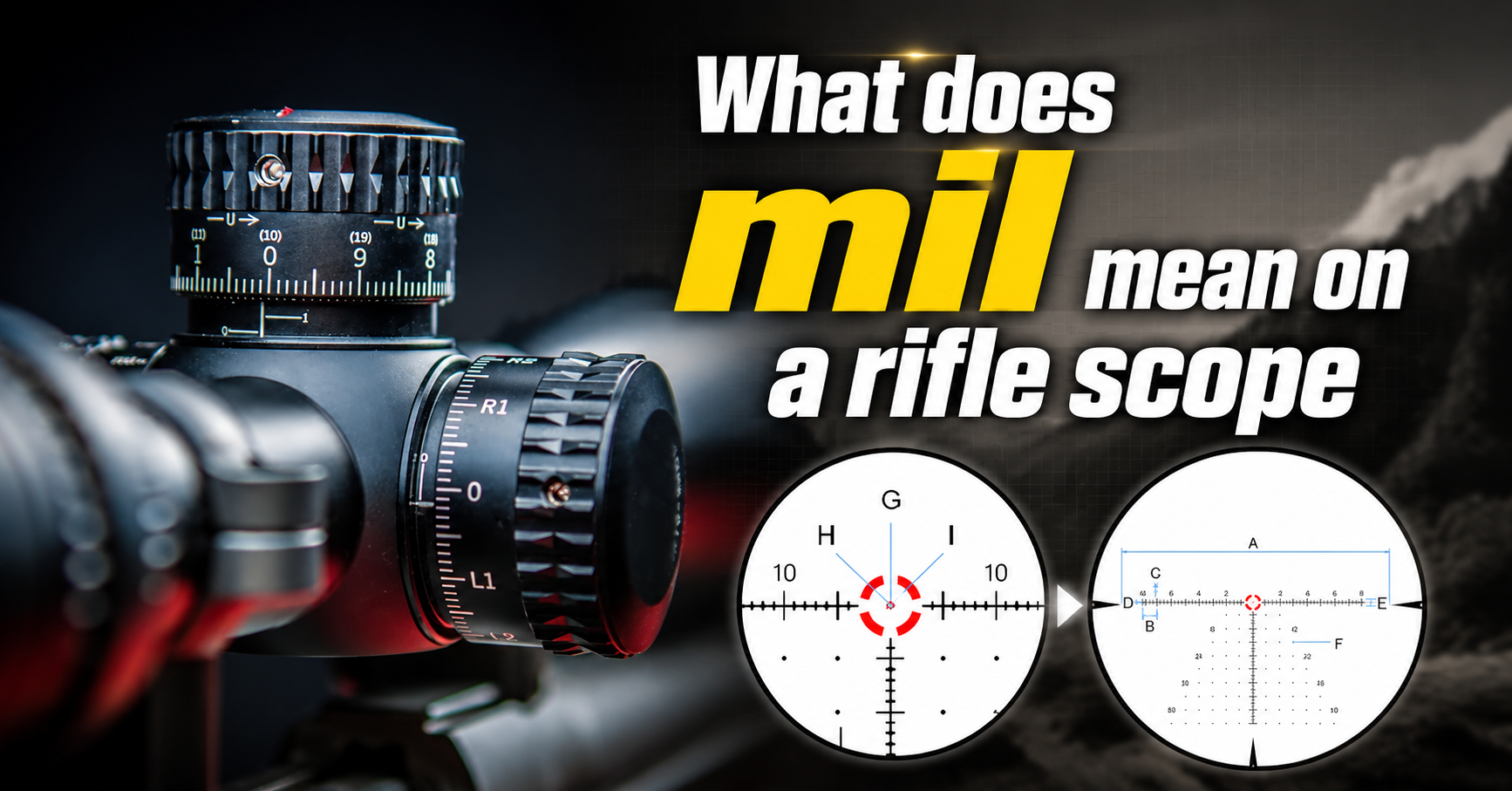

What does MIL mean on a rifle scope? MIL is short for milliradian, usually written as mil or MRAD. It is an angular unit used to describe reticle spacing, elevation adjustments, windage adjustments, and sometimes range estimates. Understanding it helps a hunter or target shooter make deliberate corrections instead of guessing at turret clicks.
This guide is for beginners learning a MIL-based optic. It explains the basic geometry, common 0.1-MIL turrets, MIL reticles, first- and second-focal-plane behavior, MIL versus MOA, and safe ways to practice. Your scope’s manual is the controlling source for its exact click value, reticle subtensions, calibration magnification, adjustment direction, and mechanical limits.
Quick Answer
MIL on a rifle scope means milliradian, an angular measurement equal to one-thousandth of a radian. One MIL spans approximately 3.6 inches at 100 yards or exactly 10 centimeters at 100 meters, and that linear span grows in direct proportion to distance. Many MIL scopes adjust in 0.1-MIL clicks, so one click equals about 0.36 inch at 100 yards or 1 centimeter at 100 meters. MIL markings can be used for measured holdovers, wind corrections, and approximate ranging when the reticle and its focal-plane rules are understood. Always verify every value in the manufacturer’s manual and confirm adjustments on paper at a safe range.
Important Firearm Safety and Legal Notice
Scope knowledge never replaces safe firearm handling or trained judgment. Follow the four primary rules summarized in recognized hunter education guidance:
- Treat every firearm as if it is loaded.
- Keep the muzzle pointed in a safe direction.
- Keep your finger outside the trigger guard until ready to shoot.
- Be certain of the target, what is in front of it, and what is beyond it.
Use an established range with a safe backstop, wear eye and hearing protection, and follow all range commands. Unload and secure the firearm before mounting, inspecting, or servicing an optic unless a supervised range procedure specifically requires otherwise. Hunting laws and permitted equipment vary by jurisdiction, so verify current regulations with the relevant wildlife agency before entering the field. General scope math does not establish an ethical or legal shooting distance.
What Does MIL Mean on a Rifle Scope in Practical Terms?
A MIL is an angle, not a fixed number of inches or centimeters. Imagine two lines leaving the scope and spreading apart. The angle between them stays the same, but the physical space between the lines gets larger as distance increases.
The basic relationship is simple: one MIL spans one unit for every 1,000 of the same units of distance. One MIL therefore spans 1 meter at 1,000 meters, 10 centimeters at 100 meters, or approximately 3.6 inches at 100 yards. EOTECH’s official Vudu MRAD documentation gives the same 10-centimeter and 3.6-inch reference values.
MIL does not mean “military,” although milliradians are widely used in military, competition, hunting, and precision-shooting optics. MIL and MRAD are two labels for the same milliradian system.
MIL Quick-Reference Table
| Distance | 1 MIL spans | 0.1 MIL spans |
|---|---|---|
| 25 yards | 0.9 inch | 0.09 inch |
| 50 yards | 1.8 inches | 0.18 inch |
| 100 yards | 3.6 inches | 0.36 inch |
| 200 yards | 7.2 inches | 0.72 inch |
| 300 yards | 10.8 inches | 1.08 inches |
| 100 meters | 10 centimeters | 1 centimeter |
| 200 meters | 20 centimeters | 2 centimeters |
| 500 meters | 50 centimeters | 5 centimeters |
The table describes the angle’s linear span, not a promise that a particular scope tracks perfectly. Mechanical tolerances, mounting, ammunition, shooter technique, weather, and other variables affect actual point of impact. Confirm the system at the range.
How 0.1-MIL Scope Clicks Work
Many MIL-based elevation and windage turrets are marked 0.1 MRAD per click. Ten clicks equal 1.0 MIL. At 100 yards, one 0.1-MIL click changes the intended point of impact by approximately 0.36 inch; at 200 yards, the same angular click corresponds to approximately 0.72 inch. At 100 meters, one click corresponds to 1 centimeter.
For example, if a careful group on a paper target is centered about 1.8 inches low at 100 yards, 1.8 divided by 3.6 equals 0.5 MIL. On a verified 0.1-MIL-per-click scope, that is five clicks in the direction indicated by the elevation turret. Fire another group to confirm; do not assume the arithmetic proves the zero.
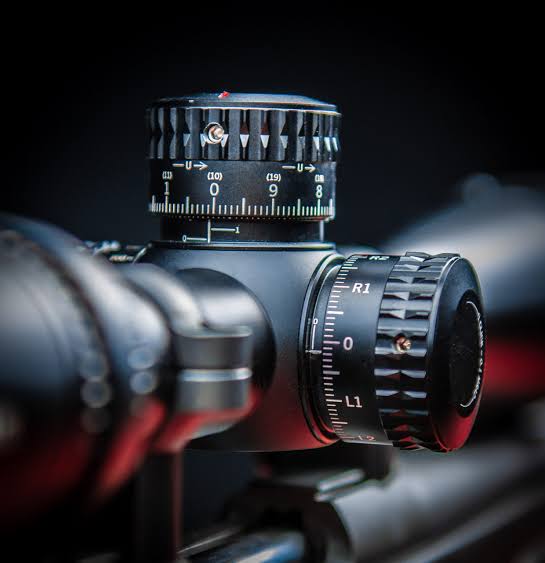
Not every scope uses 0.1-MIL clicks. Some optics use a different increment, and a scope may even pair a MIL reticle with MOA turrets. Read the engraving and manual before turning anything. Leupold, for example, lists 0.1-MIL elevation and windage clicks for a current PR2-MIL model, but that specification should not be generalized to all scopes.
How to Read a MIL Reticle
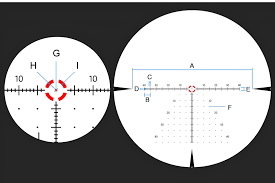
A MIL reticle uses dots, hash marks, or a grid to divide the view into known angular spaces. Traditional mil-dot reticles commonly place major marks one MIL apart, measured center to center. Modern reticles may add 0.5-, 0.2-, or 0.1-MIL subdivisions. Do not identify a subdivision by appearance alone; consult the reticle diagram.
Reticle marks can serve three broad purposes:
- Measuring a correction: observe how far a group is from the intended point on a paper target.
- Holding: use a verified reticle mark instead of dialing a known elevation or wind correction.
- Estimating range: compare the apparent MIL size of an object with its known actual size.
Leupold’s current TMR reticle information, for example, specifies 0.5-MIL hash spacing with some 0.2-MIL divisions. That pattern is only one design; another MIL reticle may be divided differently.
First Focal Plane Versus Second Focal Plane
| Feature | First focal plane (FFP) | Second focal plane (SFP) |
|---|---|---|
| Reticle appearance | Appears to grow and shrink with magnification | Appears the same size as magnification changes |
| MIL subtensions | Remain valid at every magnification | Usually valid at one designated magnification |
| Beginner concern | Marks can look fine at low power or heavy at high power | Using marks at the wrong power produces incorrect measurements |
On an FFP scope, the reticle and target image scale together, so one MIL remains one MIL throughout the zoom range. On an SFP scope, the reticle stays visually constant while the target image changes. Its MIL values are therefore correct only at the calibration magnification stated in the manual, often but not always maximum power.
This distinction matters for holding and range estimation. Turret click value does not change with magnification, but reticle subtension on an SFP optic does. EOTECH’s current FFP product information emphasizes that its reticle maintains ranging behavior across magnification; an SFP owner should instead use the specific reticle manual.
Using MILs to Estimate Distance
A MIL reticle can estimate range if you know an object’s actual size and can measure its apparent size accurately. The cleanest formulas are:
- Range in meters = target size in meters × 1,000 ÷ measured MILs
- Range in meters = target size in centimeters × 10 ÷ measured MILs
- Range in yards = target size in inches × 27.78 ÷ measured MILs
Example: a paper target board known to be 18 inches wide measures 2.0 MILs in the reticle. The estimate is 18 × 27.78 ÷ 2.0, or approximately 250 yards.
This method is only as reliable as the target size, MIL reading, focal-plane setting, and steadiness of the optic. A small reading error can create a large range error, especially when the object measures only a fraction of a MIL. For hunting, a quality rangefinder and verified field judgment are generally more dependable. Never use an uncertain MIL estimate to justify a shot beyond your demonstrated ability or without a safe backstop.
Dialing a MIL Correction Versus Holding With the Reticle
Dialing means turning the elevation or windage turret by a measured amount. Holding means leaving the turret in place and using an appropriate reticle mark as the aiming reference. Neither method changes the actual trajectory; it changes the relationship between the aiming line and the firearm’s bore.
If verified range data calls for 0.8 MIL of elevation, a 0.1-MIL turret would require eight clicks, or the shooter could use a verified 0.8-MIL hold. That example explains the unit only—it is not ballistic data for any cartridge. Obtain corrections from a reliable ballistic solution, confirm them on paper or steel at an established range, and stay within the firearm, optic, ammunition, range, and shooter limits.
Dialing can give a clean central aim point, but the turret must be returned correctly afterward. Holding is quicker and avoids losing track of the zero, but it requires a visible, correctly scaled reticle and solid familiarity with its marks. Hunters should use whichever verified method they can execute safely and consistently.
MIL Versus MOA
| Feature | MIL / MRAD | MOA |
|---|---|---|
| Full unit | 1 milliradian | 1 minute of angle |
| Approximate span at 100 yards | 3.6 inches | 1.047 inches |
| Common click value | 0.1 MIL | 0.25 MOA |
| Common click span at 100 yards | About 0.36 inch | About 0.26 inch |
| Counting style | Decimal: 0.1, 0.2, 0.3 | Often quarters: 0.25, 0.5, 0.75 |
Both systems measure angles, and both work with yards or meters. MIL is convenient with metric units and decimal corrections, but it is not restricted to metric measurement. MOA is familiar to many U.S. hunters because one MOA is close to one inch at 100 yards, but it is not inherently an “inch” unit.
One MIL equals approximately 3.438 MOA. That conversion is useful occasionally, but routine conversion invites mistakes. A scope with a MIL reticle and MIL turrets lets the shooter observe 0.6 MIL of correction and dial six 0.1-MIL clicks without converting to inches or MOA.
Should You Choose MIL or MOA?
Choose the system that matches your training, shooting partners, spotting optic, ballistic tools, and ability to think consistently. MIL is often convenient for people who prefer decimal math or participate in activities where corrections are commonly communicated in MILs. MOA may feel more familiar to a hunter who already uses MOA data and scopes.
Neither unit makes a rifle more accurate. Optical quality, reliable tracking, a sound mount, consistent ammunition, correct setup, shooter fundamentals, and verified data matter more than the label. The most beginner-friendly configuration is usually a matched system: MIL reticle with MIL turrets, or MOA reticle with MOA turrets.
How to Confirm What Your Scope Uses
- Read the turret engraving. Look for markings such as “0.1 MRAD,” “1/10 MIL,” or “1/4 MOA.”
- Identify the reticle name. The model name alone may not reveal which reticle variation is installed.
- Find the official reticle diagram. Confirm the value of major and minor hashes.
- Check focal plane. Determine whether it is FFP or SFP and, for SFP, find the calibration magnification.
- Check adjustment direction and limits. Follow the manual’s arrows, zeroing procedure, zero-stop instructions, and travel limits.
- Verify on a measured target. Use a safe range and confirm that adjustment and reticle behavior match the documentation.
Do not assume that a scope with dots is a MIL scope. Some dot or hash reticles use MOA, ballistic-drop references, or cartridge-specific spacing. Likewise, a “MIL-Dot” style reticle does not guarantee MIL turrets.
A Safe Beginner Practice Routine
- Take a hunter education, firearm fundamentals, or in-person rifle course. The IHEA-USA Firearm Fundamentals program is one place to locate structured foundational training.
- Read the rifle, scope, mount, and ammunition instructions before setup.
- Use a stable bench at an established range with a suitable backstop and required eye and hearing protection.
- Start with a large paper target at a range appropriate for the facility and your skill level.
- Fire a careful group rather than chasing a single impact. Measure the group center with the reticle or target grid.
- Make one deliberate correction, record the value, and fire another group to verify.
- Once zeroed, return turrets to the documented zero index if the scope supports that feature.
- Keep a simple data card using one angular unit. Confirm any longer-distance data only under controlled, legal range conditions.
Common MIL Scope Mistakes
- Thinking MIL means military. It means milliradian.
- Treating 1 MIL as 3.6 inches everywhere. It is 3.6 inches only at 100 yards; the span changes with distance.
- Assuming every click is 0.1 MIL. Verify the turret label and manual.
- Mixing MIL reticle measurements with MOA turret clicks. Convert carefully or, preferably, use matched units.
- Using SFP subtensions at the wrong magnification. Find the official calibration setting.
- Counting a single impact as a zero. Use groups and repeatable technique.
- Turning the turret in the wrong direction. Follow the scope’s marked direction and confirm on paper.
- Forgetting to return a dialed turret. Record corrections and check the zero index before leaving the range or beginning a hunt.
- Trusting unverified ballistic data. Confirm the specific rifle, optic, ammunition, and environmental setup at a safe range.
- Using scope math to stretch ethical distance. A known correction does not replace target identification, a safe backstop, stable conditions, or proven accuracy.
What Not to Do
- Do not handle or adjust a rifle casually while people are forward of the firing line.
- Do not look through a mounted scope at anything you are not prepared to point a firearm toward.
- Do not fire at unidentified movement, skylined targets, water, hard flat surfaces, roads, buildings, livestock, or an unsafe backstop.
- Do not rely on the scope, a mechanical safety, or a rangefinder as a substitute for the four firearm-safety rules.
- Do not exceed the manufacturer’s adjustment limits or force a turret past its stop.
- Do not assume a correction verified with one load applies to another.
- Do not hunt without checking current equipment rules, seasons, licenses, tags, and property boundaries.
FAQs
1. What does MIL stand for on a scope?
MIL stands for milliradian, usually abbreviated mil or MRAD. It is an angular unit used for reticle spacing and turret adjustments.
2. Is MIL the same as MRAD?
Yes. In rifle-scope terminology, MIL and MRAD both refer to milliradians. A manufacturer may prefer one label, but the underlying angular unit is the same.
3. Does MIL mean military?
No. MIL in this context is short for milliradian, not military. Military organizations use the system, but so do hunters, recreational shooters, and competitors.
4. How many inches is 1 MIL at 100 yards?
One MIL spans approximately 3.6 inches at 100 yards. At 200 yards it spans 7.2 inches, and at 50 yards it spans 1.8 inches.
5. How many centimeters is 1 MIL at 100 meters?
One MIL spans exactly 10 centimeters at 100 meters. The same angle spans 20 centimeters at 200 meters and 50 centimeters at 500 meters.
6. What does 0.1 MIL per click mean?
It means each turret click changes the sight angle by one-tenth of a milliradian. That corresponds to about 0.36 inch at 100 yards or 1 centimeter at 100 meters.
7. How many clicks are in 1 MIL?
On a 0.1-MIL-per-click turret, ten clicks equal 1 MIL. A scope with a different click value will require a different number, so verify the manual.
8. Does one MIL always equal 3.6 inches?
No. One MIL equals about 3.6 inches only at 100 yards. Because it is an angle, its linear span increases or decreases with distance.
9. What is a MIL-dot reticle?
A traditional MIL-dot reticle uses dots placed at known milliradian intervals, commonly one MIL center to center. Modern MIL reticles often use hash marks or grids instead. Read the diagram for the exact spacing.
10. Are all marks on a MIL reticle one MIL apart?
No. Many modern reticles include half-, two-tenths-, or other fractional-MIL marks. The shape and spacing are design-specific.
11. Can MILs be used with yards and inches?
Yes. MIL is an angular unit and works with any consistent linear units. At 100 yards, the familiar reference is approximately 3.6 inches per MIL.
12. Is MIL a metric measurement?
A milliradian is an SI-derived angular unit and pairs neatly with meters and centimeters, but it is not limited to metric distances. It works equally well with yards and inches when the correct formula is used.
13. Is MIL more accurate than MOA?
No. Both are valid angular systems. A common 0.25-MOA click is slightly finer than a common 0.1-MIL click, but optic quality, tracking, setup, ammunition, and shooter consistency usually matter more.
14. Is MIL easier than MOA?
MIL can feel easier to people who prefer decimal corrections, while MOA can feel familiar to people accustomed to inch-like references at 100 yards. The easier system is usually the one you practice consistently.
15. How many MOA are in 1 MIL?
One MIL is approximately 3.438 MOA. Routine conversion is usually unnecessary when the reticle and turrets use matching units.
16. Should my scope have MIL turrets with a MIL reticle?
A matched MIL/MIL system is generally simpler. A measured 0.7-MIL correction can be dialed directly as seven clicks on a 0.1-MIL turret without converting units.
17. Can a scope have a MIL reticle and MOA turrets?
Yes, especially on some older or specialized designs. It can work, but every reticle measurement must be converted before dialing, increasing the chance of errors.
18. Do MIL values change with magnification?
FFP reticle values remain correct across the magnification range. SFP reticle values are normally correct only at the magnification specified by the manufacturer. Turret click value itself does not change with zoom.
19. What magnification makes an SFP MIL reticle accurate?
Use the calibration magnification listed in the scope’s reticle manual. It is often maximum power, but not always, so guessing is unsafe and inaccurate.
20. Can I estimate range with a MIL reticle?
Yes, if the object’s true size is known, its MIL size is measured precisely, and the reticle is correctly scaled. The result is an estimate; a rangefinder and verified judgment are generally more dependable for hunting.
21. What is the metric MIL ranging formula?
Range in meters equals target size in meters multiplied by 1,000, divided by measured MILs. If size is in centimeters, multiply by 10 instead.
22. What is the MIL ranging formula for inches and yards?
Range in yards equals target size in inches multiplied by 27.78, divided by measured MILs. Errors in assumed size or reticle reading directly affect the estimate.
23. What is MIL holdover?
MIL holdover means using a vertical reticle mark above or below the central aim point based on a verified angular correction rather than dialing the elevation turret.
24. What is a MIL wind hold?
A MIL wind hold uses a horizontal reticle mark for a verified wind correction. Wind changes across terrain and time, so hunters should be conservative and avoid shots when conditions exceed their ability.
25. How do I know whether my scope is MIL or MOA?
Check the turret engraving, exact reticle name, model number, and official manual. Labels such as 0.1 MRAD or 1/10 MIL indicate MIL adjustments; 1/4 MOA indicates MOA adjustments.
26. Why did my impact not move the expected amount?
Possible causes include incorrect range measurement, wrong click value, reversed adjustment, loose mounting, unstable shooting, parallax, ammunition variation, or limited mechanical tracking. Stop and troubleshoot safely rather than making random corrections.
27. Should beginners buy a MIL scope?
A MIL scope can be beginner-friendly when its reticle and turrets match, the manual is clear, and the owner practices with decimal corrections. A good MOA scope is equally valid.
28. Do I need a MIL scope for ordinary hunting?
No. Many hunters use simple MOA or fixed-reticle scopes successfully. A MIL system becomes useful when you want measured holds, repeatable dialing, reticle-based corrections, or shared data in MILs.
29. Can scope adjustments replace practice?
No. Knowing a correction does not guarantee correct execution. Practice safe handling, stable positions, trigger control, range judgment, and verified accuracy under conditions appropriate to your intended hunt.
30. Where can I learn to use a MIL scope safely?
Start with the optic manufacturer’s manual, a certified hunter education or rifle fundamentals course, and supervised practice at an established range. Qualified instructors can correct setup and handling errors that written guidance cannot observe.
Final Answer
What does MIL mean on a rifle scope? It means milliradian, an angular unit used for reticle measurements and turret corrections. One MIL spans about 3.6 inches at 100 yards or 10 centimeters at 100 meters; on a common 0.1-MIL turret, one click spans one-tenth of those amounts. Match MIL reticles with MIL turrets when possible, understand whether the reticle is FFP or SFP, and verify the exact specifications in the scope manual. Confirm every zero and correction at a safe range, follow the four firearm-safety rules, and never let scope math extend a hunting shot beyond legal, ethical, or demonstrated limits.
Read more: