
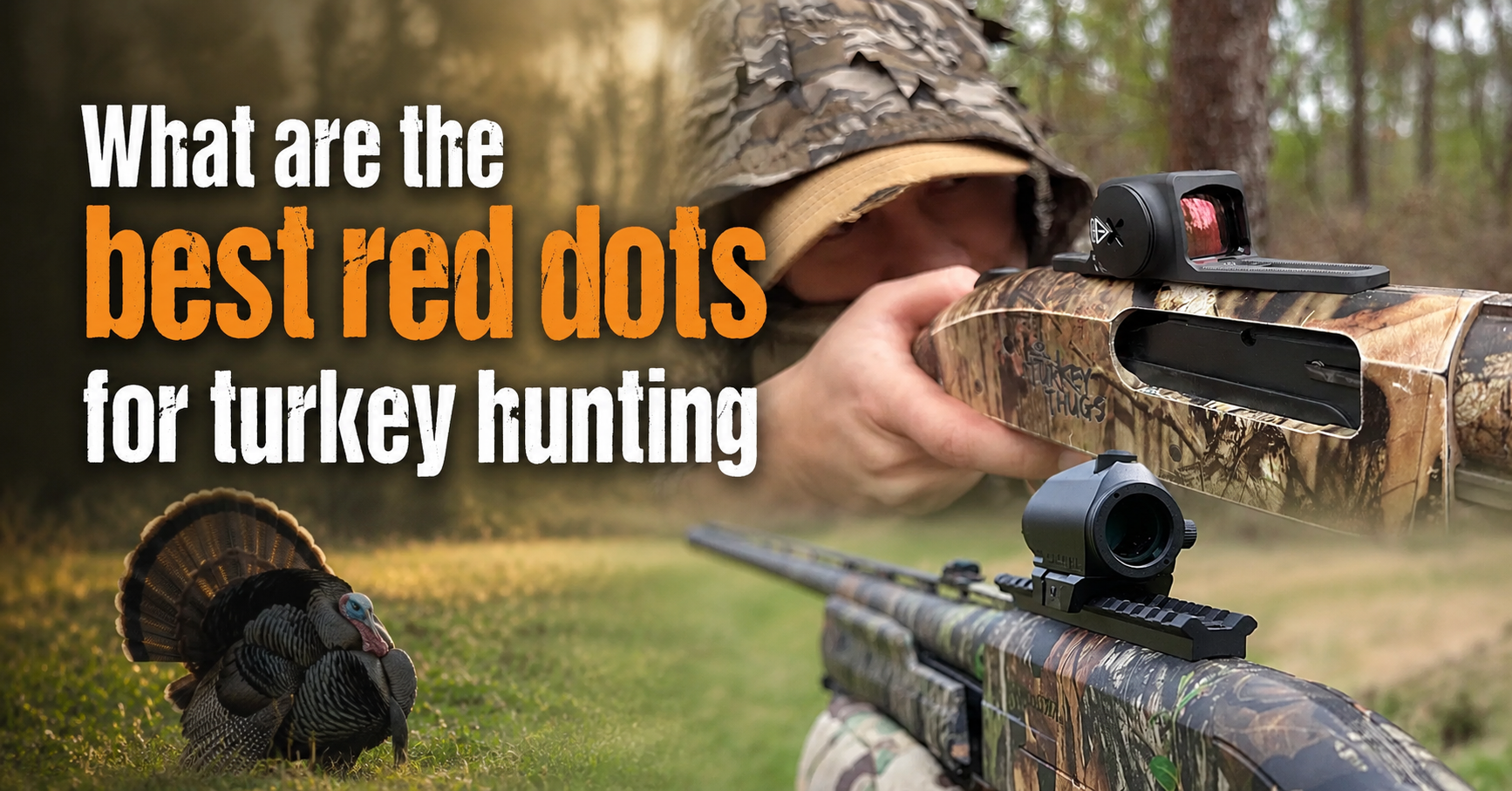

A turkey shotgun can produce a very tight pattern, but the bead, stock fit, mounting system, ammunition, choke, and hunter still need to work together. A red-dot sight can provide a clear aiming reference without requiring perfect alignment between a rear sight and front bead. This can be particularly useful when a turkey approaches from an unexpected direction or the hunter must shoot from an imperfect seated position.
The best red dots for turkey hunting are durable 1x sights that tolerate shotgun recoil, provide a daylight-visible reticle, fit the shotgun through a secure low-profile mount, and maintain zero after being carried through rain, brush, and changing temperatures. An enclosed emitter offers additional protection from water and debris, while a quality open reflex sight usually provides a lighter profile and an unobstructed viewing window.
No optic makes a shotgun, load, or hunter automatically effective. The shotgun must be patterned with the exact choke and legal hunting load, and the red dot must be mounted and zeroed according to the firearm, mount, and optic manufacturers’ instructions.
Product features and manufacturer specifications in this guide were reviewed on July 25, 2026. Models, included mounts, specifications, and availability can change.
Quick Answer
The strongest overall option is the Vortex Viper Shotgun Enclosed Micro Red Dot because it is purpose-built for turkey shotguns, uses an enclosed design, sits low, and includes an integrated universal mounting system. The Trijicon RMR HD is a premium alternative with a selectable center-dot and segmented-circle reticle, while the Holosun HS507C-X2 offers useful multi-reticle features at a less premium position.
Hunters who prefer a traditional enclosed tube should consider the Aimpoint Micro H-2 or SIG SAUER ROMEO5 Gen II. Before choosing any sight, verify the mounting footprint, required rail or plate, optic height, shotgun compatibility, and whether electronic sights are legal for the planned season and location.
Best Red Dots for Turkey Hunting at a Glance
| Red Dot | Best For | Reticle | Design | Mounting Consideration | Main Trade-Off |
|---|---|---|---|---|---|
| Vortex Viper Shotgun Enclosed | Purpose-built turkey shotgun setup | 3 MOA dot | Enclosed micro sight | Integrated universal shotgun mount; verify compatible-shotgun list | Less transferable to firearms using standard pistol footprints |
| Trijicon RMR HD | Premium multi-reticle performance | 3.25 MOA dot with optional 55 MOA segmented circle | Open reflex | RMR-pattern mounting system | Premium cost and open emitter |
| Holosun HS507C-X2 | Feature-rich multi-reticle value | 2 MOA dot, 32 MOA circle, or circle-dot | Open reflex | RMR footprint; shotgun-specific base may be required | Open emitter can collect rain or debris |
| Bushnell RXM-300 | Large viewing window | 4 MOA dot | Large open reflex | RMR footprint plus included Weaver mounts | Larger and heavier than compact micro sights |
| Aimpoint Micro H-2 | Rugged enclosed tube design | 2 MOA dot | Enclosed tube | Weaver/Picatinny mount | May sit higher than direct-mounted reflex sights |
| Leupold DeltaPoint Pro | Wide, clear open window | 2.5 MOA dot | Open reflex | Compatible plate or shotgun rail mount required | Open emitter and relatively tall housing |
| Trijicon RMR Type 2 | Compact and proven construction | 3.25 MOA dot on the RM06 model | Open reflex | RMR-pattern mounting system | Smaller window and bottom battery access |
| Burris FastFire 4 | Reticle flexibility | Four selectable reticles | Open reflex with optional weather shield | Docter interface with detachable Picatinny mount | Weather shield is an additional component |
| Vortex Defender-ST | Compact all-purpose setup | 3 MOA dot | Open reflex | Compatible mount or plate required | Not purpose-built specifically for turkey shotguns |
| SIG SAUER ROMEO5 Gen II | Simple enclosed-tube value | 2 MOA dot | Enclosed 1x20mm tube | M1913/Picatinny-style mounting | Included mount may sit too high for some shotgun stocks |
What Makes a Red Dot Good for Turkey Hunting?
Secure Shotgun Compatibility
The optic is only useful when its mount fits the shotgun securely. Some turkey shotguns are drilled and tapped for a rail, some use proprietary receiver cuts, and others require a rib-mounted system or manufacturer-approved adapter.
Check all three parts of the system:
- The shotgun receiver, rail, rib, or optics cut.
- The mounting plate, adapter, or base.
- The red dot’s footprint or rail interface.
Do not assume that an “RMR-compatible,” “Docter-compatible,” or “Picatinny-compatible” description means the sight attaches directly to every shotgun. A correctly matched plate or base may still be required.
Low Mounting Height
A turkey shotgun usually has a conventional stock designed around a bead or low rib. A tall optic can force the hunter to lift the cheek off the stock, producing an inconsistent head position.
A low mount generally makes the dot easier to find from a natural shooting position. Before hunting, shoulder the unloaded shotgun repeatedly while wearing the same clothing, face covering, and hearing protection planned for the field.
Recoil Resistance
Heavy turkey loads can subject the optic and mounting hardware to substantial recoil. Choose an optic and mount whose manufacturers approve the intended application. Inspect the mounting screws, rail, and receiver before every range session and hunt.
Visible but Adjustable Reticle
The dot must remain visible against dark timber, bright spring vegetation, open fields, and changing light. Excessive brightness can make the dot appear enlarged or distorted, while insufficient brightness can make it disappear against the background.
Practical Dot Size
A small dot provides a precise aiming reference, while a larger dot is usually easier to find quickly. A circle-dot system can help hunters center the reticle while still retaining a fine central reference.
Common turkey-hunting choices include:
- 2 to 3.25 MOA: Precise center reference and minimal target obstruction.
- 4 to 6 MOA: Faster visibility, particularly for hunters who struggle to find a tiny dot.
- Circle-dot reticle: Provides a larger visual reference around a smaller center dot.
The clearest option depends on the hunter’s eyesight. People with astigmatism may see a starburst, comma, cluster, or irregular shape instead of a perfectly round dot.
Weather Protection
An open-emitter sight places the emitter inside an exposed window. Rain, snow, mud, pine needles, or other debris can interfere with the projected dot. An enclosed red dot seals the emitter between lenses, giving it additional environmental protection.
Open sights remain useful for turkey hunting, but they require more attention to covers, cleaning, and field inspection during wet conditions.
Battery Access and Runtime
A top- or side-access battery is convenient because the sight may not need to be removed for replacement. Bottom-access designs can still be dependable, but removal may require the hunter to reconfirm zero.
Long advertised runtime does not eliminate the need for maintenance. Replace the battery on a planned schedule, inspect the contacts, carry an approved spare, and test the sight before leaving home.
Important Turkey-Hunting Safety and Legal Notice
Turkey seasons, legal weapons, ammunition restrictions, electronic-sight rules, hunter-orange requirements, public-land procedures, tagging, reporting, hunting hours, and legal hunting methods vary by jurisdiction. Check the current regulations from the applicable wildlife agency and any additional public-land or refuge rules before mounting or using an optic.
Turkey hunters frequently wear camouflage and imitate turkey sounds, which makes positive target identification especially important. The National Wild Turkey Federation advises hunters to identify the target and verify what is beyond it before shooting. Its current safety guidance also stresses that tight patterns and improved equipment do not replace responsible field decisions. :contentReference[oaicite:1]{index=1}
Apply the four fundamental firearm-safety principles at all times:
- Treat every firearm as if it is loaded.
- Keep the muzzle pointed in a safe direction.
- Keep your finger outside the trigger guard until ready to shoot.
- Be certain of the target and what lies beyond it.
These principles are part of the International Hunter Education Association’s education standards. :contentReference[oaicite:2]{index=2}
- Never shoot at movement, color, sound, or an incomplete silhouette.
- Do not stalk turkey calls without knowing whether another hunter may be producing them.
- Do not point a firearm toward a decoy that another hunter might approach.
- Do not rely on the red dot to compensate for poor identification or an unsafe background.
- Do not use a damaged optic, loose mount, or firearm with an uncertain zero.
- Wear eye and hearing protection while patterning and zeroing.
- Unload the shotgun before mounting, inspecting, cleaning, or adjusting the optic.
1. Best Overall: Vortex Viper Shotgun Enclosed Micro Red Dot
Vortex Viper Shotgun Enclosed Micro Red Dot
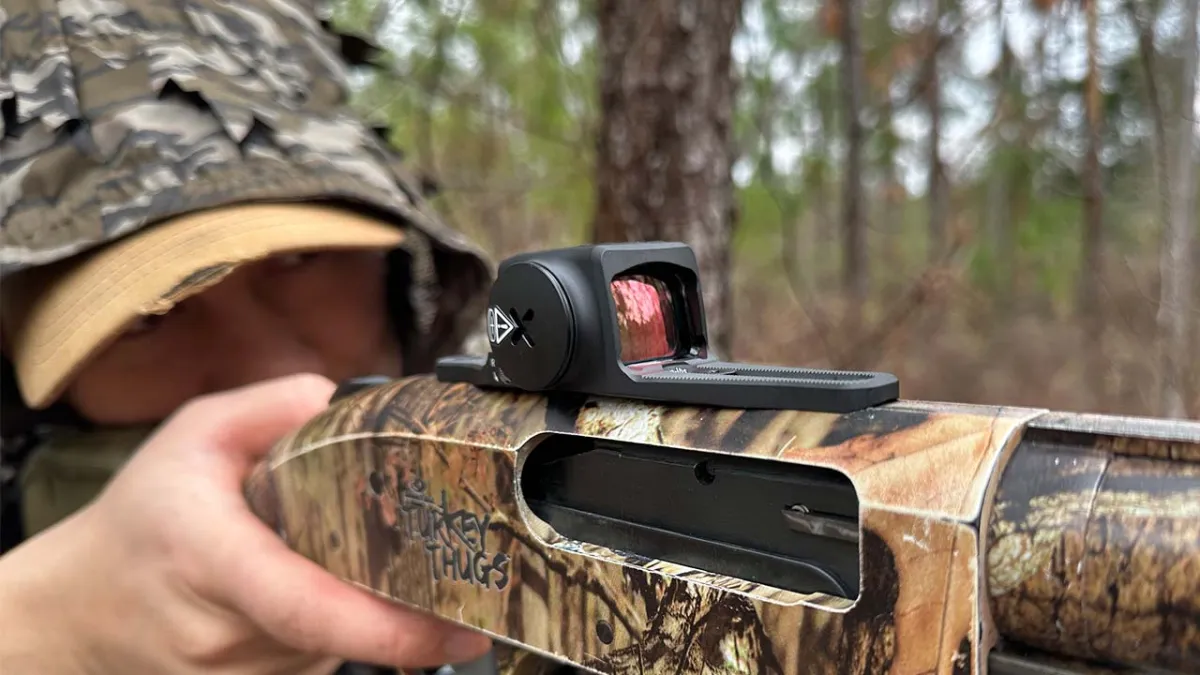
The Viper Shotgun Enclosed is the most direct answer for hunters who want a red dot designed around shotgun use rather than adapted from a handgun or carbine. Vortex describes it as purpose-built for turkey hunting and wingshooting, with an ultra-low-profile enclosed body, wide viewing window, and integrated universal mount. :contentReference[oaicite:3]{index=3}
The enclosed housing protects the emitter from rain, dust, and field debris. This can be valuable during spring hunts involving wet leaves, sudden showers, crawling through vegetation, or condensation from changing temperatures.
The integrated mounting concept may also reduce the stack of rails, adapter plates, and screws found in some shotgun setups. Buyers must still check Vortex’s current compatible-shotgun list rather than assuming the mount fits every rib or receiver.
Best For
Hunters building a dedicated turkey shotgun who prioritize a low sight line and enclosed environmental protection.
Advantages
- Designed specifically for turkey hunting and shotgun use.
- Enclosed emitter is protected from rain and debris.
- Ultra-low-profile design can support a more natural cheek position.
- Integrated universal mount simplifies many installations.
- Wide viewing window supports both-eyes-open aiming.
Limitations
- Compatibility must be confirmed through Vortex’s shotgun list.
- The specialized mount makes it less flexible than a standard RMR-footprint sight.
- Hunters changing shotguns may need a different mounting solution.
2. Best Premium Multi-Reticle Sight: Trijicon RMR HD
The RMR HD builds on the compact RMR format with a larger viewing window and selectable reticle. The 3.25 MOA version combines a center dot with a 55 MOA segmented circle that can be switched on or off. :contentReference[oaicite:4]{index=4}
That reticle flexibility suits turkey hunting well. The center dot provides a precise zeroing reference, while the outer segmented circle can make the reticle easier to find when the shotgun is shouldered from a seated or twisted position.
The RMR HD uses the established RMR mounting pattern, but the shotgun still needs an appropriate low-profile base or plate. It remains an open-emitter design, so the window and emitter area must be inspected in rain, snow, and debris.
Best For
Hunters willing to invest in a premium compact optic with a large window and selectable circle-dot system.
Advantages
- Selectable 3.25 MOA center dot and 55 MOA segmented circle.
- Larger viewing window than the classic RMR.
- Uses the widely supported RMR mounting pattern.
- Circle-dot option can speed reticle acquisition.
- Compact enough for a low shotgun mount.
Limitations
- Premium positioning may exceed the needs of occasional hunters.
- Open emitter requires inspection in wet or dirty conditions.
- Compatible shotgun mount is normally purchased separately.
3. Best Multi-Reticle Value: Holosun HS507C-X2
The HS507C-X2 provides three selectable aiming views: a 2 MOA dot, 32 MOA circle, or combined circle-dot. It uses an RMR footprint and includes Solar Failsafe, Shake Awake, a side-loading CR1632 battery tray, and a manufacturer-stated runtime of up to 50,000 hours. :contentReference[oaicite:5]{index=5}
For turkey hunters, the circle-dot is the main attraction. The larger ring can help the eye locate the reticle quickly, while the center dot remains available for zeroing and pattern evaluation.
The side battery tray allows replacement without removing the optic. Hunters should still confirm zero after maintenance and inspect the open-emitter window during wet hunts.
Best For
Hunters seeking circle-dot flexibility, motion activation, solar backup, and RMR-pattern mounting without moving into the highest premium tier.
Advantages
- Three selectable reticle configurations.
- RMR footprint provides broad mounting support.
- Side-loading battery avoids removing the optic.
- Shake Awake conserves battery power.
- Solar Failsafe supplies an additional power source.
- Lockout mode helps prevent unintended setting changes.
Limitations
- Open emitter can be obstructed by water or debris.
- A shotgun-specific RMR base may be required.
- Multiple modes add controls that some hunters may not need.
4. Best Large Window: Bushnell RXM-300
The RXM-300 combines a large open viewing window with a 4 MOA dot. Bushnell lists 12 brightness settings, an RMR-pattern interface, included low and high Weaver mounts, a top-loading CR2032 battery, Shake Awake, and runtime of up to 35,000 hours. Bushnell specifically identifies turkey hunting as one of its intended applications. :contentReference[oaicite:6]{index=6}
The large window can help hunters locate the dot when the shotgun is shouldered from a difficult field position. The included low Weaver mount is useful for shotguns already equipped with a compatible rail, while the RMR footprint supports direct attachment to suitable bases.
Its larger housing and 1.95-ounce listed weight make it less minimal than smaller reflex sights, but the trade-off is increased visual space around the dot.
Best For
Hunters who prioritize an expansive sight window and a visible 4 MOA dot.
Advantages
- Large-format window provides generous visual space.
- 4 MOA dot balances visibility and precision.
- RMR footprint plus included Weaver mounting options.
- Top-loading battery simplifies replacement.
- Shake Awake and selectable brightness controls.
- Lens coating is designed to repel water and debris.
Limitations
- Larger and heavier than compact micro-reflex sights.
- Open-emitter design still requires field inspection.
- High included mount is usually inappropriate for a conventional shotgun stock.
5. Best Enclosed Tube Sight: Aimpoint Micro H-2
The Aimpoint Micro H-2 is a compact enclosed-tube sight offered with 2, 4, or 6 MOA dots. The 2 MOA model with standard Weaver/Picatinny mount weighs 3.3 ounces without the mount and provides a manufacturer-stated 50,000 hours of battery operation. :contentReference[oaicite:7]{index=7}
An enclosed tube protects the emitter and provides front and rear lens covers. It is a strong fit for hunters who want simple controls and environmental protection without a selectable reticle.
The main challenge is height. A rail-mounted Micro H-2 may sit higher than a direct-mounted reflex sight. Choose the lowest appropriate manufacturer-approved mount and verify that the shotgun allows a repeatable cheek position.
Best For
Hunters who value a straightforward enclosed tube, long battery operation, and protected lenses.
Advantages
- Fully enclosed optical system.
- Long manufacturer-stated battery operation.
- Available in several dot sizes.
- Protective flip-up lens covers are included.
- Simple intensity control.
- Weaver/Picatinny mounting support.
Limitations
- Heavier than most open micro sights.
- Rail mount may create an elevated sight line.
- Does not offer a circle-dot reticle.
6. Best Wide Open-Emitter Window: Leupold DeltaPoint Pro
The DeltaPoint Pro is a 1x open reflex sight offered with a 2.5 MOA dot. Leupold identifies it for shotguns as well as other platforms and gives it a large, clear field of view, top-access battery compartment, click adjustments, and eight brightness settings. :contentReference[oaicite:8]{index=8}
The open window is easy to look through with both eyes open. The top battery compartment also means routine battery replacement does not require removing the sight.
The DeltaPoint Pro uses its own mounting interface rather than the RMR pattern. Confirm that the shotgun base or adapter specifically supports the DeltaPoint Pro footprint.
Best For
Hunters wanting a prominent open window and simple 2.5 MOA aiming point.
Advantages
- Large, clear viewing window.
- Fine 2.5 MOA dot.
- Top-access battery compartment.
- Eight brightness settings.
- Manufacturer lists shotguns among its supported uses.
Limitations
- Requires a DeltaPoint Pro-compatible mounting solution.
- Open emitter is exposed to rain and debris.
- Taller profile than some ultra-compact reflex sights.
7. Best Compact Rugged Classic: Trijicon RMR Type 2
Trijicon RMR Type 2 Adjustable LED
The RM06 version of the RMR Type 2 uses a 3.25 MOA adjustable red dot. Trijicon lists the sight at 1.2 ounces with 1x magnification and compact dimensions of approximately 1.8 by 1.1 by 1 inch. :contentReference[oaicite:9]{index=9}
Its small size helps keep weight and bulk off a light turkey shotgun. The 3.25 MOA dot is visible without covering an excessive portion of the target at normal turkey-hunting distances.
Its window is smaller than those of the RMR HD, RXM-300, or DeltaPoint Pro. Battery replacement also requires removing the optic, so zero should be reconfirmed afterward.
Best For
Hunters seeking a compact RMR-footprint optic with minimal weight and straightforward controls.
Advantages
- Compact and lightweight.
- Useful 3.25 MOA dot size.
- Widely supported RMR footprint.
- Manual brightness adjustment.
- Low profile suits many turkey-shotgun mounts.
Limitations
- Smaller window than newer large-format sights.
- Bottom battery requires optic removal.
- Open emitter is exposed to environmental debris.
8. Best Reticle Flexibility: Burris FastFire 4
The FastFire 4 offers four reticle patterns, including a 3 MOA dot, 11 MOA dot, 11 MOA dot with circle, and a 3 MOA dot with circle and side references. Burris lists a 1.6-ounce weight, Docter mounting interface, detachable Picatinny mount, automatic brightness option, and runtime of up to 26,000 hours at medium brightness. :contentReference[oaicite:10]{index=10}
The reticle options allow the hunter to test whether a fine dot, bold dot, or circle-based design is easiest to acquire. Burris also offers a screw-on weather shield that converts the sight into a more protected system.
The Docter footprint is not interchangeable with an RMR footprint. Verify the exact base before ordering.
Best For
Hunters who want to experiment with several reticle configurations on one optic.
Advantages
- Four selectable reticle patterns.
- Large viewing window.
- Detachable Picatinny mount included.
- Automatic and manual brightness control.
- Optional weather shield protects the emitter.
- Top battery access.
Limitations
- Docter footprint requires the correct shotgun base.
- Weather shield adds bulk and is optional.
- Multiple reticles may be unnecessary for hunters wanting simplicity.
9. Best Compact All-Purpose Reflex: Vortex Defender-ST
Vortex Defender-ST Micro Red Dot
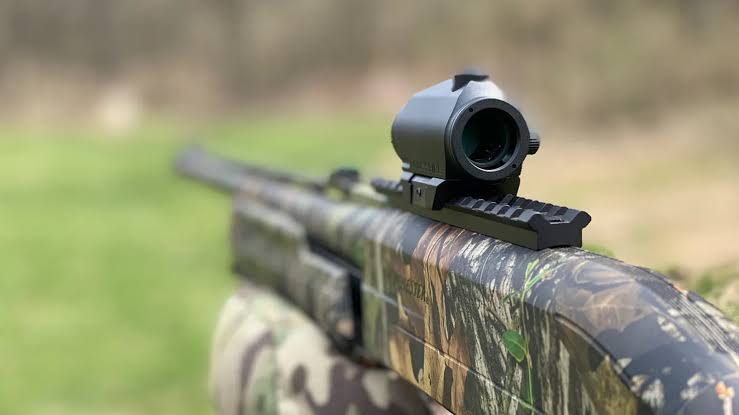
The Defender-ST is designed for use on handguns, shotguns, and as an offset optic. The 3 MOA red-dot version is listed at 1.48 ounces with a manufacturer-stated battery runtime of 25,000 hours. :contentReference[oaicite:11]{index=11}
It is a practical choice for a hunter who wants one compact optic that can move among compatible platforms. Its window is smaller than the RXM-300 or DeltaPoint Pro, but its lower weight can suit compact turkey guns.
Because the model is not packaged specifically around a turkey-shotgun mount, buyers must carefully match the footprint to the shotgun’s base or adapter.
Best For
Hunters seeking a compact, general-purpose reflex sight that is manufacturer-approved for shotgun use.
Advantages
- Compact 1.48-ounce listed weight.
- Visible 3 MOA dot.
- Designed for several firearm types, including shotguns.
- Motion activation with automatic shutoff.
- Protective housing around the lens.
Limitations
- Open emitter requires weather awareness.
- Compatible shotgun mount is separate.
- Smaller window than large-format reflex models.
10. Best Simple Enclosed-Tube Value: SIG SAUER ROMEO5 Gen II
The ROMEO5 Gen II is a compact enclosed 1x20mm sight with a 2 MOA red or green dot, CR2032 battery, MOTAC motion activation, 12 illumination settings, and manufacturer-stated runtime of 40,000 hours under standard use. SIG lists an IPX7 ingress rating and an M1913-style mounting system. :contentReference[oaicite:12]{index=12}
The enclosed tube protects the emitter and controls are straightforward. It can be a sensible option for a turkey shotgun already equipped with a rail.
The included carbine-oriented mount may be too high for a conventional shotgun stock. Hunters should use only a compatible low mount approved by the mount and optic manufacturers.
Best For
Hunters who want an affordable-style enclosed tube and whose shotgun already supports a low Picatinny mounting solution.
Advantages
- Fully enclosed 1x20mm design.
- Simple 2 MOA dot.
- MOTAC motion activation.
- Long manufacturer-stated runtime.
- Top-mounted illumination controls.
- IPX7-rated housing.
Limitations
- Included mount may sit too high on a shotgun.
- Heavier and bulkier than open micro-reflex sights.
- No circle-dot reticle on the standard ROMEO5 Gen II.
Open, Enclosed, or Tube Red Dot?
| Design | Advantages | Limitations | Best Match |
|---|---|---|---|
| Open reflex | Low profile, light weight, wide and unobstructed view | Emitter can collect rain, mud, snow, or debris | Dry-weather hunting and low shotgun mounts |
| Enclosed micro reflex | Protected emitter with compact profile | Usually heavier and may use a specialized footprint | Wet conditions and dedicated turkey guns |
| Enclosed tube | Protected emitter and lenses, simple controls | Can sit high and add more weight | Rail-equipped shotguns and hunters who prefer a traditional sight tube |
How to Choose the Right Red Dot
1. Start With the Shotgun, Not the Optic
Determine whether the shotgun is drilled and tapped, optics-ready, rib-mounted, or equipped with a rail. Identify the exact receiver model and gauge because similarly named shotguns may use different mounting systems.
2. Select the Lowest Secure Mount
A low sight line generally supports a more natural cheek position. Avoid stacking an unnecessary tall rail, riser, and adapter unless the firearm or optic manufacturer specifically requires that arrangement.
3. Choose a Reticle You Can Actually See
Look through several red dots before buying. Hunters with astigmatism may prefer a larger dot, circle-dot, green reticle, or etched optic. Do not assume that the smallest dot will appear most precise to every eye.
4. Consider Hunting Conditions
An enclosed emitter deserves priority for hunters who regularly encounter rain, wet snow, mud, or crawling through dense cover. A lightweight open reflex can remain appropriate for hunters who maintain it carefully and use a protective cover during transport.
5. Check Battery Access
Top and side battery compartments simplify replacement. If the battery sits underneath the optic, plan to reconfirm zero whenever the sight is removed.
6. Evaluate Controls With Gloves
Buttons and dials must be usable without pointing the shotgun in an unsafe direction. Set brightness before the hunt rather than attempting repeated adjustments while a turkey is approaching.
7. Confirm Manufacturer Support
Review the optic manual, mount instructions, firearm manual, warranty terms, and approved torque values. Contact the manufacturers when compatibility is unclear.
How to Mount and Zero a Turkey-Shotgun Red Dot Safely
- Unload the shotgun completely. Remove all ammunition from the work area and physically verify the chamber and magazine are empty.
- Read every applicable manual. Follow the shotgun, mount, plate, rail, and optic manufacturers’ instructions.
- Use the correct base and fasteners. Do not substitute improvised screws, adapters, or thread-locking products.
- Apply only the specified torque. Excessive torque can damage threads, plates, or optic housings; insufficient torque can allow movement.
- Check stock position. Shoulder the unloaded shotgun and confirm that the dot appears without lifting the cheek excessively.
- Begin at an authorized range. Use a safe backstop, eye and hearing protection, and the range’s handling procedures.
- Establish a preliminary zero. Lower-recoil target ammunition may reduce fatigue during initial adjustment, but the final zero must be verified with the exact legal hunting load.
- Pattern the hunting combination. Test the shotgun, choke, load, and optic together on a sufficiently large paper target.
- Check more than one distance. Learn how the pattern behaves across the distances at which you can hunt responsibly.
- Reinspect the mount. Allow the firearm to cool, confirm screw security according to the manual, and verify that the optic has not shifted.
The National Wild Turkey Federation emphasizes that patterning shows how a shotgun performs at different distances. A red dot should be zeroed to the center of the actual pattern rather than assumed to align with the barrel or bead automatically. :contentReference[oaicite:13]{index=13}
Red Dot Troubleshooting
| Problem | Possible Cause | What to Check | Safer Next Step |
|---|---|---|---|
| The dot is difficult to find | Mount is too high, inconsistent cheek position, window is too small | Mount height, stock fit, shouldering technique | Practice with an unloaded shotgun and consult a qualified fitter |
| The dot looks like a starburst | Brightness too high, dirty lens, astigmatism | Brightness setting and appearance through another optic | Reduce brightness and consult an eye professional when appropriate |
| Point of impact changes | Loose screws, shifting base, optic damage, ammunition variation | Mount, receiver, plate, choke, and load | Stop hunting and have the system inspected |
| The optic turns off | Weak battery, poor contact, damaged cap, incorrect mode | Battery orientation, contacts, motion setting, manual | Replace with an approved battery and verify function at the range |
| The window fogs | Condensation from temperature change | Lens condition and storage method | Allow gradual temperature adjustment and use approved cleaning methods |
| Rain blocks the dot | Water or debris obstructing an open emitter | Emitter area and window | Unload safely, clean according to the manual, or choose an enclosed sight |
| Brightness changes unexpectedly | Automatic mode reacting to mixed light or buttons being pressed | Selected operating mode and lockout feature | Choose manual mode when supported and set it before the hunt |
| The shotgun cannot maintain zero | Incorrect mount, damaged threads, unsuitable optic, loose receiver base | Entire mounting system | Consult the optic maker, firearm maker, or qualified gunsmith |
Common Buying and Setup Mistakes
- Buying a sight before identifying the shotgun’s mounting system.
- Assuming all micro-reflex footprints are interchangeable.
- Using a tall carbine riser on a conventionally stocked shotgun.
- Choosing a tiny dot that the hunter cannot see clearly.
- Ignoring open-emitter vulnerability in wet conditions.
- Failing to replace or test the battery before the season.
- Using unverified screw lengths or excessive torque.
- Zeroing with one load and hunting with another without confirmation.
- Testing only one distance.
- Assuming a red dot extends the ethical range of the shotgun.
- Skipping a final zero check after traveling or dropping the firearm.
- Hunting when the optic, mount, or pattern is uncertain.
Red Dot Maintenance Checklist
- Verify the shotgun is unloaded before inspection.
- Check the mount, plate, rail, and receiver for movement or damage.
- Inspect lenses for water, mud, oil, and scratches.
- Inspect the emitter area on open sights.
- Use only manufacturer-approved lens-cleaning materials.
- Test every brightness setting.
- Confirm motion activation and automatic shutoff where applicable.
- Replace batteries on a planned schedule.
- Keep an approved spare battery protected from moisture.
- Reconfirm zero after battery changes that require optic removal.
- Use the protective cover during transport.
- Store the unloaded firearm securely and prevent unauthorized access.
Final Answer
So, what are the best red dots for turkey hunting? The Vortex Viper Shotgun Enclosed Micro Red Dot is the strongest overall choice for a dedicated turkey shotgun because its enclosed, low-profile design and integrated mount are specifically intended for shotgun hunting.
The Trijicon RMR HD is the premium choice for hunters who want a large window and selectable segmented circle, while the Holosun HS507C-X2 provides a strong balance of multi-reticle functionality and convenient battery access. The Aimpoint Micro H-2 is the leading traditional enclosed-tube option, and the SIG SAUER ROMEO5 Gen II is a simpler tube-style alternative for rail-equipped shotguns.
The best choice ultimately depends on mounting compatibility, optic height, reticle visibility, weather exposure, battery access, and the hunter’s eyesight. Whichever model is selected, mount it according to the manufacturer’s instructions, pattern the exact hunting combination, verify zero before the season, and never allow an optic to replace positive target identification, a safe background, or responsible shot selection.
FAQs
1. Is a red dot good for turkey hunting?
Yes. A red dot provides a single aiming reference and does not require the hunter to align separate front and rear sights. It must still be mounted securely and confirmed through pattern testing.
2. Is a red dot better than a bead for turkey hunting?
It can be better for hunters who struggle with bead alignment, unusual field positions, or stock-fit inconsistency. A bead remains simple, lightweight, and battery-free, so the better option depends on the hunter and shotgun.
3. What MOA dot is best for turkey hunting?
A dot between approximately 2 and 4 MOA is a practical starting point. A larger dot or circle-dot can be easier to find, while a smaller dot provides a finer zeroing reference.
4. Is a 6 MOA dot too large?
Not necessarily. A 6 MOA dot is highly visible and may suit hunters with difficulty seeing smaller dots. Test it on paper to determine whether it obscures too much of the aiming reference.
5. Is a circle-dot reticle useful for turkey hunting?
Yes. The outer circle can help the hunter locate the reticle quickly, while the center dot provides the precise zeroing reference.
6. Should I choose a red or green dot?
Choose whichever color appears clearer against the local habitat and to your eyes. Green may look brighter to some people, but red often offers broader model selection and long battery operation.
7. What is an enclosed-emitter red dot?
It seals the emitter inside a housing between front and rear lenses. This protects the light source from rain, mud, dust, and other debris.
8. Are open red dots reliable in rain?
Quality open sights can tolerate wet weather, but water or debris can obstruct the exposed emitter. Inspect the sight regularly and keep it covered during transport.
9. Do I need a special turkey-shotgun red dot?
No, but the sight must be approved for shotgun recoil and fit through a secure mounting system. A purpose-built shotgun model can simplify mount height and compatibility.
10. Can I mount a pistol red dot on a shotgun?
Yes, when the optic manufacturer supports the application and the correct shotgun base or adapter is used. Do not attach it through an improvised plate.
11. What is an RMR footprint?
It is a common screw and recoil-lug pattern used by several reflex sights. It does not attach directly to every shotgun; an RMR-compatible base may still be needed.
12. Is the Docter footprint the same as the RMR footprint?
No. They use different dimensions and mounting arrangements. Always match the base to the exact optic footprint.
13. Can a red dot mount on a vent rib?
Some purpose-built mounts attach to compatible vent ribs. Confirm rib dimensions, firearm compatibility, and installation instructions before use.
14. Does a shotgun need to be drilled and tapped?
Not always. Some shotguns use vent-rib mounts, receiver cuts, saddle mounts, or existing rails. Drilling should be performed only by a qualified professional when appropriate.
15. How low should the red dot sit?
Low enough that the hunter can maintain a repeatable cheek position and find the dot naturally. Exact height depends on the stock, receiver, rail, and optic.
16. Why can I not find the dot when I shoulder the shotgun?
The optic may be too high, the stock may not fit, or the hunter may be lifting the head. Practice safely with an unloaded firearm and consider a lower mount or professional stock fitting.
17. Can a red dot fix poor shotgun fit?
No. It may make aiming more forgiving, but it cannot correct a stock that prevents a consistent shooting position.
18. How should I zero a red dot for turkey hunting?
Mount it correctly, establish an initial zero at an authorized range, and then adjust it to the center of the pattern produced by the exact choke and legal hunting load.
19. Do I need to pattern a shotgun after adding a red dot?
Yes. Patterning confirms the relationship between the dot and the actual pellet distribution at relevant distances.
20. Can I zero with inexpensive target shells?
They may be useful for preliminary adjustment and reducing recoil fatigue, but the final zero and pattern must be confirmed with the exact hunting load.
21. At what distance should I zero?
There is no universal distance. Use distances relevant to your hunting conditions and confirm performance at several ranges within your demonstrated ability.
22. Does a red dot increase a shotgun’s effective range?
No. It improves the aiming reference but does not change pattern density, pellet performance, shooter ability, legal limits, or ethical range.
23. How often should I check zero?
Check before the season, after changing mounts or batteries that require removal, after impact or rough travel, and whenever the point of impact appears uncertain.
24. Can heavy turkey loads damage a red dot?
An unsuitable optic or mount may fail under recoil. Choose products approved for shotgun use and follow the manufacturer’s installation instructions.
25. Should I use thread-locking compound?
Only when the optic or mount manufacturer specifies the exact product and application. Using the wrong compound can damage screws or complicate removal.
26. How tight should mounting screws be?
Use the torque value provided by the optic, mount, plate, or firearm manufacturer. Do not guess or tighten by feel alone.
27. Is a top-loading battery better?
It is more convenient because the optic usually remains mounted during replacement. Bottom-loading sights can still be dependable but may require a zero check after removal.
28. How long do red-dot batteries last?
Manufacturer claims range from thousands to tens of thousands of hours depending on the sight and brightness setting. Real use varies with temperature, settings, battery quality, and activation mode.
29. Should I leave the red dot turned on during turkey season?
That depends on the optic’s battery life and manufacturer guidance. Motion-activated sights can remain ready while conserving power, but function should be checked before every hunt.
30. Should I carry a spare battery?
Yes. Carry the correct battery in a dry protective container and know how to replace it without unsafe firearm handling.
31. Why does my red dot look blurry?
The lens may be dirty, brightness may be excessive, or the hunter may have astigmatism. Lower the brightness, clean the lens correctly, and compare another sight.
32. Can glasses affect a red dot?
Yes. Corrective lenses can change how the reticle appears. Evaluate the sight while wearing the same glasses used for hunting.
33. Is magnification needed for turkey hunting?
Usually not. A 1x red dot preserves a wide field of view and both-eyes-open use. Magnification adds weight, bulk, and complexity.
34. Can I use a red dot in low light?
Yes, when legal hunting hours permit and the target remains positively identifiable. Keep brightness low enough that the dot does not overpower the scene.
35. Is automatic brightness useful?
It can adjust the dot as conditions change, but mixed lighting may cause an undesirable setting. A sight with manual override provides more control.
36. Should I use a protective optic cover?
Yes during transportation and storage. Remove it before loading or beginning the hunt, and confirm the optic is functioning.
37. How do I clean a red-dot lens?
Follow the manufacturer’s instructions. Remove loose particles first and use approved lens materials rather than clothing, paper towels, or harsh chemicals.
38. Are electronic sights legal for turkey hunting?
They are legal in many jurisdictions, but equipment rules vary by state, province, public property, refuge, weapon season, and hunt type. Verify current regulations.
39. What is the safest way to test a turkey red dot?
Use an authorized range with a safe backstop, eye and hearing protection, an unloaded firearm during setup, and the handling procedures taught in hunter education.
40. What is the best red dot for a beginner?
A beginner should prioritize easy mounting, a clear reticle, simple controls, reliable battery access, and manufacturer support. The purpose-built Vortex Viper Shotgun Enclosed and simple tube-style SIG ROMEO5 Gen II illustrate two different beginner-friendly approaches, provided either fits the shotgun correctly.
Read more: