
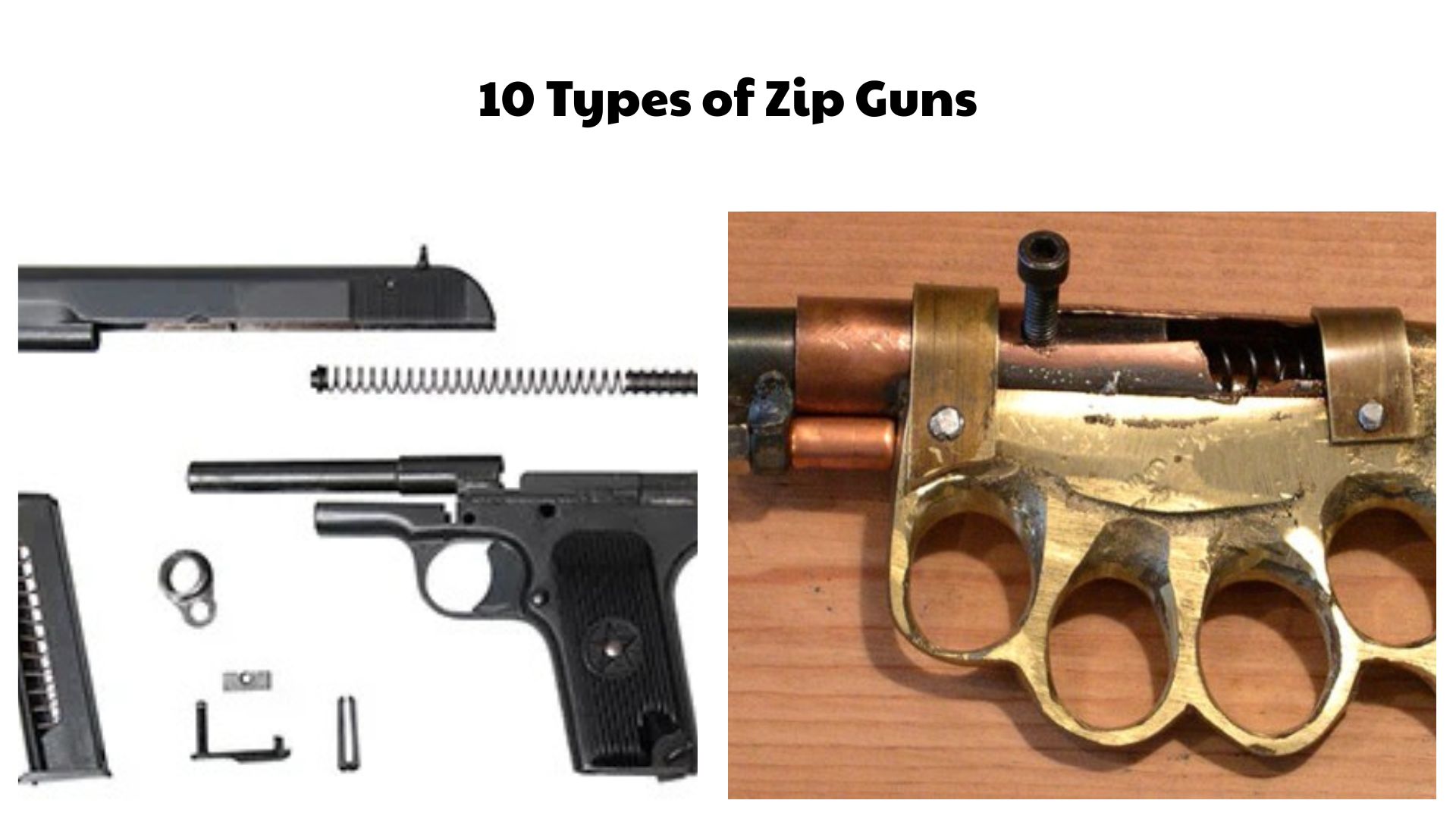

Understanding types of zip guns is essential for studying improvised firearm history, forensic analysis, and the evolution of crude weapon designs. Zip guns are generally defined as homemade or improvised firearms built from readily available materials such as pipes, metal tubes, springs, and basic mechanical components. They are not standardized weapons, which means their designs vary widely depending on environment, intent, and available resources. This guide presents a structured breakdown of 10 commonly recognized zip gun categories for educational and informational purposes. The focus is on classification, function, and general mechanical principles rather than construction details, helping readers understand how these improvised systems differ from conventional firearms.
10 Types of Zip Guns
1. Pipe Zip Gun
The pipe zip gun is one of the most basic forms in the study of improvised firearms. It typically uses a metal pipe as a barrel, combined with a simple firing mechanism that relies on direct mechanical force to ignite a cartridge. This design appears frequently in historical and forensic case studies because it requires minimal structure and no precision manufacturing.
In the broader classification of types of zip guns, the pipe variant represents the simplest functional concept: containment of a cartridge and a basic method of ignition. Because of its crude structure, performance is highly inconsistent, and structural integrity is often a concern. The lack of proper chamber reinforcement also makes this design inherently unstable under pressure.
Despite its simplicity, the pipe zip gun demonstrates the basic physics of firearm operation—containment of expanding gases and directional projectile release.
2. Wooden Frame Zip Gun
The wooden frame zip gun uses wood as its primary structural support, often combined with a metal tube that acts as a barrel. The wooden body provides grip and alignment for the internal components, while the metal tube houses the cartridge.
Within types of zip guns, this category reflects an early evolution from purely metal-based improvised firearms toward hybrid constructions using multiple materials. The use of wood provides easier shaping and assembly but reduces durability compared to all-metal designs.
Functionally, this type is still extremely basic and lacks precision engineering. Its mechanical behavior depends heavily on alignment accuracy and material strength, making performance unpredictable.
3. Rubber Band Trigger Zip Gun
A rubber band trigger zip gun uses elastic force as the primary energy source for firing a striker or pin. Instead of a traditional mechanical trigger system, tensioned rubber bands or similar elastic materials release energy when activated.
In the classification of types of zip guns, this design represents one of the simplest energy transfer mechanisms. It does not rely on complex springs or machining, making it conceptually straightforward but mechanically unreliable.
Because elastic force degrades over time, consistency is low, and ignition reliability is highly variable. This design is more often discussed in theoretical or educational contexts rather than practical use analysis.
4. Slam-Fire Zip Gun
The slam-fire zip gun operates without a traditional trigger mechanism. Instead, it fires when a cartridge is forced into a fixed firing pin or when a bolt is rapidly driven forward, causing ignition upon impact.
Within types of zip guns, this is one of the most mechanically simple yet most unpredictable categories. The absence of a controlled trigger system means that firing depends entirely on motion and impact force.
While this reduces mechanical complexity, it significantly increases safety risks due to the lack of controlled discharge mechanisms. It is often referenced in forensic studies as an example of minimalistic firearm operation.
5. Bolt-Tube Zip Gun
The bolt-tube zip gun uses a sliding metal rod or bolt inside a cylindrical tube. The bolt is manually manipulated and released to strike a primer or ignition point, producing a discharge cycle.
In the study of types of zip guns, this design is considered slightly more structured than earlier examples due to its guided motion system. The tube helps stabilize the bolt path, offering marginally improved alignment compared to free-form designs.
However, it still lacks precision engineering and is highly dependent on basic mechanical fit and material quality. Its performance is limited by friction, alignment accuracy, and structural strength.
This concludes the first segment of the classification. The next section will continue with more advanced and disguised forms of zip guns.
Types of Zip Guns – Overview (6–10)
6. Nail-Firing Zip Gun
The nail-firing zip gun is a crude improvised design that uses a nail or metal rod as a striker. When activated, the nail is driven forward by a simple spring, elastic tension, or sliding mechanism to impact the primer of a cartridge. This creates ignition in a very basic and direct way.
Within the study of types of zip guns, this design is often highlighted for its simplicity and minimal component requirement. It demonstrates how basic mechanical energy can be converted into ignition force without the need for precision-machined parts or complex trigger systems.
Because alignment is often inconsistent, reliability varies significantly. Small deviations in angle or force can lead to misfires or failure to ignite, making this design mechanically unstable and unpredictable.
7. Cartridge-Tube Zip Gun
The cartridge-tube zip gun uses a metal tube as both the chamber and barrel, with a cartridge placed directly inside. A secondary external housing or cap often holds a basic firing mechanism that strikes the primer.
In the classification of types of zip guns, this model is notable for its minimal structure. It eliminates traditional firearm components such as a dedicated chamber or bolt system, relying instead on direct containment within a simple tube.
This simplicity comes at the cost of safety and durability. Without proper reinforcement, pressure containment is inconsistent, and mechanical failure risk is high. It is primarily referenced in forensic and academic contexts rather than practical applications.
8. Disguised Object Zip Gun
A disguised object zip gun is constructed inside everyday items such as flashlights, pens, walking sticks, or similar household objects. The internal mechanism is hidden within the object’s structure, allowing it to appear harmless externally.
Within types of zip guns, this category is defined more by concealment than by mechanical design. The firing system varies widely, but typically includes a small barrel tube, a compact striker, and a basic activation mechanism.
Due to space constraints, these designs are usually limited to low-power cartridges and simplified mechanisms. Their performance is generally weak, and structural integrity is compromised by the need to fit components inside non-firearm objects.
9. Pen-Style Zip Gun
The pen-style zip gun is a highly compact form of disguised firearm designed to resemble a standard writing pen. Internally, it contains a small barrel, a miniature firing pin system, and a simple trigger or release mechanism.
In the broader set of types of zip guns, this design emphasizes concealment and portability over functionality. The extremely limited space restricts it to very small cartridges and reduces mechanical strength.
Because of its miniature scale, precision is difficult to achieve, and reliability is often inconsistent. It is frequently discussed in security and forensic studies as an example of concealment-focused improvised design.
10. Pipe Submachine Zip Gun
The pipe submachine zip gun is one of the more complex improvised designs, attempting to replicate automatic or semi-automatic firing behavior using basic mechanical systems. It is typically constructed from metal pipes, springs, and simple open-bolt or blowback-style mechanisms.
Within types of zip guns, this category represents an advanced level of improvisation. Unlike single-shot designs, it attempts repeated firing cycles, which introduces significantly higher mechanical complexity and instability.
These systems are highly unreliable due to inconsistent cycling, poor material tolerances, and lack of proper manufacturing standards. They are often referenced in forensic literature as examples of crude automatic mechanism replication.
This concludes the classification of 10 zip gun types. Each design reflects different levels of improvisation, material use, and mechanical understanding, ranging from extremely simple single-shot systems to complex but unstable repeating mechanisms.
Conclusion – Understanding the 10 Types of Zip Guns
The study of types of zip guns highlights how improvised firearms can take many forms depending on available materials, mechanical knowledge, and intended concealment or function. Across all categories, the common factor is simplicity of construction combined with a lack of standardized engineering. This results in designs that range from basic pipe-based single-shot devices to more complex but still unstable repeating mechanisms.
Each zip gun type reflects a different approach to solving the same basic challenge: creating a system that can contain a cartridge and ignite it safely enough to produce a controlled discharge. However, because these designs are not manufactured under regulated conditions, they tend to lack reliability, precision, and structural safety compared to conventional firearms.
From a technical perspective, zip guns also provide insight into fundamental firearm principles such as gas expansion, ignition mechanics, and energy transfer. Even the simplest designs demonstrate how pressure and containment interact to generate projectile motion, making them a frequent subject in forensic science and mechanical analysis.
Overall, zip guns remain important primarily as a topic of study rather than practical application. Understanding their categories helps build awareness of firearm mechanics while also reinforcing the importance of safe, regulated, and properly engineered weapon systems.
50+ FAQ About Types of Zip Guns
1. What is a zip gun?
A zip gun is a type of improvised firearm that is built using basic materials such as pipes, metal tubes, springs, and other non-standard components. It is not manufactured by licensed firearm companies and usually lacks precision engineering. Zip guns are generally studied in forensic science and criminology due to their appearance in illegal or emergency survival contexts.
2. Why are they called zip guns?
The term “zip gun” is believed to come from the quick, improvised nature of their construction. The name reflects the idea of something made quickly and crudely rather than a professionally engineered firearm. It is not an official technical classification but a colloquial term used in forensic and historical discussions.
3. Are zip guns legal?
In most countries, zip guns are illegal to manufacture, possess, or use without proper licensing. Because they are unregulated and often unsafe, they fall under strict firearm laws. Legal consequences vary depending on jurisdiction, but they are generally treated as prohibited weapons.
4. What are the main types of zip guns?
Common classifications include pipe zip guns, wooden frame zip guns, rubber band trigger systems, slam-fire designs, bolt-tube mechanisms, nail-firing types, cartridge-tube systems, disguised object guns, pen-style versions, and pipe submachine variants. Each differs in complexity and construction method.
5. How does a pipe zip gun work?
A pipe zip gun typically uses a metal pipe as a barrel and a simple firing mechanism to ignite a cartridge. It relies on basic containment of expanding gases. The simplicity of its structure makes it highly unpredictable and unsafe.
6. What materials are used in zip guns?
Zip guns are usually made from easily available materials such as metal pipes, wood blocks, springs, nails, screws, rubber bands, and scrap metal parts. The goal is functionality using minimal resources rather than precision manufacturing.
7. Why are zip guns dangerous?
Zip guns are dangerous because they lack proper engineering, safety mechanisms, and structural testing. The barrel or chamber may fail under pressure, leading to catastrophic mechanical failure during use.
8. What is a slam-fire zip gun?
A slam-fire zip gun fires when a cartridge is forced forward into a fixed firing pin or struck during bolt movement. It eliminates the need for a traditional trigger, making the system extremely simple but highly unsafe.
9. What is a bolt-tube zip gun?
A bolt-tube zip gun uses a sliding bolt inside a tube that strikes the cartridge primer to fire. It offers slightly more control than other crude designs but still lacks precision and reliability.
10. What is a nail-firing zip gun?
A nail-firing zip gun uses a nail or metal rod as a firing pin that is driven forward to ignite the cartridge. It is one of the simplest ignition-based improvised firearm systems.
11. What is a cartridge-tube zip gun?
This type uses a metal tube that acts as both chamber and barrel, where the cartridge is placed directly inside. It is a minimalistic design that relies on basic pressure containment.
12. What is a disguised zip gun?
A disguised zip gun is built inside everyday objects such as pens, flashlights, or walking sticks. The goal is concealment rather than performance, making it a category often studied in security analysis.
13. What is a pen-style zip gun?
A pen-style zip gun is a compact concealed firearm designed to resemble a writing pen. It contains a small barrel and simple firing system but is limited by size constraints and low durability.
14. What is a pipe submachine zip gun?
This is a more complex improvised design attempting repeated or automatic firing using pipes, springs, and crude mechanical systems. It is highly unstable and unreliable.
15. Are zip guns accurate?
No, zip guns are generally not accurate due to poor barrel alignment, inconsistent manufacturing, and lack of stabilization systems. Their performance varies significantly from shot to shot.
16. Can zip guns fire multiple rounds?
Most zip guns are single-shot devices. Some more complex designs attempt multiple firing cycles, but reliability is extremely low and inconsistent.
17. Why do people study zip guns?
They are studied in forensic science, criminology, and engineering analysis to understand improvised weapon construction, ballistic behavior, and illegal firearm patterns.
18. What is the simplest zip gun type?
The pipe zip gun is considered the simplest form because it requires minimal components and basic assembly. It is essentially a hollow tube with a firing mechanism.
19. What is the most complex zip gun type?
The pipe submachine zip gun is among the most complex due to its attempt at repeated firing cycles and mechanical cycling behavior.
20. Do zip guns use real ammunition?
Many zip guns are designed around standard cartridges, but compatibility is inconsistent and unsafe due to poor chamber design and lack of regulation.
21. What is the biggest risk of zip guns?
The biggest risk is structural failure during firing, which can cause injury to the user due to uncontrolled pressure release.
22. Can zip guns explode?
Yes, due to weak materials and improper construction, the barrel or chamber can rupture under pressure, causing dangerous fragmentation.
23. Are zip guns reliable?
No, zip guns are highly unreliable. Their performance depends entirely on crude construction quality and often fails unpredictably.
24. What is the purpose of a zip gun?
Historically, they were associated with improvised self-defense or illicit manufacturing, but today they are primarily studied in forensic and legal contexts.
25. What is a rubber band zip gun?
It uses elastic force from rubber bands to drive a firing pin mechanism. It is extremely simple and unreliable compared to mechanical spring systems.
26. Can zip guns be reused?
Some designs may be reused, but due to structural weakness and wear, durability is very limited.
27. Are zip guns silent?
No, they produce similar noise levels to standard firearms since noise is primarily caused by gas expansion rather than construction type.
28. What causes zip gun failure?
Failures are caused by poor alignment, weak materials, improper sealing, and uncontrolled pressure dynamics during firing.
29. What is the difference between zip guns and real guns?
Real guns are manufactured with precise engineering, safety standards, and testing, while zip guns are improvised and lack regulated construction quality.
30. Are zip guns used in crime?
They have historically appeared in illegal activities due to ease of construction, but their unpredictability makes them unsafe even for illicit use.
31. Why are zip guns studied in forensics?
They help forensic experts understand weapon origins, ballistic evidence, and patterns of improvised firearm construction.
32. What is a hidden zip gun?
A hidden zip gun is designed to be disguised within everyday objects, making detection difficult without inspection.
33. What is the main limitation of zip guns?
Their main limitation is lack of precision engineering, which leads to poor safety, accuracy, and reliability.
34. Do zip guns require maintenance?
If used repeatedly, they require basic cleaning and inspection, but their crude construction limits long-term maintenance effectiveness.
35. Are zip guns modern weapons?
No, they are considered outdated and primitive compared to modern firearms technology.
36. What is the firing mechanism in zip guns?
Most use simple mechanical impact systems such as springs, bolts, or direct force to strike a cartridge primer.
37. What is the most common zip gun design?
Pipe-based designs are the most commonly referenced due to their simplicity and accessibility of materials.
38. Can zip guns be detected easily?
Yes, most zip guns lack refinement and can often be identified through inspection due to irregular construction.
39. Are zip guns efficient?
No, they are not efficient compared to manufactured firearms in terms of accuracy, reliability, or safety.
40. What is a single-shot zip gun?
A single-shot zip gun is designed to fire only one round before requiring manual reloading and reassembly.
41. Why do zip guns fail in cold or hot conditions?
Extreme temperatures can affect material expansion, elasticity, and structural integrity, leading to failure.
42. Can zip guns be customized?
Customization is possible but highly inconsistent due to lack of standardized parts and engineering design.
43. What is the role of springs in zip guns?
Springs are often used to provide mechanical force for firing pins or bolt movement in improvised systems.
44. What is the most dangerous zip gun type?
Any poorly constructed zip gun is dangerous, but high-pressure pipe-based designs are particularly risky.
45. Are zip guns legal for study or collection?
In some jurisdictions, inert or deactivated versions may be studied under strict regulations, but laws vary widely.
46. Can zip guns be mass-produced?
They are not designed for mass production due to lack of standardization and safety compliance.
47. What is the lifespan of a zip gun?
Most zip guns have extremely short lifespans, often failing after minimal use due to structural stress.
48. What is the main takeaway about zip guns?
They represent improvised engineering attempts but lack the safety, reliability, and precision of manufactured firearms.
49. Why are zip guns not recommended?
They are unsafe, unpredictable, and illegal in most regions, making them unsuitable for any practical use.
50. What is the educational value of zip guns?
They provide insight into basic firearm mechanics, material limitations, and forensic analysis of improvised weapons.
Read more: