
Understanding types of gun muzzles is essential for anyone studying modern firearms design, shooting performance, or weapon accessories. The muzzle is the forward end of a firearm barrel where the projectile exits, and it plays a critical role in controlling recoil, flash, noise, and overall shooting behavior. Over time, manufacturers have developed specialized muzzle devices to improve accuracy, reduce shooter fatigue, and adapt firearms for different environments such as tactical operations, hunting, or sport shooting. This guide breaks down 10 key muzzle types in a structured, clear, and practical way, focusing on their function and real-world use.
10 Types of Gun Muzzles
1. Flash Hider
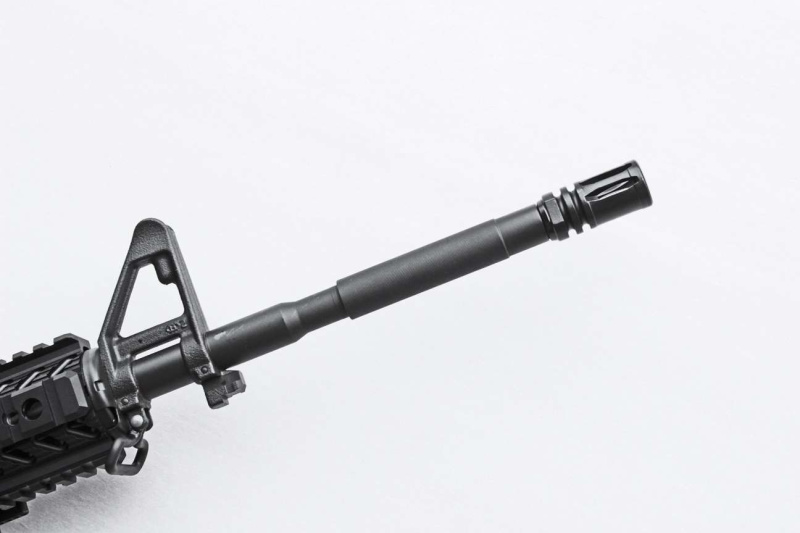
A flash hider is a muzzle device designed to reduce the visible flash produced when a firearm is fired. When hot gases exit the barrel and meet oxygen, they create a bright flash that can temporarily affect night vision and reveal the shooter’s position.
Within the study of types of gun muzzles, the flash hider is one of the most widely used devices on modern rifles. It works by dispersing burning gases through multiple prongs or slots, reducing the intensity of the visible fireball. This makes it especially useful in low-light or tactical environments where visibility control is important.
Common designs include open-prong styles and closed “birdcage” patterns. While it does not significantly reduce recoil, its main advantage lies in improving shooter concealment and visual comfort during firing.
Flash hiders are standard on many military-style rifles and are widely adopted in civilian sporting platforms.
2. Muzzle Brake
A muzzle brake is a device engineered to reduce felt recoil by redirecting high-pressure gases sideways or slightly backward as the bullet exits the barrel. This redirection counteracts rearward force, making the firearm easier to control.
In the category of types of gun muzzles, muzzle brakes are known for their strong impact on recoil reduction, especially in high-caliber rifles. They are commonly used in long-range shooting and hunting rifles where recoil management directly affects accuracy and shooter comfort.
However, muzzle brakes often increase side blast and noise for nearby shooters due to the redirected gases. Despite this drawback, their performance benefits make them highly effective in precision shooting environments.
Muzzle brakes are a popular choice for shooters who prioritize recoil control above all else.
3. Compensator
A compensator is a muzzle device designed to reduce muzzle rise, which is the upward movement of the barrel during firing. It works by venting gases upward, creating downward force that stabilizes the firearm.
Within types of gun muzzles, compensators are especially common in pistol shooting and competitive firearm disciplines. They help shooters maintain faster target reacquisition by keeping the barrel level during rapid fire sequences.
Unlike muzzle brakes, which focus on backward recoil, compensators focus primarily on vertical control. This makes them ideal for speed shooting and tactical training scenarios where follow-up shots matter.
Compensators improve shooting rhythm and control without significantly altering recoil direction.
4. Linear Compensator
A linear compensator is designed to direct blast and sound forward rather than outward. Instead of reducing recoil or muzzle rise, its main function is to improve shooter comfort by pushing concussion away from the user and nearby shooters.
In the broader category of types of gun muzzles, this device is often used in short-barreled rifles where muzzle blast is more intense. It creates a forward-focused gas flow that reduces side pressure and improves usability in enclosed or crowded environments.
While it does not significantly change recoil behavior, it enhances shooting comfort and reduces environmental disturbance during firing.
Linear compensators are often chosen for indoor ranges and tactical training setups.
5. Blast Diverter
A blast diverter is a muzzle device designed to redirect explosive gases forward, minimizing the impact of side concussion. It is particularly useful in firearms with short barrels, where gas expansion is more violent and concentrated.
Within types of gun muzzles, blast diverters are valued for their ability to improve shooter safety and comfort in close-range firing environments. They help reduce the pressure wave experienced by the shooter and those nearby.
This device does not reduce recoil significantly but plays an important role in managing gas direction and environmental blast effects.
Blast diverters are commonly used in tactical and indoor shooting scenarios where space and safety are limited.
6. Suppressor (Silencer)
A suppressor, often referred to as a silencer, is a muzzle device designed to reduce the noise, flash, and recoil produced when a firearm is discharged. It works by slowing and cooling expanding gases before they exit the barrel, which significantly reduces the intensity of the sound signature.
Within the category of types of gun muzzles, suppressors are among the most complex and regulated devices. They are widely used in hunting, tactical operations, and sport shooting where reduced noise is beneficial for safety, communication, and hearing protection.
Although they do not make firearms completely silent, suppressors greatly reduce perceived sound levels and muzzle flash. This also helps minimize shooter fatigue during extended firing sessions.
Suppressors represent a balance between performance control and shooting comfort in modern firearm systems.
7. Hybrid Muzzle Device
A hybrid muzzle device combines multiple functions into a single attachment, typically merging the features of a muzzle brake, compensator, and flash hider. This allows a firearm to benefit from recoil reduction, muzzle stability, and flash suppression simultaneously.
In the study of types of gun muzzles, hybrid designs are considered versatile solutions for shooters who want balanced performance without switching between multiple devices.
These devices are especially popular in modern tactical rifles and competition firearms, where adaptability is important. While they may not outperform dedicated single-function devices in one specific area, they offer consistent overall performance across multiple categories.
Hybrid muzzle devices are ideal for users seeking a “multi-role” solution in a single attachment.
8. Ported Barrel Muzzle
A ported barrel muzzle features small vents or holes built directly into the barrel near the muzzle end. These ports redirect expanding gases upward to reduce muzzle rise during firing.
Within types of gun muzzles, this design is often integrated into pistols and some rifles as a built-in alternative to external muzzle devices. It provides recoil and climb control without requiring additional attachments.
However, ported barrels can increase upward gas and flash visibility, especially in low-light conditions. Despite this, they remain popular in competitive shooting where fast target reacquisition is essential.
Ported barrel systems offer a streamlined, integrated approach to muzzle control.
9. Crowned Muzzle
A crowned muzzle is a precision-machined barrel end designed to protect the exit point of the bullet. The “crown” is the final surface the projectile passes before leaving the barrel, and its quality directly affects accuracy.
In the classification of types of gun muzzles, crowned muzzles are not external devices but an essential part of barrel design. They ensure that gases escape evenly around the bullet, preventing disturbances that could affect trajectory.
High-quality crowns are critical in precision rifles and long-range shooting platforms. Even minor damage to the crown can reduce accuracy significantly.
A crowned muzzle is essential for maintaining consistent shot performance and ballistic stability.
10. Threaded Muzzle
A threaded muzzle features machined threads at the end of the barrel, allowing the attachment of various muzzle devices such as suppressors, brakes, flash hiders, or compensators. This makes it one of the most versatile modern muzzle designs.
Within types of gun muzzles, threaded muzzles are the foundation of modular firearm customization. They allow shooters to switch between different devices depending on mission needs or shooting conditions.
This flexibility is widely used in both civilian and professional firearm platforms, especially in AR-style rifles and tactical systems.
Threaded muzzles provide adaptability and future-proofing for evolving firearm configurations.
Conclusion – Understanding the 10 Types of Gun Muzzles
The study of types of gun muzzles shows how modern firearms have evolved far beyond a simple barrel opening. Each muzzle device plays a specific role in shaping how a firearm behaves when it is fired, whether that means reducing recoil, controlling muzzle rise, managing flash, or improving shooter comfort. These improvements are not just technical upgrades—they directly influence accuracy, safety, and overall shooting experience.
Devices like flash hiders and suppressors focus on visibility and noise reduction, making shooting more controlled in low-light or sensitive environments. Muzzle brakes and compensators prioritize recoil and muzzle stability, helping shooters maintain accuracy during rapid or long-range firing. Meanwhile, linear compensators and blast diverters improve comfort by managing gas direction and reducing concussion effects.
On the structural side, features like crowned and threaded muzzles demonstrate that not all muzzle-related elements are external attachments. Some are precision engineering details that ensure accuracy and allow modular customization. Together, these designs create a flexible ecosystem where shooters can adapt their firearm to different roles and conditions.
Ultimately, understanding these muzzle types helps users make more informed decisions about firearm setup and performance optimization. Each design reflects a balance between physics, engineering, and practical field use, making muzzle technology a key part of modern firearm development.
50+ FAQ About Types of Gun Muzzles
1. What is a gun muzzle?
A gun muzzle is the forward end of a firearm barrel where the bullet exits. It is a critical point in the firing process because gases, pressure, and projectile stabilization all interact at this stage to influence accuracy, recoil, and overall shooting performance.
2. Why are muzzle devices used?
Muzzle devices are used to control recoil, reduce muzzle flash, manage sound signature, and improve shooting stability. They help shooters maintain better accuracy and comfort, especially during rapid or repeated firing.
3. What are the main types of gun muzzles?
The main types include flash hiders, muzzle brakes, compensators, suppressors, linear compensators, blast diverters, threaded muzzles, crowned muzzles, ported barrels, and hybrid devices. Each serves a different performance function.
4. What does a flash hider do?
A flash hider reduces visible muzzle flash by dispersing burning gases as they exit the barrel. This helps protect night vision, reduces shooter visibility, and improves tactical concealment in low-light environments.
5. Does a flash hider reduce recoil?
No, a flash hider does not significantly reduce recoil. Its primary purpose is to control brightness and visibility rather than force management.
6. What is a muzzle brake?
A muzzle brake is a device that redirects gas pressure backward or sideways to reduce felt recoil. This helps the shooter maintain better control, especially when firing powerful rifles.
7. Are muzzle brakes loud?
Yes, muzzle brakes increase perceived noise and blast for people near the shooter because gases are redirected outward rather than forward.
8. What is a compensator?
A compensator reduces muzzle rise by directing gases upward. This helps keep the barrel stable and improves accuracy during fast shooting sequences.
9. How is a compensator different from a muzzle brake?
A muzzle brake reduces backward recoil, while a compensator mainly controls upward muzzle movement. Some devices combine both functions, but their primary focus differs.
10. What is a suppressor?
A suppressor reduces the noise, flash, and recoil of a firearm by slowing and cooling expanding gases before they exit the barrel. It does not make a gun silent but significantly reduces sound intensity.
11. Are suppressors legal everywhere?
Suppressor legality depends on the country or region. Some areas allow them with permits, while others restrict or ban them entirely.
12. What is a linear compensator?
A linear compensator directs blast and sound forward, reducing side concussion and improving comfort for the shooter and nearby individuals.
13. Does a linear compensator reduce recoil?
No, it mainly manages blast direction rather than recoil force or muzzle rise.
14. What is a blast diverter?
A blast diverter redirects gas forward to reduce side pressure and concussion. It is especially useful in short-barreled rifles where gas expansion is intense.
15. What is a hybrid muzzle device?
A hybrid muzzle device combines multiple functions such as recoil reduction, flash suppression, and muzzle stability in one attachment.
16. Why use a hybrid device?
It offers balanced performance without needing multiple attachments, making it practical for general-purpose or tactical use.
17. What is a ported barrel?
A ported barrel has built-in holes near the muzzle that vent gas upward to reduce muzzle rise during firing.
18. Do ported barrels affect accuracy?
They generally do not reduce accuracy, but gas disruption and flash can be more noticeable compared to non-ported barrels.
19. What is a crowned muzzle?
A crowned muzzle is a precision-machined barrel end that ensures gases exit evenly around the bullet, improving accuracy and stability.
20. Why is barrel crown important?
A damaged crown can disrupt bullet flight, reducing accuracy and consistency.
21. What is a threaded muzzle?
A threaded muzzle has external threads that allow attachment of muzzle devices like suppressors, brakes, or flash hiders.
22. Why are threaded muzzles popular?
They offer modularity, allowing users to customize firearm performance based on different needs.
23. Can all guns have muzzle devices?
No, only firearms designed with compatible barrels or threading can accept muzzle devices.
24. What is muzzle flash caused by?
Muzzle flash is caused by hot gases igniting when they exit the barrel and mix with oxygen in the air.
25. Why is muzzle flash a problem?
It can temporarily blind the shooter, reveal position, and reduce effectiveness in low-light environments.
26. What causes recoil?
Recoil is caused by Newton’s third law: every forward projectile force produces an equal backward force on the firearm.
27. Which muzzle device reduces recoil best?
Muzzle brakes are generally the most effective at reducing recoil.
28. Which device reduces muzzle rise best?
Compensators are most effective at controlling muzzle rise.
29. Can muzzle devices improve accuracy?
Yes, by reducing movement, recoil, and muzzle rise, they help shooters maintain better shot placement.
30. Do muzzle devices affect sound?
Yes, especially suppressors and muzzle brakes, which can significantly change sound direction and intensity.
31. Are muzzle devices interchangeable?
Some are interchangeable if the firearm has compatible threading, while others are fixed or integrated into the barrel.
32. What is back pressure in muzzle devices?
Back pressure refers to gas pressure that returns toward the shooter or system after firing, affecting recoil and cycling behavior.
33. What is gas redirection?
Gas redirection is the process of controlling where expanding gases exit the barrel, which influences recoil, flash, and sound.
34. Are muzzle devices necessary?
They are not required for a firearm to function but are useful for improving performance and shooting comfort.
35. Do muzzle devices wear out?
Yes, over time high heat and pressure can cause wear, especially in suppressors and brakes used heavily.
36. What materials are muzzle devices made from?
Common materials include steel, stainless steel, aluminum, and heat-resistant alloys depending on application.
37. Do muzzle devices affect bullet speed?
They have minimal effect on velocity but can influence accuracy and stability after the bullet exits.
38. What is muzzle rise?
Muzzle rise is the upward movement of a firearm after firing caused by recoil forces.
39. Why is muzzle rise important?
It affects how quickly a shooter can reacquire a target for follow-up shots.
40. What is concussion in firearms?
Concussion refers to the pressure wave felt by shooters and nearby individuals when a firearm is discharged.
41. Can muzzle devices reduce concussion?
Yes, linear compensators and blast diverters help reduce side concussion effects.
42. What is a birdcage flash hider?
It is a common flash hider design with multiple slots that disperse gas evenly around the muzzle.
43. Are all flash hiders the same?
No, designs vary from open-prong to closed-cage structures depending on gas dispersion needs.
44. What is the main disadvantage of muzzle brakes?
They increase noise and side blast, which can be uncomfortable for shooters and nearby individuals.
45. What is the main advantage of suppressors?
They significantly reduce noise and flash while also improving shooting comfort.
46. Can muzzle devices affect cycling in rifles?
Yes, especially in gas-operated systems where back pressure changes can affect cycling behavior.
47. What is modular firearm design?
It refers to firearms that allow users to change components like muzzle devices, grips, and barrels.
48. Why is modularity important?
It allows customization based on mission, sport, or hunting requirements.
49. What is the most versatile muzzle setup?
A threaded barrel with interchangeable devices is the most versatile configuration.
50. How do I choose the right muzzle device?
Choice depends on purpose: recoil control, flash reduction, noise management, or overall balance. Different shooting environments require different solutions.
Read more: