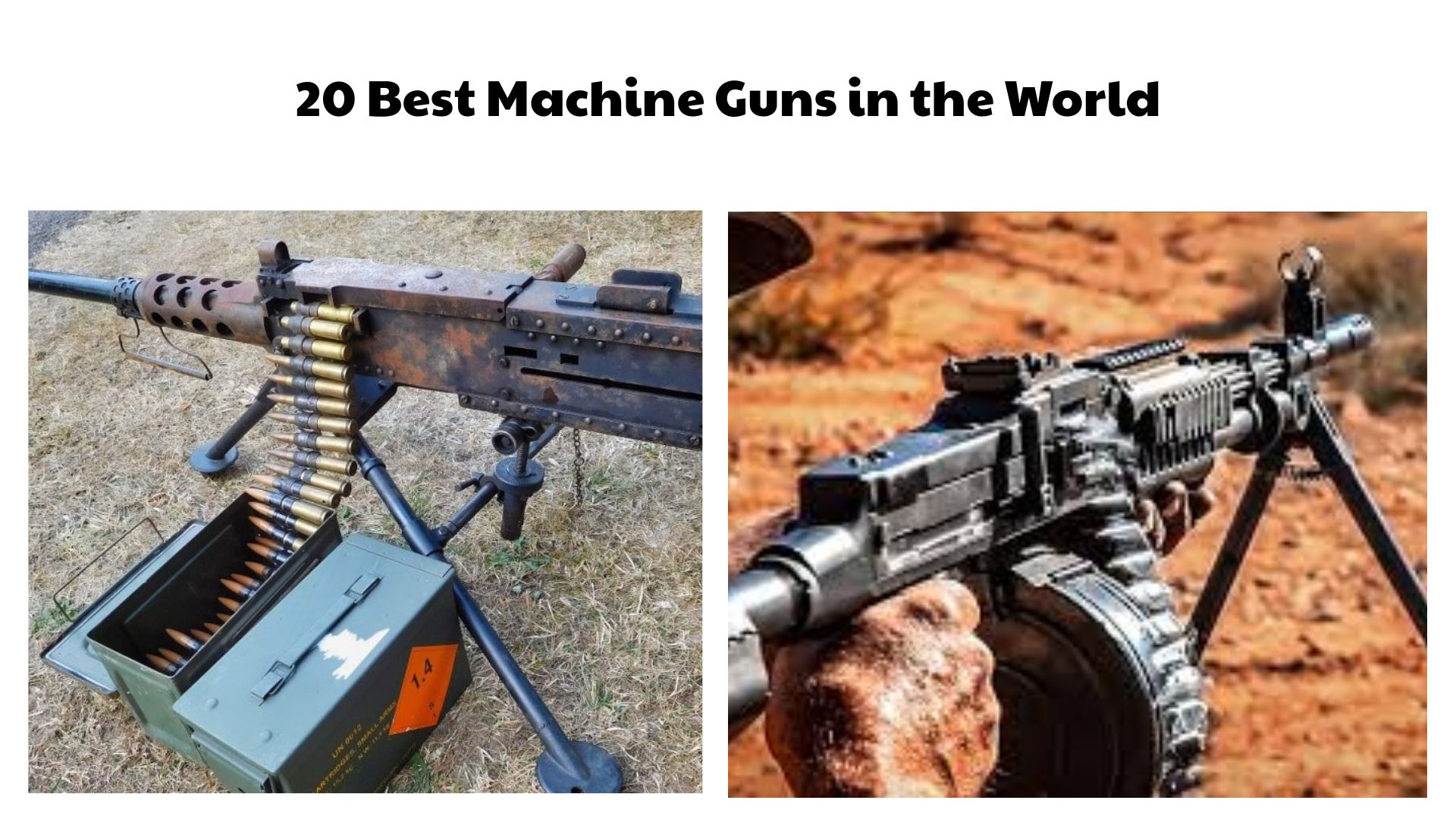

The world of modern firearms includes some of the most influential battlefield tools ever designed, and among them, machine guns remain a core element of infantry and armored warfare. The category of best machine guns includes light, medium, and heavy systems that provide sustained firepower in combat situations ranging from close-quarters engagements to long-range suppression. These weapons are valued not only for their fire rate but also for their reliability, durability, and adaptability across different environments. In this article, we explore five of the most respected machine guns used worldwide, breaking down their design philosophy, battlefield role, and lasting impact on modern military doctrine.
20 Best Machine Guns
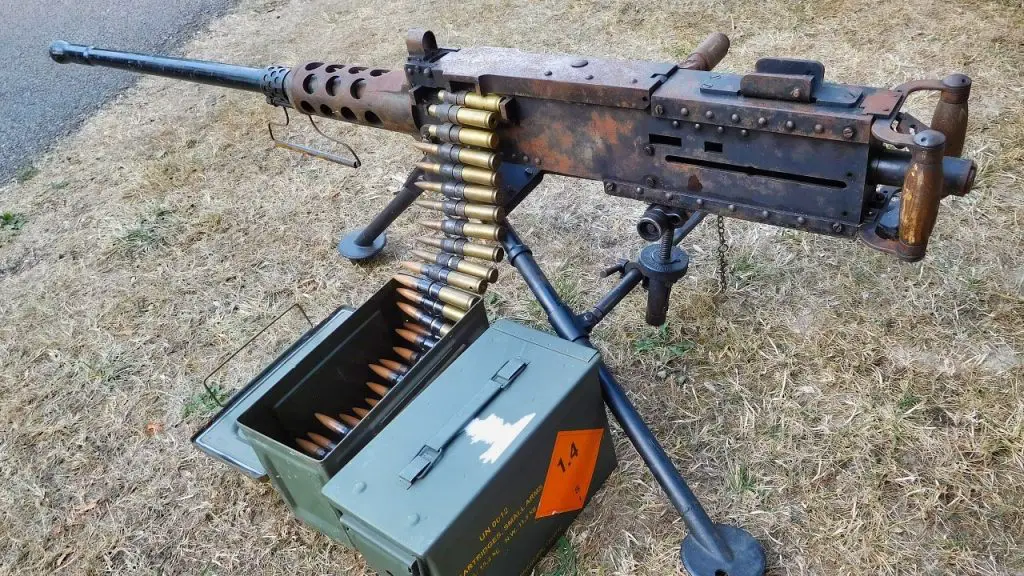
1. Browning M2 .50 Cal Heavy Machine Gun
The Browning M2 is one of the most iconic heavy guns ever developed, and its service history spans over a century. Designed by John Browning, this .50 caliber machine gun was originally intended for anti-aircraft and anti-vehicle roles, but it quickly evolved into a universal heavy support weapon used by infantry, vehicles, and naval platforms. Its ability to fire the powerful .50 BMG cartridge gives it exceptional penetration capability against light armor, fortifications, and even low-flying aircraft.
One of the defining strengths of the M2 is its unmatched reliability. It has been continuously used in various conflicts due to its ability to function in extreme environments such as deserts, jungles, and arctic conditions. The weapon’s recoil-operated system is mechanically simple but extremely robust, allowing it to sustain long firing cycles with minimal failure. This simplicity is a major reason why it remains in service across multiple modern armies today.
Beyond its mechanical performance, the M2 is valued for its psychological impact on the battlefield. The sound and destructive power of its rounds create a strong deterrent effect against enemy movement. Even in modern warfare, where precision systems dominate, the Browning M2 remains a standard reference point in discussions about the best machine guns due to its balance of power, durability, and proven battlefield effectiveness.
2. FN MAG / M240 General Purpose Machine Gun
The FN MAG, known in U.S. service as the M240, is a NATO-standard general-purpose machine gun designed for flexibility across multiple combat roles. It fires the 7.62×51mm NATO round, making it suitable for both sustained suppression and accurate medium-range engagements. Its design emphasizes reliability and adaptability, allowing it to be mounted on vehicles, tripods, and infantry support platforms.
One of the most important features of the FN MAG is its consistent performance under harsh battlefield conditions. It is engineered with a gas-operated system that reduces the risk of overheating and mechanical failure during prolonged firing sessions. This makes it especially effective in situations where continuous suppressive fire is required to control enemy movement or protect advancing troops.
The FN MAG is widely respected because it bridges the gap between light machine guns and heavy support weapons. It provides infantry units with sustained firepower without sacrificing mobility. In modern military doctrine, it is often considered one of the most balanced best machine guns due to its combination of accuracy, durability, and tactical versatility.
3. PKM General Purpose Machine Gun
The PKM is a Soviet-designed machine gun that has earned a global reputation for reliability and simplicity. Chambered in 7.62×54mmR, it is known for performing effectively in some of the harshest environments on Earth, including extreme cold, dust-heavy deserts, and humid jungle conditions. Its design prioritizes ease of maintenance and operational consistency.
Unlike more complex systems, the PKM features a lightweight construction and a straightforward gas-operated mechanism. This allows infantry units to carry and operate it with relative ease compared to heavier Western counterparts. Its belt-fed system ensures sustained fire capability, making it effective for suppressive fire roles during both offensive and defensive operations.
The PKM’s global usage across numerous military and paramilitary forces highlights its adaptability and trustworthiness. It remains one of the most widely deployed machine guns in active conflicts today. In discussions of best machine guns, the PKM stands out for its combination of simplicity, reliability, and battlefield endurance.
4. MG42 Machine Gun
The MG42 is one of the most famous machine guns in military history, known for its extremely high rate of fire and distinctive sound. Developed by Germany during World War II, it was designed to provide overwhelming suppressive fire on the battlefield. Its recoil-operated roller-locked system allowed it to achieve firing rates far higher than most contemporaries.
One of the MG42’s most notable characteristics is its psychological effect on enemy troops. The rapid firing rate produces a continuous “buzzing” sound that created significant battlefield intimidation. This feature, combined with its effectiveness in suppression roles, made it a highly feared weapon during its operational period.
Even today, the MG42’s design influences modern machine guns, including the MG3. Its engineering principles continue to shape the development of high-rate-of-fire weapons. In the category of best machine guns, the MG42 remains a historical benchmark for rapid-fire battlefield dominance.
5. M249 SAW (Squad Automatic Weapon)
The M249 SAW is a light machine gun widely used by U.S. and NATO forces to provide squad-level automatic fire support. It is chambered in 5.56×45mm NATO, allowing it to share ammunition with standard infantry rifles while offering a higher sustained rate of fire. This makes it highly practical for mobile infantry operations.
The M249 is designed for flexibility and sustained suppression rather than raw destructive power. It can be belt-fed or magazine-fed, depending on operational requirements, giving soldiers adaptability in the field. Its relatively lightweight construction allows it to be carried and deployed quickly in dynamic combat environments.
Despite its smaller caliber compared to heavier systems, the M249 plays a critical role in modern infantry tactics. It provides continuous fire support during movement and engagement phases, ensuring squad-level dominance in firefights. Within the category of best machine guns, the M249 represents the modern standard of portable automatic firepower.
6. HK MG5 Modern General Purpose Machine Gun
The HK MG5 is a modern German general-purpose machine gun designed to gradually replace older systems like the MG3 in several military forces. It fires the 7.62×51mm NATO cartridge and is built with a strong focus on ergonomics, modularity, and controlled sustained fire. Unlike older high-rate-of-fire designs, the MG5 prioritizes stability and accuracy during long bursts, making it more controllable for modern infantry operations where precision suppression is increasingly important.
One of the defining characteristics of the MG5 is its adaptability. It can be configured for multiple roles, including tripod-mounted sustained fire, vehicle mounting, or infantry carry. The design reduces recoil impact and improves heat management, allowing soldiers to maintain effective fire for longer durations without rapid barrel degradation. This makes it especially valuable in prolonged engagements where consistency matters more than extreme firing speed.
In modern battlefield doctrine, the HK MG5 represents the shift toward smarter, more efficient best machine guns that balance firepower with operator comfort and battlefield sustainability. It is widely respected for its precision engineering and modern combat suitability.
7. FN Minimi Light Machine Gun
The FN Minimi is one of the most widely used light machine guns in NATO and allied forces. It was designed to provide squad-level automatic fire support using 5.56×45mm ammunition, making it compatible with standard infantry rifles. Its lightweight design allows soldiers to maneuver more easily while still delivering sustained suppressive fire.
A key advantage of the FN Minimi is its dual-feed system, which allows it to use both belts and magazines. This flexibility is highly valuable in combat situations where ammunition supply may vary. The weapon is also known for its reliability in harsh environments, maintaining consistent performance in dust, mud, and extreme temperatures.
The FN Minimi has become a global standard for light support weapons due to its balance of mobility and firepower. In the broader category of best machine guns, it represents the ideal squad-level automatic weapon for modern infantry operations.
8. Ultimax 100 Light Machine Gun
The Ultimax 100 is a Singapore-designed light machine gun known for its exceptionally low recoil and high controllability. Chambered in 5.56×45mm NATO, it is engineered to allow accurate automatic fire even during long bursts. Its unique constant recoil system helps reduce muzzle climb, making it easier for operators to stay on target.
Unlike many traditional machine guns, the Ultimax 100 focuses heavily on shooter comfort and stability. This makes it particularly effective in close to medium-range engagements where precision suppression is required. It is also relatively lightweight, improving mobility for infantry units operating in fast-moving combat environments.
The Ultimax 100 stands out in the world of best machine guns because it prioritizes control and accuracy over raw firing rate, offering a more refined approach to squad automatic fire support.
9. DShK 12.7mm Heavy Machine Gun
The DShK is a Soviet-era heavy machine gun chambered in 12.7×108mm, designed for both anti-aircraft and ground support roles. It has been widely used in conflicts around the world due to its powerful cartridge and rugged mechanical design. The weapon is typically mounted on tripods or vehicles due to its size and recoil strength.
The 12.7mm round gives the DShK significant penetration capability against light armor, structures, and aircraft. Its gas-operated system is relatively simple, making it reliable even under harsh battlefield conditions. Although it is an older design, it remains in use because of its durability and effectiveness.
Within the category of heavy guns and machine guns, the DShK is a classic example of a weapon that has remained relevant for decades due to its raw firepower and mechanical toughness.
10. NSV Heavy Machine Gun
The NSV is a modern Soviet-designed heavy machine gun developed as a lighter and more efficient replacement for the DShK. It also fires the 12.7×108mm cartridge but features improved ergonomics, reduced weight, and better recoil control. It is widely used in armored vehicles, naval platforms, and defensive positions.
The NSV is known for its reliability and ability to maintain sustained fire in extreme conditions. Its improved design allows for easier handling and faster deployment compared to older heavy machine guns. It is particularly valued for its role in anti-aircraft and anti-vehicle engagements.
As part of the best machine guns category, the NSV represents the evolution of heavy machine gun design toward lighter, more efficient, and more adaptable battlefield systems without sacrificing firepower.
11. Kord Heavy Machine Gun
The Kord heavy machine gun is a modern Russian 12.7×108mm system designed to improve upon earlier heavy machine gun platforms like the NSV. It was developed with a strong focus on accuracy, reduced recoil, and improved durability when firing from both ground and vehicle mounts. The Kord is widely respected for maintaining stability even during sustained automatic fire, which is a critical requirement for heavy support roles.
One of the key improvements in the Kord is its enhanced recoil management system. This allows the weapon to remain controllable despite firing a large-caliber round. It is commonly mounted on armored vehicles, tripods, and defensive positions where long-range suppression is required. The weapon’s engineering also improves barrel life and heat resistance compared to older designs.
In the broader category of best machine guns, the Kord represents a refined evolution of heavy machine gun technology, combining raw firepower with improved battlefield usability and accuracy.
12. GAU-19/A Gatling-Style Machine Gun
The GAU-19/A is an electrically driven .50 caliber rotary machine gun based on the Gatling principle. It is designed for extreme rates of fire, typically mounted on helicopters, naval ships, and armored vehicles. Its multi-barrel system allows it to sustain high firing speeds while distributing heat across barrels, preventing overheating during continuous operation.
This system is primarily used for suppression and area denial rather than precision engagement. The GAU-19/A can deliver overwhelming volumes of fire in a short period, making it highly effective against light vehicles, infantry formations, and aerial threats at close range. Its electric drive system ensures consistent firing performance regardless of environmental conditions.
Within the world of heavy guns, the GAU-19/A represents modern rotary machine gun technology optimized for sustained high-intensity fire support in both land and naval warfare environments.
13. M134 Minigun
The M134 Minigun is one of the most iconic rotary machine guns ever developed. It features six rotating barrels and can achieve extremely high rates of fire, often exceeding several thousand rounds per minute. It is widely used on helicopters, vehicles, and fixed defensive platforms where maximum suppressive fire is required.
The Minigun’s electric-driven system allows it to maintain consistent firing speed while reducing individual barrel stress. This makes it highly effective in continuous fire scenarios. However, it requires a substantial ammunition supply and power source, which limits its portability and restricts it to mounted applications.
In the category of best machine guns, the M134 stands out as a symbol of extreme firepower and technological engineering focused on overwhelming suppression rather than precision engagement.
14. Stoner 63 Modular Weapon System
The Stoner 63 is a highly versatile modular weapon system designed by Eugene Stoner. It can be configured as a rifle, carbine, light machine gun, or belt-fed support weapon depending on mission requirements. This adaptability makes it one of the most innovative firearms systems ever developed.
As a machine gun configuration, the Stoner 63 provides lightweight automatic fire support with good controllability and flexibility. Its modular design allows rapid conversion between roles, which is especially useful for special operations and adaptable infantry units. However, its complexity also limited widespread adoption compared to simpler systems.
In the evolution of best machine guns, the Stoner 63 represents early experimentation with modular weapon platforms that influence many modern firearm designs today.
15. Bren Light Machine Gun
The Bren Light Machine Gun is a British-designed weapon widely used during World War II and later conflicts. It is known for its exceptional accuracy, reliability, and distinctive top-mounted magazine design. Chambered in .303 British and later adapted to NATO calibers, it served as a primary squad support weapon for decades.
The Bren’s slow rate of fire compared to modern machine guns actually contributed to its accuracy and ammunition efficiency. Soldiers valued its controllability and consistent performance in diverse combat environments. Its build quality also made it extremely durable under battlefield conditions.
As part of the best machine guns category, the Bren represents the balance between precision and sustained fire support, and it remains one of the most respected light machine guns in military history.
16. Lewis Gun
The Lewis Gun is one of the earliest successful light machine guns used in large-scale warfare. It was widely deployed during World War I and continued service into World War II in various roles. The weapon is recognizable by its distinctive top-mounted pan magazine and barrel cooling shroud, which helped it maintain more stable firing temperatures during sustained use.
Chambered in .303 British or .30-06 depending on configuration, the Lewis Gun offered infantry units portable automatic firepower at a time when most machine guns were heavy and stationary. Its relatively lightweight design made it easier to deploy in trench warfare, air defense, and even early aircraft mounting roles.
Within the evolution of best machine guns, the Lewis Gun represents a foundational step toward modern squad automatic weapons. It bridged the gap between heavy static guns and portable infantry support systems, influencing many later designs.
17. Vickers Machine Gun
The Vickers Machine Gun is one of the most reliable water-cooled machine guns ever produced. It served extensively with British and Commonwealth forces throughout World War I and World War II. Its design is based on the Maxim gun system but improved for greater durability and sustained fire capability.
The water-cooling system allowed the Vickers to fire for extremely long periods without overheating, making it ideal for defensive positions and prolonged suppression fire. It is widely known for its exceptional reliability and ability to function in harsh battlefield conditions with minimal failure rates.
In the category of best machine guns, the Vickers stands as a classic example of sustained-fire battlefield dominance and mechanical simplicity combined with extraordinary durability.
18. RPK Light Machine Gun
The RPK is a Soviet light machine gun derived from the AK platform, designed to provide squad-level automatic fire support. It uses the 7.62×39mm cartridge (or 5.45×39mm in later variants), allowing it to share ammunition with standard infantry rifles, improving logistics efficiency on the battlefield.
The RPK features a longer, heavier barrel compared to standard assault rifles, improving accuracy and heat resistance during sustained fire. Its drum magazine or extended box magazine provides higher ammunition capacity, making it suitable for suppressive fire roles in infantry squads.
As part of the best machine guns family, the RPK is valued for its simplicity, reliability, and seamless integration into infantry tactics based on the AK weapon ecosystem.
19. MG3 Machine Gun
The MG3 is a modernized version of the legendary MG42, chambered in 7.62×51mm NATO. It retains the extremely high rate of fire of its predecessor while adapting to modern ammunition standards. It is widely used in NATO and allied forces for both infantry and vehicle-mounted roles.
The MG3 is known for its aggressive firing rate, which provides strong suppressive capability but requires disciplined ammunition management. Its roller-locked recoil system ensures consistent cycling even under heavy use. The weapon is also highly durable and continues to function reliably in harsh environments.
In discussions of best machine guns, the MG3 remains a benchmark for high-rate-of-fire general-purpose machine guns and a direct link to World War II engineering excellence.
20. MG42 Machine Gun
The MG42 is one of the most influential machine guns ever created, developed by Germany during World War II. It is famous for its extremely high rate of fire, often exceeding 1,200 rounds per minute, which gave it a devastating suppressive effect on the battlefield. Its design emphasized mass production, reliability, and battlefield efficiency.
The MG42’s recoil-operated system and quick-change barrel allowed it to sustain fire more effectively than many competing systems of its era. Its distinctive sound earned it a reputation among soldiers as one of the most intimidating weapons of the war. This psychological impact was nearly as important as its physical firepower.
Even today, the MG42’s design principles continue to influence modern machine guns like the MG3. In the world of best machine guns, it remains a historical milestone that reshaped automatic weapon design for decades to come.
Conclusion – Understanding the Best Machine Guns in Modern Warfare
The study of the best machine guns reveals how military technology has evolved from simple mechanical designs into highly specialized battlefield systems. Across different eras, machine guns have consistently played a central role in shaping infantry tactics, providing sustained firepower, and controlling battlefield movement. From early designs like the Vickers and Lewis Gun to modern systems such as the HK MG5 and FN MAG, each weapon reflects the needs and limitations of its time.
What becomes clear is that machine guns are not defined by a single feature such as fire rate or caliber alone. Instead, their value comes from a combination of reliability, adaptability, ease of maintenance, and effectiveness under real combat conditions. Heavy systems like the Browning M2 deliver unmatched stopping power, while lighter designs such as the FN Minimi or RPK prioritize mobility and squad-level flexibility. Meanwhile, iconic weapons like the MG42 demonstrate how engineering innovation can influence decades of firearm development.
Modern warfare continues to reduce reliance on purely mechanical firepower, but machine guns remain essential in nearly every military force. They serve as the backbone of suppressive fire, support infantry movement, and provide defensive control in both conventional and asymmetric conflicts. Even with advances in missiles and drones, the role of machine guns has not disappeared—it has simply adapted.
In conclusion, the evolution of the best machine guns shows a continuous balance between power, control, and practicality. These weapons remain a critical part of military strategy, and their development reflects the broader story of how warfare itself has changed over the past century.
50+ Frequently Asked Questions About Best Machine Guns
This FAQ section covers the most important questions about best machine guns, including their design, history, function, and role in modern warfare. The answers are written in a clear, informative style to help readers understand how these weapons evolved and why they remain important in military systems today.
1. What is a machine gun?
A machine gun is a fully automatic firearm designed to fire continuously as long as the trigger is pressed and ammunition is available. It is primarily used to provide sustained suppressive fire in combat situations, allowing military units to control enemy movement and dominate specific areas of the battlefield.
2. What makes a machine gun “the best”?
The best machine guns are defined by reliability, durability, accuracy, ease of maintenance, and consistent performance under harsh conditions. A weapon that functions reliably in extreme environments while providing effective suppressive fire is generally considered superior.
3. What are the main types of machine guns?
Machine guns are generally classified into light machine guns (LMG), general-purpose machine guns (GPMG), heavy machine guns (HMG), and rotary machine guns. Each category serves different tactical roles ranging from squad support to vehicle-mounted suppression.
4. Why are machine guns important in warfare?
Machine guns provide continuous firepower that can suppress enemy movement, protect advancing troops, and defend strategic positions. Their ability to deliver sustained fire makes them essential in both offensive and defensive operations.
5. What is the difference between light and heavy machine guns?
Light machine guns are designed for mobility and infantry use, while heavy machine guns use larger calibers and are typically mounted on vehicles or tripods. Heavy systems provide greater range and penetration power but are less mobile.
6. What is a general-purpose machine gun?
A general-purpose machine gun can be used in both light and heavy roles depending on its mounting and configuration. It is designed to be versatile, allowing infantry or vehicle deployment with the same weapon system.
7. What is the most powerful machine gun?
The Browning M2 .50 caliber machine gun is widely considered one of the most powerful due to its large-caliber ammunition, long range, and ability to penetrate light armor and vehicles.
8. What is the fastest-firing machine gun?
Rotary systems like the M134 Minigun can achieve extremely high firing rates, often thousands of rounds per minute, making them among the fastest-firing machine guns in service.
9. Are machine guns still used today?
Yes, machine guns are still widely used in modern militaries. They remain essential for infantry support, vehicle defense, and sustained battlefield suppression despite advances in missile and drone technology.
10. What is the most reliable machine gun?
Weapons like the PKM and FN MAG are considered highly reliable due to their ability to function consistently in extreme environmental conditions with minimal maintenance issues.
11. Why is the PKM so popular?
The PKM is popular because it is lightweight, simple, and extremely reliable. It performs well in harsh conditions such as sand, mud, and cold weather, making it widely adopted across many countries.
12. What is the role of the M249 SAW?
The M249 SAW provides squad-level automatic fire support, allowing infantry units to suppress enemy positions while other soldiers maneuver. It is a key component of modern infantry tactics.
13. What is the MG42 famous for?
The MG42 is famous for its extremely high rate of fire and psychological impact on enemy troops. Its distinctive sound and effectiveness made it one of the most feared weapons of World War II.
14. Is the MG3 still used today?
Yes, the MG3 is still used by several NATO and allied forces. It is a modernized version of the MG42 adapted to 7.62×51mm NATO ammunition.
15. What is a heavy machine gun used for?
Heavy machine guns are used to engage light vehicles, fortified positions, and aircraft. They provide long-range firepower and strong penetration capability compared to lighter systems.
16. What caliber do machine guns use?
Machine guns can use a wide range of calibers, from 5.56mm in light machine guns to 12.7mm (.50 caliber) or larger in heavy machine guns.
17. What is recoil in machine guns?
Recoil is the backward force generated when a weapon is fired. Machine guns must be designed to manage recoil effectively to maintain accuracy during automatic fire.
18. Why do some machine guns have multiple barrels?
Multi-barrel systems like miniguns are designed to distribute heat and allow extremely high rates of fire without overheating a single barrel.
19. What is suppressive fire?
Suppressive fire is continuous shooting aimed at preventing the enemy from moving or returning fire effectively, allowing friendly forces to maneuver safely.
20. What is belt-fed ammunition?
Belt-fed systems use linked ammunition belts instead of magazines, allowing machine guns to fire longer without reloading interruptions.
21. Why do machine guns need barrel changes during combat?
Machine guns generate extreme heat during sustained automatic fire. To prevent barrel damage or failure, many systems are designed with quick-change barrels. This allows operators to replace overheated barrels in seconds, ensuring continuous fire without compromising safety or weapon integrity.
22. What is a quick-change barrel system?
A quick-change barrel system allows the operator to remove a hot barrel and install a cool replacement rapidly. This feature is essential for medium and heavy machine guns that are expected to sustain long bursts of fire in combat situations.
23. Why are some machine guns water-cooled?
Water-cooled machine guns use a water jacket around the barrel to absorb heat during prolonged firing. This design allows for extremely long continuous fire sessions, though it adds weight and reduces mobility compared to air-cooled systems.
24. Are water-cooled machine guns still used today?
They are largely obsolete in modern frontline combat but may still appear in static defensive roles or historical reenactments. Modern air-cooled systems are more practical due to their lighter weight and mobility.
25. What is the difference between automatic and semi-automatic fire?
Automatic fire continues as long as the trigger is held, while semi-automatic fire requires a separate trigger pull for each shot. Machine guns operate in fully automatic mode for sustained suppression.
26. Why do machine guns use belt-fed systems?
Belt-fed systems allow a continuous supply of ammunition without frequent magazine changes. This is essential for sustained fire roles where interruptions can reduce battlefield effectiveness.
27. What is a general-purpose machine gun (GPMG)?
A GPMG is a versatile machine gun that can be used in both light infantry roles and heavy mounted positions. It balances mobility with sustained fire capability, making it widely used in modern armies.
28. What is the most widely used machine gun in the world?
The PKM is often considered one of the most widely used machine guns globally due to its simplicity, reliability, and adoption by many armed forces and non-state groups.
29. Why is reliability so important in machine guns?
Machine guns are often used in high-pressure combat situations where failure is not an option. A reliable weapon ensures continuous suppression and increases the survival chances of infantry units.
30. What causes machine gun jams?
Jams can be caused by dirty ammunition, overheating, poor maintenance, damaged belts, or mechanical wear. Proper cleaning and maintenance significantly reduce malfunction risks.
31. How does barrel length affect machine gun performance?
Longer barrels generally improve bullet velocity and accuracy, while shorter barrels improve mobility. Designers must balance these factors depending on the intended role of the weapon.
32. What is muzzle climb in machine guns?
Muzzle climb refers to the upward movement of a weapon during automatic fire due to recoil. It affects accuracy and must be controlled through training or weapon design features.
33. How do soldiers control machine gun recoil?
Recoil is controlled using bipods, tripods, proper stance, controlled bursts, and sometimes recoil-reducing internal mechanisms built into the weapon.
34. What is a rotary machine gun?
A rotary machine gun uses multiple rotating barrels powered by an external motor to achieve extremely high firing rates while reducing heat buildup.
35. What is the M134 Minigun used for?
The M134 Minigun is used on helicopters, vehicles, and naval platforms for high-volume suppressive fire against infantry and light targets.
36. Why are machine guns mounted on vehicles?
Vehicle-mounted machine guns provide mobility, protection, and increased firepower. They allow forces to deliver sustained fire while staying protected behind armor.
37. What is the difference between LMG and HMG?
Light machine guns are portable and used by infantry squads, while heavy machine guns use larger calibers and are typically mounted due to their weight and recoil.
38. What role do machine guns play in infantry squads?
They provide suppressive fire, protect movement, and allow teammates to advance or reposition safely during engagements.
39. Why are machine guns important in defensive positions?
Machine guns can control large areas with sustained fire, making them highly effective for defending chokepoints, trenches, and strategic locations.
40. What is suppressive fire effectiveness based on?
It depends on ammunition volume, accuracy, rate of fire, positioning, and psychological impact on enemy forces.
41. How has machine gun design evolved over time?
Design has evolved from heavy water-cooled systems to lightweight modular weapons and rotary high-rate systems, improving mobility and efficiency.
42. What is modular weapon design?
Modular design allows a weapon to be reconfigured for different roles, such as switching between rifle and machine gun configurations.
43. Why are modern machine guns lighter?
Advances in materials and engineering allow lighter construction without sacrificing strength, improving mobility for infantry units.
44. What is the role of machine guns in urban warfare?
They provide suppression in narrow streets, buildings, and chokepoints where enemy movement must be controlled effectively.
45. How important is ammunition logistics for machine guns?
Very important. Machine guns consume large amounts of ammunition, requiring strong supply chains to maintain operational effectiveness.
46. What is the psychological effect of machine guns?
Continuous automatic fire creates fear, disrupts enemy coordination, and forces troops into cover, reducing their combat effectiveness.
47. Are machine guns effective against armored vehicles?
Heavy machine guns can damage light armor and disable exposed components, but they are not effective against heavily armored tanks.
48. What is the difference between accuracy and rate of fire?
Accuracy refers to how precisely shots hit a target, while rate of fire refers to how many rounds are fired per minute. Machine guns balance both for suppression roles.
49. Why do some machine guns have adjustable fire rates?
Adjustable fire rates allow operators to switch between controlled fire and high suppression depending on combat needs.
50. What is the future of machine guns?
Future machine guns are expected to become lighter, more modular, and integrated with digital targeting systems while maintaining high reliability.
51. Are smart systems being added to machine guns?
Yes, modern developments include smart optics, recoil sensors, and improved targeting assistance systems.
52. How are machine guns trained in military use?
Soldiers undergo training in recoil control, barrel management, ammunition handling, and coordinated squad tactics.
53. What is the biggest challenge in machine gun design?
Balancing firepower, weight, heat management, and reliability remains the biggest engineering challenge.
54. Why do machine guns remain relevant today?
They provide unmatched suppressive capability that cannot be fully replaced by missiles or drones in close combat environments.
55. What is the main takeaway about best machine guns?
The key takeaway is that best machine guns are defined not only by firepower, but by reliability, adaptability, and their ability to sustain battlefield control under real combat conditions.
Read more: