
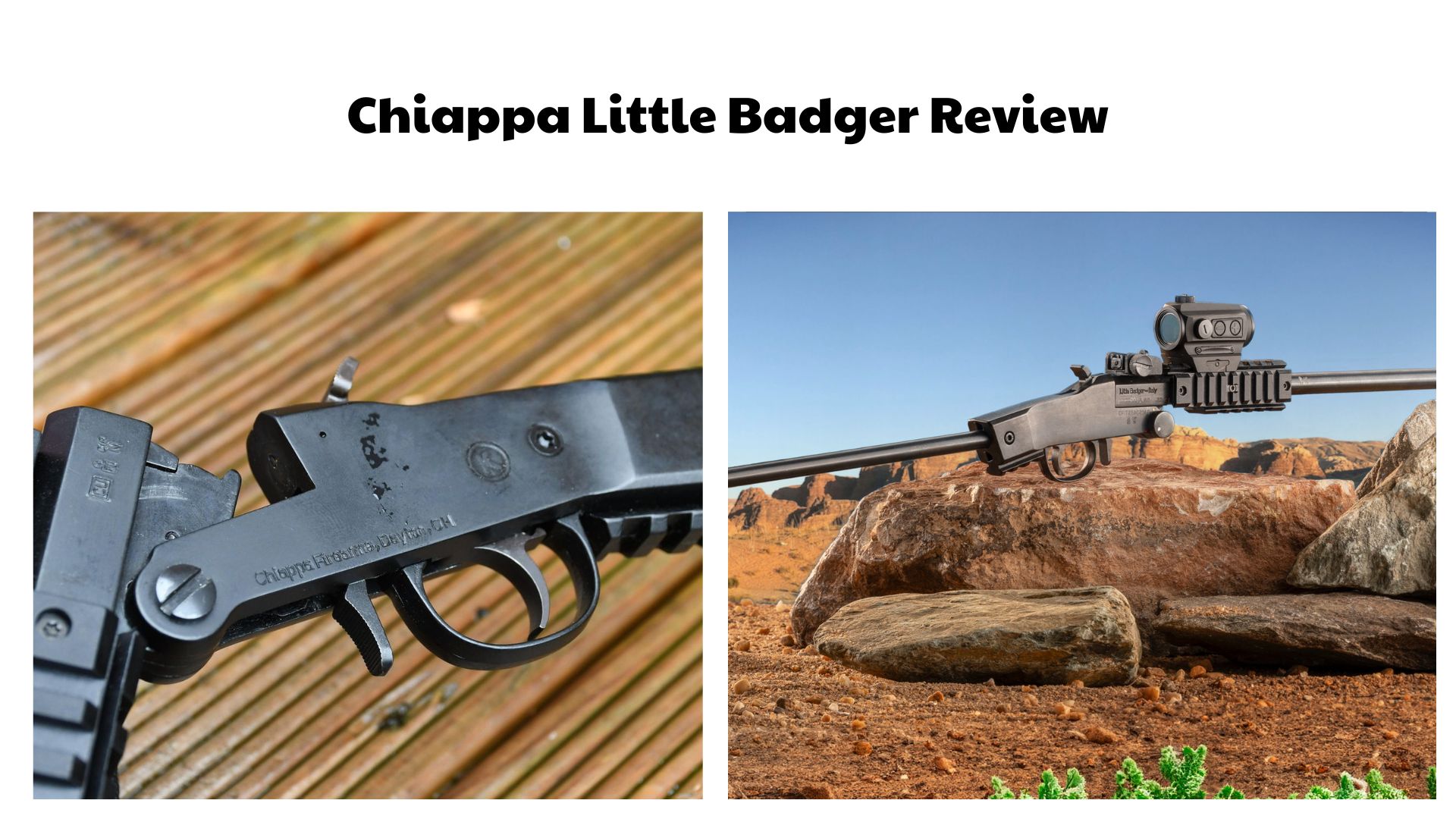

The Chiappa Little Badger is an ultra-lightweight, break-action survival rifle designed specifically for backpacking, emergency preparedness, and minimalist shooting applications. It is built around the idea of extreme portability, allowing users to carry a functional firearm in situations where space and weight are critical factors.
Featuring a distinctive folding wire-frame design and available in both .22 LR and .22 WMR chamberings, the Little Badger is best understood as a compact survival tool rather than a traditional hunting or precision rifle. Its simplicity, low weight, and packable design make it popular among outdoor enthusiasts, preppers, and minimalist shooters.
What Is the Chiappa Little Badger?
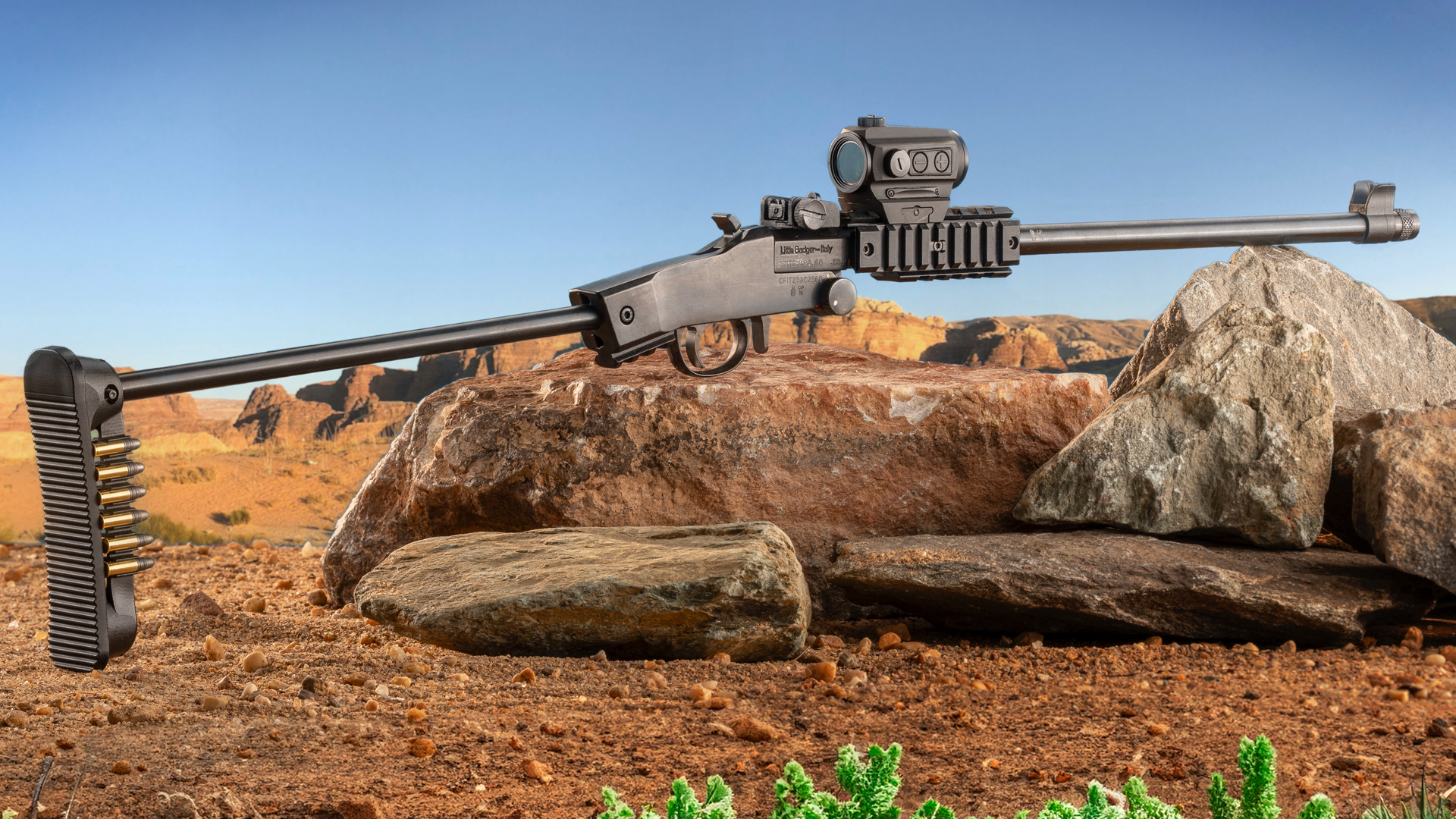
Overview of the Ultra-Lightweight Survival Rifle Concept
The Chiappa Little Badger is built around the concept of a survival firearm that prioritizes portability over traditional rifle features. It is designed to be easily carried in a backpack, vehicle emergency kit, or survival pack, making it accessible when more conventional rifles would be impractical.
Design Philosophy: Minimalism and Portability First
The design philosophy behind the Little Badger focuses on stripping the rifle down to its essential components. Instead of emphasizing tactical features or precision enhancements, it prioritizes weight reduction, simplicity, and ease of transport for emergency scenarios.
Chambering Options (.22 LR vs .22 WMR Variants)
The rifle is commonly offered in both .22 LR and .22 WMR chamberings. The .22 LR version is ideal for low-cost practice and small game hunting, while the .22 WMR variant provides increased velocity and energy for slightly more demanding field applications.
Who the Little Badger Is Designed For
This rifle is designed for survivalists, backpackers, preppers, and outdoor users who need a lightweight and dependable firearm for emergency or utility purposes. It is not intended for competitive shooting or high-volume range use.
Design and Build Quality
Wire-Frame Folding Design Explained
One of the most distinctive features of the Little Badger is its wire-frame folding design. This structure allows the rifle to collapse into a compact form, significantly reducing its storage footprint while maintaining basic functionality as a firearm.
Weight and Backpack-Friendly Construction
The rifle is extremely lightweight compared to traditional rifles, making it ideal for long-distance carry. Its backpack-friendly construction ensures it can be transported without adding significant burden to survival or hiking gear.
Materials Used (Steel Frame, Polymer Components)
The construction typically combines a steel wire frame with polymer elements to balance durability and weight savings. This combination helps maintain structural integrity while keeping the rifle as light as possible.
Durability and Field Robustness
Despite its minimalist design, the Little Badger is reasonably durable for field use. However, it is not designed for heavy abuse or high-round-count shooting sessions, and users should treat it as a utility tool rather than a rugged combat firearm.
Compactness and Storage Advantages
When folded, the rifle becomes highly compact and easy to store in small spaces. This makes it especially valuable for emergency kits, bug-out bags, or vehicle storage where space efficiency is essential.
Action and Operating System
Break-Action Single-Shot Mechanism Overview
The Chiappa Little Badger uses a break-action single-shot system, meaning the rifle must be manually opened, loaded, and closed for each shot. This simple mechanism enhances reliability and reduces mechanical complexity.
Loading and Unloading Process
Loading involves breaking open the action, inserting a single cartridge into the chamber, and closing the barrel. Unloading is equally simple, as spent or unfired cartridges can be manually removed without complex extraction systems.
Manual Cocking and Safety Features
The rifle typically uses manual cocking and simple safety mechanisms to ensure controlled operation. This straightforward design reduces the likelihood of mechanical failure and supports safe handling in field environments.
Simplicity vs Semi-Auto and Bolt-Action Rifles
Compared to semi-automatic and bolt-action rifles, the Little Badger sacrifices speed and fire volume in exchange for extreme simplicity and reliability. This makes it more suitable for deliberate, controlled shooting rather than rapid engagement scenarios.
Barrel and Accuracy Performance
Fixed Barrel Design Advantages
The fixed barrel design contributes to consistent alignment and basic accuracy potential. Because there are fewer moving parts affecting barrel position, shot consistency can remain stable within the rifle’s intended range.
Accuracy Expectations at 25–100 Yards
At typical survival distances of 25 to 100 yards, the Little Badger can deliver practical accuracy for small game hunting and utility shooting. However, its lightweight structure limits precision compared to heavier rifles.
Performance Differences Between .22 LR and .22 WMR Models
The .22 LR model is more economical and suitable for close-range use, while the .22 WMR version offers improved velocity and energy for slightly longer-range effectiveness. Both versions share similar mechanical characteristics.
Ammunition Sensitivity and Real-World Grouping
As with many rimfire rifles, performance can vary depending on ammunition quality. Higher-grade ammunition generally produces tighter groupings, while bulk ammo may result in less consistent accuracy.
Practical Accuracy for Survival and Field Use
The rifle’s accuracy is best described as “practical” rather than precision-focused. It is designed to be effective enough for survival tasks such as small game harvesting rather than competitive shooting.
Recoil and Shooting Experience
Near-Zero Recoil Characteristics of Rimfire Calibers
Both .22 LR and .22 WMR produce minimal recoil, making the Little Badger easy to control and comfortable to shoot even for inexperienced users.
Lightweight Platform Shooting Feel
The extremely light weight of the rifle creates a unique shooting experience. While easy to carry, it can feel less stable when firing compared to heavier rifles, especially without support.
Stability Challenges Due to Minimal Weight
Because of its minimal mass, the rifle is more susceptible to movement during aiming and firing. This requires the shooter to develop steady shooting techniques or use natural supports.
Shooting Comfort During Extended Use
Extended shooting sessions remain comfortable due to low recoil and simple operation, although the minimalist design may feel less ergonomic over long periods compared to traditional rifles.
Optics, Sights, and Mounting Options
Factory Iron Sights (Where Equipped)
Some Chiappa Little Badger configurations include basic factory iron sights, typically designed for close-range utility shooting. These sights are functional but minimal, reflecting the rifle’s survival-focused design philosophy rather than precision shooting applications.
Picatinny Rail for Optics Mounting
Many models feature a Picatinny rail that allows users to mount a variety of optics. This greatly enhances versatility, enabling the use of red dots, compact scopes, or lightweight survival optics depending on the intended use.
Red Dot vs Scope Setup Considerations
Red dot sights are ideal for fast target acquisition at close ranges, while compact scopes provide better precision at extended distances. Given the rifle’s lightweight nature, optic choice should balance capability with added weight.
Best Optics for Survival and Field Scenarios
For survival use, low-power scopes or compact fixed magnification optics are often preferred. These options provide sufficient clarity for small game hunting without significantly increasing the rifle’s overall weight or bulk.
Chiappa Little Badger as a Survival Rifle
Backpacking and Bug-Out Bag Applications
The Little Badger is highly popular in backpacking and bug-out bag setups due to its extreme compactness and lightweight design. It can be easily stored in survival kits without compromising mobility.
Emergency Food Procurement and Small Game Use
In survival scenarios, the rifle is capable of harvesting small game such as rabbits and squirrels, providing a potential food source when other options are unavailable.
Lightweight “Last Resort” Firearm Role
It is often viewed as a “last resort” firearm, intended for emergency use rather than primary hunting or defensive roles. Its simplicity ensures it remains functional even under harsh conditions.
Comparison to Traditional Survival Rifles
Compared to traditional survival rifles like folding semi-autos or takedown rifles, the Little Badger is lighter and simpler but lacks multi-shot capability and faster follow-up shots.
Reliability and Field Performance
Mechanical Simplicity and Reliability Strengths
The break-action single-shot design provides high mechanical reliability due to its simplicity. Fewer moving parts reduce the risk of mechanical failure in adverse conditions.
Performance in Harsh Outdoor Conditions
The rifle can perform reliably in various outdoor environments, though its exposed frame design means users should take care to protect it from excessive dirt and moisture.
Fouling, Dirt Resistance, and Maintenance Needs
Maintenance is relatively straightforward, but regular cleaning is recommended to ensure consistent performance, especially after exposure to dirt, rain, or heavy use.
Long-Term Durability Considerations
While durable enough for survival use, the rifle is not intended for heavy-duty or high-round-count applications. Long-term durability depends heavily on proper care and usage discipline.
Ammunition Compatibility and Performance
.22 LR vs .22 WMR Performance Differences
The .22 LR version is more economical and suitable for short-range use, while the .22 WMR offers increased velocity and energy, making it more effective at slightly longer distances.
Best Ammunition Types for Accuracy and Reliability
High-quality factory ammunition tends to deliver the best performance. Match-grade or premium hunting rounds provide more consistent velocity and improved accuracy.
Hollow Point vs Solid Point Performance in Field Use
Hollow point ammunition is often preferred for small game hunting due to better energy transfer, while solid point rounds may offer slightly deeper penetration and more consistent flight.
Cost vs Effectiveness for Survival Scenarios
In survival situations, cost becomes less important than reliability and effectiveness. Shooters typically prioritize dependable ammunition that functions consistently over budget bulk options.
Handling and Ergonomics
Skeletonized Frame Grip and Shooting Position
The skeletonized frame provides a minimalist grip structure that requires some adaptation. Shooting comfort depends heavily on user technique and positioning rather than traditional stock support.
Adjustable Stock Features (Paracord Wrap Options)
Many users customize the stock area with paracord wraps or aftermarket padding to improve comfort and grip, enhancing usability without adding significant weight.
Lightweight Handling Trade-Offs
While the rifle is extremely easy to carry, its light weight can reduce stability during aiming and firing, especially in unsupported shooting positions.
Comfort vs Practicality in Real Use
The design prioritizes practicality and portability over ergonomic comfort, making it highly functional in survival roles but less comfortable for extended range sessions.
Chiappa Little Badger vs Traditional .22 Rifles
Comparison with Bolt-Action .22 Rifles
Compared to bolt-action .22 rifles, the Little Badger is significantly lighter and more compact but sacrifices magazine capacity and shooting speed.
Comparison with Semi-Auto Rimfire Rifles
Semi-automatic rifles offer faster follow-up shots and higher capacity, while the Little Badger prioritizes simplicity and reliability in a single-shot platform.
Accuracy vs Portability Trade-Off
Traditional .22 rifles generally provide better accuracy due to heavier barrels and stocks, while the Little Badger focuses on portability at the cost of stability.
Use Case Differences (Survival vs Training vs Hunting)
The Little Badger is primarily a survival tool, whereas other .22 rifles are better suited for training, recreational shooting, or more frequent hunting use.
Chiappa Little Badger vs Other Survival Rifles
Comparison with Henry AR-7 Survival Rifle
The Henry AR-7 offers semi-automatic capability and floating storage design, while the Little Badger is simpler, lighter, and more mechanically straightforward.
Comparison with Folding .22 Carbines
Folding carbines generally provide higher capacity and faster shooting, but they are heavier and less compact compared to the ultra-minimalist Little Badger.
Weight and Packability Comparison
In terms of weight and packability, the Little Badger is among the lightest survival rifles available, making it highly competitive in minimalist firearm categories.
Reliability and Field Usability Differences
While other survival rifles may offer more features, the Little Badger stands out for its mechanical simplicity, which contributes to consistent field reliability under basic conditions.
Customization and Upgrades
Optics Rails and Sight Additions
The Chiappa Little Badger supports a range of simple customization options, with optics rails being the most common upgrade. Users can mount compact scopes or red dot sights to improve aiming capability, especially for small game hunting or survival scenarios where faster target acquisition is useful.
Stock Comfort Upgrades (Butt Pad, Wraps)
Because the rifle uses a minimalist wire-frame design, many owners add comfort upgrades such as paracord wraps, foam padding, or aftermarket butt pads. These modifications significantly improve shooting comfort without compromising the rifle’s lightweight nature.
Sling Attachments and Carry Options
Sling setups are highly recommended for field use, as they make carrying the rifle easier during hiking or survival travel. Various sling attachment solutions can be added to improve portability and accessibility in outdoor environments.
Barrel and Accessory Limitations
Due to its minimalist design, the Little Badger has limited compatibility with heavy aftermarket accessories. Users should avoid over-accessorizing the platform, as adding too much weight can reduce its primary advantage of extreme portability.
Pros and Cons of Chiappa Little Badger
Key Strengths of the Platform
The Chiappa Little Badger excels in portability, simplicity, and ease of storage. Its ultra-lightweight frame and folding design make it one of the most compact survival rifles available, ideal for emergency preparedness and backpacking.
Limitations and Practical Trade-Offs
Its main limitations include single-shot operation, minimal ergonomics, and reduced stability compared to traditional rifles. It is not designed for rapid shooting, competition, or high-volume range use.
Value for Survival and Budget Users
Despite its limitations, the Little Badger offers strong value for users seeking a low-cost survival firearm. It provides a functional and reliable tool for emergency situations without the complexity or weight of traditional rifles.
Who Should Buy the Chiappa Little Badger?
Survivalists and Preppers
This rifle is ideal for survivalists and preppers who want a compact, lightweight firearm that can be stored in emergency kits or bug-out bags for contingency situations.
Backpackers and Outdoor Enthusiasts
Backpackers benefit from its minimal weight and compact folding design, making it easy to carry on long outdoor expeditions without adding significant burden.
Minimalist Firearm Owners
Minimalist shooters who prefer simple, no-frills firearms will appreciate its straightforward design and lack of unnecessary complexity.
Small Game Hunters in Emergency Scenarios
While not a primary hunting rifle, it can serve as an emergency tool for harvesting small game in survival situations where other options are unavailable.
Final Verdict on Chiappa Little Badger Review
The Chiappa Little Badger stands out as an ultra-portable, survival-focused firearm built around simplicity and practicality. Its lightweight folding design, single-shot break-action system, and compact profile make it one of the most convenient emergency rifles available today.
While it is not designed for precision shooting, high-volume range use, or tactical applications, it excels in its intended role as a survival and backup firearm. Users should view it as a niche tool rather than a primary rifle.
Overall, the Little Badger delivers strong value for survivalists, backpackers, and minimalist firearm owners who prioritize portability and reliability over firepower and advanced features.
Chiappa Little Badger – 55 FAQ (Detailed Answers)
1. What is the Chiappa Little Badger?
The Chiappa Little Badger is an ultra-lightweight, break-action, single-shot survival rifle designed for maximum portability. It is primarily used for backpacking, emergency preparedness, and minimalist shooting rather than traditional hunting or tactical applications.
2. Is the Chiappa Little Badger good for survival situations?
Yes, it is specifically designed for survival scenarios. Its compact folding design and ability to fire common rimfire ammunition make it useful for small game procurement and emergency preparedness when larger firearms are impractical.
3. What calibers does the Little Badger come in?
It is commonly chambered in .22 LR and .22 WMR. The .22 LR version is more affordable and widely available, while the .22 WMR version offers greater velocity and energy for slightly longer-range effectiveness.
4. Is the Little Badger a semi-automatic rifle?
No, it is a single-shot break-action rifle. Each shot requires manual loading, which increases simplicity but reduces rate of fire.
5. How does the break-action system work?
The barrel folds open on a hinge, allowing the user to manually insert a cartridge into the chamber. The action is then closed before firing, and reopened to remove the spent casing or reload.
6. How accurate is the Chiappa Little Badger?
Accuracy is practical rather than precision-focused. It performs well within 25–100 yards, especially for small game hunting, but is not designed for tight competition-level grouping.
7. Is it suitable for long-range shooting?
No, due to its lightweight design and rimfire caliber limitations, it is best suited for short to moderate ranges typical of survival or field use.
8. What is the effective range?
The effective range is generally considered to be up to 100 yards for .22 LR and slightly further for .22 WMR under ideal conditions.
9. Is the Little Badger reliable?
Yes, its mechanical simplicity makes it highly reliable in basic conditions, as it has very few moving parts that can fail.
10. Does it jam?
Jamming is extremely rare because it is a single-shot break-action rifle. However, ammunition quality still affects performance.
11. Is it good for beginners?
It can be used by beginners under supervision, but its unconventional design may require some adjustment compared to traditional rifles.
12. How heavy is the Little Badger?
It is extremely lightweight, often weighing just a few pounds, making it one of the lightest rifles in its category.
13. Can it fit in a backpack?
Yes, it is specifically designed to fold into a compact shape that fits easily into backpacks or survival kits.
14. Is it legal to own?
Legality depends on local firearm laws. In most regions where rimfire rifles are legal, the Little Badger is also permitted, but users must always check local regulations.
15. Can it be used for hunting?
Yes, it is suitable for small game hunting such as rabbits and squirrels, especially in survival or subsistence contexts.
16. What animals can it take down?
It is typically used for small game animals. It is not suitable for large game due to limited power and caliber size.
17. Does it have recoil?
Recoil is minimal due to the .22 LR and .22 WMR cartridges, making it very comfortable to shoot.
18. Is it loud?
It produces standard rimfire noise levels, which can be loud without a suppressor but are generally manageable compared to centerfire rifles.
19. Can it be suppressed?
Yes, threaded barrel models can accept suppressors where legally permitted, significantly reducing noise levels.
20. Does it come with iron sights?
Some versions include basic iron sights, but many rely on optics rails for sighting systems.
21. Can you mount a scope?
Yes, most models include a Picatinny rail that allows mounting of scopes or red dot sights.
22. What optics are best?
Lightweight red dots or compact scopes are preferred to maintain portability while improving accuracy.
23. Is it good for backpacking?
Yes, it is one of the most popular survival rifles for backpacking due to its ultra-lightweight design.
24. Is it good for bug-out bags?
Yes, it is commonly included in emergency preparedness kits because it takes very little space and weight.
25. How durable is it?
It is durable enough for survival use but not intended for heavy-duty or high-volume shooting environments.
26. What materials is it made from?
It typically uses a combination of steel wire framing and polymer components to reduce weight while maintaining structural integrity.
27. Is it comfortable to shoot?
Comfort is basic. It is functional but lacks ergonomic features found in traditional rifles.
28. Can it be customized?
Yes, but customization is limited due to its minimalist design.
29. What upgrades are common?
Common upgrades include optics rails, slings, and paracord wraps for improved grip and comfort.
30. Does it have a stock?
It uses a skeletonized wire-frame design rather than a traditional full stock.
31. Is it good for kids?
It can be used for supervised training, but its unusual design may not be ideal for first-time shooters.
32. How does it compare to bolt-action rifles?
It is lighter and simpler but lacks magazine capacity and faster follow-up shot capability.
33. How does it compare to semi-auto rifles?
Semi-auto rifles are faster and more versatile, while the Little Badger focuses on simplicity and survival utility.
34. Is it better than AR-7 survival rifles?
The AR-7 offers semi-auto functionality and floating storage, while the Little Badger is lighter and mechanically simpler.
35. Is it accurate enough for hunting?
Yes, within reasonable distances for small game hunting, especially with proper ammunition selection.
36. What ammo works best?
High-quality .22 LR or .22 WMR ammunition generally produces the most consistent performance.
37. Is bulk ammo okay?
It will function with bulk ammo, but accuracy and consistency may decrease.
38. Is it ammo sensitive?
Yes, like most rimfire firearms, performance can vary depending on ammunition brand and type.
39. How do you clean it?
Cleaning is simple and involves basic barrel maintenance and wiping down exposed metal surfaces.
40. Does it require frequent maintenance?
Moderate maintenance is recommended, especially after outdoor or dirty conditions.
41. Is it good in bad weather?
It can function in harsh environments but should be protected from excessive moisture and dirt.
42. Does rust affect it?
Like most firearms, it can rust if not properly maintained, especially due to its exposed frame design.
43. Is it noisy when fired?
Yes, rimfire rounds still produce noticeable noise without suppression.
44. Can it be used for defense?
It is not designed for defensive use but may serve as a last-resort survival tool.
45. Is it legal everywhere?
No, legality varies by country and region, so users must check local firearm laws.
46. Does it have recoil pads?
Some users add aftermarket pads or wraps, but it does not typically include a traditional recoil pad.
47. Is it good for training?
It can help teach patience, accuracy, and fundamentals due to its single-shot design.
48. What is its biggest advantage?
Its biggest advantage is extreme portability combined with simple mechanical reliability.
49. What is its biggest disadvantage?
Its biggest disadvantage is slow rate of fire and limited ergonomics compared to traditional rifles.
50. Is it worth buying?
It is worth buying for users who specifically need a survival-oriented, ultra-lightweight firearm.
51. Who should avoid it?
Shooters who want speed, high capacity, or precision shooting performance should consider other platforms.
52. Is it good for collectors?
Yes, its unique design makes it interesting for firearm collectors and survival gear enthusiasts.
53. Can it be used for plinking?
Yes, but it is more suited for occasional shooting rather than high-volume recreational plinking.
54. Is it beginner-friendly?
It is beginner-friendly in terms of simplicity, but its single-shot operation requires patience.
55. Final verdict?
The Chiappa Little Badger is a highly specialized survival rifle that prioritizes portability and simplicity over performance, making it ideal for emergency preparedness and minimalist outdoor use.
Read more: