
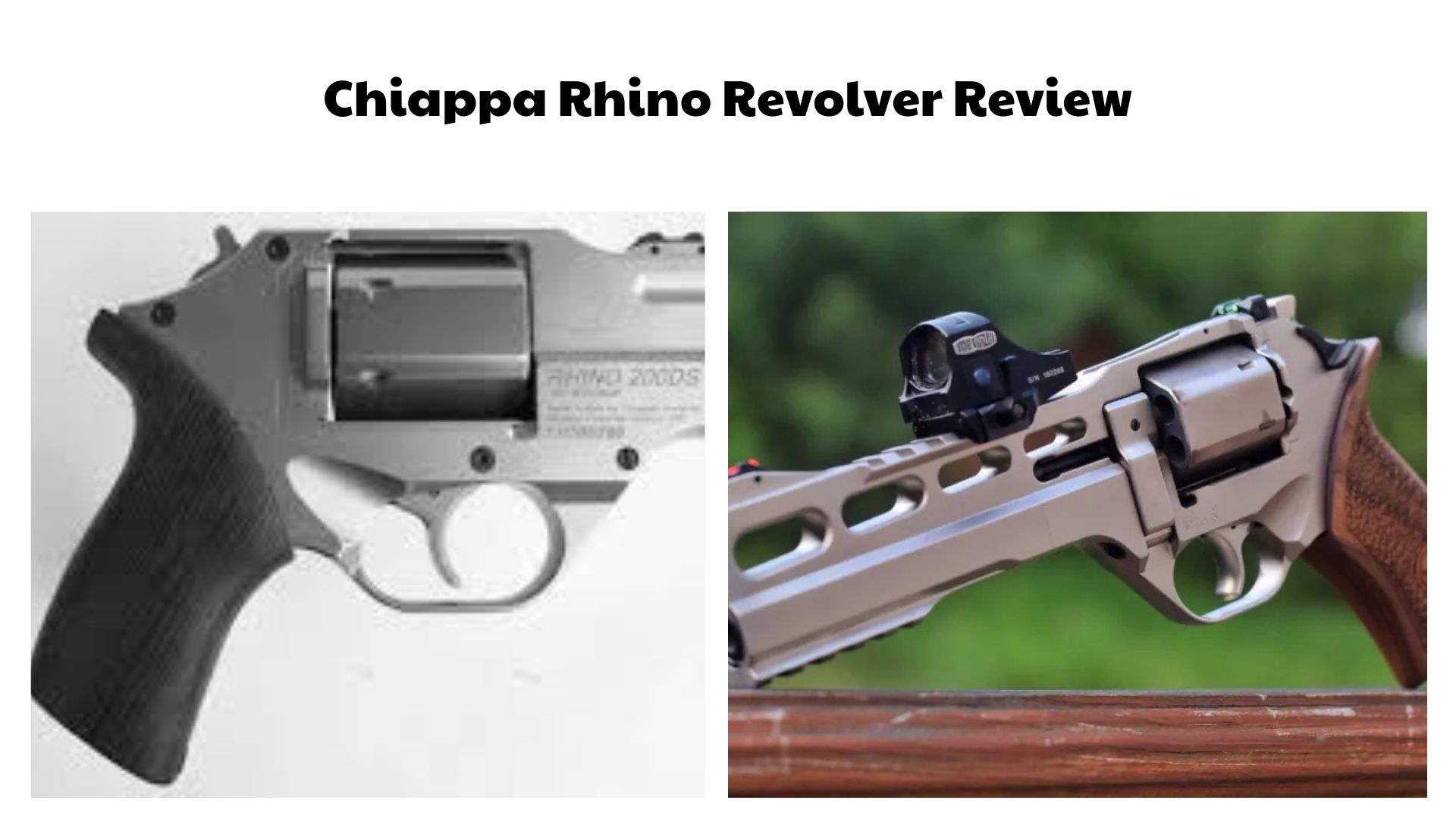

The Chiappa Rhino is a modern Italian revolver developed by Chiappa Firearms that breaks away from traditional revolver design. Unlike conventional wheel guns, it features a low bore-axis structure that significantly reduces recoil and muzzle rise.
What makes it stand out in the revolver market is its unconventional engineering approach, combining futuristic design with practical shooting improvements. The most notable feature is its low bore-axis system, which aligns the barrel with the lower chamber instead of the top, improving recoil control and shot stability.
It is chambered in multiple calibers including .357 Magnum, .38 Special, and 9mm variants, making it suitable for defense, sport shooting, and collecting purposes.
History and Development of the Chiappa Rhino
The Chiappa Rhino was developed by Chiappa Firearms in Italy as a radical redesign of the traditional revolver platform. The goal was to improve shooting comfort and recoil management while maintaining revolver reliability.
The design was influenced by firearm engineers Emilio Ghisoni and Antonio Cudazzo, and it draws inspiration from earlier experimental revolver concepts such as the Mateba designs.
Its main purpose was to address long-standing revolver limitations, especially excessive muzzle flip and heavy recoil in powerful calibers like .357 Magnum.
Unique Design Features of the Chiappa Rhino
Low Bore Axis System
The most defining feature of the Chiappa Rhino is its low bore-axis design. Instead of positioning the barrel above the cylinder like traditional revolvers, the Rhino aligns it with the bottom chamber.
This design reduces muzzle rise by directing recoil energy straight back into the shooter’s hand instead of upward rotation. The result is improved control and faster follow-up shots.
Frame and Construction
The Rhino uses a combination of an Ergal aluminum alloy frame and a steel cylinder. This hybrid construction provides a balance between reduced weight and structural strength.
While the lightweight frame improves handling and carry comfort, the internal mechanism is more complex compared to traditional revolvers, requiring tighter manufacturing precision.
Hexagonal Cylinder Design
Instead of a traditional round cylinder, the Chiappa Rhino features a hexagonal cylinder design. This reduces bulk and improves the revolver’s overall ergonomics.
The shape also helps with concealability and makes handling during reloads more efficient for experienced users.
Hammer System (Internal Striker Concept)
The Rhino replaces the traditional exposed hammer with an internal striker system controlled by an external cocking lever.
When the revolver is cocked, a red indicator appears to show single-action readiness. This system reduces external snag points and improves safety while maintaining precise shooting capability.
Chiappa Rhino Models Overview
The Chiappa Rhino lineup is designed to offer multiple barrel lengths and configurations to suit different shooting needs, ranging from concealed carry to precision range shooting.
20DS (2-inch barrel)
The 20DS is the most compact version of the Rhino series. It is designed primarily for concealed carry and close-range defensive use. Its short barrel makes it highly portable but slightly more challenging to control compared to longer variants.
30DS (3-inch barrel)
The 30DS offers a balance between concealability and shootability. It is easier to control than the 20DS while still remaining compact enough for defensive carry applications.
40DS (4-inch barrel – most reviewed model)
The 40DS is the most popular and widely reviewed model in the Rhino lineup. It is often considered the best all-around option due to its balance of size, recoil control, and accuracy.
50DS (5-inch barrel)
The 50DS is designed primarily for range use and enhanced accuracy. The longer barrel improves sight radius and stabilizes shooting performance, making it less suitable for concealed carry.
60DS (6-inch barrel)
The 60DS is the largest model in the series, optimized for precision shooting and competition. It offers maximum stability and accuracy but is not intended for everyday carry.
Differences in Intended Use
Shorter models like the 20DS and 30DS are best suited for concealed carry and defensive scenarios. The 40DS serves as a versatile middle ground for both defense and range use. Longer models such as the 50DS and 60DS are optimized for accuracy-focused shooting and competitive environments.
Chiappa Rhino 40DS In-Depth Review
Specifications
The Chiappa Rhino 40DS is chambered in .357 Magnum and .38 Special, offering flexibility in ammunition choice. It features a 6-round cylinder, a 4-inch barrel, and an overall length of approximately 8.5 inches. The revolver weighs around 1.87 pounds, making it relatively manageable for its class.
Ergonomics and Handling
The 40DS provides a comfortable grip design that fits naturally in the hand. Its low bore-axis layout contributes to a more natural point-of-aim, helping shooters maintain better control during firing.
Control placement, including the cylinder release and cocking lever, is designed for intuitive access, although it may feel unfamiliar to users transitioning from traditional revolvers.
Recoil and Shooting Performance
One of the most notable advantages of the 40DS is its reduced muzzle flip, made possible by the low bore-axis design. Instead of the typical upward kick seen in standard revolvers, recoil is directed more straight back into the shooter’s hand.
This results in smoother shooting and significantly easier follow-up shots, especially when using more powerful .357 Magnum loads.
Accuracy and Range Performance
The 40DS delivers solid accuracy at short to medium ranges. Its performance is generally consistent, although results can vary depending on ammunition type.
Many shooters find that .38 Special loads offer improved control and tighter grouping, while .357 Magnum provides more power with slightly increased recoil.
Trigger Performance
The Chiappa Rhino 40DS features a double-action/single-action trigger system. The double-action pull is relatively heavy and long compared to many competing revolvers.
While single-action mode improves precision, user opinions on overall trigger smoothness are mixed, with some appreciating the safety and others preferring a lighter pull.
Reliability
Overall, the Rhino platform is considered reliable under normal operating conditions. It performs consistently across a wide range of ammunition types.
Some users have reported occasional issues such as sticky extraction with certain loads, but these cases are relatively uncommon. Early production models had minor quality control inconsistencies, which have largely been improved in newer manufacturing batches.
Chiappa Rhino Key Features Breakdown
Fiber Optic Adjustable Sights
The Chiappa Rhino is equipped with fiber optic sights that provide a bright and highly visible sight picture, allowing for faster target acquisition in various lighting conditions.
These sights are typically adjustable for both windage and elevation, enabling shooters to fine-tune accuracy based on distance and ammunition type.
Accessory Rail System
Many Chiappa Rhino models include a Picatinny rail mounted under the barrel, enhancing modularity and customization options.
This rail allows users to attach tactical accessories such as weapon lights, lasers, and in some configurations, optic systems. This makes the Rhino more adaptable for defensive and tactical applications compared to traditional revolvers.
Unique Reload and Cylinder Operation
The Rhino features a side-mounted cylinder release mechanism designed for efficient and intuitive operation.
This system is engineered to streamline reload procedures, allowing experienced users to cycle ammunition more quickly compared to traditional top-break or swing-out revolvers.
Chiappa Rhino Pros and Cons
Advantages
The Chiappa Rhino offers several standout advantages that differentiate it from conventional revolvers. Its most notable strength is its extremely low recoil and reduced muzzle rise, made possible by its unique barrel alignment system.
It also features a futuristic and innovative design that appeals to collectors and enthusiasts. The ergonomic grip structure provides a comfortable and natural hold, improving shooting stability and control.
Additionally, the inclusion of an accessory rail system enhances versatility by allowing users to mount lights or lasers for defensive use.
Disadvantages
Despite its innovations, the Rhino has some drawbacks. One of the most commonly cited issues is its heavy and relatively stiff trigger pull, especially in double-action mode.
It is also positioned at a higher price point compared to many traditional revolvers, which may limit its accessibility for some buyers.
The mechanical design is more complex than standard revolvers, making maintenance and servicing more demanding. In addition, aftermarket support and customization options remain more limited compared to established platforms.
Chiappa Rhino vs Traditional Revolvers
When compared to traditional revolvers from manufacturers such as :contentReference[oaicite:0]{index=0} and :contentReference[oaicite:1]{index=1}, the Chiappa Rhino stands out due to its unconventional engineering and recoil management system.
Comparison with Smith & Wesson and Ruger Revolvers
Traditional revolvers from Smith & Wesson and Ruger typically follow a classic top-cylinder, high bore-axis design. While these platforms are proven and widely trusted, they tend to exhibit more noticeable muzzle rise during firing.
In contrast, the Chiappa Rhino’s low bore-axis design significantly reduces recoil flip, offering a more modern shooting experience focused on control and stability.
Recoil Differences
The Rhino delivers a straight-back recoil impulse rather than the upward kick commonly seen in traditional revolvers. This results in improved control during rapid fire and faster recovery between shots.
Trigger Feel and Shooting Experience
Traditional revolvers often feature smoother and more refined trigger systems due to decades of design refinement. The Rhino, while functional, tends to have a heavier double-action pull, which some shooters find less refined.
Practical Use vs Novelty Factor
While traditional revolvers prioritize simplicity and proven reliability, the Rhino introduces a more experimental approach. Some users value it as a practical performance upgrade, while others view it as a niche or novelty-oriented design.
Weight and Carry Considerations
The Chiappa Rhino is generally comparable in weight to other steel-frame revolvers, but its balance and shape differ due to its unique internal layout. This affects how it sits in a holster and how it feels during extended carry compared to conventional designs.
Real-World Performance Summary
In real-world use, the Chiappa Rhino demonstrates a performance profile that strongly reflects its engineering focus on recoil reduction and control. Across range sessions, many shooters consistently note that the revolver behaves differently from traditional wheel guns, especially under rapid fire.
Range performance feedback is generally positive, particularly with shooters who prioritize controllability over classic revolver feel. The low bore-axis design helps maintain target alignment, making it easier to stay on target during successive shots.
In terms of ammunition compatibility, the platform performs well with both .357 Magnum and .38 Special loads. The .38 Special is often favored for training and extended range sessions due to its softer recoil, while .357 Magnum showcases the full defensive power of the platform, albeit with increased recoil.
User experience consistency is generally strong across modern production models, with improved manufacturing quality compared to early releases. Most variations in performance tend to come from ammunition choice rather than mechanical inconsistency.
For practical applications, the Rhino is suitable for defensive use, recreational sport shooting, and range practice. However, its unique handling characteristics mean it appeals most to shooters willing to adapt to its unconventional design.
Who Should Buy the Chiappa Rhino?
The Chiappa Rhino is best suited for revolver enthusiasts and firearm collectors who appreciate innovative engineering and non-traditional firearm design. Its unique structure makes it a standout piece in any revolver collection.
It is also a strong option for shooters who specifically want reduced recoil and improved muzzle control, especially when firing powerful calibers like .357 Magnum. The design offers a noticeable advantage in comfort during extended shooting sessions.
However, it may not be ideal for users looking for a budget-friendly revolver or those who prefer simple maintenance and widely available aftermarket support. The Rhino’s mechanical complexity and higher price point make it less practical for purely utilitarian buyers.
Final Verdict
The Chiappa Rhino represents a bold departure from traditional revolver design, prioritizing innovation over convention. It successfully delivers on its core engineering goal: reducing recoil and improving shooting control through its low bore-axis system.
Its strongest advantages lie in recoil management, futuristic design, and ergonomic handling. These features make it one of the most distinctive revolvers available on the market today.
However, the platform is not without compromises. The heavier trigger pull and higher price point can be drawbacks for some shooters, particularly those accustomed to more refined traditional revolver triggers.
Overall, the Chiappa Rhino is best understood as a modern experimental revolver—one that blends unconventional engineering with practical shooting improvements. It may not replace traditional revolvers, but it offers a compelling alternative for those seeking innovation in a classic platform.
Chiappa Rhino FAQ (50+ Questions & Detailed Answers)
1. What is the Chiappa Rhino?
The Chiappa Rhino is a modern revolver designed by Chiappa Firearms that uses a unique low bore-axis system. Unlike traditional revolvers, the barrel aligns with the bottom chamber of the cylinder, which significantly reduces muzzle rise and recoil. It is considered one of the most innovative revolver designs in the modern firearms market.
2. Why is the Chiappa Rhino different from other revolvers?
The main difference is its mechanical layout. Traditional revolvers fire from the top chamber, creating more upward recoil. The Rhino fires from the bottom chamber, directing recoil more inline with the shooter’s hand, resulting in improved control and faster follow-up shots.
3. What calibers does the Chiappa Rhino come in?
It is commonly available in .357 Magnum and .38 Special, with some models also supporting 9mm through moon clips. This versatility allows shooters to choose between high-power defensive loads and lower-recoil training ammunition.
4. Is the Chiappa Rhino good for self-defense?
Yes, it can be used for self-defense, especially in .357 Magnum configuration. Its recoil reduction makes it easier to control during rapid firing. However, its size and trigger characteristics may require training for optimal defensive use.
5. Is the Chiappa Rhino good for beginners?
It can be used by beginners, but it is not the most recommended first firearm. The heavier trigger pull and unconventional design may take time to learn compared to simpler revolvers or semi-automatic pistols.
6. How does the recoil of the Rhino compare to traditional revolvers?
The recoil is noticeably reduced in terms of muzzle flip. Instead of the barrel rising sharply upward, the recoil travels more straight back into the hand, improving stability and control during firing.
7. Is the Chiappa Rhino reliable?
Yes, it is generally reliable when properly maintained. Modern production models have improved significantly in quality control. Most issues reported are minor and often related to ammunition selection or maintenance.
8. What is the Chiappa Rhino 40DS?
The 40DS is the 4-inch barrel version and is considered the most balanced model in the lineup. It offers a combination of accuracy, recoil control, and practical size for both range and defensive use.
9. Which Chiappa Rhino model is best?
The 40DS is widely considered the best all-around model. Shorter versions are better for concealment, while longer versions are better for precision shooting. The 40DS strikes a balance between both.
10. Is the Chiappa Rhino expensive?
Yes, it is generally more expensive than many traditional revolvers. The price reflects its unique engineering, materials, and niche design rather than mass-market affordability.
11. What is the trigger like on the Chiappa Rhino?
The trigger is functional but heavier than many competitors. The double-action pull can feel stiff, while single-action mode offers better precision. Some shooters require time to adapt to it.
12. Can the Chiappa Rhino use +P ammunition?
Many models rated for .357 Magnum can safely handle +P .38 Special ammunition. However, users should always follow manufacturer guidelines for safe ammunition use.
13. Is the Chiappa Rhino good for concealed carry?
Shorter models like the 20DS and 30DS are suitable for concealed carry. However, they are slightly bulkier than compact semi-automatic pistols, which may affect comfort for some users.
14. Does the Chiappa Rhino have a safety?
It does not have a traditional manual safety. Instead, safety is built into the double-action trigger system and internal mechanisms, similar to most revolvers.
15. What makes the Rhino’s design unique?
Its low bore-axis firing system and hexagonal cylinder are the most unique features. These design choices are focused on improving recoil control and ergonomics.
16. Is the Chiappa Rhino good for range shooting?
Yes, it performs very well at the range due to its stability and reduced muzzle rise. Many shooters find it easier to maintain accuracy during repeated shots compared to traditional revolvers.
17. How accurate is the Chiappa Rhino?
It is generally accurate at short to medium distances. Accuracy depends on shooter skill and ammunition type, with .38 Special often providing tighter grouping for practice sessions.
18. What is the barrel alignment feature?
The barrel aligns with the bottom chamber instead of the top. This lowers recoil force alignment, reducing upward rotation during firing.
19. Is the Chiappa Rhino heavy?
It has moderate weight depending on the model. The use of aluminum alloy helps reduce weight, but it is still comparable to other full-size revolvers.
20. Can the Chiappa Rhino be used in competition shooting?
Yes, it can be used in some shooting competitions. Its accuracy and recoil control can be advantageous, although it is less common than traditional competition revolvers.
21. Is maintenance difficult?
Maintenance is slightly more complex than standard revolvers due to its unique mechanism. Regular cleaning and proper lubrication are important for long-term reliability.
22. Does it support accessories?
Yes, many models include a Picatinny rail for mounting lights or lasers, increasing its tactical flexibility.
23. Is it better than a Glock?
It depends on use case. The Rhino is a revolver with unique recoil advantages, while Glock pistols are semi-automatic and generally easier to reload and carry. They serve different purposes.
24. Is it good for home defense?
Yes, it can be used for home defense. Its controllability and reliability make it effective, especially for users comfortable with revolvers.
25. What is the biggest disadvantage?
The main disadvantage is the heavy trigger pull and higher cost compared to traditional revolvers.
26. Why do some shooters prefer it?
Shooters appreciate its recoil reduction, unique design, and improved shooting stability compared to traditional revolvers.
27. Is it beginner-friendly for revolvers?
It is not the easiest revolver for beginners due to its trigger and mechanical differences, but it can be learned with practice.
28. Does it jam?
Revolvers like the Rhino rarely “jam” in the traditional sense. However, extraction issues can occur with poor-quality or dirty ammunition.
29. How durable is it?
It is built with strong materials and is generally durable under normal use conditions, including regular range shooting.
30. What makes it good for recoil control?
The low bore-axis system directs recoil straight back rather than upward, significantly reducing muzzle flip.
31. Can it shoot .38 Special safely?
Yes, .38 Special is commonly used in .357 Magnum models and is ideal for practice due to lower recoil.
32. Is it suitable for law enforcement?
It is not widely used by law enforcement due to the dominance of semi-automatic pistols in modern policing.
33. What is the cylinder capacity?
Most models have a 6-round cylinder, depending on caliber configuration.
34. Is it easy to reload?
Reloading is similar to other swing-out cylinder revolvers but may feel different due to its design.
35. Does it have a strong aftermarket?
No, aftermarket support is limited compared to more mainstream revolvers and pistols.
36. Is it good for recoil-sensitive shooters?
Yes, it is one of the better revolvers for recoil-sensitive users due to its design.
37. Is it better than a Smith & Wesson revolver?
It depends on preference. Smith & Wesson revolvers are more traditional and refined, while the Rhino focuses on recoil reduction innovation.
38. Does it feel futuristic?
Yes, its design is widely described as futuristic due to its unconventional shape and mechanics.
39. Is it legal in most countries?
Legal status depends on local firearm laws and regulations in each country.
40. What is the learning curve?
There is a moderate learning curve due to its trigger and unique recoil behavior.
41. Does it have recoil springs?
It does not use recoil springs like semi-automatic pistols; it operates as a revolver.
42. Can it be customized?
Customization options are limited compared to mainstream platforms.
43. Is it good for tactical use?
It can be used in tactical scenarios, especially with accessory rail-equipped models.
44. Does it overheat?
No, revolvers do not experience overheating issues like some semi-automatic firearms.
45. Is it popular among professionals?
It is more popular among enthusiasts than professionals.
46. What makes it collectible?
Its unique design and engineering innovation make it attractive to firearm collectors.
47. Is it good for small hands?
Grip size may be slightly large for some users, depending on the model.
48. Does it require special ammo?
No special ammunition is required, but quality ammo improves performance.
49. Is it loud?
Like most .357 Magnum revolvers, it produces significant noise when firing full-power loads.
50. What is the overall impression of users?
Most users appreciate its innovation and recoil control, while some prefer more traditional revolver designs.
51. Is it worth buying?
It is worth buying for shooters who value innovation, recoil reduction, and unique firearm design. However, it may not be ideal for those seeking simplicity or budget options.
Read more: