
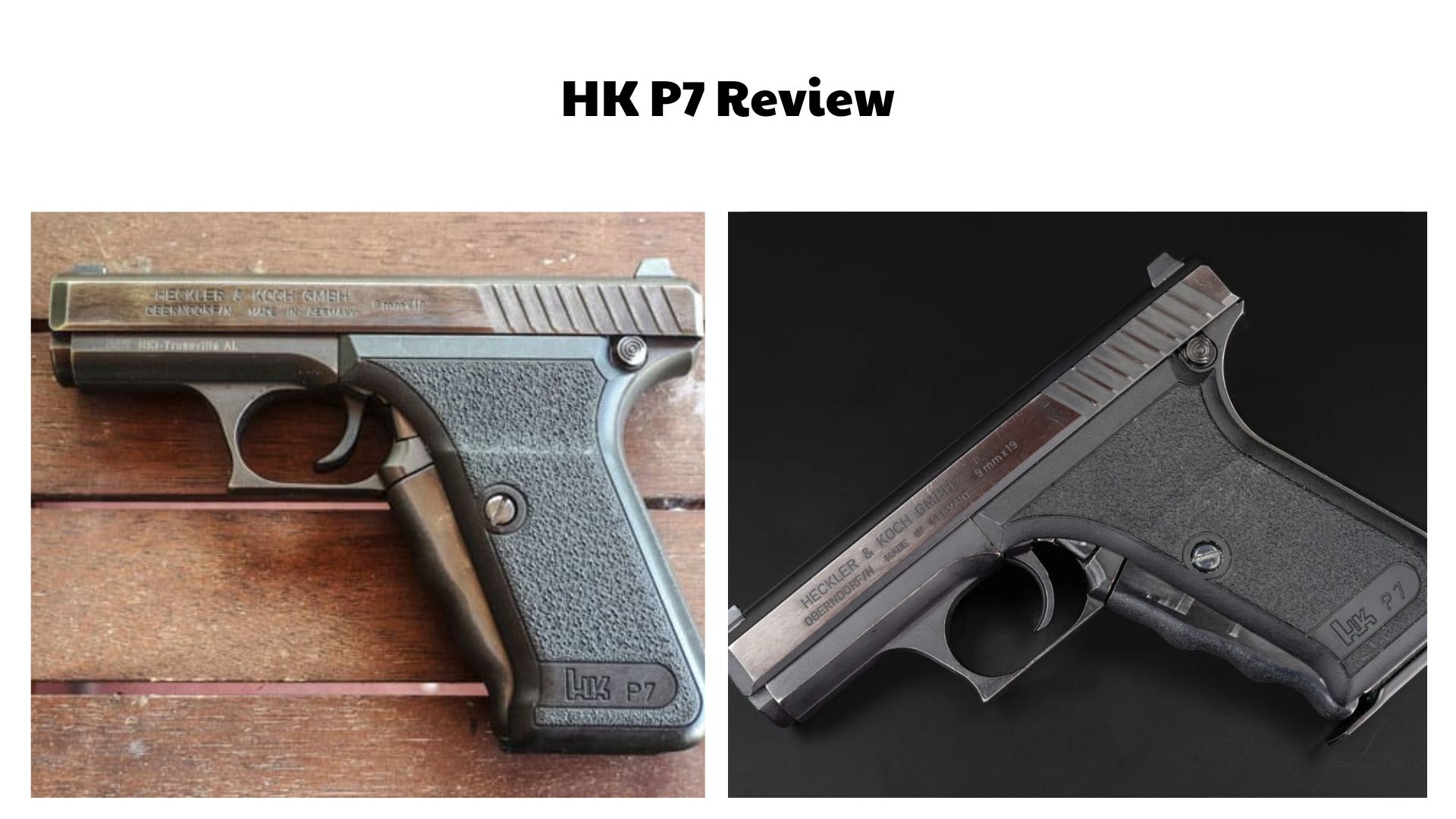

The Heckler & Koch P7 is widely regarded as one of the most unconventional and innovative semi-automatic pistols ever produced. First introduced in the late 1970s, it was developed in Germany during a period of heightened concern over public safety and rapid-response policing.
Its design was heavily influenced by the aftermath of the Munich Olympics incident, which exposed serious weaknesses in police readiness and firearm deployment speed. The goal was to create a handgun that could be drawn and fired almost instantly while maintaining maximum safety.
Even today, the P7 maintains a cult following among collectors and shooters due to its unusual engineering approach. It is often described as “weird, expensive, but mechanically brilliant.”
History of the HK P7 – From Police Requirement to Iconic Firearm
Development Background (1970s Germany)
During the 1970s, West German police forces requested a new-generation 9mm service pistol. The requirements were strict: compact size, maximum safety, and instant readiness under stress.
Competing designs from manufacturers like SIG and Walther were considered, but Heckler & Koch pursued a radically different engineering approach that eventually led to the creation of the P7.
Official Adoption and Service Use
The HK P7 was eventually adopted by various German police units and elite tactical teams, including GSG 9. Its reliability and fast deployment made it particularly attractive for high-risk operations.
It was also exported to military and law enforcement agencies worldwide, earning a reputation for consistent performance in demanding environments.
HK P7 Design Overview – What Makes It So Different
Gas-Delayed Blowback System
The HK P7 uses a gas-delayed blowback operating system instead of a traditional recoil-operated tilting barrel design. A gas piston beneath the barrel slows the slide during firing.
This system provides extremely low recoil, excellent control, and high mechanical accuracy due to its fixed barrel design. However, it also causes heat buildup in the front frame during sustained firing.
Squeeze Cocker Mechanism
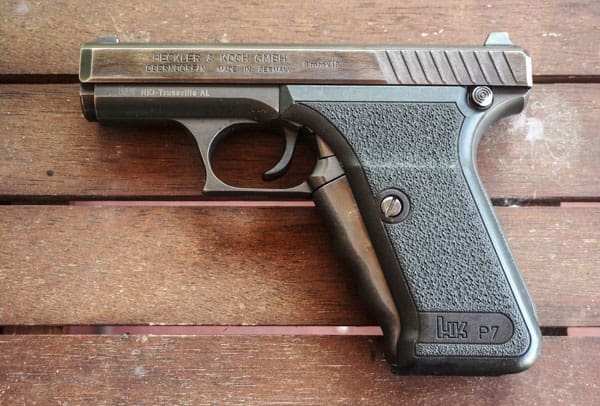
One of the most distinctive features of the P7 is its squeeze cocker system. Instead of a traditional manual safety, the pistol is cocked by squeezing a front grip lever.
When the grip is released, the firearm automatically becomes safe. When squeezed, it is instantly ready to fire. This system eliminates the need for external safety switches and allows extremely fast deployment.
While innovative, it is also a love-it-or-hate-it feature among shooters due to its unusual operation compared to modern pistols.
Fixed Barrel & Accuracy Advantage
Unlike most semi-automatic pistols, the HK P7 features a fixed barrel design. This means the barrel does not tilt during cycling, improving mechanical consistency.
Combined with polygonal rifling and a rigid steel frame, this design delivers outstanding accuracy. Many shooters describe the P7 as having “laser-like precision,” especially at typical handgun distances.
Shooting Experience – What It Feels Like to Fire the HK P7
Recoil and Control
The Heckler & Koch P7 delivers an unusually soft shooting experience thanks to its gas-delayed blowback system. Instead of feeling sharp recoil impulses, the pistol feels more controlled and linear during cycling.
Its low bore axis further reduces muzzle flip, helping the shooter stay on target more easily during rapid fire. This makes follow-up shots noticeably faster compared to many traditional 9mm service pistols.
Overall, the P7 is widely praised for its excellent recoil management and shootability, especially in close to medium-range handgun use.
Trigger Feel and Handling
The trigger system on the HK P7 is consistent and predictable, offering a uniform single-action pull once the squeeze cocker is engaged.
Most shooters describe the grip system as unusual at first, but highly intuitive after a short learning curve. Once mastered, it becomes second nature under stress.
The overall handling reflects classic German engineering—precise, mechanical, and purpose-driven rather than modern polymer ergonomics.
Heat and Ergonomics Issues
One of the most commonly mentioned drawbacks of the P7 is heat buildup. After extended firing sessions, the front frame—especially around the gas system—can become noticeably hot.
In addition, the slide serrations are relatively shallow compared to modern pistols, making manipulation slightly less ergonomic under certain conditions.
The all-steel construction also adds significant weight, which improves stability but makes it less comfortable for long carry compared to modern lightweight polymer pistols.
HK P7 Variants Explained
P7 PSP (Original Model)
The P7 PSP (Polizei Selbstlade Pistole) is the original production version of the HK P7 series. It was designed specifically for German police requirements in the late 1970s.
This version introduced the core design philosophy of the platform, focusing on safety, speed, and compact handling for duty use.
P7M8
The P7M8 is one of the most refined versions of the platform and includes several improvements over the original PSP model.
Most notably, it features a heat shield to reduce discomfort during sustained firing, making it more practical for range use and extended training sessions.
Among enthusiasts, the P7M8 is often considered the most balanced and shooter-friendly variant.
P7M13
The P7M13 expands the platform’s capacity by introducing a double-stack magazine design. This increases firepower while maintaining the core P7 operating system.
However, the tradeoff is a noticeably bulkier grip, which may not suit shooters with smaller hands.
P7K3
The P7K3 is a compact variant that differs mechanically from the standard P7 system. It was designed for concealed carry and more compact use cases.
While smaller and more portable, it operates with a different internal mechanism, making it somewhat distinct from the full-size P7 models.
HK P7 Pros and Cons
Key Advantages
The HK P7 is highly regarded for its exceptional mechanical accuracy and consistent shooting performance. Its fixed barrel design contributes significantly to its precision.
It also offers very low recoil and a flat shooting profile, making it easy to control during rapid fire sequences.
Beyond performance, the pistol is valued for its unique engineering approach and strong collector appeal. High-quality German manufacturing further adds to its reputation.
Main Drawbacks
One of the biggest disadvantages of the HK P7 is its high cost on the modern collector and secondary market.
It also suffers from heat buildup during sustained firing, which can limit comfort during extended range sessions.
Magazine capacity is relatively low compared to modern handguns, especially in earlier variants.
Additionally, its all-steel construction and older ergonomic design make it feel heavier and less modern compared to polymer-framed pistols.
HK P7 vs Modern Pistols
When compared to modern striker-fired 9mm handguns, the HK P7 feels like a completely different class of firearm. Modern pistols typically offer higher magazine capacity, lighter polymer frames, and greater modularity for optics and accessories.
In practical terms, newer designs are generally more suitable for duty carry, defensive use, and customization.
However, the P7 still stands out in terms of mechanical ingenuity, shooting smoothness, and accuracy. Its gas-delayed system and squeeze cocker mechanism remain unmatched in modern mainstream designs.
This creates a clear divide between two groups: practical shooters who prefer modern platforms, and enthusiasts or collectors who value the P7 for its unique engineering and shooting experience.
Collectibility and Market Value
The Heckler & Koch P7 has become one of the most sought-after discontinued pistols on the collector market due to its extremely limited production and iconic engineering. Since it is no longer manufactured, availability is strictly confined to the secondary market.
This scarcity has driven consistently high resale values, with certain variants—especially well-preserved models—commanding significant premiums over their original prices. As demand continues to grow among collectors and enthusiasts, the P7 has developed a strong reputation as a premium collectible firearm.
Some configurations have appreciated in value over time, particularly early production models and rare variants. As a result, many owners view the P7 not only as a functional firearm but also as a long-term investment piece with historical significance.
Real-World User Opinions and Reviews
Among firearms enthusiasts, the HK P7 is widely praised for its outstanding mechanical engineering and exceptional accuracy. Many shooters appreciate its unique gas-delayed system and the consistent performance it delivers on the range.
However, critics often point out its drawbacks, including its relatively heavy weight, heat buildup during extended firing, and lower magazine capacity compared to modern handguns.
This creates a clear divide in user opinions: some view it as a masterpiece of engineering and a collector’s dream, while others see it as impractical for everyday defensive use.
Despite these debates, the P7 has maintained a strong cult following for decades, long after production ended, solidifying its status as a legendary firearm in the shooting community.
Who Should Buy the HK P7 Today?
The HK P7 is best suited for collectors who appreciate classic German firearms and rare engineering designs. Its historical significance and mechanical uniqueness make it highly desirable for serious enthusiasts.
It also appeals to shooters who value innovation and are interested in experiencing one of the most distinctive pistol designs ever created.
However, it is not ideal for budget-conscious buyers or those seeking a modern tactical or defensive handgun platform. Its cost, weight, and limited capacity make it less practical compared to contemporary designs.
In most cases, the P7 performs best as a range firearm or collector’s centerpiece rather than a primary daily carry weapon.
Final Verdict – Is the HK P7 Worth It in 2026?
The HK P7 stands as one of the most innovative and mechanically fascinating pistols ever produced. Its combination of gas-delayed blowback operation, squeeze cocker system, and fixed barrel accuracy gives it a character that few modern firearms can replicate.
However, it also comes with clear limitations, including high cost, heat buildup, lower capacity, and outdated ergonomics compared to modern striker-fired pistols.
Ultimately, its value lies less in practicality and more in its engineering brilliance and historical importance. For many enthusiasts, the P7 is not just a tool—it is a piece of firearms history.
Final takeaway: it is not practical, but unforgettable.
FAQ – HK P7 (50+ Detailed Questions and Answers)
1. What is the HK P7?
The Heckler & Koch P7 is a 9×19mm semi-automatic pistol designed in Germany in the late 1970s. It is best known for its unusual gas-delayed blowback system and squeeze cocker mechanism. These features were designed to improve safety and allow extremely fast deployment in high-stress situations, especially for police use.
2. Why is the HK P7 considered so unique?
The HK P7 is considered unique because it does not follow traditional pistol design principles. Instead of a standard recoil-operated system, it uses a gas-delayed blowback mechanism and a grip-based cocking system. This combination creates a firearm that feels very different from modern striker-fired or DA/SA pistols.
3. Is the HK P7 still in production?
No, the HK P7 is no longer in production. It was discontinued years ago, which has significantly increased its rarity and collector value. All available units today are from the secondary market or private collections.
4. Why was the HK P7 discontinued?
The P7 was discontinued mainly due to high manufacturing costs, complex engineering, and the industry shift toward lighter polymer-framed pistols with higher capacity magazines. Modern designs became more cost-effective and practical for law enforcement and military use.
5. How does the squeeze cocker work?
The squeeze cocker is a front grip lever that must be pressed to cock the pistol. When squeezed, the gun becomes ready to fire. When released, it automatically decocks and becomes safe. This system replaces the need for a traditional manual safety.
6. Is the squeeze cocker safe?
Yes, it is considered extremely safe. The pistol cannot fire unless the grip is actively squeezed. If dropped or released, it automatically returns to a safe state. This design was specifically created to prevent accidental discharge under stress.
7. What is the HK P7 gas-delayed blowback system?
The gas-delayed blowback system uses gas pressure from the fired round to slow the slide movement. A small gas piston under the barrel resists rearward force, allowing for a fixed barrel design, reduced recoil, and improved accuracy.
8. Why does the HK P7 get hot?
The P7 channels gas directly into a piston system located under the barrel. During rapid or extended firing, this system transfers heat into the front frame of the pistol, making it noticeably hot to hold after multiple magazines.
9. Is the HK P7 accurate?
Yes, the HK P7 is widely known for exceptional accuracy. The fixed barrel design eliminates movement during cycling, and the gas-delayed system reduces recoil, both of which contribute to tight shot groupings and consistent performance.
10. What makes the fixed barrel important?
A fixed barrel improves accuracy because it does not shift during firing cycles. Unlike tilting barrel designs, the P7 maintains consistent barrel alignment, resulting in better shot consistency and precision.
11. What calibers does the HK P7 use?
The most common HK P7 models are chambered in 9×19mm Parabellum. Some compact variants were produced in .32 ACP and other calibers, but 9mm remains the standard and most widely used version.
12. Is the HK P7 good for concealed carry?
It can be used for concealed carry, especially compact versions like the P7K3. However, its weight and steel frame make it heavier than modern polymer pistols, so it is not the most comfortable carry option today.
13. What is the difference between P7 PSP and P7M8?
The P7 PSP is the original model designed for German police, while the P7M8 is an improved version featuring a heat shield, better ergonomics, and refined controls. The M8 is generally more comfortable for extended shooting sessions.
14. What is the HK P7M13?
The P7M13 is a double-stack version of the P7 that increases magazine capacity. While it offers more firepower, it also has a wider grip, which may not be comfortable for all shooters.
15. What is the HK P7K3?
The P7K3 is a compact variant designed for easier carry. Unlike other P7 models, it uses a different internal operating system and is more compact, making it suitable for concealed use.
16. Is the HK P7 reliable?
Yes, the HK P7 is extremely reliable when properly maintained. Its design was built for police and tactical use, ensuring consistent function under harsh conditions.
17. Is the HK P7 better than Glock pistols?
The HK P7 is not necessarily better than Glock pistols; it is simply different. Glock pistols are lighter, more affordable, and higher capacity, while the P7 offers superior engineering uniqueness and fixed-barrel accuracy.
18. Why is the HK P7 so expensive?
The HK P7 is expensive due to its discontinued status, limited production numbers, and strong collector demand. Its complex design also contributes to higher maintenance and ownership value.
19. Is the HK P7 a good investment?
Yes, many collectors consider it a strong investment firearm. Some models have appreciated in value due to scarcity and increasing demand among enthusiasts.
20. How many rounds can the HK P7 hold?
Capacity depends on the model. Standard versions typically hold 8–13 rounds depending on magazine type, with the P7M13 offering higher capacity due to its double-stack design.
21. Is the HK P7 difficult to maintain?
Maintenance is moderate. While it is mechanically reliable, the gas system and older design require careful cleaning, especially after extended shooting sessions.
22. Is the HK P7 good for beginners?
It is not ideal for beginners due to its unique squeeze cocker system and high cost. Modern striker-fired pistols are generally easier to learn and more forgiving for new shooters.
23. What makes the HK P7 feel different to shoot?
The combination of low recoil, fixed barrel accuracy, and unique grip activation system creates a shooting experience that feels very different from modern pistols. It feels stable, precise, and mechanical.
24. Does the HK P7 have a manual safety?
No, it does not use a traditional manual safety. Instead, the squeeze cocker system acts as both a safety and firing readiness mechanism.
25. Is the HK P7 still used by police today?
Most police forces have transitioned to modern pistols, but some units and collectors still use or maintain the P7 due to its historical and mechanical significance.
26. Why do collectors love the HK P7?
Collectors appreciate its unique engineering, historical importance, limited production, and reputation as one of the most innovative pistols ever made.
27. What is the biggest drawback of the HK P7?
The biggest drawbacks are heat buildup, high weight, low capacity compared to modern pistols, and expensive maintenance costs.
28. Is the HK P7 good for competition shooting?
It can perform well in accuracy-based shooting, but its weight and heat buildup make it less ideal for modern competitive shooting formats.
29. How durable is the HK P7?
The P7 is extremely durable and was designed for police service use. With proper care, it can last for decades without major mechanical issues.
30. What makes HK P7 different from other HK pistols?
Unlike modern HK pistols such as the VP9, the P7 uses a gas-delayed system and squeeze cocker, making it mechanically more complex and unique.
31. Is the HK P7 comfortable to shoot?
Yes, in terms of recoil and control it is very comfortable. However, heat buildup and weight can reduce comfort during long shooting sessions.
32. Does the HK P7 have recoil issues?
No, recoil is one of its strengths. The gas system significantly reduces felt recoil and muzzle rise.
33. Why do some shooters dislike the HK P7?
Some shooters dislike it due to its unusual grip system, high cost, and heat buildup during extended use.
34. Is the HK P7 still worth buying in 2026?
Yes, but mainly as a collector or enthusiast firearm. It is not the most practical choice compared to modern pistols.
35. What is the HK P7’s legacy?
Its legacy is being one of the most innovative and mechanically advanced pistols of its time, influencing firearm design discussions for decades.
36. Can the HK P7 handle +P ammunition?
The HK P7 is generally capable of handling standard +P 9mm ammunition due to its robust steel construction and gas-delayed blowback system, which helps manage recoil forces. However, prolonged use of +P or +P+ loads is not recommended because it can accelerate wear on internal components and increase heat stress in the gas system.
37. Is the HK P7 good for home defense?
The HK P7 can be used for home defense thanks to its excellent accuracy, reliability, and quick deployment via the squeeze cocker system. However, its lower magazine capacity and heavy steel frame make it less practical compared to modern polymer pistols designed specifically for defensive use.
38. How heavy is the HK P7?
The HK P7 is relatively heavy compared to modern handguns. Its all-steel construction gives it excellent stability and recoil control, but also makes it less comfortable for long-term carry. This weight contributes to its smooth shooting characteristics but reduces everyday portability.
39. What type of holster is best for the HK P7?
Because of its unique shape and squeeze cocker system, the HK P7 requires a well-fitted holster designed specifically for the model. High-quality leather or molded Kydex holsters are commonly used to ensure safe retention while allowing quick access to the grip mechanism.
40. Is the HK P7 hard to maintain?
Maintenance is moderate in difficulty. While the pistol is extremely reliable, its gas piston system requires regular cleaning to prevent carbon buildup. Shooters must also pay attention to heat-related wear if the firearm is used extensively.
41. What makes the HK P7 a “cult classic”?
The HK P7 is considered a cult classic because of its unusual engineering, limited production, and strong emotional appeal among enthusiasts. Its combination of innovation, rarity, and shooting performance has created a loyal following even decades after discontinuation.
42. Is the HK P7 suitable for tactical training?
While it was originally designed for police use, the HK P7 is not ideal for modern tactical training due to its low capacity and unconventional controls. However, it is still valued for teaching trigger discipline, accuracy, and mechanical understanding of firearms.
43. How rare is the HK P7 today?
The HK P7 is increasingly rare because production has been discontinued for many years. Certain variants, especially well-preserved or limited models, are particularly difficult to find on the civilian market.
44. Are HK P7 magazines easy to find?
Magazines for the HK P7 are available but not as common as those for modern pistols. Original factory magazines can be expensive and are often sought after by collectors to maintain authenticity.
45. What is the trigger pull like on the HK P7?
The trigger pull on the HK P7 is typically light, smooth, and consistent due to its single-action design once the squeeze cocker is engaged. This contributes significantly to its reputation for precision shooting.
46. How does the HK P7 compare to the SIG P226?
Compared to the SIG P226, the HK P7 offers better fixed-barrel accuracy and a more unique operating system. However, the P226 provides higher capacity, easier ergonomics, and more modern practicality for defensive and duty use.
47. Is the HK P7 still used by military or police units?
Most military and police units have transitioned to modern polymer pistols, but the HK P7 remains in limited service and training environments, mostly for historical or specialized purposes.
48. What is the main weakness of the HK P7?
The main weaknesses include heat buildup during sustained fire, lower magazine capacity compared to modern pistols, and high production complexity, which contributes to cost and maintenance challenges.
49. Why is the HK P7 considered mechanically brilliant?
It is considered mechanically brilliant because it integrates a gas-delayed blowback system, fixed barrel design, and squeeze cocker safety into a compact and highly functional platform. These innovations were ahead of their time.
50. Does the HK P7 have aftermarket support?
Aftermarket support for the HK P7 is limited compared to modern firearms. While some accessories and replacement parts exist, the ecosystem is much smaller due to discontinued production.
51. Can beginners easily learn the HK P7?
Beginners may find the HK P7 challenging at first due to its squeeze cocker system and unconventional operation. However, with proper instruction, it can be safely and effectively mastered.
52. Is the HK P7 good for accuracy training?
Yes, the HK P7 is excellent for accuracy training because its fixed barrel design and low recoil allow shooters to focus on fundamentals such as trigger control and sight alignment.
53. Why do some shooters prefer modern pistols over the HK P7?
Many shooters prefer modern pistols because they offer higher capacity, lighter weight, modular designs, and better ergonomics. These practical advantages make them more suitable for everyday defensive use.
54. What is the HK P7’s role in firearms history?
The HK P7 holds an important place in firearms history as one of the most innovative service pistols ever developed. Its engineering influenced discussions about safety mechanisms and recoil systems for decades.
55. Will the HK P7 continue to increase in value?
Many experts believe the HK P7 will continue to increase in value over time due to its discontinued status, limited supply, and strong collector demand. Well-maintained examples are especially likely to appreciate.
Read more: