
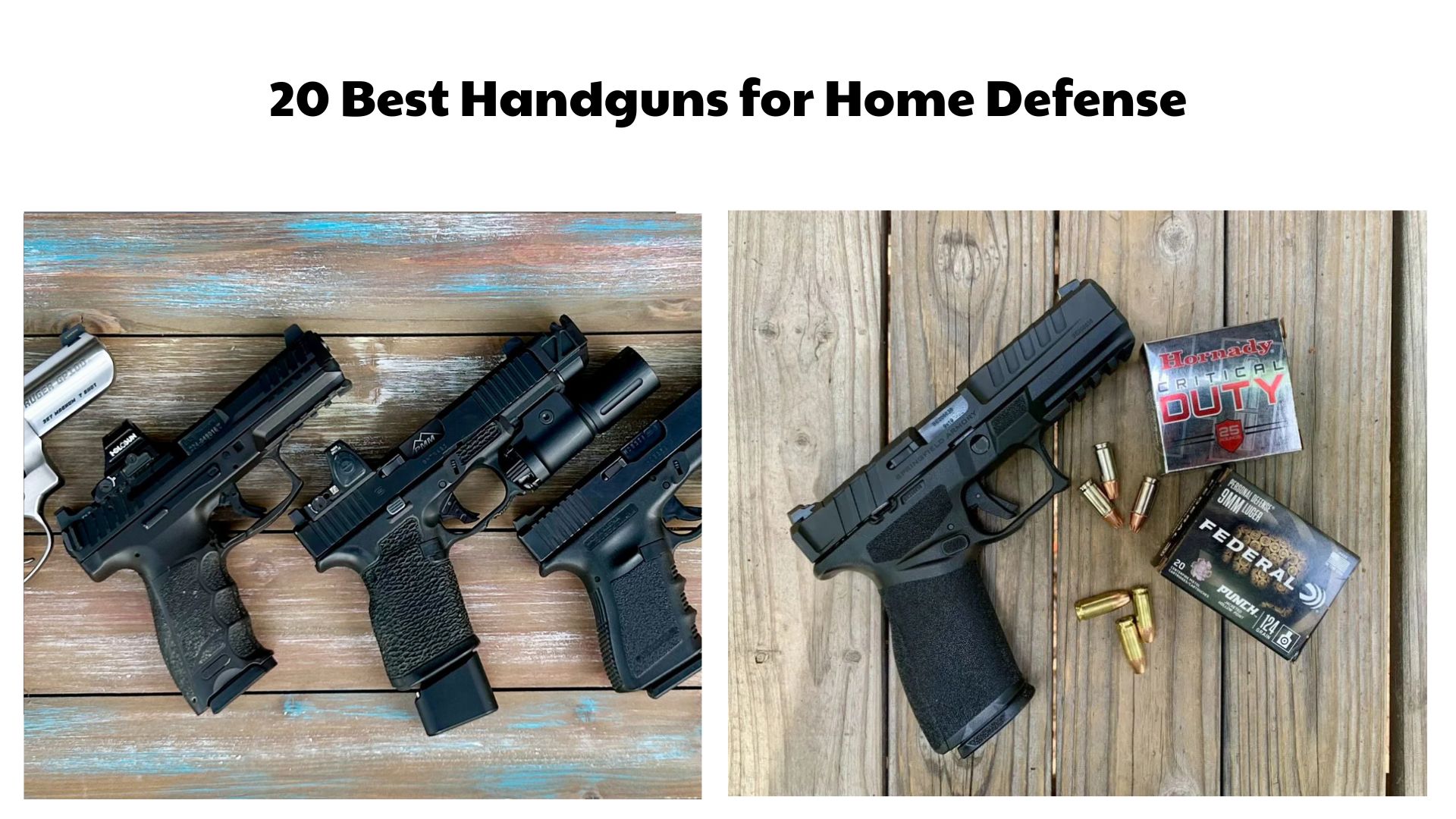

Choosing the right firearm for home protection is a serious decision that depends on reliability, ease of use, control, and real-world performance under stress. The Best Handguns for Home Defense are not necessarily the most powerful or the most advanced, but the ones that consistently perform when it matters most. In this guide, we review 20 of the most trusted defensive handguns used by civilians, law enforcement, and experienced shooters. Each model is selected for its balance of accuracy, ergonomics, capacity, and safety features. The goal is simple: help you understand which handgun fits your home defense needs without unnecessary complexity or confusion.
20 Best Handguns for Home Defense – Expert Overview
1. Glock 19 Gen5
The Glock 19 Gen5 is widely regarded as one of the most practical and balanced defensive pistols ever made, and its reputation in the home defense category is built on decades of consistent performance rather than marketing hype. It sits in a “sweet spot” between full-size control and compact concealability, which makes it suitable not only for storage in a home defense setup but also for occasional carry if needed. The Gen5 version improves on earlier generations with enhanced barrel design, a more refined trigger system, and the removal of finger grooves, which allows a more universal grip fit for different hand sizes.
In real-world defensive scenarios, simplicity matters more than complexity, and this is where the Glock 19 excels. Its striker-fired system reduces manual steps under stress, allowing the shooter to focus on target acquisition rather than mechanical operation. The recoil is manageable due to its balanced weight distribution, and the 9mm chambering ensures controllable follow-up shots, which is critical in low-light, high-pressure situations inside a home environment. The magazine capacity is also generous, giving users a practical advantage without making the firearm overly bulky or difficult to handle in tight indoor spaces.
Another important factor is reliability under imperfect conditions. The Glock platform is known for functioning even with minimal maintenance, which is a key consideration for home defense firearms that may not be handled daily. While no firearm is completely maintenance-free, the Glock 19’s tolerance for dust, minor neglect, and varied ammunition types gives it a strong edge in emergency readiness. It is also widely supported with aftermarket parts, holsters, and accessories, making it easy to configure for night stands, safes, or quick-access storage systems.
Overall, the Glock 19 Gen5 is not the most specialized or tactical-looking handgun, but it is one of the most dependable choices for home defense. Its strength lies in consistency, predictability, and ease of use, making it suitable for both beginners and experienced shooters who want a firearm they can trust without second-guessing its performance.
2. Glock 17
The Glock 17 is the full-size counterpart to the Glock 19 and is often chosen by those who prioritize stability and capacity over compactness. Its longer barrel and full grip provide a noticeable improvement in recoil control, which can make a difference when firing multiple rounds under stress. In home defense situations, where concealment is not a concern, the Glock 17 offers an advantage in accuracy and shooting comfort, especially for users who may have limited training experience.
The increased size of the Glock 17 contributes to smoother handling during rapid fire. The longer sight radius helps with alignment, making it easier to place shots accurately in high-stress environments. Its 9mm chambering ensures manageable recoil, while the higher magazine capacity allows extended defensive capability without frequent reloads. This can be particularly important in scenarios where uncertainty and movement are involved.
From a usability standpoint, the Glock 17 shares the same operating system as other Glock models, which means training on one translates easily to others. This consistency is valuable in households where multiple users may need access to the firearm. Its simple manual of arms reduces confusion during emergencies, allowing intuitive operation even under pressure.
While slightly larger than some users prefer for storage in small safes or drawers, the Glock 17 remains one of the most stable and forgiving platforms for defensive shooting. It is often recommended for those who want maximum control and capacity in a straightforward, no-nonsense design.
3. Smith & Wesson M&P 2.0
The Smith & Wesson M&P 2.0 series is a modern defensive handgun line designed with ergonomics and adaptability in mind. It has gained strong popularity among home defense users due to its comfortable grip texture, improved trigger system over earlier versions, and overall balance between performance and user control. The aggressive grip texture ensures stability even under stress or in wet conditions, which helps maintain consistent handling when precision matters most.
One of the standout improvements in the 2.0 version is the enhanced trigger, which provides a more tactile break compared to earlier models. This helps shooters develop better control and predictability during firing. The pistol also features interchangeable backstraps, allowing users to adjust grip size for better comfort and recoil management. This customization makes it suitable for households with different hand sizes and experience levels.
In terms of defensive application, the M&P 2.0 offers reliable performance with a variety of ammunition types, including hollow points commonly used for home protection. Its 9mm configuration provides a good balance of stopping capability and manageable recoil. The slide serrations are designed for improved manipulation, even in low-light conditions, which is important during emergency response situations at home.
Overall, the Smith & Wesson M&P 2.0 is a versatile and user-friendly option that blends modern design with practical defensive features. It is particularly appealing to those who want a customizable handgun that adapts to different users without sacrificing reliability or ease of operation.
4. SIG Sauer P320
The SIG Sauer P320 is a modular handgun system that has gained widespread attention for its adaptability and modern engineering. One of its most unique features is its serialized fire control unit, which allows users to change frames, calibers, and sizes without replacing the core firearm. This flexibility makes it especially useful in home defense scenarios where different configurations may be preferred by different users within the same household.
The P320 is striker-fired, offering a consistent trigger pull that helps maintain accuracy under stress. Its ergonomics are designed to fit a wide range of shooters, and the modular grip system allows further customization. This adaptability is one of its strongest advantages, particularly in environments where multiple people may need to operate the firearm.
In terms of performance, the P320 delivers reliable cycling and consistent accuracy with standard defensive ammunition. Its recoil is well-managed in 9mm variants, and the full-size versions provide excellent control for follow-up shots. The design also supports accessory mounting, allowing users to equip lights or optics for enhanced low-light performance.
The SIG Sauer P320 is a strong contender in the home defense category due to its combination of modern engineering, flexibility, and consistent reliability. It is particularly suited for users who value customization and future adaptability in their defensive firearm.
5. Springfield XD-M Elite
The Springfield XD-M Elite is a high-capacity defensive pistol designed for users who prioritize ammunition capacity, ergonomics, and modern safety features. It builds on the XD platform with improved trigger mechanics, enhanced grip texture, and increased magazine capacity, making it a strong option for home defense applications where control and readiness are key.
The grip angle and texture of the XD-M Elite contribute to a secure and stable hold, even during rapid firing. The trigger system has been refined to offer a shorter reset and cleaner break, which helps improve shot-to-shot consistency. This is particularly beneficial in high-stress defensive situations where quick follow-up shots may be necessary.
The pistol’s high-capacity magazines reduce the need for frequent reloading, which can be an advantage in defensive scenarios. Its 9mm chambering ensures manageable recoil, while the overall weight helps stabilize shooting during extended use. The inclusion of enhanced sights also improves target acquisition in low-light environments.
The Springfield XD-M Elite is a practical and modern choice for home defense, offering a combination of capacity, control, and usability. It is well-suited for users who want a feature-rich handgun that performs reliably under pressure without unnecessary complexity.
6. Glock 26 Gen5
The Glock 26 Gen5 is often called a “subcompact workhorse,” and that description fits its role in home defense more than many expect. While it is smaller than full-size pistols, it still carries the core reliability and simplicity of the Glock system. This model is frequently chosen as a secondary defensive handgun or as a compact option for users who prioritize ease of storage and quick access inside the home. The reduced size does not remove its defensive capability; instead, it shifts the focus toward concealability and fast handling in tight indoor spaces.
From a mechanical standpoint, the Glock 26 Gen5 uses the same striker-fired system found across the Glock family, which ensures consistency in trigger pull and operation. This uniformity is especially helpful in home defense environments where multiple family members may need to understand the firearm quickly. The recoil is slightly sharper due to the shorter grip and barrel, but the 9mm chambering keeps it manageable for most shooters with basic training. Despite its compact frame, it still supports double-stack magazines, giving it a respectable capacity for its size class.
In real-world defensive use, the Glock 26 performs best in scenarios where maneuverability matters. Hallways, doorways, and confined home layouts can make full-size pistols feel bulky, and this is where the compact design becomes an advantage. It draws quickly from storage, points naturally, and maintains Glock’s well-known reliability under stress. While it is not the softest-shooting option, it compensates with simplicity and durability, which are often more important in emergency situations.
Overall, the Glock 26 Gen5 is a practical choice for users who want a compact but fully capable defensive handgun. It may not offer the comfort of a full-size pistol, but it delivers dependable performance in a smaller package that fits well into minimalist home defense setups.
7. Smith & Wesson M&P Shield Plus
The Smith & Wesson M&P Shield Plus represents a modern evolution of slim defensive pistols, combining concealability with improved capacity and ergonomics. It is designed for users who want a lightweight firearm that is easy to store, easy to handle, and still capable of effective home defense performance. The Shield Plus builds on earlier Shield models by increasing magazine capacity while maintaining its thin profile, which is a key advantage in compact defensive setups.
One of the most noticeable improvements in the Shield Plus is its trigger system. It offers a cleaner break and shorter reset compared to earlier versions, which helps improve accuracy during defensive shooting. The grip texture is also more aggressive, providing better control even under stress or when hands are not in ideal condition. This makes the firearm more stable during rapid firing sequences, which can be important in high-pressure home defense situations.
Despite its slim frame, the Shield Plus remains surprisingly controllable in 9mm. The recoil is manageable, and the extended magazine options help bridge the gap between compact and full-size capacity. This balance makes it suitable for users who want a firearm that can be easily stored in a quick-access safe or nightstand without sacrificing defensive capability.
In practical terms, the Shield Plus is ideal for households that prioritize simplicity and compact design. It is not intended for extended range sessions or competition use, but for home defense it provides a reliable and straightforward solution that many users find comfortable and intuitive.
8. Springfield XD-S Mod.2
The Springfield XD-S Mod.2 is a single-stack defensive pistol designed with simplicity and slimness in mind. It is one of the most compact options in the XD lineup, making it particularly useful for users who need a firearm that can be stored discreetly yet still perform reliably when needed. Its narrow frame makes it easy to handle in confined spaces, which is a common factor in home defense environments.
The grip design of the XD-S Mod.2 is engineered for control despite its small size. The improved texture and ergonomics help reduce slippage during firing, while the trigger system provides a consistent break that supports accurate shooting. Although it has lower magazine capacity compared to double-stack pistols, its ease of use and concealability make it a practical trade-off for certain users.
In defensive scenarios, the XD-S Mod.2 performs best when quick accessibility is prioritized over sustained fire capability. It is lightweight, easy to store, and simple to operate, which reduces complexity during emergencies. The 9mm version offers manageable recoil, making it accessible to a wide range of users.
Overall, the Springfield XD-S Mod.2 is a straightforward and reliable compact handgun that fits well into minimalist home defense setups. It is not feature-heavy, but its simplicity is exactly what makes it effective for certain defensive roles.
9. SIG Sauer P365 XL
The SIG Sauer P365 XL expands on the success of the original P365 by offering a slightly larger frame and improved shootability while maintaining its concealed-carry-friendly profile. In the context of home defense, it provides a unique balance between compact size and enhanced control, making it suitable for users who want a small firearm that still feels stable during firing.
The extended grip of the P365 XL improves handling significantly compared to ultra-compact pistols. This allows for better recoil management and more consistent accuracy, especially during rapid follow-up shots. The trigger is refined and consistent, which contributes to predictable performance under stress. The optics-ready slide also allows users to add red dot sights, improving target acquisition in low-light conditions.
Despite its compact nature, the P365 XL offers a respectable magazine capacity, making it competitive with larger pistols in terms of defensive capability. Its lightweight design makes it easy to store in quick-access locations around the home, while still providing enough control for effective defensive use.
For users who want a modern, compact handgun that does not sacrifice performance, the SIG P365 XL is a strong and practical option. It bridges the gap between concealed carry and home defense effectively.
10. Walther PDP Compact
The Walther PDP Compact is a modern defensive pistol designed with a strong focus on ergonomics and rapid target acquisition. It is widely praised for its excellent trigger system, which is considered one of the best in its class. This makes it particularly appealing for home defense, where accuracy and speed are both critical factors.
The grip design of the PDP Compact is highly ergonomic, with deep texturing that ensures a secure hold under stress. The pistol also features an optics-ready slide, allowing users to mount red dot sights for improved performance in low-light environments. This is especially useful in home defense situations where visibility may be limited.
In terms of shooting performance, the PDP Compact is known for its fast follow-up shots and smooth recoil management. The 9mm chambering ensures controllable firing, while the overall balance of the firearm supports steady handling. It is designed to be intuitive, making it suitable for both experienced shooters and those newer to defensive handguns.
The Walther PDP Compact stands out as a modern, user-friendly option that emphasizes speed, accuracy, and comfort. It is a strong candidate in the home defense category for users who want a responsive and well-designed handgun.
11. SIG Sauer P229
The SIG Sauer P229 is a compact-duty handgun that has earned a strong reputation in both law enforcement and civilian defensive use. It is built around a traditional double-action/single-action (DA/SA) system, which gives it a different operating feel compared to striker-fired pistols. For home defense, this system offers an added layer of safety in the first trigger pull while still allowing a lighter, more precise trigger for follow-up shots. The P229 is widely respected for its durability, with a robust metal frame that handles long-term use without significant wear or performance loss.
One of the defining characteristics of the P229 is its balance between size and control. It is compact enough for manageable storage in a home defense setup, yet heavy enough to reduce recoil effectively. This makes it easier to maintain accuracy during rapid firing, especially in stressful situations. The grip ergonomics are solid, with a shape that fits naturally in most hands, and the textured panels provide a secure hold even when conditions are not ideal. The DA/SA trigger system requires some familiarization, but once mastered, it provides excellent precision and control.
In practical defensive use, the P229 is valued for its reliability and consistent performance across a wide range of ammunition types. It is less “modern minimalist” than striker-fired designs, but that traditional mechanical feel is exactly what many experienced shooters appreciate. The pistol’s reputation for reliability under duty conditions translates well into home defense scenarios where failure is not an option.
Overall, the SIG Sauer P229 is a dependable and time-tested defensive handgun. It is especially suited for users who prefer a more traditional operating system and want a compact firearm that still delivers strong control and accuracy.
12. Glock 22
The Glock 22 is a full-size .40 S&W handgun that has been widely used in law enforcement, giving it a strong track record of reliability and effectiveness. For home defense, it offers a higher-energy cartridge compared to 9mm options, which some users prefer for added stopping power. Its larger frame provides excellent stability during firing, making it easier to control recoil despite the more powerful caliber.
The Glock 22 follows the same simple striker-fired design as other Glock models, which contributes to its ease of use under pressure. The consistent trigger pull, minimal manual controls, and straightforward operation make it suitable for emergency situations where simplicity is critical. The full-size grip enhances control, especially during rapid fire or multiple-target scenarios within a home environment.
While .40 S&W produces more recoil than 9mm, the weight of the Glock 22 helps offset this, making it manageable for most trained users. It also benefits from Glock’s well-established reliability, meaning it can function in less-than-perfect conditions with minimal maintenance. However, users should be comfortable with the increased recoil impulse before choosing this platform for defensive use.
The Glock 22 is best suited for individuals who want a full-size defensive handgun with stronger ballistic performance. It remains a practical option, especially for users already familiar with the Glock system.
13. Beretta 92FS
The Beretta 92FS is a classic full-size handgun known for its open-slide design, smooth cycling, and long-standing service in military and law enforcement roles. For home defense, it offers excellent accuracy and soft recoil characteristics, making it easy to control even for less experienced shooters. Its alloy frame keeps weight manageable while still providing stability during firing.
One of the most noticeable traits of the 92FS is its smooth shooting behavior. The recoil impulse is gentle due to its design and weight distribution, which helps maintain sight alignment during follow-up shots. The DA/SA trigger system offers an initial heavier pull followed by lighter subsequent pulls, giving a balance between safety and precision. The grip angle is also very natural, contributing to comfortable handling during extended use.
The Beretta 92FS is widely regarded as one of the most reliable traditional handguns ever produced. Its open-slide design reduces the risk of stovepipe malfunctions, and its robust construction ensures long service life. While it is larger than some modern compact pistols, that size contributes directly to its shootability and control.
In home defense applications, the 92FS is best suited for users who value stability, accuracy, and proven mechanical reliability over compact size or modern modular features.
14. CZ 75 SP-01
The CZ 75 SP-01 is a steel-framed handgun known for its exceptional balance, accuracy, and ergonomic design. It is heavily favored by shooters who prioritize control and precision, especially in defensive scenarios where shot placement is critical. Its full-metal construction gives it a solid, grounded feel that helps reduce recoil and improve stability during firing.
One of the strongest advantages of the SP-01 is its grip design, which naturally fits the hand and allows for a very secure hold. The weight of the pistol further enhances control, making it one of the softest-shooting full-size handguns in its category. The trigger system improves with use, becoming smoother over time and allowing more precise shooting once broken in.
In defensive contexts, the CZ 75 SP-01 performs reliably and consistently. It is especially effective in home defense situations where accuracy and control matter more than concealability. The combination of high capacity, steel frame stability, and ergonomic design makes it a strong contender in this category.
The SP-01 is best suited for users who prefer a heavy, stable handgun that prioritizes shooting comfort and precision over lightweight carry features.
15. Heckler & Koch VP9
The Heckler & Koch VP9 is a modern striker-fired pistol known for its exceptional ergonomics and high-quality engineering. It is widely praised for its adjustable grip system, allowing users to customize fit for better control and comfort. For home defense, this adaptability is particularly valuable, as it ensures consistent handling across different users in a household.
The trigger on the VP9 is one of its standout features, offering a crisp break and short reset that supports fast, accurate follow-up shots. The recoil is well-managed due to its balanced frame design, making it easy to maintain control during rapid firing. The pistol also features high-visibility sights, improving target acquisition in low-light environments.
Reliability is a core strength of the VP9, as it is built to function consistently under a wide range of conditions. Its modern design includes ambidextrous controls, making it accessible for both left- and right-handed users. This makes it especially practical in home defense scenarios where multiple people may need to operate the firearm.
The Heckler & Koch VP9 is a refined and user-friendly handgun that combines modern ergonomics with proven reliability. It is a strong option for users who want a high-performance defensive pistol with excellent handling characteristics.
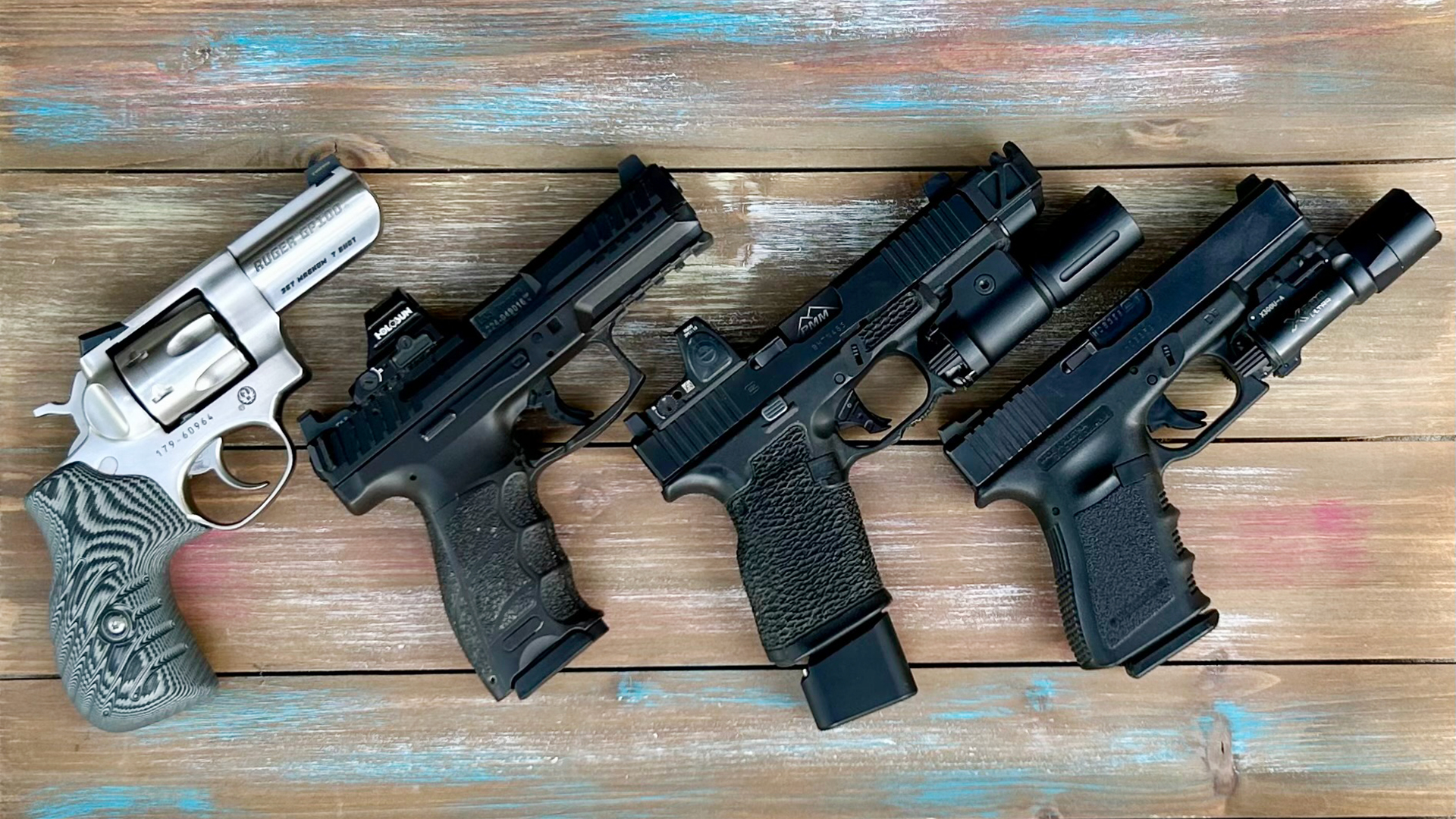
16. Ruger GP100
The Ruger GP100 is a double-action revolver that stands out in the home defense category for one key reason: mechanical simplicity. Unlike semi-automatic pistols that rely on magazines, slides, and feeding cycles, the GP100 operates with a straightforward cylinder system that is extremely resistant to malfunctions. This makes it especially appealing for users who want a defensive firearm that “just works” with minimal complexity. In stressful situations, simplicity can be a major advantage, and the GP100 is built around that philosophy.
The construction of the GP100 is robust, featuring a heavy stainless-steel frame designed to handle repeated firing without structural issues. This weight also plays an important role in recoil management, especially when using .357 Magnum loads. The recoil is more noticeable than 9mm pistols, but the revolver’s mass helps keep it under control for most shooters with basic training. The grip is ergonomic and can be customized with aftermarket options, allowing users to improve comfort and handling.
In home defense scenarios, the GP100 offers reliability that does not depend on magazines or feeding geometry. As long as ammunition is loaded correctly in the cylinder, the firearm is ready to function. This mechanical independence is why revolvers like the GP100 remain relevant even in a modern defensive landscape dominated by semi-automatic pistols.
Overall, the Ruger GP100 is a strong choice for users who value simplicity, durability, and predictable operation over high capacity or modern tactical features.
17. Smith & Wesson Model 686 Plus
The Smith & Wesson Model 686 Plus is another revolver-based option that offers a blend of traditional design and modern refinement. Chambered in .357 Magnum, it provides strong defensive capability while also allowing the use of .38 Special for reduced recoil. The “Plus” designation refers to its increased cylinder capacity compared to standard revolvers, giving it a slight edge in defensive situations where extra rounds may matter.
One of the strengths of the 686 Plus is its smooth double-action trigger, which improves with use and contributes to more controlled shooting. The stainless-steel frame ensures durability and resistance to corrosion, making it a long-lasting option for home defense storage. Its weight helps absorb recoil, making it more manageable than lighter revolvers in the same caliber class.
In practical use, the Model 686 Plus is valued for its reliability and consistency. It does not rely on magazines or complex feeding systems, which reduces potential points of failure. While it requires slower reloads compared to semi-automatic pistols, many users accept this trade-off for the confidence of mechanical simplicity.
The 686 Plus is ideal for users who prefer a traditional revolver platform but want slightly higher capacity and strong defensive performance.
18. Ruger SP101
The Ruger SP101 is a compact revolver designed for simplicity and durability in a smaller frame. It is often chosen as a secondary home defense firearm or for users who want a compact, low-maintenance option that is easy to store and operate. Despite its smaller size, it maintains Ruger’s reputation for rugged construction and reliability.
The SP101’s weight-to-size ratio is one of its most important features. It is heavy enough to manage recoil from .357 Magnum loads but still compact enough for easy storage. The double-action trigger is firm but smooths out with use, and the fixed cylinder design eliminates many of the mechanical failures associated with semi-automatic systems.
In defensive use, the SP101 is straightforward and predictable. It does not require magazine changes or slide manipulation, which simplifies operation under stress. While its capacity is limited compared to pistols, its reliability and ease of use make it a practical choice for certain users.
The Ruger SP101 is best suited for those who prioritize simplicity, durability, and compact size over high ammunition capacity.
19. FNX-45 Tactical
The FNX-45 Tactical is a modern, full-size .45 ACP handgun designed with advanced defensive features and high-capacity performance in mind. It is one of the more specialized pistols in the home defense category, offering a combination of large-caliber stopping power and modern tactical enhancements. Its polymer frame keeps weight manageable while still supporting a high-capacity magazine system.
One of the standout features of the FNX-45 Tactical is its optics-ready slide, allowing users to mount red dot sights for improved target acquisition. It also includes suppressor-height sights, making it compatible with suppressors or co-witness setups. These features make it highly adaptable for low-light defensive environments.
The pistol’s .45 ACP chambering provides strong energy transfer, while its large frame helps manage recoil effectively. The trigger system offers both double-action and single-action operation, giving users flexibility depending on readiness conditions. Controls are fully ambidextrous, making it accessible for all users in a household.
The FNX-45 Tactical is best suited for experienced users who want a highly capable, modern defensive handgun with advanced features and strong ballistic performance.
20. Smith & Wesson Governor
The Smith & Wesson Governor is a unique revolver designed to offer extreme versatility in ammunition compatibility. It can chamber .45 ACP, .45 Colt, and .410 shotgun shells, making it one of the most flexible defensive handguns available. This versatility allows users to adapt ammunition choice based on defensive needs or preference.
The Governor’s large frame is necessary to accommodate multiple cartridge types, and this results in a heavier firearm that helps manage recoil. While the recoil varies depending on ammunition selection, the weight and grip design help maintain control. The double-action trigger is consistent, and the revolver mechanism ensures reliability without dependence on magazines or feeding systems.
In home defense scenarios, the Governor offers a wide range of defensive options, though it is more specialized than traditional pistols. Its ability to fire multiple cartridge types makes it adaptable, but users must understand its limitations and strengths to use it effectively.
The Smith & Wesson Governor is best suited for users who value versatility and want a revolver capable of handling different defensive ammunition types within a single platform.
Conclusion
Selecting from the Best Handguns for Home Defense ultimately comes down to balancing reliability, simplicity, and how comfortably a firearm can be used under pressure. Across all 20 models in this guide, one clear pattern appears: there is no single “perfect” handgun for everyone. Instead, each design solves a slightly different problem—some prioritize ease of use, others focus on capacity, and a few emphasize raw durability or advanced features. What matters most is how well the handgun fits the shooter’s hand, training level, and home environment.
Striker-fired pistols like the Glock 19, SIG P320, and Walther PDP Compact tend to dominate modern home defense discussions because they are simple, consistent, and easy to train with. Full-size options such as the Glock 17, CZ 75 SP-01, and Beretta 92FS offer added stability and recoil control, which can improve accuracy in stressful situations. Meanwhile, revolvers like the Ruger GP100 and Smith & Wesson 686 Plus remain relevant because of their mechanical simplicity and dependable operation, even in less-than-ideal conditions.
At the same time, compact and subcompact pistols such as the SIG P365 XL or M&P Shield Plus show that home defense does not always require large firearms. In smaller living spaces or for users who prioritize quick access and ease of handling, these models provide a practical alternative without sacrificing essential defensive capability. On the other end, tactical-oriented handguns like the FNX-45 Tactical or HK VP9 introduce modern enhancements that may appeal to experienced users looking for additional flexibility.
In the end, the best choice is not about chasing trends or selecting the most powerful option available. It is about consistency, confidence, and familiarity. A handgun that feels natural in your hand and operates reliably under stress will always outperform a more advanced firearm that you do not fully understand. With proper training and responsible handling, any of the handguns listed in this guide can serve as an effective home defense tool when it matters most.
FAQs About Best Handguns for Home Defense
1. What makes a handgun suitable for home defense?
A handgun suitable for home defense must prioritize reliability, ease of operation, and controllability over raw power or advanced features. In real-world defensive situations, stress levels are high and decision-making time is limited, so a firearm that operates consistently with minimal manual steps is essential. Semi-automatic pistols like Glock, SIG Sauer, and Smith & Wesson models are commonly chosen because they combine manageable recoil with sufficient magazine capacity and simple mechanics. Revolvers are also viable due to their mechanical simplicity, though they offer lower capacity. Ultimately, the best choice is one that the user can handle confidently and operate without hesitation under pressure.
2. Is 9mm enough for home defense?
Yes, 9mm is widely considered more than adequate for home defense when paired with modern defensive ammunition. The cartridge offers a strong balance between stopping performance, recoil control, and magazine capacity. Lower recoil allows faster follow-up shots, which can be critical in defensive encounters. Additionally, advancements in hollow-point bullet design have significantly improved terminal performance. Many law enforcement agencies worldwide have standardized on 9mm for these same reasons. For most users, it provides the most practical balance of effectiveness and control.
3. Are full-size handguns better than compact ones for home defense?
Full-size handguns generally offer better recoil control, higher capacity, and improved accuracy due to longer sight radius and heavier frames. These characteristics make them easier to shoot under stress, which is a key advantage in home defense. However, compact handguns are easier to store, quicker to access, and more manageable in tight indoor environments. The “better” choice depends on the user’s physical comfort, storage setup, and training level. Many households choose full-size pistols for primary defense and compact models for backup or alternative users.
4. Should I choose a revolver or a semi-automatic pistol?
Both revolvers and semi-automatic pistols are valid for home defense, but they offer different advantages. Revolvers are mechanically simple, highly reliable, and less dependent on ammunition feeding systems. Semi-automatic pistols, on the other hand, provide higher capacity, faster reloads, and generally better ergonomics. In modern defensive contexts, semi-automatics are more common due to their efficiency, but revolvers remain popular among users who prioritize simplicity and minimal maintenance requirements.
5. What is the most reliable handgun brand for home defense?
Several brands have built strong reputations for reliability in defensive firearms. Glock is widely known for its durability and simplicity. Smith & Wesson’s M&P series offers ergonomic design with consistent performance. SIG Sauer provides modular systems and duty-proven models, while Heckler & Koch is known for high manufacturing standards. Ruger also produces rugged revolvers and pistols that perform well under stress. Rather than focusing on one brand, it is more important to choose a model that has a proven track record and fits the user’s needs.
6. Do I need a manual safety on a home defense handgun?
Manual safeties are optional in modern defensive handguns. Many striker-fired pistols rely on internal safeties and trigger systems rather than external switches. This simplifies operation under stress, which is beneficial in emergency situations. However, some users prefer manual safeties for added peace of mind, especially in households with multiple occupants. The key factor is consistent training—any safety system is only effective if the user understands and practices with it regularly.
7. What is the ideal magazine capacity for home defense?
There is no single ideal number, but most defensive pistols fall between 10 and 17 rounds in standard configurations. Higher capacity can reduce the need for reloads during critical moments, but capacity should not outweigh controllability and reliability. In home defense scenarios, shot placement is more important than total ammunition count. A well-placed shot with a reliable handgun is more effective than a high-capacity firearm that is difficult to control.
8. Is recoil important in a home defense handgun?
Yes, recoil plays a major role in defensive effectiveness. Lower recoil allows faster target reacquisition and improved accuracy during multiple-shot scenarios. This is why 9mm pistols are so widely recommended. Heavy recoil can slow follow-up shots and increase stress for inexperienced shooters. A handgun that the user can comfortably control will always perform better than a more powerful but difficult-to-handle alternative.
9. Are expensive handguns better for home defense?
Higher price does not always guarantee better defensive performance. Expensive handguns often offer improved fit, finish, and trigger quality, but many mid-range pistols provide excellent reliability and durability. The most important factor is proven functionality and user familiarity. A well-maintained mid-tier handgun that the user trains with regularly is often more effective than a premium firearm that is rarely practiced with.
10. How important is training with a home defense handgun?
Training is one of the most critical factors in effective home defense. Even the best handgun is only as effective as the person operating it. Regular practice helps build muscle memory, improves trigger control, and increases confidence under stress. Training should include safe handling, target acquisition, and basic malfunction clearing. Familiarity reduces hesitation, which is essential in high-pressure situations.
11. What is the difference between striker-fired and hammer-fired handguns?
Striker-fired handguns use an internal striker mechanism instead of an external hammer, which simplifies the firing process and reduces the number of manual controls. This design is common in modern defensive pistols like Glock, SIG P320, and Walther PDP. Hammer-fired pistols, such as the Beretta 92FS or SIG P229, use a visible hammer that can be cocked for a lighter single-action trigger pull. In home defense, striker-fired systems are often preferred for their simplicity, while hammer-fired systems appeal to users who want a traditional manual feel and additional control options.
12. Are red dot sights useful on home defense handguns?
Yes, red dot sights can significantly improve target acquisition speed, especially in low-light or high-stress environments. They allow the shooter to focus on the threat rather than aligning front and rear iron sights. Many modern pistols, including the Glock MOS series and SIG P320, are optics-ready. While red dots require some practice to master, they can enhance accuracy and confidence once the user becomes familiar with them.
13. What type of ammo should I use for home defense?
Hollow-point ammunition is generally recommended for home defense because it is designed to expand upon impact, reducing the risk of over-penetration while increasing stopping effectiveness. Full metal jacket (FMJ) rounds are better suited for training rather than defensive use. The key is choosing reliable defensive loads from reputable manufacturers and testing them in your firearm to ensure consistent feeding and performance.
14. Is over-penetration a real concern indoors?
Yes, over-penetration is a serious consideration in home defense scenarios. Bullets that pass through walls can pose risks to other occupants or neighbors. This is why ammunition selection and shot placement are critical. Hollow-point rounds are typically preferred because they are designed to expand and transfer energy more efficiently, reducing the likelihood of exiting the target with high velocity.
15. How should I store a home defense handgun?
A home defense handgun should be stored in a way that balances quick access with safety. Many users choose quick-access safes with biometric or keypad entry systems. The firearm should be stored in a ready condition according to safe handling practices, but secured against unauthorized access, especially in homes with children. Proper storage also includes keeping ammunition nearby but controlled.
16. What is “night sights” and are they necessary?
Night sights use tritium inserts or fiber optics to improve visibility in low-light conditions. They are not strictly necessary but are highly useful in home defense situations where lighting may be limited. They allow faster alignment of the firearm without needing a flashlight on the gun itself, though many users combine night sights with a weapon-mounted light for maximum effectiveness.
17. Do I need a weapon-mounted light?
A weapon-mounted light can be extremely helpful for identifying threats in low-light environments. In home defense situations, proper identification is critical before any action is taken. However, users must train properly to avoid flagging non-threats while using the light. Some prefer handheld flashlights combined with a handgun for more flexibility.
18. How often should I train with my home defense handgun?
Regular training is essential. Even occasional practice sessions can significantly improve performance under stress. Many experts recommend at least a few range sessions per year focused on defensive shooting skills, including drawing from storage, target acquisition, and controlled pairs. Consistency is more important than frequency alone.
19. What is the safest way to handle a loaded handgun at home?
The safest method is strict adherence to firearm safety rules, including treating every firearm as loaded, keeping the finger off the trigger until ready to fire, and ensuring the muzzle is always pointed in a safe direction. Proper training reduces the risk of accidents. Safe handling also includes secure storage when the firearm is not actively needed.
20. Are polymer-framed pistols durable enough for home defense?
Yes, modern polymer-framed pistols are extremely durable and widely used by military and law enforcement agencies. Materials like reinforced polymers provide strength while reducing weight. Brands such as Glock, SIG Sauer, and Smith & Wesson have proven that polymer frames can withstand extensive use without compromising reliability.
21. What is the importance of grip texture?
Grip texture directly affects control and stability during firing. A secure grip reduces the chance of slippage and improves recoil management. Many modern pistols feature aggressive texturing or interchangeable grip panels to accommodate different hand sizes and preferences.
22. How does barrel length affect home defense performance?
Shorter barrels make a handgun easier to maneuver in tight indoor spaces, while longer barrels generally provide better accuracy and velocity. For home defense, most full-size or compact pistols strike a balance between maneuverability and performance. The difference is usually minimal at typical indoor engagement distances.
23. Can beginners safely use semi-automatic pistols?
Yes, beginners can safely use semi-automatic pistols with proper instruction and training. Many modern designs are intentionally simplified to reduce user error. However, understanding how to load, unload, and safely operate the firearm is essential before relying on it for defense.
24. What is the role of trigger pull weight?
Trigger pull weight affects how much force is required to fire the handgun. Lighter triggers can improve accuracy but require more discipline, while heavier triggers can reduce accidental discharge risk. Most defensive pistols balance these factors to ensure safe and controlled operation.
25. Are compact pistols harder to shoot accurately?
Compact pistols can be slightly more challenging due to shorter sight radius and increased recoil feel. However, with practice, many shooters achieve excellent accuracy. Their main advantage lies in ease of storage and handling rather than raw shooting comfort.
26. What is the break-in period for a new handgun?
Some handguns perform better after a short break-in period where internal components settle through use. This is more common in tightly fitted or higher-end pistols. During this phase, reliability tends to stabilize as parts wear in naturally.
27. Should I keep multiple magazines loaded at home?
Many users keep spare magazines loaded and ready for defensive use. However, it is important to periodically rotate and inspect them to ensure spring tension remains reliable. Proper storage conditions help maintain long-term functionality.
28. Is a manual safety necessary?
A manual safety is a personal preference. Some users appreciate the added layer of control, while others prefer striker-fired pistols without external safeties for simplicity. Both approaches are valid as long as the user is properly trained.
29. What is the importance of sight alignment?
Sight alignment ensures that the front and rear sights are properly positioned relative to the target. Good alignment improves accuracy significantly, especially in stressful situations where precision is critical.
30. Can handguns be used in complete darkness?
Yes, but only with proper tools such as weapon-mounted lights or night sights. Identifying a target is essential before taking any defensive action. Shooting without visual confirmation is unsafe and strongly discouraged.
31. What is the difference between 9mm and .45 ACP for home defense?
9mm offers lower recoil, higher capacity, and faster follow-up shots, while .45 ACP delivers larger bullet diameter and higher energy per round. Both are effective when used correctly, and the best choice depends on user preference and comfort.
32. How important is handgun weight?
Weight affects recoil management and ease of handling. Heavier handguns reduce felt recoil, while lighter models are easier to maneuver and store. In home defense, moderate weight is often preferred for balance and control.
33. What is the safest direction to store a handgun?
A handgun should always be stored in a secure safe, ideally pointed in a safe direction according to storage setup. The key priority is preventing unauthorized access while maintaining readiness.
34. Are aftermarket upgrades useful?
Aftermarket upgrades such as improved sights, grips, or triggers can enhance performance, but they should not replace training. Reliability should always remain the top priority when modifying a defensive firearm.
35. What is the role of recoil spring?
The recoil spring helps absorb and cycle energy during firing, ensuring smooth operation. A worn spring can affect reliability, so periodic replacement is important for long-term performance.
36. Can home defense handguns be suppressed?
Some pistols can be equipped with suppressors, especially tactical models. However, suppressors are not commonly required for home defense and involve legal considerations depending on location.
37. What is the best grip size for control?
The best grip size is one that allows full control of the firearm without overextending the fingers or creating discomfort. Many pistols offer interchangeable backstraps to accommodate different users.
38. How do I reduce shooting anxiety?
Regular training, familiarity with the firearm, and proper instruction can significantly reduce anxiety. Confidence grows through repetition and safe handling experience.
39. What is the role of slide serrations?
Slide serrations improve grip when racking the slide, especially under stress or in adverse conditions. They help ensure reliable manipulation of the firearm.
40. Can multiple people use the same home defense handgun?
Yes, but all users must be properly trained. Shared firearms should be simple, reliable, and familiar to everyone in the household.
41. Is dry-fire practice useful?
Dry-fire practice helps improve trigger control and handling skills without live ammunition. It is a valuable training tool when performed safely.
42. What is the role of magazine springs?
Magazine springs push cartridges upward for feeding into the chamber. Weak springs can cause feeding issues, so maintenance and replacement are important over time.
43. How do I choose between full-size and compact pistols?
Full-size pistols offer better control, while compact models are easier to store and handle in tight spaces. The decision depends on environment and user comfort.
44. Are striker-fired pistols safer?
Striker-fired pistols are not inherently safer, but they reduce external controls and simplify operation. Safety depends more on user behavior and training than design alone.
45. What is the importance of reliability testing?
Testing ensures the handgun functions correctly with chosen ammunition. It builds confidence and identifies potential issues before real-world use.
46. Can I rely on one handgun for all situations?
Yes, many users rely on a single well-chosen handgun for home defense. However, training and familiarity are more important than quantity of firearms.
47. What is the role of sight picture?
Sight picture combines sight alignment and target focus. A clear sight picture improves accuracy, especially under pressure.
48. How do I maintain a defensive handgun?
Regular cleaning, lubrication, and inspection ensure reliability. Maintenance prevents buildup of debris and mechanical wear.
49. What is the importance of consistency in training?
Consistency builds muscle memory and reduces hesitation. Regular practice ensures smoother operation during emergencies.
50. Why are handguns preferred for home defense over rifles?
Handguns are easier to store, maneuver in tight spaces, and deploy quickly. While rifles offer greater power, handguns provide a practical balance of accessibility and control for indoor defense scenarios.
Read more: