


The Kel-Tec SUB 2000 is a lightweight, folding pistol-caliber carbine that has built its reputation around extreme portability, mechanical simplicity, and a price point that makes it accessible to a wide range of civilian shooters who want a compact defensive or range-ready firearm without moving into more expensive AR-based systems. Its most recognizable feature is the signature 16-inch barrel paired with a unique folding receiver design that allows the rifle to collapse nearly in half, making it small enough to fit into backpacks, vehicle compartments, or discreet storage locations where traditional carbines would be impractical to carry or store.
One of the key attractions of the SUB 2000 is its compatibility with widely available pistol magazines, including Glock, Beretta, and Smith & Wesson variants depending on the specific model, which allows users to share ammunition and magazines between handgun and carbine platforms for logistical simplicity. Over time, it has earned a reputation as one of the most compact civilian-legal carbines available, especially appealing to users who prioritize mobility and storage efficiency over traditional rifle ergonomics or modularity.
In the latest Gen 3 version, Kel-Tec introduced meaningful updates such as improved optics-friendly folding capability, redesigned ergonomics for better handling comfort, and a modernized handguard system that supports more accessories and improved usability. Despite these improvements, community feedback remains mixed, particularly regarding trigger quality, blowback recoil characteristics, and variations in factory consistency, making the SUB 2000 a platform that is often praised for its concept but debated in execution.
Kel-Tec SUB 2000 Overview
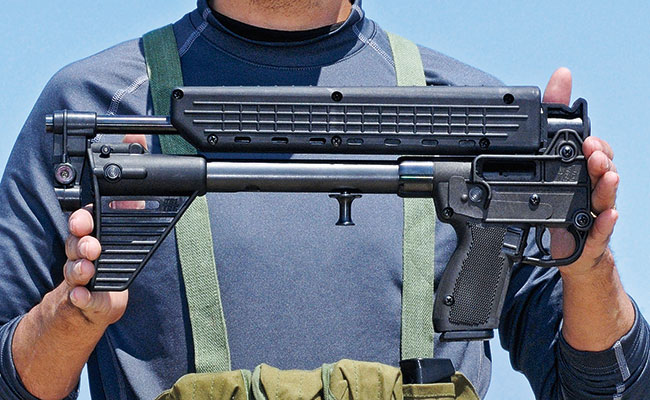
What is the Kel-Tec SUB 2000?
The Kel-Tec SUB 2000 is best understood as a folding pistol-caliber carbine (PCC), meaning it is a shoulder-fired firearm that uses handgun cartridges such as 9mm or .40 S&W while being designed in a compact rifle-style configuration that can be rapidly deployed from a folded position. This hybrid concept bridges the gap between a pistol and a rifle, offering increased stability, longer sight radius, and improved controllability compared to a handgun, while still maintaining ammunition commonality with sidearms.
Its design philosophy is heavily centered around portability-first engineering, prioritizing the ability to store, transport, and deploy the firearm in constrained environments over traditional rifle ergonomics or tactical modularity. This makes it particularly appealing for use cases such as home defense setups, vehicle “truck gun” storage, emergency preparedness kits, and recreational range shooting where convenience and compactness are more important than competitive precision or advanced customization.
Kel-Tec Company Background
Kel-Tec CNC Industries is widely recognized for its innovation-driven approach to firearm design, frequently developing unconventional platforms that challenge traditional expectations in the firearms industry. Rather than focusing solely on military contracts or conventional rifle patterns, the company has built its identity around compact, lightweight, and mechanically unique firearms that often introduce new design ideas into civilian markets.
Historically, Kel-Tec has produced a range of compact and experimental firearms, including folding carbines, bullpup rifles, and ultra-lightweight polymer-based designs that emphasize portability and cost efficiency. While their products are often praised for creativity and affordability, they also receive criticism regarding production consistency and refinement compared to higher-end manufacturers, placing the company in a niche position within the broader tactical firearms market.
Evolution of the SUB 2000 (Gen 1, Gen 2, Gen 3)
The SUB 2000 has evolved through multiple generations, with each iteration addressing specific limitations of the previous design while attempting to preserve its core identity as a folding PCC. Early versions focused primarily on establishing the folding concept and magazine compatibility, while later generations improved durability, ergonomics, and accessory integration.
The Gen 3 model introduces some of the most meaningful updates, particularly in optics compatibility, where the redesigned handguard system allows mounted optics to remain aligned and usable even after folding and unfolding the rifle. This improvement significantly enhances real-world practicality, especially for users who rely on red dot sights or compact optics for rapid target acquisition.
Despite incremental improvements, the SUB 2000 remains popular largely because it occupies a unique niche in the firearms market: an ultra-compact, folding PCC that is affordable, functional, and simple, even if it does not offer the refinement or ergonomic polish found in more expensive competitors. Its combination of novelty, practicality, and low cost continues to attract a dedicated user base.
Design and Folding Mechanism
Unique Folding Carbine Design
The defining engineering feature of the SUB 2000 is its ability to fold directly in half at the midpoint of the receiver, allowing the barrel and front assembly to pivot downward and lock into a compact folded configuration. This mechanism transforms the carbine from a full-length firearm into a highly compact package that can be stored or transported with minimal space requirements.
This folding capability provides significant advantages in terms of storage efficiency, particularly for users who need a discreet firearm option for vehicles, backpacks, or emergency kits where traditional carbines would be too long or cumbersome. In real-world terms, the folded SUB 2000 can often fit into spaces where even compact rifles would not realistically be stowed.
Gen 3 Folding Improvements
The Gen 3 SUB 2000 introduces important refinements to the folding system, most notably the rotating handguard design that allows mounted optics to remain attached and properly aligned even when the firearm is folded. This is a significant improvement over earlier generations, where optics typically had to be removed or risked losing zero after folding.
In practical use, these improvements reduce deployment time and make the rifle more user-friendly in situations where rapid transition from storage to firing condition is important. The updated system also improves overall confidence in the platform, as users can maintain their sighting setup without repeated recalibration or adjustment.
Lightweight Construction
The SUB 2000 is built primarily using polymer-based components combined with a minimal metal structure, resulting in a lightweight platform that is easy to carry and manipulate over extended periods. This design choice reflects Kel-Tec’s emphasis on portability and cost efficiency rather than heavy-duty structural rigidity.
While the reduced weight is a major advantage for transport and handling, it does introduce trade-offs in perceived recoil management and structural stiffness compared to heavier, all-metal PCC platforms. As a result, the shooting experience can feel slightly more abrupt during rapid fire, although still manageable within the context of pistol-caliber performance.
Controls and Ergonomics
Charging Handle and Manual of Arms
The SUB 2000 uses a side-mounted charging handle that operates the blowback system and allows the user to chamber or clear the firearm manually. This design keeps the mechanism simple and cost-effective, but it also differs significantly from more modern AR-style charging systems, requiring users to adapt to a different manual of arms.
The charging motion is straightforward but can feel less intuitive compared to rear-mounted or ambidextrous charging systems found on more contemporary carbines. While functional and reliable, it reflects the SUB 2000’s overall design philosophy of simplicity over ergonomic refinement.
Trigger System Design
The trigger system in the SUB 2000 is characteristic of blowback-operated PCCs, typically featuring a heavier pull weight, noticeable creep, and a less refined break compared to higher-end rifle platforms. This is largely a result of its internal design constraints and cost-conscious engineering approach.
Many users describe the trigger as functional but not exceptional, often recommending aftermarket trigger improvements or polishing modifications to enhance shooting comfort and consistency. Despite its limitations, the trigger remains adequate for defensive and recreational shooting where extreme precision is not the primary objective.
Sights and Optics Compatibility
Factory sighting systems on earlier SUB 2000 models are generally basic, often consisting of simple iron sights that serve as a backup rather than a primary aiming solution. In the Gen 3 model, however, Kel-Tec significantly improved optics compatibility by redesigning the folding system to better accommodate mounted optics.
This allows users to mount red dot sights or compact optics with improved confidence that zero will be maintained after folding and deployment. In practice, this enhancement brings the SUB 2000 closer to modern expectations for tactical PCC platforms, where optic integration plays a key role in usability and speed.
Magazine Compatibility
Pistol Magazine System
One of the most practical and widely appreciated features of the Kel-Tec SUB 2000 is its reliance on pistol magazine compatibility, which allows the carbine to share ammunition feeding systems with commonly carried handguns depending on the specific configuration purchased. The most popular variant is the Glock-compatible model, which supports widely available Glock magazines, making it especially attractive to users who already own Glock pistols and want to streamline their ammunition logistics across both platforms.
In addition to Glock compatibility, the SUB 2000 is also produced in variants that support other magazine ecosystems such as Beretta, Smith & Wesson, and SIG Sauer, depending on the specific model and production run. This flexibility allows users to choose a configuration that best matches their existing handgun setup, reducing the need to carry multiple magazine types and simplifying storage and resupply considerations.
The primary advantage of this shared magazine ecosystem is logistical efficiency, as users can maintain a single magazine type for both handgun and carbine use, which is particularly valuable in defensive or survival-oriented scenarios where minimizing gear complexity is important. This interoperability is one of the strongest practical selling points of the SUB 2000 platform.
Magazine Reliability and Feeding
Magazine reliability plays a critical role in the overall performance of the SUB 2000, and in many cases, the difference between smooth cycling and malfunctioning operation comes down to whether OEM or aftermarket magazines are being used. Factory-original magazines tend to provide the most consistent feeding performance due to tighter quality control and predictable spring tension, while lower-quality aftermarket magazines can introduce variability in reliability.
Common feeding issues, when they occur, are often traced back to magazine-related problems such as worn feed lips, inconsistent spring pressure, or poor cartridge alignment, rather than inherent flaws in the rifle’s action itself. In many cases, replacing or upgrading magazines resolves these issues quickly and restores consistent cycling performance.
Overall reliability of the SUB 2000 is heavily influenced by magazine quality, making it essential for users to prioritize well-maintained, reputable magazines in order to achieve the best possible performance from the platform.
Accuracy and Shooting Performance
Real-World Accuracy
In real-world shooting conditions, the Kel-Tec SUB 2000 delivers practical accuracy that is generally consistent with expectations for a pistol-caliber carbine, typically performing well within 50 to 100 yard engagement distances where PCC platforms are most commonly used. While it is not designed to compete with precision rifle systems, it provides sufficient accuracy for defensive shooting, recreational range use, and general-purpose target engagement within its intended range envelope.
When compared to precision rifle standards, the SUB 2000 prioritizes speed, portability, and simplicity over tight grouping consistency, meaning that its accuracy is considered practical rather than match-grade. The blowback operating system also contributes to a slightly different recoil impulse and barrel harmonics compared to locked-breech rifle systems, which can influence shot-to-shot consistency.
Barrel Heating and Performance Degradation
Like most lightweight PCC platforms, the SUB 2000 is subject to performance changes as barrel temperature increases during extended firing sessions, with heat buildup gradually affecting grouping consistency over time. As the barrel warms, minor shifts in point of impact can occur, especially during rapid or sustained fire sequences that exceed typical defensive or recreational usage patterns.
Rapid fire limitations are therefore an important consideration, as the platform is best suited for controlled semi-automatic shooting rather than extended high-volume firing strings. In realistic use cases, the SUB 2000 performs best when used in short to moderate engagement cycles rather than continuous sustained fire.
Recoil and Shooting Experience
Recoil in the SUB 2000 is generally mild due to the use of pistol calibers such as 9mm, .40 S&W, or 5.7×28mm depending on the variant, with the blowback operating system producing a straight-back recoil impulse that is simple but somewhat abrupt compared to more refined gas-operated systems. This results in a shooting experience that is easy to control for most users, especially during semi-automatic fire.
Perceived recoil characteristics can vary slightly between generations, with later models offering modest improvements in handling comfort and ergonomics that help reduce shooter fatigue during extended sessions. Overall controllability in rapid fire is generally good, making the SUB 2000 effective for close to mid-range engagements where fast follow-up shots are important.
Reliability and Common Issues
Break-In Period Behavior
The Kel-Tec SUB 2000 may exhibit a short break-in period during which cycling consistency improves as internal components settle and friction points smooth out through initial use. During this phase, some users may experience minor inconsistencies in feeding or ejection, particularly when using lower-powered ammunition or unpolished magazines.
Proper lubrication and the use of quality ammunition can significantly reduce early-stage issues, and many rifles demonstrate improved reliability after several hundred rounds of use. Over time, the platform generally becomes more consistent as mechanical surfaces wear into a smoother operating condition.
Feeding and Cycling Problems
Common feeding and cycling problems in the SUB 2000 can include double feeds, failures to eject, or occasional failure to chamber a round, although these issues are typically not inherent design flaws and are often linked to external factors such as magazine quality, ammunition inconsistencies, or insufficient cleaning of the bolt and chamber area.
Because the SUB 2000 uses a relatively simple blowback system, it is more sensitive to friction and debris buildup compared to more robust gas-operated platforms, making regular maintenance an important factor in maintaining reliable operation over time. In many cases, addressing magazine quality and cleaning routines resolves the majority of recurring issues.
Quality Control Concerns
One of the recurring themes in user discussions about the SUB 2000 is variability between individual rifles, where some units perform flawlessly out of the box while others require minor adjustments or break-in to achieve optimal reliability. This variation is often attributed to factory tolerances and production consistency rather than fundamental design flaws.
Community feedback frequently highlights this inconsistency as one of the trade-offs of the platform’s affordability and mass-market positioning, where cost efficiency is prioritized over tight manufacturing uniformity. Despite this, many users still find the rifle dependable once properly set up and maintained.
Gen 3 Improvements and Upgrades
Optics-Friendly Folding System
The Gen 3 SUB 2000 introduces a significantly improved folding system that is specifically designed to accommodate mounted optics without requiring removal during storage or transport. This is achieved through a rotating handguard mechanism that allows the optic-mounted upper assembly to maintain alignment and return to zero more consistently after folding and unfolding.
In practical terms, this improvement greatly enhances usability for modern shooters who rely on red dot sights or compact optics for faster target acquisition, as it eliminates one of the major limitations of earlier generations where optics often needed to be removed or re-zeroed after folding.
Ergonomic Enhancements
Ergonomic improvements in the Gen 3 SUB 2000 include a redesigned grip and updated handling geometry that provide a more natural shooting position and improved comfort during extended use. These refinements help reduce strain during longer shooting sessions and make the rifle feel more stable and controllable in hand.
Additionally, the updated design offers improved accessory compatibility, allowing users to mount lights, grips, and other attachments more effectively than in previous generations. This expanded modularity brings the SUB 2000 closer to modern PCC expectations, where customization and accessory integration play an important role.
Aftermarket customization options also remain an important aspect of the platform, with a growing ecosystem of upgrades such as improved charging handles, optic mounts, and trigger enhancements that allow users to tailor the rifle to their preferences and operational needs.
Suppressed Shooting Considerations
Blowback System and Suppression
When the Kel-Tec SUB 2000 is used with a suppressor, its simple straight-blowback operating system becomes an important factor in overall shooting behavior, because this type of action inherently produces higher levels of back pressure compared to more complex gas-regulated systems. As a result, shooters may notice increased gas and particulate blowback toward the shooter’s face, especially during rapid fire strings or when using higher-pressure ammunition.
This gas blowback is one of the primary limitations of suppression in pistol-caliber carbines built on blowback architecture, since the system does not actively regulate gas flow in the same way as piston or gas-impingement rifles. While suppression still provides benefits in terms of reduced sound signature and slightly softened recoil impulse, the shooter must also accept increased fouling and a somewhat less comfortable shooting experience over extended sessions.
Best Use Cases with Suppressor
Despite its limitations, the SUB 2000 can still perform effectively with a suppressor in certain contexts, particularly in training environments where reduced noise levels are beneficial for communication, situational awareness, or indoor range use. The suppression setup can also make extended practice sessions more comfortable by lowering perceived sound pressure, even if the mechanical system continues to cycle in a relatively abrupt blowback manner.
From a tuning perspective, expectations must remain realistic, as the SUB 2000 is not designed as a dedicated suppressed platform, meaning users should anticipate a balance between improved acoustic performance and increased gas exposure. Proper ammunition selection and routine cleaning become especially important when running suppressed configurations to maintain consistent cycling and reliability.
Advantages and Disadvantages
Key Advantages
The Kel-Tec SUB 2000 offers several clear advantages that contribute to its popularity, most notably its extremely compact folding design that allows the firearm to be reduced to a highly portable package in seconds, making it one of the most space-efficient carbines available on the civilian market. This portability is a defining characteristic that sets it apart from many traditional PCC platforms.
In addition, the rifle’s lightweight construction makes it easy to carry, store, and deploy in a wide variety of scenarios, from vehicle storage to emergency preparedness kits, without adding significant physical burden. Its use of common pistol magazines also enhances logistical simplicity, particularly for users who already own compatible handguns, while its relatively affordable entry price point makes it accessible to a broad range of shooters.
Key Disadvantages
Despite its strengths, the SUB 2000 also presents several disadvantages that reflect its budget-oriented and minimalist design philosophy, including a heavy and somewhat gritty trigger feel that lacks the refinement found in higher-end carbines or AR-style platforms. This can affect shooting comfort and precision during extended use.
The blowback operating system contributes to a sharper and less refined recoil impulse compared to more advanced gas-regulated systems, and the overall shooting experience can feel somewhat abrupt during rapid fire. Ergonomically, the platform also lags behind modern AR-style carbines in terms of control placement and user interface design, which may require an adjustment period for new users.
Finally, the SUB 2000 often relies heavily on aftermarket upgrades to reach its full potential, meaning that many users choose to modify components such as triggers, charging handles, or optics mounts to improve performance and comfort.
Kel-Tec SUB 2000 vs Competing PCCs
SUB 2000 vs Ruger PC Carbine
When compared to the Ruger PC Carbine, the SUB 2000 clearly prioritizes compact folding portability over modular refinement, while the Ruger platform offers a more traditional rifle-like experience with better ergonomics, smoother recoil impulse, and improved out-of-the-box stability. The Ruger design is generally considered more refined, whereas the SUB 2000 excels in ultra-compact storage capability.
SUB 2000 vs S&W M&P FPC
Against the Smith & Wesson M&P FPC, the SUB 2000 competes closely in terms of portability, but the FPC offers a more modern ergonomic layout and smoother shooting experience due to its design improvements and folding system refinement. The SUB 2000, however, remains competitive due to its simplicity and long-standing presence in the market.
SUB 2000 vs AR-9 Platforms
When compared to AR-9 platforms, the SUB 2000 trades modularity and ergonomic familiarity for superior compactness and folding capability. AR-9 carbines typically provide better control layouts, wider accessory support, and improved customization potential, while the SUB 2000 remains unmatched in terms of how compact it becomes when folded.
Folding vs Takedown Design Differences
The primary distinction between these platforms lies in how they achieve portability, with the SUB 2000 using a true folding mechanism, while many AR-9 and PCC competitors rely on takedown systems that separate the upper and lower receivers. Folding designs offer faster deployment, while takedown systems often provide more rigid shooting platforms once assembled.
Ergonomics Comparison
In terms of ergonomics, AR-9 platforms generally provide the most intuitive and user-friendly controls, followed by modern PCC designs like the FPC and PC Carbine, while the SUB 2000 remains the most unconventional due to its side charging handle and folding-centric layout.
Reliability and Modularity Comparison
Reliability across PCC platforms varies, but AR-9 systems often benefit from extensive refinement and aftermarket support, while the SUB 2000 relies more on simplicity and maintenance discipline. In terms of modularity, AR-based platforms clearly dominate due to their extensive accessory ecosystems, whereas the SUB 2000 prioritizes compact function over customization flexibility.
Best Use Cases for the Kel-Tec SUB 2000
Home Defense Applications
The SUB 2000 can serve as a viable home defense option for users who prioritize compact storage and quick deployment, as its folding design allows it to be stored in tight spaces while still offering greater stability and control than a handgun. However, its ergonomics and trigger characteristics mean it performs best when the user is familiar with the platform.
Truck Gun / Vehicle Storage Rifle
One of the most common roles for the SUB 2000 is as a vehicle or “truck gun,” where its ability to fold into a compact form factor makes it highly suitable for storage in confined spaces such as under seats, in compartments, or in emergency kits. This portability is one of its strongest practical advantages.
Backpack and Survival Kit Use
The SUB 2000 is also well-suited for survival or preparedness kits due to its ability to collapse into a backpack-friendly size while still delivering carbine-level performance with pistol ammunition. This makes it appealing for users focused on emergency readiness and mobility.
Recreational Range Shooting
For recreational shooting, the SUB 2000 provides an enjoyable and cost-effective platform that allows users to train with pistol-caliber ammunition in a rifle configuration, making it a practical option for casual range sessions and skill development.
Final Verdict
The Kel-Tec SUB 2000 stands out in the modern PCC market primarily for its unmatched compact folding design, affordability, and logistical simplicity, making it one of the most portable semi-automatic carbines available to civilian shooters. Its ability to share magazines with popular pistol platforms and collapse into a highly compact package gives it a unique niche that few competitors can truly replicate.
However, these strengths come with trade-offs, including a less refined ergonomic layout, a heavy and gritty trigger, and a level of consistency that can vary depending on maintenance and ammunition selection. As a result, the SUB 2000 is best understood as a practical utility firearm rather than a precision or competition-oriented platform.
Overall, the ideal user for the SUB 2000 is someone who values portability, affordability, and simplicity above all else, and who is willing to accept certain ergonomic and performance compromises in exchange for extreme compactness. Within the modern PCC market, it occupies a distinct role as one of the most portable and budget-friendly folding carbines available today.
Frequently Asked Questions (FAQ) – Kel-Tec SUB 2000 Review
1. What is the Kel-Tec SUB 2000?
The Kel-Tec SUB 2000 is a lightweight, semi-automatic pistol-caliber carbine designed around a folding mechanism that allows it to collapse into a highly compact form for storage and transport. It is intended for users who want rifle-like stability and accuracy while still using common handgun ammunition, making it a practical bridge between a pistol and a full-size rifle platform.
2. What does PCC mean in the SUB 2000?
PCC stands for “Pistol Caliber Carbine,” which refers to a shoulder-fired firearm that uses handgun cartridges such as 9mm, .40 S&W, or 5.7×28mm depending on the configuration. This allows for reduced recoil, lower ammunition cost, and shared logistics with compatible pistols.
3. Is the Kel-Tec SUB 2000 a rifle or pistol?
The SUB 2000 is legally classified as a rifle because it features a 16-inch barrel and a shoulder stock, even though it fires pistol ammunition. Its classification depends on barrel length and stock configuration rather than caliber alone.
4. How does the folding mechanism work?
The SUB 2000 folds by pivoting the barrel and receiver assembly in half at a central hinge point, allowing the firearm to collapse into a compact, rectangular shape. This mechanism locks securely in both folded and deployed positions for safe transport and firing stability.
5. How small is the SUB 2000 when folded?
When folded, the SUB 2000 becomes compact enough to fit inside backpacks, small storage compartments, or vehicle spaces, significantly reducing its footprint compared to traditional carbines while still retaining full barrel length when deployed.
6. What is new in the Gen 3 SUB 2000?
The Gen 3 model introduces improvements such as a redesigned folding system that better supports mounted optics, updated ergonomics for improved handling comfort, and enhanced accessory compatibility through a more modernized handguard design.
7. Is the Gen 3 SUB 2000 better than Gen 2?
Yes, the Gen 3 is generally considered an improvement over Gen 2 due to better optics integration, improved usability when folding and unfolding, and refined ergonomics, although the core operating system remains similar.
8. Can the SUB 2000 still fold with an optic mounted?
Yes, in Gen 3 models, the rotating handguard system allows optics to remain attached while still permitting the rifle to fold without losing alignment, which significantly improves practical usability compared to earlier generations.
9. What calibers does the SUB 2000 come in?
The SUB 2000 is available in multiple pistol calibers depending on configuration, most commonly 9mm, .40 S&W, and 5.7×28mm, allowing users to choose based on ammunition preference and existing handgun platforms.
10. Does the SUB 2000 use Glock magazines?
Yes, many SUB 2000 variants are designed to accept Glock magazines, making them highly popular among Glock owners who want to share magazines between handgun and carbine platforms.
11. Which Glock magazines are compatible?
Compatibility depends on the exact model, but typically includes magazines from Glock pistols chambered in 9mm or .40 S&W, with capacity and generation compatibility varying depending on production configuration.
12. Is magazine compatibility reliable?
Magazine compatibility is generally reliable when using OEM magazines, but performance can vary with aftermarket magazines due to differences in feed lip geometry, spring tension, and overall manufacturing quality.
13. Are aftermarket magazines recommended for SUB 2000?
Aftermarket magazines can be used, but OEM magazines are strongly recommended for maximum reliability, as the SUB 2000 is sensitive to magazine quality in terms of feeding consistency and cycling behavior.
14. How accurate is the SUB 2000 at 50 yards?
At 50 yards, the SUB 2000 is typically very consistent and capable of tight groupings suitable for defensive and recreational shooting, especially with quality ammunition and a stable shooting position.
15. How accurate is it at 100 yards?
At 100 yards, the SUB 2000 remains effective for center-mass engagement and general target shooting, though it is not designed for precision rifle-level accuracy and will show wider groups compared to rifle-caliber platforms.
16. Is the SUB 2000 good for home defense?
Yes, it can be effective for home defense due to its controllability, magazine capacity, and stability compared to pistols, although users must be comfortable with its manual of arms and trigger characteristics.
17. Is the SUB 2000 good for beginners?
It can be used by beginners, but its unconventional ergonomics and basic trigger system may require some training and familiarity compared to more user-friendly AR-style platforms.
18. How heavy is the Kel-Tec SUB 2000?
The SUB 2000 is relatively lightweight compared to most carbines, making it easy to carry and handle for extended periods, which is one of its key advantages in portability-focused use cases.
19. Is the SUB 2000 easy to carry daily?
Yes, its folding design makes it significantly easier to carry or store in vehicles or bags compared to full-size rifles, which is why it is often used as a compact defensive or emergency firearm.
20. Does the SUB 2000 have recoil?
Yes, but recoil is generally mild because it uses pistol-caliber ammunition; however, the straight blowback system can make recoil feel slightly sharp compared to gas-operated rifles.
21. Is recoil stronger than expected for a PCC?
Some shooters find the recoil slightly more abrupt than other PCC platforms due to its lightweight construction and blowback operation, although it remains very manageable overall.
22. What is the trigger like on the SUB 2000?
The trigger is typically described as heavy and somewhat gritty, with a longer pull and less refined break compared to higher-end PCCs or AR-style platforms.
23. Can the trigger be upgraded?
Yes, aftermarket upgrades and polishing modifications are available to improve trigger smoothness and reduce pull weight, which is a common upgrade among owners.
24. Is the SUB 2000 reliable out of the box?
Reliability can vary depending on the individual unit, but many rifles function well after proper lubrication and use of quality magazines and ammunition.
25. Does it require a break-in period?
Yes, some units benefit from a break-in period during which cycling becomes smoother as internal components wear in and friction decreases.
26. What are common malfunctions in the SUB 2000?
Common issues include failure to feed, failure to eject, or double feeds, often linked to magazine quality or insufficient maintenance rather than design flaws.
27. Why does the SUB 2000 jam sometimes?
Jams typically occur due to poor-quality magazines, dirty internals, or inconsistent ammunition pressure affecting the blowback cycling system.
28. Is the SUB 2000 sensitive to ammunition type?
Yes, it can be somewhat sensitive to underpowered or inconsistent ammunition, which may affect cycling reliability in blowback-operated systems.
29. How does the blowback system work?
The blowback system relies on the force of expanding gases pushing the bolt rearward after firing, cycling the action without a gas piston or locking mechanism.
30. Does the SUB 2000 get dirty quickly?
Yes, like most blowback PCCs, it can accumulate carbon and debris relatively quickly, requiring regular cleaning for optimal performance.
31. Is cleaning the SUB 2000 difficult?
Cleaning is moderately easy but may require familiarity with its folding design and internal layout compared to more traditional rifles.
32. How often should the SUB 2000 be cleaned?
Cleaning frequency depends on usage, but regular maintenance is recommended, especially after extended firing sessions or use with dirty ammunition.
33. What is the best optic for SUB 2000 Gen 3?
Red dot sights are commonly preferred due to their speed and compatibility with the folding system improvements in Gen 3 models.
34. Does the SUB 2000 hold zero after folding?
Gen 3 models significantly improve optic stability, helping maintain zero more reliably compared to earlier generations.
35. Can you suppress the SUB 2000?
Yes, it can be used with a suppressor, but users should expect increased gas blowback due to its blowback operating system.
36. Is suppressed shooting comfortable with SUB 2000?
It is moderately comfortable, but gas and residue blowback can make extended suppressed shooting less pleasant compared to gas-regulated systems.
37. Does the SUB 2000 have gas blowback issues?
Yes, to some extent, because it uses a straight blowback system that directs gases rearward toward the shooter.
38. What are the biggest problems with SUB 2000?
The biggest issues include trigger quality, ergonomic limitations, and variability in reliability depending on magazines and maintenance.
39. Is the SUB 2000 good for truck gun use?
Yes, it is widely used as a truck gun due to its folding design, compact storage footprint, and ease of deployment.
40. Can the SUB 2000 fit in a backpack?
Yes, when folded, it can fit into many medium to large backpacks, making it suitable for discreet transport and storage.
41. Is the SUB 2000 legal in all states?
Legality depends on local firearm laws, magazine restrictions, and configuration rules, so compliance must be checked based on jurisdiction.
42. Does the SUB 2000 have good ergonomics?
Ergonomics are functional but not modernized, with a design that prioritizes folding capability over AR-style comfort and control placement.
43. How does it compare to AR-9 carbines?
AR-9 carbines generally offer better ergonomics and modularity, while the SUB 2000 excels in folding compactness and portability.
44. How does it compare to Ruger PC Carbine?
The Ruger PC Carbine is more refined and ergonomic, while the SUB 2000 is more compact and portable due to its folding design.
45. Which is better, SUB 2000 or S&W FPC?
The S&W FPC offers better ergonomics and modern design features, while the SUB 2000 remains more compact when folded.
46. Is the SUB 2000 worth the price?
It is considered good value for users prioritizing portability and affordability, though it may not satisfy those seeking premium ergonomics.
47. Why is the SUB 2000 so popular?
Its popularity comes from its folding design, affordability, and ability to use common pistol magazines, making it highly practical for many users.
48. What are Gen 3 improvements over older models?
Gen 3 improves optics compatibility, folding usability, and ergonomics, making it more practical for modern shooting setups.
49. Is the SUB 2000 good for range training?
Yes, it is commonly used for range training due to low recoil, low ammunition cost, and simple operation.
50. Can the SUB 2000 be used for competition?
It can be used in some PCC competitions, but it is not ideal compared to more optimized AR-style competition platforms.
51. Does the SUB 2000 have good aftermarket support?
Aftermarket support exists but is more limited compared to AR platforms, requiring users to be selective about upgrades.
52. What upgrades are recommended for SUB 2000?
Common upgrades include trigger improvements, optic mounts, and ergonomic enhancements to improve handling and shooting comfort.
53. Is the SUB 2000 durable long-term?
It can be durable with proper maintenance, though long-term performance depends heavily on usage patterns and care.
54. Who should avoid buying the SUB 2000?
Users who prioritize premium ergonomics, match-grade triggers, or heavy customization may find better options elsewhere.
55. Is the Kel-Tec SUB 2000 still relevant today?
Yes, it remains relevant due to its unique folding design and affordability, even as newer PCC platforms offer improved ergonomics and refinement.
Read more: