
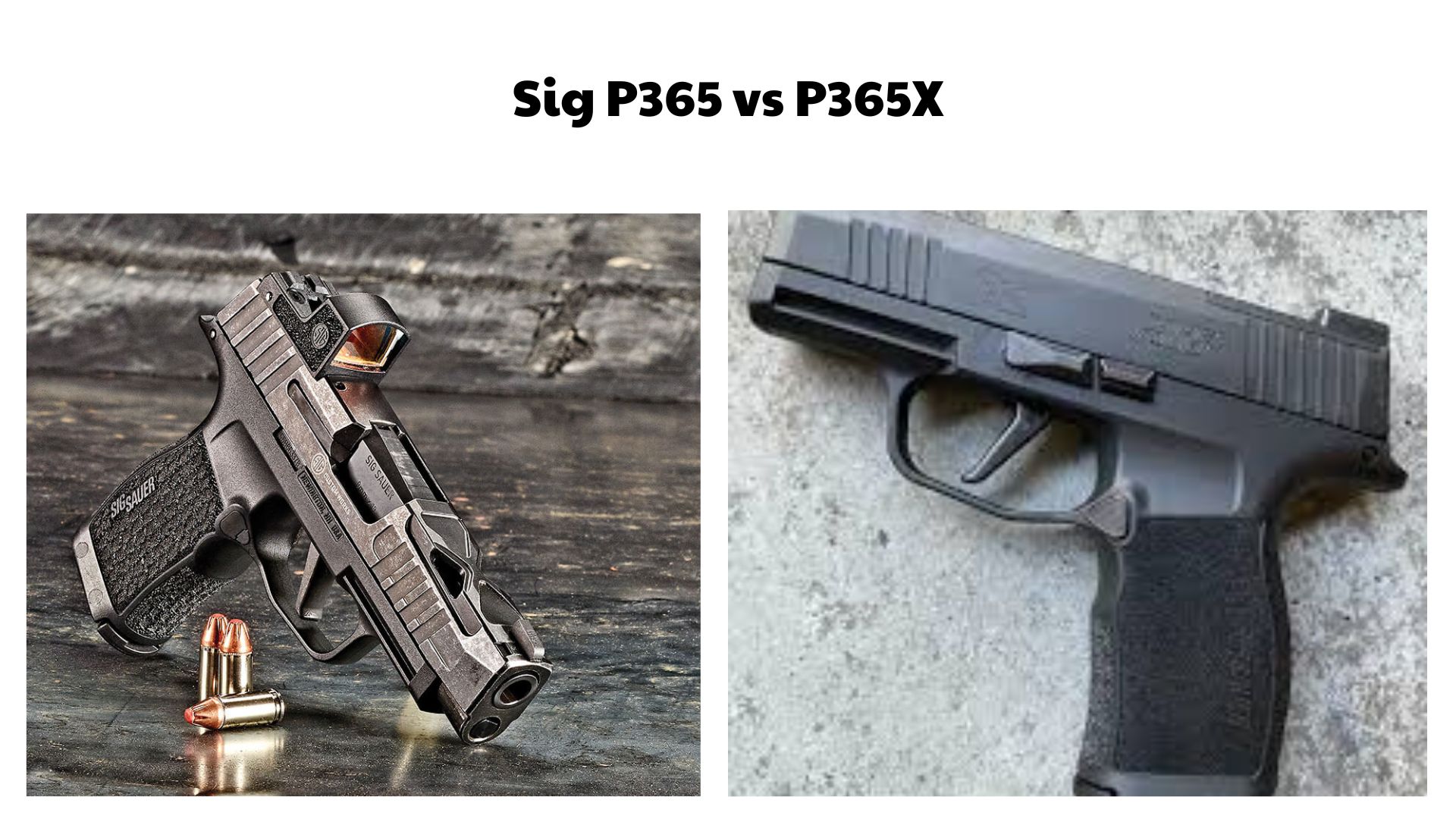

The Sig Sauer P365 has earned its reputation as a revolutionary micro-compact concealed carry pistol that reshaped the modern EDC market. It set a new standard by combining small size, high capacity, and practical defensive performance in a platform that quickly became a benchmark for concealed carry handguns.
The Sig P365X builds on that success as an upgraded hybrid version of the original platform. It combines elements of the compact P365 slide with a larger, more controllable grip module, creating a balance between concealability and shootability. This makes it a popular evolution for users who want improved handling without moving into a full-size handgun category.
Both pistols are designed with a strong focus on concealed carry performance, ergonomic efficiency, and modern optics readiness. They represent two different interpretations of the same platform philosophy: one prioritizing maximum concealment, the other improving control and usability.
Together, the P365 and P365X dominate the modern EDC landscape, competing directly with pistols like the Glock 43X, Springfield Hellcat, and other micro-9mm platforms. Their popularity comes from their ability to balance size, capacity, and defensive capability in a highly practical way.
This comparison focuses on helping shooters understand the real differences between the two models, especially in terms of size, magazine capacity, trigger feel, and real-world usability. The goal is to help determine which platform better suits deep concealment needs versus enhanced shooting performance.
Key Specifications Comparison
Sig P365 Specifications
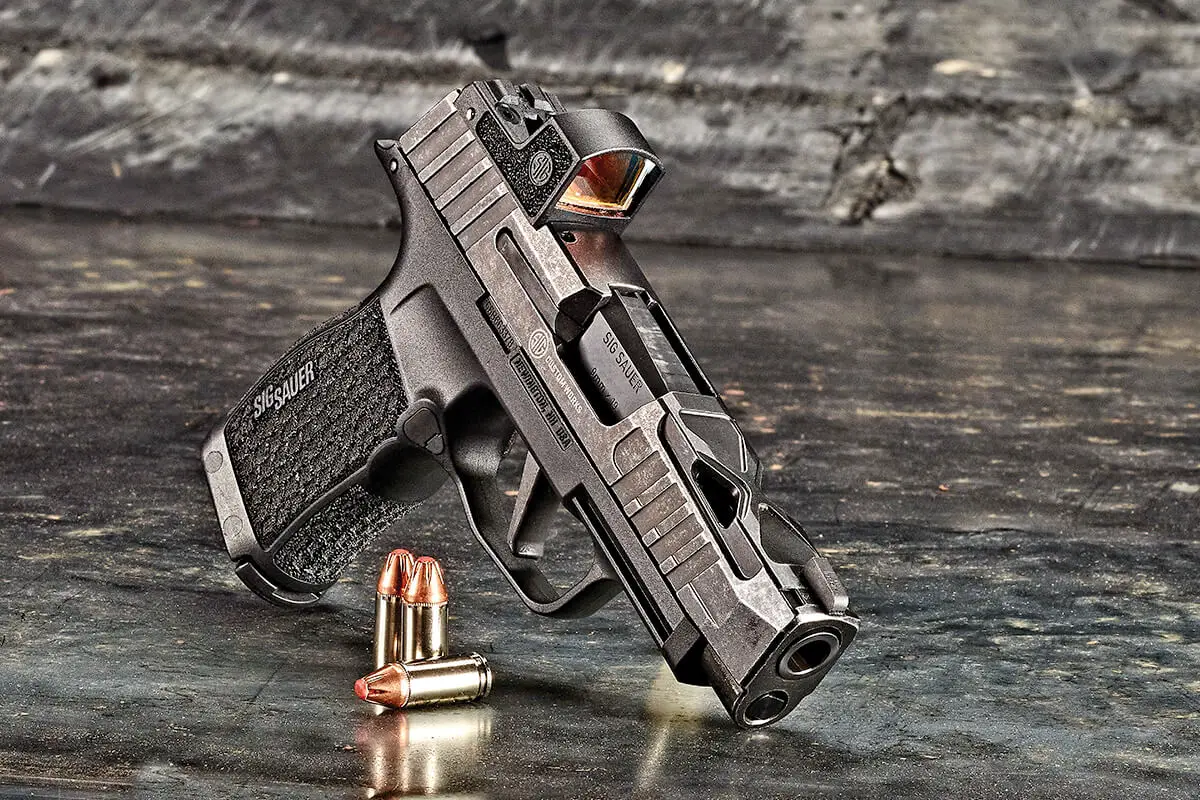
The Sig P365 is a compact micro-9mm pistol designed for ultra-concealable carry. Its dimensions are optimized for deep concealment, making it one of the smallest high-capacity handguns in its class when it was first introduced.
It typically features a 10+1 standard capacity, with extended magazines available for increased firepower. This allows users to maintain a small footprint while still having practical defensive capacity. The shorter grip module is one of its defining characteristics, specifically engineered to minimize printing under clothing.
Earlier versions of the P365 were not optics-ready, meaning users needed aftermarket modifications to mount red dot sights. While newer variants have expanded options, the original design focused primarily on simplicity and concealability rather than modularity.
Sig P365X Specifications
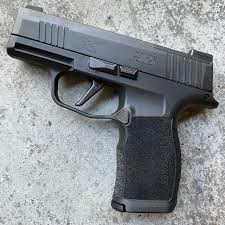
The Sig P365X represents a hybrid evolution of the original platform. It combines the standard P365 slide with an extended XL grip module, creating a pistol that offers improved control without significantly increasing overall size.
One of its key advantages is its 12+1 standard magazine capacity, giving users additional firepower compared to the original P365. This increase in capacity is paired with a slightly taller grip, which enhances stability and recoil control during shooting.
Unlike the original model, the P365X comes optics-ready from the factory. This allows users to mount modern micro red dot sights without modifications, making it more adaptable to current defensive shooting trends.
The slightly larger grip improves comfort and handling, especially for shooters with medium to large hands. While it sacrifices a small amount of concealability, it significantly improves shootability and overall control.
Design & Build Differences
Frame and Grip Module
The most noticeable difference between the Sig P365 and the P365X is the grip module. The standard P365 uses a shorter grip designed specifically for maximum concealment. This compact grip reduces printing under clothing and makes the pistol easier to carry in deep concealment setups such as pocket-adjacent IWB or appendix carry.
In contrast, the P365X features an extended grip module similar to the XL variant. This longer grip improves handling, recoil control, and overall shooting stability. It allows more of the shooter’s hand to engage the firearm, which reduces muzzle flip and improves follow-up shot consistency.
The trade-off between the two designs is clear. The P365 prioritizes concealability above all else, while the P365X shifts slightly toward shootability and comfort. For many users, grip size becomes the deciding factor because it directly affects both daily carry comfort and shooting performance at the range.
Slide and Optics Setup
Both the P365 and P365X share very similar slide lengths and barrel dimensions, which means their ballistic performance is nearly identical. The key differences appear in optics compatibility and factory configuration.
The P365X includes a factory optics-ready slide, allowing users to mount micro red dot sights without additional machining or aftermarket modification. This is a major advantage for shooters who want to modernize their concealed carry setup with faster target acquisition and improved accuracy.
The standard P365, depending on generation, typically requires aftermarket slide milling or upgraded variants to support optics. While this is still possible, it adds cost and complexity compared to the factory-ready P365X configuration.
Ergonomics and Handling
In terms of ergonomics, the P365 is designed for maximum concealability, which means its compact frame can feel tight in the hand for some shooters. It is highly efficient for concealed carry but may require more deliberate grip control during shooting.
The P365X improves this experience by offering a more natural full-hand grip. This enhances stability, reduces perceived recoil, and makes the pistol easier to control during rapid fire sequences. For many users, this results in a more comfortable and confident shooting experience.
Ultimately, ergonomics define the core difference between these two models. The P365 is optimized for discretion, while the P365X offers a more balanced approach between concealment and controllability.
Magazine Capacity & Carry Experience
Magazine capacity is another key factor when comparing the Sig P365 and P365X, especially for concealed carry users who must balance firepower with comfort and concealability.
The standard P365 offers a 10+1 capacity, which is impressive given its ultra-compact size. This makes it one of the most concealable high-capacity pistols in its class. Extended magazines are also available, but the base configuration prioritizes minimal footprint above all else.
The P365X increases capacity to 12+1 rounds as standard. This provides additional firepower without significantly increasing overall size. For many concealed carriers, this small increase in capacity is a meaningful advantage in defensive scenarios.
However, extended magazines and higher capacity setups can influence grip comfort and concealability. As magazine length increases, printing becomes more noticeable, especially under lighter clothing. This is an important consideration for users who prioritize discretion in everyday carry.
The trade-off between compact size and increased capacity defines the core difference in carry experience. The P365 is ideal for deep concealment and minimal printing, while the P365X offers a more balanced solution for users willing to accept a slightly larger footprint for improved performance.
In real-world EDC applications, this difference affects carry positions such as inside-the-waistband (IWB), appendix carry, and pocket-adjacent concealment. The P365 excels in the most discreet setups, while the P365X performs better in situations where comfort and shooting control are prioritized over absolute minimal size.
Trigger System Comparison
The trigger system is another area where subtle but meaningful differences exist between the P365 and P365X. While both pistols are striker-fired and share a similar mechanical foundation, their trigger feel can vary depending on configuration and generation.
The P365X typically features a flat-faced trigger design, which many shooters find provides better control and a more consistent finger placement. This design helps improve leverage and can contribute to a smoother perceived trigger pull during defensive shooting.
The standard P365 often uses a more curved trigger depending on the production generation. While still functional and reliable, it may feel slightly different in terms of finger positioning and pressure distribution compared to the flat-faced version.
One of the key differences lies in reset feel and shooting smoothness. The P365X is often perceived as having a more refined trigger experience, with a clearer reset point that supports faster follow-up shots. The standard P365 is still effective but may feel slightly less polished depending on usage and break-in.
In defensive shooting scenarios, these differences are subtle but noticeable to experienced shooters. Trigger feel can influence confidence, shot timing, and overall shooting rhythm under stress.
Ultimately, trigger preference between the two models is highly subjective. Some shooters prefer the familiar compact feel of the P365, while others appreciate the improved control characteristics of the P365X. Both remain effective defensive triggers, with differences mainly affecting comfort and user preference rather than core functionality.
Shooting Performance & Accuracy
Recoil & Control
In real-world shooting performance, the difference between the Sig P365 and P365X becomes more noticeable during recoil management. The P365, with its shorter grip module and more compact frame, tends to feel slightly snappier when firing 9mm ammunition. This is a natural result of reduced surface area for grip and a lighter overall shooting platform.
The P365X improves on this aspect by offering an extended grip frame that allows the shooter to achieve a more complete and stable hand position. This additional contact with the firearm helps distribute recoil forces more effectively, reducing muzzle rise and making the pistol easier to control during rapid fire strings.
While both pistols remain fully controllable within the micro-compact category, the P365X provides a noticeable advantage in terms of comfort and stability, especially for shooters who practice longer range sessions or defensive drills.
Accuracy
When it comes to accuracy, both the P365 and P365X perform very similarly at typical defensive distances. At ranges between 7 and 25 yards, both pistols are capable of consistent center-mass hits when used with proper fundamentals.
However, the P365X tends to offer slightly better practical accuracy in fast shooting scenarios. This is primarily due to its improved grip stability and reduced recoil movement, which help keep sights aligned between shots. The added control can make a meaningful difference during follow-up shots or high-stress defensive situations.
That said, shooter skill remains the most important factor in accuracy. Both platforms are capable of excellent performance in trained hands, and differences between them often become secondary once proper technique is developed.
Reliability & Real-World Use
Both the Sig P365 and P365X are built on a proven striker-fired platform that has been widely adopted in the concealed carry market. Over time, the P365 series has earned a strong reputation for reliability, especially after early production refinements were addressed.
In real-world use, both pistols demonstrate solid performance across a wide range of defensive ammunition types. They are commonly used with both full metal jacket (FMJ) rounds for training and hollow point ammunition for self-defense applications.
Like many modern semi-automatic pistols, both models benefit from a break-in period. After several hundred rounds, internal components tend to smooth out, resulting in improved cycling consistency and overall mechanical feel.
Because of their reliability and compact size, both the P365 and P365X are widely trusted for concealed carry. They have become standard choices among civilian carriers, security professionals, and off-duty law enforcement personnel who require dependable everyday defensive firearms.
Concealed Carry Comparison
Concealed carry performance is where the differences between the P365 and P365X are most clearly defined. Both pistols are designed for everyday carry, but they prioritize slightly different aspects of concealment and shooting comfort.
The P365 is best suited for deep concealment scenarios. Its shorter grip and smaller footprint make it easier to conceal under light clothing and reduce printing during movement. This makes it especially appealing for users who prioritize discretion above all else.
The P365X, on the other hand, offers a more balanced approach. While slightly larger, it provides improved shootability and control, which many users find worth the marginal reduction in concealability. It still remains highly concealable in most IWB and appendix carry setups.
Grip height plays a significant role in carry comfort. The shorter grip of the P365 reduces contact with the body, making it more comfortable for deep concealment. The P365X’s taller grip improves handling but may require more attention to holster selection and positioning.
In terms of carry positions, both pistols perform well in inside-the-waistband (IWB) and appendix carry configurations. The P365 is also more suitable for extremely discreet setups where minimal printing is critical. The P365X works better for users who prioritize shooting performance while still maintaining strong concealment capability.
Ultimately, the concealed carry choice comes down to priorities: the P365 excels in minimal size and maximum discretion, while the P365X provides a more balanced experience between concealment and practical shooting performance.
Pros and Cons Overview
Sig P365 Pros & Cons
The Sig P365 is widely respected as one of the most influential micro-compact pistols in the concealed carry market. Its design philosophy focuses heavily on minimal size and maximum concealability, which makes it a strong option for users who prioritize discretion in everyday carry situations.
Pros:
The biggest advantage of the P365 is its ultra-concealable design. Its compact frame allows it to disappear easily under light clothing, making it ideal for deep concealment setups. The lightweight construction also improves all-day carry comfort, especially for users who carry in inside-the-waistband (IWB) or appendix positions. Overall, it is easy to hide and comfortable to carry for extended periods.
Cons:
The main drawbacks of the P365 are related to its compact size. The smaller grip can feel restrictive for shooters with larger hands, potentially affecting control during rapid fire. It also has a slightly lower standard capacity compared to newer variants like the P365X. In addition, earlier versions are less optics-friendly, often requiring aftermarket modifications for red dot integration.
Sig P365X Pros & Cons
The Sig P365X represents an evolution of the original design, focusing on improving shootability while maintaining a compact concealed carry profile. It is often chosen by users who want a better balance between concealment and performance.
Pros:
The P365X offers higher standard capacity, typically 12+1 rounds, which provides a noticeable advantage in defensive scenarios. Its extended grip improves ergonomics, making it easier to control during recoil and follow-up shots. One of its most significant benefits is its factory optics-ready slide, allowing users to mount micro red dot sights without modifications. This makes it more aligned with modern concealed carry trends.
Cons:
The primary trade-off with the P365X is its slightly larger size. While still highly concealable, it is not as discreet as the standard P365, especially in deep concealment setups. The extended grip may also make it marginally harder to conceal under lighter clothing, depending on body type and holster choice.
Final Verdict
The decision between the Sig P365 and P365X ultimately comes down to individual carry priorities and shooting preferences. Both pistols are highly capable and have proven themselves in the concealed carry market, but they serve slightly different roles within the same platform family.
The P365 is best suited for users who prioritize maximum concealment and minimal footprint. Its compact design makes it ideal for deep concealment, discreet everyday carry, and situations where printing must be minimized at all costs.
The P365X, on the other hand, is better suited for shooters who value improved shootability, higher capacity, and modern optics integration. It offers a more balanced experience that leans toward performance without sacrificing too much concealability.
In the end, the recommendation depends on carry priority: concealability versus performance balance. Both models remain top-tier choices in the micro-compact 9mm category, and neither is a wrong decision. Instead, they represent two different approaches to the same concealed carry philosophy.
Sig P365 vs P365X – 50+ FAQ (Detailed Answers)
1. What is the main difference between the Sig P365 and P365X?
The main difference is grip size, capacity, and optics readiness. The P365 is smaller and more compact for deep concealment, while the P365X uses a longer grip module, increasing control and magazine capacity. The P365X is also factory optics-ready, making it more modern for red dot setups.
2. Which is better for concealed carry, P365 or P365X?
The P365 is better for deep concealment because of its smaller grip and lighter profile. The P365X is slightly larger but still very concealable. If maximum concealment is the priority, the P365 wins. If balanced carry and shooting comfort matter more, the P365X is better.
3. Does the P365X shoot better than the P365?
Yes, most shooters find the P365X easier to control due to its extended grip. The additional surface area improves recoil management and stability, especially during fast follow-up shots.
4. Is the P365 more comfortable to carry than the P365X?
Yes, the P365 is generally more comfortable for deep concealment and all-day carry. Its smaller footprint reduces printing and pressure against the body, especially when sitting or bending.
5. Which has better capacity, P365 or P365X?
The P365X has better capacity with 12+1 standard magazines compared to the P365’s 10+1. Both can use extended magazines, but the P365X starts with a higher baseline capacity.
6. Is the P365X worth upgrading from the P365?
It depends on your needs. If you want better shooting control, higher capacity, and optics compatibility, the P365X is worth it. If concealment is your top priority, upgrading may not be necessary.
7. Are the triggers the same on P365 and P365X?
They are very similar mechanically since both use the same striker-fired system. However, the P365X often feels slightly smoother due to updated trigger components and flat-face trigger design.
8. Which has less recoil, P365 or P365X?
The P365X has less perceived recoil due to its longer grip, which allows better control. The P365 feels slightly snappier because of its smaller grip surface.
9. Is the P365X harder to conceal?
Slightly, yes. The longer grip can print more under tight clothing. However, with a good holster and proper carry position, it is still very concealable for most users.
10. Can both pistols use the same magazines?
Yes, magazines are cross-compatible within the P365 family. The P365X can use P365 magazines, but capacity and grip length may vary depending on magazine type.
11. Is the P365 reliable enough for self-defense?
Yes, the P365 has a strong track record of reliability in defensive use. It is widely used by civilians and professionals and is considered dependable when properly maintained.
12. Is the P365X more reliable than the P365?
Both are equally reliable mechanically. Differences in performance are minimal and mostly depend on maintenance, ammunition quality, and break-in period.
13. Does the P365 need a break-in period?
Yes, like most compact pistols, both models benefit from a break-in period of a few hundred rounds to smooth out internal components.
14. Can the P365X mount a red dot sight?
Yes, the P365X is factory optics-ready and supports micro red dot sights without modification, making it more modern for defensive shooting setups.
15. Can the P365 be upgraded to optics-ready?
Yes, but it typically requires aftermarket slide milling or purchasing an optics-ready slide, which adds extra cost.
16. Which is better for beginners?
Both are suitable, but the P365X is often easier for beginners due to better grip control and reduced recoil.
17. Which is better for experienced shooters?
Experienced shooters may prefer the P365X for performance, while some still choose the P365 for deep concealment needs.
18. Are both pistols good for appendix carry?
Yes, both are commonly used for appendix inside-the-waistband carry. The P365 is more discreet, while the P365X offers better handling.
19. Which is better for pocket carry?
Neither is ideal for true pocket carry, but the P365 is closer due to its smaller size. However, holster use is still required for safe carry.
20. Do both pistols use striker-fired systems?
Yes, both use Sig Sauer’s striker-fired system designed for consistent trigger performance and reliability.
21. Is the P365 safe to carry without a manual safety?
Yes, both pistols rely on internal safeties and trigger safety systems. Many users carry them safely without a manual safety.
22. Which has better ergonomics?
The P365X has better ergonomics due to its extended grip module, which improves hand placement and control.
23. Which is better for small hands?
The P365 is better for small hands because of its shorter grip and more compact frame.
24. Which is better for large hands?
The P365X is better for larger hands due to its extended grip surface and improved ergonomics.
25. Is the P365X worth the extra cost?
For most users, yes. The added capacity, optics readiness, and improved handling justify the price difference.
26. Which is more popular in the EDC community?
Both are popular, but the P365X has gained more traction recently due to optics readiness and improved handling balance.
27. Are both pistols good for home defense?
Yes, both can be used for home defense, though they are primarily designed for concealed carry rather than full-size defensive roles.
28. Which has better resale value?
Both hold value well, but the P365X may retain slightly better resale due to its modern features.
29. Are aftermarket parts widely available?
Yes, especially for the P365. The P365X also has growing support, but the P365 ecosystem is slightly more established.
30. Which is easier to shoot accurately?
The P365X is generally easier to shoot accurately due to its improved grip stability and reduced recoil movement.
31. Does the P365X have better recoil control than the P365?
Yes, the P365X generally offers better recoil control thanks to its extended grip module. The longer grip allows the shooter to achieve a fuller hand purchase on the firearm, which helps distribute recoil forces more evenly. This results in reduced muzzle flip and faster sight realignment between shots compared to the more compact P365.
32. Is there a difference in slide length between P365 and P365X?
No, both pistols use very similar slide and barrel lengths. The key difference lies in the grip module rather than the slide. This means ballistic performance is nearly identical, and the primary differences are related to handling and concealment.
33. Which pistol prints less under clothing?
The P365 prints less due to its shorter grip and overall smaller footprint. Printing is one of the most important considerations in concealed carry, and the P365 has an advantage in deep concealment scenarios where minimal visibility is required.
34. Is the P365X still good for deep concealment?
Yes, the P365X is still very suitable for concealed carry, but it is slightly less optimal for deep concealment compared to the P365. With the right holster and clothing, it can still be carried discreetly in most everyday situations.
35. Which pistol is better for all-day carry comfort?
The P365 is generally more comfortable for all-day carry due to its smaller grip and reduced contact with the body. However, comfort also depends heavily on holster quality and carry position.
36. Do both pistols have the same maintenance requirements?
Yes, both the P365 and P365X share similar maintenance requirements. Regular cleaning, lubrication, and periodic inspection are recommended to maintain reliability and long-term performance.
37. Which is better for rapid follow-up shots?
The P365X is better for rapid follow-up shots due to improved grip stability. The extended frame allows for better recoil management, which helps keep sights on target during faster shooting sequences.
38. Can both pistols be used for duty carry?
While both can be used in a duty role, they are primarily designed for concealed carry. Law enforcement or security users may choose them as backup or off-duty firearms rather than primary duty weapons.
39. Which has a better trigger reset?
Both pistols have similar trigger reset characteristics, but many shooters report the P365X feels slightly more refined due to updated trigger components and flat-faced design improvements.
40. Are there differences in slide serrations?
Both models feature effective slide serrations for manipulation, though the exact pattern may vary slightly depending on production generation. Functionally, they perform similarly in practice.
41. Which is easier to rack the slide on?
Both are similar in slide tension, but the P365X may feel slightly easier due to improved ergonomics and grip stability when manipulating the slide.
42. Is there a difference in barrel accuracy?
No significant difference exists between the two models in terms of barrel accuracy. Both use similar barrel lengths and are capable of excellent defensive accuracy at typical engagement distances.
43. Which pistol is better for training purposes?
The P365X is generally better for training due to its improved control and reduced recoil fatigue during longer practice sessions.
44. Does grip size affect shooting confidence?
Yes, grip size significantly affects shooting confidence. The P365X provides a more secure grip for most users, which can increase confidence during defensive shooting situations.
45. Are both pistols suitable for beginners in concealed carry?
Yes, both are suitable, but beginners often find the P365X easier to shoot and control. The P365 may be better for those prioritizing concealment over ease of shooting.
46. Which is more forgiving for new shooters?
The P365X is more forgiving due to its improved grip and recoil management. It helps reduce common beginner shooting errors such as poor grip pressure and recoil anticipation.
47. Which has a better balance overall?
The P365X is often considered to have better overall balance between concealment and shooting performance, while the P365 leans heavily toward concealability.
48. Do both pistols use the same internal mechanism?
Yes, both use the same striker-fired internal system developed by SIG Sauer, ensuring similar mechanical reliability and trigger operation.
49. Which pistol is more modern in design?
The P365X is more modern due to its optics-ready slide and updated grip module, reflecting current concealed carry trends.
50. Final summary comparison of P365 vs P365X?
The Sig P365 and P365X are closely related pistols designed for different priorities. The P365 focuses on maximum concealability and minimal size, making it ideal for deep concealment and discreet everyday carry. The P365X builds on that foundation with improved ergonomics, higher capacity, and factory optics readiness, making it better suited for users who prioritize shooting performance and modern features. Both remain excellent choices in the micro-compact 9mm category, and the final decision depends on whether concealment or shootability is the primary concern.
Read more: