
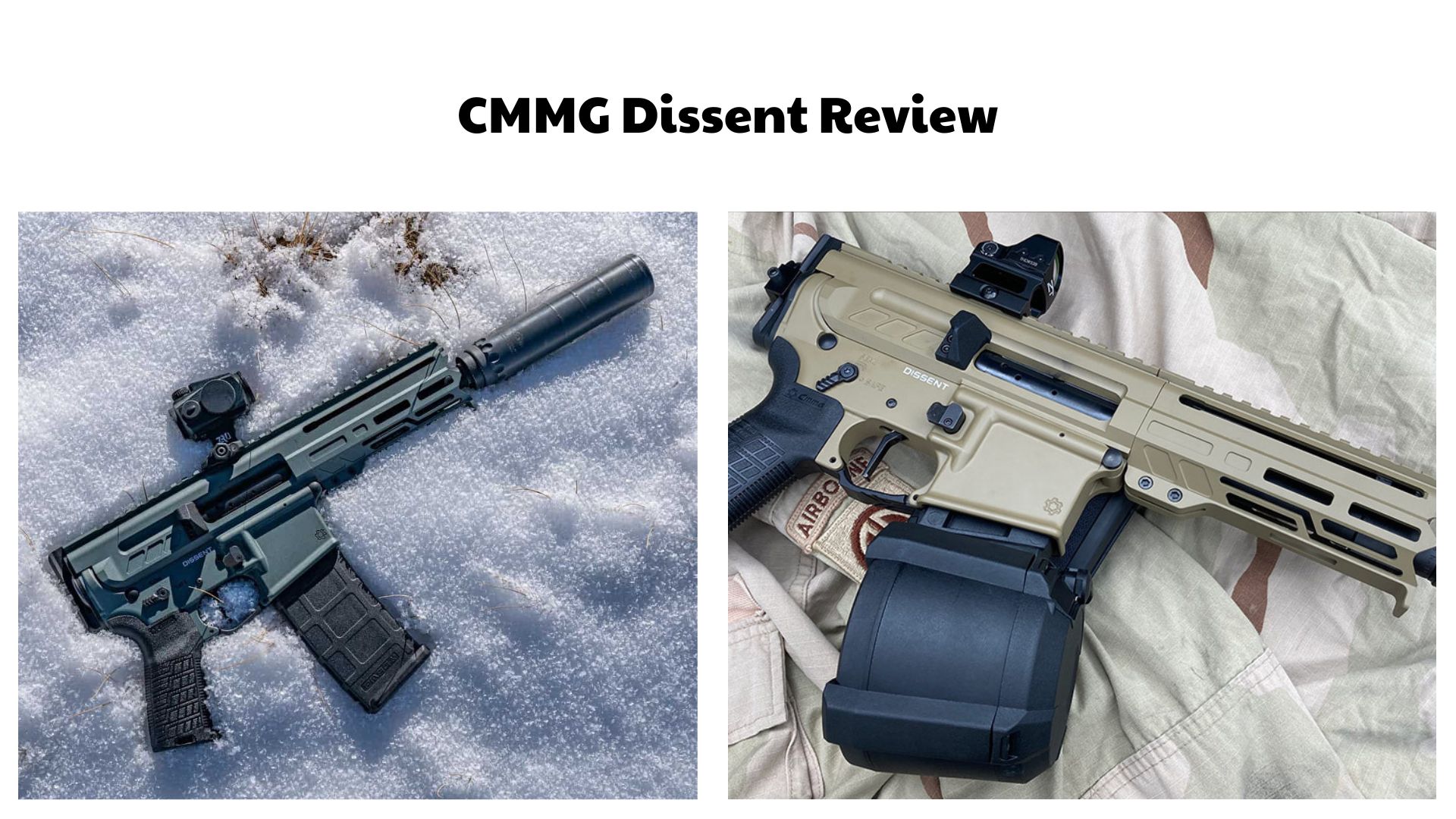

The CMMG Dissent is a modern bufferless AR-platform firearm engineered for compact performance, simplified mechanics, and improved ergonomics. It introduces CMMG’s radial delayed blowback system in an ultra-compact configuration designed to reduce overall system complexity while maintaining AR-style familiarity.
Available in pistol and SBR configurations, the Dissent has gained popularity among shooters looking for a lightweight, suppressor-friendly alternative to traditional AR-15 carbines. It sits between conventional AR platforms and next-generation PDW-style firearms, offering a unique blend of compactness, control, and modern engineering.
What Is the CMMG Dissent?

Overview of the Bufferless AR Platform Concept
The CMMG Dissent eliminates the traditional buffer tube assembly found in standard AR-15 rifles. Instead, it uses a redesigned internal system that allows for a more compact rear profile, making the platform easier to store, transport, and deploy in confined environments.
CMMG’s Engineering Goals and Design Philosophy
The design philosophy behind the Dissent focuses on reducing mechanical complexity while improving handling characteristics. CMMG aimed to create a firearm that retains AR familiarity while improving compactness and suppressor compatibility.
Role of the Dissent in Modern PCC/PDW Market
The Dissent occupies a niche in the modern PDW and compact rifle market, competing with other high-end compact platforms. It is designed for users who want rifle-level performance in a shorter, more maneuverable package.
Why It Stands Out from Traditional AR-15 Platforms
Unlike traditional AR-15 rifles, the Dissent removes the buffer system entirely and integrates a more compact recoil solution. This results in a shorter overall length and improved handling in close-quarters environments.
CMMG Dissent Key Specifications
Caliber Options (5.56 NATO, .300 BLK, 9mm Variants in Some Configs)
The CMMG Dissent is available in multiple calibers including 5.56 NATO and .300 Blackout, with certain configurations supporting 9mm variants depending on model selection. This allows users to tailor the platform for either supersonic performance or suppressed subsonic use.
Barrel Length Options (Ultra-Compact to Carbine Length)
Barrel lengths vary across configurations, ranging from ultra-compact short barrels designed for PDW-style use to longer carbine-length setups for improved ballistic performance and velocity.
Bufferless Operating System Explained
The bufferless system removes the need for a traditional receiver extension and buffer tube assembly. Instead, recoil management is handled through CMMG’s internal mechanical design, enabling a compact rear profile.
Weight and Overall Compact Dimensions
The Dissent is designed to be lightweight and highly maneuverable, making it suitable for close-quarters use and rapid target transitions. Its reduced length enhances portability without significantly sacrificing performance.
Magazine Compatibility (AR-15 and Platform-Specific Magazines)
Depending on caliber configuration, the Dissent is compatible with standard AR-15 magazines for rifle calibers and appropriate platform-specific magazines for pistol caliber variants, ensuring broad usability.
Trigger and Control Layout
The firearm maintains a familiar AR-style control layout, including standard safety selector, magazine release, and trigger positioning, making it easy for experienced AR users to transition to the platform.
Design and Build Quality
Upper and Lower Receiver Construction
The CMMG Dissent features precision-machined upper and lower receivers designed for strength and reliability. The construction emphasizes tight tolerances and durability under repeated firing cycles.
Folding/Compact Stock and Non-Buffer Tube Design
One of the most defining features of the Dissent is its lack of a buffer tube, allowing for folding or highly compact rear-end configurations depending on setup. This enhances storage efficiency and portability.
Handguard and M-LOK Integration
The platform includes modern handguard designs with M-LOK compatibility, enabling attachment of accessories such as optics, lights, grips, and other tactical components.
Fit, Finish, and Manufacturing Quality
The Dissent is built with attention to machining precision and finish quality, reflecting CMMG’s focus on producing a premium-level compact firearm system with consistent assembly standards.
Durability and Field-Grade Construction
The platform is engineered for durability under real-world use conditions, including high round counts, suppressor use, and environmental stress such as dust and moisture exposure.
Operating System and Reliability
Radial Delayed Blowback System Explained
The Dissent utilizes CMMG’s radial delayed blowback system, which slows bolt movement through rotational force mechanics rather than relying on a traditional gas piston or direct impingement system. This helps reduce felt recoil and improves cycling control.
Reliability with Supersonic and Subsonic Ammo
The platform is designed to function reliably with both supersonic and subsonic ammunition depending on caliber configuration, particularly in .300 Blackout setups optimized for suppressed shooting.
Suppressor Performance and Gas Management
When used with a suppressor, the Dissent benefits from reduced gas blowback compared to some direct impingement systems. This improves shooter comfort and reduces fouling in the receiver area.
High Round Count Reliability Testing
High round count testing demonstrates that the platform maintains consistent cycling performance over extended shooting sessions, with minimal wear when properly maintained.
Common Issues and User-Reported Fixes
Some users report minor tuning requirements depending on ammunition type or suppressor setup. These issues are generally resolved through buffer system adjustments, ammo selection, or gas optimization depending on configuration.
Accuracy and Performance
Practical Accuracy at Close to Mid-Range Distances
The CMMG Dissent delivers practical accuracy that aligns with modern compact AR-style platforms. At close to mid-range distances, it performs consistently well, especially when paired with quality ammunition and a red dot or low-power optic. Its design prioritizes fast target engagement over extreme long-range precision.
Barrel Performance and Stabilization Characteristics
Barrel performance on the Dissent varies depending on caliber and length configuration. The shorter barrel setups are optimized for maneuverability, while longer barrels provide improved stabilization and consistency for mid-range shooting applications.
Velocity Performance Across Barrel Lengths
Velocity output is influenced heavily by barrel length, with shorter PDW-style configurations producing lower muzzle velocity compared to carbine-length variants. This trade-off is expected in compact platforms but is balanced by improved handling and portability.
Optics Use and Red Dot Performance
The Dissent is highly compatible with modern optics, particularly red dots and low-power variable optics (LPVOs). Its stable recoil system allows for fast sight recovery and consistent target tracking during rapid shooting sequences.
Real-World Shooting Consistency
In real-world use, the platform maintains consistent shot-to-shot performance, especially in controlled environments such as range training or defensive scenarios. Its reliability contributes to predictable performance under repeated firing cycles.
Recoil and Shooting Experience
Recoil Characteristics vs Traditional AR-15
Compared to a standard AR-15, the CMMG Dissent exhibits a slightly different recoil impulse due to its radial delayed blowback system. Many shooters describe it as smooth and linear, with reduced abrupt cycling feel.
Reduced Buffer System Influence on Shooting Feel
Eliminating the traditional buffer tube system changes the recoil dynamics, resulting in a more compact and balanced rear-end feel. This contributes to a more controlled shooting experience in close quarters.
Muzzle Rise and Fast Follow-Up Shots
Muzzle rise is generally manageable, allowing for quick follow-up shots. The compact configuration helps shooters maintain better control during rapid fire sequences, especially in PDW-style setups.
Suppressed Shooting Behavior
When suppressed, the Dissent benefits from reduced perceived recoil and improved sound suppression characteristics. However, gas tuning and ammunition selection can influence overall shooting smoothness.
Beginner-Friendly Handling Characteristics
Despite its advanced design, the platform remains approachable for newer shooters due to its familiar AR controls and manageable recoil profile, especially in 9mm or .300 BLK configurations.
Ergonomics and Handling
Ultra-Compact Form Factor Advantages
The ultra-compact design of the CMMG Dissent makes it highly suitable for confined environments, vehicle storage, and rapid deployment scenarios. Its reduced length enhances mobility without sacrificing core functionality.
Charging Handle and Manual of Arms Differences
While maintaining AR-style familiarity, the bufferless design introduces subtle differences in handling, particularly in charging and rear-end manipulation, which may require a short adjustment period for AR-15 users.
Balance and Weight Distribution
Weight distribution is optimized toward the center of the firearm, improving balance and reducing front-heavy fatigue during extended use.
One-Handed Handling and CQB Use
The compact size allows for easier one-handed manipulation in close-quarters scenarios, making it suitable for tactical movement and confined space engagement.
Storage and Transport Advantages
Without a traditional buffer tube, the Dissent is easier to store and transport, fitting more efficiently into compact cases, backpacks, and vehicle storage compartments.
CMMG Dissent vs Other AR Platforms
Dissent vs Standard AR-15 Carbines
Compared to standard AR-15 carbines, the Dissent offers a more compact form factor and modern operating system, while traditional ARs generally provide broader aftermarket support and familiarity.
Dissent vs CMMG Banshee Series
The Banshee series shares some design philosophy but typically includes a more traditional buffer system, whereas the Dissent fully embraces the bufferless architecture for maximum compactness.
Dissent vs SIG MCX and Other PDW Platforms
Against platforms like the SIG MCX, the Dissent competes closely in terms of innovation and compact design, though each system differs in gas operation and modularity approaches.
Dissent vs Ruger and Budget PCC/AR Pistols
Compared to budget PCC and AR-style pistols, the Dissent operates in a higher price and performance tier, offering more advanced engineering and compact design advantages.
Value, Innovation, and Performance Comparison
The Dissent stands out for its innovation and compact engineering, though it commands a premium price compared to traditional AR platforms, reflecting its specialized design and advanced operating system.
Suppressor Compatibility and Performance
Suppressor-Ready Design Benefits
The platform is designed with suppressor use in mind, offering improved compatibility and reduced gas blowback compared to many traditional direct impingement systems.
Gas Blowback and Tuning Characteristics
Gas behavior varies depending on configuration, suppressor choice, and ammunition, but overall the system tends to manage gas more efficiently than standard AR platforms.
Subsonic Ammo Performance (.300 BLK Focus)
In .300 Blackout configurations, subsonic ammunition performs particularly well, especially when paired with suppressors for reduced noise and recoil.
Best Suppressor Setups for the Dissent
Optimized suppressor setups typically focus on balancing backpressure and sound reduction, ensuring smooth cycling without excessive gas blowback or reliability issues.
Hearing Safety and Range Experience Improvements
Suppressor use significantly improves shooter comfort by reducing noise levels and recoil impulse, making the platform more enjoyable for extended shooting sessions.
Customisation and Upgrades
AR-Style Compatibility and Limitations
While the Dissent retains AR-style elements, its bufferless design introduces some compatibility limitations compared to standard AR-15 platforms, particularly in stock and buffer-related components.
Optics, Lights, and Rail Accessories
The platform supports a wide range of optics and tactical accessories through its M-LOK handguard system, allowing users to customize it for defensive or range use.
Trigger Upgrade Options
Shooters can install aftermarket triggers compatible with AR-style lower receivers, enabling improved trigger pull and reset characteristics for precision shooting.
Stock/Brace Configurations
Depending on legal configuration, the Dissent supports various brace or stock setups designed specifically for bufferless platforms, enhancing ergonomics and stability.
Aftermarket Ecosystem for CMMG Platforms
Although smaller than the AR-15 ecosystem, aftermarket support for CMMG platforms continues to grow, offering increasing options for upgrades, tuning, and customization.
Maintenance and Durability
Cleaning Requirements for Blowback/Delayed Systems
The CMMG Dissent requires routine maintenance similar to other modern AR-platform firearms, though its operating system influences fouling patterns. Because of its radial delayed blowback system, carbon buildup tends to be distributed differently compared to traditional direct impingement rifles, but regular cleaning is still essential for long-term reliability.
Bolt Carrier and Internal Wear Patterns
Wear patterns in the bolt carrier group and internal components are generally consistent with high-performance compact rifle systems. Over time, users may observe normal contact wear on locking surfaces, especially under high round count or suppressed firing conditions, but these are expected in well-used firearms.
Long-Term Reliability Expectations
With proper maintenance and quality ammunition, the platform is designed to maintain long-term reliability. The simplified bufferless architecture reduces some mechanical complexity, which can contribute to consistent performance over extended use cycles.
Field Maintenance and Ease of Disassembly
Field stripping the CMMG Dissent is relatively straightforward, allowing users to perform basic cleaning and inspection without specialized tools. This makes it practical for both range use and field environments where quick maintenance may be necessary.
Durability in High Round Count Use
The Dissent is engineered for durability under high round count conditions, including training environments and repeated suppressed firing. While components will naturally experience wear over time, the platform is designed to remain stable and functional under sustained use when properly maintained.
Pros and Cons of the CMMG Dissent
Major Advantages of the Platform
The CMMG Dissent offers significant advantages including its ultra-compact bufferless design, reduced overall length, modern recoil system, and strong suppressor compatibility. It provides AR familiarity while delivering PDW-style performance in a lightweight package.
Drawbacks and Trade-Offs of Bufferless Design
Despite its innovations, the bufferless system introduces trade-offs such as higher cost, reduced parts commonality with standard AR-15 platforms, and a smaller aftermarket ecosystem. Some users may also require a short adjustment period to adapt to its unique handling characteristics.
Best Use Cases (Home Defense, Range, Suppressed Shooting)
The Dissent is well-suited for home defense, tactical range training, and suppressed shooting applications. Its compact size and reduced recoil impulse make it particularly effective in close-quarters environments and controlled defensive scenarios.
Who Should Buy the CMMG Dissent?
Shooters Wanting a Compact PDW-Style AR
Shooters looking for a modern PDW-style firearm with AR familiarity will find the Dissent appealing due to its compact footprint and advanced operating system.
Suppressor Enthusiasts
The platform is especially attractive to suppressor users, particularly in .300 Blackout configurations, where subsonic ammunition and gas management create a smoother shooting experience.
Tactical and Home Defense Users
For defensive applications, the Dissent offers maneuverability, fast handling, and reliable performance in close-quarters environments, making it suitable for home defense setups.
AR-15 Owners Looking for a Modern Upgrade
Experienced AR-15 owners may view the Dissent as a next-step evolution, offering a more compact and technologically advanced alternative to traditional buffer-based AR platforms.
Not Ideal for Traditional AR Purists or Budget Buyers
The platform may not appeal to shooters who prefer classic AR-15 systems or those seeking budget-friendly options, as the Dissent sits in a higher price and more specialized category.
Final Verdict on CMMG Dissent Review
The CMMG Dissent represents a forward-thinking approach to compact rifle design, combining bufferless architecture, radial delayed blowback operation, and strong suppressor compatibility into a highly modern platform. It delivers excellent handling characteristics and AR-style familiarity in a significantly more compact form factor.
While its premium pricing and departure from traditional AR-15 design may limit its appeal to some users, it stands out as a niche leader in the PDW-style firearm category. For shooters seeking innovation, compactness, and modern engineering, the Dissent is a compelling option in today’s evolving AR-platform market.
CMMG Dissent Review FAQ (55 Detailed Questions and Answers)
1. What is the CMMG Dissent?
The CMMG Dissent is a modern bufferless AR-style firearm designed for compact performance, using a radial delayed blowback system instead of a traditional buffer tube setup.
2. How is the CMMG Dissent different from an AR-15?
Unlike a standard AR-15, the Dissent removes the buffer tube and uses an internal recoil system, resulting in a shorter, more compact firearm.
3. What makes the Dissent “bufferless”?
It eliminates the traditional receiver extension and buffer assembly, integrating recoil management into the upper receiver design.
4. What calibers does the CMMG Dissent come in?
It is commonly offered in 5.56 NATO and .300 Blackout, with some configurations designed for specialized use cases like suppressed shooting.
5. Is the CMMG Dissent good for home defense?
Yes, its compact size, fast handling, and controllable recoil make it suitable for home defense applications in confined spaces.
6. Is the Dissent good for beginners?
It can be used by beginners due to AR-style controls, but its price and advanced system make it more appealing to experienced shooters.
7. What is radial delayed blowback?
It is a system where the bolt rotates during cycling, slowing rearward movement and reducing felt recoil compared to direct blowback.
8. Is the Dissent reliable?
Yes, it is generally reliable when properly maintained and used with quality ammunition suited to its configuration.
9. Does the Dissent use a gas system?
No, it uses a radial delayed blowback system instead of a traditional gas piston or direct impingement system.
10. Is it better than a direct impingement AR-15?
It depends on use case; the Dissent is more compact and smoother in recoil impulse, while DI AR-15s are simpler and more common.
11. Is the CMMG Dissent good for suppressors?
Yes, it is designed with suppressor use in mind, especially in .300 Blackout configurations.
12. Does it have a buffer tube?
No, it is a bufferless design, meaning it does not require a traditional buffer tube or stock extension.
13. Is the Dissent compact?
Yes, it is significantly more compact than standard AR-15 rifles due to its bufferless architecture.
14. How does recoil compare to AR-15?
Recoil is often described as smooth and slightly different in impulse, with reduced “springy” buffer feel.
15. Is the Dissent good for CQB?
Yes, its compact size and maneuverability make it well-suited for close-quarters battle scenarios.
16. What magazines does it use?
It uses standard AR-15 magazines for rifle calibers and appropriate magazines for specific configurations.
17. Is it compatible with Glock magazines?
No, Glock magazine compatibility is typically associated with PCC platforms, not the Dissent AR platform.
18. Is the Dissent heavy?
No, it is designed to be lightweight and balanced for improved handling and mobility.
19. Is it good for long-range shooting?
It is not optimized for long-range precision; it is better suited for close to mid-range engagement distances.
20. What is the effective range?
Effective range depends on caliber, but generally it is optimized for close to mid-range shooting rather than extreme distance.
21. Does it work with optics?
Yes, it is fully compatible with red dots, holographic sights, and low-power variable optics.
22. Is the Dissent durable?
Yes, it is built with modern materials and is designed for high round count durability when properly maintained.
23. Does it require special maintenance?
Maintenance is similar to AR-style rifles, but attention should be given to its unique operating system components.
24. Is it easy to clean?
Yes, it can be field stripped and cleaned relatively easily compared to many compact firearm systems.
25. Does suppressor use affect reliability?
It can, depending on configuration and ammunition, but the system is designed to handle suppressor use well.
26. Does it have more recoil than AR-15?
Recoil is different rather than strictly higher or lower; many users find it smoother in impulse.
27. Is it good for competition shooting?
It can be used in some competitive formats but is not primarily designed as a dedicated competition rifle.
28. What is its main advantage?
Its main advantage is compactness combined with modern recoil management and suppressor-friendly design.
29. What is its biggest disadvantage?
The biggest disadvantage is its higher cost compared to standard AR-15 platforms.
30. Is it worth the price?
It depends on user needs; those wanting compact PDW performance often find it worth the premium.
31. Can it replace an AR-15?
It can serve similar roles but does not fully replace a traditional AR-15 due to cost and configuration differences.
32. Is it good for tactical use?
Yes, especially in close-quarters and rapid deployment scenarios.
33. Does it have ambidextrous controls?
Many configurations include or support ambidextrous-friendly AR-style controls.
34. Is the trigger good?
Trigger quality depends on model and can be upgraded using AR-compatible aftermarket options.
35. Can you upgrade the trigger?
Yes, many AR-compatible triggers can be installed depending on configuration.
36. Does it heat up quickly?
Like most compact firearms, it can heat up during sustained fire but remains within normal operating expectations.
37. Is it reliable with cheap ammo?
It generally performs best with quality ammunition, but can run many standard loads reliably.
38. Is it good for indoor range use?
Yes, especially in suppressed configurations where noise and concussion are reduced.
39. Is it louder than AR-15?
Unsuppressed, it is similar in sound level; suppressed, it can be significantly quieter depending on caliber.
40. Does it have muzzle rise?
Muzzle rise is present but generally manageable due to its recoil system and weight distribution.
41. Can it be used one-handed?
Its compact design allows for limited one-handed manipulation in close quarters situations.
42. Is it good for vehicle use?
Yes, its compact size makes it practical for storage in vehicles compared to full-length rifles.
43. Is it modular?
Yes, it supports AR-style modularity for optics, accessories, and some internal components.
44. Does it have good aftermarket support?
Aftermarket support is growing but is still smaller compared to traditional AR-15 platforms.
45. Is it better than SIG MCX?
Both are premium platforms; the MCX offers broader adoption, while the Dissent emphasizes bufferless simplicity.
46. Is it better than AR-15 pistols?
It offers a more refined bufferless system, but at a significantly higher price point.
47. Does it fold?
Some configurations support folding or compact storage depending on setup.
48. Is it legal everywhere?
Legality depends on local laws regarding pistol braces, SBRs, and firearm classification.
49. Can it be used for hunting?
It can be used in some hunting scenarios depending on caliber and local regulations, though it is not its primary purpose.
50. What is its main competition?
It competes with platforms like SIG MCX, BRN-180, and other compact PDW-style rifles.
51. Is it loud unsuppressed?
Yes, like most short-barrel rifles, it can be loud without a suppressor.
52. Does it kick hard?
Recoil is generally manageable and smoother than many direct blowback systems.
53. Is it easy to transport?
Yes, its compact size makes it easier to transport than full-length rifles.
54. What is its best use case?
Its best use case is close-quarters tactical use, home defense, and suppressed shooting setups.
55. What is the final verdict?
The CMMG Dissent is a high-end, innovative bufferless AR platform offering excellent compact performance, suppressor compatibility, and modern engineering, but at a premium price that targets niche users.
Read more: