
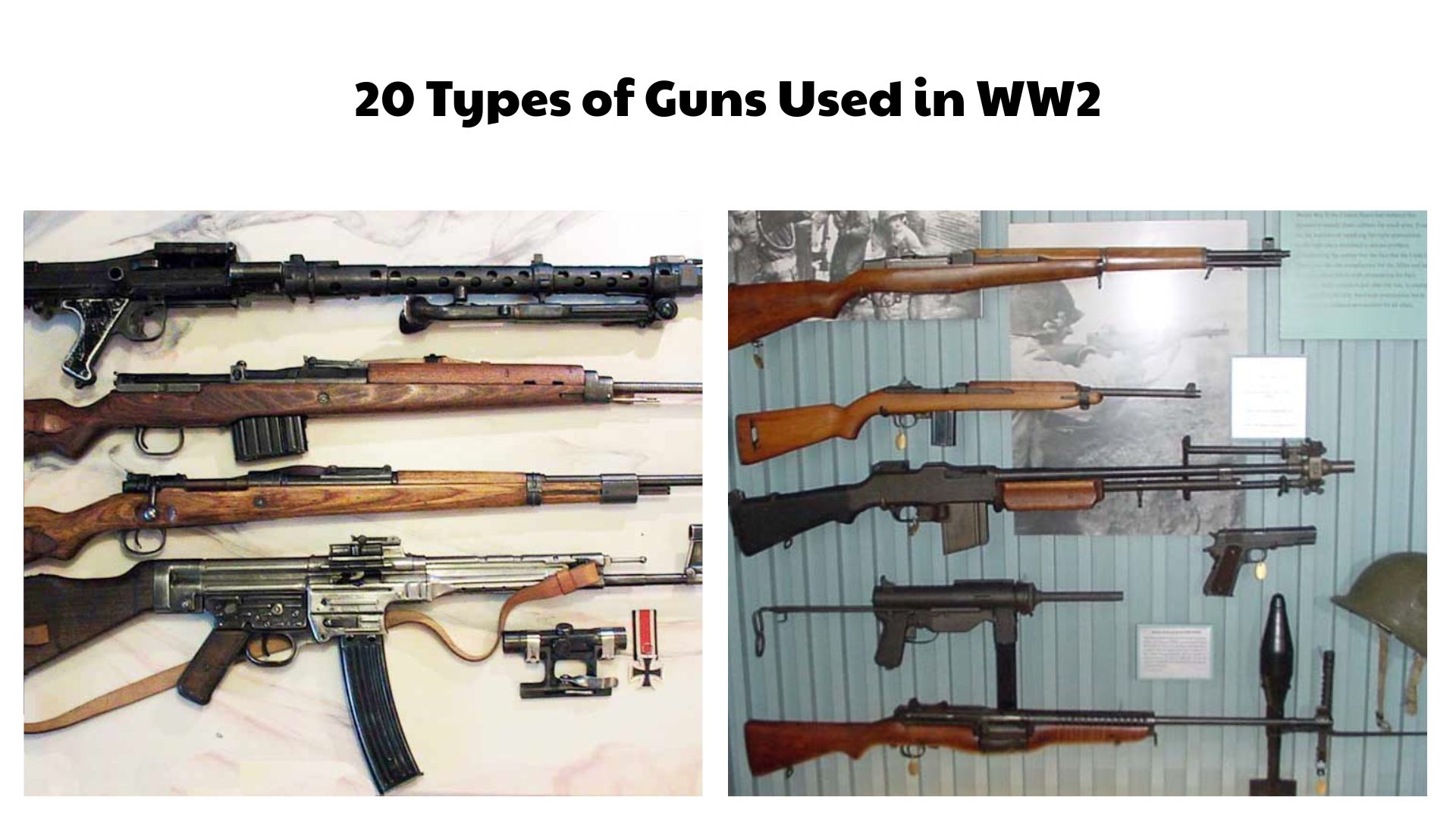

World War II was one of the most intense and technologically transformative conflicts in modern history, and firearms played a central role in shaping battlefield outcomes. The types of guns used in WW2 ranged from bolt-action rifles and semi-automatic rifles to submachine guns and heavy machine guns, each designed to meet specific tactical needs. Different nations developed their own distinctive weapon systems based on industrial capacity, combat doctrine, and battlefield experience. This guide provides a structured and expert-level overview of the most important guns used in WW2, focusing on their design philosophy, combat performance, and historical significance. Each weapon is explained in a clear and accessible way, helping readers understand not just what these guns were, but how they were actually used in real combat situations.
20 Types of Guns Used in WW2
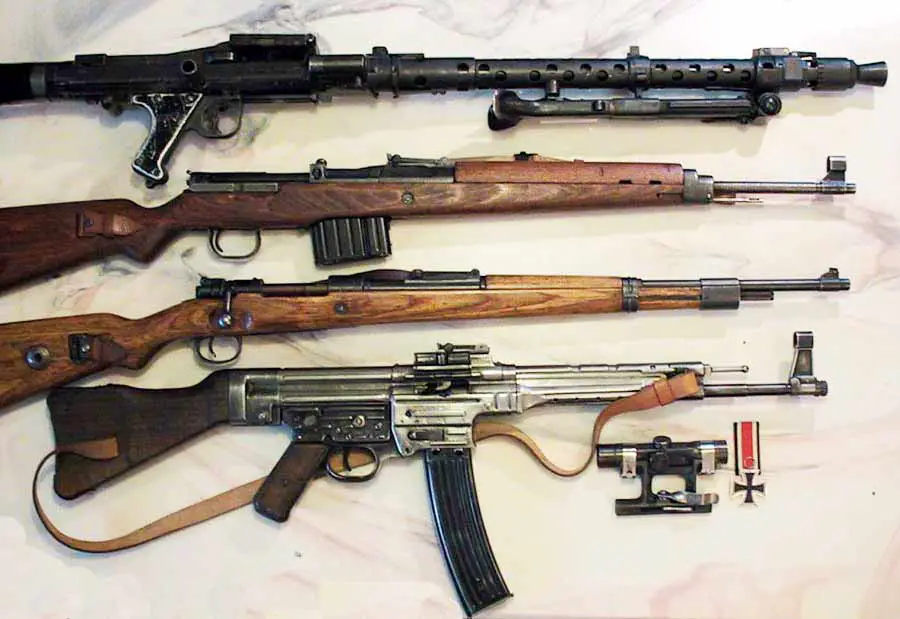
1. Karabiner 98k (Germany)
The Karabiner 98k was the standard service rifle of German infantry forces during World War II, and it represents one of the most refined bolt-action rifle designs of its era. Built on the Mauser system, it was known for its exceptional accuracy, strong build quality, and reliable performance in harsh battlefield conditions. The rifle used 7.92×57mm Mauser ammunition, which delivered high velocity and strong penetration power, making it effective at both medium and long ranges. In the broader category of guns used in WW2, the Kar98k is often regarded as a benchmark for bolt-action engineering.
From a practical standpoint, the Kar98k required manual cycling after each shot, which limited its rate of fire compared to semi-automatic weapons. However, this limitation was offset by its precision and consistency. Skilled marksmen could effectively engage targets at long distances, making it a preferred choice for designated sharpshooters. The rifle’s iron sights were simple but highly effective, and its solid construction allowed it to withstand rough field conditions, including mud, cold, and prolonged use without major failures.
In combat doctrine, the Kar98k reflected the German emphasis on disciplined marksmanship and controlled fire. Infantry units were trained to make deliberate, accurate shots rather than rely on volume of fire. While later stages of the war introduced more automatic weapons, the Kar98k remained a core infantry tool. Within the study of WW2 firearms, it stands as a classic example of precision-focused design in the era of bolt-action rifles.
2. Mosin-Nagant M1891/30 (Soviet Union)
The Mosin-Nagant M1891/30 was the primary infantry rifle of the Soviet Union during World War II and one of the most widely produced bolt-action rifles in history. Known for its simplicity and rugged construction, it was designed to function reliably under extreme conditions, including freezing temperatures and battlefield mud. Chambered in 7.62×54mmR, the rifle delivered strong ballistic performance and effective range, making it suitable for both standard infantry use and sniper applications. Among the many guns used in WW2, the Mosin-Nagant is notable for its sheer production scale and battlefield durability.
One of the key strengths of the Mosin-Nagant was its mechanical simplicity. It could be manufactured quickly and repaired easily, which was essential for wartime Soviet industry. The rifle’s bolt-action system was robust, although not as smooth as some Western counterparts. Despite this, it proved highly reliable in combat situations where maintenance conditions were poor. Its long barrel contributed to stable bullet trajectory, giving it respectable accuracy at distance.
In sniper configuration, the Mosin-Nagant became a feared weapon in skilled hands. Soviet snipers used it effectively in urban combat, forest engagements, and defensive operations. Its role in battles such as Stalingrad highlights its importance in Soviet defensive strategy. As part of the wider ecosystem of WW2 firearms, the Mosin-Nagant represents durability, simplicity, and mass-production efficiency under wartime pressure.
3. Lee-Enfield No.4 Mk I (United Kingdom)
The Lee-Enfield No.4 Mk I was the standard service rifle of British and Commonwealth forces during World War II. It is widely recognized for its exceptional bolt-action speed, which allowed trained soldiers to achieve a remarkably high rate of fire for a manually operated rifle. Chambered in .303 British, the weapon combined solid stopping power with practical battlefield usability. Within the category of guns used in WW2, the Lee-Enfield stands out for its balance between precision and rapid fire capability.
One of its most distinctive features was its 10-round magazine capacity, which was significantly higher than many bolt-action rifles of the era. This reduced the need for frequent reloading and gave soldiers an advantage in sustained engagements. The smooth bolt mechanism also contributed to faster cycling, allowing experienced users to maintain consistent pressure on enemy positions. Its durability made it suitable for diverse combat environments, from desert warfare in North Africa to jungle operations in Southeast Asia.
The Lee-Enfield also played a psychological role on the battlefield. Its rapid firing capability created the impression of automatic fire, even though it was manually operated. This contributed to its effectiveness in suppressive roles. In the broader context of WW2 weapons, it represents a unique hybrid between traditional bolt-action design and near semi-automatic performance in practical use.
4. M1903 Springfield (United States)
The M1903 Springfield was a bolt-action rifle used by American forces in the early stages of World War II, later supplemented by semi-automatic designs. Based on the Mauser system, it shared design similarities with other high-precision rifles of its era. Chambered in .30-06 Springfield, it offered strong ballistic performance and excellent long-range accuracy. Among the various guns used in WW2, the M1903 is often associated with precision shooting and early-war infantry doctrine.
The rifle was highly regarded for its accuracy, making it a preferred platform for designated marksmen and sniper variants. Its controlled bolt-action system ensured consistent shot placement, which was critical in engagements requiring precision. However, its lower rate of fire compared to semi-automatic rifles eventually led to its replacement in frontline infantry roles as the war progressed.
Despite being phased out in favor of the M1 Garand, the M1903 Springfield remained in service throughout the war in specialized roles. Its contribution to training, sniping, and reserve units highlights its versatility. Within WW2 firearms history, it represents the transition period between traditional bolt-action rifles and modern semi-automatic infantry weapons.
5. Arisaka Type 99 (Japan)
The Arisaka Type 99 was the standard bolt-action rifle of the Imperial Japanese Army during World War II. Designed to replace earlier models, it was chambered in 7.7×58mm Arisaka ammunition, offering improved stopping power and range. The rifle was built with simplicity and ruggedness in mind, making it suitable for varied combat environments across the Pacific theater. In the broader classification of guns used in WW2, the Type 99 reflects Japan’s emphasis on durable and efficient infantry weapons.
One of the notable features of the Type 99 was its strong receiver design, which made it highly resistant to damage and mechanical failure. It also included a unique anti-aircraft sight system in early models, reflecting battlefield adaptation to changing warfare conditions. While its bolt-action system limited its firing speed, it remained reliable in jungle warfare, where environmental durability was more important than rapid fire.
In combat use, the Arisaka Type 99 served as a dependable infantry rifle throughout the Pacific campaigns. Its performance varied depending on production quality, especially in later-war models, but overall it maintained a reputation for toughness. As part of WW2 small arms history, it represents the practical engineering approach of Japanese wartime weapon design.
6. M1 Garand (United States)
The M1 Garand is one of the most historically significant semi-automatic rifles of World War II and is often described as a turning point in infantry weapon design. Unlike bolt-action rifles that required manual cycling after each shot, the M1 Garand allowed soldiers to fire multiple rounds rapidly without losing sight of the target. Chambered in .30-06 Springfield, it delivered strong ballistic performance combined with a higher rate of fire, giving American infantry a noticeable advantage in many battlefield situations. Among the many types of guns used in WW2, the M1 Garand stands out as a symbol of technological advancement in infantry warfare.
One of its most defining features was its 8-round en-bloc clip system, which automatically ejected once empty with a distinctive metallic “ping” sound. This system simplified reloading under pressure, allowing soldiers to maintain combat effectiveness with minimal interruption. The rifle was also praised for its reliability under harsh conditions, including mud, rain, and dust, which were common in European and Pacific theaters. While slightly heavier than some bolt-action rifles, its semi-automatic capability more than compensated for this drawback.
In combat use, the M1 Garand significantly increased individual soldier firepower, changing infantry tactics toward more aggressive and mobile engagements. It reduced the need for bolt manipulation after each shot, allowing faster response times in close-to-medium range combat. Within the broader ecosystem of WW2 firearms, it represents the transition from traditional manual rifles to modern semi-automatic infantry weapons, shaping future military rifle development.
7. MP40 Submachine Gun (Germany)
The MP40 is one of the most recognizable submachine guns of World War II and was widely used by German infantry, paratroopers, and armored vehicle crews. Designed for close-quarters combat, it fired 9×19mm Parabellum rounds in fully automatic mode, making it highly effective in urban environments, trenches, and building-to-building engagements. Among the various guns used in WW2, the MP40 is often associated with mobility and controlled automatic fire.
The weapon was designed with practicality in mind. It featured a folding metal stock, compact frame, and simplified construction that allowed mass production. Unlike earlier submachine guns that often suffered from poor controllability, the MP40 had a relatively low rate of fire, which made it easier to handle during sustained bursts. This balance between controllability and firepower made it effective in fast-paced combat scenarios where precision mattered less than volume of fire.
Although it was not intended for long-range combat, the MP40 excelled in close engagements where speed and maneuverability were critical. Its influence extended beyond the war, shaping post-war submachine gun designs around the world. In the study of WW2 firearms, it represents the evolution of compact automatic weapons designed for modern infantry warfare.
8. Thompson M1A1 Submachine Gun (United States)
The Thompson M1A1, often called the “Tommy Gun,” was one of the most iconic submachine guns used during World War II. Known for its distinctive appearance and high rate of fire, it became a symbol of American firepower in both military and media portrayals. Chambered in .45 ACP, it delivered strong stopping power at close range, making it effective in urban combat, trench warfare, and amphibious assaults. Among guns used in WW2, the Thompson is one of the most culturally recognizable.
The M1A1 variant simplified earlier Thompson designs to make production faster and more cost-effective. It eliminated some complex features while retaining its core performance characteristics. The weapon featured a straight blowback system and a high-capacity magazine, allowing soldiers to deliver sustained automatic fire in short bursts. However, its relatively heavy weight and high ammunition consumption limited its practicality in prolonged engagements.
Despite these limitations, the Thompson was highly valued for its reliability and effectiveness in close combat. It was especially useful during island-hopping campaigns in the Pacific, where engagements often occurred at very short distances. Within WW2 small arms history, it represents the balance between raw firepower and practical battlefield application.
9. PPSh-41 Submachine Gun (Soviet Union)
The PPSh-41 is one of the most widely produced submachine guns of World War II and played a critical role in Soviet infantry tactics. Designed for mass production and battlefield durability, it fired 7.62×25mm Tokarev rounds at an extremely high rate of fire. This made it especially effective in close-range combat, where overwhelming firepower could quickly suppress enemy positions. Among the types of guns used in WW2, the PPSh-41 is known for its simplicity and sheer volume of fire.
Its drum magazine allowed for a large ammunition capacity, reducing the need for frequent reloading during intense firefights. The weapon’s stamped metal construction made it inexpensive and fast to produce, which was essential for wartime Soviet manufacturing. Despite its simplicity, it was surprisingly reliable and could function effectively in harsh winter conditions, mud, and battlefield debris.
In combat, the PPSh-41 became a favorite among Soviet assault troops due to its ability to dominate close-quarters engagements. Its high rate of fire created a significant psychological and tactical advantage in urban warfare. Within WW2 firearms evolution, it represents the concept of mass-produced, high-volume infantry weapons designed for aggressive frontline tactics.
10. MG42 General Purpose Machine Gun (Germany)
The MG42 is one of the most feared and effective machine guns of World War II, known for its extremely high rate of fire and battlefield efficiency. It was designed as a general-purpose machine gun capable of serving in both light and sustained fire roles. Chambered in 7.92×57mm Mauser, it delivered devastating suppressive fire that could dominate entire combat zones. Among all guns used in WW2, the MG42 is often regarded as one of the most advanced machine guns of its time.
Its most notable feature was its incredibly high cyclic rate, which created a distinctive and intimidating sound often described as a “buzz saw” effect. This psychological impact, combined with its raw firepower, made it highly effective in defensive and offensive operations. The MG42 used a belt-fed system, allowing continuous firing with minimal interruption when properly supplied with ammunition.
While its performance was exceptional, it also required significant ammunition and barrel management due to heat buildup. Despite this, its reliability and adaptability made it a cornerstone of German defensive strategy. In the broader history of WW2 weapons, the MG42 stands as a benchmark for machine gun design that influenced many post-war systems.
11. Sten Gun Mk II (United Kingdom)
The Sten Gun Mk II was one of the most practical and widely produced submachine guns used by British and Commonwealth forces during World War II. Designed under urgent wartime conditions, it prioritized simplicity, low production cost, and ease of manufacture over refined ergonomics. Chambered in 9×19mm Parabellum, it delivered effective close-range firepower while being extremely cheap and fast to produce. Among the many types of guns used in WW2, the Sten Gun represents industrial efficiency under pressure.
Its design was intentionally minimalistic. The weapon used stamped metal parts and a straightforward blowback operation system, which reduced manufacturing complexity. This allowed factories with limited resources to produce large quantities quickly. However, this simplicity also introduced trade-offs in handling comfort and reliability compared to more refined submachine guns of the era.
In combat, the Sten Gun excelled in guerrilla warfare, resistance operations, and airborne missions where lightweight and compact weapons were essential. Its folding or fixed stock variants made it adaptable to different mission profiles. Despite its rough design, it played a crucial role in arming resistance fighters across occupied Europe, making it one of the most strategically important WW2 firearms in terms of accessibility.
12. M3 “Grease Gun” (United States)
The M3 Submachine Gun, commonly known as the “Grease Gun,” was developed as a cost-effective alternative to the Thompson. Designed for simplicity and mass production, it fired .45 ACP rounds and featured a slow, controllable rate of fire. Within the broad category of guns used in WW2, the M3 stands out as a pragmatic solution to wartime production demands.
Its design heavily emphasized manufacturability. The weapon used stamped steel construction and minimal machining, significantly reducing production time and cost. This allowed the United States to equip large numbers of troops without straining industrial capacity. The retractable wire stock and compact frame also made it suitable for vehicle crews and paratroopers.
In terms of battlefield performance, the M3 was reliable and easy to maintain, though not as refined as higher-end submachine guns. Its slower rate of fire improved controllability, making it effective in short bursts during close-range engagements. It represents a shift in WW2 weapon philosophy toward efficiency and scalability.
13. Bren Light Machine Gun (United Kingdom)
The Bren Light Machine Gun was one of the most respected support weapons used by British forces during World War II. Based on a Czech design, it was chambered in .303 British and fed through a top-mounted magazine. Among all types of guns used in WW2, the Bren is widely recognized for its accuracy and reliability in sustained fire roles.
Unlike many machine guns designed purely for suppression, the Bren was known for its precision. It could be fired in controlled bursts, allowing operators to engage specific targets rather than simply saturate an area. Its quick-change barrel system also helped manage heat during prolonged engagements, improving battlefield endurance.
The Bren was typically operated by a small team, often providing covering fire for advancing infantry. Its balanced design allowed it to be used both in defensive positions and mobile operations. In WW2 infantry doctrine, it represented the ideal combination of accuracy, durability, and sustained fire capability.
14. Browning Automatic Rifle (BAR M1918) (United States)
The Browning Automatic Rifle, commonly known as the BAR, was a hybrid between a rifle and a light machine gun. It fired .30-06 Springfield rounds and was designed to provide mobile automatic fire support for infantry units. Within the broader classification of guns used in WW2, the BAR filled a unique tactical role.
Its main advantage was mobility. Unlike heavier machine guns, the BAR could be carried and fired by a single soldier, allowing for flexible deployment in fast-moving combat situations. It offered both semi-automatic and automatic firing modes, giving operators control over ammunition usage and recoil management.
Although it had a relatively small magazine capacity, its reliability and firepower made it highly effective in supporting infantry assaults. It was particularly useful in jungle and urban warfare where mobility and quick reaction times were essential. The BAR represents an early step toward modern squad automatic weapons.
15. DP-27 Degtyaryov Light Machine Gun (Soviet Union)
The DP-27 was a Soviet light machine gun known for its distinctive pan magazine and rugged battlefield performance. Chambered in 7.62×54mmR, it was designed for infantry support roles and could deliver sustained suppressive fire. Among the various types of guns used in WW2, the DP-27 is recognized for its simplicity and battlefield resilience.
Its top-mounted disc magazine gave it a unique appearance and allowed for a high ammunition capacity compared to some belt-fed systems. The weapon was designed to function reliably in extreme environments, including freezing temperatures and muddy conditions common on the Eastern Front.
While it had a slower reload process compared to belt-fed machine guns, its durability and ease of maintenance made it a dependable support weapon. It played a significant role in Soviet infantry tactics, especially in defensive operations and large-scale offensives.
16. Browning M1919 Medium Machine Gun (United States)
The Browning M1919 was a versatile medium machine gun widely used by American forces during World War II. Chambered in .30-06 Springfield, it was designed for sustained fire support in both infantry and vehicle-mounted roles. Within WW2 firearms systems, it is known for its adaptability and long service life.
The M1919 used a belt-fed system that allowed for continuous fire when supplied with ammunition. It was typically mounted on tripods, vehicles, or defensive positions, making it a key component of battlefield suppression tactics. Its air-cooled design simplified logistics compared to water-cooled systems.
Despite being heavier than light machine guns, it offered superior sustained fire capability and reliability. It was widely used across multiple theaters of war, proving effective in both offensive and defensive operations. It remains one of the most influential machine guns in military history.
17. SVT-40 Tokarev Rifle (Soviet Union)
The SVT-40 Tokarev Rifle was one of the most advanced semi-automatic rifles used by Soviet forces during World War II. Designed to increase infantry firepower, it offered a significant improvement over traditional bolt-action rifles. Chambered in 7.62×54mmR, it provided strong ballistic performance combined with a faster rate of fire. Among the many types of guns used in WW2, the SVT-40 represents an early attempt to modernize infantry combat through semi-automatic technology.
The rifle featured a gas-operated mechanism that allowed automatic cycling after each shot, reducing the need for manual bolt operation. This increased the speed at which soldiers could engage multiple targets, especially in medium-range combat. However, the design was more complex than simpler bolt-action rifles, making it more sensitive to maintenance conditions and battlefield wear.
Despite its challenges, the SVT-40 was appreciated for its firepower advantage and ergonomic design. It provided Soviet infantry with a higher level of offensive capability, especially in early-war engagements. In WW2 firearms evolution, it represents a transitional step toward modern semi-automatic service rifles.
18. Gewehr 43 (Germany)
The Gewehr 43 was Germany’s answer to semi-automatic infantry rifles during World War II. It was developed to improve the firepower of German soldiers, especially as battlefield conditions demanded faster engagement speeds. Chambered in 7.92×57mm Mauser, it combined semi-automatic operation with strong stopping power, making it a valuable addition to late-war German infantry units. Among guns used in WW2, the G43 reflects technological adaptation under pressure.
The rifle used a gas-operated system that allowed rapid follow-up shots without manual cycling. This significantly improved combat efficiency compared to bolt-action rifles like the Kar98k. It was also designed with mounting options for optical scopes, making it suitable for designated marksmen roles.
Although produced in limited numbers compared to earlier rifles, the Gewehr 43 demonstrated Germany’s shift toward semi-automatic infantry weapons. It represents the increasing importance of firepower density in late-war combat scenarios.
19. M1941 Johnson Rifle (United States)
The M1941 Johnson Rifle was an innovative semi-automatic weapon used by select American forces during World War II. It was designed as an alternative to the M1 Garand, featuring a recoil-operated system rather than gas operation. Chambered in .30-06 Springfield, it delivered comparable performance with a slightly different mechanical approach. Among the types of guns used in WW2, it is known for its unique engineering design.
One of its distinctive features was its rotary magazine, which allowed for smoother feeding compared to clip-based systems. This design also made it possible to top-load the rifle without removing the magazine, offering flexibility in combat reload situations. The weapon was lightweight and accurate, making it suitable for both infantry and specialized units.
However, the M1941 Johnson saw limited widespread adoption due to logistical preferences for the M1 Garand. Despite this, it remains an important example of innovation in WW2 firearms development, showcasing alternative approaches to semi-automatic rifle design.
20. Fedorov Avtomat (Soviet Experimental Rifle)
The Fedorov Avtomat is often considered one of the earliest examples of an automatic rifle concept, predating many later World War II designs. Although developed earlier, it saw limited use and experimental deployment into the early 20th century conflicts. It fired 6.5mm Arisaka ammunition and was capable of both semi-automatic and fully automatic fire. Within the broader study of guns used in WW2, it represents foundational experimentation in automatic infantry weapons.
Its design aimed to create a lightweight automatic rifle that could bridge the gap between submachine guns and traditional rifles. This concept was ahead of its time, as most armies still relied heavily on bolt-action systems during early warfare development. The weapon demonstrated the potential advantages of automatic fire in infantry combat, even if it was not widely produced.
Although production numbers were limited, the Fedorov Avtomat influenced later Soviet thinking about infantry firepower. It is often studied as a conceptual predecessor to modern assault rifles, making it an important milestone in the evolution of WW2-era and pre-WW2 firearms technology.
Conclusion
The full range of types of guns used in WW2 reflects a period of rapid technological change and intense battlefield adaptation. From bolt-action rifles built for precision to submachine guns designed for aggressive close-range combat, each weapon was shaped by the strategic needs of its nation. Semi-automatic rifles marked a shift toward increased infantry firepower, while machine guns provided the backbone of suppression and defensive control.
Together, these weapons illustrate how World War II accelerated firearm development across the world. They were not just tools of war but also catalysts for modern military design principles that continue to influence weapons today. Understanding these guns used in WW2 provides deeper insight into how warfare evolved into the modern era.
Frequently Asked Questions (50+ FAQs) About Guns Used in WW2
1. What were the most common guns used in WW2?
The most common guns used in World War II included bolt-action rifles like the Kar98k and Mosin-Nagant, semi-automatic rifles such as the M1 Garand, submachine guns like the MP40 and PPSh-41, and machine guns such as the MG42 and Browning M1919. These weapons formed the backbone of infantry combat across all major armies. Each nation adapted its firearms based on industrial capability, combat doctrine, and battlefield needs, which is why WW2 saw such a wide variety of weapon designs.
2. What was the deadliest gun in WW2?
There is no single “deadliest” gun, but the MG42 machine gun is often considered one of the most lethal due to its extremely high rate of fire and ability to suppress entire enemy units. It could fire up to 1,200–1,500 rounds per minute, creating overwhelming battlefield pressure. However, its effectiveness depended on ammunition supply and tactical positioning, meaning its impact was greatest in defensive roles.
3. What was the most used rifle in WW2?
The Mosin-Nagant and Kar98k were among the most widely issued bolt-action rifles, while the M1 Garand was the most prominent semi-automatic rifle. These weapons were mass-produced and issued to millions of soldiers. Their widespread use reflects the importance of reliable infantry rifles in WW2 combat operations.
4. Why were bolt-action rifles still used in WW2?
Bolt-action rifles remained common because they were simple, reliable, and easy to mass-produce. They also offered high accuracy at long range. Although slower to fire than semi-automatic weapons, they were sufficient for many battlefield roles and could function in harsh conditions with minimal maintenance.
5. What is a submachine gun in WW2?
A submachine gun is a compact automatic weapon that fires pistol-caliber ammunition. It is designed for close-range combat, such as urban warfare and trench fighting. Examples include the MP40, Thompson, and PPSh-41. These weapons provided high firepower in short bursts, making them extremely effective in close engagements.
6. What made the M1 Garand special?
The M1 Garand was the first widely issued semi-automatic rifle in WW2. It allowed soldiers to fire multiple shots without manually cycling the bolt, greatly increasing combat speed. Its reliability, accuracy, and firepower made it a major advantage for American forces.
7. What was the role of machine guns in WW2?
Machine guns were used primarily for suppression and defensive fire. They controlled battlefield movement by forcing enemy troops to take cover. Heavy and light machine guns like the MG42 and Bren played a critical role in both offensive and defensive strategies.
8. Were WW2 guns automatic?
Not all WW2 guns were automatic. There were bolt-action, semi-automatic, and fully automatic weapons. Submachine guns and machine guns were typically automatic, while rifles varied depending on design and role.
9. What was the fastest-firing gun in WW2?
The MG42 had one of the highest rates of fire, reaching up to 1,500 rounds per minute. This made it extremely effective for suppression but also required careful ammunition management and barrel changes to avoid overheating.
10. What guns did American soldiers use in WW2?
American soldiers commonly used the M1 Garand rifle, Thompson submachine gun, M1919 machine gun, BAR (Browning Automatic Rifle), and later the M3 Grease Gun. These weapons provided a mix of accuracy, firepower, and mobility.
11. What guns did German soldiers use in WW2?
German soldiers used the Kar98k rifle, MP40 submachine gun, MG34 and MG42 machine guns, and later semi-automatic rifles like the Gewehr 43. These weapons were known for engineering precision and battlefield efficiency.
12. What guns did Soviet soldiers use in WW2?
Soviet forces used the Mosin-Nagant rifle, PPSh-41 submachine gun, DP-27 machine gun, and SVT-40 semi-automatic rifle. Their weapons emphasized durability, simplicity, and mass production.
13. What guns did Japanese soldiers use in WW2?
Japanese forces primarily used the Arisaka Type 99 rifle, Type 100 submachine gun, and various light machine guns. Their weapons were designed for reliability in jungle warfare conditions.
14. What is the difference between SMG and rifle?
A submachine gun (SMG) fires pistol ammunition and is designed for close-range combat, while a rifle fires more powerful cartridges suitable for medium to long-range engagement. SMGs are more compact and faster in close combat scenarios.
15. Were WW2 guns accurate?
Accuracy varied by weapon type. Bolt-action rifles were highly accurate at long range, while submachine guns were less precise but effective at close range. Machine guns were used more for suppression than precision shooting.
16. What was the best sniper rifle in WW2?
The Mosin-Nagant sniper variant and Kar98k sniper versions were among the most effective. They were equipped with optical scopes and used for long-range precision engagements.
17. Did WW2 guns overheat?
Yes, especially machine guns. Continuous firing caused barrels to overheat, requiring cooling periods or barrel changes to maintain performance.
18. What was the most reliable WW2 gun?
The Lee-Enfield and M1 Garand are often considered among the most reliable due to their durability, ease of use, and consistent performance in harsh conditions.
19. What is a light machine gun?
A light machine gun is a portable automatic weapon designed for infantry support. It provides sustained fire while still being movable by a single soldier or small team.
20. What is a heavy machine gun?
A heavy machine gun is larger, more powerful, and usually mounted on tripods or vehicles. It is used for long-range suppression and anti-material roles.
21. Why were submachine guns important?
They were important because they provided high firepower in close-range combat situations such as urban warfare, trenches, and building clearing operations.
22. What was the cheapest WW2 gun?
The Sten Gun was one of the cheapest and easiest to produce due to its simple design and stamped metal construction.
23. What is a bolt-action rifle?
A bolt-action rifle requires manual cycling after each shot. It is known for accuracy and reliability but has a slower firing rate compared to automatic weapons.
24. What is a semi-automatic rifle?
A semi-automatic rifle fires one bullet per trigger pull without manual cycling, increasing rate of fire while maintaining control.
25. Did WW2 guns have safety features?
Yes, most WW2 guns had basic safety mechanisms to prevent accidental discharge, though they were simpler than modern safety systems.
26. What was the most powerful rifle in WW2?
Rifles like the M1 Garand and Gewehr 43 were among the most powerful semi-automatic rifles due to their caliber and fire rate.
27. What is a carbine?
A carbine is a shorter, lighter rifle designed for mobility while maintaining reasonable firepower.
28. Were WW2 guns easy to use?
Ease of use depended on the weapon. Submachine guns were generally easy to handle, while sniper rifles required training and skill.
29. What was the role of rifles in WW2?
Rifles were the primary infantry weapon used for medium to long-range combat and formed the backbone of most armies.
30. Why did armies use different guns?
Different guns were used to match combat roles, terrain, and tactical needs, such as close combat, long-range shooting, or suppression.
31. What is ammunition type in WW2 guns?
Ammunition types varied widely, including rifle cartridges, pistol rounds, and machine gun belts, each designed for specific performance.
32. Did WW2 guns jam often?
Some weapons could jam under poor maintenance or harsh conditions, especially in mud, sand, or extreme cold.
33. What was the most advanced WW2 gun?
Semi-automatic rifles like the M1 Garand and Gewehr 43 were considered advanced due to their improved fire rate and technology.
34. What is a bayonet?
A bayonet is a blade attached to a rifle for close combat when ammunition is unavailable or impractical.
35. Were WW2 guns reused after war?
Yes, many WW2 guns continued to be used in post-war conflicts due to durability and availability.
36. What is recoil in WW2 guns?
Recoil is the backward force generated when a gun is fired. It affects accuracy and handling.
37. What was the role of engineers in gun design?
Engineers designed weapons based on battlefield needs, balancing power, cost, and production speed.
38. What is suppressive fire?
Suppressive fire is continuous shooting aimed at keeping enemies pinned down rather than directly hitting targets.
39. What was the most feared WW2 gun?
The MG42 was widely feared due to its high rate of fire and psychological impact on soldiers.
40. Did WW2 guns have scopes?
Yes, sniper rifles were equipped with scopes for long-range precision targeting.
41. What is a drum magazine?
A drum magazine holds a large number of rounds in a circular container, commonly used in SMGs like the PPSh-41.
42. What is a belt-fed machine gun?
A belt-fed machine gun uses linked ammunition belts for continuous firing without frequent reloads.
43. What was the role of infantry weapons?
Infantry weapons were used by foot soldiers for direct combat and formed the core of military forces.
44. What is rate of fire?
Rate of fire refers to how many bullets a gun can fire per minute.
45. Why were WW2 guns so different?
Differences came from national design philosophy, industrial capability, and battlefield experience.
46. What is muzzle velocity?
Muzzle velocity is the speed of a bullet when it leaves the gun barrel.
47. What is effective range?
Effective range is the distance at which a weapon can accurately hit a target.
48. What is gun maintenance in WW2?
Maintenance included cleaning, oiling, and replacing parts to ensure reliability.
49. Were WW2 guns standardized?
Yes, most armies standardized weapons for easier training and logistics.
50. What is the legacy of WW2 guns?
WW2 guns influenced modern firearm design, especially in automation, reliability, and infantry tactics.
51. Why are WW2 guns still studied today?
They are studied for historical insight, engineering development, and military evolution, showing how modern weapons evolved from wartime innovation.
Read more: