


The Swampfox Raider is a compact 1×20 micro prism sight built for shooters who want red-dot speed with the added benefits of an etched reticle. In this Swampfox Raider Review, we look at its design, specifications, reticle options, field of view, mounting system, battery-saving features, strengths, drawbacks, and best use cases. The Raider stands out because it uses a prism optical system, a T-2 mounting footprint, Shake N’ Wake illumination, and a rugged die-cast zinc alloy housing. It is especially appealing for users who struggle with red-dot starburst from astigmatism, want an aiming point that remains visible without battery power, or need a simple close-range optic for rifles, PCCs, rimfire rifles, and similar platforms.
Swampfox Raider Overview
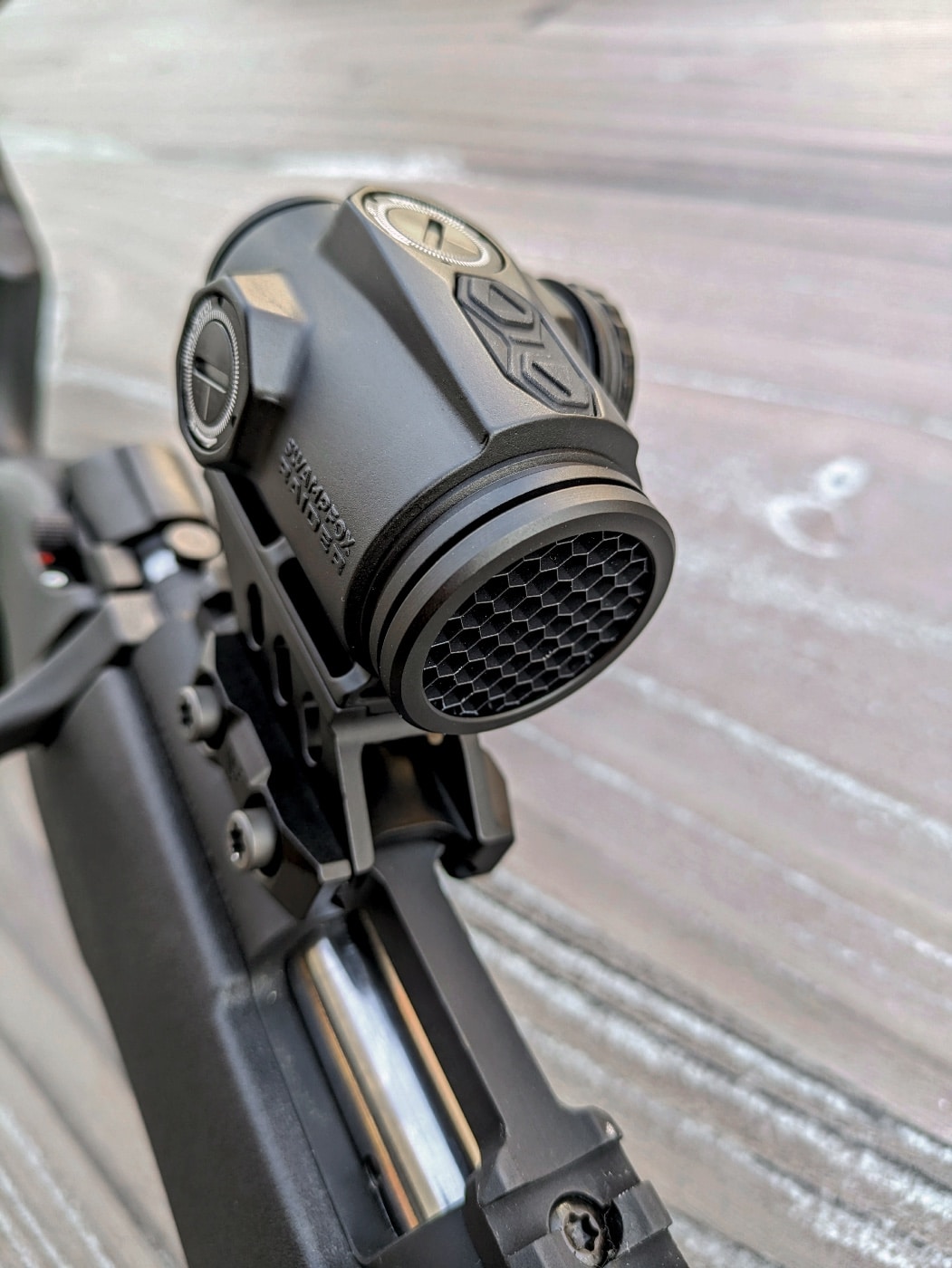
The Swampfox Raider is a 1×20 micro prism optic designed to compete with compact red dots while solving some common red-dot complaints. Unlike a reflex red dot, the Raider uses an etched reticle inside a prism system. That means the reticle can still appear as a black aiming reference when the illumination is off or the battery fails. Swampfox positions the Raider as a close-range optic with enough reticle utility for practical short-to-midrange shooting.
According to Swampfox, the Raider is available with red or green illumination and offers two reticle styles: the Bullet Rise Compensation reticle and a simpler 6 MOA dot reticle. The BRC reticle is designed around close-range height-over-bore holds while retaining a 50/200-yard zero reference. Swampfox also lists 10 illumination settings, with the first two compatible with night vision devices. :contentReference[oaicite:0]{index=0}
The Raider’s main appeal is simple. It gives you a red-dot-like sight picture, but with the more defined reticle behavior of a prism sight. For many shooters, especially those with astigmatism, that can make the aiming point appear cleaner than a projected red dot. Swampfox also states that the etched reticle helps prevent the washout problems that can occur when a bright weapon light overwhelms a projected red dot. :contentReference[oaicite:1]{index=1}
Key Specifications
| Feature | Swampfox Raider 1x Micro Prism |
|---|---|
| Magnification | 1x |
| Objective Lens | 20mm |
| Reticle Options | BRC reticle or 6 MOA dot reticle |
| Illumination | Red or green, depending on model |
| Brightness Settings | 10 total settings, including 2 night-vision-compatible settings |
| Battery | CR2032 |
| Battery-Saving Feature | Shake N’ Wake |
| Field of View | 70.7 feet at 100 yards, according to Swampfox |
| Exit Pupil | 15mm, according to Swampfox |
| Housing | Die-cast zinc alloy |
| Mounting Footprint | Aimpoint T-2 compatible footprint |
| Included Mounts | Low-profile 1.1-inch mount and medium 1.6-inch mount |
| Warranty | Limited Lifetime Warranty, with 10-year LED coverage listed by Swampfox |
Swampfox states that the Raider uses a die-cast zinc alloy body and is rated to withstand up to 1200 Gs of force. The optic also uses a common T-2 footprint, which improves compatibility with aftermarket mounts and risers. :contentReference[oaicite:2]{index=2}
Design and Build Quality
The Raider has a short, enclosed, tube-like body that looks closer to a compact red dot than a traditional prism scope. That is part of its appeal. Many older prism optics were bulky, heavy, or visually awkward on smaller carbines and rimfire rifles. The Raider keeps the footprint compact while still offering a diopter, etched reticle, and enclosed optical system.
The housing is one of the Raider’s most discussed features. Swampfox chose die-cast zinc alloy rather than the more common CNC-machined aluminum body used on many optics. The company describes this construction as rugged and impact-resistant, with the optic rated up to 1200 Gs. :contentReference[oaicite:3]{index=3}
That construction choice may not matter to every buyer, but it does support the Raider’s value argument. The optic is meant to feel more serious than a budget red dot, while remaining less expensive than many premium prism sights. Reviewers have generally described the optic as solid, simple to mount, and easy to operate. GunMade highlighted its durable construction, etched reticle, side battery access, Shake N’ Wake system, and included accessories as major positives. :contentReference[oaicite:4]{index=4}
Optical Performance
The Raider is a 1x optic, so it is built for fast shooting with both eyes open rather than precision magnification. The goal is not to replace an LPVO or magnified scope. Instead, it offers a close-range sight picture with a defined reticle and enough field of view to feel quick on carbines, rimfire rifles, and similar platforms.
Swampfox lists the Raider’s field of view at 70.7 feet at 100 yards and its exit pupil at 15mm. The company says the optic can be used with both eyes open after adjusting the rear diopter. :contentReference[oaicite:5]{index=5}
Target Tamers described the Raider as easy to mount, manipulate, and use, and praised it as a prism sight that behaves like a workhorse red dot. Their field test also noted the Raider’s etched reticle, usable eye relief, and practical 1x performance. :contentReference[oaicite:6]{index=6}
Reticle Options: BRC vs 6 MOA Dot
The Raider is available with two main reticle choices. The first is the BRC, or Bullet Rise Compensation, reticle. The second is a simpler 6 MOA dot. Both are etched reticles, which means the aiming point remains visible in black when the illumination is off.
BRC Reticle
The BRC reticle is the more distinctive option. It is designed for close-range applications where optic height over bore can matter. Swampfox states that the BRC includes dedicated holds for 5, 10, and 15 yards while retaining a 50/200-yard zero point. :contentReference[oaicite:7]{index=7}
Firearms News explained the same concept in practical terms. A standard red dot zeroed at 50 or 100 yards can create confusion at very short distances because the point of impact can be lower than the point of aim. The Raider’s BRC reticle gives separate references for close-range holds, including the 15-yard, 10-yard, and 5-yard references. :contentReference[oaicite:8]{index=8}
6 MOA Dot Reticle
The 6 MOA dot version is better for shooters who want the Raider to feel more like a conventional red dot. It is simpler, less visually busy, and easier to understand at a glance. It still offers the etched-reticle advantage, which means it does not fully depend on battery power for basic visibility.
For most buyers, the decision comes down to intended use. Choose the BRC if you want the close-range hold references. Choose the 6 MOA dot if you prefer a clean, familiar aiming point with fewer visual elements.
Illumination and Shake N’ Wake
The Raider offers 10 illumination settings. Swampfox states that settings 1 and 2 are night-vision compatible, settings 3 through 8 are intended for lower-light and indoor conditions, and settings 9 and 10 are daylight-bright settings. :contentReference[oaicite:9]{index=9}
Shake N’ Wake is included as a standard feature. After 225 seconds of inactivity, the illumination shuts off to conserve battery life. When the optic detects movement, it powers back on to the previous brightness setting. :contentReference[oaicite:10]{index=10}
This is a useful feature for a practical rifle optic because it reduces the chance of accidentally leaving the illumination on for long periods. It also keeps the optic simple. You can stage it at a preferred brightness setting, and the motion sensor helps manage power without requiring constant manual adjustment.
Mounting System and Compatibility
The Raider uses the industry-standard T-2 footprint. This is one of its strongest practical features. Many aftermarket mounts, risers, and offset mounts are designed around the Aimpoint Micro/T-2 footprint, so the Raider gives buyers more flexibility than a proprietary mounting system.
Swampfox includes a low-profile 1.1-inch mount and a medium 1.6-inch mount with the Raider. The company also says each included riser uses titanium mounting screws. :contentReference[oaicite:11]{index=11}
Firearms News also praised the use of the common T-2 mounting interface, noting that there are many riser options available for that pattern. :contentReference[oaicite:12]{index=12}
Controls and Usability
The Raider is straightforward to operate. Brightness buttons are located on top of the optic. Windage and elevation adjustments are exposed and easy to access. The battery compartment is side-mounted, which makes battery replacement simpler than optics that require removal from the mount.
GunMade listed the side-mounted battery as one of the Raider’s positives, along with the crisp etched reticle, Shake N’ Wake illumination, and solid eye relief. The same review noted minor personal dislikes, including the battery cap logo and brightness button spacing. :contentReference[oaicite:13]{index=13}
The diopter is another important control. A diopter lets the user focus the reticle to their eye. This is one of the reasons prism optics are often recommended to shooters who see distorted dots through reflex optics. Target Tamers noted that the Raider has a diopter, but also mentioned that the smooth diopter ring lacked knurling and could be harder to adjust at first. :contentReference[oaicite:14]{index=14}
Recoil, Durability, and Practical Use
The Raider is designed for rifles and similar firearm platforms, not just light-duty range toys. Swampfox rates the optic’s die-cast zinc alloy housing up to 1200 Gs of force. :contentReference[oaicite:15]{index=15}
That said, buyers should understand what a review can and cannot prove. Unless a reviewer publishes a controlled durability protocol, round count, recoil platform, and failure criteria, broad claims about “duty-grade” performance should be treated carefully. The safest conclusion is that the Raider is built with durability in mind and has been reviewed positively by several optics and firearms publications, but buyers should still match the optic to their own use case.
Accuracy and Reliability
A 1x micro prism does not mechanically make a rifle more accurate. Instead, it gives the shooter a consistent aiming reference. The Raider’s etched reticle can help by offering a clean, defined aiming point, especially for users who see a starburst through standard red dots.
The BRC reticle can also help users understand close-range hold differences. This does not replace training or range confirmation. It simply gives visual references that may be more useful than a plain dot in certain close-range contexts.
Target Tamers reported positive hands-on impressions of the Raider’s sight picture, reticle visibility, and ease of use. Firearms News also praised the etched reticle’s visibility and explained why a prism reticle can avoid the starburst effect some shooters see with red dots. :contentReference[oaicite:16]{index=16}
Pros and Cons
Pros
- Etched reticle remains visible without illumination.
- Prism design can be friendlier for some shooters with astigmatism.
- BRC reticle gives useful close-range hold references.
- Available with red or green illumination.
- 10 illumination settings, including 2 night-vision-compatible settings.
- Shake N’ Wake helps conserve battery life.
- T-2 footprint gives excellent mount compatibility.
- Includes low and medium mounts.
- Compact size compared with many older prism optics.
- Side battery access is convenient.
Cons
- The BRC reticle may feel busy to users who prefer a plain dot.
- It is still a prism optic, so it may not feel exactly like an unlimited-eye-relief red dot to every shooter.
- The diopter may require careful adjustment before use.
- Some users may prefer lighter aluminum-bodied optics.
- Brightness button layout may be a matter of personal preference.
Best Use Cases
The Raider makes the most sense for users who want a compact close-range optic with a visible etched reticle. It is especially useful for range rifles, rimfire training rifles, pistol-caliber carbines, AR-style platforms, and general-purpose carbines where 1x speed matters more than magnification.
The BRC version is best for users who want dedicated close-range hold references. The 6 MOA dot version is best for users who want a simpler sight picture that feels closer to a red dot.
Who Should Buy the Swampfox Raider?
The Raider is a strong option for buyers who want red-dot speed but prefer an etched reticle. It is also a smart choice for shooters who have tried red dots and disliked the starburst effect. Because the reticle can remain visible without battery power, it also appeals to users who want a backup aiming reference built into the optic itself.
It is also a good fit for users who value mount flexibility. The T-2 footprint makes it easier to tailor height and mounting position than optics with unusual proprietary mounts.
Who Should Avoid the Swampfox Raider?
The Raider is probably not the best choice for buyers who want magnification for distance work. It is a 1x optic, so it is built for speed and simplicity rather than long-range target identification.
It may also not be ideal for users who want the lightest possible optic. Some micro red dots are lighter. If weight is the top priority, a small reflex sight may still win.
Finally, buyers who want an extremely minimal sight picture should consider the 6 MOA dot version rather than the BRC reticle, or choose a traditional red dot if they do not need the etched-reticle benefits.
Swampfox Raider vs Primary Arms SLx 1x MicroPrism
The Primary Arms SLx 1x MicroPrism is one of the Raider’s most obvious competitors. It also uses a prism design, etched reticle, motion-activated illumination, and close-range-friendly layout. Primary Arms documentation says the SLx 1x MicroPrism offers 13 brightness settings, includes multiple mounting-height options, uses AutoLive motion-sensing technology, and is IP67 waterproof and dustproof. :contentReference[oaicite:17]{index=17}
The Raider’s advantage is its T-2 footprint and BRC reticle option. The Primary Arms advantage is its mature reticle ecosystem and broad popularity among prism-optic buyers. Both are credible options. The better choice depends on reticle preference, mount preference, price at the time of purchase, and how the optic looks to your eye.
Swampfox Raider vs Vortex Spitfire AR 1x
The Vortex Spitfire AR 1x is another established prism option. Vortex describes the Spitfire AR as a 1x prism optic with an etched reticle designed for close-quarters use and for shooters who prefer a prism design because of astigmatism. :contentReference[oaicite:18]{index=18}
The Raider is more modern in footprint and packaging. Its T-2 compatibility gives it more mount flexibility, while the Spitfire AR has the advantage of Vortex’s long reputation and well-known warranty support. The Raider is likely the more compact and modular choice. The Spitfire AR may appeal to buyers who already trust Vortex or prefer its reticle layout.
Maintenance and Cleaning
Maintenance for the Raider is simple. Keep the lenses clean, inspect the mount screws periodically, replace the CR2032 battery when needed, and avoid using harsh chemicals on the glass or housing. A microfiber cloth and proper lens-safe cleaning tools are the best choice for routine cleaning.
Because the Raider is an optic, not a firearm component that requires internal disassembly, users should avoid unnecessary tinkering. Do not modify the optic body, drill parts, force the diopter, or use threadlocker carelessly near the glass or adjustment system. Follow the manufacturer’s instructions for installation, torque values, battery replacement, and warranty support.
Accessories and Upgrade Options
The Raider already includes useful accessories. Swampfox lists included mounts, protective covers, and mounting hardware. The optic’s T-2 footprint is the biggest upgrade path because it opens the door to many compatible risers and mounts. :contentReference[oaicite:19]{index=19}
A honeycomb anti-reflection device is another accessory commonly discussed with the Raider. GunMade noted that the Honeycomb Grid comes included with the Raider and can help reduce glare. :contentReference[oaicite:20]{index=20}
For most users, the best upgrades are simple: choose the right mount height, confirm the optic is securely mounted, and select the reticle color and pattern that works best for your eyes.
Final Verdict
The Swampfox Raider is a compelling 1x micro prism sight for buyers who want a compact optic with an etched reticle, modern mount compatibility, and practical close-range features. Its strongest points are the BRC reticle option, Shake N’ Wake illumination, T-2 footprint, side battery access, and rugged housing design.
It is not the right optic for every shooter. If you want magnification, a minimalist ultralight red dot, or a traditional scope, the Raider is not the best fit. But if you want a red-dot alternative that remains visible without illumination and may look cleaner to astigmatic eyes, the Raider deserves serious consideration.
Overall, this Swampfox Raider Review finds the optic to be a strong value-focused prism sight for close-range rifles, PCCs, rimfire rifles, and general-purpose carbines. It is practical, compact, easy to understand, and different enough from a standard red dot to justify its place in the market.
Frequently Asked Questions About the Swampfox Raider
1. What is the Swampfox Raider?
The Swampfox Raider is a compact 1×20 micro prism sight designed for close-range shooting. It is similar in use to a red dot, but it uses a prism optical system and an etched reticle. This gives it one major advantage over a traditional reflex red dot: the reticle can remain visible even when illumination is turned off or the battery is dead.
2. Is the Swampfox Raider a red dot?
Not exactly. The Raider is often used like a red dot because it has 1x magnification and is designed for fast target acquisition. However, it is technically a prism sight. A red dot projects an illuminated dot onto a lens, while the Raider uses an etched reticle inside a prism system.
3. What is the main advantage of a prism sight?
The main advantage is the etched reticle. It can be easier to see clearly for some shooters, especially those who experience starburst or distortion with standard red dots. It also remains usable without battery-powered illumination, which adds a layer of practical reliability.
4. Is the Swampfox Raider good for astigmatism?
Many shooters with astigmatism prefer prism sights because the reticle is etched rather than projected. Swampfox specifically markets the Raider as an alternative for users who struggle with red-dot starburst. Individual eyes vary, so the best answer is to look through one before buying if possible.
5. What reticle options does the Raider offer?
The Raider is available with a Bullet Rise Compensation reticle or a 6 MOA dot reticle. The BRC reticle is more specialized and includes close-range hold references. The 6 MOA dot is simpler and feels more like a conventional red-dot aiming point.
6. What is the BRC reticle?
BRC stands for Bullet Rise Compensation. It is designed to help with close-range height-over-bore offsets. Swampfox states that the BRC reticle includes holds for 5, 10, and 15 yards while maintaining a 50/200-yard zero reference.
7. Should I choose the BRC reticle or the 6 MOA dot?
Choose the BRC reticle if you want more aiming references for close-range use. Choose the 6 MOA dot if you prefer a cleaner, simpler sight picture. The BRC gives more information, but the dot version is easier for users who want minimal visual clutter.
8. Is the Swampfox Raider magnified?
No. The Raider is a 1x optic. It is not designed for magnified shooting. It is built for close-range speed, wide field of view, and both-eyes-open use.
9. Can the Raider be used with both eyes open?
Yes. Swampfox states that the Raider can be used with both eyes open after adjusting the rear diopter. This is important because both-eyes-open shooting helps maintain a wider field of view and a more natural sight picture.
10. What battery does the Swampfox Raider use?
The Raider uses a CR2032 battery. This is a common coin-style battery used in many optics and small electronic devices. The side-mounted battery compartment makes replacement more convenient because the optic does not need to be removed from the mount.
11. Does the Raider work without a battery?
Yes, the etched reticle remains visible in black without illumination. The battery powers the illumination, not the physical existence of the reticle. This is one of the biggest reasons some buyers choose prism optics over reflex red dots.
12. What is Shake N’ Wake?
Shake N’ Wake is Swampfox’s motion-sensing illumination system. After a period of inactivity, the optic turns off illumination to save battery power. When it detects movement, it returns to the previous illumination setting.
13. How long before Shake N’ Wake turns the Raider off?
Swampfox states that the Raider shuts off illumination after 225 seconds of inactivity. When movement is detected, the optic powers back on to the previous brightness setting.
14. Does the Raider have night vision settings?
Yes. Swampfox states that the Raider has 10 illumination settings, with settings 1 and 2 being night-vision compatible. Buyers should still confirm compatibility with their specific night vision equipment and legal requirements before use.
15. Is the Raider daylight bright?
Swampfox lists settings 9 and 10 as daylight brightness settings. Real-world brightness perception can vary based on sunlight, target background, reticle color, and user eyesight. The etched reticle also helps because it remains visible as a black reticle even when illumination is not ideal.
16. Is red or green illumination better?
Neither color is automatically better for everyone. Some shooters see green more easily in daylight, while others prefer red because it feels familiar and less distracting. If your eyes strongly prefer one color, choose that version.
17. What mount does the Swampfox Raider use?
The Raider uses a T-2 mounting footprint. This is a major advantage because the Aimpoint T-2 pattern is widely supported by many mount manufacturers. It gives the Raider more mounting flexibility than optics with proprietary mounts.
18. What mounts come with the Raider?
Swampfox states that the Raider includes a low-profile 1.1-inch mount and a medium 1.6-inch mount. This gives users two starting height options without immediately buying extra mounting hardware.
19. Can I use aftermarket mounts with the Raider?
Yes, the T-2 footprint makes aftermarket mounting one of the Raider’s strengths. Users can choose risers and mounts that match their firearm, cheek weld, backup sight setup, and personal preference.
20. Is the Swampfox Raider good for AR-15 rifles?
Yes, the Raider is well suited to AR-style rifles, especially when the user wants a close-range 1x optic. The BRC reticle was designed with AR-style height-over-bore issues in mind, and the included mount options make AR mounting straightforward.
21. Is the Raider good for pistol-caliber carbines?
Yes, it can work well on pistol-caliber carbines if the user wants a compact 1x optic. The 6 MOA dot version may be especially appealing for PCC users who want a simple, fast aiming point without the extra BRC references.
22. Is the Raider good for rimfire rifles?
Yes. The Raider can be a practical optic for rimfire training rifles and range rifles. The Armory Life reviewed the Raider on a Springfield Armory 2020 Rimfire and discussed its usefulness on that platform. :contentReference[oaicite:21]{index=21}
23. Is the Raider good for shotguns?
The Raider may be usable on some shotguns, depending on mount compatibility, recoil level, and intended use. However, buyers should confirm the optic is appropriate for their specific shotgun and should follow the manufacturer’s mounting and durability guidance.
24. Is the Raider waterproof?
Retail and review sources commonly describe the Raider as water-resistant or waterproof-rated, and Firearms News noted an IPX7 rating. Buyers should still confirm the current rating on the manufacturer’s product page or manual before relying on it for harsh conditions. :contentReference[oaicite:22]{index=22}
25. Is the Raider shockproof?
Swampfox states that the Raider’s die-cast zinc alloy housing can withstand up to 1200 Gs of force. That suggests the optic was designed for durability, but users should still avoid unnecessary abuse and should inspect mounts and screws regularly.
26. How clear is the glass?
Reviewers have generally described the Raider’s glass as clear for a compact 1x prism. Firearms News noted that the image was clear with only faint edge distortion. As with all optics, glass quality is subjective and depends on lighting, eyesight, and expectations.
27. Does the Raider have edge distortion?
Some edge distortion can occur with compact 1x optics. Firearms News said the Raider had only faint distortion around the edges and noted that few 1x optics have absolutely zero distortion. This is normal for the category.
28. Is the Raider better than a red dot?
It depends on the user. The Raider is better if you want an etched reticle, diopter adjustment, and possible astigmatism benefits. A red dot may be better if you want the lightest optic, the simplest sight picture, or the most forgiving eye position possible.
29. Is the Raider faster than a red dot?
For many users, it can feel very close to red-dot speed because it is 1x and compact. However, a traditional red dot may still feel slightly more forgiving because reflex sights generally have fewer eye-position concerns. The difference depends heavily on the shooter.
30. Does the Raider have unlimited eye relief?
Prism optics usually have more eye-position considerations than reflex red dots. The Raider is designed with generous eye relief for a prism optic, and reviewers have praised its usability, but it should not be assumed to behave exactly like a reflex sight.
31. What is the field of view?
Swampfox lists the Raider’s field of view as 70.7 feet at 100 yards. For a compact 1x prism sight, that is broad enough to support both-eyes-open shooting and fast close-range use.
32. Does the Raider have a diopter?
Yes. The Raider has a rear diopter that allows the user to focus the reticle to their eye. This is important because proper diopter adjustment can make the etched reticle appear sharper and easier to use.
33. Is the diopter easy to adjust?
Target Tamers noted that the Raider’s diopter adjustment was useful but that the smooth ring lacked knurling and could be difficult to move initially. Once adjusted, it should not need frequent changes unless multiple users share the optic.
34. Can the Raider be used with a magnifier?
Some reviewers have discussed using the Raider with other optics or magnifiers, but users should be careful. Prism optics and magnifiers can be more sensitive to alignment and diopter settings than red dots. If magnifier use is important, test the setup before committing.
35. What comes in the box?
According to reviews and manufacturer information, the Raider package includes the optic, mounts, lens covers, mounting tools, battery, microfiber cloth, and a honeycomb-style anti-reflection accessory. Included contents may change, so check the current product listing before buying.
36. What is the honeycomb grid for?
The honeycomb grid is an anti-reflection device. It helps reduce glare from the objective lens. For most civilian range users, it is more of a nice included accessory than a required part, but it adds value to the package.
37. Is the Raider easy to zero?
Yes, the Raider should zero like most compact optics. It uses windage and elevation adjustments, and reviewers have described the adjustments as straightforward. Always zero in a safe, controlled range environment and follow the optic manual.
38. What zero should I use with the BRC reticle?
Swampfox describes the BRC reticle around a 50/200-yard zero reference. Users should confirm zero with their own firearm, ammunition, optic height, and range conditions because ballistic performance varies.
39. Can I use the Raider for hunting?
The Raider may be useful for close-range hunting where 1x magnification is appropriate and legal. It is not ideal for identifying targets at distance. Hunters should follow local laws and use an optic suitable for the terrain, game, and expected range.
40. Is the Raider good for home-defense firearms?
The Raider has features that may appeal to responsible home-defense firearm owners, such as an etched reticle and motion-activated illumination. However, safe storage, legal compliance, training, and responsible handling matter far more than optic choice.
41. Is the Raider legal to own?
In many places, firearm optics are legal accessories. However, laws vary by country, state, and locality. Buyers should check current local laws before purchasing, mounting, transporting, or using any firearm accessory.
42. Does the Raider require special maintenance?
No. Basic optic care is enough. Keep the lenses clean, replace the battery when needed, check mount screws periodically, and avoid harsh chemicals. Do not disassemble or modify the optic.
43. Can I clean the lenses with household glass cleaner?
It is better to use lens-safe cleaning tools and a microfiber cloth. Household cleaners may contain chemicals that can damage lens coatings. When in doubt, follow Swampfox’s maintenance instructions.
44. How often should I replace the battery?
Battery replacement depends on brightness setting, storage habits, temperature, and use. Shake N’ Wake helps conserve power, but responsible users should check battery function regularly and replace it before important range sessions or serious use.
45. Is the Raider better than the Primary Arms SLx 1x MicroPrism?
Neither optic is automatically better for everyone. The Raider offers a T-2 footprint and BRC reticle option. The Primary Arms SLx 1x MicroPrism offers a strong reticle ecosystem and many mounting-height options. The best choice depends on your eyes, mount needs, and reticle preference.
46. Is the Raider better than the Vortex Spitfire AR?
The Raider has a more modern micro-prism style and T-2 mount compatibility. The Vortex Spitfire AR has the advantage of a long-standing brand reputation and a familiar etched reticle design. Both are useful 1x prism options.
47. Is the Raider worth the money?
For buyers who want an etched-reticle 1x optic with Shake N’ Wake and T-2 compatibility, the Raider offers strong value. It may not be worth it if you are satisfied with a simple budget red dot and do not need prism-specific advantages.
48. Is the Raider too complicated for beginners?
No, but beginners should choose the reticle carefully. The 6 MOA dot is simpler. The BRC reticle provides more information, but it may require more explanation and range confirmation to use confidently.
49. Can the Raider replace iron sights?
The Raider can serve as a primary aiming optic, but whether it replaces iron sights depends on user preference and firearm setup. Because the reticle is etched, it remains visible without battery power, which reduces one common reason for backup irons.
50. Should I still use backup iron sights with the Raider?
That depends on your setup and comfort level. Some users may skip backup irons because the etched reticle remains visible without illumination. Others may prefer backup sights for redundancy. Both approaches can be reasonable.
51. Is the Raider suitable for competition?
It can be suitable for close-range competition divisions where 1x optics are allowed. Competitors should verify division rules, optic restrictions, and reticle preferences before choosing it for a match setup.
52. Is the Raider heavy?
The Raider is compact, but it may be heavier than some small reflex red dots because it uses a prism system and rugged housing. If every ounce matters, compare current manufacturer weights before buying.
53. Does the Raider look bulky on small firearms?
It is compact for a prism sight, but it is still larger than many tiny reflex dots. On a full-size carbine or rimfire rifle, it looks proportional. On very small platforms, users may prefer a smaller red dot.
54. What is the biggest weakness of the Raider?
The biggest weakness is that it sits between categories. It is not as feather-light or eye-position-forgiving as some red dots, and it is not magnified like a scope. Its value comes from the etched reticle, compact prism design, and practical close-range features.
55. What is the final verdict on the Swampfox Raider?
The Swampfox Raider is a strong 1x micro prism sight for shooters who want red-dot-like speed with the security and clarity of an etched reticle. It is especially appealing for users with astigmatism concerns, buyers who value T-2 mount compatibility, and anyone who wants a compact close-range optic with modern features.
Read more: