
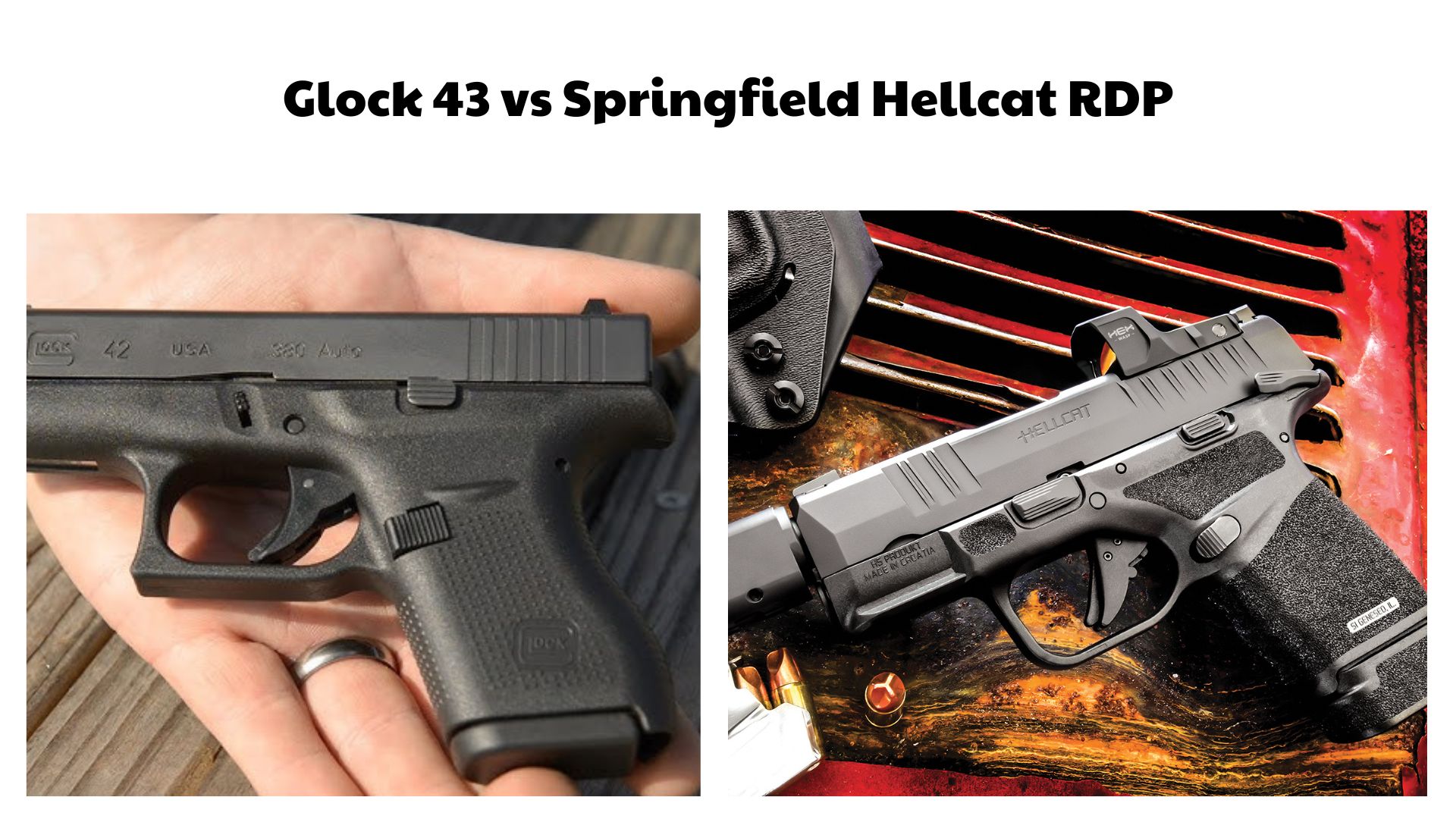

The Glock 43 and the Springfield Hellcat RDP are two popular choices in the modern concealed carry world, but they represent very different design philosophies. The Glock 43 is a slim, single-stack 9mm pistol built around simplicity, lightweight carry, and deep concealment. It is designed for users who want a reliable defensive handgun that disappears easily under clothing without adding bulk or weight.
On the other hand, the Springfield Hellcat RDP is a feature-rich micro-compact pistol built for maximum performance in a small package. It uses a double-stack magazine system to deliver higher capacity and includes modern enhancements such as an optics-ready slide and an integrated compensator to improve recoil control. It is designed for users who want more capability in a compact defensive platform.
Although both pistols are aimed at the concealed carry (CCW) market, they take very different approaches. The Glock 43 focuses on minimalism and ease of concealment, while the Hellcat RDP emphasizes firepower, modern features, and enhanced shooting performance.
This comparison is centered on practical real-world factors such as size, capacity, recoil control, feature set, and defensive usability. These are the areas that matter most when choosing a daily carry handgun.
In today’s micro-9mm category, the competition is intense, with strong alternatives like the Sig P365, Glock 43X, and Smith & Wesson Shield Plus. Each pistol offers a different balance of concealability, capacity, and performance, making it important to understand where each model fits.
The goal of this comparison is simple: help shooters decide whether they should prioritize minimal concealment and simplicity or move toward a more capable, feature-rich defensive platform.
Key Specifications Comparison
Glock 43 Specifications
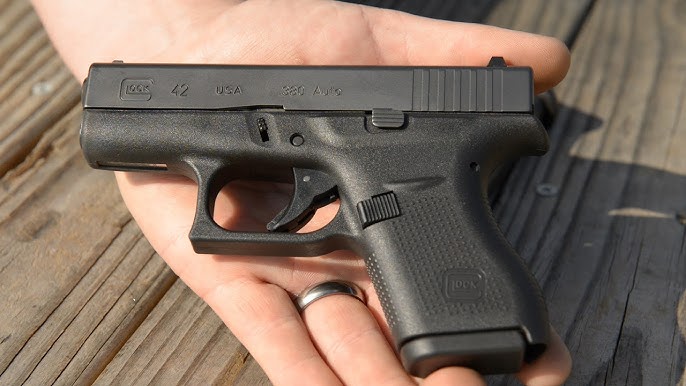
The Glock 43 is an ultra-slim single-stack 9mm pistol designed specifically for deep concealment. Its compact and lightweight design makes it one of the easiest Glock pistols to carry discreetly on a daily basis.
It comes with a standard 6+1 capacity, which reflects its focus on minimal size rather than maximum firepower. While the capacity is lower than many modern micro-compacts, it is consistent with its slim profile and concealability-first design.
The barrel length is approximately 3.39 inches, and the overall frame is extremely thin at around 1.06 inches. This narrow profile is one of its biggest advantages for users who prioritize minimal printing under clothing.
Due to its lightweight construction, the Glock 43 is easy to carry throughout the day without causing fatigue. It is especially popular for inside-the-waistband (IWB) and appendix carry setups where discretion is critical.
The pistol is not optics-ready in its factory configuration, which reflects its minimalist design approach. It is intended for users who prefer traditional iron sights and a straightforward defensive platform without added complexity.
Overall, the Glock 43 is built around simplicity, concealability, and reliability, making it a strong choice for users who want a no-frills defensive handgun.
Springfield Hellcat RDP Specifications
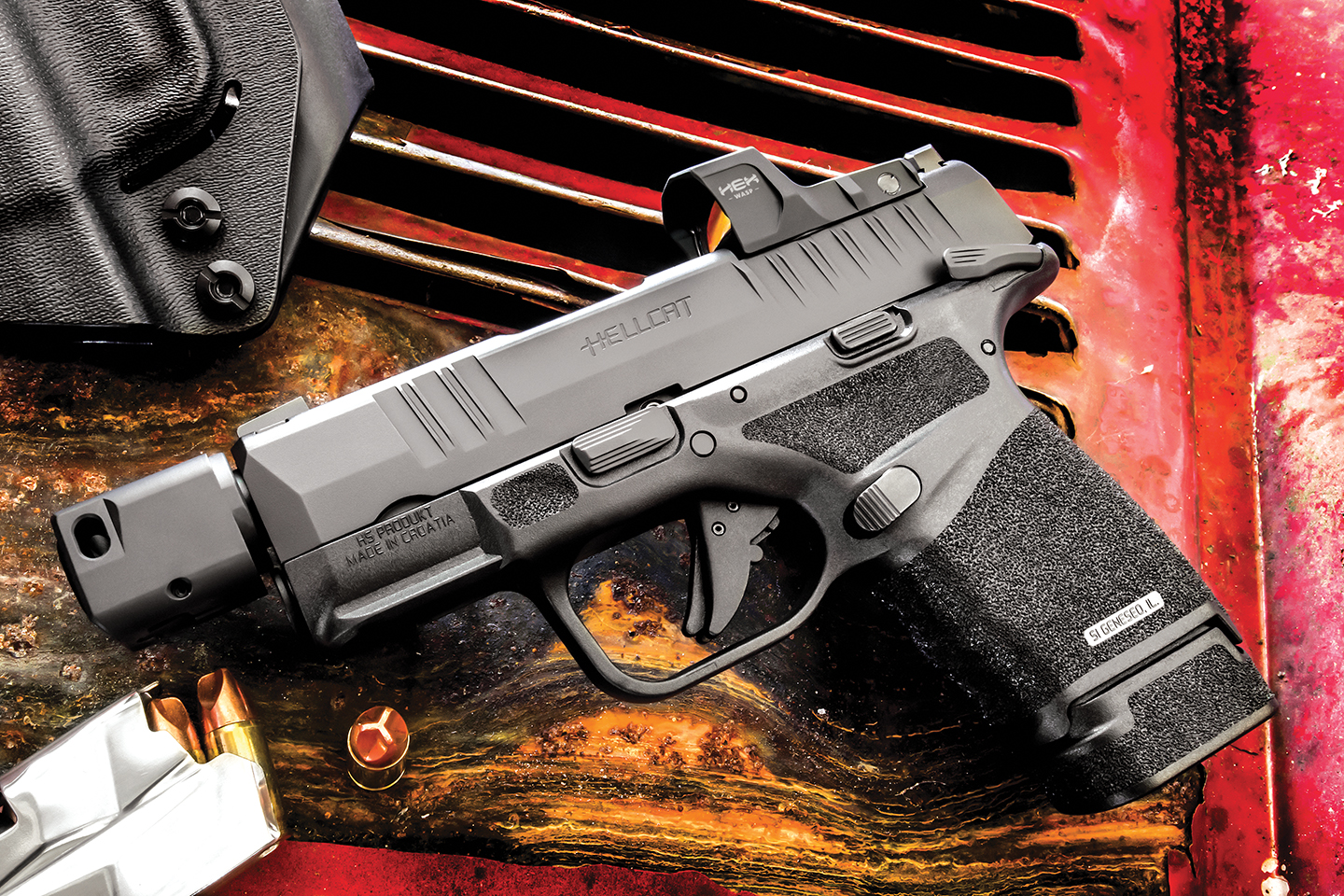
The Springfield Hellcat RDP is a modern micro-compact 9mm pistol designed for high performance in a small frame. It uses a double-stack magazine system, allowing it to deliver significantly higher capacity compared to traditional slimline pistols.
It offers either 11+1 or 13+1 magazine capacity depending on configuration, making it one of the highest-capacity pistols in its size class. This gives users more defensive rounds without needing to move to a larger handgun platform.
The barrel length is approximately 3.8 inches, and although it is slightly larger than the Glock 43, it still remains compact enough for everyday concealed carry.
One of its most important features is its factory optics-ready slide, compatible with red dot sights. This allows users to mount compact optics for faster target acquisition and improved accuracy in defensive scenarios.
The Hellcat RDP also includes an integrated compensator system designed to reduce muzzle rise and improve recoil control. This makes follow-up shots faster and more manageable compared to many other micro-compacts.
While slightly larger than ultra-slim pistols, the Hellcat RDP is still highly concealable and is designed for users who want modern features, higher capacity, and improved shooting performance in a compact defensive firearm.
In summary, the Hellcat RDP is a feature-rich platform that focuses on maximizing capability while maintaining a relatively small footprint suitable for concealed carry.
Design & Size Differences
Frame and Thickness
The Glock 43 and Springfield Hellcat RDP differ significantly in frame construction, and this directly impacts how each pistol carries and performs in everyday use. The Glock 43 is built around an ultra-slim single-stack design, which keeps the frame narrow and optimized for deep concealment. This slim profile is one of its defining strengths, especially for users who prioritize minimal printing under clothing.
In contrast, the Hellcat RDP uses a double-stack magazine design. This allows it to hold more rounds, but it also increases overall thickness compared to the Glock 43. While still compact for a modern micro-9mm pistol, the Hellcat is noticeably wider in the grip area, which can affect concealment depending on body type and clothing choice.
This difference in thickness is one of the most important practical factors. The Glock 43 tends to disappear more easily under light or fitted clothing, while the Hellcat RDP may require more attention to holster selection and positioning to avoid printing.
Weight and Dimensions
Weight plays a major role in daily carry comfort, especially for users who carry for extended periods. The Glock 43 is lighter overall, which makes it easier to carry throughout the day with minimal fatigue. This lightweight design is especially appreciated in summer carry or for users who prefer minimal gear weight.
The Hellcat RDP, while still compact, is slightly heavier due to its double-stack frame and added features such as the compensator system. This additional weight is not excessive, but it is noticeable when compared directly to the Glock 43.
Dimensionally, both pistols fall into the micro-compact category, but they prioritize different goals. The Glock 43 emphasizes reduced size and weight, while the Hellcat RDP accepts a slightly larger footprint in exchange for higher capacity and enhanced performance features.
This trade-off reflects a clear design philosophy difference: concealment efficiency versus performance capability.
Ergonomics
Ergonomics between these two pistols also reflect their intended roles. The Glock 43 features a simple, minimal grip design that prioritizes concealment above all else. It is straightforward, easy to handle, and ideal for users who value a no-frills defensive tool.
However, the smaller grip can feel limited for users with larger hands, and it provides less surface area for recoil control compared to larger micro-compacts.
The Hellcat RDP, on the other hand, features a more aggressive grip texture and improved ergonomics designed for better control during shooting. The enhanced grip pattern helps maintain stability under recoil, especially during rapid follow-up shots.
In practical terms, the Glock 43 favors concealment and simplicity, while the Hellcat RDP favors shootability and control. This difference becomes more noticeable during extended range sessions or defensive shooting drills.
Magazine Capacity & Firepower
Glock 43 Capacity Trade-Off
The Glock 43 uses a single-stack magazine system, resulting in a standard capacity of 6+1 rounds. This lower capacity is one of the most discussed trade-offs of the platform, but it is directly tied to its slim and highly concealable design.
By limiting capacity, the Glock 43 achieves one of the thinnest profiles in its class, making it extremely effective for deep concealment and discreet everyday carry. For many users, this trade-off is acceptable because the pistol is intended for defensive rather than extended engagement scenarios.
It is important to understand that the Glock 43 prioritizes concealment over firepower. It is designed for users who value a compact, lightweight defensive option that can be carried comfortably in a wide range of environments.
Hellcat RDP Capacity Advantage
The Springfield Hellcat RDP offers a significant advantage in magazine capacity. With options of 11+1 or 13+1 rounds, it delivers nearly double the firepower of the Glock 43 in a similarly compact form factor.
This high capacity makes the Hellcat RDP one of the most competitive pistols in the micro-compact category. It allows users to carry more defensive ammunition without moving up to a larger handgun platform.
For users who prioritize preparedness and want additional rounds available in a defensive situation, the Hellcat RDP provides a clear advantage.
Capacity vs Concealment Balance
The difference between these two pistols ultimately comes down to balancing capacity and concealability. The Glock 43 is optimized for users who want minimal printing, lightweight carry, and simplicity. It excels in situations where discretion is the top priority.
The Hellcat RDP, however, is designed for users who want more capability in the same general size class. It delivers significantly higher capacity while still maintaining a compact footprint suitable for concealed carry.
In summary, the Glock 43 is best for minimal carry and deep concealment, while the Hellcat RDP is best for users who want maximum firepower without transitioning to a full-sized pistol.
Features & Controls
Glock 43 Features
The Glock 43 follows Glock’s traditional design philosophy of simplicity, reliability, and ease of use. It is a striker-fired pistol with a minimal control layout, which reduces complexity and makes it straightforward to operate even under stress. There are no unnecessary external features, which aligns with its purpose as a deep concealment defensive handgun.
The slide serrations are simple but functional, providing enough grip for basic manipulation such as chamber checks and slide racking. The sight system is also traditional, typically using basic fixed iron sights designed for quick target acquisition at close defensive distances.
One of the defining limitations of the Glock 43 is the absence of a factory accessory rail or optics-ready slide. This means users cannot mount lights, lasers, or red dot optics without aftermarket modifications. This reinforces its identity as a minimalist carry pistol rather than a modular tactical platform.
Overall, the Glock 43 prioritizes simplicity over features, making it highly reliable and easy to maintain, but less adaptable compared to modern feature-rich pistols.
Hellcat RDP Features
The Springfield Hellcat RDP represents a more modern approach to concealed carry design, offering a wide range of features in a compact platform. One of its most important upgrades is the optics-ready slide with an RMSc footprint, allowing users to mount compact red dot sights directly from the factory. This significantly enhances target acquisition speed and accuracy potential.
Another key feature is the integrated compensator system, which helps reduce muzzle rise and improve recoil control. This makes the Hellcat RDP easier to shoot quickly and accurately, especially during rapid follow-up shots.
The pistol also includes an accessory rail, allowing users to attach tactical lights or lasers. This adds versatility for low-light defensive scenarios, something the Glock 43 does not offer in its standard configuration.
In addition, the Hellcat RDP uses enhanced sights designed for faster acquisition, often combining high-visibility front elements with a more practical rear sight design. These improvements make it more suited for modern defensive applications where speed and adaptability matter.
Overall, the Hellcat RDP provides a significantly more modern feature set, giving users greater flexibility and performance potential in a compact platform.
Shooting Performance & Accuracy
Accuracy
Both the Glock 43 and the Hellcat RDP are capable of solid defensive accuracy within typical engagement distances, which are generally between 7 and 25 yards. At these ranges, both pistols are more than adequate for defensive use when handled correctly.
The Hellcat RDP tends to offer improved practical accuracy due to its enhanced ergonomics, better grip texture, and compatibility with optics. The addition of a red dot sight can significantly improve target acquisition speed and shot placement consistency, especially for shooters with training in optic-equipped handguns.
The Glock 43, while accurate in its own right, relies more heavily on shooter skill and traditional iron sight alignment. Its shorter grip and lighter frame can make it slightly less stable during rapid shooting, but it remains effective when used within its intended role.
In general, both pistols are accurate enough for defensive scenarios, but the Hellcat RDP offers a noticeable advantage in consistency and speed under pressure.
Recoil & Control
Recoil characteristics differ significantly between these two pistols. The Glock 43, due to its lightweight frame and slim grip, produces more noticeable recoil impulse. This is often described as “snappier,” especially during fast follow-up shots or extended range sessions.
While the recoil is still manageable, it requires more focus on grip technique and stance to maintain control during rapid fire.
The Hellcat RDP, on the other hand, is designed to improve recoil management through multiple features. The integrated compensator helps redirect gases to reduce muzzle rise, while the more aggressive grip texture improves stability in the hand.
As a result, the Hellcat RDP generally feels softer and more controlled during shooting. It allows for faster follow-up shots and better overall control, especially for shooters who practice defensive shooting drills or high-tempo training.
In summary, the Glock 43 prioritizes simplicity and concealment, while the Hellcat RDP delivers a more controlled and modern shooting experience.
Reliability & Real-World Use
Both the Glock 43 and Springfield Hellcat RDP are striker-fired pistols designed for defensive reliability. In real-world use, both platforms have strong reputations for functioning under a wide variety of conditions, including dust, moisture, and extended carry environments.
The Glock 43 benefits from Glock’s long-established reputation for extreme reliability. Its simple internal design and proven operating system make it a trusted option among law enforcement, military personnel, and civilian carriers worldwide.
The Hellcat RDP, while newer to the market, has also demonstrated strong reliability through extensive field testing and user reports. Springfield Armory designed the Hellcat platform specifically for concealed carry reliability and modern defensive needs.
Both pistols require minimal maintenance and perform well with quality ammunition, including standard FMJ training rounds and defensive hollow-point loads. When properly maintained, neither platform presents significant reliability concerns for everyday carry use.
Overall, both the Glock 43 and Hellcat RDP are dependable defensive tools, with the Glock emphasizing long-term proven reliability and the Hellcat offering modern enhancements built on a newer but well-tested design foundation.
Concealed Carry Comparison
Glock 43 for Deep Concealment
The Glock 43 is purpose-built for deep concealment, making it one of the easiest pistols to carry discreetly in a wide range of environments. Its ultra-slim single-stack profile allows it to sit close to the body, reducing printing even under lightweight or fitted clothing.
This makes it especially well-suited for pocket-friendly carry options and ultra-minimal inside-the-waistband (IWB) setups. While not a true pocket pistol for all users, it is compact enough to work in larger pockets or specialized holsters.
The Glock 43 excels in summer carry conditions, where thinner clothing makes concealment more challenging. Its lightweight design and narrow frame make it easy to carry without discomfort, even during long days.
Overall, it offers the lowest printing profile in this comparison, making it the preferred choice for users who prioritize discretion above all else.
Hellcat RDP for Modern Carry
The Springfield Hellcat RDP is slightly larger than the Glock 43, but it remains highly concealable for a pistol with its level of features and capacity. It strikes a balance between concealability and performance, making it suitable for users who want more than just a minimal carry gun.
It is particularly well-suited for modern concealed carry setups that include optics or accessories. The optics-ready slide and accessory rail allow for more advanced configurations, which are becoming increasingly common in defensive carry practices.
The Hellcat RDP also adapts well to duty-style concealed carry, where users may prioritize capability and performance over maximum concealment. It works effectively in appendix carry and IWB setups with a proper holster.
While it may require slightly more effort to conceal compared to the Glock 43, it offers significantly greater flexibility for users who want a more capable everyday carry platform.
Carry Comfort Factors
Comfort is a critical factor in concealed carry, and both pistols offer different advantages. The Glock 43 is lighter and slimmer, making it easier to forget you are carrying it. This is especially important for users who prioritize all-day comfort and minimal intrusion.
The Hellcat RDP, while still compact, has more presence due to its thicker grip and added features. However, this additional size contributes to improved shooting confidence, as the pistol provides better control and stability during firing.
Ultimately, the choice comes down to personal preference. The Glock 43 offers unmatched concealment comfort, while the Hellcat RDP offers greater confidence and capability when it comes to actual shooting performance.
Pros and Cons Overview
Glock 43 Pros & Cons
Pros: The Glock 43 stands out for its ultra-slim profile and lightweight design, making it one of the easiest pistols to conceal. Its simplicity also contributes to reliability and ease of maintenance, which are key advantages for everyday carry.
Cons: The main drawbacks include its lower 6+1 capacity, lack of factory optics support, and slightly snappier recoil due to its lightweight frame. It is designed for concealment first, which means sacrificing some performance features.
Hellcat RDP Pros & Cons
Pros: The Hellcat RDP offers high capacity, optics-ready capability, and an integrated compensator that improves recoil control. It represents a modern, feature-rich approach to concealed carry with strong overall performance.
Cons: These advantages come at the cost of increased price, slightly larger size, and added complexity. It may not be as easy to conceal as ultra-slim pistols like the Glock 43.
Final Verdict
The Glock 43 and Springfield Hellcat RDP are both excellent choices in the micro-compact concealed carry category, but they are designed for different priorities.
The Glock 43 is best for users who value maximum concealment, simplicity, and lightweight carry. It is ideal for those who want a discreet defensive tool that can be carried comfortably in almost any situation.
The Springfield Hellcat RDP is best for users who want modern features, higher capacity, and improved shooting performance. It provides a more capable platform for those willing to accept slightly more size in exchange for better control and flexibility.
The final decision depends on what matters most to the user. If deep concealment and comfort are the top priorities, the Glock 43 is the better choice. If capacity, optics compatibility, and shooting performance are more important, the Hellcat RDP stands out.
Both pistols remain strong and reliable options, and either one can serve effectively as a concealed carry firearm when matched to the user’s needs and preferences.
50+ FAQ – Glock 43 vs Springfield Hellcat RDP (Detailed Answers)
1. What is the main difference between Glock 43 and Hellcat RDP?
The main difference is philosophy. The Glock 43 is a slim, single-stack pistol designed for maximum concealability and simplicity. The Hellcat RDP is a modern micro-compact designed for higher capacity, optics readiness, and improved shooting performance. One prioritizes minimalism, the other prioritizes capability.
2. Which pistol is better for concealed carry?
Both are excellent concealed carry pistols, but for different reasons. The Glock 43 is better for deep concealment and minimal printing, while the Hellcat RDP is better for users who want more firepower and modern features while still carrying concealed.
3. Which has higher magazine capacity?
The Hellcat RDP has a clear advantage with 11+1 or 13+1 capacity depending on magazine configuration. The Glock 43 only holds 6+1 rounds in its standard form.
4. Is the Glock 43 easier to conceal than the Hellcat RDP?
Yes. The Glock 43 is significantly slimmer due to its single-stack design, making it easier to conceal under tight clothing and more suitable for deep concealment.
5. Which pistol is better for beginners?
Both can work for beginners, but the Glock 43 is simpler, while the Hellcat RDP offers better shooting control. Beginners who prioritize ease of carry may prefer Glock 43, while those who want better shooting performance may prefer Hellcat RDP.
6. Which has less recoil?
The Hellcat RDP generally feels softer due to its compensator system and better grip ergonomics. The Glock 43 feels snappier because of its lighter frame and slimmer grip.
7. Is the Hellcat RDP too big for concealed carry?
No. Although slightly larger than the Glock 43, it is still a micro-compact pistol designed for concealed carry and remains highly practical for IWB and appendix carry.
8. Does the Glock 43 support optics?
No, the Glock 43 is not optics-ready from the factory. Adding optics requires aftermarket slide modification or replacement.
9. Does the Hellcat RDP support red dot sights?
Yes. The Hellcat RDP comes optics-ready from the factory with an RMSc footprint, allowing direct mounting of compatible micro red dots.
10. Which pistol is lighter?
The Glock 43 is lighter due to its smaller frame and single-stack design, making it easier for long-duration carry.
11. Which pistol is more accurate?
Both are accurate at defensive distances (7–25 yards). However, the Hellcat RDP offers more stability and faster follow-up shots, especially with optics installed.
12. Which is better for appendix carry?
Both are suitable, but the Glock 43 is often preferred for comfort due to its slimmer profile, while the Hellcat RDP offers better shooting performance.
13. Which pistol prints less?
The Glock 43 prints less because it is thinner and more compact overall.
14. Which has better grip texture?
The Hellcat RDP has a more aggressive grip texture designed for better control under recoil, while the Glock 43 has a simpler, smoother grip.
15. Which is better for summer carry?
The Glock 43 is better for summer carry due to its slim profile and lighter weight.
16. Which is better for home defense?
The Hellcat RDP is generally better for home defense because of its higher capacity and ability to mount optics and lights.
17. Is the Glock 43 reliable?
Yes. The Glock 43 inherits Glock’s proven reliability system and is widely trusted for concealed carry use.
18. Is the Hellcat RDP reliable?
Yes. The Hellcat RDP is built on Springfield’s modern micro-compact platform and has strong reliability in real-world testing.
19. Which pistol is more comfortable to carry all day?
The Glock 43 is more comfortable due to its lighter weight and slimmer profile.
20. Which pistol is better for recoil control?
The Hellcat RDP is better for recoil control thanks to its compensator and improved grip design.
21. Can the Glock 43 accept extended magazines?
Yes. Aftermarket extended magazines are available, which can increase capacity and improve grip length.
22. Does Hellcat RDP have a rail for accessories?
Yes. The Hellcat RDP includes a rail for lights or lasers, unlike the Glock 43.
23. Which pistol is easier to maintain?
Both are easy to maintain, but the Glock 43 has a simpler design with fewer features, making it slightly easier.
24. Which is more expensive?
The Hellcat RDP is generally more expensive due to its advanced features like optics readiness and compensator.
25. Which has better aftermarket support?
The Glock 43 has a larger aftermarket ecosystem overall due to Glock’s popularity and long market presence.
26. Which is better for concealed carry in hot climates?
The Glock 43 is better because its slim design reduces discomfort in lightweight clothing.
27. Which is better for cold weather carry?
The Hellcat RDP can be more comfortable in cold weather where thicker clothing helps conceal slightly larger pistols.
28. Which pistol has better sights?
The Hellcat RDP has enhanced factory sights designed for faster acquisition compared to the basic Glock 43 sights.
29. Can both pistols use +P ammo?
Yes, both are rated for modern defensive ammunition, including +P loads, when used according to manufacturer guidelines.
30. Which is better for fast follow-up shots?
The Hellcat RDP is better due to reduced muzzle rise and improved grip ergonomics.
31. Which is better for deep concealment under tight clothing?
The Glock 43 is significantly better for deep concealment under tight or lightweight clothing.
32. Which pistol is easier to shoot accurately under stress?
The Hellcat RDP is easier due to better grip, recoil control, and optional optics use.
33. Which pistol is more beginner-friendly?
The Glock 43 is simpler, but the Hellcat RDP may be easier to shoot effectively for some beginners due to better ergonomics.
34. Which is better for duty backup use?
The Hellcat RDP is better suited for backup duty roles due to higher capacity and modern features.
35. Which pistol is better for low-light use?
The Hellcat RDP is better because it supports lights and optics, improving low-light performance.
36. Which has a better trigger?
Both are similar in striker-fired design, but perception varies; the Hellcat RDP often feels smoother to some shooters.
37. Which is better for pocket carry?
The Glock 43 is closer to being pocket-carry capable, though holster choice is critical for safety.
38. Which pistol has less muzzle flip?
The Hellcat RDP has less muzzle flip due to its compensator system.
39. Which pistol is easier to conceal in business attire?
The Glock 43 is easier to conceal under dress clothing due to its slim frame.
40. Which pistol is better for travel carry?
The Glock 43 is often preferred due to its lightweight and minimal footprint.
41. Which pistol is better for range practice?
The Hellcat RDP is better due to improved recoil control and higher capacity.
42. Which pistol is easier to upgrade?
The Hellcat RDP has built-in modern features, while the Glock 43 relies more on aftermarket upgrades.
43. Which pistol is more versatile?
The Hellcat RDP is more versatile due to optics, rail system, and higher capacity.
44. Which pistol is more discreet?
The Glock 43 is more discreet due to its slim profile.
45. Which pistol is better for everyday carry comfort?
The Glock 43 is better for comfort during long daily carry.
46. Which pistol is better for defensive scenarios?
Both are effective, but the Hellcat RDP offers more firepower and faster follow-up shots.
47. Can both pistols be used for concealed carry permits?
Yes, both are widely used for CCW permits and legal concealed carry applications.
48. Which pistol is better for long-term ownership?
Both are durable, but Glock’s long-term track record gives the Glock 43 an edge in simplicity and longevity perception.
49. Which pistol should I choose overall?
Choose the Glock 43 if concealment and simplicity are your top priorities. Choose the Hellcat RDP if you want modern features, higher capacity, and better shooting performance.
50. Are both pistols good for concealed carry in 2026?
Yes. Both remain highly relevant in 2026, representing two strong but different approaches to modern concealed carry design.
Read more: