
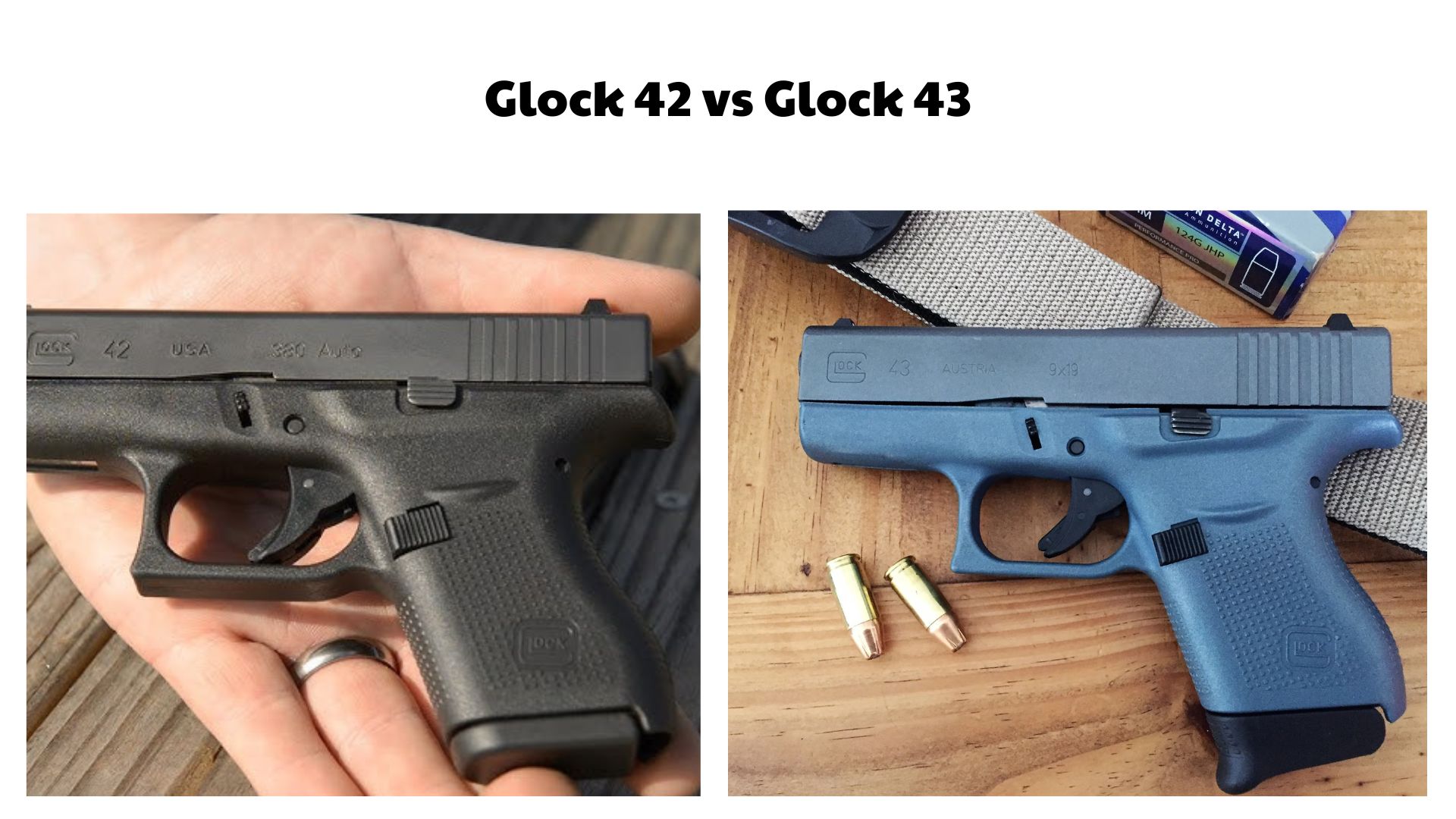

The Glock 42 and Glock 43 are two of Glock’s most compact concealed carry pistols, both designed with one primary goal in mind: deep concealment for everyday defensive use. These handguns are especially popular among concealed carry permit holders who want a lightweight, easy-to-carry firearm that does not compromise reliability.
While they may look similar at first glance, the key difference lies in their chambering and overall design approach. The Glock 42 is chambered in .380 ACP and focuses on ultra-light recoil and maximum concealability. The Glock 43, on the other hand, is chambered in 9mm, offering more stopping power in a slightly larger frame.
This comparison is particularly important for users choosing between pocket carry, appendix carry, and lightweight inside-the-waistband (IWB) setups. Both pistols fit into the “deep concealment” category, but they serve slightly different roles depending on user priorities.
In the broader market, both pistols compete with popular micro-compact and subcompact options such as the Sig P365, Glock 26, Ruger LCP, and similar ultra-compact defensive handguns. Each of these firearms balances size, capacity, and recoil in different ways.
The purpose of this comparison is to help users understand the trade-offs between concealability, recoil management, and defensive effectiveness so they can choose the pistol that best fits their everyday carry needs.
Key Specifications Comparison
Glock 42 Specifications
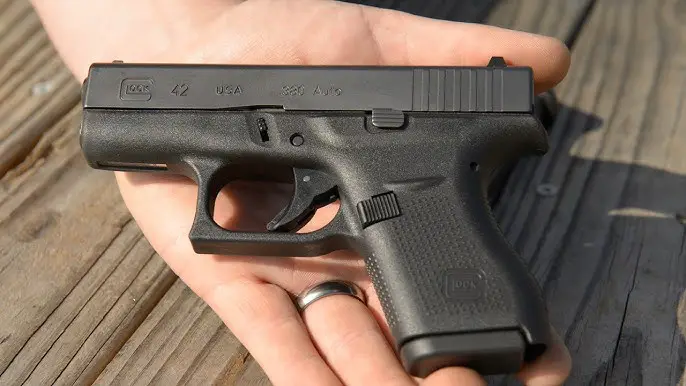
The Glock 42 is Glock’s smallest production pistol and is widely regarded as one of the most concealable defensive handguns available. It is chambered in .380 ACP, a cartridge known for its manageable recoil and suitability for lightweight defensive pistols.
It features a standard 6+1 magazine capacity, which aligns with its compact size and intended role as a deep concealment firearm. While the capacity is modest, it is designed to maximize ease of carry and discretion.
The frame is a slim single-stack design measuring approximately 0.94 to 0.98 inches in width, making it extremely easy to conceal under light clothing or in a pocket holster setup.
Weighing very little compared to larger handguns, the Glock 42 is ideal for all-day carry without causing fatigue. Its barrel length is approximately 3.25 inches, contributing to its compact footprint and ease of concealment.
Overall, the Glock 42 is engineered for minimal recoil, maximum concealment, and simple defensive use in close-range scenarios.
Glock 43 Specifications
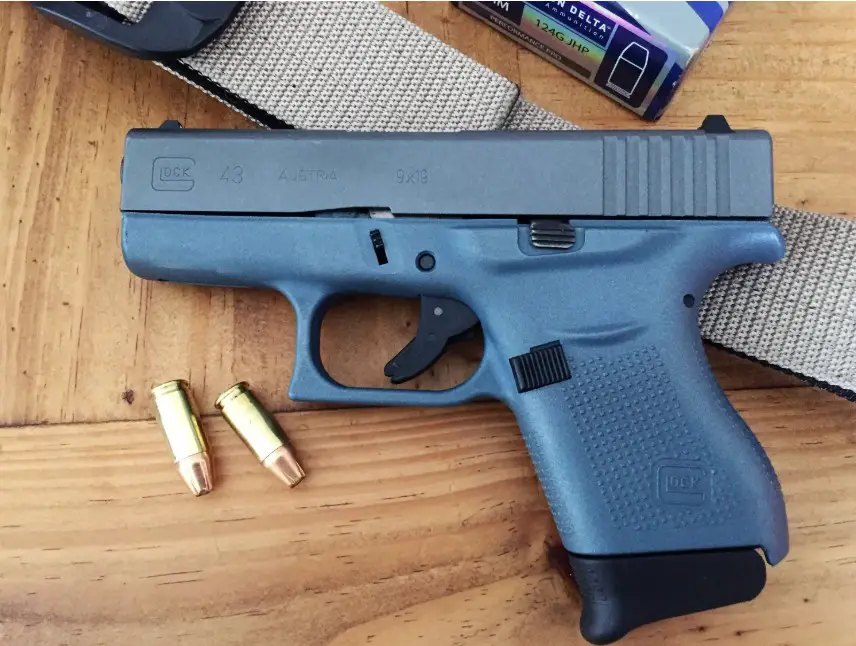
The Glock 43 is a single-stack 9mm subcompact pistol designed to offer more defensive power while still maintaining a compact and carry-friendly size. It represents a step up in ballistic performance compared to the Glock 42.
It also features a 6+1 standard capacity, though extended magazine options are available for users who want additional rounds or improved grip length.
The Glock 43 is slightly larger and heavier than the Glock 42, which contributes to better shooting stability and recoil control. This added size is primarily due to its use of the more powerful 9mm cartridge.
Its barrel length ranges from approximately 3.39 to 3.41 inches, offering a balance between concealability and effective defensive performance.
The grip is slightly wider than the Glock 42, providing improved handling and better control during rapid fire or defensive shooting drills.
In summary, the Glock 43 is designed to deliver stronger defensive capability with 9mm power while still remaining compact enough for everyday concealed carry.
Design & Size Differences
Frame and Thickness
One of the most noticeable differences between the Glock 42 and Glock 43 is the frame design, particularly the thickness of the grip. The Glock 42 uses a thinner, single-stack frame that is specifically engineered for deep concealment. This slim profile allows it to sit closer to the body, which significantly reduces printing under clothing. For users who prioritize discretion above all else, this is one of its strongest advantages.
The Glock 43, while still compact, is slightly thicker due to its chambering in 9mm and its structural requirements. This added thickness comes primarily from the wider grip needed to accommodate the more powerful cartridge. While it is still considered a slim pistol by modern standards, it is not as minimal as the Glock 42.
In real-world concealed carry scenarios, this difference affects holster choice and wardrobe flexibility. The Glock 42 tends to disappear more easily under tight or lightweight clothing, making it ideal for summer carry or professional environments. The Glock 43 may require slightly more attention to holster positioning and clothing selection, but it rewards the user with improved shooting control.
Weight and Dimensions
Weight plays a major role in daily carry comfort, especially for users who carry for extended periods. The Glock 42 is noticeably lighter than the Glock 43, making it one of the easiest Glock pistols to carry all day without fatigue. This lightweight design is particularly beneficial for pocket carry or minimal inside-the-waistband (IWB) setups where comfort is critical.
The Glock 43, while still lightweight compared to larger handguns, carries slightly more mass due to its 9mm chambering and reinforced frame design. This additional weight is not a disadvantage in most cases; instead, it contributes to better stability during shooting.
From a dimensional standpoint, both pistols fall into the ultra-compact category, but their priorities differ. The Glock 42 is optimized for minimal footprint and maximum ease of concealment, while the Glock 43 is slightly larger to improve controllability and shooting performance.
This creates a clear trade-off: the Glock 42 excels in comfort and concealability, while the Glock 43 offers better balance and recoil management during live fire.
Ergonomics
Ergonomics is another area where the design philosophy of each pistol becomes very clear. The Glock 42 features a very minimal grip designed primarily for concealment and simplicity. Its slim profile makes it easy to carry discreetly, but it also limits the amount of surface area available for a full firing grip.
As a result, shooters with larger hands may find the Glock 42 less comfortable during extended shooting sessions. However, for short defensive engagements, its ergonomic simplicity is often considered sufficient.
The Glock 43 improves upon this by offering a slightly wider grip and more usable surface area. This results in better recoil control and improved handling during rapid fire. The added grip texture also enhances stability, especially under stress or in defensive shooting scenarios.
In practical use, the Glock 42 favors discreet carry and minimal presence, while the Glock 43 favors control and shooting confidence. The difference becomes more noticeable during fast follow-up shots or longer range sessions, where grip stability plays a larger role in performance.
Magazine Capacity & Firepower
Glock 42 Capacity
The Glock 42 uses a single-stack magazine design chambered in .380 ACP, with a standard capacity of 6+1 rounds. This limited capacity is a direct trade-off for its ultra-slim profile and exceptional concealability.
While 6+1 rounds may seem modest compared to modern micro-compacts, the Glock 42 was designed with a specific purpose in mind: deep concealment and ease of carry. In situations where discretion is more important than extended firepower, this capacity is often considered acceptable.
The .380 ACP cartridge also contributes to reduced recoil, making the Glock 42 easier to control for newer shooters or those sensitive to heavier recoil impulses. However, this comes at the cost of lower ballistic performance compared to 9mm.
Overall, the Glock 42 prioritizes concealability and shootability over raw firepower, making it best suited for backup roles or minimal carry setups.
Glock 43 Capacity
The Glock 43 maintains the same 6+1 standard capacity but uses the more powerful 9mm cartridge. This immediately increases its effectiveness in defensive scenarios, as 9mm is widely regarded as a more capable self-defense round than .380 ACP.
Although the magazine capacity is the same on paper, the real advantage of the Glock 43 lies in its stopping power. It delivers significantly more energy on target, which is a key factor for defensive handgun selection.
The slightly wider grip and stronger frame design also allow for better control when firing 9mm ammunition, especially during rapid follow-up shots or high-stress situations.
For many users, this makes the Glock 43 a more balanced defensive option, even though it sacrifices some concealability compared to the Glock 42.
Capacity vs Concealment Balance
The comparison between the Glock 42 and Glock 43 ultimately comes down to a fundamental trade-off between concealment and firepower.
The Glock 42 is best suited for users who prioritize extreme concealability, minimal printing, and lightweight everyday carry. It excels in situations where discretion and comfort are more important than ammunition capacity or ballistic performance.
The Glock 43, on the other hand, is better suited for users who want a more effective defensive cartridge without moving into larger pistol platforms. It provides a stronger balance between size and stopping power, making it a more capable primary concealed carry firearm for many users.
In simple terms, the Glock 42 is about carrying easier, while the Glock 43 is about shooting better. Both approaches are valid, but they serve different priorities in the concealed carry world.
Shooting Performance
Accuracy
In terms of practical defensive accuracy, the Glock 42 and Glock 43 perform in a very similar range at typical engagement distances of 7 to 15 yards. At these ranges, both pistols are fully capable of delivering accurate shots when handled with proper fundamentals.
At this level of comparison, shooter skill becomes a far more important factor than mechanical differences between the platforms. Grip consistency, trigger control, and sight alignment have a greater impact on accuracy than the small dimensional differences between the two pistols.
That said, the Glock 43 does offer a slight advantage in stability due to its wider grip and heavier frame. This added stability can help some shooters achieve tighter groupings, especially during rapid fire or stress-based shooting drills.
Recoil & Control
Recoil characteristics are one of the most noticeable differences between the Glock 42 and Glock 43. The Glock 42, chambered in .380 ACP, produces a softer and more manageable recoil impulse. This makes it comfortable to shoot, especially for beginners or recoil-sensitive users.
However, the trade-off for this reduced recoil is a lighter frame and smaller grip surface, which can make the pistol feel less stable during rapid shooting sequences. The gun may move more in the hand, even though the recoil itself is mild.
The Glock 43, chambered in 9mm, produces a sharper recoil impulse due to the more powerful cartridge. While the recoil is stronger, the pistol’s improved grip geometry and slightly heavier frame help absorb and control this energy more effectively.
As a result, the Glock 43 generally offers better control during follow-up shots and faster target reacquisition. This makes it more suitable for users who prioritize defensive shooting performance over minimal recoil.
In simple terms, the Glock 42 is softer to shoot, while the Glock 43 is easier to control during fast, defensive shooting scenarios.
Concealed Carry Comparison
Glock 42 for Deep Concealment
The Glock 42 is widely regarded as one of the best options for deep concealment carry. Its ultra-slim profile and lightweight design make it ideal for pocket carry or ultra-discreet inside-the-waistband (IWB) setups.
It performs especially well in situations where light clothing is worn, such as during summer months or in professional environments where printing must be minimized. The pistol’s small footprint allows it to remain virtually unnoticed when properly holstered.
For users who prioritize concealment above all else, the Glock 42 is one of the easiest Glock models to carry on a daily basis.
Glock 43 for Versatility
The Glock 43, while slightly larger, remains highly concealable and offers a more versatile balance between size and performance. It is still compact enough for everyday concealed carry but provides improved defensive capability due to its 9mm chambering.
This makes it a strong choice for users who want a single firearm that can handle both deep concealment and more traditional concealed carry roles.
The Glock 43 is especially well-suited for inside-the-waistband and appendix carry setups, where its slightly larger grip actually contributes to better control and shooting confidence.
Carry Comfort Factors
Comfort plays a significant role in long-term concealed carry habits. The Glock 42 is often described as a pistol that is easy to forget you are carrying, thanks to its light weight and slim profile. This makes it ideal for users who prioritize all-day comfort and minimal disruption.
The Glock 43, while still comfortable, is slightly more noticeable due to its increased size and weight. However, this added presence often translates into greater confidence when handling and shooting the firearm.
Ultimately, holster choice and clothing selection play a major role in how comfortable and concealable each pistol feels in daily use.
Reliability & Durability
Both the Glock 42 and Glock 43 share Glock’s well-known Safe Action system, which has built a strong reputation for reliability across civilian, law enforcement, and military use worldwide.
These pistols are designed to function reliably under a wide range of real-world conditions, including dirt, moisture, and extended carry periods. Their simple internal design reduces the likelihood of mechanical failure.
Both models require minimal maintenance and are known for long service life when properly cleaned and lubricated. This makes them highly practical choices for everyday concealed carry users who depend on consistent performance.
Overall, both pistols maintain Glock’s established standard for durability and reliability, making them trusted options in the ultra-compact defensive handgun category.
Pros and Cons Overview
Glock 42 Pros & Cons
Pros: The Glock 42 stands out as one of the most concealment-friendly handguns in Glock’s lineup. Its ultra-lightweight design makes it extremely comfortable for all-day carry, even in pocket holsters or minimal IWB setups. The .380 ACP chambering also contributes to very low recoil, making it easy to shoot and control for a wide range of users, including beginners or recoil-sensitive shooters.
Cons: The main limitations come from its defensive capability. The .380 ACP cartridge offers less stopping power compared to 9mm, which can be a deciding factor for self-defense-focused users. In addition, the 6+1 capacity is relatively low compared to modern micro-compacts, meaning fewer rounds available before reloading.
Glock 43 Pros & Cons
Pros: The Glock 43 offers a stronger defensive platform due to its 9mm chambering, which provides significantly better stopping power. It also features improved grip control compared to the Glock 42, allowing for more stable shooting and faster follow-up shots. These advantages make it a more balanced option for everyday concealed carry users who prioritize effectiveness.
Cons: The increased power of the 9mm cartridge results in more noticeable recoil, especially in such a compact frame. While still manageable, it is sharper than the Glock 42. Additionally, the Glock 43 is slightly larger and heavier, making it a bit less discreet for deep concealment compared to the ultra-slim Glock 42.
Final Verdict
The Glock 42 and Glock 43 are both excellent concealed carry pistols, but they are designed with different priorities in mind.
The Glock 42 is best suited for users who prioritize maximum concealment, pocket carry, and lightweight everyday carry comfort. It excels in situations where discretion and ease of carry are more important than raw defensive power.
The Glock 43, on the other hand, is better suited for users who want 9mm defensive performance, improved shooting capability, and a more balanced carry platform. It offers greater stopping power while still remaining compact enough for concealed carry use.
Ultimately, the choice comes down to personal priorities: the Glock 42 favors ultimate concealment and minimal footprint, while the Glock 43 favors stopping power and overall defensive effectiveness.
Both remain strong and proven options in the ultra-compact concealed carry category, and either can serve effectively depending on the user’s needs and carry style.
50+ FAQ – Glock 42 vs Glock 43 (Detailed Answers)
1. What is the main difference between Glock 42 and Glock 43?
The main difference is caliber and design purpose. The Glock 42 is chambered in .380 ACP and focuses on ultra-light recoil and deep concealment. The Glock 43 is chambered in 9mm and prioritizes defensive stopping power while still remaining compact. This difference influences everything from recoil to real-world defensive effectiveness.
2. Which pistol is better for concealed carry?
Both are excellent for concealed carry, but the answer depends on priority. The Glock 42 is better for deep concealment and minimal printing, while the Glock 43 is better for users who want more defensive power in a slightly larger frame.
3. Which is easier to conceal daily?
The Glock 42 is easier to conceal due to its thinner frame and lighter weight. It is especially effective for pocket carry or very light IWB setups where printing must be minimized.
4. Which has better stopping power?
The Glock 43 has better stopping power because it uses 9mm ammunition, which delivers significantly more energy and penetration than .380 ACP used in the Glock 42.
5. Is Glock 42 good for beginners?
Yes. The Glock 42 is often recommended for beginners who are sensitive to recoil or want a simple, lightweight handgun for concealed carry. Its low recoil makes it easy to learn fundamentals.
6. Is Glock 43 good for beginners?
Yes, but it has slightly more recoil. However, many beginners prefer it because 9mm is more effective for defense and widely available for training.
7. Which pistol has less recoil?
The Glock 42 has less recoil because it uses .380 ACP, which produces a softer shooting experience compared to 9mm in the Glock 43.
8. Which pistol is lighter?
The Glock 42 is lighter, making it easier to carry for long periods without fatigue.
9. Which pistol is more powerful?
The Glock 43 is more powerful due to its 9mm chambering, which is a standard defensive handgun caliber.
10. Which is better for pocket carry?
The Glock 42 is better suited for pocket carry due to its smaller size and lighter weight. The Glock 43 is generally too large for comfortable pocket carry in most cases.
11. Can Glock 43 be pocket carried?
It is possible in some large pockets with proper holster use, but it is not ideal. The Glock 42 is much more practical for pocket carry.
12. Which has better accuracy?
Both are similarly accurate at defensive distances. The Glock 43 may feel slightly more stable due to its grip size, but real-world accuracy depends more on shooter skill.
13. Which is better for appendix carry?
Both work well, but the Glock 42 is more comfortable for deep concealment, while the Glock 43 offers better shooting control in appendix carry setups.
14. Which prints less under clothing?
The Glock 42 prints less because it is thinner and more compact overall.
15. Which has better grip?
The Glock 43 has a better grip due to its slightly larger frame, allowing for more control during firing.
16. Which is easier to shoot fast?
The Glock 43 is easier to shoot quickly due to improved recoil control and grip stability.
17. Which has better follow-up shots?
The Glock 43 performs better in follow-up shots because of better control and slightly heavier frame.
18. Which is more comfortable to carry all day?
The Glock 42 is more comfortable due to its lighter weight and smaller size.
19. Which is better for summer carry?
The Glock 42 is better for summer carry because it is easier to conceal under light clothing.
20. Which is better for winter carry?
Both are suitable, but the Glock 43 may feel more natural with heavier clothing that helps conceal slightly larger firearms.
21. Which has better reliability?
Both pistols are extremely reliable and share Glock’s Safe Action system, which is proven in military, law enforcement, and civilian use.
22. Do both pistols use the same magazines?
No. They use different magazines due to different frame sizes and calibers. Glock 42 uses .380 ACP magazines, while Glock 43 uses 9mm magazines.
23. Which has better aftermarket support?
The Glock 43 has significantly better aftermarket support due to the popularity of 9mm concealed carry pistols.
24. Which is easier to modify?
The Glock 43 is easier to modify with sights, triggers, and accessories compared to the Glock 42.
25. Can Glock 42 use extended magazines?
Yes, extended magazines are available and can improve grip length and capacity slightly.
26. Which is better for self-defense?
The Glock 43 is generally better for self-defense due to its 9mm cartridge and improved stopping power.
27. Which is better for low recoil training?
The Glock 42 is better for low recoil training because it is easier to shoot for extended practice sessions.
28. Which is better for law enforcement backup?
The Glock 43 is more commonly used as a backup option due to its 9mm chambering.
29. Which is better for beginners with small hands?
Both work well, but the Glock 42 may feel more comfortable due to its slimmer grip.
30. Which is better for larger hands?
The Glock 43 is better for larger hands because it offers more grip surface and control.
31. Which pistol is more forgiving in shooting mistakes?
The Glock 43 is more forgiving due to better stability and recoil control.
32. Which is better for home defense backup?
The Glock 43 is better due to higher power and better handling under stress.
33. Which is better for travel carry?
The Glock 42 is better for travel due to its lightweight and discreet size.
34. Which is better for ankle carry?
The Glock 42 is more suitable for ankle carry because of its lighter weight.
35. Which has better holster availability?
The Glock 43 has more holster options due to its popularity.
36. Which is more beginner-friendly overall?
The Glock 42 is easier to learn initially, but the Glock 43 may offer better long-term defensive capability.
37. Which is better for defensive accuracy under stress?
The Glock 43 performs better under stress due to improved control and recoil management.
38. Which pistol lasts longer?
Both are extremely durable and can last tens of thousands of rounds with proper maintenance.
39. Which is better for concealed carry permits?
Both are widely used for CCW licensing and training programs.
40. Which is more popular overall?
The Glock 43 is more popular due to the widespread preference for 9mm concealed carry pistols.
41. Which is better for minimalistic carry setups?
The Glock 42 is better for minimalistic setups where size and weight matter most.
42. Which is better for tactical use?
The Glock 43 is better due to higher capacity potential and better accessory compatibility.
43. Which is better for concealed carry training?
The Glock 43 is better for training because it more closely represents modern defensive pistols.
44. Which is better for recoil-sensitive shooters?
The Glock 42 is better for recoil-sensitive users due to its softer shooting .380 ACP cartridge.
45. Which is better for fast draw situations?
Both are similar, but the Glock 42 may feel slightly quicker due to lighter weight.
46. Which is better for long-term carry comfort?
The Glock 42 is better for long-term comfort due to reduced weight and size.
47. Which is better overall for defense?
The Glock 43 is better overall for defense due to 9mm power and better control.
48. Can both pistols use +P ammo?
The Glock 43 can safely use +P 9mm ammunition, while the Glock 42 should only use ammunition within manufacturer recommendations for .380 ACP.
49. Which is better for concealed carry in 2026?
Both remain relevant, but the Glock 43 aligns more closely with modern concealed carry trends favoring 9mm micro-compacts.
50. Which should I choose overall?
Choose the Glock 42 if your priority is maximum concealment and minimal carry footprint. Choose the Glock 43 if you prioritize defensive effectiveness, better recoil control, and 9mm stopping power.
51. Are both pistols still worth buying today?
Yes. Both Glock 42 and Glock 43 remain highly relevant concealed carry options, each serving a distinct role in modern defensive handgun selection.
Read more: