
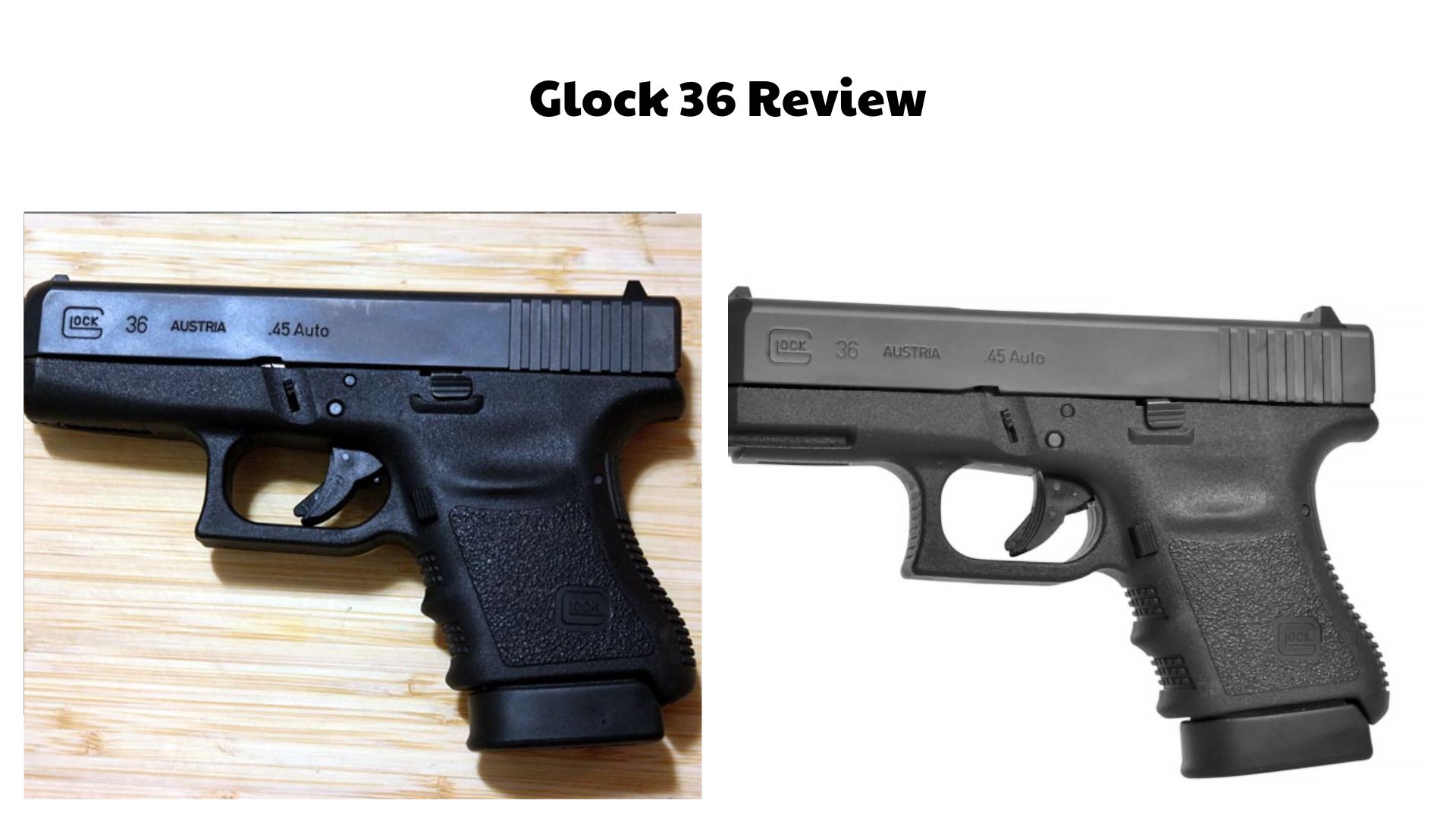

The Glock 36 is a slim, subcompact .45 ACP pistol designed specifically for concealed carry users who want the stopping power of a larger caliber in a thinner and more manageable frame. Unlike bulkier .45 ACP handguns, the Glock 36 was engineered to reduce width while still maintaining the core reliability Glock is known for across its lineup.
Introduced as part of Glock’s effort to bring a single-stack .45 ACP option to the civilian and concealed carry market, the Glock 36 quickly gained attention for its unique balance of power and concealability. While newer micro-compact 9mm pistols dominate today’s CCW market, the Glock 36 remains a “forgotten Glock” that still holds value among dedicated enthusiasts.
Its key appeal lies in a combination of slim profile design, proven Glock durability, and the hard-hitting performance of the .45 ACP cartridge. This makes it especially attractive to shooters who prioritize terminal performance over magazine capacity.
The core question remains relevant today: despite its age and low capacity, is the Glock 36 still a practical concealed carry choice in a modern market dominated by higher-capacity compact and micro-compact pistols?
2. Glock 36 Background & Development History
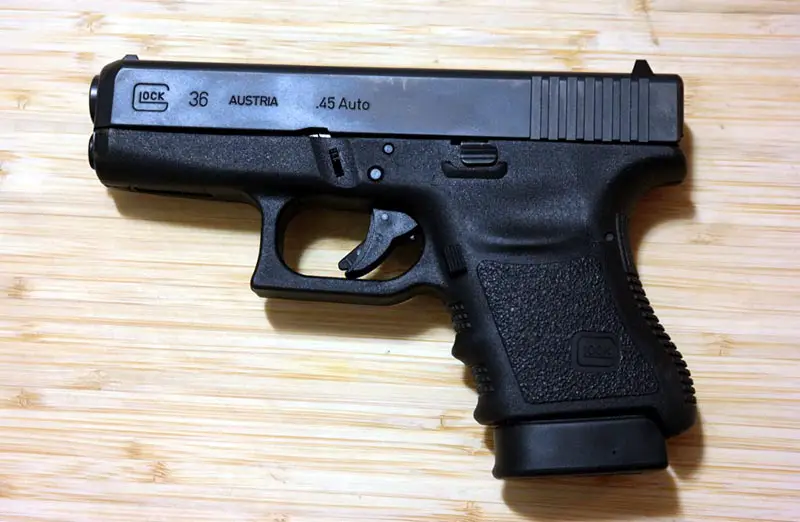
The Glock 36 was released in the early 2000s as Glock’s first single-stack .45 ACP pistol, marking an important shift in the company’s approach to concealed carry firearms. Prior to its introduction, Glock’s .45 ACP offerings such as the Glock 21 and Glock 30 were known for reliability but also for their wider double-stack frames.
The main design goal of the Glock 36 was to reduce overall width and improve concealability without abandoning the .45 ACP cartridge. This resulted in a slimmer frame that appealed to concealed carriers who found traditional .45 ACP pistols too bulky for everyday carry.
Unlike duty-oriented handguns, the Glock 36 was clearly built for concealed carry first. Its simplified design, reduced magazine capacity, and slim profile all reflect a focus on discretion, comfort, and portability rather than high-capacity tactical use.
However, its timing also contributed to its decline in mainstream popularity. As newer compact and micro-compact pistols entered the market—especially high-capacity 9mm platforms—the Glock 36 gradually became overshadowed. Despite this, it still maintains a loyal niche following among .45 ACP enthusiasts.
3. Key Specifications & Technical Overview
The Glock 36 is built around a simple, proven configuration that emphasizes reliability and concealability over modern modular features. Its specifications reflect its role as a dedicated concealed carry handgun.
It is chambered in .45 ACP, a cartridge widely known for its larger bullet diameter and strong stopping power. This makes it appealing to users who prioritize terminal effectiveness in defensive scenarios.
The barrel length is approximately 3.7 to 3.8 inches, providing a balance between concealability and acceptable ballistic performance. The overall length ranges from about 6.7 to 7.0 inches, placing it firmly in the subcompact category.
Weight typically falls between 22 and 27 ounces unloaded, depending on configuration. While not the lightest pistol available, it remains manageable for everyday concealed carry with a proper holster setup.
Capacity is one of its defining limitations, offering a 6+1 single-stack magazine configuration. This low capacity is a direct trade-off for its slim profile, placing it behind modern CCW pistols in terms of firepower.
The Glock 36 uses Glock’s Safe Action striker-fired system, delivering a consistent trigger pull and contributing to its well-known reliability under stress.
It features a polymer frame paired with a steel slide, maintaining Glock’s signature durability while keeping overall weight reasonable. The design focus remains clearly on slim concealed carry performance, prioritizing reduced width, simplicity, and dependable operation over modularity or high capacity.
4. Design & Build Quality
The Glock 36 follows a clear design philosophy centered on concealability, simplicity, and durability. Its slim single-stack frame is one of its defining characteristics, allowing it to carry more comfortably and discreetly than wider double-stack .45 ACP pistols.
Built with Glock’s proven polymer construction and a hardened steel slide, the Glock 36 maintains the brand’s reputation for ruggedness and long-term durability. The materials are designed to withstand heavy use, harsh environments, and minimal maintenance while still delivering consistent performance.
The overall design is intentionally simple and utilitarian. There are very few external features or unnecessary design elements, which helps reduce potential failure points and keeps operation straightforward for defensive use.
Compared to larger .45 ACP handguns, the Glock 36 significantly reduces grip bulk. This makes it easier to conceal, especially for users who struggle with thicker double-stack frames. However, this slimness comes with the trade-off of reduced magazine capacity.
The design philosophy strongly emphasizes reliability and ease of maintenance. Like most Glock pistols, the Glock 36 is built to function under stress with minimal cleaning requirements, making it practical for everyday carry users.
Ultimately, the Glock 36 prioritizes concealment over firepower, and its design reflects a deliberate compromise: a thinner, more carry-friendly .45 ACP platform at the cost of lower ammunition capacity.
5. Ergonomics & Handling Experience
The Glock 36 offers a slim grip profile that significantly improves concealability, but this same feature reduces overall hand support compared to larger pistols. For many users, especially those with larger hands, the grip can feel short and somewhat compact.
Despite its limitations, the Glock grip angle helps promote fast and natural target acquisition. This design feature is consistent across Glock pistols and contributes to quick alignment during defensive shooting situations.
In terms of control, the Glock 36 remains manageable with proper technique. While the .45 ACP cartridge produces noticeable recoil in a lightweight frame, a firm grip and correct stance help maintain control during firing sequences.
One of its strongest advantages is concealability. Compared to wider pistols like the Glock 21 or Glock 30, the Glock 36 is significantly easier to carry discreetly, especially in inside-the-waistband or appendix setups.
However, ergonomics are clearly optimized for carry rather than extended shooting comfort. It is designed to be carried more than shot for long range sessions, which is an important distinction for users evaluating it as a defensive firearm.
6. Trigger System & Shooting Characteristics
The Glock 36 uses the standard Glock Safe Action striker-fired trigger system, which is known for its simplicity and consistency. This system has been widely used across Glock’s lineup for decades and is trusted for defensive reliability.
The trigger pull is approximately 5.5 pounds, offering a balance between safety and usability in high-stress situations. It is neither too light nor too heavy, making it predictable for defensive applications.
One of its strengths is the predictable break and short reset. This allows for relatively fast follow-up shots once the shooter becomes familiar with the trigger system.
However, the trigger is functional rather than refined. It does not deliver the crisp, match-grade feel found in higher-end or competition-focused pistols. Instead, it prioritizes consistency and reliability over tactile refinement.
The design is clearly intended for defensive shooting rather than precision marksmanship. It performs reliably under stress conditions, which is where its strengths become most apparent.
Overall, the Glock 36 trigger system supports its role as a simple, dependable concealed carry handgun rather than a performance or competition platform.
7. Recoil & Shootability
The Glock 36 produces noticeable recoil due to its .45 ACP chambering combined with a relatively lightweight frame. This is expected for a subcompact pistol firing a larger caliber cartridge, and it is one of the key characteristics users must adapt to.
Despite the recoil, the Glock 36 is generally more controllable than many other small .45 ACP pistols. Glock’s consistent frame geometry and recoil system help manage energy in a predictable way, making the pistol less harsh than some competitors in the same category.
The recoil impulse is typically described as straight-back, which is a common trait in Glock pistols. This linear movement helps reduce unpredictable muzzle flip and allows shooters to maintain better sight alignment between shots.
Control improves significantly with a firm grip and proper shooting technique. While the platform is not designed to be soft-shooting, training plays a major role in making the Glock 36 manageable and effective in defensive scenarios.
Compared to compact 9mm pistols, the Glock 36 feels snappier, particularly during rapid fire. However, shooters who are accustomed to .45 ACP recoil generally find it manageable and consistent.
Overall, the Glock 36 is suitable for defensive shooting, but it rewards practice and proper fundamentals rather than casual or inexperienced use.
8. Accuracy & Range Performance
The Glock 36 delivers effective defensive accuracy within typical real-world engagement distances, generally between 5 and 15 yards. This range aligns with most concealed carry defensive scenarios.
With proper training, the pistol is also capable of producing solid and consistent groupings out to 25 yards. While it is not designed for precision shooting, it performs reliably when handled by a trained shooter.
One limiting factor is its short sight radius, which is inherent to its compact design. This can make precision alignment more challenging compared to full-size handguns, especially at extended distances.
The Glock 36 is not intended for competition or precision target shooting. Instead, it is optimized for real-world defensive use where speed and reliability matter more than pinpoint accuracy.
A key strength is its consistent point-of-impact when using quality ammunition. This reliability helps build confidence in defensive situations where repeatable performance is critical.
In summary, the Glock 36 offers dependable accuracy for concealed carry applications, focusing on practical effectiveness rather than long-range precision.
9. Concealed Carry Performance
The Glock 36’s slim profile is one of its greatest advantages for concealed carry. Its reduced width allows it to sit more comfortably against the body and improves concealability under everyday clothing.
It is best suited for inside-the-waistband (IWB) and appendix carry setups, where its slim frame helps reduce bulk and improves discretion during daily movement.
Compared to wider .45 ACP pistols, the Glock 36 produces less printing, making it easier to conceal under light or fitted clothing. This is a key benefit for users prioritizing discretion.
Despite chambering a powerful cartridge, it remains comfortable for everyday carry when paired with a proper holster and belt system. Weight and size are balanced well enough for consistent all-day use.
The Glock 36 is ideal for users who prioritize a combination of concealment and stopping power. It fills a niche where shooters want .45 ACP performance without the bulk of traditional double-stack pistols.
However, its size and shape limit its suitability for pocket carry. While compact, it is still too large and wide for most standard pocket holsters.
Overall, the Glock 36 performs well as a concealed carry handgun, especially for users who value slim design and .45 ACP effectiveness over high magazine capacity.
10. Reliability & Ammo Performance
The Glock 36 benefits from Glock’s long-standing reputation for reliability, which is one of the main reasons it continues to be respected in the concealed carry community. Like other Glock pistols, it is designed to function consistently under a wide range of conditions with minimal maintenance requirements.
In real-world use, the Glock 36 performs well with both FMJ training ammunition and modern defensive hollow-point loads. This flexibility allows users to train economically while still trusting the same platform for carry ammunition.
One of its strongest traits is its low malfunction rate when properly maintained. With quality magazines and appropriate ammunition, the Glock 36 is known to run reliably over long periods of use.
The pistol is also capable of handling various ammunition types without significant tuning or adjustment. This makes it practical for users who want a straightforward defensive handgun without compatibility concerns.
Unlike some compact pistols, the Glock 36 does not require a significant break-in period. It is generally reliable out of the box, which adds to its appeal as a defensive firearm.
Overall, it is widely trusted for self-defense and concealed carry use due to its mechanical simplicity and proven track record.
11. Glock 36 Position in Modern Market
In today’s concealed carry market, the Glock 36 occupies a very specific and somewhat niche position. It competes indirectly with modern compact 9mm pistols and micro-compact platforms that dominate the current CCW landscape.
Its popularity has declined over time primarily due to its low magazine capacity of 6+1 rounds. Modern pistols often offer significantly higher capacity in similar or even smaller frames, making the Glock 36 less competitive in terms of firepower.
However, it still maintains a dedicated following among .45 ACP enthusiasts who value its slim profile and traditional defensive philosophy. For these users, caliber preference outweighs capacity considerations.
The Glock 36 has largely been outpaced by modern concealed carry designs that prioritize capacity, modularity, and reduced recoil through 9mm platforms. Despite this, it remains relevant for users who specifically want a slim .45 ACP handgun.
Ultimately, the Glock 36 represents an older but still functional approach to concealed carry, often described as part of the “old-school CCW philosophy,” where simplicity and stopping power were prioritized over magazine capacity.
12. Glock 36 vs Competitors (Glock 30, 1911 Compact, Modern Micro Pistols)
When compared to the Glock 30, the Glock 36 offers a noticeably slimmer profile, making it significantly easier to conceal. However, this comes at the cost of reduced magazine capacity, as the Glock 30 provides more rounds in a wider double-stack frame.
Against compact 1911 pistols, the Glock 36 benefits from lighter weight, simpler maintenance, and Glock’s reliability reputation. However, 1911 platforms often provide a superior trigger feel and more refined shooting experience, albeit with increased weight and mechanical complexity.
When compared to modern micro-compact 9mm pistols, the Glock 36 falls behind in several key areas. These newer designs typically offer higher capacity, lighter recoil, and improved ergonomics in similarly sized or smaller frames.
The primary advantage of the Glock 36 is its slim .45 ACP platform, which remains relatively unique in today’s market. It offers a combination of concealability and caliber that is increasingly rare among modern handguns.
Its main weakness is clear: limited capacity and an aging design that does not incorporate modern CCW trends such as optics readiness or high-capacity magazine systems.
In today’s concealed carry market, the Glock 36 occupies a niche position. It is best suited for users who prioritize .45 ACP performance in a slim frame over modern features and increased ammunition capacity.
13. Advantages of Glock 36
The Glock 36 offers several clear advantages that continue to make it relevant for a specific group of concealed carry users. Its most defining strength is its very slim profile, which allows it to serve as one of the more comfortable .45 ACP concealed carry options available.
Another major advantage is Glock’s legendary reliability. The Glock 36 benefits from the same design philosophy that has made Glock pistols trusted worldwide for defensive use, ensuring consistent performance under stress.
The pistol also features a simple manual of arms, making it easy to operate, maintain, and train with. This simplicity is a key reason many shooters still prefer Glock platforms for defensive carry.
In terms of performance, the Glock 36 provides good defensive accuracy within typical engagement distances. While it is not a precision-focused handgun, it performs well in real-world concealed carry scenarios.
Compared to larger .45 ACP pistols, it is significantly easier to conceal. Its slim frame reduces printing and improves comfort during everyday carry, especially in inside-the-waistband configurations.
The design is also durable and low-maintenance, requiring minimal upkeep while still delivering long-term reliability, which is a key requirement for a defensive firearm.
14. Disadvantages & Limitations
Despite its strengths, the Glock 36 has several limitations that affect its competitiveness in today’s concealed carry market. The most obvious drawback is its low 6-round magazine capacity, which is significantly lower than modern CCW pistols.
Recoil is also more noticeable due to the combination of .45 ACP chambering and a relatively lightweight frame. This can make rapid follow-up shots more challenging for some shooters.
The platform also has limited aftermarket support compared to other Glock models. While accessories exist, it does not benefit from the same level of customization as more popular Glock pistols.
In a broader sense, the Glock 36 is less competitive compared to modern 9mm pistols, which offer higher capacity, reduced recoil, and more advanced features in similar or smaller packages.
It is also not ideal for users with large hands, as the slim grip can feel short and less supportive during extended shooting sessions.
Finally, it is considered an aging platform, lacking modern enhancements such as optics-ready slides or modular grip systems found in newer concealed carry designs.
15. Ideal Users for Glock 36
The Glock 36 is best suited for a specific type of shooter rather than the general concealed carry market. It appeals strongly to .45 ACP enthusiasts who want a slim, concealable option without switching calibers.
It is also a good choice for experienced concealed carriers who understand recoil management and prioritize consistency over capacity. These users are typically more comfortable working within the platform’s limitations.
For those who value stopping power over magazine size, the Glock 36 remains a viable option, especially in scenarios where shot placement and caliber preference are prioritized.
It can also serve effectively as a backup or deep concealment carry firearm, where size and discretion are more important than capacity.
Minimalist concealed carry users who prefer simple, no-frills designs may also appreciate the Glock 36’s straightforward functionality and proven reliability.
Finally, it remains a natural fit for Glock platform loyalists who prefer consistency across their firearms and trust the brand’s long-standing reputation for defensive handguns.
16. Final Verdict: Is the Glock 36 Still Worth It?
The Glock 36 remains a capable concealed carry .45 ACP pistol even in today’s highly competitive handgun market. While it is no longer at the forefront of modern CCW innovation, it still delivers on the core principles Glock is known for: reliability, simplicity, and durability in a compact package.
One of its biggest strengths is its slim design, which continues to make it one of the more comfortable ways to carry a .45 ACP handgun discreetly. Combined with Glock’s proven reliability, the platform still earns trust from shooters who value consistency over features.
However, when compared to modern concealed carry pistols, the Glock 36 is clearly outclassed in both capacity and advanced features. Newer designs offer higher round counts, improved ergonomics, optics-ready slides, and reduced recoil in smaller or similarly sized frames.
Because of this, the Glock 36 is best suited for a niche group of users—particularly those who specifically want a slim .45 ACP concealed carry option and are willing to accept lower capacity in exchange for caliber preference and concealability.
The final takeaway is straightforward: the Glock 36 is a classic slim .45 that still holds practical value, especially for dedicated enthusiasts, but it is no longer a mainstream choice in the modern concealed carry landscape dominated by higher-capacity 9mm pistols.
1. Is the Glock 36 still good for concealed carry in 2026?
Yes, the Glock 36 is still a capable concealed carry pistol in 2026, but its relevance depends heavily on user priorities. It remains attractive for shooters who specifically want a slim .45 ACP handgun with Glock’s reputation for reliability. Its low profile makes it comfortable for everyday carry, especially inside-the-waistband setups. However, compared to modern micro-compact 9mm pistols, it is clearly behind in capacity, recoil management, and feature set. In short, it is still good—but more of a niche choice than a mainstream EDC option today.
2. Why did Glock design the Glock 36?
The Glock 36 was designed to give shooters a single-stack .45 ACP option that was thinner and easier to conceal than Glock’s double-stack .45 pistols like the Glock 21 and Glock 30. At the time of its release, many concealed carriers wanted .45 ACP stopping power but found traditional models too wide for comfortable daily carry. Glock responded by creating a slim-frame alternative focused on concealability rather than duty or high-capacity use.
3. How much ammo does the Glock 36 hold?
The Glock 36 uses a single-stack magazine design with a standard capacity of 6+1 rounds of .45 ACP. This low capacity is one of its biggest trade-offs, but it directly contributes to the pistol’s slim profile. Some users carry spare magazines, but compared to modern concealed carry pistols offering 10–17+ rounds, the Glock 36 is significantly lower in firepower.
4. Is the Glock 36 reliable?
Yes, the Glock 36 is widely considered very reliable. It benefits from Glock’s proven Safe Action system and simple internal design. When properly maintained and used with quality ammunition, it cycles consistently with minimal malfunctions. Like most Glocks, it does not require a break-in period and is trusted by many users for defensive carry.
5. How bad is recoil on the Glock 36?
Recoil on the Glock 36 is noticeable due to its .45 ACP chambering and relatively lightweight frame. It is sharper than most 9mm pistols and can feel snappy during rapid fire. However, it is still more manageable than many compact .45 ACP handguns thanks to Glock’s frame geometry. With proper grip technique, most shooters can control it effectively.
6. Is the Glock 36 better than the Glock 30?
It depends on priorities. The Glock 36 is slimmer and easier to conceal, making it better for deep carry. The Glock 30, however, offers higher magazine capacity and better recoil control due to its wider double-stack frame. If concealment is the priority, the Glock 36 wins. If firepower and shootability matter more, the Glock 30 is the stronger option.
7. What makes the Glock 36 different from other Glock pistols?
The Glock 36 stands out because it is one of Glock’s few single-stack .45 ACP pistols. Most Glock handguns are double-stack designs, which increase capacity but also width. The Glock 36 prioritizes slimness over capacity, making it unique in the lineup and more suitable for discreet concealed carry.
8. Is the Glock 36 good for beginners?
The Glock 36 is not the most beginner-friendly handgun due to its .45 ACP recoil and low capacity. While its operation is simple, new shooters may find 9mm pistols easier to control and train with. It is better suited for users who already have experience with handguns and understand recoil management.
9. Can you pocket carry a Glock 36?
Pocket carry is generally not practical for the Glock 36. Although it is slim, it is still too large and heavy for most standard pockets. It is best suited for inside-the-waistband (IWB) or appendix carry with a proper holster rather than pocket concealment.
10. What caliber does the Glock 36 use?
The Glock 36 is chambered in .45 ACP, a cartridge known for its larger bullet diameter and strong stopping power. This caliber choice is one of the main reasons users select the Glock 36 despite its low capacity, as it prioritizes terminal performance over magazine size.
11. Is the Glock 36 outdated?
The Glock 36 is considered somewhat outdated compared to modern concealed carry pistols. It lacks features like optics-ready slides, higher-capacity magazines, and advanced ergonomics found in newer designs. However, it is still functional and reliable, which keeps it relevant for niche users.
12. Does the Glock 36 have a rail for attachments?
No, the Glock 36 does not have an accessory rail. This was a design choice to keep the frame as slim and minimal as possible for concealed carry. While this limits customization options like lights or lasers, it improves concealability and reduces bulk.
13. How accurate is the Glock 36?
The Glock 36 is accurate within typical defensive distances, usually 5 to 15 yards. With practice, it can maintain consistent grouping even out to 25 yards. However, it is not designed for precision shooting, but rather real-world defensive scenarios.
14. What is the trigger pull weight of the Glock 36?
The Glock 36 uses Glock’s standard Safe Action trigger system with an approximate pull weight of around 5.5 pounds. It is designed to be consistent and predictable rather than light or competition-grade.
15. Is the Glock 36 good for concealed carry in warm weather?
Yes, the Glock 36 performs well in warm weather carry due to its slim frame. It reduces printing under lightweight clothing and is comfortable for inside-the-waistband carry, making it suitable for year-round concealed carry use.
16. Does the Glock 36 have good aftermarket support?
The Glock 36 has some aftermarket support, but it is not as extensive as more popular Glock models like the Glock 19. You can still find holsters, sights, and some upgrade parts, but customization options are more limited overall.
17. Is the Glock 36 good for self-defense?
Yes, the Glock 36 is effective for self-defense when used within its intended range. Its .45 ACP chambering offers strong stopping power, and its reliability makes it a dependable defensive firearm. The main limitation is its low capacity.
18. How does the Glock 36 compare to modern 9mm pistols?
Modern 9mm pistols generally outperform the Glock 36 in capacity, recoil control, and size-to-performance ratio. However, the Glock 36 offers .45 ACP power in a slim frame, which some users still prefer despite the trade-offs.
19. Is the Glock 36 comfortable to carry all day?
Yes, the Glock 36 is generally comfortable for all-day carry due to its slim profile. It distributes weight well in an IWB holster and does not feel overly bulky compared to double-stack .45 ACP pistols.
20. What is the main disadvantage of the Glock 36?
The biggest disadvantage is its low magazine capacity of 6+1 rounds. In a modern concealed carry context where higher-capacity pistols are common, this is a significant limitation for some users.
21. Is the Glock 36 still worth buying today?
It depends on the user. If you specifically want a slim .45 ACP concealed carry pistol, it is still worth considering. However, if capacity, modern features, and recoil control are priorities, newer 9mm pistols may be a better choice.
22. How does Glock 36 recoil compare to Glock 19?
The Glock 36 has noticeably more recoil than the Glock 19 due to its .45 ACP chambering and lighter frame. The Glock 19 in 9mm is easier to control and faster for follow-up shots.
23. Is the Glock 36 good for appendix carry?
Yes, the Glock 36 is well-suited for appendix carry due to its slim profile. Many users find it comfortable in AIWB setups, provided a quality holster is used for safety and stability.
24. Can the Glock 36 be used for home defense?
Yes, the Glock 36 can be used for home defense, but its low capacity makes it less ideal compared to full-size handguns. It is still reliable and effective at close range.
25. Does the Glock 36 require a break-in period?
No, the Glock 36 typically does not require a break-in period. Like most Glock pistols, it is designed to function reliably out of the box with proper ammunition.
26. Is the Glock 36 easy to maintain?
Yes, the Glock 36 is very easy to maintain. Its simple design allows for quick disassembly, cleaning, and reassembly without specialized tools.
27. What holster works best for Glock 36?
Inside-the-waistband (IWB) holsters are most commonly recommended for the Glock 36. Appendix carry holsters are also popular due to the pistol’s slim profile.
28. Why is the Glock 36 called a “forgotten Glock”?
It is called a “forgotten Glock” because it was overshadowed by newer compact and micro-compact pistols that offer higher capacity and more modern features, reducing its mainstream popularity.
29. Is the Glock 36 good for small hands?
Yes, the slim grip of the Glock 36 can actually fit smaller hands well. However, the short grip may feel limiting for larger-handed shooters.
30. What is the main purpose of the Glock 36?
The primary purpose of the Glock 36 is concealed carry. It is designed to offer .45 ACP performance in a slim, easily concealable frame for everyday defensive use.
31. Is the Glock 36 good for law enforcement backup use?
The Glock 36 has seen some use as a backup or off-duty firearm due to its reliability and slim profile. However, modern law enforcement tends to prefer higher-capacity 9mm pistols for backup roles. The Glock 36 is still mechanically dependable, but its limited 6+1 capacity makes it less ideal compared to more modern compact duty options.
32. How does the Glock 36 perform with hollow-point ammo?
The Glock 36 generally performs well with quality hollow-point ammunition designed for defensive use. Most modern .45 ACP defensive loads feed reliably through the platform. As with any defensive handgun, it is recommended to test your chosen ammunition in advance to ensure consistent cycling and point-of-impact.
33. Is the Glock 36 good for left-handed shooters?
The Glock 36 is not fully ambidextrous, but it can still be used effectively by left-handed shooters. Its simplicity and lack of complex controls make it relatively easy to adapt to, though some users may prefer mirrored controls found in newer pistol designs.
34. Does the Glock 36 have a manual safety?
No, the Glock 36 does not include a manual safety. It relies on Glock’s Safe Action system, which uses internal safeties rather than external switches. This design simplifies operation and is intended to support fast defensive use under stress.
35. How durable is the Glock 36?
The Glock 36 is highly durable, consistent with Glock’s reputation for rugged polymer-frame pistols. It is designed to withstand long-term use, environmental stress, and high round counts with minimal maintenance.
36. Can the Glock 36 be used for range training?
Yes, the Glock 36 can be used for range training, but it is not the most comfortable option for extended sessions due to .45 ACP recoil. It performs well for defensive practice but is less ideal for high-volume shooting compared to 9mm pistols.
37. Is the Glock 36 good for beginners learning concealed carry?
The Glock 36 is not the easiest choice for beginners due to its recoil and low capacity. Most new concealed carry users find 9mm pistols more manageable. However, it can still be used effectively with proper training and supervision.
38. What makes the Glock 36 different from Glock 19?
The Glock 36 is slimmer and chambered in .45 ACP with a single-stack magazine, while the Glock 19 is a double-stack 9mm pistol with higher capacity. The Glock 19 offers better balance for most users, but the Glock 36 is more concealable in certain setups.
39. Is the Glock 36 still in production?
The Glock 36 is still produced, but it is not as widely featured or marketed as newer Glock models. Availability may vary depending on region and demand, but it remains part of Glock’s lineup.
40. How does Glock 36 compare to SIG P365?
The SIG P365 offers significantly higher capacity, lighter weight, and more modern features in a smaller footprint. The Glock 36, however, uses .45 ACP, which some users prefer for stopping power. Overall, the P365 is more modern and versatile.
41. Is the Glock 36 good for deep concealment?
Yes, the Glock 36 is suitable for deep concealment due to its slim profile. While not as small as micro pistols, its reduced width makes it easier to hide under clothing compared to double-stack .45 ACP handguns.
42. What is the barrel length of the Glock 36?
The Glock 36 has a barrel length of approximately 3.7 to 3.8 inches. This provides a balance between compact size and usable ballistic performance for defensive applications.
43. Does Glock 36 have good resale value?
The Glock 36 typically holds moderate resale value. While not as in-demand as more popular Glock models, it retains value due to Glock’s reliability reputation and its niche .45 ACP slim design.
44. Is Glock 36 better than Glock 43X?
The Glock 43X generally offers higher capacity in 9mm and better shootability for most users. The Glock 36 offers .45 ACP power in a slimmer frame but falls behind in capacity and modern usability.
45. Can you upgrade Glock 36 sights?
Yes, the Glock 36 can be upgraded with aftermarket sights, including night sights and improved visibility options. While its aftermarket ecosystem is not as large as other Glock models, sight upgrades are still widely available.
46. Is the Glock 36 heavy?
The Glock 36 is relatively lightweight for a .45 ACP pistol, but it is not the lightest handgun available. At roughly 22–27 ounces unloaded, it is comfortable for concealed carry but still has some noticeable weight.
47. What is the best use case for Glock 36?
The best use case for the Glock 36 is concealed carry for users who specifically want a slim .45 ACP handgun. It is most effective as a defensive carry pistol rather than a range or competition firearm.
48. Is the Glock 36 comfortable for all-day carry?
Yes, the Glock 36 is generally comfortable for all-day carry due to its slim frame. It distributes weight well in a quality holster, making it suitable for consistent everyday carry use.
49. Does Glock 36 have good aftermarket holster support?
Yes, the Glock 36 has good holster availability, especially for IWB and appendix carry setups. While not as extensive as Glock 19 options, most major holster manufacturers support it.
50. What is the final takeaway for Glock 36 owners?
The Glock 36 remains a reliable and practical concealed carry pistol for users who prioritize slim .45 ACP performance. However, it is no longer a mainstream choice due to limited capacity and newer competing designs. It is best viewed as a specialized tool rather than a general-purpose modern CCW pistol.
Read more: